
Wi-Fi 8 Explained: Features, Benefits and Applications Wi-Fi 7 (IEEE 802.11be) is still rolling out across industrial and enterprise deployments,…
OpenWrt Planning Starts With the Platform Path
When an industrial wireless project is evaluating OpenWrt, the most useful starting point is not a feature checklist. It is…
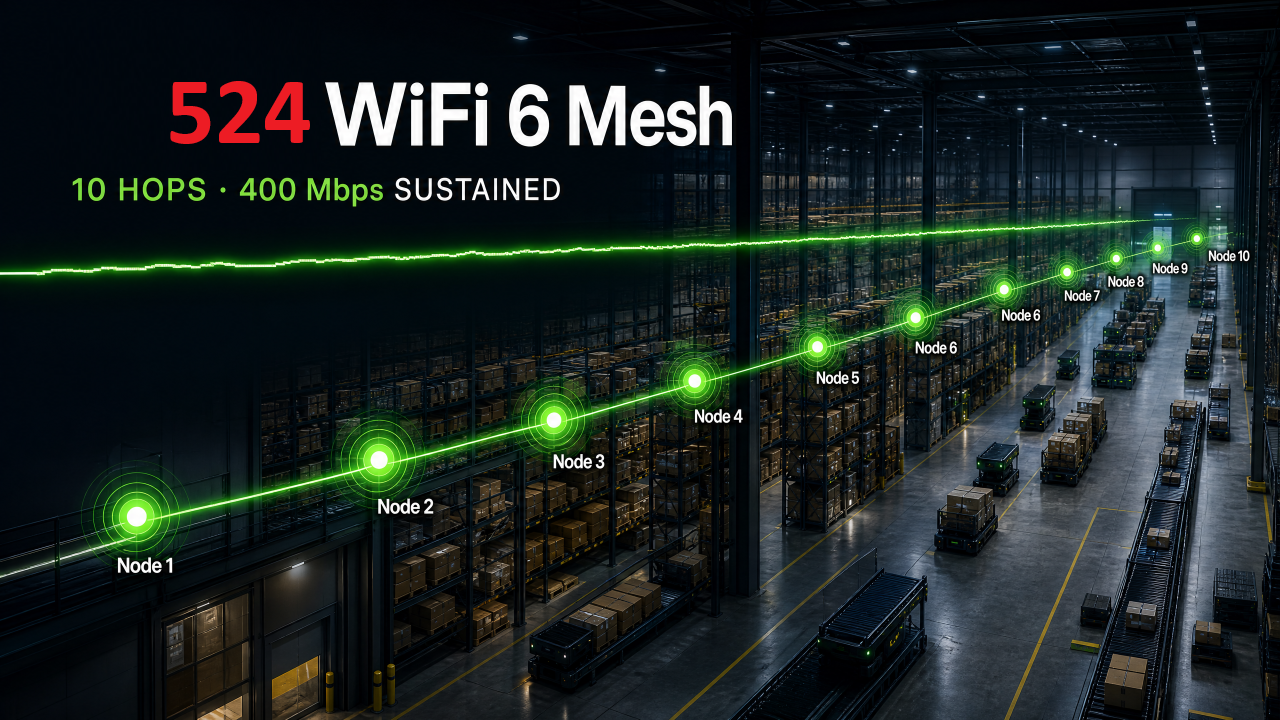
DR5018S 524 WiFi 6 MESH|10 Hops. Zero Compromise. 400Mbps
10 Hops. Near-zero attenuation. 400Mbps. Most industrial mesh networks start choking after 3-4 hops — latency spikes, throughput collapses, and…
Why Your Next Edge AI Platform Needs a Tri-Band WiFi 7 Module, Not Just Dual-Band
Wireless is usually the last spec finalized on an edge AI hardware design and the first thing that becomes a…
GPS Smart Deployment for Long-Range WiFi PtP: What If Your AP Could Tell You Where to Point?
Deploying long-range wireless links has always been a field engineering challenge. For a Point-to-Point (PtP) wireless connection, performance depends heavily…
When Robots Move Beyond Wi-Fi Coverage: Why Mesh Matters
How Wireless Mesh Networks Enable Autonomous Robots in Large and Dynamic Environments The future of robotics is moving beyond controlled…
A Smarter Drone Still Needs a Stronger Wireless Link
The future of drones is no longer only about flying. Modern drones are becoming intelligent platforms equipped with: But behind…
The Hidden Challenge in Robot Fleets: Roaming, Latency, and Wireless Stability
When people talk about autonomous robots, the conversation usually focuses on AI models, sensors, cameras, and navigation algorithms. But there…
Physical AI Connectivity – AI Robots Don’t Run on AI Alone. They Run on Connectivity.
Every week, we see exciting breakthroughs in robotics. Smarter vision models. Faster inference. More powerful edge AI hardware. But when…
Why Controller-Based Industrial WiFi Is Breaking in Real Deployments
Most industrial WiFi networks are still built on a controller-based architecture. And in controlled lab environments, it works. But in…