
Wireless is usually the last spec finalized on an edge AI hardware design and the first thing that becomes a bottleneck in the field. Worth a closer technical look before your next carrier board revision locks in.
The RF problem, precisely
Dual-band designs (2.4GHz + 5GHz) share spectrum with every consumer device, AP, and IoT sensor in range. In dense deployments — multi-robot fleets, factory floors, warehouses — this shows up as elevated retransmission rates, unpredictable jitter, and tail latency spikes under contention. For a control loop or a real-time inference pipeline streaming sensor data upstream, tail latency is what actually breaks the system, not average throughput.
WiFi 7 (802.11be) addresses this at the PHY/MAC level in three ways relevant to edge AI hardware:
- 6GHz band access — largely unlicensed spectrum with far lower device density than 2.4/5GHz today, meaning lower channel contention and more predictable airtime
- 320MHz channel bandwidth (vs. 160MHz max on WiFi 6) — higher raw throughput ceiling per link
- Multi-Link Operation (MLO) — the ability to aggregate or fail over across bands simultaneously, so a device isn’t fully dependent on the health of a single channel
For multi-camera streams, telemetry and software updates, define the required traffic profile and latency budget. Review the supported radio and software configuration, then measure application behaviour under the intended RF load.
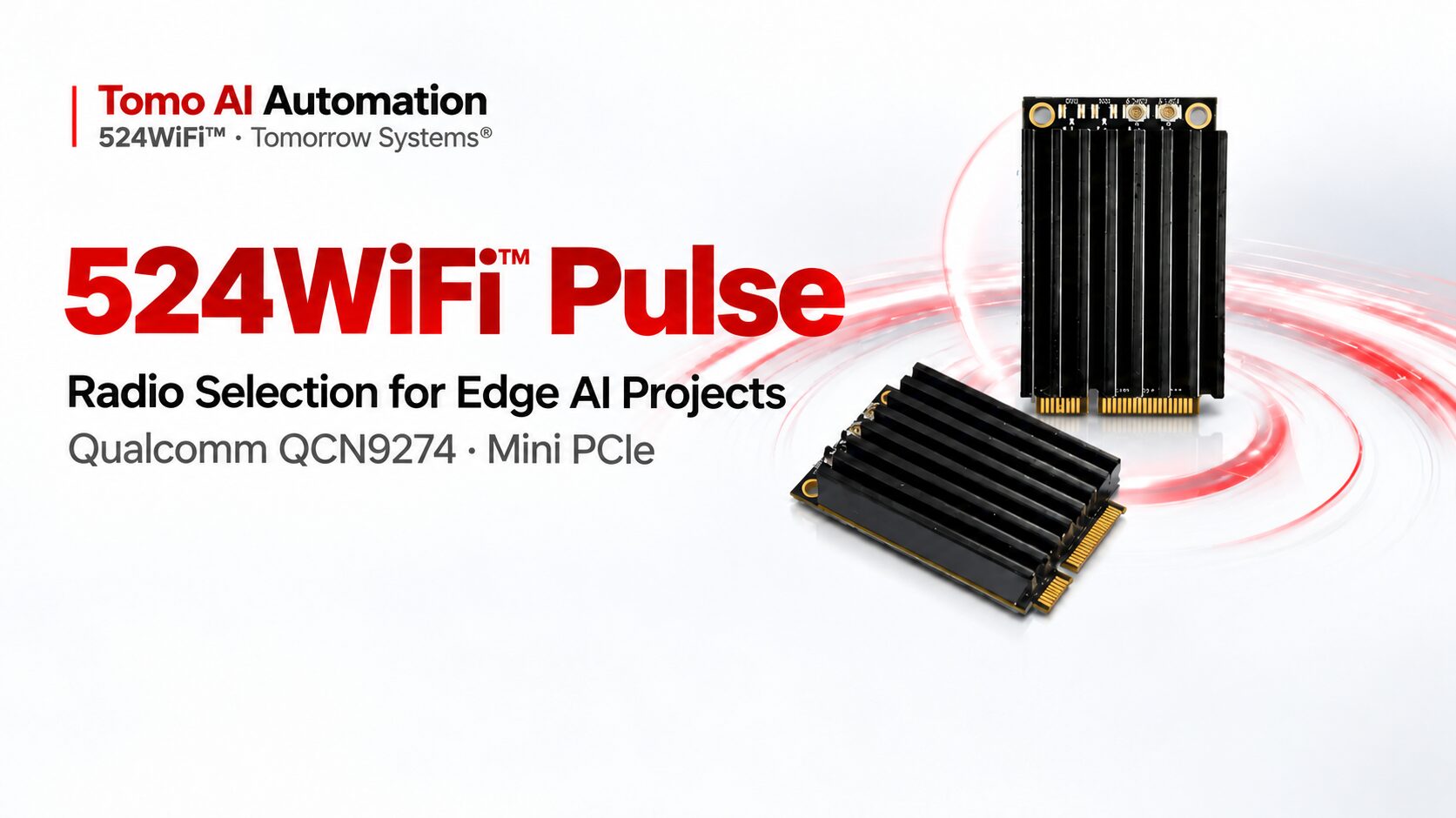
524WiFi™ Pulse Mini PCIe options for your edge AI host
Tomo AI Automation selects the radio together with the carrier board, operating system, antenna layout and installation country. Qualcomm QCN9274 is the actual wireless platform; the Pulse model identifies the offered configuration.
- 524WiFi™ Pulse P9274-2×2-2G-5G6G-MP Pro Plus — Qualcomm QCN9274 Waikiki Wi-Fi 7 Mini PCIe Radio Module, 2.4 + 5/6 GHz Dual-Band Concurrent, 2×2 per Radio — review the specified 2.4 + 5/6 GHz configuration for the intended host.
- 524WiFi™ Pulse P9274-2×2-5G6G-MP Pro Plus — Qualcomm QCN9274 Waikiki Wi-Fi 7 2×2 Dual-Band Concurrent Mini PCIe Radio Module, 5 + 6 GHz — an alternative Mini PCIe configuration with 5 + 6 GHz radios.
Plan around the exact electrical interface, radio configuration, driver, firmware and board data. Include host power, antenna placement, enclosure effects and a sustained traffic test in the integration scope. Channel availability and multi-link operation depend on the selected configuration, client, software and deployment region.
Where the tri-band architecture actually matters
Not every application needs 6GHz. It matters specifically where you have:
- High device density (multi-robot fleets, dense AP deployments)
- Latency-sensitive control or telemetry loops
- Concurrent high-bandwidth streams (multi-camera vision, sensor fusion payloads)
- Environments where 2.4/5GHz spectrum is already saturated by other systems
That covers most edge AI computing platforms, industrial routers/IoT gateways, enterprise APs in high-density environments, outdoor CPE/wireless bridges, and mesh networking nodes.
The engineering takeaway
Select the Pulse radio as part of the complete edge system. A site survey, compatible host image and documented application test provide a practical basis for deciding which bands and link configuration suit the installation.
Happy to go deeper on channel planning, MLO configuration, or driver-level integration for teams currently specifying wireless for a Jetson-based or other edge AI carrier board.
📩 Reach out to 524WiFi™ for datasheets, samples, or OEM customization.
524WiFi™ Pulse Options for Your Project
These are separate own-brand product variants. Select the model and configuration against your host, software, antenna system and operating requirements.
Plan your project with Tomo AI Automation
Bring your application, enclosure, interfaces, power requirements, software environment and expected quantity into one project brief. Tomorrow Systems® and 524WiFi™ can review the engineering scope with you.