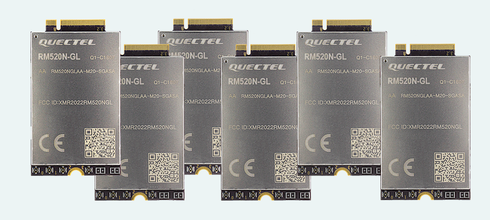
With downlink speeds up to 4.7 Gbps and uplink speeds up to 1.25 Gbps, the RM520N-GL is ideal for applications requiring ultra-low latency and high throughput, such as industrial automation, CPE routers, telematics, video surveillance, and AR/VR platforms.
Among the most sold 5G NR modules out there, the Quectel RM520N-GL is engineered to deliver blazing-fast connectivity for next-generation broadband applications. Supporting both 5G NR (SA/NSA) and fallback to high-speed LTE and 3G, this module ensures reliable coverage and seamless global deployment.
Your device will connect to 5G. But will it be Standalone or Non-Standalone? The answer depends on the network, and the Quectel RM520N-GL handles both. With fallback to LTE and 3G, it keeps devices connected wherever they are deployed.
That flexibility is one reason it’s among the best-selling 5G NR modules available. Add up to 4.7 Gbps downlink and 1.25 Gbps uplink, and it’s a proven choice for CPE routers, industrial automation, telematics and video surveillance.
A common misunderstanding is that the future of industrial wireless is simply about faster Wi-Fi.
In reality, industrial applications require much more:
Reliable roaming
Mobile robots need seamless handover between access points while moving across large facilities.
Stable performance under interference
Factories often contain metal structures, machinery, and RF noise.
Long-term platform support
Industrial customers expect hardware platforms that can operate reliably for years.
Flexible deployment options
Different environments require different designs:
Indoor industrial APs
Outdoor wireless bridges
Embedded Wi-Fi modules
Custom router platforms
The Future: AI Robots Need AI-Ready Networks
As robotics continues to evolve, wireless connectivity will become a strategic infrastructure layer.
The next generation of robots will not work alone.
They will communicate with:
Other robots
Edge servers
AI vision systems
Factory automation platforms
Cloud management systems
A powerful AI model without reliable connectivity cannot deliver its full value.
The future belongs to systems where:
AI intelligence + Edge computing + Advanced wireless connectivity work together.
Wi-Fi 7 is not just a faster wireless standard.
It is becoming the communication backbone for intelligent machines.
Building the Industrial Wireless Foundation for Tomorrow
At 524WiFi and Wallys, we are exploring the next generation of industrial wireless platforms by combining:
Qualcomm-based Wi-Fi 6 / Wi-Fi 7 solutions
Industrial-grade router boards
High-performance wireless modules
Edge AI application platforms
OEM/ODM customization capability
Our goal is to help robotics companies, AI developers, and industrial solution providers build reliable wireless infrastructure for the intelligent world.
Because the future of robotics will not only depend on smarter machines.
It will depend on how well those machines can communicate.
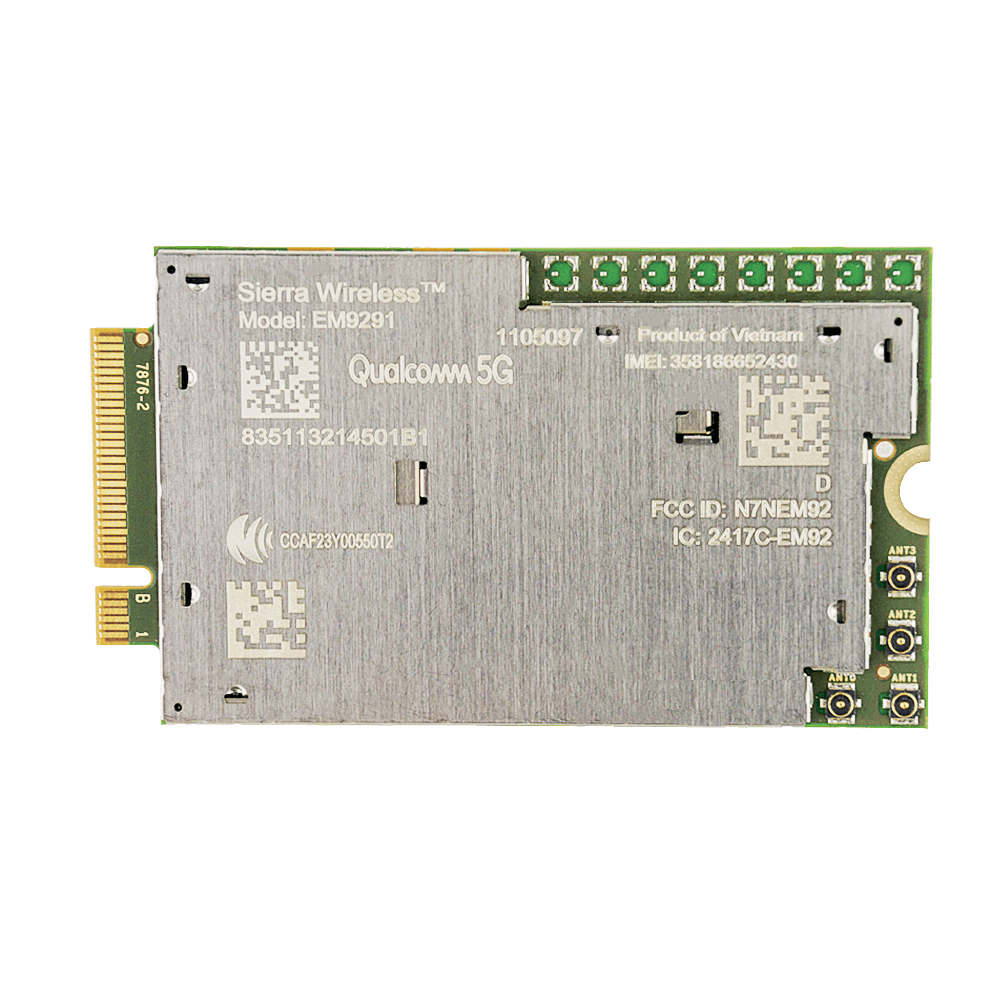
Powered by the Qualcomm X61 modem, the Semtech EM9295 brings cost-optimized 5G connectivity in the well known M.2 30x52mm form factor. It supports 3GPP Release 16 and downlink speeds reaching up to 2.5 Gbps. This latest addition to Semtech’s portfolio hits a sweetspot between capability and affordability.
Whether you’re deploying routers, industrial gateways, or edge computing platforms, the EM9295 delivers the right balance of speed, functionality, and cost – making 5G a practical choice for value-driven projects where every design decision matters. Get your sample today, or reach out to our experts to discuss your project needs.
5G NR Sub-6 GHz embedded module delivers up to 4.9Gbps downlink speed and 660Mbps uplink speed. With automatic 4G and 3G fallback networks and integrated GNSS receiver (GPS, GLONASS, BeiDou, and Galileo satellite systems supported), the EM9295 is applicable to a wide range of IoT applications such as industrial routers, home gateways, industrial and consumer laptops, rugged tablet PCs, video surveillance and digital signage.
Key Benefits
Worldwide coverage on a single module
Dual Sim Single Standby (DSSS)
Industrial grade
Optional Embedded Consumer eUICC to simplify and add flexibility to IoT deployment
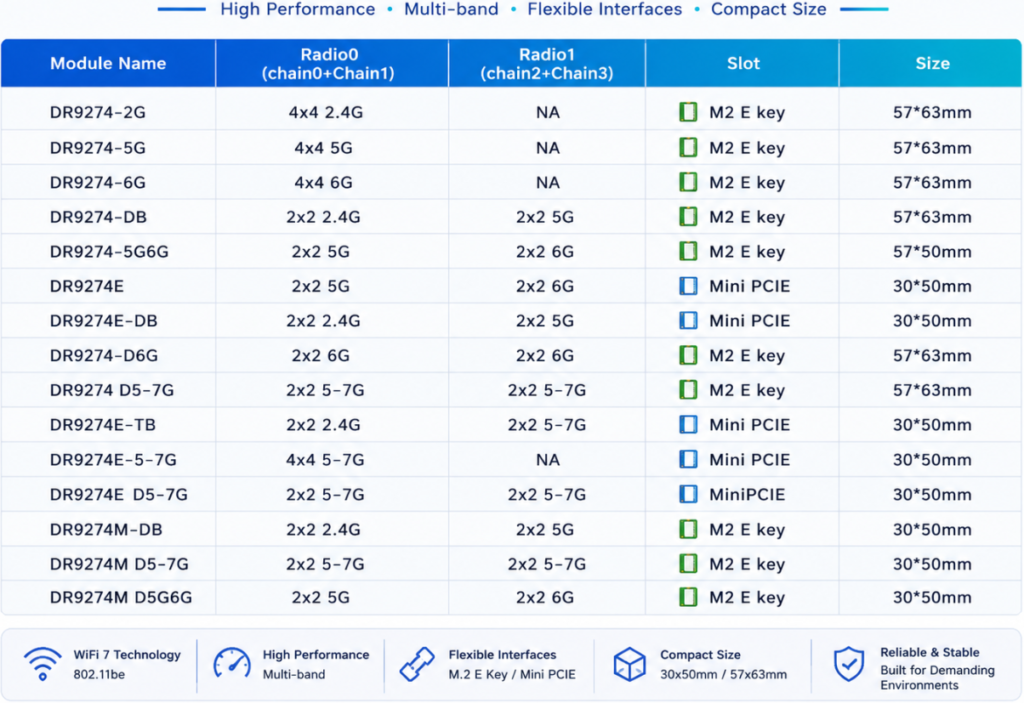
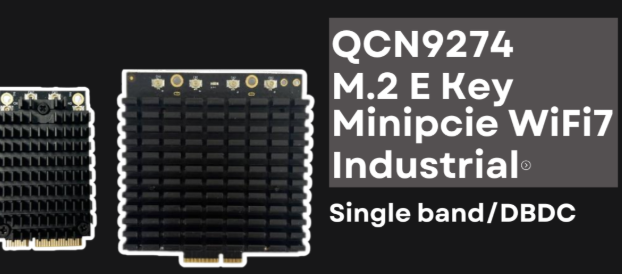
DR9274 QCN9274 QCN6274 WiFi 7 Single Band M.2 E Key Module Datasheet
Overview
The DR9274 WiFi 7 Single Band M.2 E Key module is based on the Qualcomm® QCN9274 or QCN6274 chipset, delivering exceptional wireless performance for industrial, enterprise, and embedded applications. With Single Band (5 GHz or 6 GHz) capability and M.2 E Key form factor, it offers high-speed, low-latency connectivity optimized for modern networking solutions.
Key Features
Chipset Options: Qualcomm® QCN9274 or QCN6274
WiFi Standard: IEEE 802.11be (WiFi 7)
Band Support: Single Band (5 GHz or 6 GHz)
Form Factor: M.2 E Key
Interface: PCIe Gen 3
Modulation: Up to 4096-QAM for higher throughput
Security: WPA3, Enhanced Encryption
Industrial Temperature Range: -40°C to +85°C
Performance Advantages
Ultra-High Throughput – Supports up to 320 MHz channel bandwidth for faster data transfer.
Low Latency – Ideal for time-sensitive industrial control, AR/VR, and streaming applications.
Improved Spectrum Efficiency – Thanks to Multi-Link Operation (MLO) and advanced modulation.
Power Efficiency – Optimized for battery-powered or embedded devices.
Applications
Industrial Wireless APs
5G/WiFi 7 Gateways
Smart Cities and IoT
AR/VR and Immersive Media
High-Speed Enterprise Networking
Embedded Systems with M.2 E Key Interface
Technical Specifications
ParameterDescriptionChipsetQCN9274 / QCN6274StandardWiFi 7 (IEEE 802.11be)BandSingle Band (5 GHz / 6 GHz)InterfaceM.2 E Key, PCIe Gen 3Channel BandwidthUp to 320 MHzModulationUp to 4096-QAMAntenna ConnectorIPEX MHF4Temperature Range-40°C to +85°CSecurityWPA3
Why Choose Wallys DR9274 Module from 524WiFi ?
Wallys and 524WiFi specializes in custom industrial wireless solutions, offering:
In today’s fast-paced digital landscape, the demand for robust and efficient wireless connectivity has never been greater. Mediatek’s cutting-edge Wi-Fi 6, Wi-Fi 6E, and Wi-Fi 7 modules are designed to meet these demands, providing seamless integration with various AI Linux PCs, including popular distributions like Debian, Ubuntu, Fedora, and more. These modules are set to revolutionize how users experience connectivity across multiple platforms.
Key Features of 524WiFi MIDIATEK’s Wi-Fi Modules
Wi-Fi 6 (802.11ax): This standard introduces significant improvements in speed, capacity, and efficiency. With features like Orthogonal Frequency Division Multiple Access (OFDMA) and Multi-User Multiple Input Multiple Output (MU-MIMO), Wi-Fi 6 can handle multiple devices simultaneously without compromising performance. This is particularly beneficial in environments with high device density, such as offices or public spaces.
Wi-Fi 6E: Expanding on the capabilities of Wi-Fi 6, Wi-Fi 6E operates in the newly available 6 GHz band. This additional spectrum allows for more channels, reducing congestion and enabling higher data rates for bandwidth-intensive applications like streaming and gaming. The increased capacity ensures that users can enjoy uninterrupted connectivity even in crowded environments.
Wi-Fi 7 (802.11be): As the latest advancement in wireless technology, Wi-Fi 7 promises even faster speeds and lower latency through features like 320 MHz channels and enhanced MU-MIMO capabilities. This will be a game-changer for applications requiring real-time data transmission, such as augmented reality (AR) and virtual reality (VR).
Compliance and Certifications
524WiFi’s commitment to quality and safety is underscored by its extensive certifications. Most of their modules have passed rigorous testing and obtained certifications from recognized international bodies, including:
FCC (Federal Communications Commission): Ensuring compliance with U.S. regulations for electronic devices.
CE (Conformité Européenne): Certifying that products meet European health, safety, and environmental protection standards.
IC (Industry Canada): Meeting Canadian regulatory requirements for communication devices.
RCM (Regulatory Compliance Mark): Compliance with Australian electrical safety standards.
NCC (National Communications Commission): Adhering to Taiwanese communication regulations.
These certifications emphasize the performance and reliability of 524WiFi’s products while demonstrating their dedication to creating a seamlessly connected IoT landscape.
Compatibility with Linux Distributions
Mediatek’s Wi-Fi modules are designed with compatibility in mind, ensuring that they work seamlessly across various Linux distributions:
Debian/Ubuntu: Users can easily install drivers through package managers or compile from source if necessary.
Fedora/CentOS: The modules support the latest kernels available in these distributions, providing out-of-the-box functionality for most users.
Arch Linux/OpenSUSE/Manjaro: These distributions often have up-to-date kernel support, allowing users to take advantage of the latest features offered by Mediatek’s modules.
Red Hat Enterprise Linux/Oracle/Linux Mint/Gentoo/Slackware: These distributions may require additional configuration but are fully capable of supporting Mediatek’s Wi-Fi technology with the right drivers.
Enhanced Performance for AI Applications
The integration of Mediatek’s Wi-Fi modules into AI-driven Linux PCs enhances performance significantly. The high throughput and low latency provided by these technologies enable faster data processing and improved communication between devices. This is crucial for applications such as machine learning models that require large datasets to be transmitted quickly and efficiently.Moreover, the power efficiency of Wi-Fi 6 and beyond means that devices can maintain longer operational times without frequent recharging or energy consumption concerns. This is particularly important for IoT devices that rely on continuous connectivity.
Conclusion
Mediatek’s Wi-Fi 6, 6E, and 7 modules represent a significant leap forward in wireless technology. Their compatibility with a wide range of Linux distributions makes them an ideal choice for users looking to enhance their AI Linux PC experience. With faster speeds, increased capacity, improved efficiency, and compliance with international standards, these modules are poised to transform how we connect in an increasingly digital world. Embrace the future of connectivity with 524WiFi’s innovative solutions today!