
Posted on

How to Build Reliable Wireless Infrastructure for Autonomous Mobile Robots?

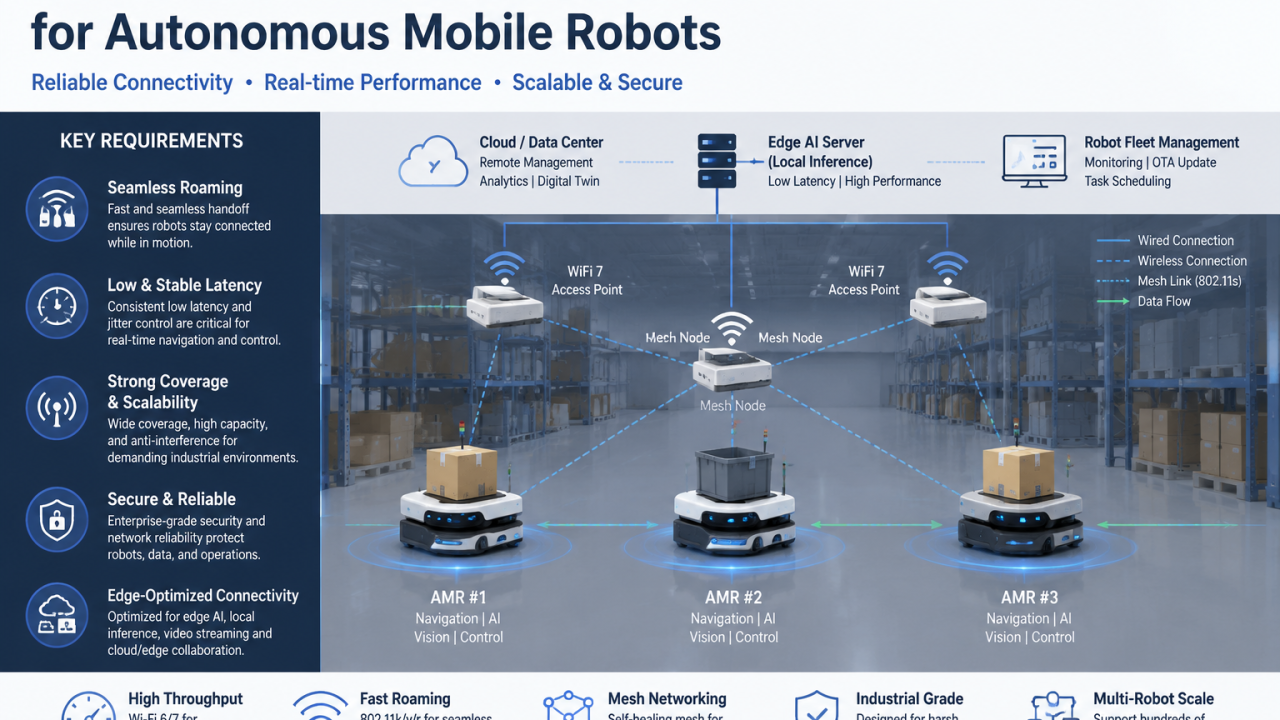
When companies deploy autonomous mobile robots (AMRs) in real environments, the biggest challenge is often not the robot itself.

It is the network that keeps the robot connected.

An AMR depends on continuous communication for:

– Real-time navigation

  • Vision data transmission

⚡ Edge AI inference

– Fleet coordination

☁️ Cloud and remote management

A short network interruption may result in:

  • Navigation delays
  • Video stream drops
  • Task interruptions
  • Reduced operational efficiency

So, what does a reliable wireless infrastructure for AMRs require?

1. Seamless Roaming

AMRs continuously move through different areas.

A reliable network must allow robots to switch between access points without interrupting communication.

2. Low and Stable Latency

For autonomous systems, average speed is not enough.

What matters is consistent response time.

Network jitter and packet loss can directly impact robot performance.

3. Strong Coverage and Scalability

Factories and warehouses often have:

  • Large areas
  • Metal structures
  • RF interference
  • Hundreds of connected devices

A scalable wireless architecture is essential.

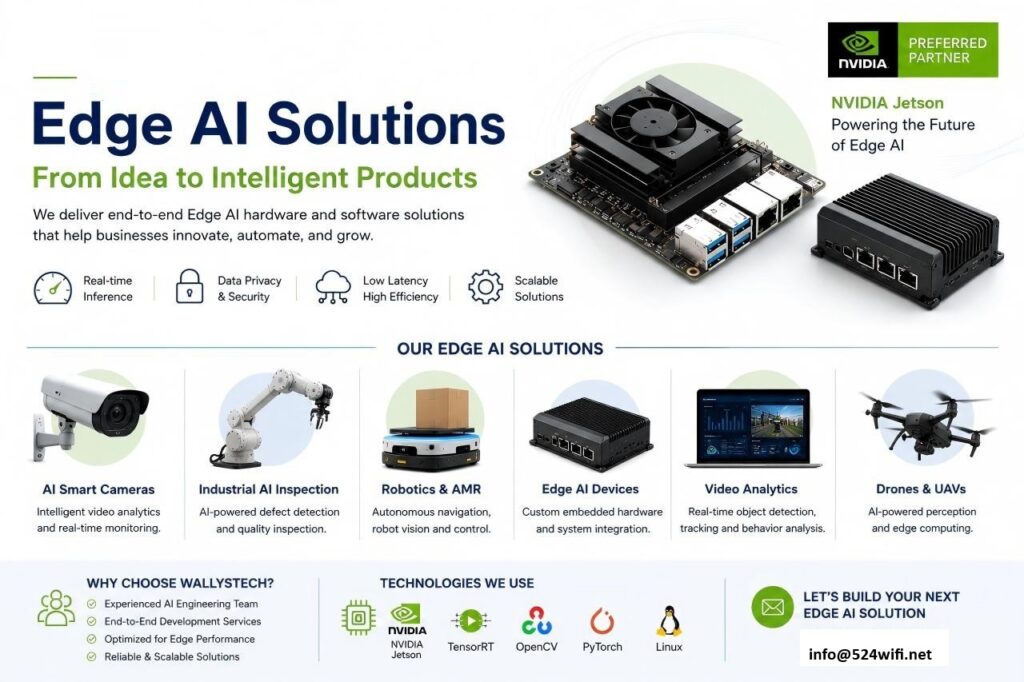
4. Edge-Optimized Connectivity

Modern robots combine:

– AI computing – Wireless communication – Sensors ⚙️ Real-time control
Email: [email protected] or [email protected]

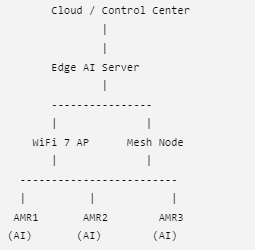
The wireless network is no longer just an access layer.

It becomes part of the AI system.

As Physical AI moves from laboratories into factories, warehouses, and outdoor environments, reliable connectivity will become a key factor determining whether autonomous systems can scale.

AI gives robots intelligence.

Connectivity gives robots the ability to operate.

What challenges have you experienced when deploying wireless networks for autonomous robots?

Building the next generation of AI-powered edge devices requires reliable connectivity. Explore how WallysTech helps robotics, AI vision, and industrial applications achieve stable wireless performance.
Article content
Posted on

How AP Controllers Simplify Industrial Wireless Network Management

In industrial environments, managing a wireless network is no small feat. The complex layout, high device density, and diverse use cases make ensuring seamless connectivity a challenging task. Fortunately, AP (Access Point) Controllers offer a centralized solution to manage, optimize, and secure industrial wireless networks efficiently.


The Complexity of Industrial Wireless Network Management

Industrial wireless networks must contend with a host of challenges, including:

  • High Device Density: Hundreds or even thousands of devices may need to connect simultaneously.
  • Dynamic Environments: Equipment relocation and layout changes require adaptive network configurations.
  • Security Risks: Critical operations demand robust security to prevent unauthorized access.

Manual management of individual APs becomes impractical in such scenarios. This is where AP controllers come in, providing a centralized and intelligent approach to network management.


Core Features of AP Controllers

AP controllers revolutionize network management with the following key functionalities:

1. Centralized Management

AP controllers enable administrators to manage multiple APs from a single interface.

  • Configure SSIDs, encryption settings, and channels simultaneously.
  • Simplify large-scale network deployments and reduce manual effort.

2. Wireless Optimization

Enhancing performance and reliability is a priority in industrial networks. AP controllers achieve this through:

  • Automatic Channel Selection: Reduces interference by dynamically assigning optimal channels.
  • Power Adjustment: Optimizes coverage by adjusting transmission power based on environmental conditions.
  • Load Balancing: Distributes devices evenly across APs to prevent overloads.(concept feature)

3. Enhanced Security Management

Industrial operations require stringent security protocols. AP controllers deliver:

  • Access Control: Employ whitelists, blacklists, or MAC-based ACLs to restrict access.
  • VLAN Isolation: Separate production, monitoring, and management traffic to ensure data integrity.
  • Wireless Firewalls: Detect and block unauthorized attempts to access the network.

Applications of AP Controllers

The versatility of AP controllers makes them essential in various industrial scenarios:

Factory Floors and Production Lines

  • Support seamless connectivity for IoT devices, sensors, and automated machinery.
  • Ensure low-latency communication for real-time monitoring and control.

Smart Cities and Public WiFi

  • Manage high-density user connections in public areas.
  • Optimize performance for diverse applications like public safety and urban planning.

Video Surveillance and Security Systems

  • Enable stable connections for high-resolution cameras.
  • Facilitate quick data transmission for immediate threat detection and response.

Why Wallystech’s AP Controllers Stand Out

Wallystech offers industry-leading AP controllers that excel in performance and adaptability:

1. Powered by IPQ6010

Our AP controllers leverage the Qualcomm IPQ6010 platform, providing robust performance and scalability for demanding industrial applications.

2. Simplified Expansion

With plug-and-play capabilities, new APs can be quickly integrated into the existing network. This reduces the time and cost associated with network upgrades.

3. Proactive Monitoring and Fault Management

Real-time monitoring detects and addresses AP issues promptly. Automatic fault recovery ensures network resilience in case of failures.