Posted on

Top QCA IPQ 9574 Chip Features for Next-Gen Wi-Fi 7 Connectivity

op IPQ9574 Chip Features for Next-Gen Wi-Fi 7 Connectivity

As the demand for faster, more reliable wireless networks continues to grow, the introduction of Wi-Fi 7 has become a game-changer in the world of wireless technology. At the heart of this new generation of Wi-Fi is the IPQ9574 chip, designed by Qualcomm, which is quickly emerging as one of the leading chips for Wi-Fi 7 connectivity. With its advanced features, the IPQ9574 is set to unlock unprecedented speeds, capacity, and reliability, paving the way for cutting-edge applications across industries. In this article, we’ll take a closer look at the top features of the IPQ9574 chip and how it is revolutionizing the way we connect.

1. Multi-Link Operation (MLO) for Ultra-Fast Speeds

One of the standout features of the IPQ9574 chip is its support for Multi-Link Operation (MLO), a critical component of Wi-Fi 7. MLO allows devices to simultaneously connect to multiple frequency bands (e.g., 2.4 GHz, 5 GHz, and 6 GHz) instead of relying on a single band. This results in faster data transfer speeds and improved network efficiency.

With MLO, the IPQ9574 can combine multiple data streams from different channels, enhancing throughput and reducing latency. This makes it ideal for demanding applications such as 4K/8K video streaming, virtual reality (VR), and high-speed gaming, where a seamless and ultra-fast connection is essential.

2. Increased Capacity for Dense Environments

The IPQ9574 chip is built with the capacity to handle a large number of devices simultaneously, which is critical in today’s increasingly connected world. Whether it’s a smart home, a busy office, or a large public venue, the chip ensures that network congestion is minimized, allowing for smooth communication even in dense environments.

With the Wi-Fi 7 technology powered by the IPQ9574, your network will be able to efficiently handle more devices without sacrificing performance. This is especially important as the Internet of Things (IoT) continues to expand and more smart devices are added to networks every day.

3. Better Spectrum Utilization with 320 MHz Channel Width

The IPQ9574 chip supports 320 MHz channel width, which significantly increases the amount of data that can be transmitted over the network. This feature is crucial for taking full advantage of the newly available 6 GHz spectrum offered by Wi-Fi 7, allowing for less interference and more bandwidth.

With wider channels, users can expect higher throughput and faster data speeds. For example, large file transfers, high-definition video streaming, and bandwidth-intensive tasks will see massive improvements in speed and efficiency.

4. Enhanced Reliability and Reduced Latency

One of the most important factors in ensuring a reliable network is minimizing latency—the delay between sending and receiving data. The IPQ9574 chip addresses this with advanced features that optimize network reliability and ensure a low-latency experience.

In applications such as live streaming, online gaming, and real-time video conferencing, low latency is essential for smooth, uninterrupted experiences. The IPQ9574 chip’s ability to provide consistent, stable connections is what sets it apart, ensuring high performance even during heavy traffic periods.

5. Seamless Connectivity with Enhanced Roaming

The IPQ9574 chip supports seamless roaming, which allows devices to smoothly transition between access points without interruption. Whether you’re walking around your home or office, the network will automatically hand off your connection to the nearest access point, ensuring a continuous, reliable experience.

This is especially beneficial in larger spaces or environments with many users, such as hotels, hospitals, or large campuses, where maintaining an uninterrupted connection is crucial.

6. Backward Compatibility with Wi-Fi 5 and Wi-Fi 6

Although the IPQ9574 chip is built for the future with Wi-Fi 7, it also maintains backward compatibility with older Wi-Fi standards, such as Wi-Fi 5 and Wi-Fi 6. This means that users with older devices can still enjoy fast and reliable connections on Wi-Fi 7 networks, without the need to upgrade all their devices at once.

Conclusion: The Future of Wireless Connectivity

The IPQ9574 chip is a powerhouse for Wi-Fi 7 technology, offering game-changing features like Multi-Link Operation (MLO), higher capacity, wider channels, and seamless roaming. These features make it the perfect choice for applications demanding high-speed, reliable, and efficient wireless connections—whether it’s for streaming, gaming, smart cities, or enterprise networks.

At Wallys Communications, we leverage the IPQ9574 chip to deliver cutting-edge solutions that meet the needs of modern wireless networks. Additionally, we have developed AI-driven solutions, such as human recognition and vehicle detection, powered by QCN9074 chips, offering innovative applications in security and automation.

Contact us today to learn more about how our Wi-Fi 7 solutions powered by IPQ9574 can elevate your wireless network and unlock the full potential of next-gen connectivity.

Posted on

Mastering MLO on the IPQ 5332 Board with DR 9274 5G6G Card: Step-by-Step Video Guide

Are you working on industrial wireless projects and looking for a reliable guide to set up Multi-Link Operation (MLO)? Look no further! At 524WiFi and WallysTech, we’ve just released a comprehensive tutorial video to help you configure MLO on the IPQ5332 board (DR5332) paired with the DR9274-5G6G card.

This video covers everything you need to know, including:

✅ Hardware connection setup

✅ Firmware loading instructions

✅ Access Point (AP) configuration

✅ Practical tips to optimize your industrial wireless network

Why MLO Matters

MLO is a game-changing feature in WiFi 7 that allows simultaneous use of multiple bands for enhanced throughput and reliability. With industrial applications demanding higher speeds and more stable connections, mastering MLO is key to staying ahead.

Watch the Tutorial Now

Click below to watch the full step-by-step guide: 👉 How to Set Up MLO on the IPQ5332 Board with DR9274-5G6G Card

Need This Hardware? We’ve Got You Covered!

If you’d like to test this setup or integrate it into your project, contact our sales team at [email protected]. We’re here to provide tailored solutions and support your success.


💬 We’d love to hear from you! What other topics would you like us to cover? Comment below with your suggestions, and don’t forget to share this article with your network.

📢 Follow us for more updates, tutorials, and insights into the latest wireless technologies!

Posted on

Can WiFi 7 Meet the Growing Demands of Modern Manufacturing?

WiFi 7: Redefining the Game of Industrial Connectivity

As industries across the globe continue to evolve, the need for robust and efficient connectivity solutions has never been more critical. Enter WiFi 7, the latest advancement in wireless technology, which promises to transform industrial connectivity like never before. With its unparalleled speed, low latency, and ability to support a vast number of devices, WiFi 7 is set to redefine the landscape of industrial applications.

Unmatched Speed and Low Latency

One of the standout features of WiFi 7 is its ability to deliver incredibly high data rates. With potential speeds reaching up to 46 Gbps, WiFi 7 enables real-time data transmission that is essential for modern industrial operations. This speed is particularly beneficial for applications such as automated manufacturing processes, where quick communication between machines is crucial. Additionally, the low latency characteristic of WiFi 7 ensures that commands and data packets are transmitted almost instantaneously, enhancing the responsiveness of industrial systems.

Multi-Link Operation (MLO): The Game Changer

WiFi 7 introduces a groundbreaking feature known as Multi-Link Operation (MLO). This allows devices to connect to multiple frequency bands simultaneously, optimizing network performance and reliability. In environments where interference is a common issue, MLO provides a solution by seamlessly switching between channels to maintain a stable connection. This is particularly important in industrial settings, where equipment operates in close proximity and reliable communication is essential for safety and efficiency.

Increased Device Connectivity

The Internet of Things (IoT) is rapidly becoming a cornerstone of industrial operations, with countless devices needing to connect and communicate. WiFi 7 excels in this area, supporting a significantly higher number of simultaneous connections compared to its predecessors. This capability allows factories and warehouses to deploy a wide array of smart sensors, cameras, and other devices without the fear of overwhelming the network. As a result, businesses can gather more data, monitor performance in real time, and optimize operations based on actionable insights.

Efficient Spectrum Utilization

WiFi 7 employs advanced technologies that enable more efficient spectrum utilization, reducing congestion and enhancing overall network performance. By utilizing wider channels and advanced modulation techniques, WiFi 7 can maximize throughput while minimizing interference. This is especially beneficial in complex industrial environments where multiple devices compete for bandwidth. With WiFi 7, manufacturers can ensure their networks remain agile and efficient, even as demands increase.

Supporting Edge Computing

As industries shift toward data-driven decision-making, edge computing is becoming increasingly important. WiFi 7’s capabilities align perfectly with this trend, enabling data processing to occur closer to the source. This reduces the need for constant communication with centralized servers, decreasing latency and improving response times. In applications such as predictive maintenance, where timely data analysis can prevent costly downtimes, WiFi 7 provides the necessary infrastructure for effective edge computing.

Future-Proofing Industrial Connectivity

Investing in WiFi 7 not only addresses current connectivity challenges but also prepares industries for the future. As technologies evolve, and the demand for faster, more reliable connections grows, WiFi 7 is positioned to meet these needs. Its compatibility with existing WiFi standards ensures a smooth transition, allowing businesses to upgrade their networks without significant disruptions.

Conclusion

WiFi 7 is more than just a technological upgrade; it is a paradigm shift that will redefine industrial connectivity. With its high speed, low latency, multi-link capabilities, and increased device support, WiFi 7 empowers businesses to embrace the future of smart manufacturing and IoT integration. As industries continue to navigate the complexities of modernization, WiFi 7 stands ready to lead the way, transforming how we connect, communicate, and innovate in the industrial realm. Embrace the change, and prepare for a new era of connectivity with WiFi 7!

Posted on

Compex Systems Expands Dual-Band Wi-Fi 7 Family – Now with M.2 Variants!

Wi-Fi 7 is here, ushering in a new era of wireless connectivity that promises to transform the way we experience the internet. At Compex, we are excited to introduce the new M.2 variants to our popular dual-band Wi-Fi 7 module lineup. Meet the new WLTB7002E25 with a M.2 B+M Key and the WLTE7002E25 with a M.2 E Key — both designed to complement our existing WLE7002E25, which features the popular standard miniPCIe form factor. Together, these Wi-Fi 7 modules offer a comprehensive solutions with enhanced performance, flexibility and compatibility — all at competitive Wi-Fi 6 prices!

Powered by Qualcomm’s QCN6224, QCN6274 and QCN9274 Waikiki series radio chipsets, the WLE/WLTE/WLTB7002E25 are dual-band concurrent 2.4+5GHz Wi-Fi 7 (802.11be) modules, offering wider signal coverage by transmitting both bands concurrently, reducing latency with Multi-Link Operation (MLO) support, featuring OFDMA and 4096 QAMs. Delivering up to 20dBm per chain, these 2×2 MU-MIMO models are ideal for enterprise, industrial, cybersecurity, transportation and SMB applications.

What are the features of the Compex Wi-Fi 7 Modules WLE/WLTE/WLTB7002E25?

  • Dual-Band Dual-Concurrent Operation: Support both 2.4GHz and 5GHz bands simultaneously.
  • Variants for Easy Adoption: WLE7002E25 features a MiniPCIe interface with PCIe 3.0, while the WLTE7002E25 and WLTB7002E25 both have M.2 connectors, supporting E Key and B+M Key respectively.
  • MLO: All Compex Wi-Fi 7 modules support Multi-Link Operation, a key performance advantage of Wi-Fi 7, which increases throughput, lowers latency and enhances reliability.
  • Open Source Ath12k Support: Compatible with Qualcomm and third-party platforms such as Marvell, NXP and x86 platform.
Posted on

Your Go-To Guide for Loading Firmware and Configuring MLO on QCA DR9574 IPQ9574 !

Your Go-To Guide for Loading Firmware and Configuring MLO on IPQ9574 !

Hey there! Are you feeling a bit lost when it comes to loading firmware and configuring MLO on the IPQ9574? Fret not! Here at 524WiFi, we’ve crafted a super easy and detailed tutorial just for you. Let’s jump right into it!

Why This Guide?

Whether you’re a seasoned pro or a complete newbie, setting up advanced hardware can be daunting. That’s why we’re here to break it down into simple, manageable steps. By the end of this guide, you’ll be a pro at loading firmware and configuring your device like a champ!

What You’ll Get

  • Clear Hardware Setup: We’ll kick things off by connecting the hardware. Don’t worry; we’ll guide you through the process of connecting your UART cable without any hassle.
  • Seamless Firmware Loading: Next, we’ll tackle loading the firmware. We’ll ensure you have everything in the right place and give you step-by-step instructions to make it a breeze.
  • Effortless AP Configuration: Finally, we’ll walk you through configuring the Access Point. This step is crucial for ensuring your device runs at its best.

Stick Around for More!

But wait, there’s more! If you stick around until the end of the video, you’ll get an exclusive sneak peek at our upcoming DR9574kit throughput test. Trust us, you won’t want to miss it!

Ready to Dive In?

So, what are you waiting for? Click the link below to watch our tutorial and empower yourself with the skills to conquer firmware loading and MLO configuration!

📺 Watch here:

P.S.: The MLO for DR5332/DR5322 is currently in active preparation. We appreciate your patience as our R&D team works diligently on this. Stay tuned for the latest updates coming your way soon—just you wait!

Posted on

IPQ 9574: Does DR9574 Router Powered by Qualcomm IPQ9574 Support MLO?

524WiFi Wi-Fi 7 Router Powered by Qualcomm IPQ9574 and QCN9274: Enhanced Network Experience with MLO Technology

MLO (Multi-Link Operation) is a key technology in Wi-Fi 7 that allows data to be transmitted across multiple wireless links simultaneously, significantly improving network performance, stability, and efficiency. Specifically, MLO enables devices to transmit and receive data on multiple frequency bands (2.4GHz, 5GHz, and 6GHz) at the same time, rather than being limited to a single band.

Key Roles of MLO in Wi-Fi 7:

  • Increased Throughput: MLO allows devices to utilize multiple links for data transmission, greatly boosting bandwidth and data transfer speeds, especially for high-bandwidth applications like 4K/8K streaming, cloud gaming, and VR/AR.
  • Reduced Latency: Parallel transmission across multiple links accelerates data transfer, lowering latency, which is crucial for real-time applications like online gaming and video conferencing.
  • Enhanced Reliability: MLO can automatically switch to other links if one experiences interference or congestion, ensuring connection stability, especially in crowded environments or when devices are far from the router.
  • More Efficient Spectrum Usage: MLO dynamically distributes traffic across different links, improving spectrum resource utilization and reducing wireless congestion.

Why Many Applications Need MLO:

  • High Bandwidth Demands: As 4K/8K video and immersive media become more prevalent, applications increasingly require higher bandwidth. MLO’s multi-link capability meets these demands.
  • Low Latency Requirements: Applications like cloud gaming and video conferencing require very low latency. MLO can significantly reduce latency through parallel transmission.
  • Reliability: Smart home and industrial automation applications need stable connections. MLO’s multi-link mechanism ensures stability even if one link fails.

About IPQ9574 and QCN9274:

  • Qualcomm IPQ9574: This powerful SoC (System on Chip) is designed for high-performance networking applications, providing robust processing power and advanced features to support next-gen Wi-Fi 7 capabilities. Its architecture is optimized for handling multiple data streams, ensuring seamless connectivity and improved network efficiency.
  • Qualcomm QCN9274: Qualcomm Wi-Fi 7 ‘Waikiki’ series radio solution.

In summary, MLO is a core technology in Wi-Fi 7 that enhances network experience by providing higher throughput, lower latency, and greater reliability, making it essential for modern high-performance applications.

524WiFi Solution:

524WiFI and Wallystech’s Wi-Fi 7 router DR9574 supports MLO functionality with the DR9274 Wi-Fi 7 card, fulfilling diverse Wi-Fi project needs:

  • DR9574 supports 3 DR9274 single cards: 2.4G, 5G, and 6G can operate simultaneously.
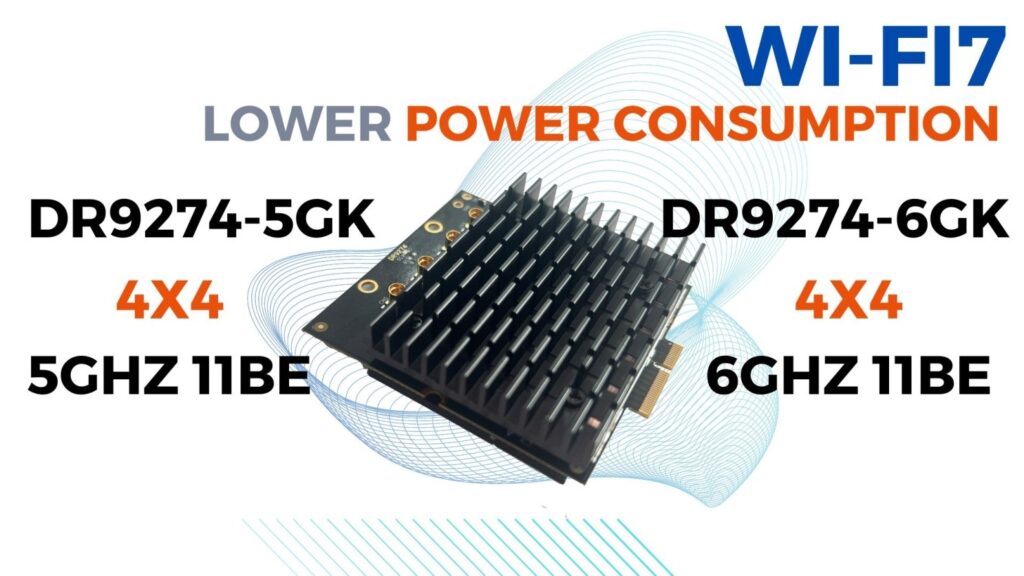
  • DR9574 supports one DBDC card: DR9274-5G6G
Posted on

Wi-Fi 7 Unleashed: Explore Qualcomm’s 4×4 Tri-Band Powerhouse!

Exploring Wi-Fi 7 4×4 Qualcomm Triband Solutions

Wi-Fi 7, also known as 802.11be, marks a significant leap forward in wireless networking technology, offering enhanced performance, higher throughput, and lower latency compared to its predecessors. With features like 320 MHz channel bandwidth, 4K-QAM modulation, and Multi-Link Operation (MLO), it is poised to deliver speeds up to 46 Gbps, ideal for the ever-increasing demands of modern networks.

This article explores several Qualcomm-based Wi-Fi 7 4×4 triband solutions from 524WiFi and Wallys Communications, highlighting their key features and applications.

1. DR9574: Tri-Band Routerboard with Qualcomm IPQ9574

  • Overview: The DR9574 routerboard is equipped with the Qualcomm IPQ9574 chipset and features 4×4 MU-MIMO technology, offering robust performance across three bands (2.4 GHz, 5 GHz, and 6 GHz). It supports four M.2 slots, which provides significant flexibility for module integration and customization.
  • Specifications:
  • Chipset: Qualcomm IPQ9574 and QCN9274
  • Bands: Tri-band (2.4 GHz, 5 GHz, 6 GHz)
  • Ports: 2x 10G Ethernet and 4x 1G Ethernet ports
  • Applications: Suitable for high-performance networking applications such as routers, access points, and enterprise-level solutions, the DR9574 is designed for environments where both speed and reliability are critical.
  • Use Case: It is ideal for deployment in offices, large homes, or enterprise environments that demand simultaneous high-speed connections across multiple devices.

More about DR9574

IPQ9574 QCN9274

2. DR9274 Series: Single-Band Wi-Fi 7 M.2 Modules

  • Overview: The DR9274 series consists of three single-band Wi-Fi 7 cards—each catering to a different frequency band (2.4 GHz, 5 GHz, and 6 GHz). These M.2 modules provide high-speed 4×4 MU-MIMO functionality, enabling better coverage and increased data throughput in densely populated environments.
  • Key Models:
  • DR9274-2G: Focuses on the 2.4 GHz band, which is ideal for devices requiring long-range connectivity with moderate data requirements.
  • DR9274-5G: Optimized for the 5 GHz band, offering a balance between range and speed, perfect for most modern devices.
  • DR9274-6G: Leverages the 6 GHz band, providing ultra-fast connectivity with minimal interference, designed for future-proofing wireless networks.
  • Specifications:
  • Chipset: Qualcomm QCN9274 and QCN6274
  • Form Factor: M.2 slot, ensuring easy integration into a wide range of devices.
  • 4×4 MU-MIMO: Delivers enhanced performance for demanding applications, such as streaming, gaming, and large file transfers.
  • Use Case: The DR9274 series is ideal for laptops, embedded systems, and other devices requiring high-performance wireless modules in specialized applications.

More about DR9274-2G

More about DR9274-5G

More about DR9274-6G

3. DR5332: Qualcomm IPQ5332 Dual-Band Routerboard

  • Overview: The DR5332 is a dual-band routerboard that comes with a Qualcomm IPQ5332 chipset, offering support for 2.4 GHz and 5 GHz bands. It is designed for network solutions that require fast, stable, and efficient connections.
  • Specifications:
  • Chipset: Qualcomm IPQ5332
  • Ports: 10G SFP for high-speed fiber connections, making it ideal for data-heavy applications.
  • Memory: 1 GB DDR4, enhancing performance for processing-intensive tasks.
  • Use Case: This model is well-suited for small- to medium-sized business environments, especially where high data throughput and fiber connectivity are crucial.

More about DR5332

IPQ5332 4×4 Solution

Conclusion

The Qualcomm Wi-Fi 7 4×4 triband solutions provide a comprehensive range of products tailored to meet the needs of high-performance networking applications. From single-band M.2 modules to advanced routerboards supporting multiple frequencies, 524WiFi’ lineup offers flexibility and scalability for various industries and use cases.

Posted on

WiFi 7 Technology 6 new features: Market Growth, Opportunities, and Challenges

WiFi 7 Technology: Market Growth, Opportunities, and Challenges

Introduction

As wireless network technology evolves, the WiFi standard continues to advance. Following WiFi 6, WiFi 7 (802.11be) emerges as the cornerstone of the next generation of wireless connectivity technology. WiFi 7 offers significant improvements in speed and efficiency, introducing numerous new features poised to revolutionize future network experiences. This article delves into the current state of the WiFi 7 device market, its future growth prospects, opportunities, and challenges.

Overview of WiFi 7 Technology

WiFi 7 brings several advancements over its predecessors:

  • Higher Speeds: WiFi 7 achieves a maximum transmission speed of up to 46 Gbps, more than four times that of WiFi 6.
  • Lower Latency: Leveraging multiple low-latency mechanisms, WiFi 7 excels in real-time applications such as gaming and video conferencing.
  • Improved Multi-Device Performance: Supporting Multi-Link Operation (MLO), WiFi 7 utilizes multiple bands (2.4GHz, 5GHz, 6GHz) simultaneously, enhancing network efficiency and stability.
  • Enhanced Security: WiFi 7 incorporates state-of-the-art encryption technologies, ensuring robust protection of user data.

Market Growth

Current Market Status

As of the end of 2023, the WiFi 7 device market is in its nascent stages, primarily driven by early adopters and technologically advanced enterprises. Market research indicates that the global WiFi 7 device market size was approximately $1 billion in 2023.

Future Growth Projections

Industry forecasts suggest robust growth for the WiFi 7 device market over the next five years. By 2028, it is expected to reach $15 billion globally, with a compound annual growth rate (CAGR) of around 45%. This accelerated growth is propelled by several factors:

  • Demand for Technological Advantages: Enterprises and consumers are drawn to WiFi 7’s high speed, low latency, and superior stability, particularly in bandwidth-intensive applications like AR/VR, cloud gaming, and 4K/8K video streaming.
  • Broad Application Scenarios: WiFi 7 will extend its reach beyond homes and businesses to include smart cities, industrial internet, telemedicine, and other emerging fields, driving further market demand.
  • Device Upgrade Cycle: With WiFi 7 technology becoming ubiquitous, many homes and businesses will gradually replace outdated equipment with new WiFi 7-compatible devices, expanding the market size.

Opportunities

  • Diverse Applications: WiFi 7 devices will play a pivotal role in various sectors such as smart cities, industrial internet, and telemedicine, catalyzing digital transformation across industries.
  • Synergy with 5G: WiFi 7 and 5G will form a seamless wireless network ecosystem, complementing each other to deliver high-speed connectivity experiences.
  • Cost Efficiency: As production scales and technology matures, the cost of WiFi 7 devices will decrease, making them more accessible.
  • Ecosystem Development: Hardware and software vendors will build a comprehensive ecosystem around WiFi 7 technology, encompassing WiFi 7-supported terminal devices, software support, and application services.

Challenges

Despite promising prospects, the WiFi 7 device market faces challenges:

  • High Costs: Initial costs of WiFi 7 devices are relatively high, potentially influencing adoption rates among consumers and businesses.
  • Technical Compatibility: Introducing new technology requires addressing compatibility issues with existing devices and networks to ensure smooth integration.
  • Standard Refinement: While the WiFi 7 standard is well-established, continuous refinement and optimization are necessary for practical applications.

Conclusion

The WiFi 7 device market is poised for rapid expansion, projected to experience significant development in the coming years. The demand for high-bandwidth applications, the proliferation of IoT devices, and the imperative for enterprise digital transformation are key drivers of this growth. Addressing challenges related to costs and technical compatibility will be crucial. Overall, the future of the WiFi 7 device market looks promising, positioning it as a pivotal component of the wireless network technology landscape.