The demand for high-performance, customizable wireless solutions is surging across industries – from enterprise networks to industrial IoT and smart city deployments. At Wallys Communications, we bridge cutting-edge hardware with open-source flexibility through our OpenWrt-compatible WiFi 6 modules, engineered for reliability and scalability.
Why OpenWrt + WiFi 6 = Future-Proof Networking
OpenWrt Advantages: Full network stack control, lightweight operation (ideal for embedded systems), and 3,000+ software packages
WiFi 6 Benefits:
▶ 4× device capacity vs. WiFi 5
▶ 75% lower latency
▶ 1.8Gbps aggregate throughput (DR7915)
▶ BSS Coloring for dense deployments
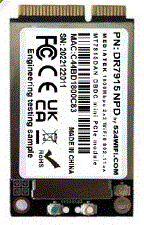
Mediatek DR7915 MT7915
Featured Solutions: Enterprise-Grade WiFi 6 Modules
In the rapidly evolving world of wireless networking, the MT7915 stands out as a powerful and versatile solution for modern connectivity needs. Designed to deliver high performance, reliability, and flexibility, this WiFi 6 chip is ideal for a wide range of applications, from industrial IoT to enterprise networking. In this article, we’ll take a deep dive into the features and benefits of the MT7915, and explore why it’s a top choice for next-gen wireless solutions.
Key Features of the MT7915
1. WiFi 6 Technology
The MT7915 supports 802.11ax (WiFi 6), the latest wireless standard that offers significant improvements over previous generations. With features like OFDMA (Orthogonal Frequency Division Multiple Access) and MU-MIMO (Multi-User Multiple Input Multiple Output), it enables faster speeds, lower latency, and better performance in high-density environments.
2. Dual-Band Support
The MT7915 operates on both 2.4GHz and 5GHz bands, providing flexibility for various networking scenarios. Whether you need broader coverage or higher throughput, this chip delivers optimal performance.
3. High Throughput
With support for 2T2R (2 Transmit, 2 Receive) streams, the MT7915 offers impressive data rates, making it suitable for bandwidth-intensive applications like video streaming, online gaming, and industrial automation.
4. OpenWRT Compatibility
The MT7915 is compatible with OpenWRT, a popular open-source operating system for routers and networking devices. This allows for greater customization and flexibility, enabling developers to tailor the solution to their specific needs.
5. Mini PCIe and M.2 keay A+E or B+M Form Factor
The MT7915 comes in a Mini PCIe or m.2 module, making it easy to integrate into a wide range of devices, from routers and access points to industrial equipment and IoT devices.
6. Industrial-Grade Reliability
Designed for harsh environments, the MT7915 operates reliably in extreme temperatures and conditions, making it ideal for industrial applications.
Benefits of the MT7915
1. Enhanced Performance
The MT7915 delivers faster speeds and lower latency compared to previous-generation WiFi chips, ensuring a seamless user experience even in high-density environments.
2. Cost-Effective Solution
With its high performance and flexibility, the MT7915 offers excellent value for money, making it a cost-effective choice for businesses and developers.
3. Future-Proof Technology
By supporting WiFi 6, the MT7915 ensures that your network is ready for the future, with the ability to handle increasing data demands and new applications.
4. Easy Integration
The Mini PCIe form factor and OpenWRT compatibility make the MT7915 easy to integrate into existing systems, reducing development time and costs.
5. Versatility
From smart homes and offices to industrial IoT and smart cities, the MT7915 is suitable for a wide range of applications, providing reliable connectivity wherever it’s needed.
Applications of the MT7915
1. Industrial IoT
The MT7915’s industrial-grade reliability and high throughput make it ideal for industrial IoT applications, such as factory automation, remote monitoring, and smart logistics.
2. Enterprise Networking
With its support for WiFi 6 and high-density environments, the MT7915 is perfect for enterprise networks, providing fast and reliable connectivity for offices, campuses, and data centers.
3. Smart Homes
The MT7915’s dual-band support and high performance make it a great choice for smart home devices, ensuring seamless connectivity for streaming, gaming, and smart appliances.
4. Public WiFi
The MT7915’s ability to handle high-density environments makes it suitable for public WiFi hotspots, such as airports, malls, and stadiums.
Why Choose Mediatek MT7915 Solution?
At 524WiFi, we offer various MT7915 and MT7916 WiFi 6 / 6E module based on the Mediatek chip, designed to meet the needs of modern wireless networks. Our solution includes:
High-quality hardware: Built for durability and performance.
OpenWRT support: Enabling customization and flexibility.
Expert support: Our team is available to assist with integration and optimization.
The MT7915 is a powerful and versatile WiFi 6 chip that offers high performance, reliability, and flexibility for a wide range of applications. Whether you’re building an industrial IoT system, an enterprise network, or a smart home solution, the MT7915 is a future-proof choice that delivers exceptional value.
In today’s fast-paced digital landscape, the demand for robust and efficient wireless connectivity has never been greater. Mediatek’s cutting-edge Wi-Fi 6, Wi-Fi 6E, and Wi-Fi 7 modules are designed to meet these demands, providing seamless integration with various AI Linux PCs, including popular distributions like Debian, Ubuntu, Fedora, and more. These modules are set to revolutionize how users experience connectivity across multiple platforms.
Key Features of 524WiFi MIDIATEK’s Wi-Fi Modules
Wi-Fi 6 (802.11ax): This standard introduces significant improvements in speed, capacity, and efficiency. With features like Orthogonal Frequency Division Multiple Access (OFDMA) and Multi-User Multiple Input Multiple Output (MU-MIMO), Wi-Fi 6 can handle multiple devices simultaneously without compromising performance. This is particularly beneficial in environments with high device density, such as offices or public spaces.
Wi-Fi 6E: Expanding on the capabilities of Wi-Fi 6, Wi-Fi 6E operates in the newly available 6 GHz band. This additional spectrum allows for more channels, reducing congestion and enabling higher data rates for bandwidth-intensive applications like streaming and gaming. The increased capacity ensures that users can enjoy uninterrupted connectivity even in crowded environments.
Wi-Fi 7 (802.11be): As the latest advancement in wireless technology, Wi-Fi 7 promises even faster speeds and lower latency through features like 320 MHz channels and enhanced MU-MIMO capabilities. This will be a game-changer for applications requiring real-time data transmission, such as augmented reality (AR) and virtual reality (VR).
Compliance and Certifications
524WiFi’s commitment to quality and safety is underscored by its extensive certifications. Most of their modules have passed rigorous testing and obtained certifications from recognized international bodies, including:
FCC (Federal Communications Commission): Ensuring compliance with U.S. regulations for electronic devices.
CE (Conformité Européenne): Certifying that products meet European health, safety, and environmental protection standards.
IC (Industry Canada): Meeting Canadian regulatory requirements for communication devices.
RCM (Regulatory Compliance Mark): Compliance with Australian electrical safety standards.
NCC (National Communications Commission): Adhering to Taiwanese communication regulations.
These certifications emphasize the performance and reliability of 524WiFi’s products while demonstrating their dedication to creating a seamlessly connected IoT landscape.
Compatibility with Linux Distributions
Mediatek’s Wi-Fi modules are designed with compatibility in mind, ensuring that they work seamlessly across various Linux distributions:
Debian/Ubuntu: Users can easily install drivers through package managers or compile from source if necessary.
Fedora/CentOS: The modules support the latest kernels available in these distributions, providing out-of-the-box functionality for most users.
Arch Linux/OpenSUSE/Manjaro: These distributions often have up-to-date kernel support, allowing users to take advantage of the latest features offered by Mediatek’s modules.
Red Hat Enterprise Linux/Oracle/Linux Mint/Gentoo/Slackware: These distributions may require additional configuration but are fully capable of supporting Mediatek’s Wi-Fi technology with the right drivers.
Enhanced Performance for AI Applications
The integration of Mediatek’s Wi-Fi modules into AI-driven Linux PCs enhances performance significantly. The high throughput and low latency provided by these technologies enable faster data processing and improved communication between devices. This is crucial for applications such as machine learning models that require large datasets to be transmitted quickly and efficiently.Moreover, the power efficiency of Wi-Fi 6 and beyond means that devices can maintain longer operational times without frequent recharging or energy consumption concerns. This is particularly important for IoT devices that rely on continuous connectivity.
Conclusion
Mediatek’s Wi-Fi 6, 6E, and 7 modules represent a significant leap forward in wireless technology. Their compatibility with a wide range of Linux distributions makes them an ideal choice for users looking to enhance their AI Linux PC experience. With faster speeds, increased capacity, improved efficiency, and compliance with international standards, these modules are poised to transform how we connect in an increasingly digital world. Embrace the future of connectivity with 524WiFi’s innovative solutions today!
DBDC Cards: A Solution for High-Density, High-Interference, and High-Bandwidth Network Environments
In today’s network landscape, the rapid increase in connected devices has introduced unprecedented challenges for stable and high-speed connectivity. In environments with high device density, strong signal interference, and high bandwidth requirements, traditional single-band networks often fall short of meeting users’ demands. Enter the Dual-Band Dual-Concurrent (DBDC) card, a breakthrough solution that redefines network performance. This article delves into the advantages of DBDC cards in tackling these network challenges, along with some recommended DBDC products from 524WiFi.
Key Advantages of DBDC Cards
1. Dual-Band Concurrency to Distribute Network Load
DBDC cards’ primary feature is their ability to operate simultaneously on both 2.4GHz and 5GHz bands. This dual-band functionality effectively expands total bandwidth, allowing devices to spread across two frequency bands, reducing congestion on a single channel. In high-density environments, DBDC cards enable devices to efficiently locate open channels, significantly decreasing signal interference and delays.
2. Interference Reduction for Stable Connections
In interference-heavy environments, such as public venues or industrial zones, DBDC cards’ dual-band capability is essential. The 5GHz band, which is typically less congested, is allocated for high-bandwidth, high-stability tasks, while the 2.4GHz band is reserved for low-bandwidth, non-time-sensitive tasks. This smart frequency allocation minimizes interference, ensuring stable connections for critical devices.
3. High Throughput for Future Bandwidth Needs
With increased demands for bandwidth due to high-resolution video, VR/AR applications, and cloud computing, DBDC cards provide substantial throughput improvements. Dual-band usage enables faster data transfers, reducing latency and supporting high-bandwidth applications, making DBDC cards ideal for bandwidth-heavy environments.
4. Enhanced Network Reliability
DBDC cards offer a dual-frequency safety net for devices, maintaining connection stability even if one band experiences interference or connection issues. This built-in redundancy is crucial for industries that rely on uninterrupted data transmission, providing higher levels of reliability across connected devices.
DBDC Card Applications Across Industries
1. Enterprise Environments
In office settings, DBDC cards improve network efficiency by managing multiple users and devices on separate bands. Enterprises that depend on video conferencing, data sharing, and collaborative work benefit from DBDC cards’ stability, optimizing productivity through smoother network performance.
2. Industrial IoT (IIoT)
DBDC cards are ideal for Industrial IoT applications, where a network of sensors, monitoring systems, and data collectors are continuously connected. Their high stability and resistance to interference enable DBDC cards to support IIoT environments with real-time data transmission, enhancing industrial device performance.
3. Public Venues and Smart Cities
In high-density public areas like airports and sports arenas or within smart city networks, countless IoT devices are connected simultaneously. DBDC cards’ dual-band functionality effectively reduces channel congestion and enhances connectivity between devices. In addition, DBDC-enabled devices in public networks can substantially improve user experience with smoother connections.
Recommended DBDC Products from 524WiFi
524WiFi offers a range of high-performance DBDC modules. Here are a few standout DBDC card options:
MediaTek MT 7915 / 7916
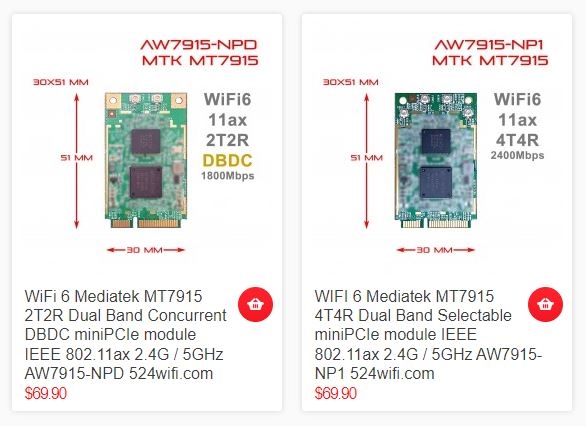
Overview: Powered by MediaTek’s MT7915 or 7916 chip, this WiFi 6 / 6E DBDC card supports 2T2R and is compatible with OpenWRT.
Highlights: Supports 802.11AX standard and features a MiniPCIe interface, making it suitable for enterprise and industrial IoT applications.
DBDC cards offer an innovative approach to networking in high-density, high-interference, and high-bandwidth environments. By leveraging dual-band concurrent operation, DBDC cards effectively address pain points like channel congestion, signal interference, and bandwidth bottlenecks, improving network reliability and stability. 524WiFi’ DBDC products, with their robust performance and reliable design, are paving the way for enterprises and industrial users to meet the future of networking with confidence.
Empowering Customization and Connectivity: The IPQ4019-Based Industrial Board
In the realm of industrial connectivity, adaptability reigns supreme. Introducing the IPQ4019-based industrial board, a versatile solution engineered to offer unparalleled customization and connectivity options. Let’s explore its key features:
Tailored Dual LTE Support
– This board supports customizable configurations for dual LTE support, allowing for routerboard/baseboard+SOM setups tailored to specific requirements. Whether it’s optimizing bandwidth or ensuring redundancy, users can fine-tune their connectivity solutions with ease.
Efficient Network Segmentation via VLANs
– Recognizing the importance of network segmentation, this board seamlessly integrates VLAN support. Users can create distinct virtual networks within a single physical infrastructure, enhancing security and efficiency.
Customized LUCI Interface
– Elevate brand identity and user experience with a customized LUCI interface featuring the customer’s logo. This personalized touch adds a professional flair while maintaining familiarity for end-users.
Extended Range Firmware Customization
– Break through geographical barriers with custom firmware designed for long-distance transmission, reaching up to 20km. Whether it’s remote installations or expansive deployments, rest assured that firmware updates will reach even the most remote endpoints.
Seamless Integration with Leading Controllers
– Integrate effortlessly into existing network architectures with support for Wallys AP Controller and TIP Cloud Controller. Benefit from centralized management, configuration, and monitoring capabilities, enhancing operational efficiency and scalability.
Conclusion: Unmatched Flexibility for Industrial Connectivity
In conclusion, the IPQ4019-based industrial board stands as a beacon of innovation and adaptability in industrial connectivity. With its support for customizable LTE configurations, VLANs, branded interfaces, long-distance firmware transmission, and integration with leading management controllers, this board offers unparalleled flexibility and connectivity options. Whether optimizing performance, enhancing security, or streamlining operations, this versatile solution is poised to revolutionize industrial connectivity challenges.
DR4019
Featuring with industrial-grade IPQ4019/IPQ4029 chipset
Integrated with 2x 2 5G high power Radio module and 2×2 2.4G high power Radio module
Support 4.940GHz to 5.825GHz Frequency Range
Support 2.400GHz to 2.482GHz
Support 2 x 5G MMCX Connectors and 2×2.4G MMCX
Support 5MHz/10MHz/20MHz/40MHz/80MHz Bandwidth
Support 11ABGN/AC
Support fixed data rate
RoHS compliance ensure a high level protection of human health and the environment from risks that can be posed by chemicals
Empowering Customization and Connectivity: The IPQ4019-Based Industrial Board
In the realm of industrial connectivity, adaptability reigns supreme. Introducing the IPQ4019-based industrial board, a versatile solution engineered to offer unparalleled customization and connectivity options. Let’s explore its key features:
Tailored Dual LTE Support
– This board supports customizable configurations for dual LTE support, allowing for routerboard/baseboard+SOM setups tailored to specific requirements. Whether it’s optimizing bandwidth or ensuring redundancy, users can fine-tune their connectivity solutions with ease.
Efficient Network Segmentation via VLANs
– Recognizing the importance of network segmentation, this board seamlessly integrates VLAN support. Users can create distinct virtual networks within a single physical infrastructure, enhancing security and efficiency.
Customized LUCI Interface
– Elevate brand identity and user experience with a customized LUCI interface featuring the customer’s logo. This personalized touch adds a professional flair while maintaining familiarity for end-users.
Extended Range Firmware Customization
– Break through geographical barriers with custom firmware designed for long-distance transmission, reaching up to 20km. Whether it’s remote installations or expansive deployments, rest assured that firmware updates will reach even the most remote endpoints.
Seamless Integration with Leading Controllers
– Integrate effortlessly into existing network architectures with support for Wallys AP Controller and TIP Cloud Controller. Benefit from centralized management, configuration, and monitoring capabilities, enhancing operational efficiency and scalability.
Conclusion: Unmatched Flexibility for Industrial Connectivity
In conclusion, the IPQ4019-based industrial board stands as a beacon of innovation and adaptability in industrial connectivity. With its support for customizable LTE configurations, VLANs, branded interfaces, long-distance firmware transmission, and integration with leading management controllers, this board offers unparalleled flexibility and connectivity options. Whether optimizing performance, enhancing security, or streamlining operations, this versatile solution is poised to revolutionize industrial connectivity challenges.
DR4019 / DR4029
Featuring with industrial-grade IPQ4019/IPQ4029 chipset
Integrated with 2x 2 5G high power Radio module and 2×2 2.4G high power Radio module
Support 4.940GHz to 5.825GHz Frequency Range
Support 2.400GHz to 2.482GHz
Support 2 x 5G MMCX Connectors and 2×2.4G MMCX
Support 5MHz/10MHz/20MHz/40MHz/80MHz Bandwidth
Support 11ABGN/AC
Support fixed data rate
RoHS compliance ensure a high level protection of human health and the environment from risks that can be posed by chemicals
Title: A Comparative Analysis of QCA9882, QCA9880, and MT7915 WiFi Cards for OpenWrt
In the realm of OpenWrt-compatible WiFi cards, selecting the right one can significantly impact your network’s performance and reliability. Among the options available, the QCA9882, QCA9880, and MT7915 stand out as popular choices. In this article, we will delve into the differences between these WiFi cards to help you make an informed decision.
**QCA9882**
The QCA9882 WiFi card boasts a robust chipset designed to deliver exceptional performance. It supports various wireless standards, including WiFi 5 (802.11ac), ensuring compatibility with modern networks. Performance metrics such as throughput and range are commendable, making it suitable for demanding applications. QCA9882 is known for its seamless integration with OpenWrt, offering extensive configuration options and stability. While pricing may vary, it generally falls within a reasonable range, providing value for money.
**QCA9880**
Similar to the QCA9882, the QCA9880 WiFi card features a reliable chipset optimized for high-performance networking. It also supports WiFi 5 standards, guaranteeing compatibility with modern networks. Performance metrics are commendable, although specific benchmarks may vary. QCA9880 is well-supported by OpenWrt, offering users a plethora of configuration options and stability. Pricing for the QCA9880 is competitive, making it an attractive choice for budget-conscious consumers seeking reliable performance.
**MT7915**
The MT7915 WiFi card is another contender in the OpenWrt ecosystem, boasting a chipset designed to deliver robust performance. It supports WiFi 6 (802.11ax) standards, offering enhanced throughput and efficiency compared to its predecessors. Performance metrics such as throughput and latency are impressive, catering to demanding networking requirements. While OpenWrt compatibility may vary, efforts are underway to ensure seamless integration with the platform. Pricing for the MT7915 tends to be higher compared to WiFi 5 alternatives, reflecting its advanced features and capabilities.
**Comparative Analysis**
When comparing these WiFi cards, several factors come into play. Performance-wise, the MT7915 holds an edge with its support for WiFi 6 standards, offering superior throughput and efficiency. However, both the QCA9882 and QCA9880 remain competitive choices, especially for users with WiFi 5 networks. In terms of OpenWrt compatibility, all three options offer varying degrees of support, with QCA9882 and QCA9880 being more established within the community.
**Conclusion**
In conclusion, the choice between the QCA9882, QCA9880, and MT7915 WiFi cards depends on your specific requirements and budget constraints. If you prioritize cutting-edge performance and have the budget for it, the MT7915 is an excellent option. However, for users seeking reliable performance at a more affordable price point, both the QCA9882 and QCA9880 are viable alternatives. Regardless of your choice, each WiFi card offers unique features and capabilities that can enhance your OpenWrt experience.
524WiFi Modules and Platform
524WiFi Dream882 (QCA9882): – high power
Chipset: Atheros QCA9882
2×2 5G high-power radio card
Frequency range: 4.940GHz to 5.825GHz
2x 5G MMCX connectors
Bandwidth: 20MHz/40MHz/80MHz
Supports 802.11ac/an standards
RoHS compliant
524WiFi 900VX Pro+
Chipset: Qualcomm-Atheros QCA9880
Output power: 2.4GHz max 26dBm, 5GHz max 25dBm
IEEE 802.11a/b/g/n/ac compliant and backward compatible
3×3 MIMO technology, up to 1.3Gbps
Mini PCI Express edge connector
RoHS compliant
Supports various technologies and IEEE standards (e.g., spatial multiplexing, LDPC codes, MRC, STBC, DFS)
FCC, CE, and IC certification
524WiFi 600VX Pro+
Chipset: Qualcomm-Atheros QCA9880
Output power: 2.4GHz max 24dBm, 5GHz max 23dBm
IEEE 802.11a/b/g/n compliant and backward compatible
2×2 MIMO technology, up to 867Mbps
Mini PCI Express edge connector
Frequency support: 4920MHz~5825MHz
RoHS compliant
Supports various technologies and IEEE standards (e.g., spatial multiplexing, LDPC codes, MRC, STBC, DFS)
FCC, CE certification
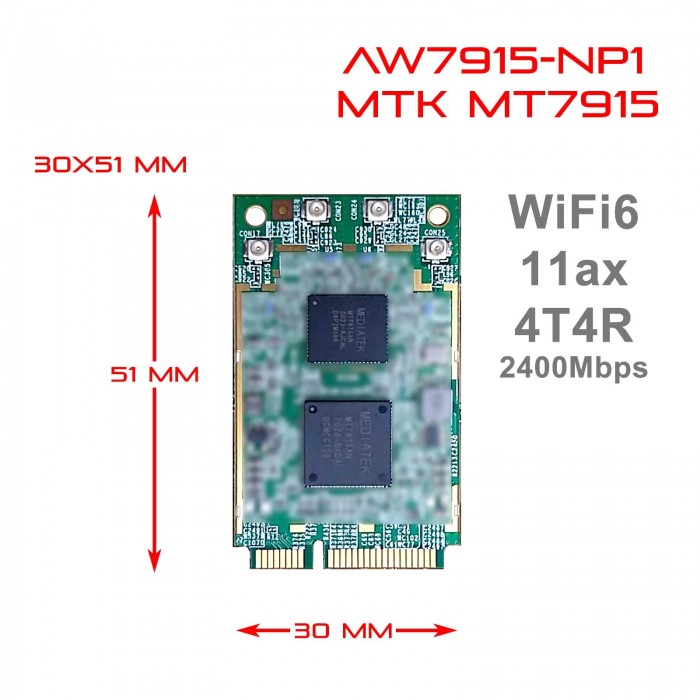
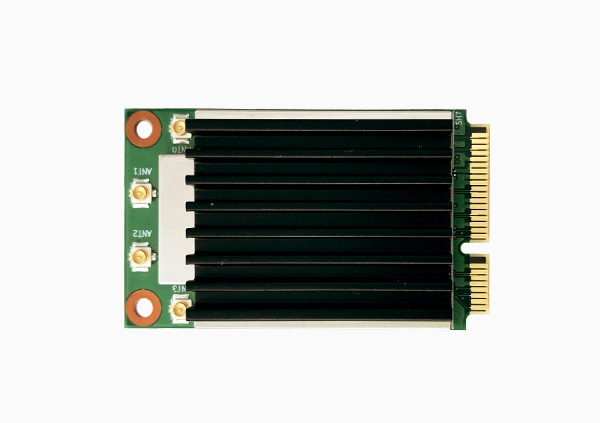
524WiFi 6 DR7915 – NPD DBDC
Chipset: MT7915+MT7975
Host Interface: Mini PCI Express 2.1
Antenna Connector: 2 x UF.L
Frequency Range: 2.4GHz: 2.412GHz to 2.472GHz, 5GHz: 5.180GHz to 5.825GHz
4×4 MU-MIMO WIFI 6 MODULE FOR THE 5GHZ BAND, MINI PCIE MODULE, QUALCOMM ATHEROS QCN9074, 4T4R
The first WiFi-6 (802.11ax) Qualcomm based AP solution on module formfactor from SparkLAN. WPEQ-405AX, is based on QCN9074 chipset solution. This is a true enterprise based wireless module that powers 4T4R (4×4) MU-MIMO, in 5Ghz Single band mode, hitting a theoretical speed of up to 4.8Gbps with 160MHz support.
Unlike typical Qualcomm reference design around QCN9074 (PN02.1), WPEQ-405AX shrink the traditional 50mmx50mm M.2 E-Key design to a more popular Mini PCIe Full size formfactor of just 50mm x 30mm, run at 3.3V voltage. Provides a greater versatility to use on more common seen design.
WPEQ-405AX performs both AP and STA functionality with 4 spatial streams, although recommended more for hardware AP applications as it supports 4096-QAM, OFDMA technology, makes it perfect for heavy lifting applications such as Enterprise grade AP, UTM, public & transportation Hotspot, and other industrial capable Access Points.
Wallys DR9074 5G , 6E dual band and Triband modules and available for order ! And special promo price for partners with MOQ100pcs is USD 80 per module only ! Nokia, facebook and many more already started to use this card to develop own WiFi 6 / WiFi 6E devices!
– HOW WE MAKE QCA QCN9074 WLAN WIFI 6 MODULE DR9074 4X4 WORK ON X86 LINUX PLATFORM – PLEASE READ HERE.
Pine Series WiFi Module from Wallys:Introducing Qualcomm’s 4×4 11ax AP mode enabled radio module! Based on Pine series QCN 9074 / 9024 chipset, radio modules supporting 2.4GHz, 5GHz as well as the lately approved WiFi 6E is now available from Wallys ! Hop on the newly approved spectrum, increase the number of channels your clients can hop on, at 160MHz bandwidth!
QCN9074 VS QCN9024 | WIFI6E IOT 4X4 TRIBAND 2.4G 5G 6G NETWORK CARD AND APPLICATION
WHAT ARE THE APPLICATIONS OF AN INDUSTRIAL TRI-BAND NETWORK CARD SUPPORTING 2.4GHZ, 5GHZ, AND 6GHZ?
Imagine the boundless possibilities that come with an industrial Tri-Band network card, seamlessly embracing the 2.4GHz, 5GHz, and lightning-fast 6GHz frequency bands. Here’s a glimpse into the exciting realms of its potential applications:
1. Smart Manufacturing & IoT Revolution: In the heart of smart manufacturing, these Tri-Band cards orchestrate a symphony of devices. From factory robots to floor sensors, they unite the Internet of Things (IoT) to make real-time data analytics and intelligent production a reality.
2. Robotic Precision & Automation: When it comes to industrial robots and automated machinery, precision and speed are paramount. Tri-Band network cards deliver high-speed data transfers and unwavering connections, ensuring uninterrupted automation.
3. Surveillance with Clarity: Industrial sites demand top-tier security. Tri-Band cards support high-definition video streams, fortifying security systems. They extend the eyes and ears of surveillance networks, enhancing vigilance.
4. Scientific Excellence: In the world of scientific research and high-performance computing, these network cards are the lifeline. They enable lightning-fast data transfer, facilitating experiments, simulations, and data analysis at astonishing speeds.
5. Connecting the Unreachable: When it’s about connecting distant devices in remote locations, Tri-Band cards are the bridge. They make remote monitoring, diagnostics, and maintenance a breeze, minimizing downtime.
6. Agriculture & Environmental Guardians: In the fields of agriculture and environmental monitoring, they enable large-scale sensor networks. These networks collect invaluable data for better decision-making, crop management, and environmental preservation.
7. Aerospace & Beyond: Think of satellite communications and aerospace ventures. Tri-Band cards empower high-speed data exchanges between spacecraft, satellites, and ground stations, venturing into the far reaches of the cosmos.
With the 6GHz band, an integral part of the WiFi 6E, industrial Tri-Band network cards offer an abundance of spectrum resources. They cater to the insatiable appetites of high bandwidth and low latency. The future of industrial connectivity shines brighter than ever before!
Both the QCN9074 and QCN9024 are Qualcomm chips, and Wallys has chosen this platform for the development of Tri-Band card due to its exceptional stability and superior performance.
Let me share the fascinating story of its inception. Before the advent of the remarkable DR9074 Tri-Band Network card, Wallys had already pioneered single-band network cards like the DR9074-2.4G, DR9074-5G, and DR9074-6E, each earning a reputation for top-notch performance.
Then came an intriguing request from one of our valued customers: ‘The DR9074-5G and DR9074-6E deliver exceptional performance; do you have plans for a Tri-Band version of this card?’ As an innovation-centric company, this question ignited a spark among our engineers.
Fuelled by passion and driven by the pursuit of excellence, our engineers toiled day and night. And voilà, Wallys proudly presents the DR9074 Tri-Band Network card, a testament to our commitment to innovation and customer satisfaction.
Now, let’s dive into the exciting features of this groundbreaking card!
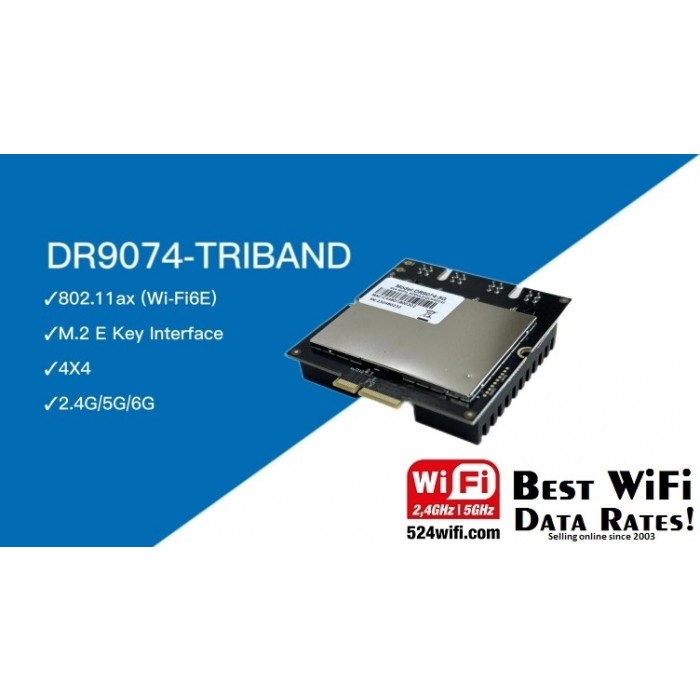
DR9074-TRIBAND
■ Qualcomm Atheros QCN9024
■ Maxim 23 dBm per chain,up to 4949Mbps
■ Data Rateup to 4949Mbps
■ Support Tri Band 2.4GHz&5GHz&6GHz 4×4 WiFi 6E (802.11ax)
■ 4 spatial streams (4SS)
■ M.2 E Key Interface
■ PCI Express 3 .0 Interface
Symbol/Parameter
Chipset:Qualcomm Atheros QCN9024
WLAN Host Interface:PCI Express 3.0 Interface
System Memory:2Mbit serial I²C bus EEPROM
Standard Operating Voltage:5V
Operating Systems:QSDK
Host Interface:M.2 E Key
Antenna Cable / Port:4 x MMCX Connectors,4T4R
Frequency Range:2.412GHz-2.472GHz & 5.18GHz-5.825GHz & 5.925GHz-7.125GHz
Data Rates for WALN:Maxim 23dBm per chain, up to 4949Mbps
Channel Spectrum Widths for WLAN:Support 20/40/80/160MHz
– NEW 11AX BOARDS BASED ON QUALCOMM WITH MU-MIMO 802.11AX WIFI 6 RADIO ON BOARD! NOW WE SUPPORT 4G / 5G LTE GSM MODEMS!
– FOR WIFI 6 WE HAVE DEVELOPED THE LONG DISTANCE FUNCTION, IN FRANCE OUR CUSTOMER CAN RUN 10KM LINK! THIS FUNCTION NEED MODIFY THE CORE OF WIFI PROTOCOL. WE JUST FIND ONLY 524WIFI.COM WALLYS DR6018 QCA IPQ6018 BOARDS GET THE WIFI6 RUN ON 3-10KM DISTANCE!
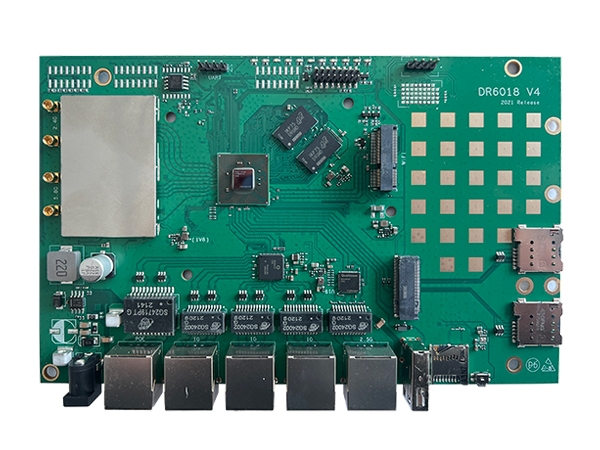
Quad-core ARM 64bit [email protected] Processor 1GB DDRL3L System Memory 8MB NOR Flash, 256MB NAND Flash Supports Dynamic Frequency Selection (DFS 2x2On-board2.4GHz radio,upto 573Mbps physical Data Rate 2x2On-board 5GHz radio,upto 1201Mbps physical Data Rate
Support: QCN9074 WiFi 6E Card in M.2 slot
Product Description
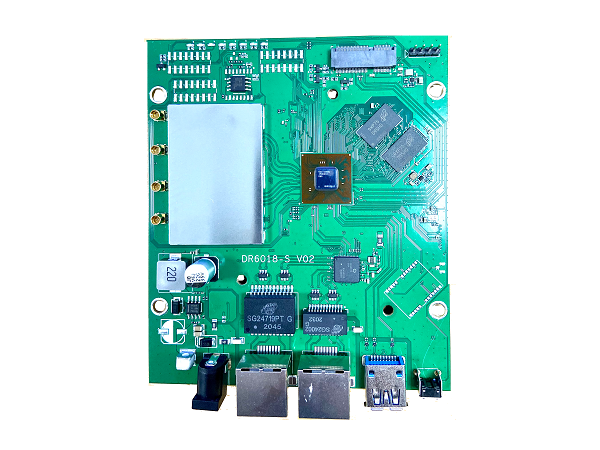
DR6018-S based on IPQ6010 chipset is an enterprise wireless module integrated with 2×2 5G high power Radio module and 2×2 2.4G high power Radio module designed specifically to provide users with mobile access to high-bandwidth video streaming, voice, and data transmission for office and challenging RF environment in factories, warehouses establishment. Passive POE 24-48V supported, DC jack 24-48V. If you need 802.3af/bt active POE support , then please order DR6018-S HV version.
– FOR WIFI 6 WE HAVE DEVELOPED THE LONG DISTANCE FUNCTION, IN FRANCE OUR CUSTOMER CAN RUN 10KM LINK! THIS FUNCTION NEED MODIFY THE CORE OF WIFI PROTOCOL. WE JUST FIND ONLY 524WIFI.COM WALLYS DR6018 QCA IPQ6018 BOARDS GET THE WIFI6 RUN ON 3-10KM DISTANCE!
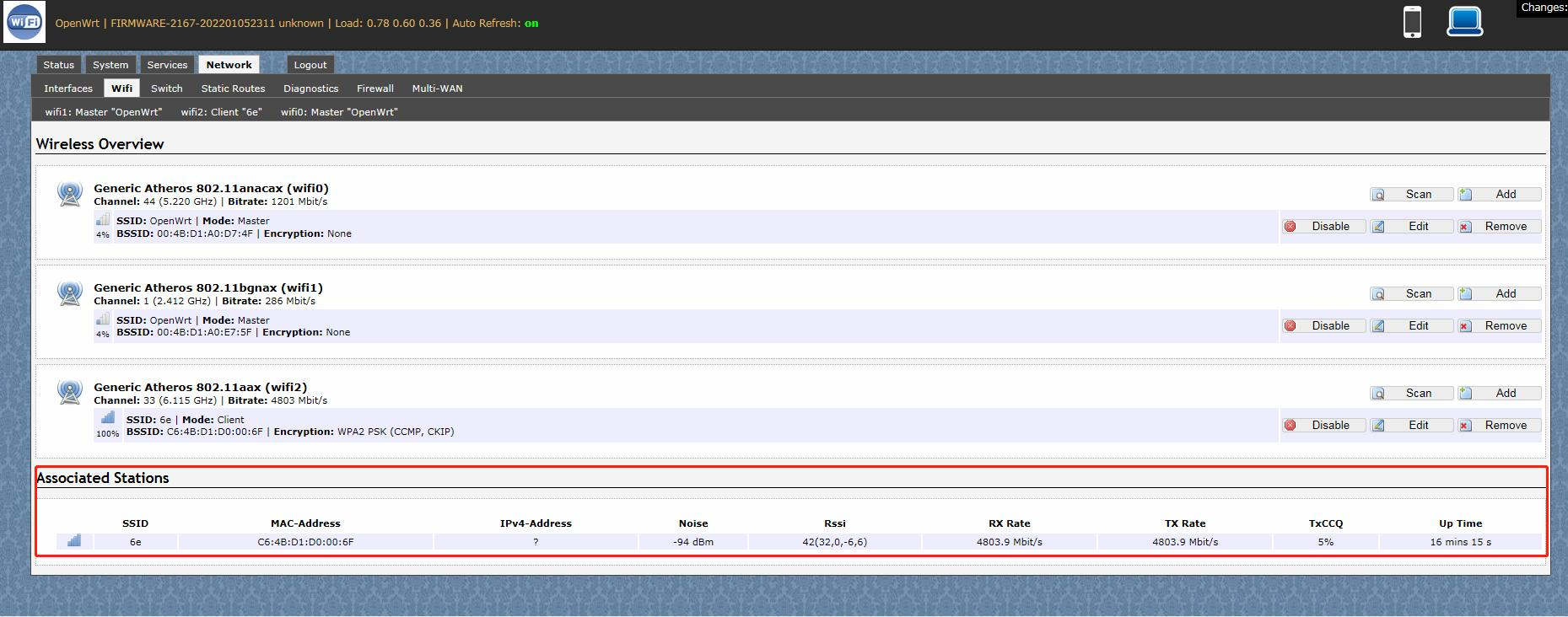
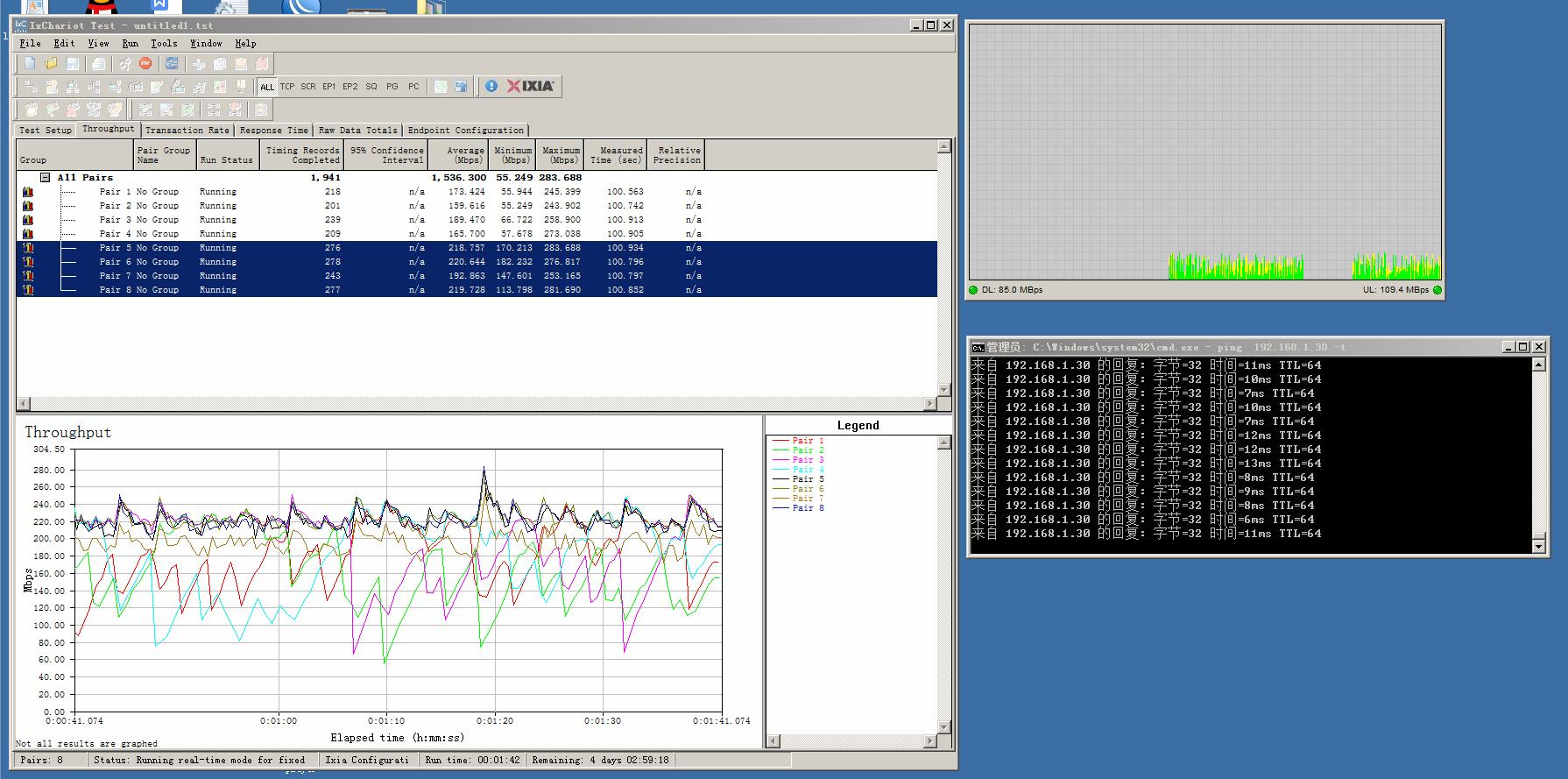
QCN9074-6E WITH DR6018 PLATFORM: ACHIEVING 1.5GBPS SPEED IN THROUGHPUT TEST!
QCN9074-6E THROUGHPUT TEST REPORT IN DR6018
Are you curious about the performance capabilities of the QCN9074-6E network card in the DR6018?
Look no further! In this blog, we’ll walk you through the hardware you’ll need, how to set up one board as an Access Point (AP) and the other as a Station (STA), and perform a throughput test. Plus, we’ll share our exciting conclusions.
HARDWARE REQUIRED:
DR6018 x2
DR9074-6E x2
SETTING UP THE TEST:
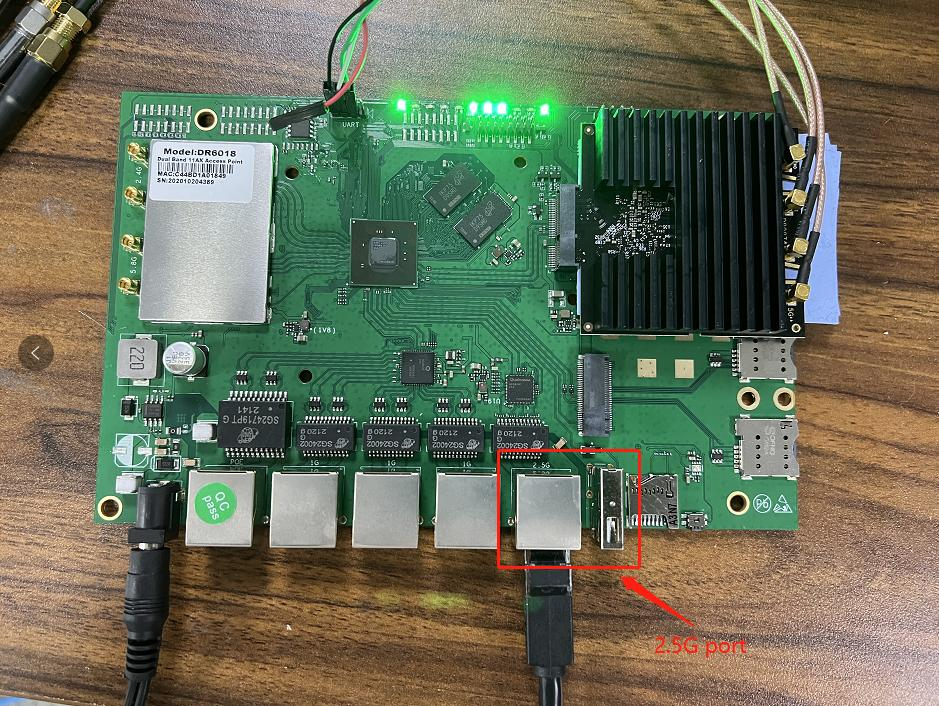
Board Configuration: Install two DR6018 boards and two DR9074-6E network cards.
Role Assignment: Set one DR9074-6E card as the Access Point (AP) and the other as the Station (STA).
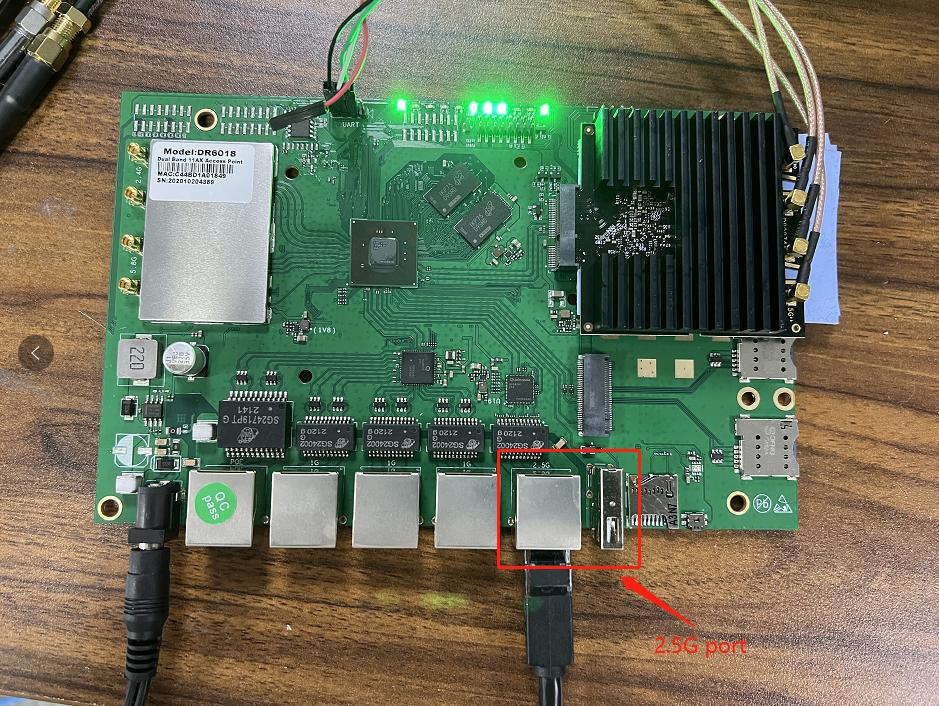
Network Connection: Utilize the onboard 2.5G Ethernet port for connectivity.
PERFORMING THE THROUGHPUT TEST:
Once the radios are linked, it’s time to assess the performance:
CONCLUSION:
The results are nothing short of impressive. On average, the QCN9074-6E network card in the DR6018 achieves a remarkable speed of up to 1500 Mbps. This speed can be even faster in better environments or when used with the IPQ8072/8074 platform.
In summary, the QCN9074-6E in the DR6018 proves to be a high-performance choice for wireless connectivity. These results showcase the potential of our products, and we’re thrilled to provide you with reliable and speedy wireless solutions.
IPQ6010 AND IPQ8072:OFDMA SUPPORT IN WIFI6 SOLUTION
Introduction:
In the dynamic landscape of wireless communication, the techniques employed play a crucial role in optimizing data transmission and overcoming challenges. Two key technologies, FDMA (Frequency Division Multiple Access) and OFDMA (Orthogonal Frequency Division Multiple Access), are pivotal in this context. This blog aims to unravel the disparities between FDMA and OFDMA, shedding light on their applications and significance in mitigating multipath interference, particularly in the realm of Wi-Fi.
The Need for Multiple Carrier Technologies:
To comprehend the essence of OFDMA, it’s imperative to first delve into the concept of OFDM (Orthogonal Frequency Division Multiplexing). OFDM is a multicarrier modulation technique designed to combat multipath interference encountered in wireless communication. Multipath interference occurs when radio waves encounter obstacles, causing reflections and refractions. This phenomenon results in multiple versions of the same signal reaching the receiver, leading to what is known as multipath interference.
The Challenge of Inter-Symbol Interference:
Multipath interference directly contributes to intersymbol interference (ISI). In the realm of wireless communication, ISI poses a challenge where, for a given set of serial signals, the receiver encounters difficulty distinguishing between them. This challenge arises when the time delay between two identical signals is less than the signal’s transmission interval. The outcome is known as inter-symbol interference, making it arduous for the receiver to accurately decipher the intended signals.
OFDM as a Solution:
OFDM addresses this issue by transforming high-speed serial data into parallel low-speed data streams, thereby reducing inter-symbol interference. However, OFDM comes with its own set of drawbacks. In Wi-Fi 4/5, where communication is single-user-centric, each data transmission occupies all available subcarriers. This results in inefficiencies when small data packets, such as instant messages or web browsing, are transmitted, as the entire bandwidth is underutilized.
Introduction of OFDMA:
In response to this inefficiency, Wi-Fi 6 introduced OFDMA, borrowing a page from 5G’s playbook. OFDMA, despite its name’s resemblance to OFDM, is fundamentally a multiple access technique. Multiple access techniques distinguish different users, and common methods include FDMA, TDMA, and CDMA.
FDMA vs. OFDMA:
FDMA relies on allocating different frequency channels to different users. In the analogy of a gathering, it’s akin to separating rooms for distinct conversations. On the other hand, OFDMA divides the channel into Resource Units (RUs), each orthogonal to the others. In our gathering analogy, OFDMA creates individual compartments within a room, facilitating multiple conversations simultaneously.
Enhancing Efficiency with OFDMA:
OFDMA optimizes spectral efficiency by scheduling users in specific resource units instead of utilizing the entire channel for a single user, as seen in traditional OFDM. It introduces a more flexible approach, akin to efficiently utilizing a delivery vehicle by allocating designated compartments for different recipients.
Conclusion:
In summary, while OFDM successfully addresses multipath interference by transforming data streams, OFDMA takes a step further by introducing an innovative multiple access technique. By adopting OFDMA, Wi-Fi 6 has elevated efficiency in point-to-multipoint communication, ensuring that a single cycle completes communication with multiple users. This evolution underscores the dynamic nature of wireless communication technologies, continually adapting to enhance performance and meet the demands of evolving applications.
Here are some of 524WiFi 802.11ax products support OFDMA:
Support Tri Band 2.4GHz&5GHz&6GHz 4×4 WiFi 6E (802.11ax)
4 spatial streams (4SS)
M.2 E Key Interface
PCI Express 3 .0 Interface
524WiFi is dedicated to continuous innovation, constantly pushing the boundaries of WiFi technology. In addition to its hardware products, 524WiFi + Wallys also offer a range of ODM/OEM services, including:
Customization: 524WiFi and Wallys can customize their WiFi 5/6/7 modules and embedded boards to meet the specific needs of its customers.
524WIFI 6 MT7915 WITH IPQ4019/IPQ4029 5G RADIO ACHIEVE 843 MBPS THROUGHPUT | DBDC NETWORK CARD
The throughput of a network card refers to the data transfer rate or the amount of data that the network card can handle in a specific period. It is usually measured in bits per second (bps) or its multiples like kilobits per second (Kbps), megabits per second (Mbps), or gigabits per second (Gbps).
The throughput of a network card is influenced by various factors, including the hardware capabilities of the card, the quality of the network cables, the network environment, and the protocols being used. Different network card models may have varying throughputs based on their design and capabilities.
Modern network cards, especially those designed for high-speed networks like Gigabit Ethernet (1000 Mbps) or even faster, can handle data transfers at very high rates. The throughput of a network card is an important consideration in network performance, as it directly impacts the data transmission speed and overall efficiency of the network.
It’s worth noting that the actual throughput experienced in a network may be lower than the maximum throughput of the network card due to factors like network congestion, latency, and other network bottlenecks. Network administrators often perform tests and optimizations to achieve the best possible throughput in their specific network setups.
Dual band antenna SENCITY® Omni-SR is installed in the front of the bus and above rear door
Used HW platform
Intel i5-6442EQ, 1.9/2.7GHz, 8GB or 16 GB RAM
Intel i7-6822EQ, 2.0/2.8 GHz, 8GB or 16 GB RAM
Intel I5-4300U, Dual core 1.9Ghz, 8GB RAM
Intel Celeron J1900 Quad-Core 2 Ghz, 8GB RAM
Used Linux distribution:
Debian (bullseye-backports) linux-image-amd64, verze 5.15.0-0.bpo.2-amd64, that corresponds to vanilla kernel 5.15.5.
Latest Kernel version also work well – tested for new installation Please take note – there is no module firmware inside of the module. You need to compile the driver again after your Linux kernel update!
We have also concluded the tests using the ARM based board and were able to get around 800 Mbit/s with an MCS between 10 and 11 (1020.8 to 1134.3 Mbit/s). This board runs Ubuntu 20.04.4 LTS with a compiled kernel.
You can also use OpenWRT, these modules are supported in OpenWRT version 21 and newer – In OPENWRT you need to set up read RF parameters from eFuse. Kindly be noted.
OpenWRT drivers – GITHUB – https://github.com/openwrt/mt76/tree/master/mt7915 (for MT7916 modules you can use same driver)
WA Firmware Version: DEV_000000, Build Time: 20201105222323
(Posted on 1/20/2022 – Latest Kernel version also work well – tested for new installation)
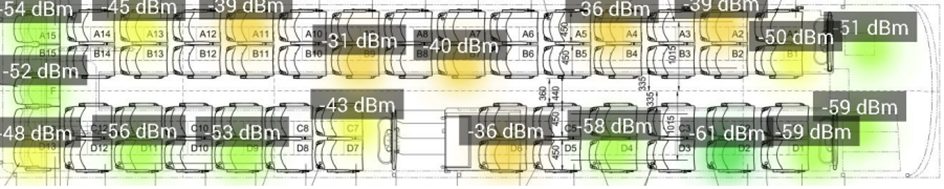
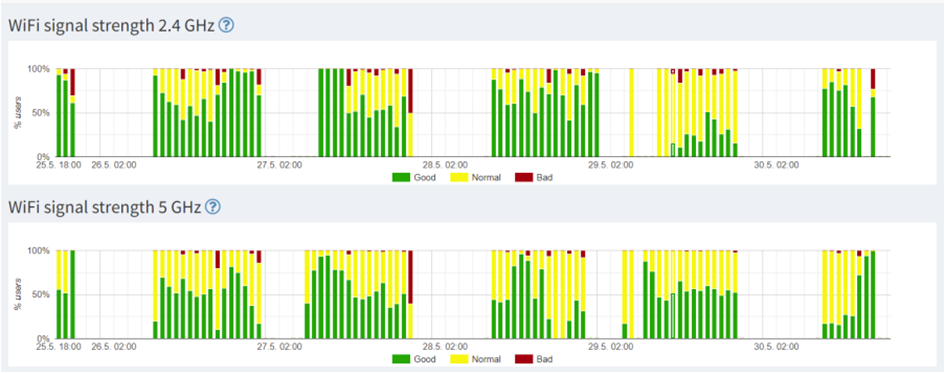
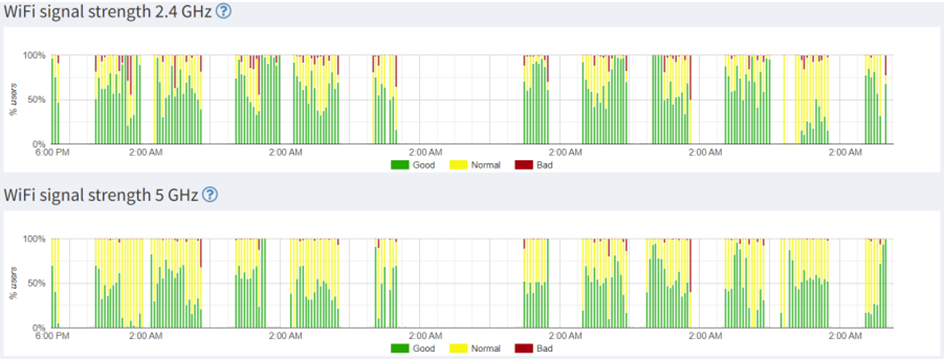
MEASURING THE SIGNAL STRENGTH IN THE BUS
2.4 GHz antenna Huber & Suhner in the middle of the bus + 524wifi.com-AW7915-NPD
5 GHz antenna Huber & Suhner in the middle of the bus + 524wifi.com-AW7915-NPD
2.4 GHz antenna Antonics in the front of the bus + 524wifi.com-AW7915-NPD
5 GHz antenna Antonics in the front of the bus + 524wifi.com-AW7915-NPD
CONCLUSIONS FROM THE TESTING:
The test operations verified that the 524wifi.com-AW7915-NPD DBDC modules are usable in real situations and they are a full-fledged replacement for 2 Compex WLE900VX modules. The module was normally connected to 20-30 mobile devices. The signal strength on the device was in most cases up to 70 dBm.
Good
>50 dBm
Normal
50-70 dBm
Weak
<70 dBm
For DBDC wifi operation, it is important to use an antenna for both 2.4 and 5 GHz frequency zones located in the bus area so that the signal covers all seats. When the bus is heavily occupied, two phenomena are happening at the same time: 1) Multiple devices are connected to the module 2) There is a deterioration of the spread of the RF signal (the human body acts as a signal shield) The main advantage of using DBDC modules is the reduction of the number of antennas and cables by half. Which brings significant savings and simplifies installation. The disadvantage, on the other hand, can be a bit less coverage of the bus space because of smaller antenna amount.
In OPENWRT you need to set up read RF parameters from eFuse. Kindly be noted.



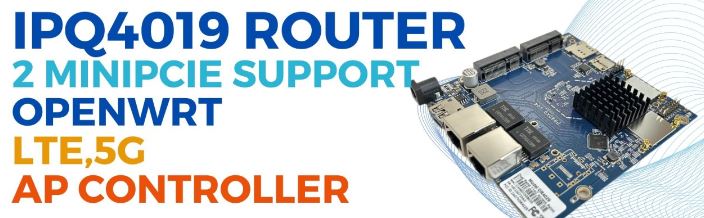

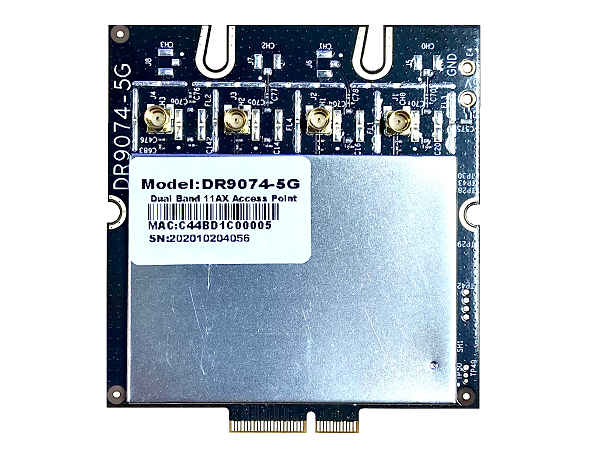 Introducing Qualcomm’s 4×4 11ax AP mode enabled radio module! Based on Pine series QCN 9074 / 9024 chipset, radio modules supporting 2.4GHz, 5GHz as well as the lately approved WiFi 6E is now available from Wallys ! Hop on the newly approved spectrum, increase the number of channels your clients can hop on, at 160MHz bandwidth!