Posted on

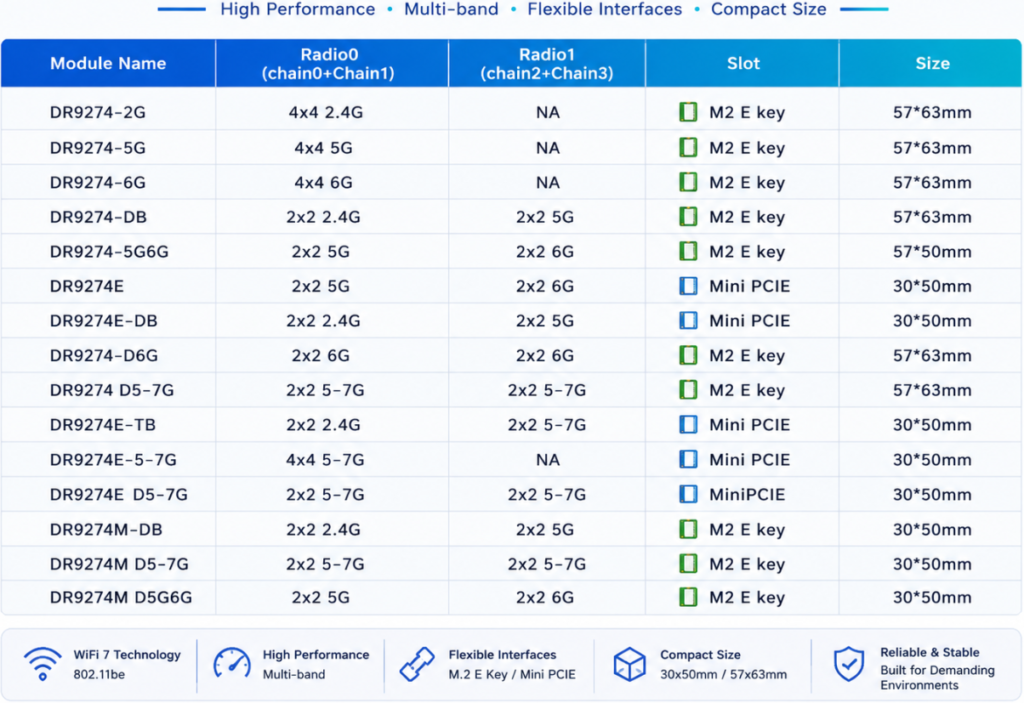
List of our Qualcomm WiFi 7 modules – new populer versions !

Module NameBDwlanRadio0
(chain0+Chain1)
Radio1
(chain2+Chain3)
SlotStatusNote
DR9274-2GB00014×4 2.4GNAM2 E keyavailable 
DR9274-5GB00024×4 5GNAM2 E keyavailableB0015
DR9274-6GB00044×4 6GNAM2 E keyavailableB0016
DR9274-DBB10032×2 2.4G2×2 5GM2 E keyavailable 
DR9274-5G6GB10062×2 5G2×2 6GM2 E keyavailable 
DR9274-5GKB00114×4 5GNAM2 E keyavailablebdwlanKCT.b0002
DR9274-6GKB00134×4 6GNAM2 E keyavailablebdwlanKCT.b0004
DR9274EB10182×2 5G2×2 6GMini PCIEavailableNew bdwlan
DR9274E-DBB10172×2 2.4G2×2 5GMini PCIEavailableNew bdwlan
DR9274-D6GB10192×2 6G2×2 6GM2 E keyavailableNew bdwlan
DR9274 D5-7GB100d2×2 5-7G2×2 5-7GM2 E keyavailableNew bdwlan
DR9274E-TBB100e2×2 2.4G2×2 5-7GMini PCIEComing soonNew bdwlan
DR9274E-5-7G 4×4 5-7GNAMini PCIEComing soon 
DR9274E D5-7G 2×2 5-7G2×2 5-7GMini PCIEComing soon 

Why Wi-Fi 7 Matters for Robotics

Wi-Fi 7 introduces several capabilities that directly address the requirements of next-generation robotics.

1. Higher Throughput for AI Data Streams

With features such as:

  • 320MHz channel bandwidth
  • 4096-QAM modulation
  • Multi-Link Operation (MLO)

Wi-Fi 7 significantly improves wireless capacity.

This enables robots to transmit and receive more data, supporting applications such as:

  • Real-time HD/4K video analysis
  • Multi-camera perception
  • Digital twin visualization
  • Remote robot operation

For industrial environments, higher bandwidth means more robots can operate simultaneously without creating network bottlenecks.


2. Lower Latency for Real-Time Control

Latency is critical for autonomous systems.

A delayed wireless connection can impact:

  • Robot navigation
  • Collision avoidance
  • Remote control
  • Human-machine collaboration

Wi-Fi 7’s Multi-Link Operation allows devices to utilize multiple frequency bands simultaneously, improving connection stability and reducing congestion.

For mobile robots operating in complex environments, maintaining a consistent connection is often more important than achieving maximum peak speed.


3. Better Connectivity in High-Density Environments

Future factories and warehouses may contain:

  • Hundreds of autonomous mobile robots (AMRs)
  • AI cameras
  • Industrial sensors
  • Wireless controllers
  • Edge computing nodes

A wireless infrastructure designed only for consumer environments may not be enough.

Industrial Wi-Fi requires:

  • Stable roaming
  • RF optimization
  • Enterprise-level management
  • Long-term hardware reliability

Wi-Fi 7 provides a stronger foundation for these high-density deployments.


Edge AI + Wi-Fi 7: Bringing Intelligence Closer to Machines

While cloud computing remains important, many robotic applications are moving toward edge AI.

Why?

Because robots need:

  • Faster response times
  • Reduced dependence on cloud connectivity
  • Better privacy protection
  • More reliable operation in industrial environments

Edge AI platforms process data locally, allowing robots to make decisions in real time.

But edge intelligence requires a powerful communication layer.

The relationship is simple:

Edge AI provides the intelligence. Wi-Fi 7 provides the nervous system.

Together, they enable robots to:

  • Understand their environment faster
  • Coordinate with other machines
  • Adapt to changing conditions
  • Operate autonomously at scale

Beyond Speed: Industrial Wireless Requires Reliability

A common misunderstanding is that the future of industrial wireless is simply about faster Wi-Fi.

In reality, industrial applications require much more:

Reliable roaming

Mobile robots need seamless handover between access points while moving across large facilities.

Stable performance under interference

Factories often contain metal structures, machinery, and RF noise.

Long-term platform support

Industrial customers expect hardware platforms that can operate reliably for years.

Flexible deployment options

Different environments require different designs:

  • Indoor industrial APs
  • Outdoor wireless bridges
  • Embedded Wi-Fi modules
  • Custom router platforms

The Future: AI Robots Need AI-Ready Networks

As robotics continues to evolve, wireless connectivity will become a strategic infrastructure layer.

The next generation of robots will not work alone.

They will communicate with:

  • Other robots
  • Edge servers
  • AI vision systems
  • Factory automation platforms
  • Cloud management systems

A powerful AI model without reliable connectivity cannot deliver its full value.

The future belongs to systems where:

AI intelligence + Edge computing + Advanced wireless connectivity work together.

Wi-Fi 7 is not just a faster wireless standard.

It is becoming the communication backbone for intelligent machines.


Building the Industrial Wireless Foundation for Tomorrow

At 524WiFi and Wallys, we are exploring the next generation of industrial wireless platforms by combining:

  • Qualcomm-based Wi-Fi 6 / Wi-Fi 7 solutions
  • Industrial-grade router boards
  • High-performance wireless modules
  • Edge AI application platforms
  • OEM/ODM customization capability

Our goal is to help robotics companies, AI developers, and industrial solution providers build reliable wireless infrastructure for the intelligent world.

Because the future of robotics will not only depend on smarter machines.

It will depend on how well those machines can communicate.

Posted on

NSA Non-Standalone vs SA Standalone 5G New Radio Technologi

As 5G is moving in to it’s fifth generation chipset with the Qualcomm SDX8x series 3GPP Rel-18 compliant architecture, a question of the network side of 5G still lingers among many of our customers. We have already covered what 5G RedCap (NR-Light) is, it’s pros and cons and what it will mean for the future of IoT connectivity, but for the attentive reader one thing stands out: it requires 5G SA. And in reality, a lot of the promises of a future with 5G evolves around this technology, namely a complete 5G network, from the core (datacenter) to the RAN (base station) and everything in between being 5G.

In this post we will dive in to some of the so called options in 5G networking, the multitude of abbreviations, as well as the differences in technology.

5G Networking – Non-Standalone vs Standalone 5G New Radio

LTE Networking

Let’s start by taking a step back and look at LTE (4G) networking. The so-called Option 1 consists of an Evolved Packet Core (EPC – the 4G core network) and eNodeB (eNB – 4G cellular base stations). It can be defined as an SA option as it utilizes 4G from backend to frontend, and as long as you have a 4G LTE capable device you can connect to the network and use it’s functions as we’ve all come to know it.

Simplified picure of LTE Networking

5G networking

Non-Standalone

When looking at 5G networking, things quickly became more complex. As previously mentioned 5G NSA was introduced as a way to ease the burden on the operators when deploying 5G base stations, by utilizing part of the existing 4G network already in place. The most popular approach to this dual-networking is called Option 3 with it’s abbreviation EN-DC (E-UTRA-New Radio Dual-Connectivity – IE 4G and 5G dual-mode).

Worth noting is that Option 3 in turn contains 3 sub-options 3, 3a and 3x. Most of which are available in eMBB (high-speed) 5G modules today, but notably not in RedCap.

By using NSA the modules and network uses some intelligence to know when to utilize the 5G side of the network, vs the 4G side of the same. This has been around for quite a while now, and we are starting to see 5G SA investments increasing globally.

Simplified picture of 3x, as we can see here, the 4G core of the network is connected with both an LTE eNB and 5G gNB (base station).

Simplified picture of NSA

Standalone

5G SA is the final step in the migration to 5G networks, where you switch the core of the network itself to 5G so that it acts as option 1 but with 5G, now called option 2. Don’t get us wrong, it’s nowhere near as easy as “remove this and replace with that” but in an overly simplified manner it now looks like the picture below.

Simplified picure of 5G SA

The options a module can work with are typically outlined in the datasheet or hardware guide. As mentioned above however, most new eMBB (high-speed) 5G modules can use both 5G NSA (typically ENDC Option 3/3a/3x) and 5G SA (Option 2) + LTE fallback (Option 1).

If you want to learn more about Standalone deployments, Ookla and Omdia has released a report with information on the current state of deployments: https://www.ookla.com/articles/europe-5gsa-2025

Posted on

WiFi 7 Technology 6 new features: Market Growth, Opportunities, and Challenges

WiFi 7 Technology: Market Growth, Opportunities, and Challenges

Introduction

As wireless network technology evolves, the WiFi standard continues to advance. Following WiFi 6, WiFi 7 (802.11be) emerges as the cornerstone of the next generation of wireless connectivity technology. WiFi 7 offers significant improvements in speed and efficiency, introducing numerous new features poised to revolutionize future network experiences. This article delves into the current state of the WiFi 7 device market, its future growth prospects, opportunities, and challenges.

Overview of WiFi 7 Technology

WiFi 7 brings several advancements over its predecessors:

  • Higher Speeds: WiFi 7 achieves a maximum transmission speed of up to 46 Gbps, more than four times that of WiFi 6.
  • Lower Latency: Leveraging multiple low-latency mechanisms, WiFi 7 excels in real-time applications such as gaming and video conferencing.
  • Improved Multi-Device Performance: Supporting Multi-Link Operation (MLO), WiFi 7 utilizes multiple bands (2.4GHz, 5GHz, 6GHz) simultaneously, enhancing network efficiency and stability.
  • Enhanced Security: WiFi 7 incorporates state-of-the-art encryption technologies, ensuring robust protection of user data.

Market Growth

Current Market Status

As of the end of 2023, the WiFi 7 device market is in its nascent stages, primarily driven by early adopters and technologically advanced enterprises. Market research indicates that the global WiFi 7 device market size was approximately $1 billion in 2023.

Future Growth Projections

Industry forecasts suggest robust growth for the WiFi 7 device market over the next five years. By 2028, it is expected to reach $15 billion globally, with a compound annual growth rate (CAGR) of around 45%. This accelerated growth is propelled by several factors:

  • Demand for Technological Advantages: Enterprises and consumers are drawn to WiFi 7’s high speed, low latency, and superior stability, particularly in bandwidth-intensive applications like AR/VR, cloud gaming, and 4K/8K video streaming.
  • Broad Application Scenarios: WiFi 7 will extend its reach beyond homes and businesses to include smart cities, industrial internet, telemedicine, and other emerging fields, driving further market demand.
  • Device Upgrade Cycle: With WiFi 7 technology becoming ubiquitous, many homes and businesses will gradually replace outdated equipment with new WiFi 7-compatible devices, expanding the market size.

Opportunities

  • Diverse Applications: WiFi 7 devices will play a pivotal role in various sectors such as smart cities, industrial internet, and telemedicine, catalyzing digital transformation across industries.
  • Synergy with 5G: WiFi 7 and 5G will form a seamless wireless network ecosystem, complementing each other to deliver high-speed connectivity experiences.
  • Cost Efficiency: As production scales and technology matures, the cost of WiFi 7 devices will decrease, making them more accessible.
  • Ecosystem Development: Hardware and software vendors will build a comprehensive ecosystem around WiFi 7 technology, encompassing WiFi 7-supported terminal devices, software support, and application services.

Challenges

Despite promising prospects, the WiFi 7 device market faces challenges:

  • High Costs: Initial costs of WiFi 7 devices are relatively high, potentially influencing adoption rates among consumers and businesses.
  • Technical Compatibility: Introducing new technology requires addressing compatibility issues with existing devices and networks to ensure smooth integration.
  • Standard Refinement: While the WiFi 7 standard is well-established, continuous refinement and optimization are necessary for practical applications.

Conclusion

The WiFi 7 device market is poised for rapid expansion, projected to experience significant development in the coming years. The demand for high-bandwidth applications, the proliferation of IoT devices, and the imperative for enterprise digital transformation are key drivers of this growth. Addressing challenges related to costs and technical compatibility will be crucial. Overall, the future of the WiFi 7 device market looks promising, positioning it as a pivotal component of the wireless network technology landscape.