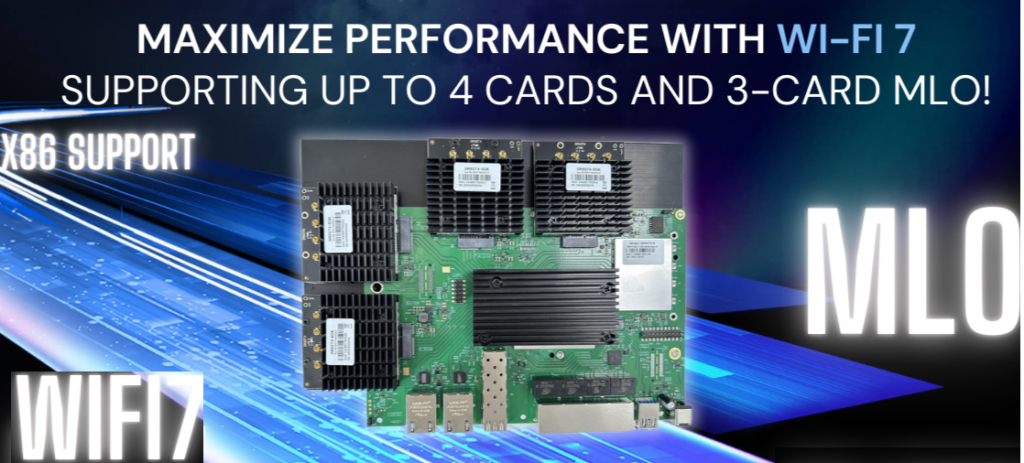
With the rapid development of AI and IoT, traditional network architectures are no longer capable of handling the growing demands for data traffic and ultra-low latency. 524WiFis WiFi 7 hardware, with its groundbreaking technology, is specifically designed for AI-driven applications, offering infinite possibilities for the future of networking.
Core Advantages of WiFi 7 for AI Applications:
🔌 Ultra-High Bandwidth WiFi 7 hardware supports an impressive 46.116 Gbps link speed(maximum 6ghz peak data rate 11.529 Gbps x 4), effortlessly handling the massive data transfers required by AI algorithms. It ensures smooth operation for AI applications such as machine learning, data analysis, and automation, while also managing high-bandwidth device connections.
🌐 Seamless AI Device Connectivity WiFi 7 supports multiple devices simultaneously, ensuring AI-driven endpoints like smart cameras, industrial robots, and automation control systems enjoy ultra-stable, high-bandwidth connections. This meets the demands of industrial automation and smart city infrastructure.
💡 Future-Proofing Capability Wallys WiFi 7 hardware is compatible with future 5G networks and edge computing, offering ultra-low latency and efficient transmission to allow real-time interaction between AI applications and IoT devices, building a smarter and more interconnected ecosystem.
Solutions Tailored for Industrial AI Applications
Whether in smart factories, smart cities, autonomous driving, or telemedicine, 524WiFi WiFi 7 ensures seamless connectivity and ultra-fast transmission, guaranteeing real-time performance and stability for AI applications.
Maximizing Wireless Performance with the Qualcomm IPQ9574: A Wi-Fi 7 Powerhouse
In today’s fast-paced digital world, industries are increasingly relying on advanced wireless technologies to support high-speed data transfer and seamless connectivity. The Qualcomm IPQ9574, a cutting-edge chipset powering the DR9574 router board, is revolutionizing wireless communication by supporting Wi-Fi 7 and offering industry-leading performance for demanding applications. This article delves into the key features and specifications of the IPQ9574 and DR9574, highlighting how they are shaping the future of wireless networking.
Why the Qualcomm IPQ9574 is a Game-Changer for Wi-Fi 7 Networks
The IPQ9574 chipset is at the heart of the DR9574, delivering unmatched wireless capabilities. It supports up to 4 Wi-Fi 7 cards, allowing flexibility for a variety of MLO (Multi-Link Operation) configurations, including compatibility with any 3-card MLO setup. This level of flexibility and performance ensures that industries can scale their networks to meet the growing demand for high-speed wireless communication.
Key Features of the IPQ9574-Based DR9574
Advanced Quad-Core ARM Processor: The IPQ9574 chipset is powered by a Quad-Core ARM-A73 processor running at 2.2GHz. This ensures high-speed processing for data-intensive tasks and complex networking functions.
Support for Wi-Fi 7: The IPQ9574 is designed to support the latest Wi-Fi 7 technology, providing faster speeds, better efficiency, and higher network capacity compared to its predecessors.
Multiple M.2 E Key Interfaces: The DR9574 offers 4 M.2 E Key interfaces with PCIe 3.0, enabling support for up to four Wi-Fi 7 cards. This flexibility is crucial for environments that require high-performance networking.
Excellent Power Efficiency: The board consumes 13W without the onboard Wi-Fi and up to 23W with Wi-Fi integrated, striking a balance between power efficiency and high-performance operation.
Broad Operating Range: With operating temperatures between -20°C to 70°C and storage temperatures from -40°C to 90°C, the DR9574 is built to endure harsh industrial environments.
Optimized for High-Speed Data: The 2.4GHz band supports 802.11b/g/n/ax standards, with data rates reaching 24dBm per chain, ensuring robust and fast wireless connections.
Key Hardware Specifications of the DR9574 Router Board
Power Consumption13W (Board only), 23W (with onboard Wi-Fi)
Temperature RangeOperating: -20°C to 70°C, Storage: -40°C to 90°C
Applications of the DR9574 in Industry
With its robust feature set and Wi-Fi 7 capabilities, the DR9574 is perfect for a variety of industries, including:
Smart Cities: The ability to support multiple Wi-Fi 7 cards and MLO configurations makes it ideal for managing the wireless backbone of smart cities, where high-speed and reliable communication are essential.
Industrial IoT (IIoT): As industrial applications increasingly rely on wireless technology for device communication, the DR9574 ensures reliable data transfer, low latency, and the ability to scale as the number of connected devices grows.
Telecommunications: The IPQ9574 chipset allows telecommunications providers to build next-generation infrastructures that offer superior performance and capacity.
Absolute Maximum Ratings for Reliable Operation
Parameter/RatingUnit
Operating Temperature-20 ~ 70ºC
Storage Temperature-40 ~ 90ºC
Operating Humidity5% ~ 95 (non-condensing)%
Storage Humidity0% ~ 90 (non-condensing)%
Conclusion: Future-Proof Your Network with IPQ9574 and DR9574
The Qualcomm IPQ9574 and DR9574 router board are poised to lead the charge in Wi-Fi 7 technology, providing businesses and industries with the high-performance, reliable, and scalable networking solutions they need. With support for multiple Wi-Fi 7 cards, MLO configurations, and the ability to operate in challenging environments, the DR9574 is an ideal choice for industries looking to upgrade their wireless networks for the future.
As Wi-Fi 7 continues to gain traction in the industry, the IPQ9574 is at the forefront of delivering the connectivity that next-gen applications demand, from industrial IoT to smart cities and beyond.
With the rapid adoption of Wi-Fi 7, businesses and industrial applications require high-performance, multi-band networking platforms that deliver exceptional speed, low latency, and robust connectivity. The IPQ5322 + QCN9274 + QCN6274 solution is a powerful 10-stream Wi-Fi 7 networking platform, designed for next-generation routers, enterprise APs, and industrial wireless deployments.
Key Features of IPQ5322 + QCN9274 + QCN6274 Wi-Fi 7 Platform
🔹 Tri-Band Wi-Fi 7 with 10-Stream Configuration
IPQ5322: Dual-core networking SoC for high-speed processing
QCN9274 (5GHz 4×4 MIMO): High-performance Wi-Fi 7 radio
QCN6274 (6GHz 4×4 MIMO): Optimized for the new 6GHz band
Combines multiple frequency bands for lower latency
Supports 320MHz ultra-wide channels for faster throughput
🔹 High-Speed Connectivity & Low Latency
10Gbps+ total throughput, ideal for industrial networking
Reduced interference & congestion with 6GHz band support
🔹 Optimized for Enterprise & Industrial Wi-Fi Applications
Supports large-scale wireless deployments
Enhanced performance in smart factories, warehouses, and IoT networks
Why Choose IPQ5322 + QCN9274 + QCN6274 for Wi-Fi 7?
🚀 Superior Wi-Fi 7 Performance: Supports 10 streams for ultra-fast, low-latency wireless connectivity.
🔗 Enhanced MLO & MU-MIMO: Ensures seamless multi-device communication with high efficiency.
🏭 Industrial-Grade Reliability: Ideal for smart cities, industrial automation, and enterprise networking.
🛠 Customizable & Scalable: Flexible OEM/ODM options for tailored solutions.
Get Started with Wallys’ Wi-Fi 7 Solutions
524WiFi provides a full range of Wi-Fi 7 networking platforms, including IPQ5322-based solutions with QCN9274 and QCN6274 modules. Whether you’re developing enterprise APs, industrial routers, or high-performance wireless systems, our custom hardware and software solutions can help accelerate your project.
Unlocking High-Performance Wireless Connectivity for Next-Gen Intelligent Systems
Introduction
As AIoT ( Artificial Intelligence of Things ) and autonomous robotics continue to transform industries — from smart factories to unmanned logistics and surveillance systems — high-performance wireless connectivity has become a mission-critical requirement. Advanced machines need real-time data exchange, seamless remote control, and ultra-reliable low-latency communication (URLLC). This is exactly where WiFi 6 and WiFi 7 modules powered by Qualcomm’s IPQ5018 and IPQ9574 shine.
Why Wireless Connectivity Matters for AIoT & Autonomous Robots
1. Real-Time Sensor Fusion
Robots in smart warehouses, delivery drones, and autonomous patrol vehicles rely on multiple sensors, including cameras, LiDAR, and radar. These sensors generate vast amounts of data that need to be transmitted to central controllers or edge processing nodes in real time.
2. Collaborative Operations
Swarm robotics (groups of robots working together) demand synchronized communication to coordinate movements, object handling, and obstacle avoidance — requiring high bandwidth and low latency.
3. Mobile AI Processing
For AIoT devices in industrial and outdoor environments, real-time data streaming between edge AI processors and cloud systems is crucial to optimize performance using advanced analytics and machine learning models.
Meet the Power Duo: IPQ5018 and IPQ9574
📡 IPQ5018 — Optimized WiFi 6 Solution for Cost-Effective Performance
Ideal for Mid-Range AIoT and Autonomous Devices
Feature Specification : Wireless StandardWiFi 6 802.11ax Bands 2.4GHz + 5GHz Dual-band Data Rate Up to 3Gbps CPU Dual-core ARM Cortex A53 Security WPA3, Secure Boot, Trusted Execution Environment (TEE)Target Applications Drones, AGVs, Smart Cameras, Industrial Sensors
🚀 IPQ9574 — High-Performance WiFi 7 Solution for Next-Level Intelligence
Designed for High-End Robotics and AIoT Hubs
Feature Specification: Wireless StandardWiFi 7 802.11be Bands Tri-band (2.4GHz + 5GHz + 6GHz) Data Rate Up to 21Gbps CPU Quad-core ARM Cortex A73 MLO (Multi-Link Operation)✅ Supported Target Applications Autonomous Vehicles, Smart Manufacturing, Large-Scale Sensor Networks
Key Benefits for AIoT and Autonomous Robotics
✅ Ultra-Low Latency Control
With OFDMA and MLO (in WiFi 7), these modules significantly reduce wireless communication delays, which is essential for real-time remote control and mission-critical data feedback.
✅ High Throughput for AI Workloads
AI-driven devices, particularly those with onboard vision processing or collaborative SLAM (Simultaneous Localization and Mapping), generate vast streams of data. WiFi 6/7 ensures uninterrupted, high-bandwidth transmission.
✅ Interference Mitigation in Dense Environments
AIoT ecosystems often operate in challenging RF environments — factories, ports, or urban areas — where multiple devices compete for bandwidth. Features like BSS Coloring and MU-MIMO (in both WiFi 6 & 7) guarantee efficient channel sharing.
✅ Future-Proof Connectivity
With WiFi 7’s 320 MHz channels and 4096-QAM, autonomous robots and AIoT nodes can benefit from unprecedented wireless speeds, supporting emerging workloads like real-time AI inference streaming or collaborative deep learning updates.
Application Scenarios
Use Case WiFi Module Recommendation Autonomous Mobile Robots (AMR) IPQ5018 Smart Drones IPQ5018 High-Speed AGVs in Warehouses IPQ9574 Remote AI Surveillance Towers IPQ9574 AIoT Sensor Networks in Smart Cities IPQ5018 Large-Scale Robotic Fleets IPQ9574
Why Choose DR5018S & DR9574 Modules
At 524WiFi andWallys Communications, we specialize in developing cutting-edge wireless hardware tailored for industrial applications. Our DR5018S (IPQ5018) and DR9574 (IPQ9574) modules offer:
✅ Industrial-grade durability for harsh environments
✅ Full support for OpenWRT and customizable firmware
✅ Compact form factors perfect for integration into AIoT devices
✅ Strong RF performance with advanced antenna design support
✅ Flexible customization — from hardware interfaces to security features
Final Thoughts
As AIoT and autonomous robots become smarter and more connected, choosing the right wireless solution becomes a strategic decision. Whether you’re building the next-gen delivery robot or deploying a real-time AI sensor network in a smart factory, 524WiFi’s IPQ5018 and IPQ9574-based modules ensure your devices communicate reliably and efficiently — today and into the future.
Wi-Fi 7 with Multi-Link Operation (MLO) on X86 Devices: A New Era of Connectivity
As the world of wireless technology continues to evolve, the introduction of Wi-Fi 7 is nothing short of a game-changer. With its potential for significantly higher speeds, lower latency, and enhanced reliability, Wi-Fi 7 is set to revolutionize industries and applications ranging from industrial IoT to high-performance consumer devices. At Wallys, we’re always driven by customer needs, and as part of our commitment to offering cutting-edge solutions, we’re focused on expanding the possibilities for Wi-Fi 7 technology—specifically by enabling Multi-Link Operation (MLO) support on X86 platforms.
Expanding the Reach of Wi-Fi 7: A New Level of Compatibility
Last year, we introduced X86 driver support for our Wi-Fi 6 module, DR9074, which enabled seamless integration across a broader range of motherboard platforms, not just Qualcomm devices. This support empowered our customers to experience high-quality, stable Wi-Fi data transmission and opened the door for new applications that demand reliable and high-throughput wireless connections.
With the introduction of Wi-Fi 7, cross-platform compatibility becomes even more critical. Wi-Fi 7 brings with it a new set of features designed to push the boundaries of wireless connectivity, and one of the most significant is Multi-Link Operation (MLO). But to harness the full potential of MLO, we need to ensure that our solutions can operate on multiple platforms—something we’re excited to announce we’re working on with our DR9274 (QCN9274) and QCN6274 Wi-Fi 7 modules.
wifi6 vs wifi7
What is MLO? And Why Does It Matter?
Multi-Link Operation (MLO) is one of the standout features of Wi-Fi 7. MLO allows devices to transmit data across multiple frequency bands (like 2.4 GHz, 5 GHz, and 6 GHz) simultaneously. This multi-band transmission significantly improves throughput and reliability, while reducing latency and congestion, making it an ideal solution for environments that require high-speed and low-latency communication.
In simple terms, MLO will enable your devices to leverage the full bandwidth potential of Wi-Fi 7, resulting in faster speeds, more stable connections, and more efficient use of available spectrum.
Introducing the QCN9274 & QCN6274 Wi-Fi 7 Modules
To enable the full potential of MLO, we’re leveraging the power of QCN9274 and QCN6274—two of Qualcomm’s latest Wi-Fi 7 chipsets, both designed for high-performance applications.
QCN9274 (Waikiki)
QCN6274 (Waikiki)
MLO
These two powerful chipsets represent the future of Wi-Fi 7 and provide the foundation for expanding compatibility across a variety of platforms. With MLO support, both the QCN9274 and QCN6274 enable better utilization of the 2.4, 5, and 6 GHz bands, delivering faster speeds and more reliable connections.
wifi7 new features
What Will MLO Bring to Your X86 Devices?
By introducing MLO support for X86 devices, we’re pushing the envelope on what’s possible in wireless networking. Users of X86 platforms will now be able to tap into the full power of Wi-Fi 7, unlocking:
Higher Throughput: With MLO, data is split across multiple channels, leading to faster speeds and higher data rates, ideal for bandwidth-hungry applications like streaming, gaming, and industrial IoT.
Enhanced Reliability: MLO ensures that devices can maintain stable connections, even in environments with interference or congestion, by balancing traffic across different frequency bands.
Reduced Latency: Faster communication between devices can significantly reduce lag and improve the responsiveness of real-time applications, from virtual reality to autonomous systems.
The implications are significant. Wi-Fi 7, combined with MLO, could transform industries that rely on seamless, high-performance wireless connectivity—think smart cities, industrial automation, healthcare, and beyond.
At 524WiFi, we’re committed to ensuring that our solutions are as versatile and adaptable as possible. With the upcoming X86 driver support for DR9274 and MLO functionality, you’ll be able to take full advantage of Wi-Fi 7 speeds and unlock new potential for your devices.
Thoughtput testing:achieve 8Gbps+ speed
This new capability will open up new opportunities for a variety of applications, and we’re eager to see how our customers will integrate this powerful technology into their own use cases.
DR9274 wifi7 M.2 card
Are You Ready for the Future of Wireless Connectivity?
With Wi-Fi 7’s blazing-fast speeds and MLO’s game-changing capabilities, the possibilities are endless. How do you envision using Wi-Fi 7 with MLO on your X86 platforms? Whether it’s enhancing your industrial IoT devices, supporting next-gen gaming applications, or powering high-bandwidth communications, the potential is vast.
At 524WiFi, we’re excited to continue innovating and providing the tools you need to stay ahead in the rapidly evolving wireless landscape. If you’re interested in learning more about our Wi-Fi 7 solutions or how we can help with your next project, feel free to reach out to us.
op IPQ9574 Chip Features for Next-Gen Wi-Fi 7 Connectivity
As the demand for faster, more reliable wireless networks continues to grow, the introduction of Wi-Fi 7 has become a game-changer in the world of wireless technology. At the heart of this new generation of Wi-Fi is the IPQ9574 chip, designed by Qualcomm, which is quickly emerging as one of the leading chips for Wi-Fi 7 connectivity. With its advanced features, the IPQ9574 is set to unlock unprecedented speeds, capacity, and reliability, paving the way for cutting-edge applications across industries. In this article, we’ll take a closer look at the top features of the IPQ9574 chip and how it is revolutionizing the way we connect.
1. Multi-Link Operation (MLO) for Ultra-Fast Speeds
One of the standout features of the IPQ9574 chip is its support for Multi-Link Operation (MLO), a critical component of Wi-Fi 7. MLO allows devices to simultaneously connect to multiple frequency bands (e.g., 2.4 GHz, 5 GHz, and 6 GHz) instead of relying on a single band. This results in faster data transfer speeds and improved network efficiency.
With MLO, the IPQ9574 can combine multiple data streams from different channels, enhancing throughput and reducing latency. This makes it ideal for demanding applications such as 4K/8K video streaming, virtual reality (VR), and high-speed gaming, where a seamless and ultra-fast connection is essential.
2. Increased Capacity for Dense Environments
The IPQ9574 chip is built with the capacity to handle a large number of devices simultaneously, which is critical in today’s increasingly connected world. Whether it’s a smart home, a busy office, or a large public venue, the chip ensures that network congestion is minimized, allowing for smooth communication even in dense environments.
With the Wi-Fi 7 technology powered by the IPQ9574, your network will be able to efficiently handle more devices without sacrificing performance. This is especially important as the Internet of Things (IoT) continues to expand and more smart devices are added to networks every day.
3. Better Spectrum Utilization with 320 MHz Channel Width
The IPQ9574 chip supports 320 MHz channel width, which significantly increases the amount of data that can be transmitted over the network. This feature is crucial for taking full advantage of the newly available 6 GHz spectrum offered by Wi-Fi 7, allowing for less interference and more bandwidth.
With wider channels, users can expect higher throughput and faster data speeds. For example, large file transfers, high-definition video streaming, and bandwidth-intensive tasks will see massive improvements in speed and efficiency.
4. Enhanced Reliability and Reduced Latency
One of the most important factors in ensuring a reliable network is minimizing latency—the delay between sending and receiving data. The IPQ9574 chip addresses this with advanced features that optimize network reliability and ensure a low-latency experience.
In applications such as live streaming, online gaming, and real-time video conferencing, low latency is essential for smooth, uninterrupted experiences. The IPQ9574 chip’s ability to provide consistent, stable connections is what sets it apart, ensuring high performance even during heavy traffic periods.
5. Seamless Connectivity with Enhanced Roaming
The IPQ9574 chip supports seamless roaming, which allows devices to smoothly transition between access points without interruption. Whether you’re walking around your home or office, the network will automatically hand off your connection to the nearest access point, ensuring a continuous, reliable experience.
This is especially beneficial in larger spaces or environments with many users, such as hotels, hospitals, or large campuses, where maintaining an uninterrupted connection is crucial.
6. Backward Compatibility with Wi-Fi 5 and Wi-Fi 6
Although the IPQ9574 chip is built for the future with Wi-Fi 7, it also maintains backward compatibility with older Wi-Fi standards, such as Wi-Fi 5 and Wi-Fi 6. This means that users with older devices can still enjoy fast and reliable connections on Wi-Fi 7 networks, without the need to upgrade all their devices at once.
Conclusion: The Future of Wireless Connectivity
The IPQ9574 chip is a powerhouse for Wi-Fi 7 technology, offering game-changing features like Multi-Link Operation (MLO), higher capacity, wider channels, and seamless roaming. These features make it the perfect choice for applications demanding high-speed, reliable, and efficient wireless connections—whether it’s for streaming, gaming, smart cities, or enterprise networks.
At Wallys Communications, we leverage the IPQ9574 chip to deliver cutting-edge solutions that meet the needs of modern wireless networks. Additionally, we have developed AI-driven solutions, such as human recognition and vehicle detection, powered by QCN9074 chips, offering innovative applications in security and automation.
Contact us today to learn more about how our Wi-Fi 7 solutions powered by IPQ9574 can elevate your wireless network and unlock the full potential of next-gen connectivity.
X86 Industrial Computer + QCN9024 DR9024 MINI PCIE Interface 1v1 and 1v100 Performance Test Report:
Test purpose: Test the performance of QCN9024 network card with industrial computer 1v1 and 1v10 Test tool: Ixchariot 6.7 Test equipment: X86 industrial computer + MINI PCIE QCN9024 DR9024 module
X86 as STA test environment:
Self-developed equipment as AP, X86 industrial computer as STA
Chariot traffic test Test 1: STA to AP traffic, throughput 2145Mbps
Test 2: AP sends traffic to STA, throughput 2318Mbps
Test 3: AP and STA bidirectional traffic, throughput 2660Mbps
X86 as AP test environment:
Self-developed equipment as STA, X86 industrial computer as AP
Chariot traffic test Test 1: AP to STA traffic, throughput 2215Mbps
Test 2: STA sends data to AP, throughput 2271Mbps
Test 3: AP and STA bidirectional traffic, throughput 2603Mbps
X86 Industrial Computer + QCN9024 DR9024 MINI PCIE Interface 1v1 and 1v100 Performance Test Report:
Test purpose: Test the performance of QCN9024 network card with industrial computer 1v1 and 1v10 Test tool: Ixchariot 6.7 Test equipment: X86 industrial computer + MINI PCIE QCN9024 DR9024 module
IPQ 5018 DR5018S: A Powerful Network Device with 2.4G, 5G, and 6G Support, CE-UKCA-FCC Certifications
The router board DR5018S is an innovative network device based on Qualcomm’s IPQ5018 SOC chipset, designed to meet the high demands of various commercial and industrial applications. With its powerful performance and multifunctional configuration, it stands out as one of the leading Wi-Fi 6 solutions in the industry. Below, we provide a detailed analysis of the DR5018S’s features and advantages, offering a comprehensive understanding of this exceptional device.
Core Hardware: IPQ5018 SOC Chipset
The DR5018S is powered by Qualcomm’s IPQ5018 chipset, a leader in Wi-Fi 6 technology. This chipset delivers higher transmission speeds, lower latency, and more stable connections, excelling at handling multi-device connections and high-bandwidth demands. It is ideal for both commercial and industrial environments, managing a large number of simultaneous device connections while maintaining network stability and performance.
Multi-Band Support: 2.4G, 5G, and 6G
A standout feature of the DR5018S is its support for three frequency bands: 2.4GHz, 5GHz, and 6GHz. This tri-band support provides a flexible network solution for various application scenarios. In crowded Wi-Fi environments, selecting the right frequency band helps avoid interference, ensuring faster speeds and higher stability.
2.4GHz: Ideal for wider coverage, though with lower speeds. Best for devices with low bandwidth needs.
5GHz: Offers higher speeds, making it suitable for modern devices requiring higher bandwidth and low latency.
6GHz: As part of Wi-Fi 6E, 6GHz offers clearer channels with less interference, perfect for high-density environments and bandwidth-intensive applications.
This tri-band support allows the DR5018S to deliver outstanding performance, addressing different connection needs across various environments.
Available Versions for Customization
The DR5018S is available in multiple versions to meet your specific project needs:
The DR5018S is equipped with built-in GPS functionality, making it ideal for applications requiring precise location tracking. This feature is especially useful in asset management, fleet tracking, and location-based services. Whether in smart transportation, logistics, or other industries that require accurate positioning, the DR5018S provides robust support.
Global Certifications: CE, UKCA, FCC
The DR5018S holds multiple global certifications, including CE (European Union), UKCA (United Kingdom), and FCC (United States), ensuring compliance with regulatory standards across major international markets. These certifications guarantee that the DR5018S meets high-performance and safety standards, allowing seamless use across regions without legal or regulatory issues.
CE Certification: Complies with health, safety, and environmental standards for the European market.
UKCA Certification: Meets UK market requirements, ensuring smooth access to the UK market.
FCC Certification: Ensures compliance with wireless communication requirements in the U.S., preventing excessive wireless interference.
These certifications are essential for the sale and use of electronic products globally, allowing the DR5018S to be easily promoted and deployed in international markets.
Comprehensive Advantages
Powerful Processing Capability: The IPQ5018 chipset offers strong network processing, handling high volumes of device connections with ease.
Tri-Band Support: Supports 2.4GHz, 5GHz, and 6GHz frequency bands for flexible and efficient network services.
Built-In GPS Functionality: Strong support for location-based applications, expanding use cases.
Global Certifications: With CE, UKCA, and FCC certifications, the DR5018S meets regulatory requirements for global markets.
Stability and Compatibility: Wi-Fi 6 technology ensures excellent performance in high-density environments, offering greater adaptability.
Conclusion
The DR5018S is a highly integrated, high-performance network device that combines Wi-Fi 6 technology, tri-band support, built-in GPS functionality, and global certifications, making it suitable for a wide range of applications. Whether for commercial offices, industrial networks, or smart device applications requiring precise location tracking, the DR5018S ensures stable, reliable network connections and accurate positioning services. With its global certifications, it can be deployed confidently across international markets, expanding your business reach.
The DR5018S is not just a technologically advanced product; it’s a standout solution in the global network connectivity space.
If you’re looking for a powerful and flexible wireless communication solution, the QCA based DR6018 Router Board, powered by the Qualcomm IPQ6018 CPU, and paired with the DR9074 network card (featuring the QCN9074 chip), offers exceptional performance for industrial applications. Whether you’re setting up a wireless network for IoT devices, smart factories, or remote monitoring systems, this combination provides the speed, reliability, and scalability you need.
Key Features of the DR6018 Router Board with IPQ6018 and DR9074 Network Card
Powerful Qualcomm IPQ6018 CPU
The Qualcomm IPQ6018 is a high-performance quad-core processor designed for Wi-Fi 6 (802.11ax) solutions. This powerful CPU ensures that your router board can handle high traffic and multiple simultaneous connections without compromising performance, making it perfect for demanding industrial and enterprise networks.
Flexible Wireless Connectivity with DR9074 Network Card
The DR9074 network card features the QCN9074 chip, which supports Wi-Fi 6 and offers high-speed wireless performance. Wallys’ DR9074 card comes with multiple radio options—2.4GHz, 5GHz, and even 6GHz—allowing you to choose the most suitable band for your specific application.
Wi-Fi 6 for Faster, More Efficient Networks
Wi-Fi 6 brings a host of advantages, including faster speeds, better range, and improved efficiency, especially in crowded networks. The DR6018 Router Board combined with the DR9074 network card ensures that your system can handle multiple devices, with the ability to prioritize traffic and reduce latency, making it ideal for high-demand environments like smart manufacturing, IoT systems, and enterprise networking.
Scalability with Multiple Radio Options
With the DR9074 network card, you can select between 2.4GHz, 5GHz, and 6GHz radios depending on your needs:2.4GHz: Great for long-range communication, even through obstacles, with decent speeds.5GHz: Ideal for fast, high-throughput applications like video streaming, data-intensive tasks, and real-time monitoring.6GHz: The latest in Wi-Fi technology, offering the fastest speeds, least congestion, and low latency for high-density environments.
Enhanced Network Security
With the latest WPA3 encryption standard, your DR6018 Router Board and DR9074 network card ensure that your data remains secure, protecting sensitive information and ensuring safe communication across your network.
Applications for the DR6018 Router Board with DR9074 Network Card
Industrial IoT (IIoT)
The DR6018 Router Board with the DR9074 card is ideal for IIoT applications where reliability and real-time data transmission are crucial. Whether you’re managing smart sensors, automated machinery, or monitoring systems, this combination ensures your devices stay connected with minimal downtime.
Smart Factories
In smart manufacturing environments, the DR6018 Router Board delivers fast and reliable wireless communication, supporting machine-to-machine (M2M) communication, predictive maintenance, and data analysis. The Wi-Fi 6 capabilities and flexible radio options ensure smooth operation in a fast-paced industrial setting.
Enterprise Networking
For enterprise applications requiring high-speed and high-capacity networks, the DR6018 Router Board provides the performance needed to handle large amounts of data, multi-user connectivity, and high-density environments, ensuring your business operations run smoothly.
Smart Cities
The DR6018 Router Board and DR9074 network card are perfect for smart city applications like traffic management systems, public safety monitoring, and environmental monitoring networks. The flexibility of the Wi-Fi 6 technology and different radio options makes it easy to deploy high-performance networks across urban environments.
Wireless Access Points
Whether you’re upgrading existing infrastructure or setting up new wireless access points in an industrial setting, the DR6018 Router Board with the DR9074 network card offers reliable, high-speed connectivity. The multiple radio options make it adaptable to different use cases, from wide-area coverage to high-speed, low-latency communication.
Why Choose the DR6018 Router Board with DR9074 Network Card?
High Performance: Powered by the Qualcomm IPQ6018 CPU and Wi-Fi 6 technology, this solution offers exceptional speed and capacity for high-demand industrial networks.
Flexible Wireless Options: With the DR9074 network card, you can select the best radio for your environment—2.4GHz, 5GHz, or 6GHz—for optimal performance.
Scalable: Easily scale your network as your needs grow, with multiple wireless channels and a modular design.
Reliability: Designed for industrial environments, this solution ensures continuous, stable communication even in challenging conditions.
Security: Built-in WPA3 encryption ensures that your network is secure and your data is protected from unauthorized access.
Conclusion
The DR6018 Router Board, powered by the Qualcomm IPQ6018 CPU and paired with the DR9074 network card, offers a comprehensive and flexible solution for industrial wireless communication. With support for Wi-Fi 6 and multiple radio options, this platform ensures your systems remain fast, reliable, and secure, no matter how demanding the environment.
If you’re looking to enhance your industrial network with high-speed wireless communication, contact 524WiFi team to learn more about our products and how we can tailor a solution for your needs.
As the logistics industry continues to evolve, there is a growing need for efficient, stable, and flexible networking solutions. Virtual Local Area Networks (VLANs) provide a powerful tool for managing network traffic, optimizing resources, and improving both efficiency and security within logistics operations. Below are several key VLAN application scenarios within the logistics industry.
1. Smart Warehouse & Automation Systems
Smart warehouses, equipped with automated systems like robotic arms, conveyor belts, sensors, and RFID systems, rely on a robust network for seamless data exchange. VLANs can improve network performance by segmenting traffic based on device type.
VLAN Segmentation:
VLAN 10 (Automated Guided Vehicle Network): Ensures low-latency, high-priority communication for automated guided vehicles (AGVs).
VLAN 20 (RFID & Scanners): Provides dedicated bandwidth for RFID systems and scanners, ensuring real-time tracking.
VLAN 30 (Surveillance Network): Segregates video surveillance data from other traffic to prevent congestion.
VLAN helps ensure that critical devices such as AGVs and RFID scanners can communicate without interference, enhancing warehouse efficiency.
2. Sorting Systems in Distribution Centers
Sorting systems in distribution centers often involve complex automation machinery that requires real-time communication to optimize the sorting of parcels. VLANs help ensure smooth operation by prioritizing the traffic of sorting equipment.
VLAN Segmentation:
VLAN 100 (Sorting Equipment Network): Dedicated VLAN for the machinery that handles sorting, minimizing delays caused by high data traffic.
VLAN 200 (Office Management Network): Separates office traffic from operational machinery, avoiding disruptions to real-time sorting tasks.
VLAN 300 (Customer Service Interface): Isolates customer-facing systems, ensuring customer data remains secure while other operational processes run smoothly.
VLANs optimize data flow within the sorting systems and prevent network congestion, increasing overall throughput.
3. IoT Devices and Wireless Networks
In the logistics industry, IoT devices such as temperature sensors, GPS trackers, and smart locks play an integral role in monitoring and managing goods during transit and storage. VLANs are essential for managing and securing wireless network traffic.
VLAN Segmentation:
VLAN 50 (IoT Device Network): Creates a dedicated VLAN for all IoT devices, ensuring reliable data transfer while isolating traffic from other networks.
VLAN 60 (Customer Wi-Fi Network): Segregates visitor and employee Wi-Fi access from critical business systems to ensure security.
Using VLANs ensures that sensitive logistics data from IoT devices is protected and prioritized, enabling real-time monitoring and secure communications.
4. Security and Data Isolation
The logistics industry handles sensitive customer data, inventory management information, and delivery details. VLANs are used to isolate these critical data streams from other less sensitive traffic, adding an additional layer of security.
VLAN Segmentation:
VLAN 10 (Management and Control Network): Isolates administrative systems and critical control networks to prevent unauthorized access.
VLAN 20 (Customer Data Network): Protects customer and order information by creating a separate VLAN for processing sensitive data.
VLAN 30 (Surveillance Network): Ensures video feeds from surveillance cameras are kept within a dedicated network, preventing bandwidth overload.
VLANs improve data security by isolating sensitive systems from regular traffic, reducing the risk of data breaches or unauthorized access.
5. Integration with 5G Networks
As logistics operations increasingly incorporate 5G technology, VLANs help ensure that high-priority devices, such as autonomous delivery vehicles and drones, have dedicated network resources for efficient communication.
VLAN Segmentation:
VLAN 70 (Autonomous Vehicle Network): Dedicated VLAN for vehicles and drones that require low-latency and high-bandwidth communication.
VLAN 80 (Public-facing Network): Provides separate VLANs for external systems, ensuring no interference with mission-critical logistics systems.
Integrating VLANs with 5G allows logistics companies to optimize network performance for high-demand devices, ensuring smooth and efficient operations.
Router board DR4019 Vlan Solution
✅ Industrial-Grade Performance
Qualcomm IPQ4019/IPQ4029 chipset for stable, 24/7 operation.
Frequency range: 4.940GHz–5.825GHz & 2.400GHz–2.482GHz.
MMCX connectors for flexible antenna deployment.
Supports 5MHz/10MHz/20MHz/40MHz/80MHz bandwidth.
✅ VLAN & Network Optimization
VLAN-ready for secure network segmentation in logistics hubs.
802.11s Mesh support for seamless warehouse connectivity.
Fixed data rate for AGVs, RFID, and IoT tracking.
✅ Flexible Firmware & Integration
Supports OpenWRT, QSDK, OpenWiFi.
Compatible with Quectel modules for LTE/5G expansion.
✅ Environmentally Safe
RoHS compliant, ensuring safety and sustainability.
DR4019 mainboard ipq4019
Conclusion
VLAN technology plays a crucial role in optimizing network performance, improving security, and supporting the growth of smart logistics systems. By segmenting traffic based on device type and use case, logistics companies can improve data flow, reduce congestion, and ensure secure communication across their networks. As the logistics industry continues to evolve with IoT, automation, and 5G, VLANs will remain a key component in driving efficiency, security, and innovation.