Posted on

IPQ5018 WiFi 6 Routerboard | Industrial-Grade DR5018S

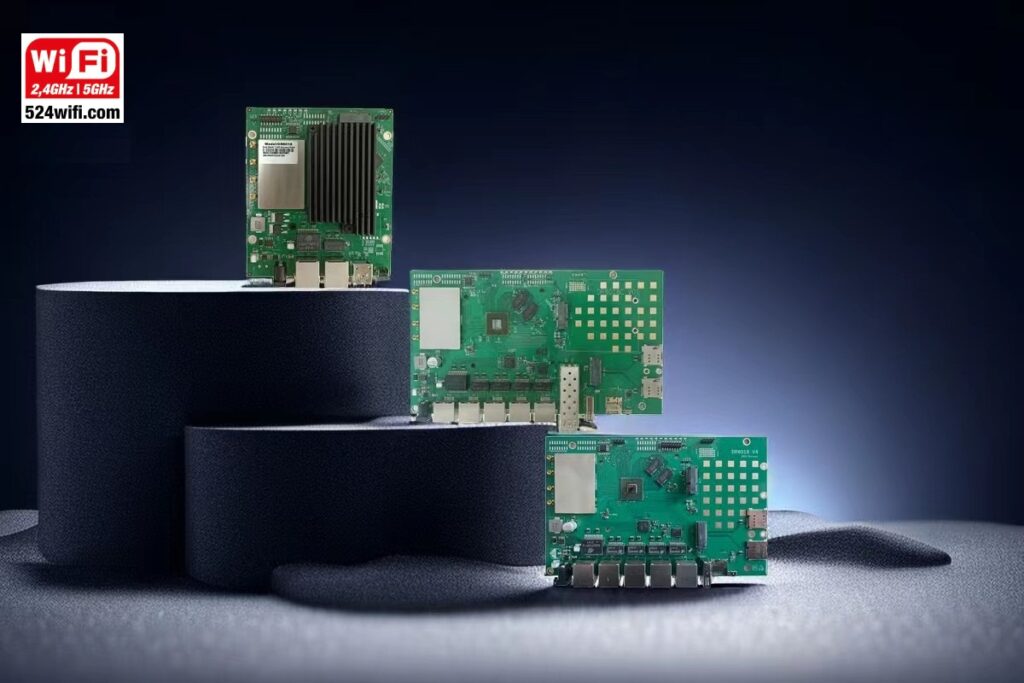
The DR5018S is a compact, feature-rich Wi-Fi 6 routerboard powered by the IPQ5018 SoC, engineered to streamline the development of embedded devices and networking applications.

Overview

Compact. Powerful. Versatile.

The DR5018S is a highly integrated Wi-Fi 6 routerboard driven by the IPQ5018 SoC. Designed to simplify the creation of embedded devices and wireless systems, it’s an ideal solution for a wide range of applications, from IoT to advanced networking. With a high-performance processor, ample memory and storage, and robust networking capabilities, the DR5018S accelerates time-to-market and reduces product costs.

Key features include support for Triband(2.4Ghz,5Ghz,6Ghz) two spatial streams (2×2 MiMo), a 64-bit dual-core ARM Cortex A53 processor with a 1 GHz clock speed, and optional GPS and Bluetooth 5.1 support. Additionally, the DR5018S is compatible with OpenWiFi, providing flexibility for custom wireless solutions.

Wallys also offers OEM/ODM services, allowing customization of the routerboard to SOM modules and other interfaces tailored to your specific project or product design.

Specifications

  • Processor: IPQ-5018 SoC (Maple)
  • CPU: Dual-core 1 GHz ARM Cortex A53
  • Wi-Fi:2×2 MiMo 2.4GHz WiFi 6 radio2x2 MiMo 5GHz WiFi 6 radio2x2 MiMo 6GHz WiFi 6 radio
  • Data Rate:573.5 Mbps (2.4GHz, 1024 QAM, 2SS)Up to 2402Mbps (5GHz, 2×2 On-board radio)Up to 2402Mbps (6GHz, 2×2 On-board radio)
  • Ethernet Interfaces: 2.5G and 1G (customizable)
  • Interfaces: PCIe and mini PCIe for external radio (customizable)
  • Power: Low power consumption
  • Form Factor: Compact size
  • Additional Features:Support for OpenWiFiOptional GPS supportOptional Bluetooth 5.1 support

DR5018S DETAILS

Need Wi-Fi 6 or Wi-Fi 7?

With years of experience in Qualcomm chip hardware and embedded software development, 524WiFi and Wallys offer customized services that help companies bring their products to market quickly and effectively.

We can assist at any stage of product design—from project planning to prototyping, and even mass production. Whether you need a daughterboard with specific requirements and interfaces or a fully custom hardware design, we’re here to help.

Posted on

6GHz Band: A New Era of WiFi

In the ever-evolving realm of wireless technology, the introduction of the 6 GHz band marks a significant milestone, promising a new era of enhanced connectivity and unlocking the potential for transformative advancements in various applications. This newly available frequency range, spanning between 5.925 GHz and 7.125 GHz, offers a plethora of benefits that far exceed those of its predecessors, the 2.4 GHz and 5 GHz bands. The addition of 6GHz into WiFi is poised to revolutionise wireless connectivity.

A Bandwidth Bonanza for Unfettered Data Flow

In today’s digital age, where data-intensive applications and high-resolution content reign supreme, the demand for bandwidth has skyrocketed. The 2.4 GHz and 5 GHz bands, the traditional workhorses of wireless connectivity, have struggled to keep pace with this ever-increasing demand, leading to frustrating congestion and sluggish performance.

At the heart of the 6 GHz band’s allure lies its expansive bandwidth, more than doubling the capacity of the 5 GHz band. This substantial increase in spectrum translates into significantly faster data speeds, enabling users to enjoy seamless video streaming in stunning 4K and 8K resolutions without encountering buffering or lag. Large file transfers can be completed in a fraction of the time, enabling efficient collaboration and data sharing. And immersive virtual reality experiences can be enjoyed without the hindrance of latency or choppy graphics.

Latency Triumphs over Distance: Real-time Applications Thrive

In the realm of real-time applications, where immediacy is paramount, latency, the time it takes for data to travel between devices, emerges as a critical factor. For applications like video conferencing, online gaming, and remote device control, even the slightest latency can lead to noticeable delays, glitches, and an overall diminished experience.

The 6 GHz band, the latest addition to the wireless spectrum, holds the key to conquering latency, offering a significant reduction in lag compared to its predecessors, the 2.4 GHz and 5 GHz bands. This latency reduction stems from several factors:

  • Wider Channels: The 6 GHz band supports wider data channels, allowing for more data to be transmitted in a single go, reducing the number of round trips required for data transfer.
  • Less Congestion: The 6 GHz band is less crowded than the 2.4 GHz and 5 GHz bands, minimising interference and ensuring that data packets reach their destination with minimal delays.
  • Enhanced Technology: The 6 GHz band utilises advanced technologies like Target Wake Time (TWT), which allows devices to negotiate sleep intervals, further reducing network overhead and improving latency.

The impact of reduced latency extends beyond consumer applications and into real-world scenarios that demand instantaneous responsiveness:

  • Autonomous Vehicles: The 6 GHz band is crucial for the development of autonomous vehicles, enabling real-time communication between the vehicle’s sensors, processors, and external infrastructure, ensuring safe and efficient operation.
  • Industrial Automation: In industrial settings, the 6 GHz band facilitates precise control of machinery and robotics, enabling seamless coordination and improved production efficiency.
  • Medical Robotics: Surgical robots, controlled remotely by surgeons, benefit significantly from reduced latency, ensuring accurate and life-saving procedures.

Embracing the Challenges: Navigating the Road Ahead

While the 6 GHz band presents a wealth of opportunities, it is not without its challenges. Device compatibility remains a hurdle, as not all devices currently support this new frequency range. Additionally, the 6 GHz band’s shorter range compared to its predecessors may require strategic router placement to ensure optimal coverage. Finally, regulatory approvals vary across countries, necessitating a cautious approach to deployment.

Despite these challenges, the 6 GHz band represents a significant leap forward in wireless technology, offering a combination of speed, reliability, security, and capacity that was previously unattainable. As device compatibility expands and regulatory approvals are granted, the 6 GHz band is poised to become the backbone of future wireless networks, shaping the way we work, play, and connect.

At Compex, we strive to provide the latest technology to our customers. Compex offers 6GHz WiFi solution for both WiFi 6E and WiFi 7 offering:

  1. WLE3000H56: 4×4 wide band 5-7GHz WiFi 6E module. This is a good solution for customers who are aiming to offer their customers an option of either 5GHz or 6GHz backhaul.
  2. WLE3000H6 (Filter version): 4×4 single band 6GHz WiFi 6E module. This filter version ensures that interference issue will not occur, when WiFi 6E module coexists with another 5GHz module. This is a perfect solution for customers who are aiming for tri-band implementation.
  3. WLE7002E56: 2×2 dual band dual concurrent 5 + 6GHz WiFi 7 module. This is a cost effective solution for customers who need 5 + 6GHz in a single package. This is a good solution for low-cost tri-band WiFi 7 implementation.

All products mentioned above have samples readily available for your testing.

Posted on

WI-Fi 7 module news: Everything you need to know about Compex WLE7002E25D

The future of connectivity is here with Compex! Wi-Fi 7 is set to revolutionize wireless connectivity with its lightning-fast speeds and seamless connectivity. The launch of Compex WLE7002E25D Wi-Fi 7 Dual-Band Dual Concurrent Module delivers enhanced wireless performance and reliability — all at Wi-Fi 6 prices!

Here’s a closer look on what you need to know about this new Wi-Fi Modules:

1. Dual- Band Dual-Concurrent Wi-Fi 7 Module

The new Compex WLE7002E25D is a Dual-Band Concurrent 2.4+5GHz WiFi 7 (802.11be) module, powered by Qualcomm’s QCN6224, QCN6274 or QCN9274 ‘Waikiki’ series radio chipsets, offering 2X2 MU-MIMO.

2. Stardard miniPCIe form factor

The new WLE7002E25D comes in a standard miniPCIe form factor. This means it is readily compatible with existing systems, particularly those devices that use Wi-Fi 4 or Wi-Fi 5 standard miniPCIe modules. This simplifies integration, reduces development costs and accelerates time-to-market.

3. Multi-Link Operation (MLO)

The new WLE7002E25D supports up to 4096 QAMs and features OFDMA and MLO. The new MLO allows devices to connect to the same access point (AP) across multiple channels and different frequency bands simultaneously, increasing throughput, lowering latency and enhancing reliability.

4. Cost-efficient diplexer design

Combines the 2.4GHz and 5GHz signals into a single dual-band antenna, reducing the need for multiple antennas and enhancing the performance and reliability of wireless devices.

5. Open Source Ath12K support

Compatible with Qualcomm and third-party platforms such as Marvell, NXP and x86 platform.

6. Enhanced wireless performance and reliability at Wi-Fi 6 prices

Ideal for enterprise, industrial, cybersecurity, transportation and SMB applications, offering enhanced wireless performance and reliability at competitive prices.

Key Takeaways for the Future

The new WLE7002E25D is an investment in the future. With its cutting-edge technology, comprehensive features and diverse application potential, it is set to redefine the standards of wireless connectivity.

The module is now available for order on our eshop. 

Posted on

Wi-Fi 7 module : 5 Things to Know about Compex WLE7002E25

In today’s hyper-connected world, reliable and high-speed wireless connectivity is no longer a luxury, but a necessity. WiFi standards have evolved rapidly. WiFi 6, which has been around for only a few years, is now being replaced by WiFi 7 or IEEE 802.11be. Equipment manufacturers are now rushing to phase in WiFi 7 products. Compex has released its latest WiFi 7 module WLE7002E25 to help shorten time to market. The Compex WLE7002E25 is a dual band concurrent 2×2 2.4GHz and 2×2 5GHz radio based on Qualcomm’s Waikiki high performance WiFi 7 chipset which is capable of over 10Gbps raw data rate. It is in a stardard miniPCIe form factor.

1. Standard MiniPCIe Form Factor

The standard miniPCIe footprint means that WLE7002E25 is readily compatible with existing systems and designs, particularly customers whose devices have been using WiFi 4 or WiFi 5 standard miniPCIe module. This simplifies integration since device manufacturers do not need to make modifications on their hardware to support a new generation WiFi module, thus reduces development costs and accelerates time-to-market.

Below diagram shows the dimension difference between Qualcomm’s high performance Waikiki M.2 E-key reference design and Compex’s standard size miniPCIe module using the same Waikiki chipset:

2. Lower Power Consumption, Impressive Transmit Power

Compex’s RF engineers set themselves the twin targets of condensing the Qualcomm reference design by about 50% to an industrial standard form factor, as well as reducing its power consumption significantly. Compared with the high performance Qualcomm reference design, Compex is able to achieve the size and consumption targets with a little loss in performance. The following is a comparison of the RF power outputs and consumption between Compex WLE7002E25 and QualcommWK03.2 reference board.

3. Multi-Link Operation (MLO)

An Important differentiator of WiFi 7 to WiFi 6 is MLO (Multi Link Operation). This allows a client to connect to the AP through multiple bands simultaneously. This has significant advantage in reducing latency. Latency is of critical importance to interactive applications such as games, robotics, real-time translation, teleconferencing and etc.

Compex’s WLE7002E25 supports MLO between its 2.4GHz and 5GHz bands. It also implements MLO signals between adapters to support MLO between the WLE7002E25 and other WiFi 7 modules such as Compex’s 4×4 6GHz module WLE7000E6.

4. Open Source Ath12k Support on Foreign Platform

Compex Systems recognize the importance of supporting customers’ products integration with open source ath12k. Ath12k integration support for non-Qualcomm platforms such as x86 embedded boards is also available.

5. Competitive Pricing

Compex’s WLE7002E25 is only marginally more expensive than WiFi 6 products of similar configurations. This is to encourage direct migration from WiFi 4 and WiFi 5 to WiFi 7, skipping the WiFi 6 development time and costs.

Investing in the Future

The Compex WLE7002E25 represents more than just a Wi-Fi module; it’s an investment in the future. With its cutting-edge technology, comprehensive features, and diverse application potential, the Compex WLE7002E25 stands poised to rewrite the rules of wireless connectivity.

Posted on

Analyzing Efficiency:QCN6224 vs QCN6274 WiFi7 chipset

Analyzing Efficiency:QCN6224 vs QCN6274 WiFi7 chipset

In the rapidly evolving landscape of wireless technology, the choice of chipset can significantly impact the efficiency and performance of devices. As WiFi 7 emerges as the next frontier in connectivity, it becomes paramount to discern between leading chipsets like the QCN6224 and QCN6274. In this article, we’ll delve into a comprehensive comparison of these two powerhouse chipsets, focusing on their efficiency and how it translates into real-world benefits for users.

1. Speed and Throughput

The QCN6224 and QCN6274 both boast impressive speed capabilities, but nuances exist in their throughput performance. While the QCN6224 may excel in certain scenarios with its optimized data transfer rates, the QCN6274 might offer superior throughput under specific conditions. Understanding these distinctions is crucial for users seeking optimal performance in high-demand environments.

2. Range and Coverage

Efficiency extends beyond raw speed, encompassing factors like range and coverage. Here, the QCN6274 often demonstrates a slight edge, leveraging advanced signal processing techniques to extend the reach of WiFi signals. For users prioritizing seamless connectivity across expansive spaces, the QCN6274’s enhanced coverage capabilities could prove instrumental.

3. Power Consumption

In the era of mobile devices and IoT ecosystems, power efficiency is paramount. Both chipsets are engineered with power-saving features, but subtle differences may influence their efficiency profiles. The QCN6224, for instance, might strike a balance between performance and power consumption suitable for compact devices, whereas the QCN6274 could cater to applications demanding ultra-low power consumption without compromising performance.

4. Advanced Features

Beyond basic connectivity, modern chipsets offer an array of advanced features enhancing efficiency and functionality. MU-MIMO, beamforming, and advanced security protocols are among the features integrated into both the QCN6224 and QCN6274. Delving into the specifics of these features and how they’re implemented can provide insights into each chipset’s efficiency in diverse usage scenarios.

5. Compatibility and Scalability

Efficiency encompasses compatibility with existing infrastructure and scalability for future advancements. Assessing the compatibility of each chipset with different devices and network configurations is crucial for seamless integration. Moreover, understanding the scalability of these chipsets ensures future-proofing against evolving connectivity standards and requirements.

6. Real-world Performance

While specifications provide a foundational understanding, real-world performance ultimately determines user experience. Analyzing performance benchmarks, user reviews, and case studies can offer invaluable insights into how each chipset performs in practical scenarios. Identifying use cases aligned with one’s specific requirements is key to leveraging the efficiency benefits of these chipsets effectively.

In conclusion, the QCN6224 and QCN6274 stand as exemplars of efficiency in the realm of WiFi 7 chipsets. By dissecting their speed, range, power consumption, features, compatibility, and real-world performance, users can make informed decisions tailored to their unique needs. Whether optimizing for speed, coverage, or power efficiency, understanding the nuances between these chipsets empowers users to harness the full potential of WiFi 7 technology.

524WiFi and Wallystech,specialize in research and developmen,production of wireless communication products. Excel in providing industrial-grade APs, router boards, and network cards based on Qualcomm chip solutions, covering WiFi 5, WiFi 6, and WiFi 7 technologies. Our expertise extends to offering both standardized solutions and customized options tailored to meet specific requirements. Don’t hesitate to contact us with your precise needs, and let us assist you in finding the perfect solution for your wireless communication challenges!

Posted on

IPQ9574 vs. IPQ4019 in Real-World Applications

Interconnectivity of Industrial Equipment: IPQ9574 vs. IPQ4019 in Real-World Applications

In the rapidly evolving landscape of industrial automation and the Industrial Internet of Things (IIoT), robust and reliable network connectivity is crucial. The choice of a network chipset can significantly impact the performance, scalability, and reliability of industrial equipment. This article compares two popular Qualcomm chipsets, the IPQ9574 and IPQ4019, examining their suitability for various industrial applications.

Overview of IPQ9574 and IPQ4019

IPQ9574: The Qualcomm IPQ9574 is a high-performance chipset designed for advanced networking applications, particularly Wi-Fi 7. It features a quad-core Cortex-A53 processor clocked at 2.2 GHz, supporting Wi-Fi 7 (802.11be) with tri-band capabilities, including the new 6 GHz band. It offers enhanced throughput, low latency, and high capacity, making it ideal for dense environments with numerous connected devices.

IPQ4019: The Qualcomm IPQ4019 is a more mature chipset, featuring a quad-core ARM Cortex-A7 processor clocked at 717 MHz. It supports dual-band Wi-Fi 5 (802.11ac) and is widely used in various networking applications due to its balance of performance and cost-effectiveness.

Application 1: High-Performance Industrial Gateways

Industrial gateways act as the central hub for communication between field devices and cloud services. The IPQ9574, with its powerful processing capabilities and tri-band Wi-Fi 7 support, excels in environments requiring high throughput and low latency. It can handle multiple simultaneous connections and data-intensive applications more efficiently than the IPQ4019, which, while reliable, may struggle with high data loads due to its lower processing power and Wi-Fi 5 limitations.

Application 2: Smart Manufacturing

In smart manufacturing, real-time data processing and communication are vital. The IPQ9574’s advanced features enable seamless connectivity and faster data exchange between machines, sensors, and control systems. Its support for Wi-Fi 7 reduces congestion and interference, ensuring reliable performance in a crowded industrial environment. The IPQ4019, while adequate for less demanding applications, may not provide the same level of performance in high-density settings.

Application 3: Factory Automation

Factory automation relies heavily on reliable network connectivity to synchronize operations and improve efficiency. The IPQ9574’s superior processing power and advanced Wi-Fi capabilities offer a significant advantage in these scenarios, ensuring smooth and uninterrupted communication between automated systems. The IPQ4019, though capable, may face challenges in handling the increased data traffic and connectivity demands of a fully automated factory.

Application 4: Warehouse Management

In warehouse management, robust and scalable network solutions are essential to support inventory tracking, automated guided vehicles (AGVs), and other smart systems. The IPQ9574’s high throughput and low latency are beneficial for real-time inventory management and AGV navigation. The IPQ4019 can support basic warehouse operations but may not deliver the same performance in a high-traffic, dynamic environment.

Application 5: Industrial Robotics

Industrial robots require reliable and low-latency connectivity to perform precise operations. The IPQ9574, with its enhanced Wi-Fi 7 support, ensures stable and fast communication, reducing downtime and improving productivity. The IPQ4019, while suitable for less complex robotic applications, may not provide the same level of performance in environments with multiple robots and high data exchange requirements.

Application 6: Smart City Infrastructure

Smart city infrastructure demands robust and scalable network solutions to support various applications, from traffic management to public safety. The IPQ9574’s advanced capabilities make it ideal for handling the high data loads and numerous connections required in smart city deployments. The IPQ4019 can support smaller-scale applications but may struggle with the extensive connectivity and performance demands of a fully developed smart city infrastructure.

Application 7: Remote Industrial Monitoring

Remote monitoring of industrial sites requires reliable and secure network connectivity to ensure continuous data transmission. The IPQ9574’s enhanced processing power and tri-band support provide robust performance for remote monitoring applications, even in harsh environments. The IPQ4019, while reliable, may not offer the same level of performance and scalability for remote monitoring over large areas or multiple sites.

Application 8: High-Density Client Environments

In high-density client environments, such as industrial plants with numerous connected devices, the IPQ9574’s advanced Wi-Fi 7 capabilities and high processing power provide a significant advantage. It can manage more connections simultaneously with lower latency compared to the IPQ4019, which may experience performance bottlenecks in such demanding settings.

Application 9: Interconnectivity of Industrial Equipment

Interconnecting various industrial equipment requires a network solution that can handle diverse communication protocols and high data volumes. The IPQ9574’s superior performance and advanced features make it well-suited for this task, ensuring seamless communication between different types of equipment. The IPQ4019, while capable of supporting basic interconnectivity, may not deliver the same level of performance in more complex and data-intensive environments.

Application 10: Real-World Performance and Scalability

In real-world applications, the scalability and performance of the network solution are critical. The IPQ9574, with its high processing power and advanced Wi-Fi capabilities, offers better scalability and performance for growing industrial networks. The IPQ4019, though cost-effective, may require more frequent upgrades and optimizations to meet the evolving demands of industrial applications.

524WiFi and Wallys Solutions: IPQ9574 and IPQ4029

524WiFi offers advanced solutions based on both IPQ9574 and IPQ4029 chipsets, catering to various industrial needs. The DR9574 board leverages the power of the IPQ9574 chipset, providing unparalleled performance and scalability for high-demand environments. It features 4×4 2.4G, 4xM.2 slots, and multiple Ethernet ports, making it a versatile choice for industrial applications. More details can be found here.

For those seeking a cost-effective solution without compromising on reliability, the DR40X9 board based on the IPQ4029 chipset is an excellent choice. It supports dual-band 802.11AC Wave2 MU-MIMO and onboard WiFi radio, and can be embedded with LTE. This makes it a suitable option for industrial parks with moderate network demands. More information is available here.

Conclusion

Both the IPQ9574 and IPQ4019 have their strengths and are suited for different types of industrial applications. The IPQ9574, with its advanced features and higher performance, is ideal for demanding environments requiring robust and scalable network solutions. The IPQ4019, on the other hand, provides a reliable and cost-effective solution for less demanding applications. When choosing between the two, it’s essential to consider the specific requirements and constraints of your industrial environment to ensure optimal performance and connectivity.

Posted on

524WiFi 6 Dream and Driver DR5018M: High-Performance WiFi 6 Routerboard for Industrial Applications

DR5018M: High-Performance WiFi 6 Routerboard for Industrial Applications

In modern industrial settings, the demand for reliable and high-speed wireless communication is ever-increasing. Wallys Communications offers the DR5018M, a WiFi 6 routerboard designed to meet these needs. This board integrates Qualcomm’s IPQ5018 chipset, providing robust performance and advanced features tailored for challenging industrial environments.

Key Features of the DR5018M

Advanced Processor

The DR5018M is powered by the Qualcomm IPQ5018, a dual-core ARM 64-bit A53 processor clocked at 1.0GHz. This ensures high processing power for handling multiple tasks and maintaining stable connections under heavy loads.

Exceptional Wireless Performance

The routerboard supports 2×2 MU-MIMO and OFDMA technologies, which enhance data transmission efficiency and network capacity. With onboard 2.4GHz radio, it delivers up to 573Mbps physical data rate, suitable for high-bandwidth applications like video streaming and data transmission in factories and warehouses.

Long-Distance PTP Transmission

The DR5018M excels in long-distance Point-to-Point (PTP) transmission:

  • 3.3KM Test:5GHz: 949Mbps6GHz: 821Mbps
  • 1.5KM Test:5GHz: 1.5Gbps6GHz: 1Gbps

These capabilities make it ideal for large industrial sites requiring extensive wireless coverage.

Flexible Connectivity Options

The DR5018M includes multiple M.2 slots for various radio cards (QCN9074 for WiFi 6E, QCN6122 for 6GHz, and QCN6102 for 5GHz), providing flexibility to meet different frequency band requirements. Additionally, it features a 1Gbps Ethernet port, USB 3.0, and PCIe 3.0 interfaces for versatile connectivity.

Enhanced Security with WPA3

Security is a top priority in industrial networks. The DR5018M supports WPA3 encryption, offering:

  • Stronger encryption protocols for enhanced data security.
  • Improved protection against brute-force attacks.
  • Secure, individualized encryption for each device on the network.

Rugged Design for Industrial Use

Designed to withstand harsh industrial conditions, the DR5018M operates within a wide temperature range (-40°C to 70°C) and humidity levels (5% to 95% non-condensing), ensuring reliability in various environments.

Industrial Applications

Factory Automation

The DR5018M provides stable, high-speed wireless connections for automated production lines, supporting real-time data transmission and control.

Smart Warehousing

It enables efficient operation in smart warehouses by supporting numerous concurrent connections and high data throughput.

Industrial Surveillance

With its robust wireless performance, the DR5018M supports high-definition video streaming and real-time monitoring, essential for surveillance systems.

Remote Monitoring and Control

The long-distance PTP capabilities make it perfect for remote monitoring and control applications, ensuring reliable communication across vast industrial sites.

Conclusion

DR5018M routerboard combines high-performance wireless technology with robust security features, making it an ideal choice for industrial applications. Its powerful IPQ5018 processor, excellent long-distance transmission capabilities, and support for WPA3 encryption ensure that it meets the demanding needs of modern industrial environments.

For more information or to inquire about our products, please contact us .

Posted on

Revolutionizing Connectivity: WiFi 6, OpenWiFi, and the QCA IPQ6010 DR6018 board

In an era where connectivity is paramount, the evolution of wireless networking technology never ceases to amaze. WiFi 6, also known as 802.11ax, represents the latest leap forward, building upon the strong foundation laid by its predecessor, WiFi 5 (802.11ac), and introducing a host of groundbreaking enhancements.

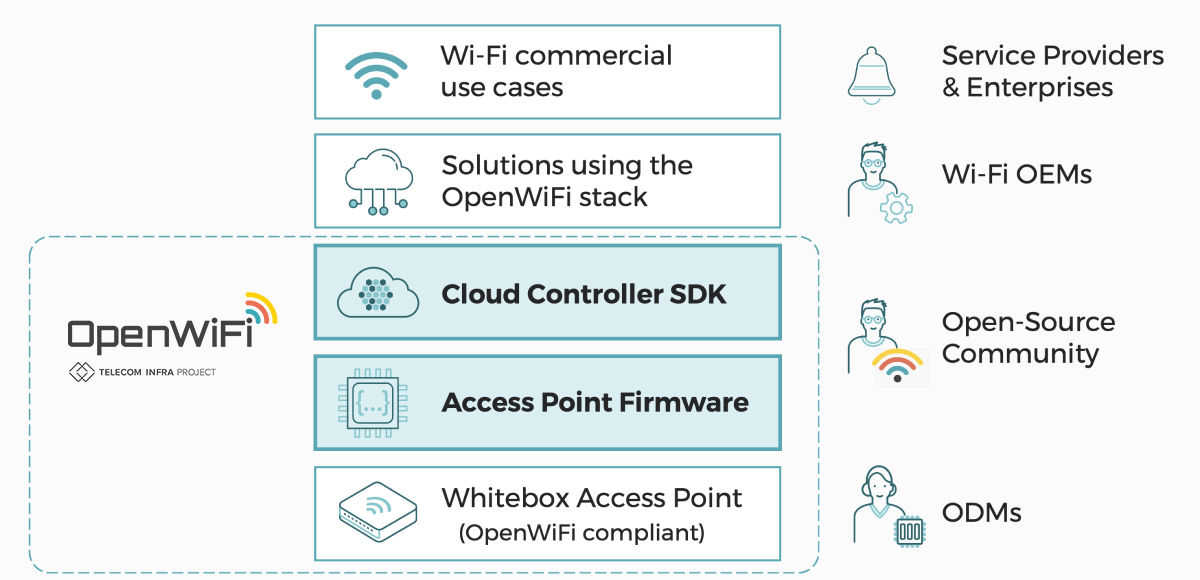
But WiFi 6 isn’t the only star of the show. Enter OpenWiFi, an industry movement that’s reshaping the landscape of Wi-Fi infrastructure innovation. OpenWiFi is an open-sourced, community-driven Wi-Fi software system, comprising a cloud controller SDK and enterprise-grade Access Point (AP) firmware, meticulously designed to work in perfect harmony.
The Power of OpenWiFi

OpenWiFi is a game-changer in several aspects:

  1. Cost-Efficiency: Developing enterprise-grade Wi-Fi solutions can be a costly endeavor. OpenWiFi significantly reduces R&D costs, empowering both existing and new suppliers to deliver top-notch Wi-Fi products with less development effort.
  2. Accelerated Innovation: OpenWiFi fosters open innovation by providing a common foundation for suppliers and service providers. With shared control, data, and management layers, the focus shifts from reinventing Wi-Fi basics to service innovation.
  3. Seamless Integration: The cloud controller SDK offers open north-bound APIs, enabling over-the-top Wi-Fi applications to integrate effortlessly with multiple vendor solutions. This not only saves integration costs but also accelerates time to market.
  4. Economic Benefits: For service providers and enterprises alike, OpenWiFi translates into substantial savings. With reduced deployment costs (CAPEX) and automation-driven operational efficiency (OPEX), the Total Cost of Ownership (TCO) drops significantly compared to proprietary solutions.
  5. Diverse Choice: OpenWiFi offers a wide selection of cloud controllers and access points from multiple vendors, providing flexibility and choice in enterprise-grade Wi-Fi infrastructure.

Meet the QCA IPQ 601 DR6018 board from Wallys

Empowering the OpenWiFi revolution is the Wallys DR6018—an industrial-grade, concurrent dual-band Wi-Fi 6 Routerboard. Let’s explore what makes it a standout choice:

  • Processing Prowess: Equipped with the Qualcomm-Atheros IPQ6010, a quad-core ARM 64-bit A53 processor running at 1.8GHz, it’s designed for exceptional performance.
  • Ample Memory: With 1GB of DDR3L system memory and a clever memory bus design, it’s ready for demanding networking tasks.
  • Wireless Wizardry: Onboard 2×2 2.4GHz and 5GHz radios with support for MU-MIMO and OFDMA technologies deliver top-tier wireless performance.
  • Connectivity Galore: Multiple Ethernet ports, including a 2.5Gbps Ethernet port, offer a wealth of wired connectivity options.
  • POE Versatility: Whether you need passive POE or active POE (802.3bt), the DR6018 has you covered.
  • Compact Form: At 185mm x 116mm, it packs power into a compact design.

Unlocking New Possibilities

What’s truly remarkable is that the DR6018 series routers have recently undergone rigorous long-distance testing, achieving an astonishing 23 km long-distance transmission.

To explore how the Wallys DR6018 can transform your connectivity, check out WallysTech.

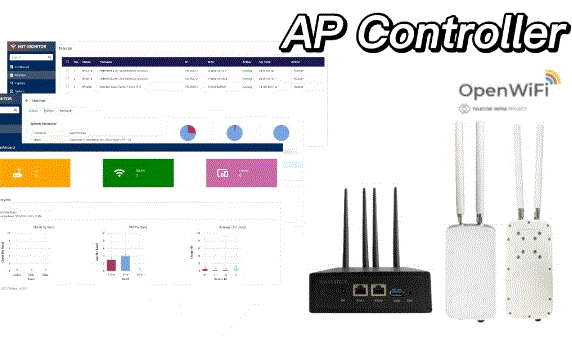
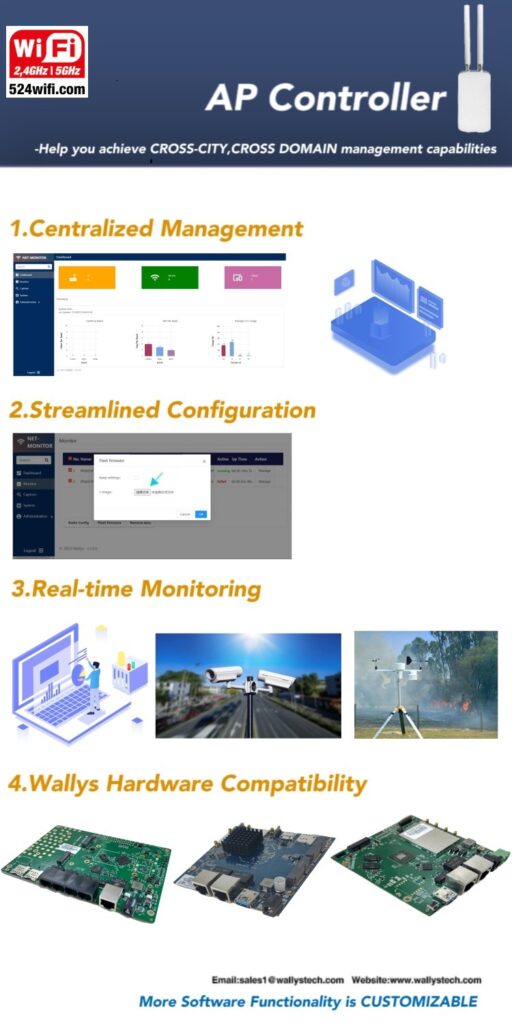
Furthermore, 524WIFI and Wallystech offers the opportunity to customize your own AC+AP Solution (AP Controller). Their AC software is designed to enable cross-city, cross-domain management capabilities, with customizable special functions. Reach out to our sales team to learn more.

Posted on

How to use QCA QCN DR 9074 TriBand 4×4 Wlan module on QCA based PCBA board or a third party x86 ecosys like Ubuntu?

NEW 524 WIFI DUAL BAND TRI-BAND DR9074 WIFI 6/6E MODULES INFO – “WE CAN HELP OUR CUSTOMERS DEVELOP ATH11K TO BE USED WITH DR9074 CARDS” :

Informations regarding Linux and OpenWRT drivers – The ath11k code from github can’t support the dual / tri band card now, it needs modification. Wallystech and 524WiFi did some changes and applied in Linux kernel version 5.17.0 – if you use different kernel version, then 524WiFi will do some work for you. That is a Linux issue, there are some incompatible with different kernel versions. So the Customer need tell us the kernel version, then we release the ath11k and board-2.bin, bdf and amss.bin to customer – all is binary. Jason, chief of development, told us : “We will build it based on the Customer’s Linux version, The kernel should be 5.17 up. The Card can be AP or Client mode on x86. We do it better than others, DR9074 Triband and Dualband cards are very good and its is powerful opportunity for all customers developing WiFi6 devices. We have software engineers and we we have resources to support all Customers tu use our WiFI6 modules“

If The Customer has big volume order, then we can open the ath11k code to the customer customer based on NDA, SLA.

NEW WIFI 6 TRIBAND AND DUAL BAND MODULES LIST. 

HOW TO USE 524WIFI 6 DR9074-TRIBAND M.2 WIFI MODULE TOGETHER WITH WALLYS ROUTER PCBA OR A THIRD PARTY X86 ECOSYS LIKE UBUNTU? AND LOADING QCN9024 QCN9074 – DR9074-TRIBAND DRIVER ON LINUX 5.17.0 – STEP-BY-STEP GUIDE !


As you know, 524WiFI recently has launched two new unique Wifi modules DR9074-Triband M.2 and DR9074E – Dual Band miniPCIe,Today, this article will present how to use the module together with target platform. OpenWRT systems also use ath11k, so the information above is same for OpenWRT users.


(1) USAGE WITH WALLYS ROUTER PCBA WITH QCA IPQ 6018 CPU AND QSDK FIRMWARE :


DR6018 PCBA x1 (the board has to be pre-flashed with an exclusive version of firmware which
we developed via QSDK and bootargs has been pre-set under U-boot CLI to ensure the correct
board_id for the module )
DR9074-Triband M.2 wifi module x1

wallys pcba router board with the module

After we plug the module onboard and power on, we can access to the GUI webpage via board’s default ip address 192.168.1.1, login (admin / asdf1234)

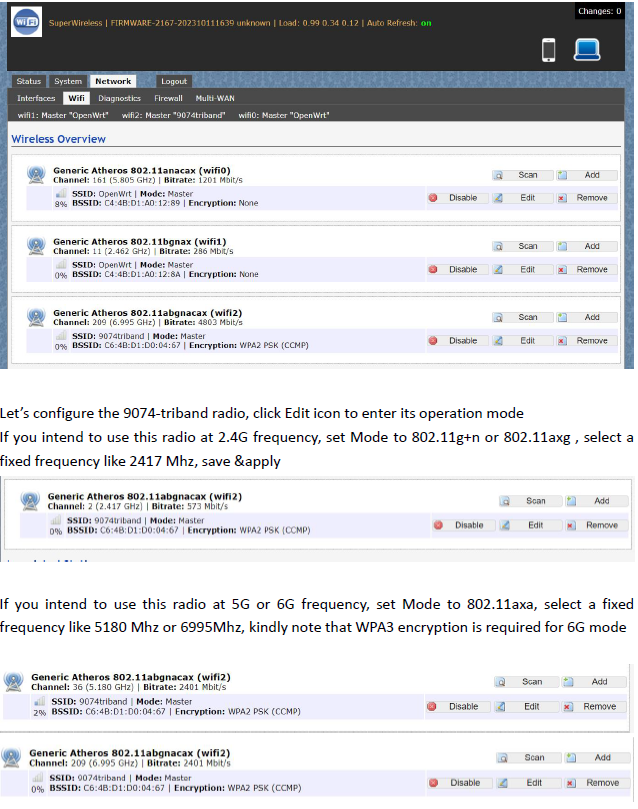
Network>Wifi, at this section, as we can see, there are three radios available, they are Wifi0(2.4G radio),Wifi1(2.4G radio), Wifi2(9074-triband selectable radio)

Let’s configure the 9074-triband radio, click Edit icon to enter its operation mode. If you intend to use this radio at 2.4G frequency, set Mode to 802.11g+n or 802.11axg , select a
fixed frequency like 2417 Mhz, save &apply

config page

If you intend to use this radio at 5G or 6G frequency, set Mode to 802.11axa, select a fixed frequency like 5180 Mhz or 6995Mhz, kindly note that WPA3 encryption is required for 6G mode

Bitrate can be up to 4803Mbit/s under 160Mhz channel spectrum width, both 5G and 6G mode support 160Mhz channel spectrum width. And the 9074-triband module can work under both ap and sta mode

tri band selectabl config

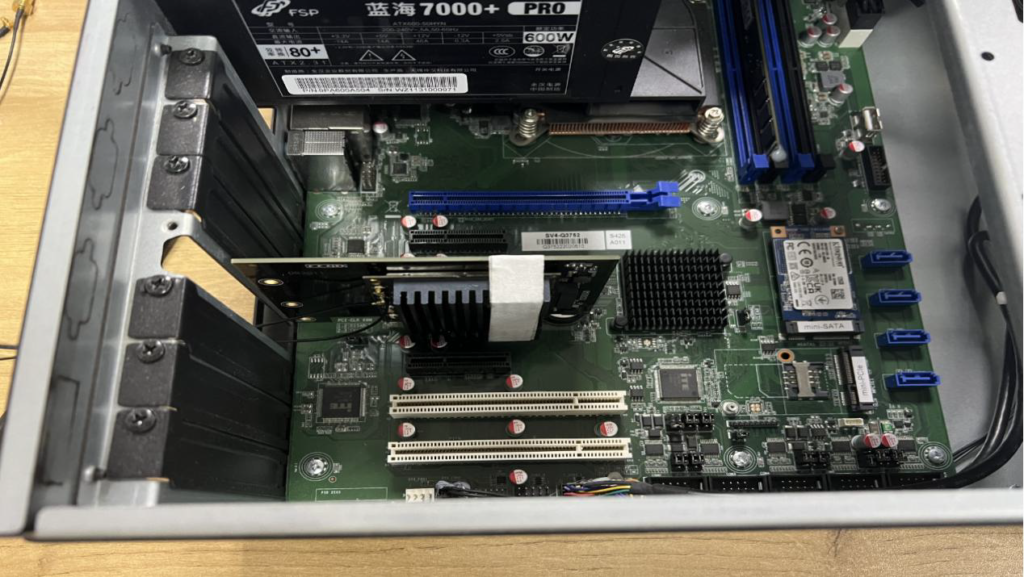
(2) USAGE WITH X86 PLATFORM UBUNTU


Desktop PC x1 installed Ubuntu 22.04
DR9074-triband module x1
DR3G11 adpater x1 – https://www.524wifi.com/index.php/catalogsearch/result/?q=dr3g11

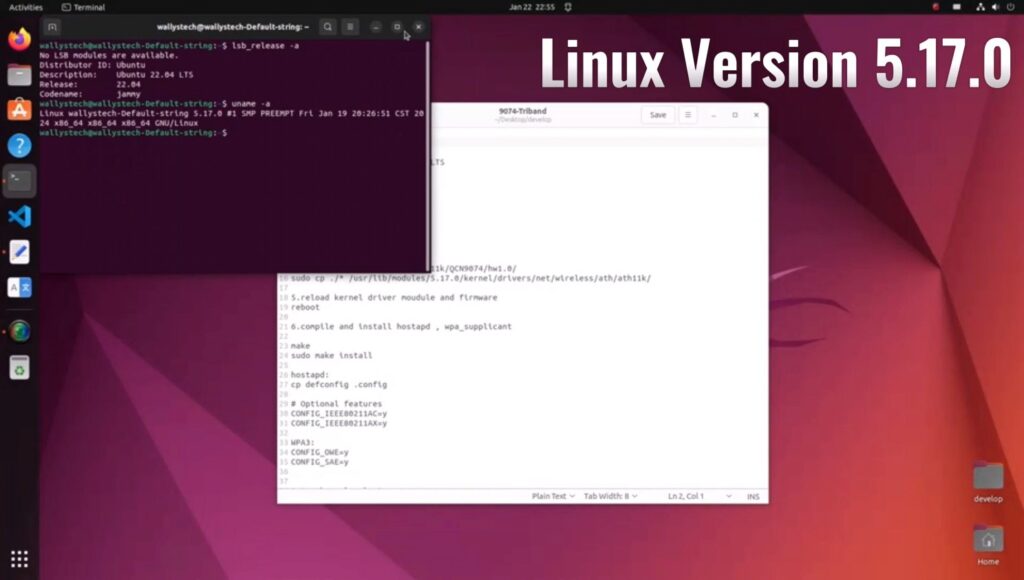
The kernel version is 5.17.0 which integrated ath11k driver
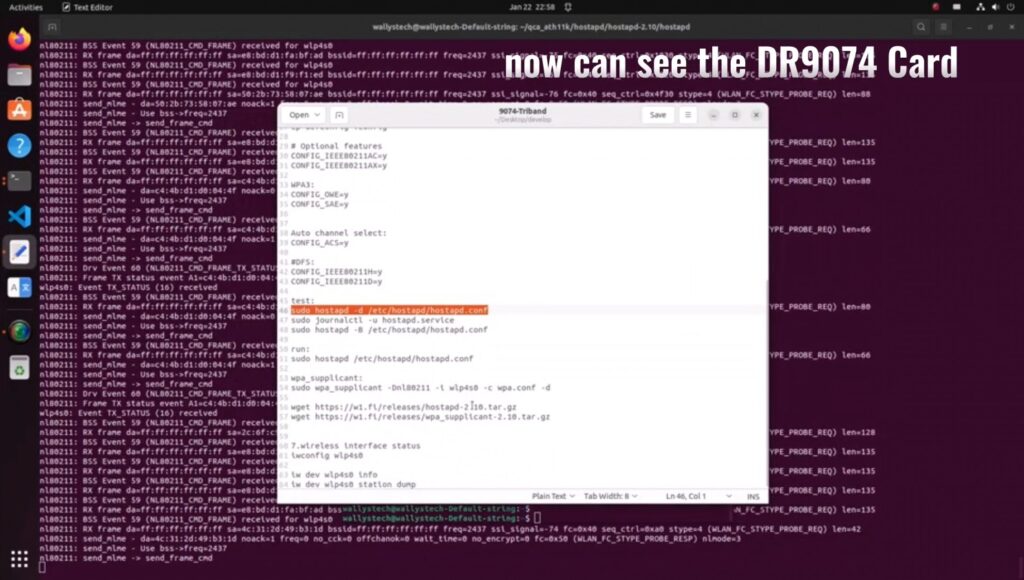
Use this command ‘sudo hostapd -dd /etc/hostapd/hostapd.conf ’to enable the module under AP mode

UBUNTU system config

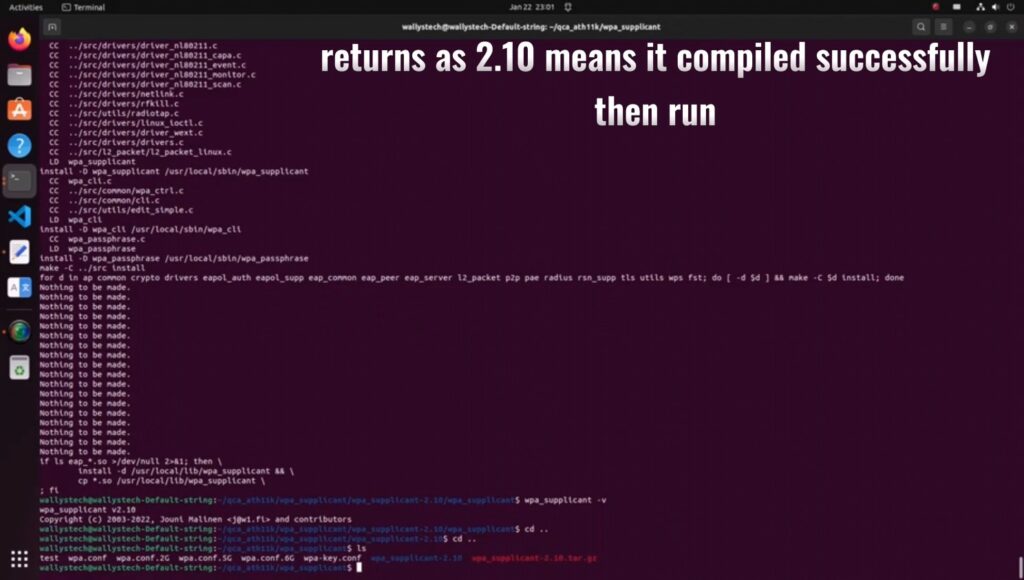
The module can work under STA mode as well, and this command need to be run ‘ sudo wpa_supplicant -Dnl80211 -i wlp4s0 -c wpa.conf’
If you are interested in the product or have any technical questions, feel free to reach out 524WiFi or Wallys team

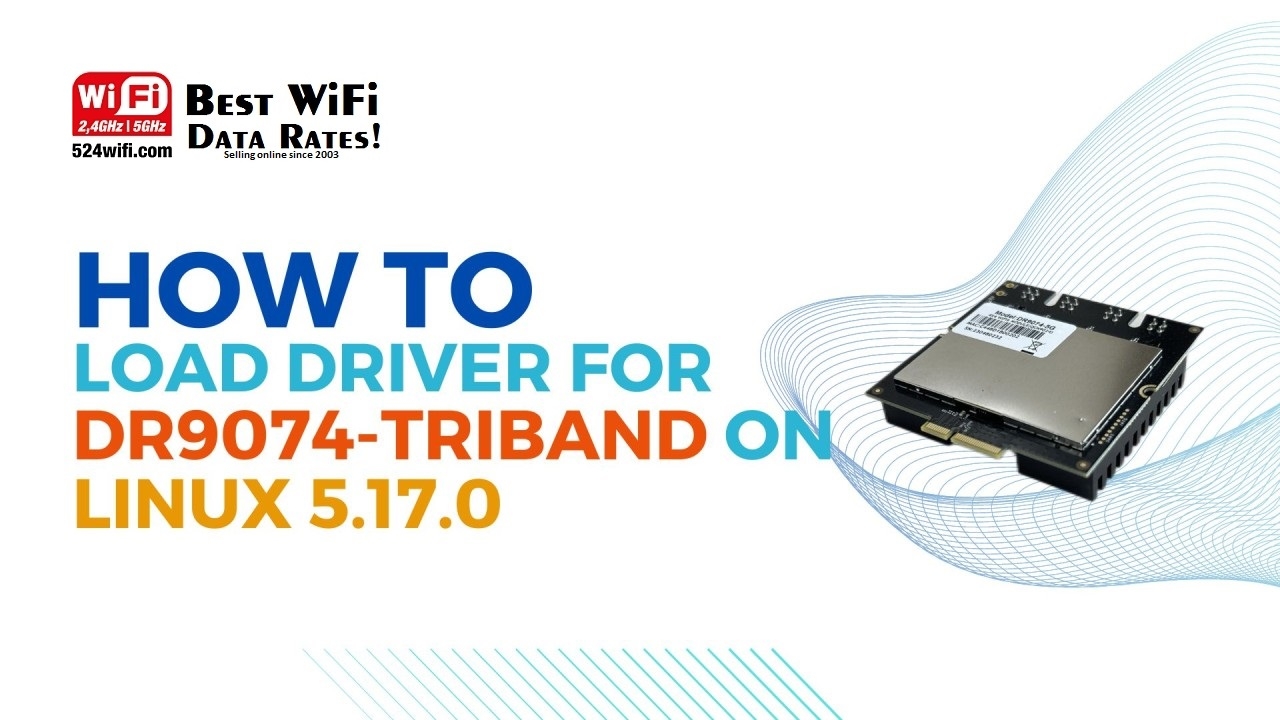
QCN9024 QCN9074 | LOADING DR9074-TRIBAND DRIVER ON LINUX 5.17.0 – STEP-BY-STEP GUIDE 

how to load driver linux

Wallys recently announced the compatibility of DR9074-TRIBAND with ATH11K on Linux, expanding its support beyond Qualcomm platforms to various Linux embedded systems, including Ubuntu. In this guide, we’ll walk you through the process of loading the driver for DR9074-Triband on Linux 5.17.0, demonstrating its seamless integration with ath11k. The module is showcased to function effectively in both AP (Access Point) and STA (Station) modes across the 2.4GHz, 5GHz, and 6GHz bands.

INTRODUCTION TO DR9074 (QCN9024):

DR9074-Triband equipped with the Qualcomm Atheros QCN9024 chipset, is an advanced enterprise wireless module. It incorporates a 4×4 MU-MIMO Dual Band Wireless Module, tailored for mobile access in high-bandwidth applications such as video streaming, voice communication, and data transmission. Key features include a maximum power of 23 dBm per chain, supporting data rates up to 4949Mbps. Operating in Tri-Band (2.4GHz, 5GHz, and 6GHz) with 4×4 WiFi 6E (802.11ax) and 4 spatial streams, it features an M.2 E Key Interface and PCI Express 3.0 Interface. Applications span security surveillance, commercial radio coverage, hotel wireless setups, and specialized scenarios.

Device Specifications:

  • Chipset: Qualcomm Atheros QCN9024
  • WLAN Host Interface: PCI Express 3.0
  • Frequency Range: 2.412GHz-2.472GHz & 5.18GHz-5.825GHz & 5.925GHz-7.125GHz
  • Data Rates: Maxim 23dBm per chain, up to 4949Mbps
  • Channel Spectrum Widths: Support 20/40/80/160MHz
  • Modulation Techniques: OFDMA, including BPSK, QPSK, DBPSK, DQPSK, 16-QAM, 64-QAM, 256-QAM, 1024-QAM, 4096-QAM
  • Temperature Range: Operating: -20°C to 70°C, Storage: -40°C to 90°C
  • Humidity: Operating: 5% to 95% (non-condensing), Storage: Max. 90% (non-condensing)
  • Certification: TBD
  • Reference Design: PN02.7
  • Power Consumption: TBD
  • Dimensions (WxHxD): 57mm x 63mm x 6mm

Device Setup:

  • PC with Linux 5.17.0
  • Adapter card (1pc)
  • DR9074-Triband (1pc)

Driver Loading Steps:

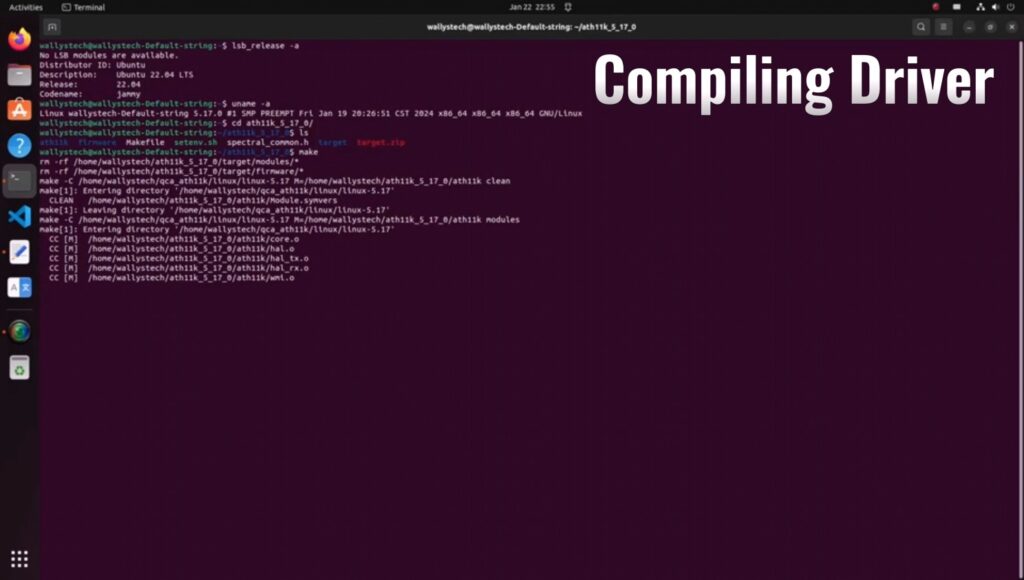
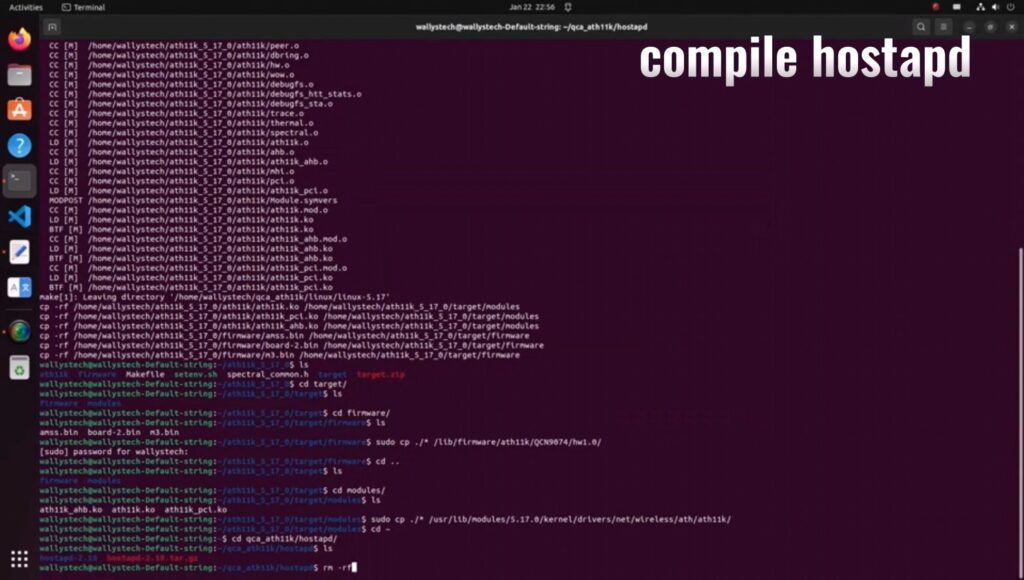
Compile the driver.

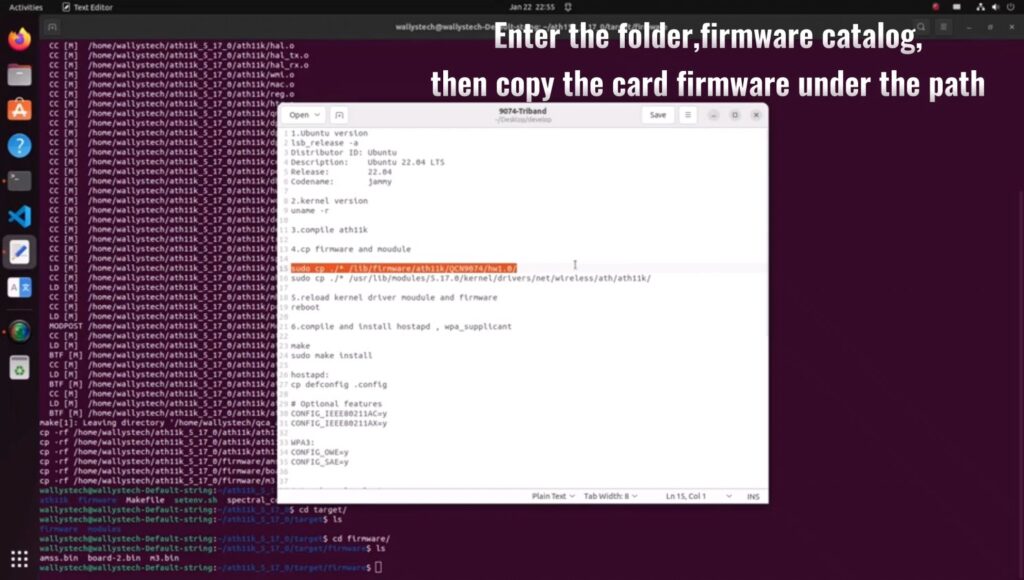
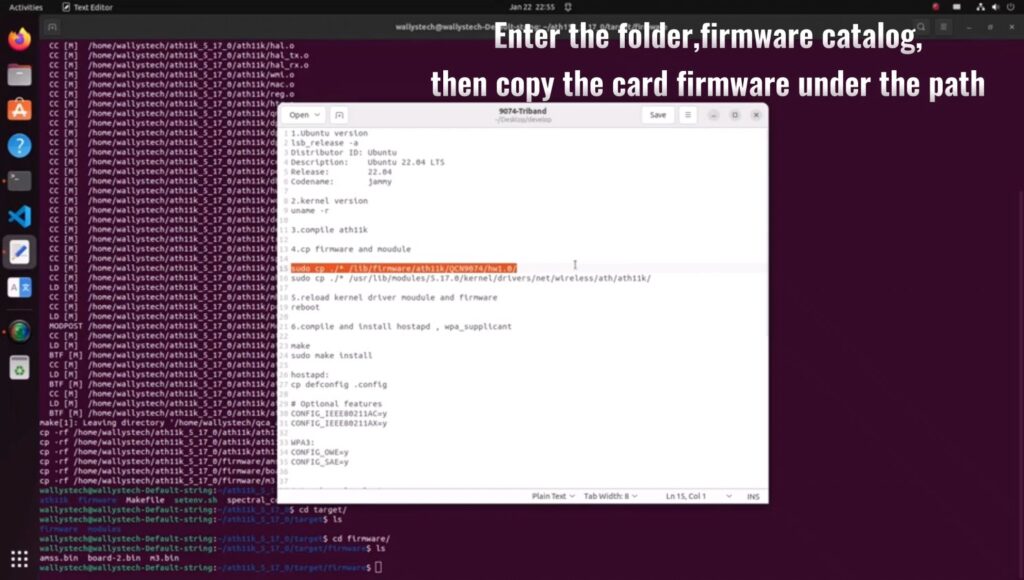
Navigate to the firmware folder and copy the card firmware.

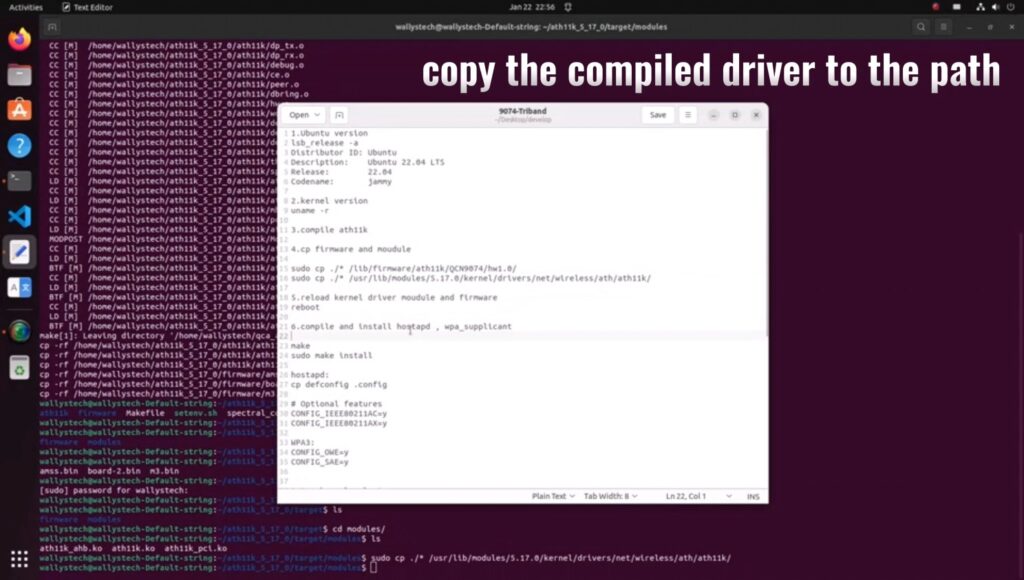
Copy the compiled driver to the designated path.

Compile hostapd.

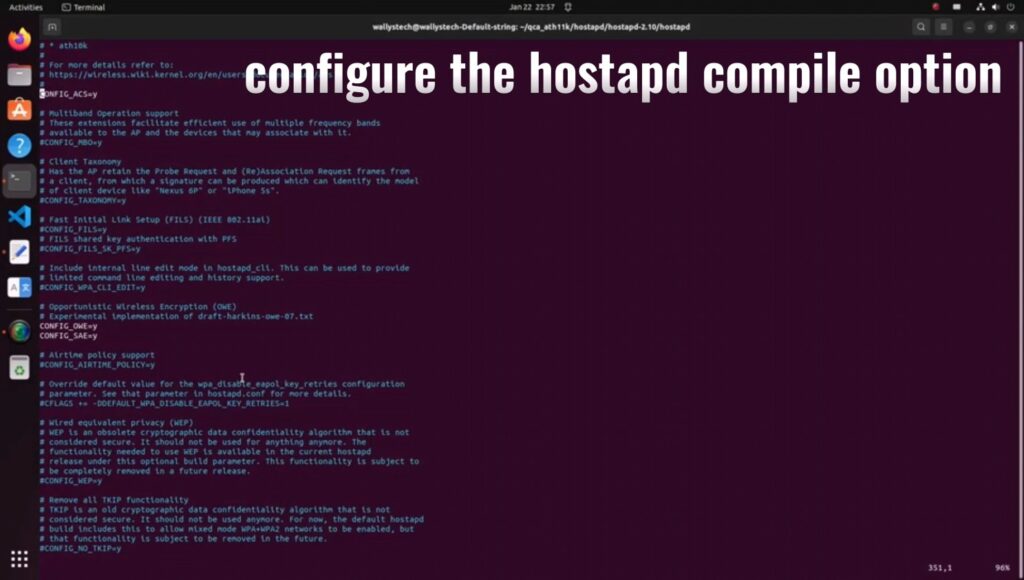
Configure hostapd compile option

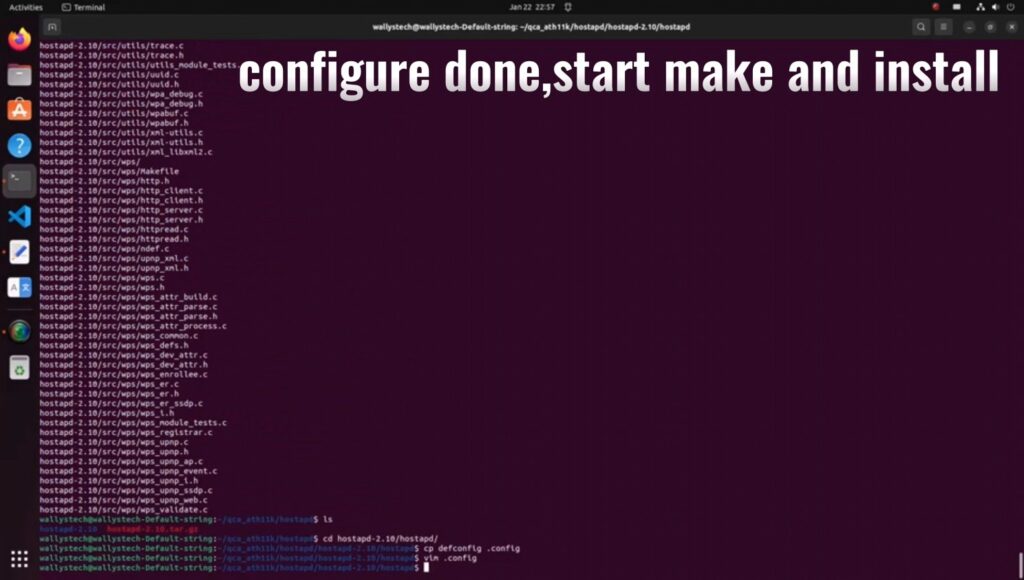
Complete configuration, commence making, and install.

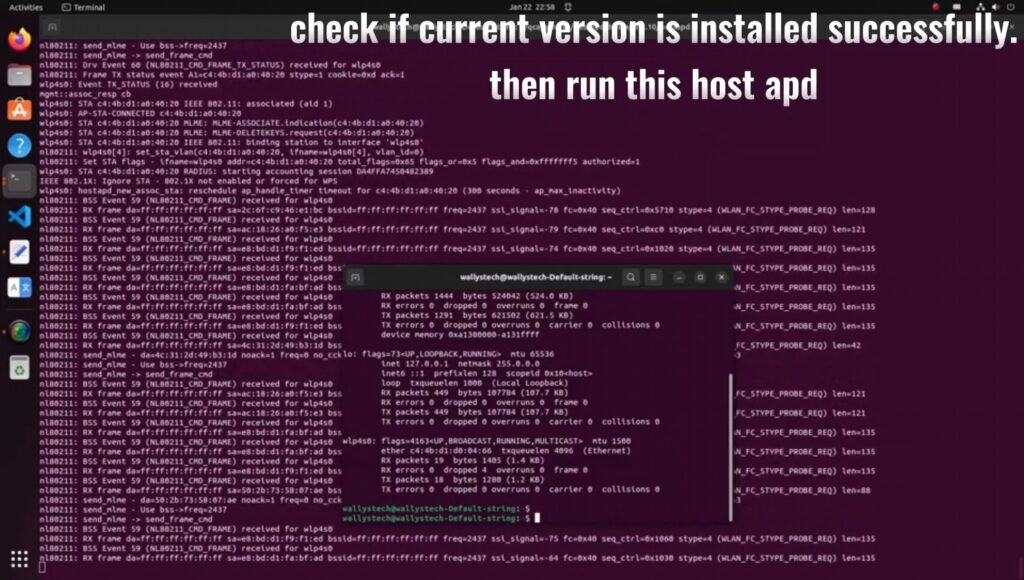
Verify the successful installation of the current version, then run hostapd.

Confirm the presence of the DR9074 card.

Validate the functionality of 2.4G/5G/6G under AP mode.

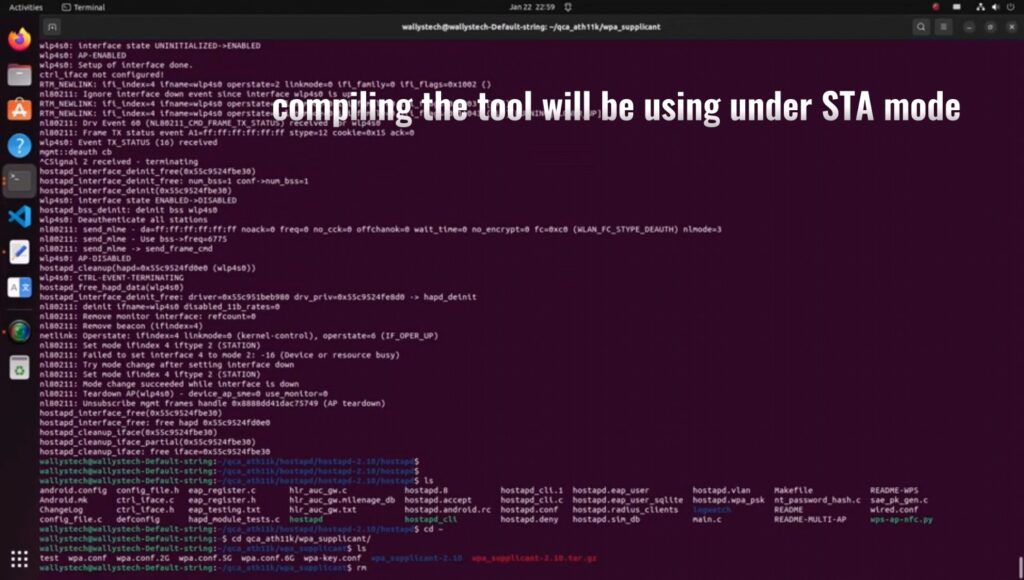
Compile the tool for STA mode and configure compile options.

Finish compilation, check the version (returns as 2.10 for successful compilation), then run.

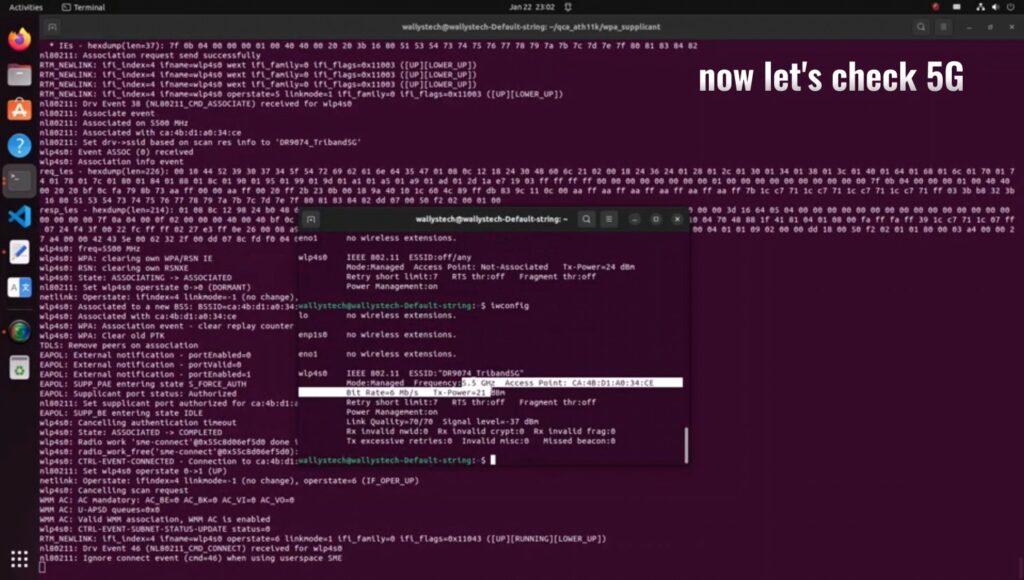
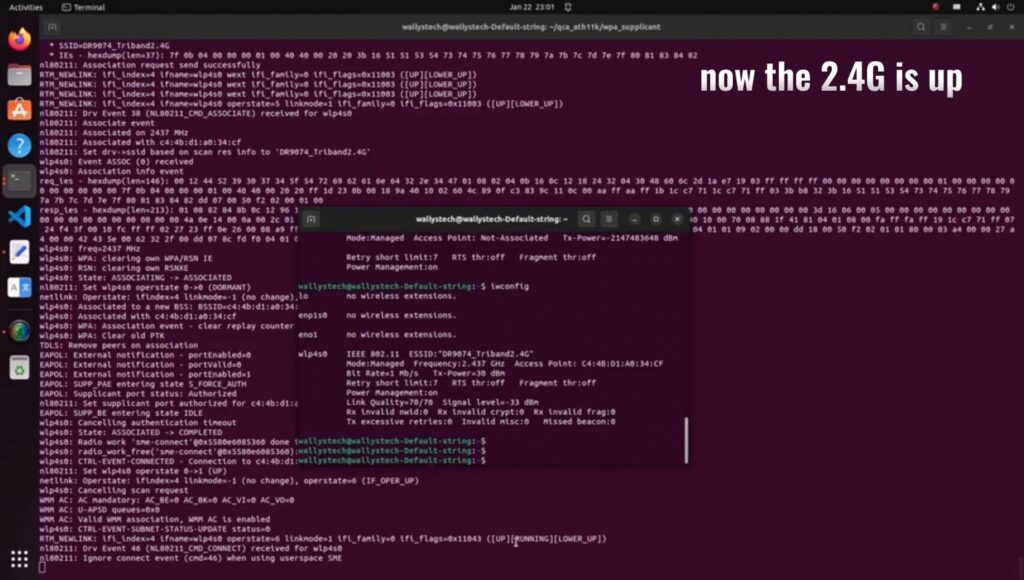
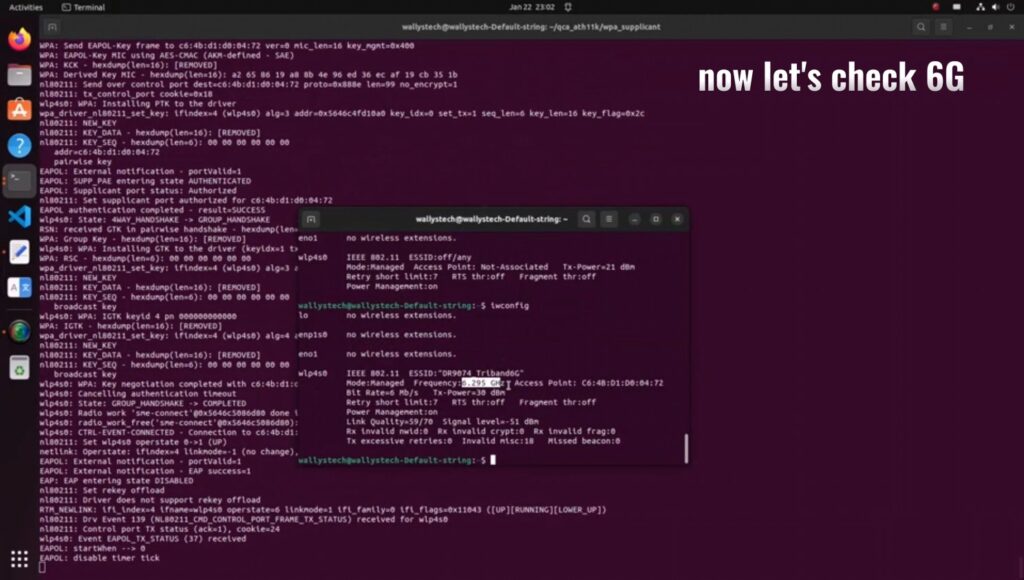
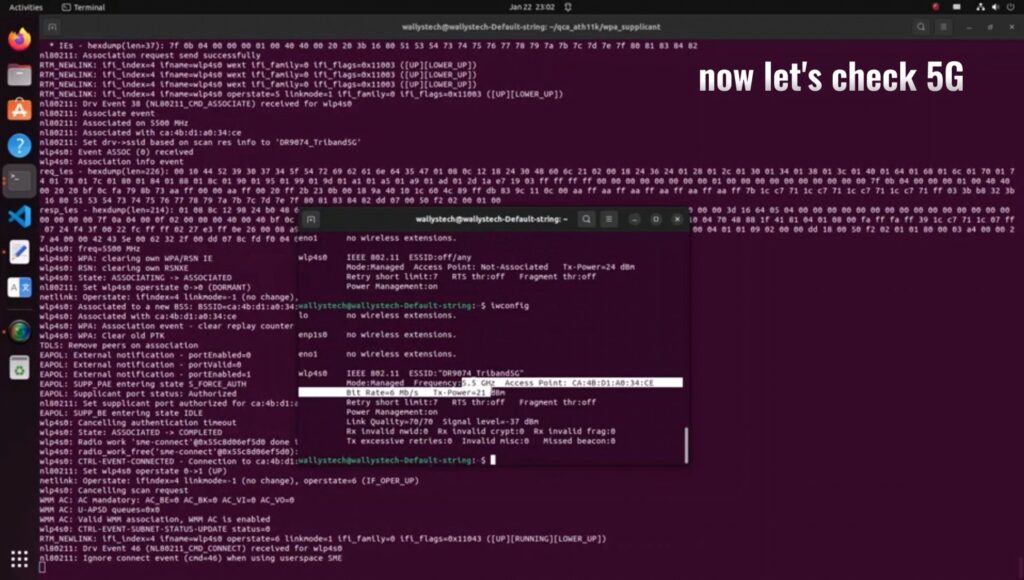
Confirm the functionality of 2.4G/5G/6G under STA mode

For any uncertainties, refer to the YouTube channel for a comprehensive video tutorial:

https://youtu.be/RL6X0xm74Fc?si=F-tuNn-wHNkeAvLB

Thanks for watching…

And now you can continue to 

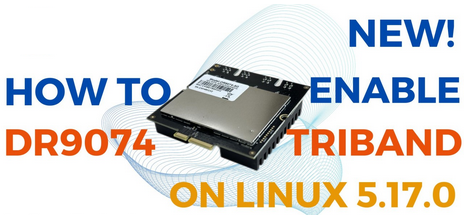
How to Enable DR9074-Triband Functionality on Linux 5.17.0: Step-by-Step Guide

This tutorial builds upon the previous one and provides additional information on:

1.How to download Ubuntu 22.04.

2.How to compile the 5.17 kernel to support ath11k.