Posted on

When Robots Move Beyond Wi-Fi Coverage: Why Mesh Matters

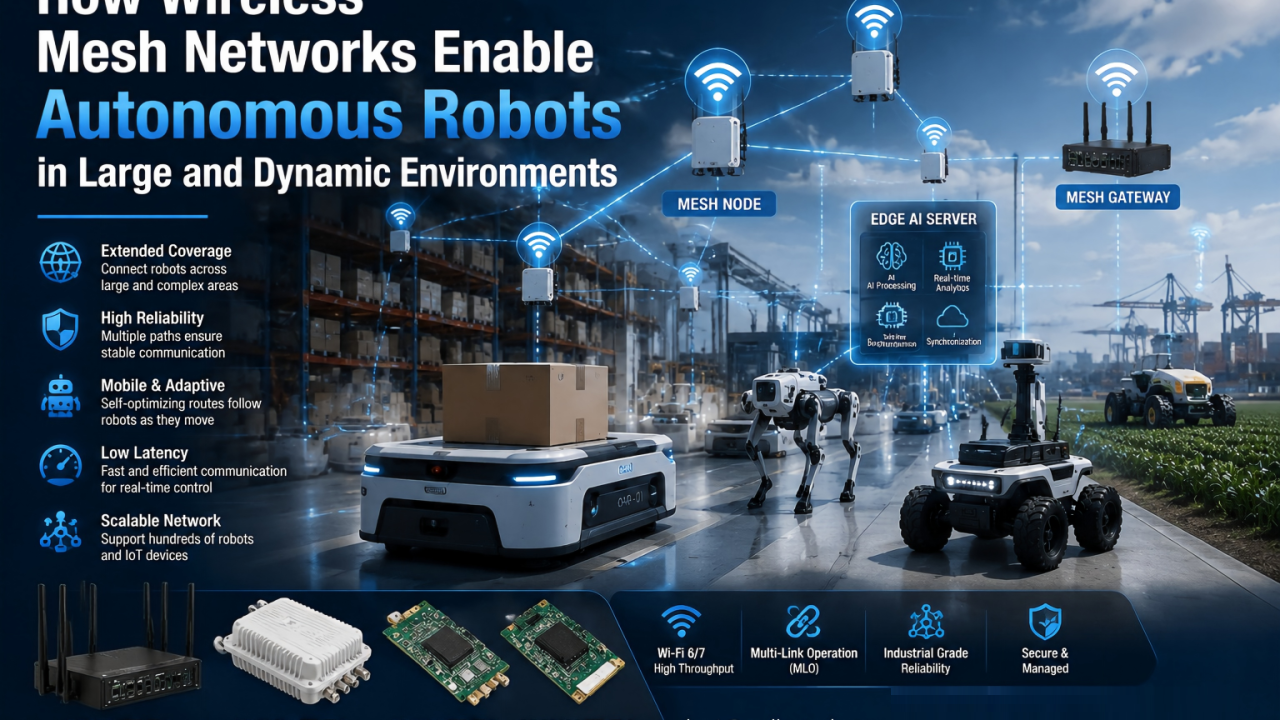
How Wireless Mesh Networks Enable Autonomous Robots in Large and Dynamic Environments

The future of robotics is moving beyond controlled spaces.

Autonomous robots are no longer limited to laboratory demonstrations or small indoor environments.

Today, robots are being deployed in:

  • Large warehouses
  • Smart factories
  • Outdoor farms
  • Ports and logistics centers
  • Mining sites
  • Industrial inspection areas
  • Hospitals and commercial buildings

As robot deployment expands, one challenge becomes increasingly important:

How do we maintain reliable connectivity when robots move beyond traditional Wi-Fi coverage?

The answer is not simply adding more access points.

The future of autonomous robotics requires a more flexible and intelligent wireless infrastructure.

This is where wireless mesh networking becomes increasingly important.
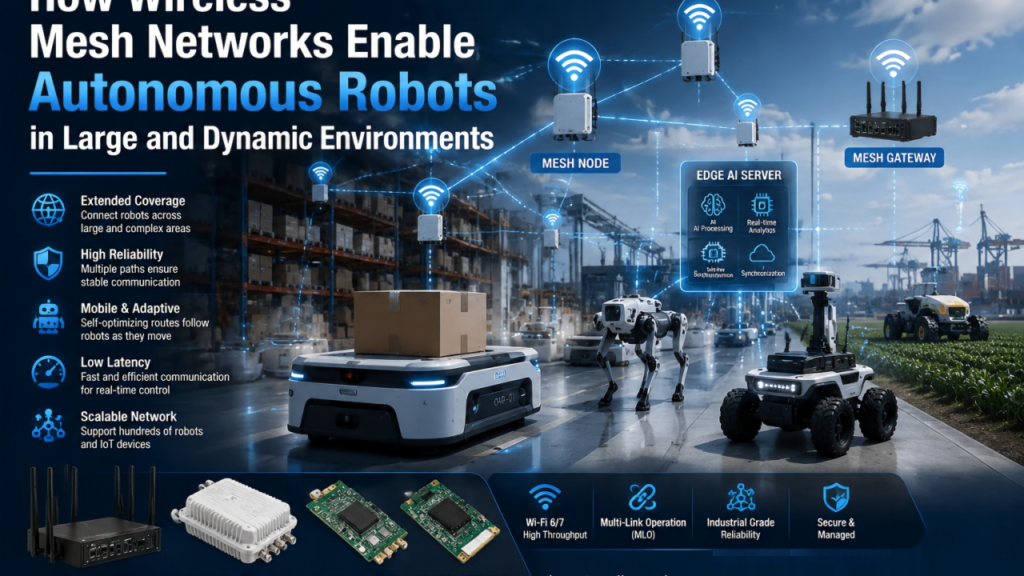

Autonomous Robots Need Connectivity Everywhere They Operate

A robot is only autonomous when it can continuously:

  • Sense its environment
  • Process information
  • Communicate with other systems
  • Receive updates
  • Report status

Connectivity enables critical robot functions:

  • Navigation assistance
  • Remote monitoring
  • Fleet management
  • Mission updates
  • Data synchronization
  • Safety communication

For a fixed device, losing wireless connectivity may be inconvenient.

For an autonomous robot, connectivity loss can impact the entire operation.

A warehouse robot that loses connection may stop.

An inspection robot that disconnects may fail to complete a mission.

A farming robot operating in a large field may become unreachable.

Reliable wireless communication is not an optional feature.

It is operational infrastructure.


The Limitation of Traditional Wi-Fi Networks

Traditional Wi-Fi deployments are usually designed around fixed infrastructure:

Access Point → Client Device

This works well for:

  • Offices
  • Small factories
  • Indoor environments

However, robotics introduces new challenges.

1. Large Operating Areas

Many robotic applications cover large spaces:

  • Warehouses with thousands of square meters
  • Outdoor industrial sites
  • Agricultural fields
  • Logistics yards

Installing wired access points everywhere may become:

  • Expensive
  • Difficult to maintain
  • Limited by infrastructure availability

2. Dynamic Robot Movement

Robots are constantly moving.

Their communication environment changes every second.

A robot may travel:

  • From one building to another
  • Through different production areas
  • Around obstacles and machinery

The wireless network must adapt dynamically.


3. Rapid Deployment Requirements

Many robotics deployments need flexibility.

For example:

A logistics company may expand warehouse operations.

A factory may redesign production lines.

An agricultural operation may deploy robots across changing areas.

A wireless solution should not require rebuilding the entire network every time the environment changes.


What Is Wireless Mesh Networking?

A traditional Wi-Fi network depends mainly on wired access points connected to a central network.

A wireless mesh network creates multiple communication paths.

Instead of:

Robot → Access Point → Network

A mesh environment can support:

Robot → Robot → Mesh Node → Network

or:

Robot → Mesh Node → Mesh Node → Gateway

Each node can help extend network coverage and improve flexibility.


Why Mesh Matters for Autonomous Robots

1. Extending Coverage Across Large Areas

Robots often operate in places where complete wired infrastructure is difficult.

Examples:

Smart Agriculture

Autonomous agricultural robots may operate across:

  • Fields
  • Orchards
  • Greenhouses

Mesh networking can help extend connectivity across larger areas without requiring extensive cabling.


Industrial Sites

Factories and industrial facilities often include:

  • Metal structures
  • Moving equipment
  • Complex layouts

Mesh networks can provide more flexible coverage.


Warehouses

Large warehouses may contain:

  • High shelves
  • Multiple zones
  • Moving inventory systems

A flexible wireless architecture helps robots maintain communication while navigating different areas.


2. Improving Network Resilience

One of the biggest advantages of mesh networking is redundancy.

In traditional networks:

If one access point fails:

Connected devices may lose communication.

In a mesh network:

Multiple paths may exist.

If one route becomes unavailable, the network can potentially find another path.

For autonomous robots, this means:

  • Higher availability
  • Better reliability
  • Reduced downtime

A robot fleet should not depend on a single communication point.


3. Supporting Mobile Robot Fleets

Robotics is moving toward multi-robot collaboration.

A warehouse may have:

  • Hundreds of AMRs
  • Multiple autonomous forklifts
  • Robotic arms
  • AI vision systems

These machines need continuous communication.

Mesh networking can provide a more adaptable communication layer for:

  • Robot-to-network communication
  • Robot-to-robot communication
  • Edge computing connectivity

Mesh Networking and Edge AI Robotics

The growth of Edge AI makes connectivity even more important.

A modern autonomous robot may follow this architecture:

Sensors

↓

Camera / LiDAR / Vision Data

↓

Wireless Network

↓

Edge AI Server

↓

Decision Making

↓

Robot Control

If communication between these layers becomes unstable, the entire AI workflow is affected.

Mesh networking helps create a more flexible communication foundation for distributed AI systems.


The Role of Wi-Fi 6 and Wi-Fi 7 in Industrial Mesh

Modern robotics applications require more than coverage.

They need:

  • High bandwidth
  • Low latency
  • High reliability
  • Multiple device support

Wi-Fi 6 introduces important capabilities:

  • OFDMA
  • Improved efficiency in dense environments
  • Better support for many connected devices

Wi-Fi 7 further expands possibilities with:

Multi-Link Operation (MLO)

Multiple frequency links can improve reliability and latency.

Higher Throughput

Supports demanding applications such as:

  • Multi-camera robots
  • AI vision systems
  • Remote operation

Better Network Performance

Helps support increasingly complex robotic environments.


Challenges: Mesh Networks Must Be Designed for Robotics

Not all mesh networks are suitable for autonomous robots.

Robotics requires careful engineering.

Important considerations include:

Low Latency Routing

A robot cannot wait several seconds for network decisions.

Fast Path Optimization

The network should select efficient communication paths.

Mobility Support

Routes must adapt as robots move.

Network Management

Large fleets require visibility and control.


From Connected Robots to Connected Robot Ecosystems

The future factory will not contain isolated robots.

It will contain an ecosystem:

  • Autonomous mobile robots
  • AI cameras
  • Edge servers
  • Industrial sensors
  • Cloud platforms

All these systems require reliable communication.

Mesh networking provides a path toward more flexible and scalable robot infrastructure.


Conclusion: Mesh Is Becoming Part of the Robot Infrastructure

Autonomous robots are moving into larger, more complex environments.

As deployment expands, traditional wireless coverage models become insufficient.

Robots need communication systems that can:

  • Follow them as they move
  • Adapt to changing environments
  • Maintain reliable connections
  • Support large-scale operations

Wireless mesh networking is becoming an important technology for building the connected infrastructure behind autonomous machines.

The future of robotics is not only about making robots smarter.

It is about creating the wireless systems that allow them to operate anywhere.

AI is the brain. Sensors are the eyes. Connectivity is the nervous system.

And mesh networking helps build that nervous system at scale.

How 524WiFi and Wallys Support Autonomous Robot Connectivity

At 524WiFi and Wallys, we focus on building reliable wireless infrastructure for the next generation of intelligent machines.

Our industrial Wi-Fi solutions support robotics applications that require:

  • High-performance wireless communication
  • Low-latency connectivity
  • Flexible deployment
  • Scalable mesh networking

By combining Wi-Fi 6/Wi-Fi 7 technology with industrial-grade hardware, Wallys helps robotics companies create reliable connectivity between:

Autonomous Robots → Edge AI Systems → Industrial Networks

Because smarter robots need more than intelligence.

They need a reliable wireless nervous system.
Posted on

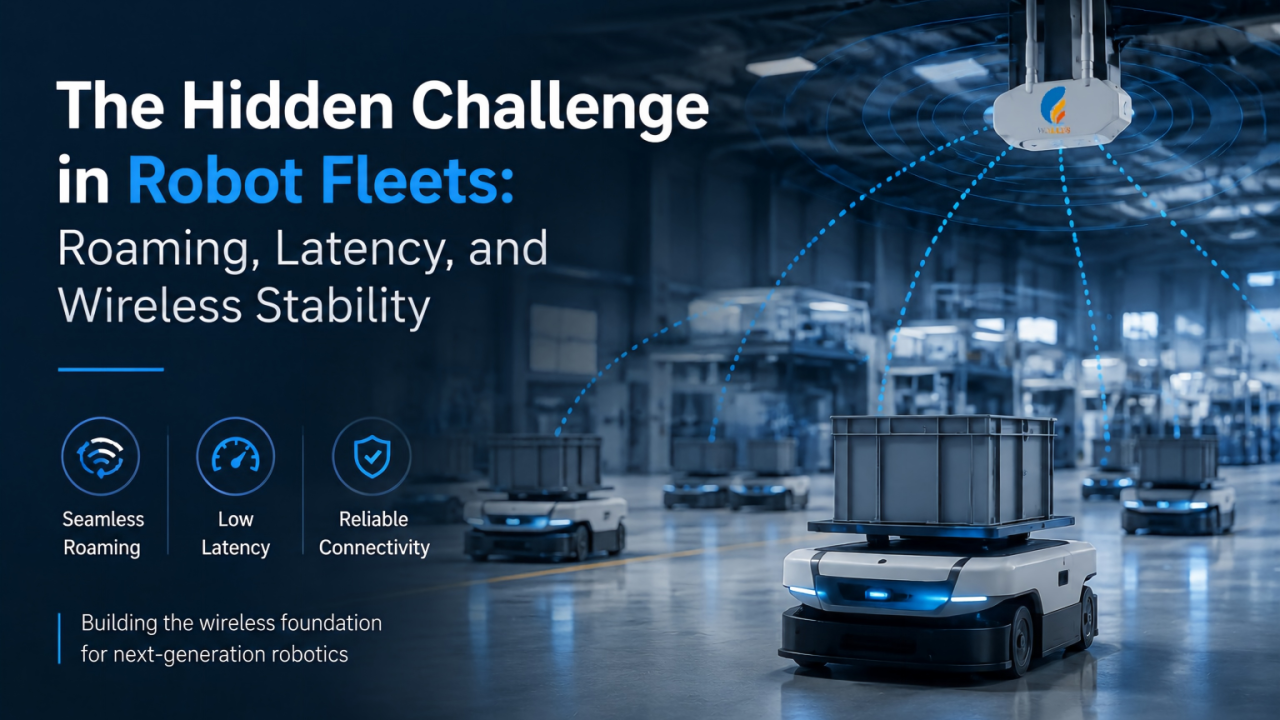
The Hidden Challenge in Robot Fleets: Roaming, Latency, and Wireless Stability

When people talk about autonomous robots, the conversation usually focuses on AI models, sensors, cameras, and navigation algorithms.

But there is another critical layer that often determines whether a robot system succeeds in real-world deployment:

Wireless connectivity.

A robot can have advanced AI capabilities, but without reliable communication, even the smartest robot may struggle in a dynamic industrial environment.

For large-scale robot fleets, connectivity is no longer just a networking feature. It becomes part of the robot’s operational reliability.

The Reality of Wireless Challenges in Robot Deployments

In warehouses, factories, farms, and outdoor industrial environments, robots are constantly moving.

An AMR (Autonomous Mobile Robot), for example, may need to:

  • Move across different areas with changing RF conditions
  • Maintain real-time communication with control systems
  • Upload high-resolution camera data
  • Receive navigation and task instructions
  • Coordinate with other robots in the same environment

During these operations, wireless networks face several challenges:

1. Roaming: Staying Connected While Moving

A robot moving through a large facility often needs to transition between multiple access points.

A poor roaming experience can cause:

  • Packet loss
  • Video interruption
  • Control delays
  • Temporary disconnection

For industrial robots, even a short communication interruption can affect efficiency and safety.

Advanced roaming mechanisms such as 802.11k/v/r help devices make faster and smarter roaming decisions by improving network awareness and reducing handover time.

However, successful roaming also depends on:

  • Proper RF planning
  • AP deployment strategy
  • Client behavior optimization
  • Network management

2. Latency: Every Millisecond Matters

Many industrial robot applications require real-time communication.

Examples include:

  • Remote monitoring
  • Vision-based inspection
  • Autonomous navigation
  • Robot fleet coordination

High latency can impact:

  • Motion control
  • Response time
  • Task execution efficiency

The challenge is not only achieving high throughput.

A network can provide high speed but still suffer from unstable latency due to:

  • Network congestion
  • Interference
  • Poor link quality
  • Inefficient routing

Reliable industrial wireless networks need predictable performance, not just peak speed.

3. Wireless Stability in Complex Environments

Industrial environments are very different from homes or offices.

Factories and outdoor deployments may include:

  • Metal structures causing reflections
  • Moving equipment blocking signals
  • Multiple wireless networks creating interference
  • Large numbers of connected devices

A robot fleet may experience changing wireless conditions every moment.

This requires networks that can adapt dynamically.

Important capabilities include:

  • Intelligent channel management
  • Interference detection
  • Dynamic path optimization
  • Mesh networking
  • Traffic prioritization

Why Traditional Wi-Fi Approaches Are Not Always Enough

A standard Wi-Fi deployment may work well for static users.

However, robot fleets introduce new requirements:

  • Mobility
  • High device density
  • Continuous connectivity
  • Low latency
  • Reliable uplink performance

The network needs to be designed around the robots’ movement and operational workflow.

Building the Wireless Foundation for Next-Generation Robots

The future of autonomous systems will depend on the combination of:

AI + Robotics + Reliable Connectivity

Advanced wireless technologies such as Wi-Fi 6 and Wi-Fi 7 bring important improvements:

  • Higher capacity
  • Better multi-device performance
  • Lower latency
  • Multi-band operation with MLO
  • Improved reliability in demanding environments

But technology alone is not enough.

Successful industrial deployments require:

  • The right wireless architecture
  • Proper RF optimization
  • Reliable hardware platforms
  • Long-term firmware support
  • Real-world validation

Final Thoughts

Autonomous robots are becoming smarter every day.

But intelligence alone does not guarantee successful deployment.

Behind every reliable robot fleet is a reliable communication infrastructure.

The next generation of industrial automation will not only depend on better AI algorithms — it will depend on wireless networks that can keep robots connected, responsive, and operational in the real world.

Reliable connectivity is the foundation that allows autonomous robots to truly become autonomous.

Posted on

Physical AI Connectivity – AI Robots Don’t Run on AI Alone. They Run on Connectivity.

Every week, we see exciting breakthroughs in robotics.

Smarter vision models. Faster inference. More powerful edge AI hardware.

But when robots leave the lab and enter factories, warehouses, farms, or outdoor environments, something interesting happens.

The biggest challenge often isn’t AI.  It’s connectivity !

An autonomous robot may have enough computing power to understand its surroundings, but it still needs to:

  • Receive sensor data in real time
  • Stream video reliably
  • Exchange information with other robots
  • Connect to edge servers and cloud platforms
  • Roam seamlessly across large facilities without interruption

If the wireless network becomes unstable, even the most advanced AI model can’t perform as intended.

In real-world deployments, we’ve learned that customers rarely complain about TOPS or benchmark scores.

Instead, they ask questions like:

• Can the connection stay stable after days or weeks of continuous operation?

• Will roaming interrupt navigation?

• How does the network perform in environments with heavy RF interference?

• Can hundreds of devices operate simultaneously without impacting latency?

These are deployment questions—not benchmark questions.

As Physical AI continues to evolve, networking is no longer just supporting the system.

It is becoming part of the AI infrastructure itself.

The future of intelligent robots won’t be built by AI alone.

It will be built by the combination of:

  • AI Computing
  • Reliable Wireless Connectivity

⚡ Edge Networking

  • Seamless Mobility

The industry has spent years optimizing AI models.

Perhaps it’s time we give the same attention to the networks that keep those models connected.

AI may be the brain.  Connectivity is the nervous system.

I’d love to hear your perspective:

What has been the biggest networking challenge in your robotics or Edge AI deployments?

Posted on

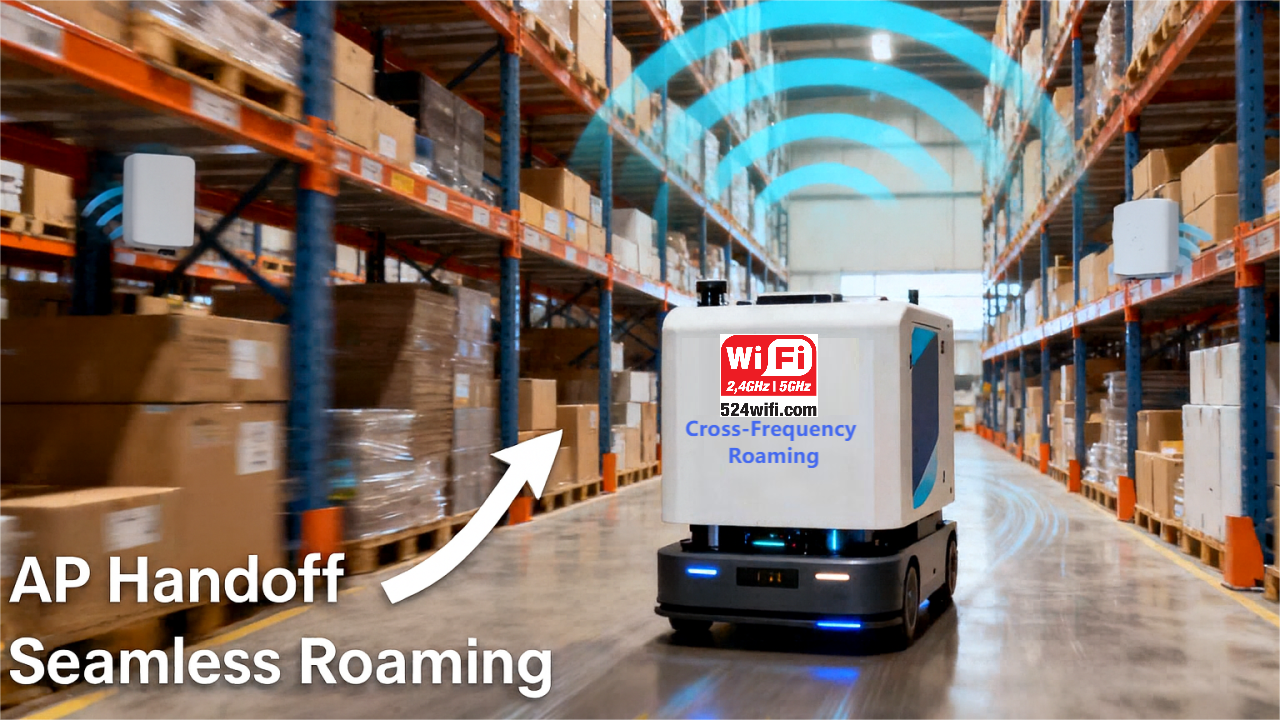
IPQ5018 + QCN6102 Enable Seamless Same & Cross Frequency Roaming for AGVs and AMRs

Seamless Same-Frequency & Cross-Frequency Roaming for AGVs and AMRs

In modern automated warehouses, stable and uninterrupted wireless connectivity is essential. Autonomous vehicles such as AGVs and AMRs depend on real-time communication for navigation, safety, and task execution. Any packet loss or delay can disrupt operations.

To meet these challenges, 524WiFi and Wallys Communications introduces its next-generation 5G Roaming Technology, engineered for mission-critical industrial environments requiring both same-frequency roaming and cross-frequency roaming. This new solution builds on the proven foundation of our Peacock Series while delivering significantly enhanced stability for complex warehouse deployments.


Why 524WiFi & Wallys 5G Roaming Is a Game Changer

Traditional roaming solutions often struggle when APs operate on different channels or when robots move rapidly across overlapping wireless coverage zones.

Wallys 5G Roaming enables instantaneous transitions between APs, whether the next AP is operating on:

  • The same frequency and same channel
  • The same frequency but a different channel
  • A different frequency band entirely

This flexibility eliminates typical roaming delays and ensures continuous operation in heterogeneous RF environments.


1. Cross-Frequency Roaming

AGVs and AMRs can move seamlessly between APs operating on different channels or different frequency bands. This is ideal for large warehouses where RF planning varies across zones.

Key benefit: ✔ Smooth transitions even when moving from Channel 36 to Channel 149, Channel 165, or mixed-band coverage areas.


2. Same-Frequency Roaming

In environments where APs share the same channel—common in dense warehouse layouts—Wallys roaming provides uninterrupted handoffs with zero packet loss.

Key benefit: ✔ Reliable connectivity even in high-density, same-channel deployments.


3. Zero Packet Loss & Ultra-Low Latency

Whether roaming is same-frequency or cross-frequency, the system consistently maintains:

  • Zero packet loss during handoff
  • Sub-millisecond switching times
  • Stable connectivity during continuous movement

This eliminates lag, communication gaps, and navigation issues associated with traditional roaming.


Real-World Warehouse Application

Imagine a fleet of AGVs navigating:

  • Narrow aisles
  • Large open areas
  • Mixed indoor and semi-outdoor regions
  • Zones where APs operate on different 5G channels

As each AGV moves from one coverage zone to another, Wallys roaming ensures instant, seamless transitions:

  • Channel 36 → Channel 149 → Channel 165
  • Same-channel AP-to-AP switching
  • Transition between heterogeneous frequency zones

Connectivity remains solid throughout—no interruptions, no delays, no impact on workflows.


Why Warehouse Leaders Are Choosing 524WiFi & Wallys

  • Supports both same-frequency and cross-frequency roaming
  • Designed for AGVs, AMRs, and industrial IoT environments
  • Demonstrated performance in complex, high-interference warehouses
  • Backed by 524WiFi’ extensive wireless engineering expertise

This positions warehouses for higher automation efficiency and long-term scalability.


Upgrade Your Warehouse Connectivity

524WiFi and Wallys 5G Roaming Technology delivers the reliability required for next-generation warehouse automation. Enable your AGVs and AMRs to operate consistently, safely, and efficiently—no matter how challenging the RF environment.

Posted on

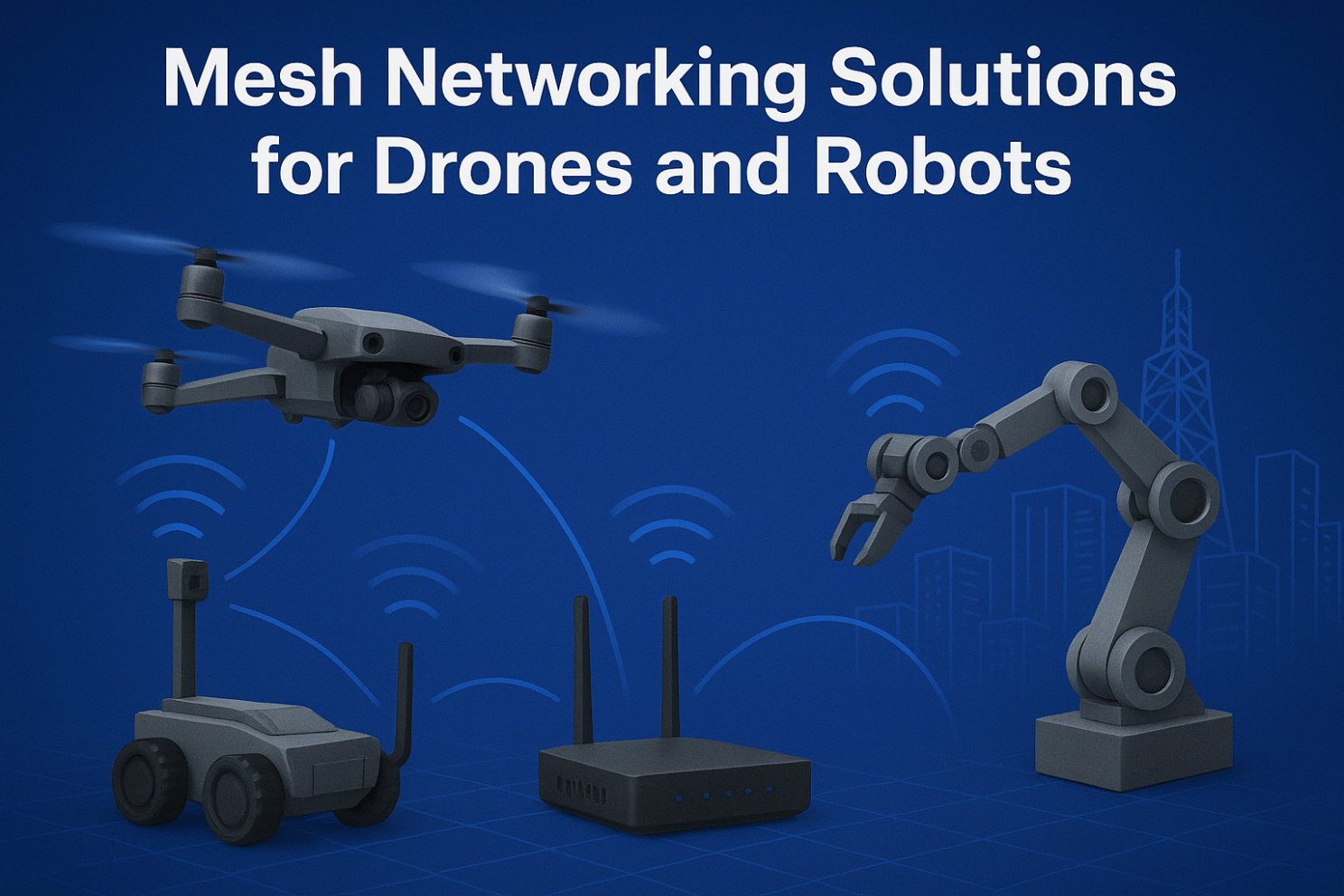
Mesh Networking Solutions for Drones and Robots

Mesh Networking Solutions for Drones and Robots

1. Introduction: Why Mesh for Drones and Robots?

Traditional wireless setups (AP + client) often fail in dynamic, mobile, and large-scale environments. Drones and robots require:

  • Low-latency links for real-time control
  • Resilient communication when nodes move or fail
  • Flexible scalability for adding new devices instantly

This is where Mesh networking shines — offering self-healing, self-configuring, and adaptive connectivity.


2. Mesh Networking for Drones

  • Formation Flying & Swarm Operations Drones in formation need constant synchronization of GPS, sensor, and video feeds. Mesh ensures each drone acts as a node, maintaining real-time links.
  • Emergency Response & Disaster Recovery In areas without cellular coverage, drones can instantly deploy a Mesh network, relaying data back to the command center for faster rescue operations.
  • Beyond Line-of-Sight Missions Mesh allows drones to extend their communication range via relays, enabling operators to control them far beyond visual range.

3. Mesh Networking for Robots

  • Smart Warehouses & Industrial Automation Robots need to stay connected across large spaces with moving inventory. Mesh avoids single-point AP failures and supports seamless roaming.
  • Security & Patrol Robots Continuous connectivity is essential for live video streaming and real-time threat detection. Mesh keeps robots online without service drops.
  • Collaborative Swarm Robots Multiple robots can share sensory data, distribute tasks, and adapt dynamically using Mesh as their backbone.

4. Key Technical Aspects of Drone & Robot Mesh

  • Dynamic Routing Protocols (OLSR, B.A.T.M.A.N, HWMP) ensure optimal paths in mobile networks.
  • Frequency Bands:
  • 2.4 GHz for longer range
  • 5 GHz / 6 GHz for high throughput
  • Wi-Fi 6/7 with MLO for ultra-stable multi-link performance
  • Security: WPA3, AES encryption, and private protocols protect mission-critical data.
  • Low Latency Optimization: Necessary for navigation and collision avoidance in autonomous systems.

5. Real-World Use Cases

  • Drone Relay Networks for Search & Rescue
  • Mesh-Enabled Warehouse Robots for Amazon-like Logistics
  • Hybrid Mesh + 5G Networks for Smart City Patrols

6. Future Trends

  • Wi-Fi 7 with Multi-Link Operation (MLO): Brings reliability and speed to swarms of robots and drones.
  • Integration with 6G & Edge AI: Mesh networks will work hand-in-hand with edge computing for local decision-making.
  • Larger-Scale Autonomous Systems: From 5 drones to 500 robots, Mesh will scale efficiently.

Mesh networking is transforming how drones and robots communicate in real time. Whether for industrial automation, emergency missions, or smart city deployments, Mesh provides the backbone for reliability and scalability.

👉 At 524WiFi and Wallys, we design industrial-grade router boards and network cards (IPQ5018, IPQ9574, QCN9074, etc.) that support advanced Mesh networking. Our hardware enables drone and robotics developers to build custom, robust, and scalable Mesh solutions.

Article content