With the rapid development of AI and IoT, traditional network architectures are no longer capable of handling the growing demands for data traffic and ultra-low latency. 524WiFis WiFi 7 hardware, with its groundbreaking technology, is specifically designed for AI-driven applications, offering infinite possibilities for the future of networking.
Core Advantages of WiFi 7 for AI Applications:
🔌 Ultra-High Bandwidth WiFi 7 hardware supports an impressive 46.116 Gbps link speed(maximum 6ghz peak data rate 11.529 Gbps x 4), effortlessly handling the massive data transfers required by AI algorithms. It ensures smooth operation for AI applications such as machine learning, data analysis, and automation, while also managing high-bandwidth device connections.
🌐 Seamless AI Device Connectivity WiFi 7 supports multiple devices simultaneously, ensuring AI-driven endpoints like smart cameras, industrial robots, and automation control systems enjoy ultra-stable, high-bandwidth connections. This meets the demands of industrial automation and smart city infrastructure.
💡 Future-Proofing Capability Wallys WiFi 7 hardware is compatible with future 5G networks and edge computing, offering ultra-low latency and efficient transmission to allow real-time interaction between AI applications and IoT devices, building a smarter and more interconnected ecosystem.
Solutions Tailored for Industrial AI Applications
Whether in smart factories, smart cities, autonomous driving, or telemedicine, 524WiFi WiFi 7 ensures seamless connectivity and ultra-fast transmission, guaranteeing real-time performance and stability for AI applications.
Are you working on industrial wireless projects and looking for a reliable guide to set up Multi-Link Operation (MLO)? Look no further! At 524WiFi and WallysTech, we’ve just released a comprehensive tutorial video to help you configure MLO on the IPQ5332 board (DR5332) paired with the DR9274-5G6G card.
This video covers everything you need to know, including:
✅ Hardware connection setup
✅ Firmware loading instructions
✅ Access Point (AP) configuration
✅ Practical tips to optimize your industrial wireless network
Why MLO Matters
MLO is a game-changing feature in WiFi 7 that allows simultaneous use of multiple bands for enhanced throughput and reliability. With industrial applications demanding higher speeds and more stable connections, mastering MLO is key to staying ahead.
Watch the Tutorial Now
Click below to watch the full step-by-step guide: 👉 How to Set Up MLO on the IPQ5332 Board with DR9274-5G6G Card
Need This Hardware? We’ve Got You Covered!
If you’d like to test this setup or integrate it into your project, contact our sales team at [email protected]. We’re here to provide tailored solutions and support your success.
💬 We’d love to hear from you! What other topics would you like us to cover? Comment below with your suggestions, and don’t forget to share this article with your network.
📢 Follow us for more updates, tutorials, and insights into the latest wireless technologies!
QCA9880 vs QCA9882: A Comprehensive Comparison of Qualcomm-Atheros Wi-Fi Chipsets for Industrial and Enterprise Applications
In today’s rapidly evolving wireless communication landscape, selecting the right Wi-Fi chipset can make a significant difference in the performance and reliability of a network. Qualcomm-Atheros, a leader in wireless technology, offers a range of Wi-Fi chipsets tailored for different applications. Among these, the QCA9880 and QCA9882 are two highly-regarded chipsets known for their strong performance and versatility. But which one is the best fit for your needs? In this article, we will break down the key differences between these two chipsets, their technical features, and their ideal applications.
QCA9880: This high-end Wi-Fi chipset supports the 802.11ac standard and features 3×3 MIMO technology, enabling higher throughput and broader coverage. It is ideal for applications where performance and robust connectivity are critical, such as enterprise-grade routers, access points, and wireless gateways.
QCA9882: Positioned as a cost-effective solution, the QCA9882 also supports the 802.11ac standard but uses a 2×2 MIMO configuration. While offering slightly lower throughput than the QCA9880, its compact design and energy-efficient operation make it suitable for embedded systems, industrial devices, and smaller-scale networking applications.
QCA9880 is equipped with 3×3 MIMO (Multiple Input Multiple Output) technology, allowing it to transmit and receive data on three spatial streams simultaneously. This setup is especially useful in environments with high device density, such as large office buildings or public spaces, where the demand for reliable, high-speed Wi-Fi is constant. The ability to handle multiple streams means greater bandwidth and less interference, which translates into a superior user experience.
QCA9882, on the other hand, uses a 2×2 MIMO configuration. While this is more than adequate for smaller networks or embedded devices, it does not offer the same level of performance as the QCA9880. However, its reduced complexity makes it ideal for environments where cost, power consumption, and space are more critical considerations, such as in IoT devices or compact industrial gateways.
Dual-band Operation
Both QCA9880 and QCA9882 support dual-band operation on the 2.4GHz and 5GHz frequency bands. The 2.4GHz band is commonly used for longer-range communications, while the 5GHz band provides faster data transfer speeds over shorter distances. This flexibility ensures that both chipsets can be used in a variety of scenarios, allowing devices to switch between frequency bands based on network demand and interference.
Data Rates
QCA9880 supports data rates of up to 1.3 Gbps, making it an excellent choice for high-bandwidth applications such as video streaming, online gaming, or large data transfers. The 3×3 MIMO configuration ensures that it can handle multiple simultaneous connections without a dip in performance, making it ideal for enterprise-level networks.
QCA9882, with its 2×2 MIMO configuration, supports data rates of up to 867 Mbps, which is still a significant improvement over older Wi-Fi standards but not quite as fast as the QCA9880. For smaller-scale applications, such as smart industrial devices or IoT gateways, this data rate is more than sufficient.
Due to its powerful 3×3 MIMO capabilities and high data rates, QCA9880 is well-suited for environments that require robust, high-speed wireless communication, including:
Enterprise networks: QCA9880 is ideal for use in enterprise-level access points (APs) and wireless gateways where multiple devices need to connect simultaneously without compromising speed or reliability.
Public Wi-Fi hotspots: Its ability to manage high-density device environments makes it perfect for deployment in public spaces like shopping malls, airports, and stadiums.
Video streaming and gaming: With its high throughput, the QCA9880 can handle bandwidth-heavy applications such as 4K video streaming and online gaming with minimal latency.
The QCA9882 is designed for more specialized use cases where power efficiency and space optimization are critical. Some typical applications include:
Industrial IoT (IIoT): In environments such as factories or remote sensor networks, the QCA9882’s compact design and reliable performance are perfect for maintaining stable wireless connections across devices in challenging conditions.
Embedded systems: For products like industrial gateways or compact routers, the QCA9882 offers a cost-effective, low-power solution that still delivers high-speed 802.11ac Wi-Fi performance.
Small and medium businesses (SMBs): QCA9882 can be integrated into networking products for SMBs that require a balance between performance and cost, ensuring reliable Wi-Fi without the need for enterprise-grade features.
5. Choosing the Right Chipset for Your Needs
When choosing between QCA9880 and QCA9882, the decision ultimately depends on the specific requirements of your application:
QCA9880 is the better choice for high-performance, enterprise, or high-density networking environments. Its 3×3 MIMO configuration and high data rates make it a powerful solution for demanding use cases.
QCA9880 VS QCA9882
QCA9882 is ideal for applications where space, power consumption, and cost are critical considerations, such as in industrial IoT and embedded systems.
QCA9880 VS QCA9882
6. Conclusion
Both the QCA9880 and QCA9882 from Qualcomm-Atheros are excellent Wi-Fi chipsets that cater to different market segments. The QCA9880 excels in high-performance networking scenarios, while the QCA9882 is a perfect fit for cost-conscious applications with lower power requirements. Whether you’re building a cutting-edge enterprise network or integrating Wi-Fi into an industrial IoT device, Qualcomm’s chipsets offer reliable, scalable, and future-proof solutions for every need.
524WiFi 600VX / 900VX modules for industrial applications :
Unveiling the Future of Connectivity: Introducing 524WiFi’ 2.4GHz WiFi 7 Module
In today’s rapidly evolving digital landscape, seamless connectivity is no longer a luxury but a necessity. As businesses and industries continue to embrace digital transformation, the demand for high-speed, reliable wireless communication solutions has never been greater. At 524WiFi, we are committed to driving innovation and empowering our customers with the tools they need to thrive in the digital age. That’s why we’re thrilled to announce the launch of our latest breakthrough: the 524WiFi 2.4GHz WiFi 7 Module.
The Next Generation of Wireless Technology
The 524WiFi 2.4GHz WiFi 7 Module represents the pinnacle of wireless technology, offering unparalleled performance, reliability, and versatility. Designed to meet the demands of modern connectivity, this module is powered by Qualcomm’s QCN9274 and QCN6274 ‘Waikiki’ series radio solutions, ensuring top-notch performance and compatibility.
Single Band vs. DBDC: Which One Fits Your Needs?
One of the key features of the Wallys 2.4GHz WiFi 7 Module is its availability in two versions: the Single Band and the DBDC (Dual Band Dual Concurrent). Each version offers unique advantages, allowing customers to choose the one that best suits their specific requirements.
– Single Band Version: Engineered for applications that demand robust connectivity within the 2.4GHz spectrum, the Single Band version delivers exceptional throughput and coverage. With its 4×4 MU-MIMO configuration, this version is ideal for high-density environments and data-intensive tasks.
– DBDC Version: Offering the added advantage of dual-band concurrent operation, the DBDC version supports both 2.4GHz and 5GHz frequencies simultaneously. With its 2×2 MU-MIMO configuration, this version provides versatility and flexibility, catering to diverse deployment scenarios and demanding applications.
With the 524WiFi 2.4GHz WiFi 7 Module, customers can stay ahead of the curve and embrace the next generation of wireless technology. Whether you prioritize performance and coverage within the 2.4GHz spectrum or need the flexibility to operate in both 2.4GHz and 5GHz bands simultaneously, we have the solution you need.
524WiFi, a trailblazer in connectivity solutions, unveils a range of cutting-edge Wi-Fi 6 router boards tailored to meet various requirements. Now, let’s explore the intricacies of WiFi 6 router boards and analyze their specifications with informative data sheets.
A Quick Overview
1.DR5018-IPQ5018 WiFi 6 Routerboard with 2.4GHz and BT5.1 Support
2.DR6018-IPQ6010 WiFi 6 Routerboard with Dual-Band Support
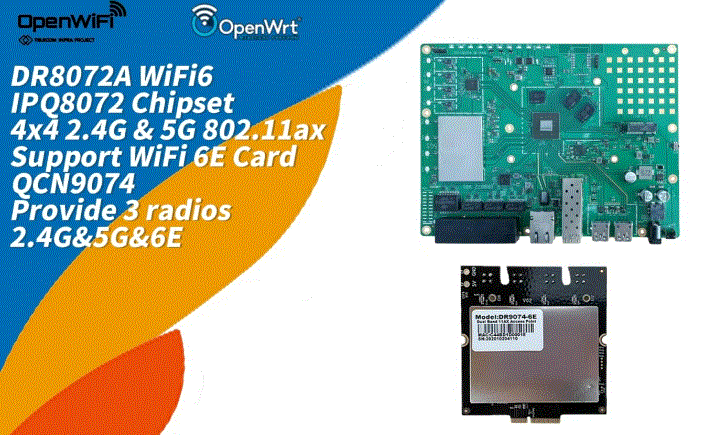
3.DR8072-IPQ8072 Dual-Band WiFi 6 Routerboard
4.DR8074-IPQ8074 WiFi 6 Routerboard with 2.4GHz Support
1.DRiver 5018-IPQ5018 WiFi 6 Routerboard with 2.4GHz and BT5.1 Support
The DR5018 is an enterprise-grade wireless module designed for high-bandwidth applications in challenging environments. Key features include:
BT5.1 Radio module integration
2×2 2.4GHz high-power Radio module
Dual-core ARM 64bit A53 processor clocked at 1.0GHz
512MB DDR L3L system memory
4MB NOR Flash and 128MB NAND Flash storage
Onboard 2.4GHz radio supporting up to 573Mbps data rates
M.2 card slots for QUECTEL RM 500Q-GL 5G module and QCN9074 WiFi 6E card
Openwifi support for enhanced flexibility and compatibility
This routerboard also have a SOM version:DR5018M
2.DRiver 6018-IPQ6010 WiFi 6 Routerboard with Dual-Band Support
The DR6018 is a high-performance router board equipped with advanced features for seamless connectivity. Key features include:
Qualcomm-Atheros IPQ6010 chipset
Quad-core ARM 64bit A53 processor running at 1.8GHz
1GB DDRL3L system memory for efficient multitasking
32MB NOR Flash and 256MB NAND Flash storage for data storage
Supports Dynamic Frequency Selection (DFS) for optimized wireless performance
2×2 On-board 2.4GHz radio with up to 573Mbps physical data rate
2×2 On-board 5GHz radio with up to 1201Mbps physical data rate
Compatibility with QUECTEL RM500Q-GL for 5G connectivity
Support for QCN9074 WiFi 6E Card for enhanced wireless capabilities
Openwifi support for flexibility and compatibility
The DR8072 boasts powerful features for robust connectivity. Key highlights include:
Qualcomm Atheros IPQ8072A AR Quad Core CPU for efficient processing
On-board 5GHz radio with up to 2475 Mbps physical data rate
On-board 2.4GHz radio with up to 1147Mbps physical data rate
8 MB NOR Flash and 256MB NAND Flash storage (Optional NAND Flash upgrade to 1GB)
Support for 11ax TX Beamforming, MU-MIMO DL and UL, and OFDMA DL and UL for optimized wireless performance
Dynamic Frequency Selection (DFS) support for improved spectrum utilization
1GB DDR3L system memory (Optional DDR3L upgrade to 2GB)
M.2 connector compatibility for QCN9074 production module support
4.DRiver DR8074-IPQ8074 WiFi 6 Routerboard with 2.4GHz Support
The DR8074 is a high-performance router board designed for demanding networking applications. Key features include:
Qualcomm Atheros IPQ8074A AR Quad Core CPU for robust processing power
On-board 5GHz radio with up to 4804Mbps physical data rate
On-board 2.4GHz radio with up to 1147Mbps physical data rate
Support for 11ax TX Beamforming for enhanced signal strength
Support for 11ac/ax MU-MIMO DL and UL for efficient multi-user communication
Support for OFDMA DL and UL for improved spectral efficiency
Tri-band support with 5G SBS (4×4/5GHz + 4×4/5GHz) + 4×4/2.4GHz for versatile connectivity options
Dynamic Frequency Selection (DFS) support for optimized wireless performance
524WiFi Wallys WiFi 6 routerboard are engineered for versatility and reliability, making them ideal for Enterprise, Industrial, Cybersecurity, Transportation, and SMB applications.
Inquiries:
Wallys is dedicated to continuous innovation, constantly pushing the boundaries of WiFi technology. In addition to its hardware products, Wallys also offers a range of ODM/OEM services, including:
Customization: Wallys can customize its WiFi 6 products and embedded boards to meet the specific needs of its customers.