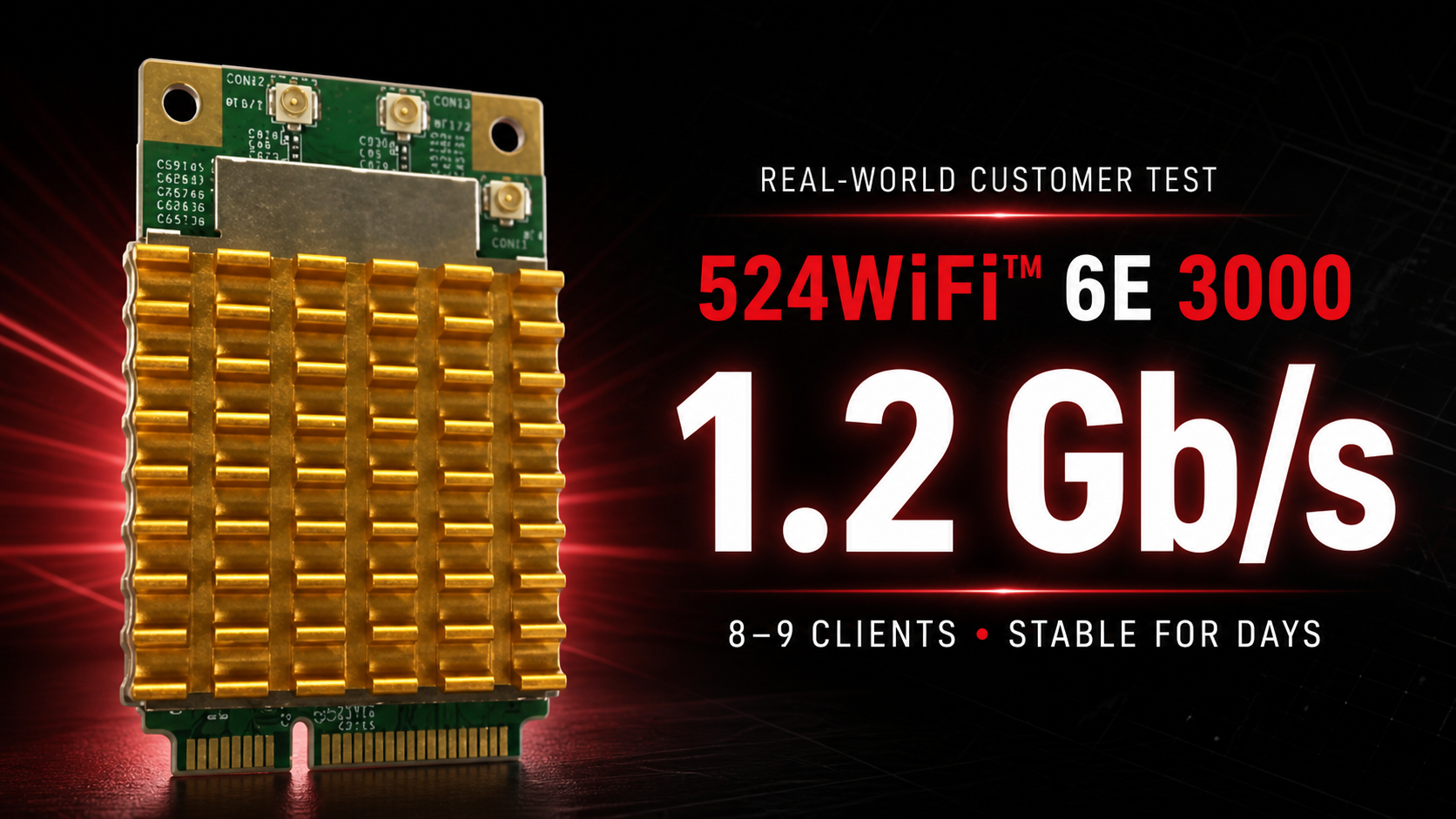
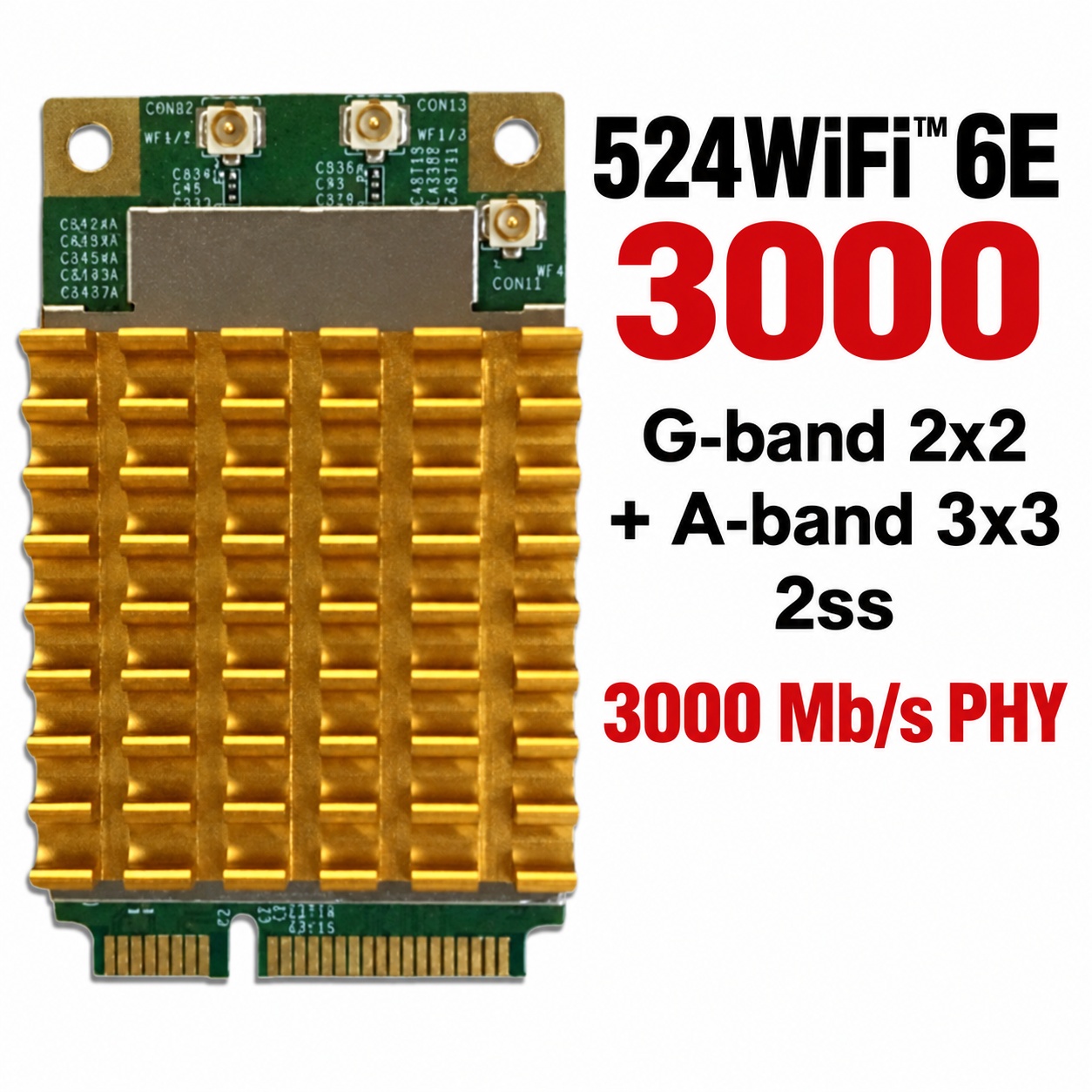
A real customer deployment has put the 524WiFi™ 6E 3000, SKU 524WiFi-7916-NPD through exactly the kind of demanding upgrade this professional module was built for: an older desktop platform, a Linux access point, multiple simultaneous clients and sustained gigabit-class traffic. The verdict was immediate:
“this device is a banger”
This is not a theoretical peak-rate claim. In the customer’s own working access-point setup, the card sustained 1.2 Gb/s to a Wi-Fi 6 client while serving a real network.
The upgrade that finally delivered
The customer installed the 524WiFi-7916-NPD in an older small-form-factor PC through a miniPCIe-to-PCIe adapter. It was configured as a Linux access point using hostapd—the service that lets a compatible Wi-Fi module operate as an access point and manage connected clients.
After years limited to older Wi-Fi technology and several unsuccessful adapter trials, this was the module that finally delivered the upgrade he wanted.
1.2 Gb/s with 8–9 concurrent clients
1.2 Gb/s sustained application throughput
8–9 simultaneous Wi-Fi 6 and Wi-Fi 5 clients
Several days of continuous operation without a crash
Stable Linux access-point operation
A successful upgrade on a legacy desktop platform
The customer described the setup as “very stable.” That combination of real throughput, multi-client operation and stability is why 524WiFi™ focuses on specialist wireless hardware for professional integrations.
A practical note about cooling
The customer also reported that the card runs quite hot despite its fitted heatsink. In this compact installation, the slot direction left the module upside down. It nevertheless remained stable, but builders should provide suitable airflow and verify temperatures in compact or passively ventilated systems.
Why customers choose 524WiFi™
Strong hardware is only part of the purchase. Correct product selection, dependable logistics and specialist experience matter just as much.
“i’d recommend”
“as usual, 524wifi order, logistics, products are top notch quality.”
That feedback captures what 524WiFi™ is built to deliver: carefully selected professional wireless products backed by an experienced supplier selling online since 2003.
Build your own high-performance access point
For a compact mPCIe radio for a Linux router, access point, embedded system or specialist wireless upgrade, choose the 524WiFi-7916-NPD. The customer’s result shows what the right 524WiFi™ module can unlock—even in hardware more than a decade old.
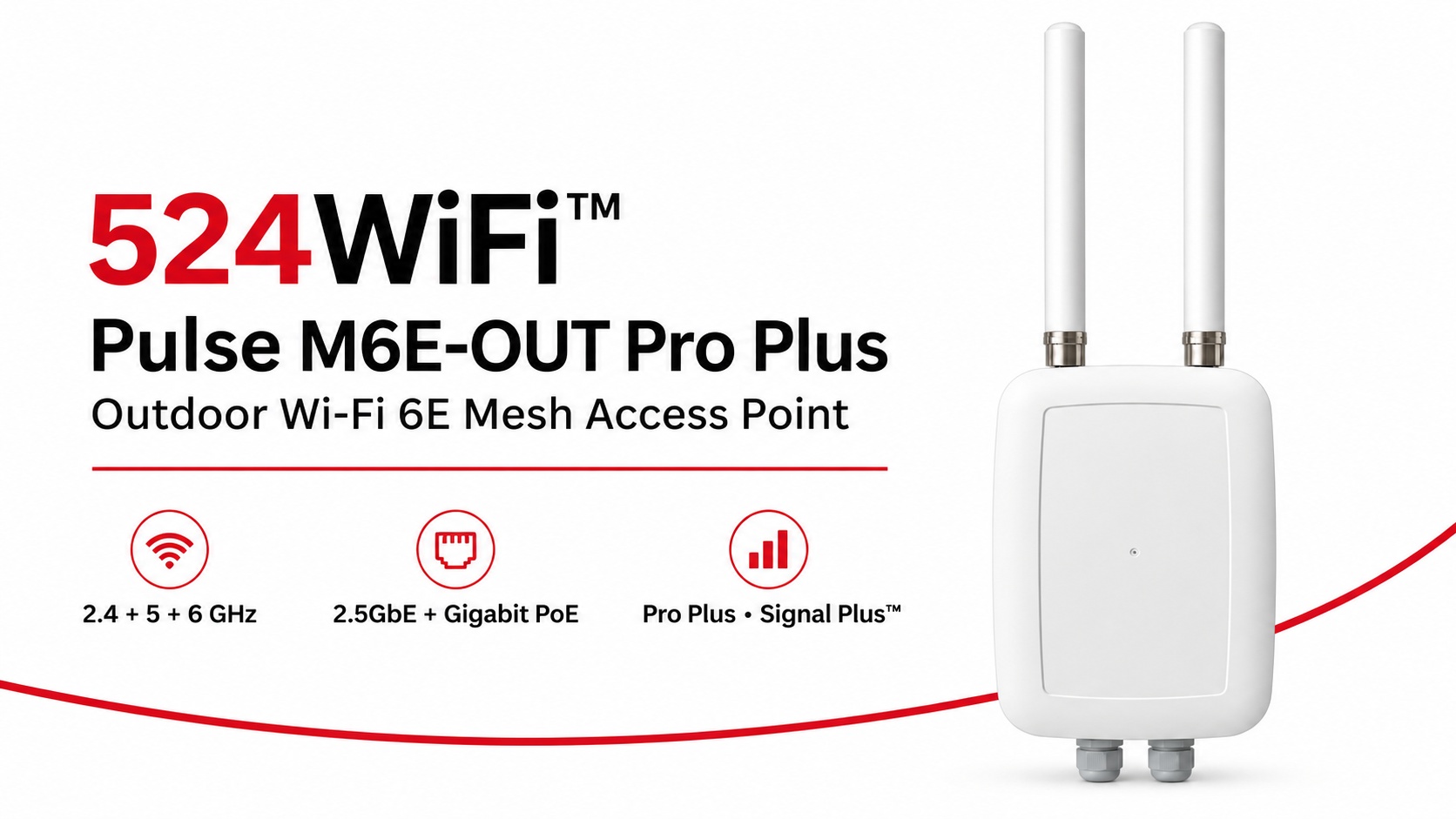
524WiFi™ Pulse M6E-OUT Pro Plus brings the radio platform, outdoor enclosure and model-specific antenna assembly together for a professionally planned Wi-Fi 6E mesh installation. Start with a complete fixed network node and build coverage and inter-node links around the working area.
Three radio bands for the complete site network
Independent 2.4, 5 and 6 GHz radios give the installation three concurrent 2×2 radio paths. The Qualcomm IPQ5018 platform combines a dual-core ARM Cortex-A53 processor at 1.0 GHz with 512 MB DDR3L. A 2.5GbE interface supports the wired uplink, while a Gigabit Ethernet interface with PoE provides practical network and power integration.
The published theoretical PHY rates are up to 573 Mb/s at 2.4 GHz and 2,402 Mb/s each at 5 and 6 GHz. Channel widths reach 40 MHz at 2.4 GHz and 160 MHz on the two higher bands. Choose channels and radio roles around client traffic, the mesh topology and the operating country.
An antenna assembly matched to the outdoor node
The assembly combines two external 5 GHz omnidirectional antennas, two internal 2.4 GHz omnidirectional antennas and an internal directional 6 GHz panel serving the two 6 GHz RF paths. Aim the panel toward the intended link and keep its enclosure face clear of metalwork. This lets the installation use directional interconnection and local coverage deliberately.
Pro Plus and Signal Plus™ for deployment
Pro Plus combines our tuned product configuration, model-specific firmware selection and integration support. Signal Plus™ brings antenna placement, polarization, feed losses, radio roles and channel planning into the same RF system. Commission the complete node under the traffic and RF conditions of the actual site.
Fixed mesh nodes and moving clients
Use the M6E-OUT as a fixed outdoor infrastructure node. Pair it with Pulse M6E-IN for indoor infrastructure and Pulse R6-D2-IN or R6-T3-IN roaming clients on moving Ethernet-equipped machinery. Plan compatible firmware, authentication and RF overlap across the route. Mesh interconnection and moving-client roaming serve complementary roles in the complete network.
From IPQ8074 to IPQ9574: How Wi-Fi 7 Redefines Wireless Performance
As wireless networks evolve, the leap from Qualcomm’s IPQ8074 (Wi-Fi 6/6E) to the next-generation IPQ9574 (Wi-Fi 7) represents one of the most significant performance shifts in recent years. For industrial, enterprise, and high-density environments, this upgrade isn’t just incremental—it’s transformational. In this article, we break down what changes with Wi-Fi 7, why IPQ9574 is a major step forward, and how it unlocks new possibilities for advanced wireless solutions.
1. The Legacy of IPQ8074: A Strong Wi-Fi 6 Foundation
Qualcomm’s IPQ8074 helped establish Wi-Fi 6/6E in demanding applications by offering:
High throughput via 8×8 5 GHz + 4×4 2.4 GHz capabilities
OFDMA and MU-MIMO for better multi-user efficiency
Enhanced reliability through higher modulation and optimized scheduling
Support for 6 GHz (Wi-Fi 6E) in many deployments
This platform has been widely used in enterprise APs, outdoor CPEs, industrial gateways, and operator-grade devices. But growing demand for ultra-low latency, multi-link performance, and higher spectrum efficiency set the stage for the next leap: Wi-Fi 7.
2. Enter IPQ9574: Qualcomm’s Wi-Fi 7 Powerhouse
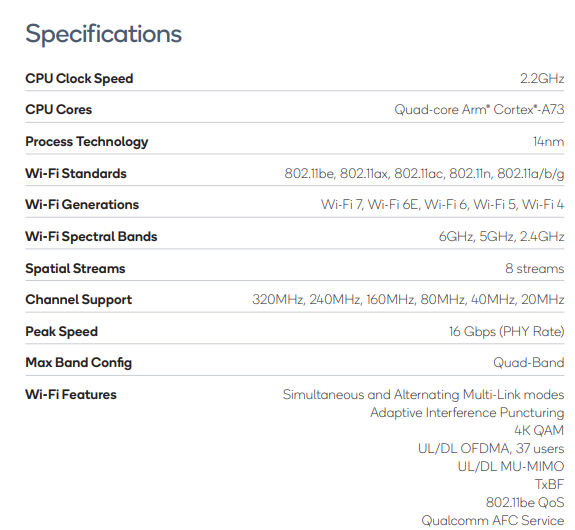
The IPQ9574 brings a new architecture, improved RF design, and cutting-edge Wi-Fi 7 features. Key upgrades include:
✔ 320 MHz Channel Support
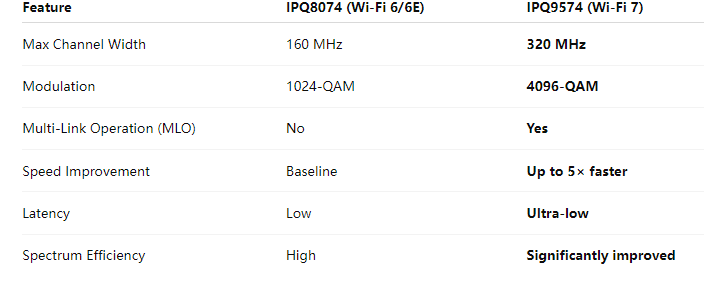
Wi-Fi 7 doubles the maximum channel width from 160 MHz (Wi-Fi 6) to 320 MHz, enabling much higher peak throughput.
✔ Multi-Link Operation (MLO)
One of the biggest breakthroughs:
Devices can simultaneously use multiple bands
Improved reliability, near-zero latency, and seamless failover
Ideal for industrial and mission-critical networks
✔ Higher Modulation: 4096-QAM
Compared to IPQ8074’s 1024-QAM, Wi-Fi 7 pushes spectral efficiency even further.
✔ Enhanced OFDMA & Preamble Puncturing
Better resource allocation in congested spectrum environments.
✔ Multi-RU Capability
More flexible scheduling across users and channels.
3. Performance Comparison: IPQ8074 vs IPQ9574
The IPQ9574 isn’t just faster—it is more stable, adaptive, and efficient, especially in congested or industrial environments.
4. Real-World Impact: Why the Upgrade Matters
✔ Industrial IoT
Stable multi-link communication
Reduced packet loss in noisy RF environments
Higher throughput for camera streams, sensors, and gateway devices
✔ Enterprise and Public Networks
Better performance in stadiums, airports, shopping malls
Improved roaming and handoff with MLO
✔ Outdoor Wireless & WISP
Stronger long-range performance
Less interference due to flexible spectrum use
✔ AI, Edge Computing & Real-Time Apps
Consistent high-speed connection
Enabling latency-sensitive applications such as robotics and AR/VR
5. Hardware Evolution: DR8074 → DR9574
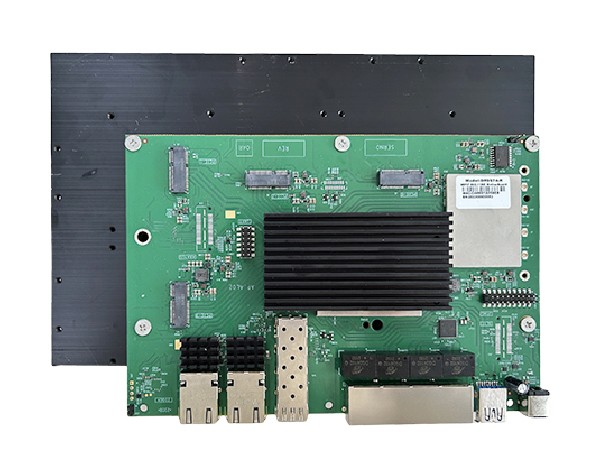
As the chipset evolves, so do high-performance hardware platforms. Our DR9574 brings the full power of the IPQ9574 Wi-Fi 7 SoC into a production-ready board designed for:
2× 10G Ethernet + 4× 1G Ethernet
4× M.2 slots for QCN9274/6274 Wi-Fi 7 radios
Industrial-grade operation
High-power RF design for long-range wireless
Customizable firmware and OpenWrt/QSDK support
It is an ideal upgrade path for users currently deploying DR8074/IPQ8074 platforms but looking to move into Wi-Fi 7 performance levels.
6. Conclusion: Wi-Fi 7 Redefines What’s Possible
The transition from IPQ8074 to IPQ9574 is more than a chipset upgrade—it is a shift to a new era of wireless networking:
Faster speeds
Lower latency
Higher reliability
Better performance in crowded environments
New capabilities through MLO and 320 MHz channels
For industrial, enterprise, and high-density deployments, adopting Wi-Fi 7 solutions such as the IPQ9574-based DR9574 creates a stronger, more scalable wireless infrastructure ready for the future.
🚀 Introducing the DR5018S – Built for Industrial-Grade Wireless
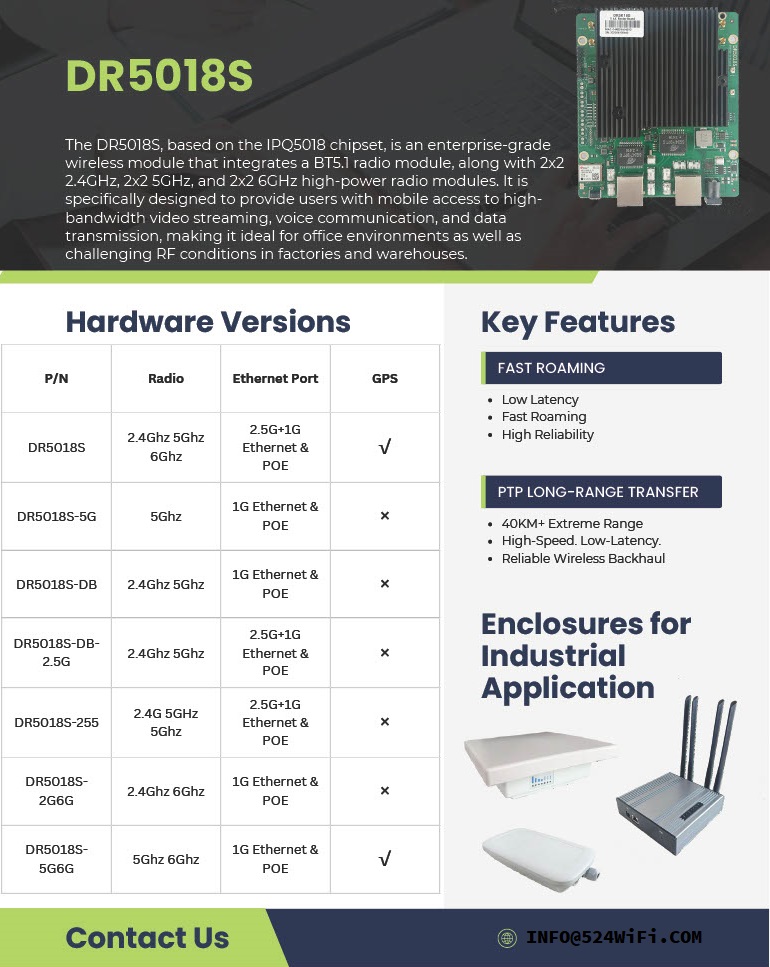
From smart ports to logistics hubs to long-range PTP connections, the DR5018S is engineered to deliver: ✅ Fast Roaming ✅ 40km+ PTP Long-Range Transmission ✅ Flexible Enclosures for Any Industrial Application
Whether it’s powering connectivity in smart cities, transportation, or critical infrastructure, the DR5018S ensures powerful performance with reliability you can trust.
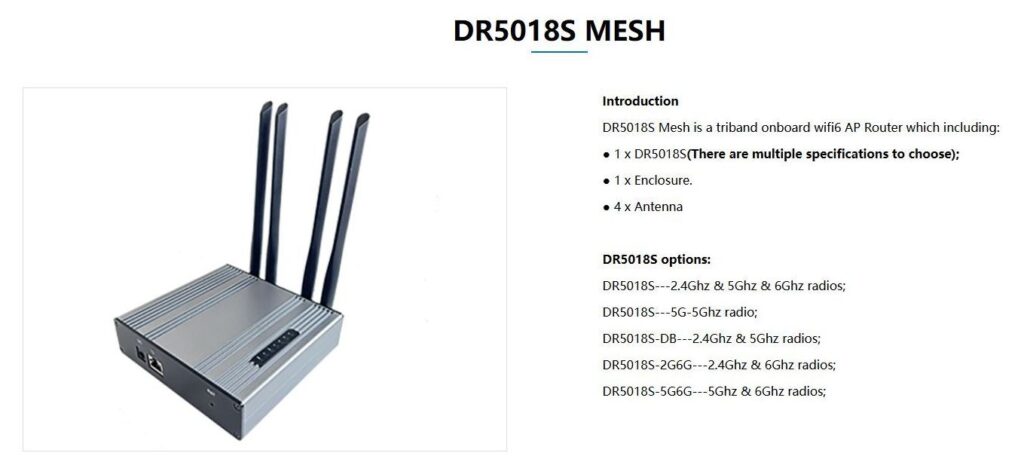
xperience next-level WiFi 6 tri-band performance with the DR5018S Mesh – designed for industrial, enterprise, and large-scale applications. Seamless connectivity, EasyMesh support, and robust hardware all in one compact solution. 💡 Learn more and explore full specifications on our website:
: Introducing the DR5018S – Built for Industrial Grade Wireless – Qualcomm IPQ5018
🚀 When 5G NR Meets Mesh: Filling the Coverage Gaps
5G NR provides standardized, high-performance connectivity — but there are still scenarios where base station deployment is difficult or impractical:
Drone swarms requiring real-time coordination in remote airspace Robots in underground mines where signals can’t penetrate Military field operations demanding resilient, ad-hoc communication In such environments, Mesh networks step in as a complementary layer, ensuring local connectivity even when 5G NR coverage is limited.
👉 Question for the community: Do you see Mesh as a temporary patch until 5G expands everywhere, or as a long-term complement to 3GPP 5G NR in mission-critical deployments?
The Qualcomm IPQ8072 has long been a reliable choice for Wi-Fi 6 networking hardware. Many enterprise routers, carrier CPEs, and industrial access points are still powered by IPQ8072 due to its strong balance of cost and performance. However, with the rapid evolution of Wi-Fi 7 (802.11be), the Qualcomm IPQ9574 offers significant technical advantages that make it the logical upgrade path for next-generation solutions.
In this article, we compare IPQ8072 vs IPQ9574, highlighting the major differences and why developers should consider migrating to Wi-Fi 7 hardware.
Overview of IPQ8072 (Wi-Fi 6 SoC)
The Qualcomm IPQ8072 is part of the IPQ807x family, designed for Wi-Fi 6. It features:
Quad-core ARM Cortex-A53 processor
8×8 MU-MIMO capability
Up to 160 MHz channel bandwidth
1024-QAM modulation
Robust support for enterprise and carrier-grade networking
While still capable, the IPQ8072 has reached maturity, and limitations in throughput and latency become noticeable in demanding applications.
Overview of IPQ9574 (Wi-Fi 7 SoC)
The Qualcomm IPQ9574 represents the new generation of Wi-Fi 7 platforms, optimized for ultra-high throughput and low latency. Key features include:
Enhanced multi-core CPU architecture for higher processing power
320 MHz channel bandwidth (double that of IPQ8072)
4096-QAM modulation for higher spectral efficiency
Support for Multi-Link Operation (MLO)
Designed for advanced enterprise, industrial, and carrier networks
This makes IPQ9574 ideal for data-heavy applications such as 8K video streaming, AR/VR, industrial IoT, and low-latency control systems.
IPQ8072 vs IPQ9574 Technical Comparison
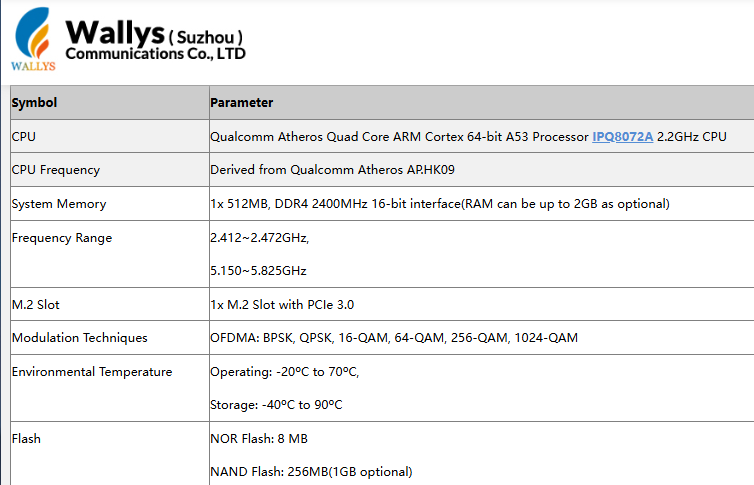
The Qualcomm IPQ8072 is a Wi-Fi 6 (802.11ax) SoC built with a quad-core Cortex-A53 processor. It supports channel bandwidths of up to 160 MHz and uses 1024-QAM modulation, making it a strong choice for enterprise routers, carrier CPE, and industrial APs.
Data from Wallys DR8072 Webpage
By contrast, the Qualcomm IPQ9574 belongs to the Wi-Fi 7 (802.11be) generation. It features a more advanced multi-core CPU architecture, supports 320 MHz channel bandwidth (double that of IPQ8072), and enables 4096-QAM modulation for higher spectral efficiency. Unlike IPQ8072, it also supports Multi-Link Operation (MLO), a Wi-Fi 7 feature that allows simultaneous use of multiple frequency bands to reduce latency and improve stability. These enhancements make IPQ9574 ideal for next-generation enterprise networks, industrial IoT deployments, low-latency applications, and high-density environments.
Data from Qualcomm IPQ9574 Datasheet
Why Upgrade from IPQ8072 to IPQ9574?
Performance Leap – Wi-Fi 7 doubles available channel bandwidth and introduces 4096-QAM for significantly higher throughput.
Ultra-Low Latency – MLO ensures faster and more reliable connectivity, critical for real-time applications.
Future-Proofing – As Wi-Fi 6 hardware reaches end of lifecycle, Wi-Fi 7 ensures long-term product competitiveness.
Scalability – IPQ9574’s stronger CPU supports more devices, traffic, and complex networking tasks.
524WiFi and Wallys’ IPQ9574 Router Board Solution
At 524WiFi, we provide hardware solutions based on Qualcomm IPQ9574, including the DR9574 Router Board, designed for Wi-Fi 7 networks. With strong processing power, advanced wireless features, and industrial-grade reliability, it is the perfect upgrade path for developers currently using IPQ8072-based designs.
Frequently Asked Questions (FAQ)
1. Is IPQ8072 still good in 2025?
Yes. The Qualcomm IPQ8072 is still a stable and cost-effective Wi-Fi 6 chipset, suitable for enterprise routers and industrial APs. However, for new projects that require higher throughput, lower latency, and longer product lifecycle, Wi-Fi 7 chipsets such as IPQ9574 are strongly recommended.
DR9574 board
2. What is the difference between IPQ8072 and IPQ9574?
The IPQ8072 is a Wi-Fi 6 (802.11ax) SoC, supporting up to 160 MHz bandwidth and 1024-QAM. The IPQ9574 is a Wi-Fi 7 (802.11be) SoC with 320 MHz bandwidth, 4096-QAM, and Multi-Link Operation (MLO), enabling much higher throughput and lower latency.
3. Why upgrade from Wi-Fi 6 to Wi-Fi 7?
Upgrading to Wi-Fi 7 provides faster data rates, reduced latency, and better efficiency in high-density environments. For applications such as AR/VR, 8K streaming, and industrial automation, Wi-Fi 7 ensures future-proof performance and competitiveness.
4. Does 524WiFi provide IPQ9574-based solutions?
Yes. 524WiFi and Wallys Communications offer router boards and network modules based on Qualcomm IPQ9574, including the DR9574 Router Board. These solutions are designed for enterprise, carrier, and industrial use cases that demand next-generation Wi-Fi 7 performance.
With the increasing demand for high-speed wireless networks, WiFi 6 technology has become the preferred choice for upgrading enterprise and industrial wireless solutions. Offering higher throughput, lower latency, and superior interference resistance, WiFi 6 enables seamless connectivity across multiple applications.
524WiFi introduces the DR9074-TRIBAND, a high-performance WiFi 6 tri-band network card powered by the Qualcomm QCN9024 chipset. Supporting 2.4GHz, 5GHz, and 6GHz frequency bands, this card is designed for high-density environments, multi-device connectivity, and low-latency applications. This article will explore the technical features, application scenarios, and benefits of the DR9074-TRIABND in upgrading wireless network solutions.
DR9074-TRIABND Specifications
524WIFi DREAM DR9074-TRIBAND is built on the Qualcomm QCN9024 chipset and boasts the following core specifications:
ParameterSpecificationChipset Qualcomm QCN9024 WiFi Standard 802.11ax (WiFi 6) Frequency Bands 2.4GHz / 5GHz / 6GHz Antenna Interface 4×4 MU-MIMO Throughput 2.4GHz: 1148 Mbps ;5GHz: 2402 Mbps ;6GHz: 2402 Mbps Interface PCIe 3.0 Transmit Power Up to 23dBm Security WPA3 Encryption Compatibility Supports OpenWRT / Linux / Custom Firmware
Advantages of a Tri-Band WiFi Design
One of the standout features of the DR9074-TRIABDN is its tri-band support (2.4GHz, 5GHz, 6GHz). Compared to traditional single-band or dual-band network cards, it provides higher throughput, reduced interference, and more flexible networking options.
1. 2.4GHz Band: Wide Coverage, Ideal for IoT Devices
Advantages: Strong penetration capability, suitable for long-distance connections.
Applications: Smart home devices, industrial sensors, low-power IoT devices.
2. 5GHz Band: High Throughput for Mainstream Wireless Applications
Advantages: Supports higher bandwidth while avoiding congestion in the 2.4GHz band.
Applications: Enterprise WiFi networks, HD video streaming, cloud computing offices.
BSS Coloring ✅ Supported ❌ Not Supported ❌ Not Supported
TWT Power Saving ✅ Supported ❌ Not Supported ❌ Not Supported
WPA3 Security ✅ Supported ❌ Not Supported ❌ Not Supported
As seen in the comparison, DR9074-TRIBAND offers superior performance, broader frequency options, less interference, and enhanced security, making it a leading WiFi 6 solution.
Why Choose 524WiFi DR9074-TRIBAND?
✅ Tri-band WiFi 6 support – 2.4G / 5G / 6G compatibility for diverse applications. ✅ Powered by Qualcomm QCN9024 – 4×4 MU-MIMO for ultra-fast, stable connections. ✅ OFDMA & BSS Coloring – Increases network efficiency and reduces congestion. ✅ Advanced WPA3 security – Ideal for enterprise and industrial wireless deployments. ✅ Mesh & Backhaul compatibility – Perfect for high-density WiFi installations.
The 524WiFi DREAM DR9074-TRIBAND is designed for enterprises, industrial applications, smart cities, and high-performance wireless networking, bringing WiFi 6 capabilities to the next level.
IPQ5010 vs. IPQ5018: A Comprehensive Comparison and Why IPQ5018 is the Future of Networking Solutions
In the rapidly evolving world of networking technology, choosing the right platform for your wireless solutions is crucial. Two prominent players in this space are the IPQ5010 and IPQ5018 chipsets. While the IPQ5010 has proven its worth in various applications, the IPQ5018, particularly Wallys’ DR5018S solution, offers a host of advanced features and performance enhancements that make it the superior choice for modern networking needs. This article delves into the key differences between the two platforms and highlights why the IPQ5018 is the future of networking solutions.
IPQ5010: A Solid Foundation
The IPQ5010 has been widely adopted in the networking industry due to its reliable performance and versatility. It supports dual-band Wi-Fi 6 (802.11ax) and is suitable for a range of applications, including home routers, enterprise access points, and IoT devices. Its key features include:
Efficient Performance: Handles moderate traffic loads with ease.
Cost-Effective: A budget-friendly option for basic networking needs.
Wide Compatibility: Works well with various networking protocols and devices.
However, as networking demands grow, the limitations of the IPQ5010 become apparent. It struggles to handle high-density environments, lacks advanced roaming capabilities, and offers limited support for mesh networking—areas where the IPQ5018 excels.
IPQ5018: The Next-Generation Solution
The IPQ5018 builds on the strengths of the IPQ5010 while addressing its shortcomings. Wallys’ DR5018S solution, powered by the IPQ5018, is a game-changer in the networking industry. Here’s why:
1. Enhanced Performance
Higher Throughput: The IPQ5018 delivers superior performance, making it ideal for high-density environments such as stadiums, airports, and large enterprises.
Improved Stability: A more robust platform ensures consistent performance even under heavy traffic loads.
2. Advanced Roaming and Mesh Networking
Fast Roaming: Wallys’ self-developed fast roaming technology ensures seamless switching between access points, reducing latency and improving user experience.
Mesh Networking: The IPQ5018 is optimized for mesh networks, making it perfect for large-scale deployments that require seamless coverage.
3. GPS Integration
DR5018S with GPS Module: The inclusion of a GPS module in Wallys’ DR5018S solution enables precise location tracking, making it ideal for applications such as fleet management, asset tracking, and location-based services.
4. Cost-Effective and Scalable
Competitive Pricing: Despite its advanced features, the IPQ5018 offers a cost-effective solution, making it accessible for businesses of all sizes.
Bulk Management: Wallys’ self-developed AP Controller supports bulk firmware upgrades and management, simplifying large-scale deployments and reducing operational overhead.
5. Future-Proof Technology
Support for Emerging Standards: The IPQ5018 is designed to support future networking standards, ensuring your investment remains relevant for years to come.
Flexibility: Its modular design allows for easy customization to meet specific application requirements.
Real-World Applications
Enterprise Networks: The IPQ5018’s superior performance and fast roaming capabilities make it ideal for large office spaces and campuses.
Smart Cities: Its support for mesh networking and GPS integration enables seamless connectivity across urban areas.
IoT Deployments: The IPQ5018’s stability and scalability make it a perfect fit for IoT applications requiring reliable and consistent connectivity.
Why Choose 524WiFi’ IPQ5018 Solution?
524WiFi and Wallys have leveraged the IPQ5018’s capabilities to create a solution that stands out in the market. Here’s what sets our Dream router board DR5018S apart:
Self-Developed Fast Roaming(value added service): Ensures uninterrupted connectivity, even in high-mobility scenarios.
Seamless Mesh Networking(value added service): Simplifies the deployment of large-scale networks.
GPS Module: Adds a layer of functionality for location-based applications.
AP Controller Support: Streamlines bulk management and firmware upgrades, reducing operational complexity.
Cost-Effective: Offers advanced features at a competitive price point.
Conclusion
While the IPQ5010 has served as a reliable workhorse in the networking industry, the IPQ5018, particularly 524wifi + Wallys’ DR5018S solution, represents the next generation of networking technology. With its enhanced performance, advanced roaming capabilities, GPS integration, and cost-effective pricing, the IPQ5018 is the ideal choice for businesses looking to future-proof their networks.
For those seeking a more robust, scalable, and feature-rich solution, our IPQ5018-based DR5018S is the clear winner. Its unique advantages make it the perfect platform for enterprise networks, smart cities, and IoT deployments. Upgrade to the IPQ5018 today and experience the future of networking.
Contact us today to learn more about the DR5018S solution and how it can transform your network!
The demand for high-performance, customizable wireless solutions is surging across industries – from enterprise networks to industrial IoT and smart city deployments. At Wallys Communications, we bridge cutting-edge hardware with open-source flexibility through our OpenWrt-compatible WiFi 6 modules, engineered for reliability and scalability.
Why OpenWrt + WiFi 6 = Future-Proof Networking
OpenWrt Advantages: Full network stack control, lightweight operation (ideal for embedded systems), and 3,000+ software packages
WiFi 6 Benefits:
▶ 4× device capacity vs. WiFi 5
▶ 75% lower latency
▶ 1.8Gbps aggregate throughput (DR7915)
▶ BSS Coloring for dense deployments
Mediatek DR7915 MT7915
Featured Solutions: Enterprise-Grade WiFi 6 Modules
In the rapidly evolving world of wireless networking, the MT7915 stands out as a powerful and versatile solution for modern connectivity needs. Designed to deliver high performance, reliability, and flexibility, this WiFi 6 chip is ideal for a wide range of applications, from industrial IoT to enterprise networking. In this article, we’ll take a deep dive into the features and benefits of the MT7915, and explore why it’s a top choice for next-gen wireless solutions.
Key Features of the MT7915
1. WiFi 6 Technology
The MT7915 supports 802.11ax (WiFi 6), the latest wireless standard that offers significant improvements over previous generations. With features like OFDMA (Orthogonal Frequency Division Multiple Access) and MU-MIMO (Multi-User Multiple Input Multiple Output), it enables faster speeds, lower latency, and better performance in high-density environments.
2. Dual-Band Support
The MT7915 operates on both 2.4GHz and 5GHz bands, providing flexibility for various networking scenarios. Whether you need broader coverage or higher throughput, this chip delivers optimal performance.
3. High Throughput
With support for 2T2R (2 Transmit, 2 Receive) streams, the MT7915 offers impressive data rates, making it suitable for bandwidth-intensive applications like video streaming, online gaming, and industrial automation.
4. OpenWRT Compatibility
The MT7915 is compatible with OpenWRT, a popular open-source operating system for routers and networking devices. This allows for greater customization and flexibility, enabling developers to tailor the solution to their specific needs.
5. Mini PCIe and M.2 keay A+E or B+M Form Factor
The MT7915 comes in a Mini PCIe or m.2 module, making it easy to integrate into a wide range of devices, from routers and access points to industrial equipment and IoT devices.
6. Industrial-Grade Reliability
Designed for harsh environments, the MT7915 operates reliably in extreme temperatures and conditions, making it ideal for industrial applications.
Benefits of the MT7915
1. Enhanced Performance
The MT7915 delivers faster speeds and lower latency compared to previous-generation WiFi chips, ensuring a seamless user experience even in high-density environments.
2. Cost-Effective Solution
With its high performance and flexibility, the MT7915 offers excellent value for money, making it a cost-effective choice for businesses and developers.
3. Future-Proof Technology
By supporting WiFi 6, the MT7915 ensures that your network is ready for the future, with the ability to handle increasing data demands and new applications.
4. Easy Integration
The Mini PCIe form factor and OpenWRT compatibility make the MT7915 easy to integrate into existing systems, reducing development time and costs.
5. Versatility
From smart homes and offices to industrial IoT and smart cities, the MT7915 is suitable for a wide range of applications, providing reliable connectivity wherever it’s needed.
Applications of the MT7915
1. Industrial IoT
The MT7915’s industrial-grade reliability and high throughput make it ideal for industrial IoT applications, such as factory automation, remote monitoring, and smart logistics.
2. Enterprise Networking
With its support for WiFi 6 and high-density environments, the MT7915 is perfect for enterprise networks, providing fast and reliable connectivity for offices, campuses, and data centers.
3. Smart Homes
The MT7915’s dual-band support and high performance make it a great choice for smart home devices, ensuring seamless connectivity for streaming, gaming, and smart appliances.
4. Public WiFi
The MT7915’s ability to handle high-density environments makes it suitable for public WiFi hotspots, such as airports, malls, and stadiums.
Why Choose Mediatek MT7915 Solution?
At 524WiFi, we offer various MT7915 and MT7916 WiFi 6 / 6E module based on the Mediatek chip, designed to meet the needs of modern wireless networks. Our solution includes:
High-quality hardware: Built for durability and performance.
OpenWRT support: Enabling customization and flexibility.
Expert support: Our team is available to assist with integration and optimization.
The MT7915 is a powerful and versatile WiFi 6 chip that offers high performance, reliability, and flexibility for a wide range of applications. Whether you’re building an industrial IoT system, an enterprise network, or a smart home solution, the MT7915 is a future-proof choice that delivers exceptional value.
As industrial networks grow more complex, the need for high-performance, efficient wireless connectivity becomes more critical. Qualcomm’s QCN9274 (Wi-Fi 7) and QCN9024 (Wi-Fi 6) are both top-tier chipsets that power industrial wireless solutions, but each is optimized for different needs. In this article, we’ll compare the QCN9274 and QCN9024, focusing on their speed, efficiency, and application suitability, to help you determine which chipset is best for your industrial Wi-Fi network.
Overview of QCN9274 and QCN9024
QCN9274 – The Power of Wi-Fi 7
The QCN9274 is Qualcomm’s latest offering featuring Wi-Fi 7 (802.11be). Wi-Fi 7 brings revolutionary improvements to speed, latency, and capacity compared to previous generations. With Wi-Fi 7, the QCN9274 is designed to handle extremely high-demand environments, making it the perfect choice for future-proofing large-scale industrial networks, AI and IoT applications, and high-bandwidth use cases.
Key Features of QCN9274:
Wi-Fi 7 (802.11be) Support: Provides ultra-fast speeds and advanced features like Multi-Link Operation (MLO) and Enhanced QAM (Quadrature Amplitude Modulation).
Data Rates up to 5.8Gbps: The QCN9274 supports significantly faster speeds than its predecessors, ideal for large data transfers and demanding applications.
Reduced Latency: With Wi-Fi 7, the QCN9274 is optimized for ultra-low latency, which is crucial for real-time industrial applications.
Higher Capacity: Enhanced support for more simultaneous connections without sacrificing performance.
Advanced Features: Includes MLO for simultaneous operation on multiple channels, reducing congestion and improving network reliability.
524WiFi Dream QCN9274 Modules
QCN9024 – The Reliability of Wi-Fi 6
The QCN9024, based on Wi-Fi 6 (802.11ax), delivers faster speeds and improved efficiency compared to previous Wi-Fi standards like Wi-Fi 5. It supports OFDMA (Orthogonal Frequency Division Multiple Access) and MU-MIMO (Multi-User, Multiple Input Multiple Output), which optimize the use of available spectrum, making it ideal for crowded environments with multiple connected devices. While Wi-Fi 6 doesn’t offer the same level of performance as Wi-Fi 7, the QCN9024 still provides excellent performance in most industrial settings.
Key Features of QCN9024:
Wi-Fi 6 (802.11ax) Support: Provides faster speeds and improved efficiency compared to Wi-Fi 5, though it lacks the advancements found in Wi-Fi 7.
Data Rates up to 2.4Gbps: Offers strong throughput for most industrial applications, though not as high as Wi-Fi 7.
Improved Efficiency: Supports OFDMA and MU-MIMO for better use of available bandwidth.
Good for High-Density Environments: While it doesn’t scale as well as Wi-Fi 7 in extremely dense environments, it still offers excellent performance in smaller to mid-sized applications.
Speed and Throughput Comparison
QCN9274: Unmatched Speed with Wi-Fi 7
The QCN9274 supports Wi-Fi 7, delivering data rates up to 5.8Gbps. This makes it ideal for high-demand applications such as 4K/8K video streaming, virtual reality (VR), augmented reality (AR), and large-scale industrial automation systems. The advanced capabilities of Wi-Fi 7, such as Multi-Link Operation (MLO), allow the chipset to utilize multiple channels simultaneously, improving throughput and reducing network congestion.
Wi-Fi 7 offers dramatic speed improvements over Wi-Fi 6, enabling faster data transfers, better device density handling, and the ability to operate seamlessly in congested environments.
DR9274 6G SPEED THOUGHPUT TEST
QCN9024: Excellent Wi-Fi 6 Performance
On the other hand, QCN9024 supports Wi-Fi 6, with data rates up to 2.4Gbps. While this is more than sufficient for many industrial applications, it doesn’t match the ultra-high speeds of Wi-Fi 7. Wi-Fi 6 excels in dense environments with many devices, offering improved network efficiency and reduced latency compared to older Wi-Fi standards like Wi-Fi 5.
However, for environments with extreme data throughput requirements, Wi-Fi 7 offers significant improvements in both speed and efficiency.
DR9074(QCN9074)-6E SPEED THOUGHPUT TEST
Efficiency and Capacity
QCN9274: Higher Efficiency for Dense, High-Traffic Environments
The QCN9274, supporting Wi-Fi 7, offers significantly higher capacity and better efficiency compared to Wi-Fi 6. With the help of MLO and Wider Channel Bandwidth, it can handle multiple data streams simultaneously, making it perfect for high-density environments. This is a critical feature in industrial networks, where many devices (IoT sensors, automated machines, etc.) need to operate concurrently.
Wi-Fi 7 is specifically designed for environments that require simultaneous handling of multiple high-bandwidth applications, ensuring that each device gets sufficient bandwidth without causing congestion.
QCN9024: Efficient but Less Scalable
The QCN9024, based on Wi-Fi 6, performs well in dense environments, but it has limitations when scaling up to larger networks. It does support OFDMA and MU-MIMO, which helps in efficient spectrum use and ensures that the network can handle more devices without slowing down. However, compared to Wi-Fi 7, Wi-Fi 6 does not have the same level of capacity or congestion mitigation.
While the QCN9024 is highly efficient in environments with moderate device density, Wi-Fi 6 has its limits in large-scale, high-density industrial deployments.
Latency and Real-Time Applications
QCN9274: Ultra-Low Latency with Wi-Fi 7
One of the key benefits of Wi-Fi 7 is its ultra-low latency, crucial for real-time applications in industrial environments. The QCN9274 is designed for instantaneous communication, which is essential for applications like real-time monitoring, automated systems, and video surveillance. Wi-Fi 7 improves upon Wi-Fi 6 with reduced delay and more predictable performance, even in busy environments.
QCN9024: Reliable but Slightly Higher Latency
The QCN9024, with its Wi-Fi 6 capabilities, also provides low latency, making it suitable for most industrial applications. However, when compared to Wi-Fi 7, the latency is slightly higher, especially in large-scale environments where many devices are connected simultaneously. This might be noticeable in highly time-sensitive applications.
Which Chipset is Right for Your Industrial Wi-Fi Network?
Choose QCN9274 if:
You need ultra-fast speeds and high data throughput for demanding applications.
Your industrial network requires low latency for real-time monitoring, automation, and control.
You have a large number of devices connected to the network and need a future-proof solution.
You want to take advantage of Wi-Fi 7‘s advanced features, such as MLO and wider channels for optimal performance in dense environments.
Choose QCN9024 if:
Your network has a moderate number of devices and Wi-Fi 6 is sufficient for your current needs.
You don’t need the latest Wi-Fi 7 features but still require high-speed connectivity for industrial applications.
You are looking for a reliable, cost-effective solution for environments that do not demand extreme speeds or massive scalability.
Conclusion
Both the QCN9274 and QCN9024 are excellent choices, but they cater to different needs. The QCN9274 with Wi-Fi 7 is ideal for high-performance, large-scale, and future-proof industrial networks, while the QCN9024 with Wi-Fi 6 is a great option for environments where Wi-Fi 6’s capabilities are more than adequate. Ultimately, the right choice depends on your network’s requirements—whether it’s speed, efficiency, capacity, or future scalability.
By selecting the right chipset, you can ensure your industrial Wi-Fi network delivers the performance, reliability, and efficiency required for success.