Posted on

Top QCA IPQ 9574 Chip Features for Next-Gen Wi-Fi 7 Connectivity

op IPQ9574 Chip Features for Next-Gen Wi-Fi 7 Connectivity

As the demand for faster, more reliable wireless networks continues to grow, the introduction of Wi-Fi 7 has become a game-changer in the world of wireless technology. At the heart of this new generation of Wi-Fi is the IPQ9574 chip, designed by Qualcomm, which is quickly emerging as one of the leading chips for Wi-Fi 7 connectivity. With its advanced features, the IPQ9574 is set to unlock unprecedented speeds, capacity, and reliability, paving the way for cutting-edge applications across industries. In this article, we’ll take a closer look at the top features of the IPQ9574 chip and how it is revolutionizing the way we connect.

1. Multi-Link Operation (MLO) for Ultra-Fast Speeds

One of the standout features of the IPQ9574 chip is its support for Multi-Link Operation (MLO), a critical component of Wi-Fi 7. MLO allows devices to simultaneously connect to multiple frequency bands (e.g., 2.4 GHz, 5 GHz, and 6 GHz) instead of relying on a single band. This results in faster data transfer speeds and improved network efficiency.

With MLO, the IPQ9574 can combine multiple data streams from different channels, enhancing throughput and reducing latency. This makes it ideal for demanding applications such as 4K/8K video streaming, virtual reality (VR), and high-speed gaming, where a seamless and ultra-fast connection is essential.

2. Increased Capacity for Dense Environments

The IPQ9574 chip is built with the capacity to handle a large number of devices simultaneously, which is critical in today’s increasingly connected world. Whether it’s a smart home, a busy office, or a large public venue, the chip ensures that network congestion is minimized, allowing for smooth communication even in dense environments.

With the Wi-Fi 7 technology powered by the IPQ9574, your network will be able to efficiently handle more devices without sacrificing performance. This is especially important as the Internet of Things (IoT) continues to expand and more smart devices are added to networks every day.

3. Better Spectrum Utilization with 320 MHz Channel Width

The IPQ9574 chip supports 320 MHz channel width, which significantly increases the amount of data that can be transmitted over the network. This feature is crucial for taking full advantage of the newly available 6 GHz spectrum offered by Wi-Fi 7, allowing for less interference and more bandwidth.

With wider channels, users can expect higher throughput and faster data speeds. For example, large file transfers, high-definition video streaming, and bandwidth-intensive tasks will see massive improvements in speed and efficiency.

4. Enhanced Reliability and Reduced Latency

One of the most important factors in ensuring a reliable network is minimizing latency—the delay between sending and receiving data. The IPQ9574 chip addresses this with advanced features that optimize network reliability and ensure a low-latency experience.

In applications such as live streaming, online gaming, and real-time video conferencing, low latency is essential for smooth, uninterrupted experiences. The IPQ9574 chip’s ability to provide consistent, stable connections is what sets it apart, ensuring high performance even during heavy traffic periods.

5. Seamless Connectivity with Enhanced Roaming

The IPQ9574 chip supports seamless roaming, which allows devices to smoothly transition between access points without interruption. Whether you’re walking around your home or office, the network will automatically hand off your connection to the nearest access point, ensuring a continuous, reliable experience.

This is especially beneficial in larger spaces or environments with many users, such as hotels, hospitals, or large campuses, where maintaining an uninterrupted connection is crucial.

6. Backward Compatibility with Wi-Fi 5 and Wi-Fi 6

Although the IPQ9574 chip is built for the future with Wi-Fi 7, it also maintains backward compatibility with older Wi-Fi standards, such as Wi-Fi 5 and Wi-Fi 6. This means that users with older devices can still enjoy fast and reliable connections on Wi-Fi 7 networks, without the need to upgrade all their devices at once.

Conclusion: The Future of Wireless Connectivity

The IPQ9574 chip is a powerhouse for Wi-Fi 7 technology, offering game-changing features like Multi-Link Operation (MLO), higher capacity, wider channels, and seamless roaming. These features make it the perfect choice for applications demanding high-speed, reliable, and efficient wireless connections—whether it’s for streaming, gaming, smart cities, or enterprise networks.

At Wallys Communications, we leverage the IPQ9574 chip to deliver cutting-edge solutions that meet the needs of modern wireless networks. Additionally, we have developed AI-driven solutions, such as human recognition and vehicle detection, powered by QCN9074 chips, offering innovative applications in security and automation.

Contact us today to learn more about how our Wi-Fi 7 solutions powered by IPQ9574 can elevate your wireless network and unlock the full potential of next-gen connectivity.

Posted on

Mediatek Unveils the New Wi-Fi 7 Platform AP7988-002, Delivering High-Performance Wireless Solutions for the AI Era

As AI development and the IoT market continue to mature, Wi-Fi has become one of the most universal and indispensable transmission methods in everyday life. However, with the growing demand for data traffic, existing networking technologies are facing challenges. To address these needs, 524WiFi proudly introduces its latest generation Wi-Fi 7 router development board, the AP7988-002. Designed to provide exceptional performance and seamless connectivity in the wireless communications field, the AP7988-002 is powered by the four-core ARM Cortex-A73 MediaTek MT7988A processor, making it the ideal choice for AI-driven communication and high-bandwidth applications.

In terms of wireless performance, the AP7988-002 is equipped with the MediaTek MT7996 Wi-Fi chipset, supporting Wi-Fi 7 technology and offering ultra-high-speed connectivity of up to 19,000 Mbps. This ensures ultra-low latency and outstanding data transmission capabilities, providing the perfect solution for next-generation network applications. To further enhance wireless signal coverage, the AP7988-002 features a high-power amplifier front-end module, significantly boosting signal strength and transmission range. This makes it especially suitable for large-scale infrastructure and environments requiring stable connections, positioning it as an essential networking device for both enterprise and residential applications.

The AP7988-002 is built around versatility, combining Tri-Band Triple Concurrent (TBTC) technology with 10G PHY high-speed wired connectivity. This allows it to handle substantial data transmissions simultaneously, ensuring optimal performance in multi-device connected environments and providing a stable network foundation for high-bandwidth applications.

Additionally, the product comes with an integrated M.2 B Key slot, supporting 4G/5G WWAN modules to offer flexible mobile network connectivity options. The M.2 M Key slot enables storage expansion, making it especially suitable for data-intensive applications such as large-scale data processing needed by small to medium-sized businesses. An integrated GPS module further enhances the device’s positioning capabilities, broadening its adaptability in modern network environments.

The launch of the AP7988-002 solidifies Mediatek’s leadership in wireless connectivity solutions, demonstrating the company’s commitment to technological innovation and laying a solid foundation for IoT applications. 524WiFi continues to drive advancements in wireless technology, striving to improve the performance and ease of use of IoT technologies, expanding the ways people live and work.

This product’s release marks a new milestone for Mediatek in the wireless technology field. With its exceptional performance and flexible application options, it brings an unprecedented network experience to both industries and individual users. For more information, please visit the 524WiFi official website for the latest updates and technical support.

Posted on

The Impact of Quantum Computers on Traditional Encryption: Why Wi-Fi Technology Needs PQC Encryption

With the rapid advancement of quantum computing, traditional encryption standards are facing significant challenges. Quantum computers possess immense computational power, enabling them to break conventional encryption techniques in a fraction of the time. This poses a serious risk to many areas dependent on data security, including Wi-Fi communications. To protect future data transmissions, Wi-Fi technology urgently requires the implementation of Post-Quantum Cryptography (PQC) to address this emerging threat.

How Quantum Computing Threatens Existing Encryption Standards

  1. Weaknesses of Current Encryption Methods
    Currently, Wi-Fi encryption standards such as WPA2 and WPA3 rely on encryption algorithms like AES and RSA to secure data transmissions. These algorithms are based on the complexity of certain mathematical problems that traditional computers struggle to solve. However, quantum computers can leverage quantum bits’ parallel processing capabilities to crack these encryption methods swiftly. In particular, Shor’s algorithm can break RSA and ECC (Elliptic Curve Cryptography) methods, which rely on integer factorization and discrete logarithms, respectively. This exposes a critical vulnerability in today’s encryption protocols.
  2. Long-Term Risks to Data Security
    While quantum computers are not yet fully developed, the rapid progress of quantum technology means that, in the future, quantum computers could be powerful enough to crack the encrypted data we rely on today. Once this threshold is crossed, sensitive information transmitted over Wi-Fi networks—such as financial transactions and personal data—could be compromised. This is an urgent concern for both enterprises and individual users, particularly as Wi-Fi networks are used to transmit more sensitive and personal data.

PQC Encryption: Providing Quantum Resistance for Wi-Fi Technology

To address the threat of quantum computing, Post-Quantum Cryptography (PQC) has emerged as a new encryption solution. PQC algorithms are based on mathematical problems that remain secure even in the presence of quantum computing, such as lattice-based cryptography and multivariate equations. These new algorithms not only defend against quantum attacks but also provide additional security in today’s non-quantum computing environment.

  1. Enhanced Security for Wi-Fi Communications
    PQC can strengthen existing Wi-Fi encryption protocols (such as WPA3), ensuring that even if quantum attacks become a reality, data transmissions remain secure. This means that Wi-Fi users will continue to have secure and reliable network connections even in the quantum era.
  2. Protecting IoT Device Communications
    As more IoT devices connect to Wi-Fi networks, the need for robust security measures grows. PQC encryption can safeguard these devices’ communications from being compromised by attackers utilizing quantum computing capabilities, thereby ensuring the security of the entire IoT ecosystem.
  3. Mitigating Future Data Decryption Risks
    It’s essential to consider not only current threats but also future risks posed by quantum computing. PQC can protect encrypted data transmitted today, ensuring that even when quantum computers are fully operational, the data remains secure. This is crucial for industries that require long-term data storage, such as healthcare and finance.

Conclusion: The Future of Wi-Fi and PQC Encryption

As quantum computing technology evolves, Wi-Fi technology will face new challenges. Traditional encryption methods will no longer suffice, and the adoption of Post-Quantum Cryptography (PQC) will be essential to secure future data transmissions. At 524WiFi, we are committed to integrating PQC encryption into our Wi-Fi 7 solutions, ensuring robust security for future-proof data transmission and keeping your network safe from the quantum threat.

Posted on

The New Era of Wi-Fi 7: Elevating the Network to the Next Level – MediaTek MT7996

In the ever-evolving landscape of wireless communication, 524WiFi has once again asserted its commitment to innovation by diving headfirst into the realm of Wi-Fi 7 technology. As the demand for faster and more reliable connectivity continues to surge, 524WiFi’s strategic move positions the company at the forefront of the next generation of wireless networking.

524WiFi’s Wi-Fi 7 technology, utilizing MediaTek MT7996, leverages MediaTek’s distinctive 4T5R technology platform with advanced receiver diversity techniques and MRC (Multiple Receive Chains). This boosts throughput in the 6GHz frequency for indoor use, delivering wider coverage, top-notch performance, and a stable, efficient 6GHz mesh backhaul. As a manufacturer committed to maximizing MediaTek’s capabilities, AsiaRF strives to collaboratively craft an enhanced connectivity experience for Wi-Fi 7.

What is Wi-Fi 7

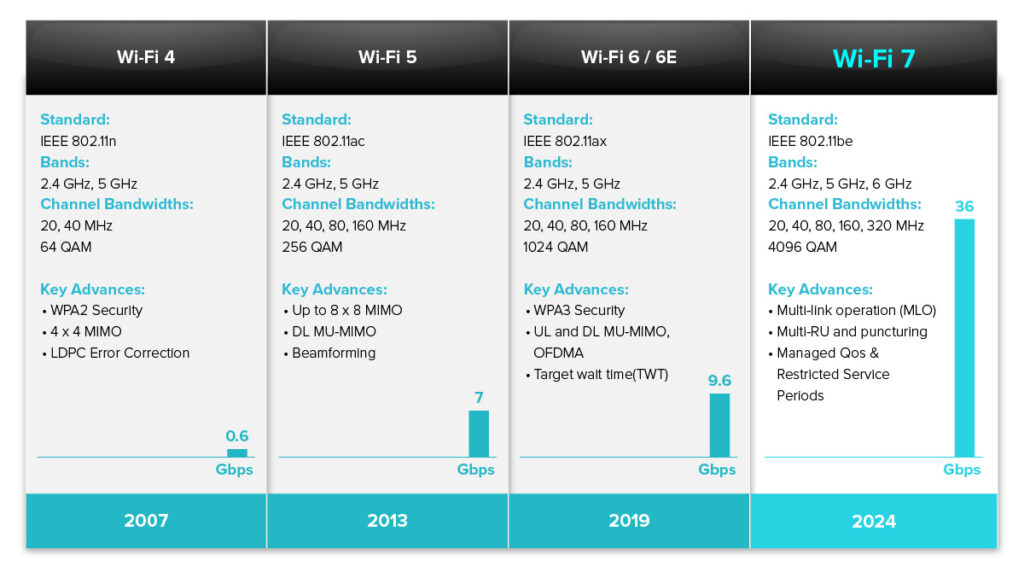
WiFi 7, based on the new IEEE 802.11be standard, operates in three frequency bands: 2.4 GHz, 5 GHz, and 6 GHz. With a maximum bandwidth of 320 MHz in the 6 GHz band, it significantly boosts data transfer rates, addressing the need for faster and more efficient wireless communication in modern networks.

Advantages of Wi-Fi 7 Technology

  • Ultra-High Speed:

Wi-Fi 7 operates on the 6GHz spectrum, enabling the use of channels as wide as 320Hz, further enhancing transmission speeds and achieving a threefold increase compared to the previous generation.

  • Low Latency:

Wi-Fi 7 technology reduces latency, offering more real-time connectivity suitable for applications with stringent low-latency requirements, such as video conferencing.

  • Multi-Link Operation (MLO):

Using Multiple Link Operation (MLO), Wi-Fi 7 enables devices to transmit and receive data across different frequency bands and channels simultaneously, enhancing throughput and reducing latency.

  • Reliable Connectivity:

The use of advanced modulation techniques and signal processing in Wi-Fi 7 enhances the reliability of wireless connections, reducing the likelihood of signal interference and disruptions in enterprise environments.

In summary, Wi-Fi 7, as the next-generation wireless technology, with its enhanced speed and performance, is set to redefine our online experience. 524WiFi is at the forefront of innovation, gearing up to launch high-performance Wi-Fi 7 products, including system platforms and modules. These products will elevate our connectivity experience to higher levels. Anticipate the exciting advancements that Wi-Fi 7 and 524WiFi´s upcoming products promise to bring, leading us into a new era of seamless and superior wireless connectivity.

Posted on

Why IPQ5322 is the Ideal Choice for Wi-Fi 7 IoT Networks

As the demand for faster, more reliable wireless connectivity continues to grow, the need for advanced networking solutions has never been greater. One of the standout solutions for next-generation wireless networks is the IPQ5322 chip, which supports Wi-Fi 7 (802.11be). Developed by Qualcomm, the IPQ5322 is optimized to deliver exceptional performance, efficiency, and scalability, making it the perfect choice for IoT (Internet of Things) applications that require high-speed, low-latency connections. In this article, we’ll explore why the IPQ5322 is the ideal solution for Wi-Fi 7 IoT networks.

1. Wi-Fi 7: The Future of Connectivity

The IPQ5322 is built to support Wi-Fi 7, the latest Wi-Fi standard offering several key enhancements over its predecessors. Wi-Fi 7 introduces wider channels, faster data transfer speeds, and lower latency, providing a significantly better user experience. With Wi-Fi 7, the IPQ5322 is capable of supporting multi-gigabit speeds and seamless, stable connections even in high-demand environments. This is particularly crucial for IoT devices that need to transfer large amounts of data quickly and reliably.

2. High-Speed Data Transfer for IoT Devices

One of the main advantages of Wi-Fi 7, and by extension the IPQ5322, is its ability to handle higher bandwidth and support more devices simultaneously. This is essential for IoT networks where devices like sensors, cameras, and smart devices are constantly communicating with each other. The increased data transfer rates provided by Wi-Fi 7 enable faster communication between devices, which is crucial for time-sensitive applications like industrial automation, smart cities, and healthcare monitoring.

With the IPQ5322, IoT networks can experience high-speed data transfer without sacrificing reliability, allowing devices to operate smoothly and efficiently even in crowded environments with many connected devices.

3. Low Latency for Real-Time IoT Applications

Latency is a critical factor for many IoT applications that require real-time communication. The IPQ5322 supports low-latency operation thanks to the improvements in Wi-Fi 7, ensuring that data is transmitted with minimal delay. This makes the chip ideal for mission-critical IoT applications, such as autonomous vehicles, remote surgery, or smart grids, where milliseconds matter.

The low latency offered by the IPQ5322 ensures that data is transmitted quickly, helping to reduce any potential delays that could compromise the performance of these real-time systems.

4. Efficient Use of Spectrum with Multi-Link Operation (MLO)

Wi-Fi 7 introduces Multi-Link Operation (MLO), a feature that enables devices to use multiple frequency bands simultaneously, improving throughput, reliability, and reducing interference. The IPQ5322 fully supports MLO, making it possible to aggregate 2.4GHz, 5GHz, and 6GHz bands for more efficient and flexible use of the wireless spectrum.

This feature is particularly valuable in IoT environments where devices may be spread across large areas, or where interference from other networks can degrade performance. MLO ensures that devices stay connected and operate at optimal speeds, no matter where they are located within the network.

5. Enhanced Network Efficiency and Scalability

IoT networks are typically large-scale systems consisting of many interconnected devices. The IPQ5322 excels in supporting large, scalable IoT networks by enabling devices to operate with optimal efficiency. With Wi-Fi 7’s advanced modulation techniques, the chip can handle high-density environments, where a large number of devices are simultaneously transmitting and receiving data.

The increased capacity of Wi-Fi 7 ensures that IoT networks can grow without sacrificing performance. Whether it’s a smart home with hundreds of devices or an industrial setting with thousands of sensors and machines, the IPQ5322 can scale to meet the needs of the network.

6. Improved Security for IoT Applications

Security is a top priority in IoT networks, where devices often handle sensitive data. The IPQ5322 integrates advanced security features to protect IoT devices from threats. Wi-Fi 7 includes enhanced encryption protocols and more secure authentication methods, ensuring that data transmitted over the network remains safe from unauthorized access.

The IPQ5322’s security features are critical for industries that require high levels of data integrity, such as healthcare, finance, and critical infrastructure. With the IPQ5322, IoT devices can communicate securely, safeguarding both user data and network integrity.

7. Energy Efficiency for Long-Lasting IoT Devices

While Wi-Fi 7 provides superior performance, it also maintains energy efficiency, which is crucial for IoT devices that run on batteries or need to minimize power consumption. The IPQ5322’s power-efficient design ensures that devices can operate for longer periods without frequent charging, making it ideal for battery-powered IoT devices deployed in remote or hard-to-reach locations.

8. Cost-Effective for Mass Deployment

Despite its high-end performance, the IPQ5322 offers a cost-effective solution for deploying Wi-Fi 7 IoT networks at scale. The chip’s affordability, combined with its advanced capabilities, makes it an attractive choice for businesses and organizations looking to deploy large-scale IoT solutions without exceeding their budgets.

DR5322 Product Information

The DR5322 is a powerful wireless solution based on the Qualcomm IPQ5322 chip, designed to meet the growing demands of modern IoT networks. Here are some key features and applications of the DR5322:

DR5322 Features

  • Qualcomm IPQ5322 Quad-Core Cortex-A53 @ 1.5GHz processor for robust performance.
  • 2×2 on-board 2.4GHz radio, offering up to 573Mbps physical data rate for reliable connectivity.
  • Supports 2×2 5GHz & 2×2 6GHz QCN9274/QCN6274 Wi-Fi 7 modules, delivering up to 5764Mbps physical data rate for high-speed wireless transmission.
  • Equipped with 4 x 2.5Gbps Ethernet ports and 1x 10Gbps SFP port, providing fast and flexible wired connectivity options.

Applications

  • 802.11be MU-MIMO OFDMA Access Point: Ideal for high-demand wireless environments with multiple devices.
  • Internet of Things (IoT): Perfect for large-scale IoT networks that require high-speed, low-latency connectivity.
  • HD Streaming and Gaming: Supports high-definition content streaming and low-latency gaming, making it suitable for entertainment applications.

The DR5322 is a versatile, high-performance solution for IoT, smart homes, industrial applications, and more, offering next-generation Wi-Fi 7 capabilities with advanced features for seamless connectivity and optimal performance.

Posted on

IPQ5322: Your Key to Wi-Fi 7 Superiority

IPQ5322: Your Key to Wi-Fi 7 Superiority

As technology continues to advance at an unprecedented pace, the demand for faster, more reliable, and efficient wireless connectivity has never been higher. Enter Wi-Fi 7, the next-generation wireless standard set to revolutionize how we connect and communicate. At the heart of this transformation is the IPQ5322, a cutting-edge chipset designed to unlock the full potential of Wi-Fi 7.

The Promise of Wi-Fi 7

Wi-Fi 7, also known as 802.11be, is the latest evolution in wireless technology, promising significant improvements in speed, capacity, and latency compared to its predecessors. With support for wider channels, more spatial streams, and advanced modulation techniques, Wi-Fi 7 is poised to deliver unmatched performance for both consumer and enterprise applications.

Introducing the IPQ5322

The IPQ5322 is a state-of-the-art chipset engineered to harness the capabilities of Wi-Fi 7, offering a superior connectivity experience. Designed with the future in mind, the IPQ5322 is set to become the backbone of next-generation networking solutions.

Key Features of the IPQ5322

  1. Blazing Fast Speeds
  2. Increased Network Capacity
  3. Ultra-Low Latency
  4. Enhanced Reliability
  5. Advanced Security Features

The Future of Connectivity

The IPQ5322 is more than just a chipset; it’s a gateway to the future of connectivity. By embracing Wi-Fi 7, users can look forward to a world where limitations on speed, capacity, and reliability are a thing of the past. Whether you’re a consumer looking to enhance your home network or a business aiming to future-proof your operations, the IPQ5322 offers the performance and flexibility needed to stay ahead.

Conclusion

The IPQ5322 and Wi-Fi 7 together represent a significant leap forward in wireless technology. With its unparalleled speed, capacity, and reliability, the IPQ5322 is set to redefine the standards of connectivity, making it an essential component for anyone looking to achieve Wi-Fi 7 superiority.

Posted on

Exploring the Potential of # ath12k in Industrial, Home, and Enterprise Settings

In the rapidly advancing world of wireless technology, ath12k is emerging as a focal point thanks to its exceptional connectivity capabilities and open architecture. It has shown remarkable value across various application scenarios.

🏭 Industrial Applications: In complex industrial environments, ath12k stands out with its robust performance, supporting more stable device connectivity, optimizing production processes, and achieving more efficient automation.

🏠 Home Networking: For modern households, ath12k, with its support for WiFi 6 and 6E technology, meets high bandwidth demands, enhances the seamless operation of smart home devices, and improves the experience of streaming high-definition videos and online gaming.

🏢 Enterprise Solutions: In corporate settings, ath12k’s low-latency characteristics in high-density environments make video conferencing and large data transfers more efficient, thereby boosting team collaboration and workflow efficiency.

🔜 We are excited to announce that 524WiFi and Wallys are developing ath12k solutions with WiFi 7 support, expected to be available soon! We believe this will further enhance user experience and drive the advancement of wireless technology.

🤝 We invite you to share your thoughts or experiences with ath12k applications in the comments, and let us know what you expect from the upcoming WiFi 7 support! We look forward to engaging with you and advancing technology together.

Posted on

Struggling with High-Density Networks? WiFi 7 on Ubuntu Has the Answer

How WiFi 7 Network Cards on Ubuntu Can Future-Proof Your Networking Needs

In the fast-evolving world of wireless technology, staying ahead means embracing innovation. WiFi 7, the latest generation of wireless networking, is not just an incremental upgrade—it’s a game changer. Combined with the flexibility and reliability of Ubuntu, deploying WiFi 7 network cards can open doors to unparalleled performance, adaptability, and security. Let’s explore how this powerful duo can address the growing demands of modern networks.

Meeting High-Performance Networking Demands

  1. High-Speed Local Area Networks (LANs) Enterprises require robust and ultra-fast LANs to handle data-intensive operations. WiFi 7’s Multi-Link Operation (MLO) and wider channel bandwidths deliver a seamless, high-speed experience for local connections.
  2. High-Speed Wireless Bridging Connecting remote sites without sacrificing performance is a critical challenge. WiFi 7 enables stable, high-speed wireless bridges, making it ideal for industries like smart cities, ports, and remote offices.
  3. Optimizing Networks in High-Density Scenarios Managing heavy traffic in environments like stadiums, campuses, and smart factories demands superior technology. WiFi 7’s advanced features, such as improved spectral efficiency and enhanced MU-MIMO capabilities, ensure optimal performance even under peak loads.

Why Ubuntu?

Ubuntu, as an open-source operating system, offers unparalleled flexibility for developers and enterprises. Its active community support, security features, and adaptability make it the ideal platform for integrating WiFi 7 network cards. Together, they create an ecosystem where innovation thrives and networks operate at their full potential.

Advantages of WiFi 7 Network Cards on Ubuntu

  • Performance: Exceptional speeds and reduced latency redefine network efficiency.
  • Flexibility: Open-source compatibility allows tailored solutions for unique use cases.
  • Security: Enhanced encryption and network integrity to protect sensitive data.

Why 524WiFi?

For 23 years, 524WiFi and Wallys R&D teams have specialized in WiFi protocols, continuously innovating to meet the needs of industrial and enterprise clients. Whether you’re building cutting-edge WiFi 7 solutions or optimizing existing networks, our team is here to support your goals.

Posted on

Mastering MLO on the IPQ 5332 Board with DR 9274 5G6G Card: Step-by-Step Video Guide

Are you working on industrial wireless projects and looking for a reliable guide to set up Multi-Link Operation (MLO)? Look no further! At 524WiFi and WallysTech, we’ve just released a comprehensive tutorial video to help you configure MLO on the IPQ5332 board (DR5332) paired with the DR9274-5G6G card.

This video covers everything you need to know, including:

✅ Hardware connection setup

✅ Firmware loading instructions

✅ Access Point (AP) configuration

✅ Practical tips to optimize your industrial wireless network

Why MLO Matters

MLO is a game-changing feature in WiFi 7 that allows simultaneous use of multiple bands for enhanced throughput and reliability. With industrial applications demanding higher speeds and more stable connections, mastering MLO is key to staying ahead.

Watch the Tutorial Now

Click below to watch the full step-by-step guide: 👉 How to Set Up MLO on the IPQ5332 Board with DR9274-5G6G Card

Need This Hardware? We’ve Got You Covered!

If you’d like to test this setup or integrate it into your project, contact our sales team at [email protected]. We’re here to provide tailored solutions and support your success.


💬 We’d love to hear from you! What other topics would you like us to cover? Comment below with your suggestions, and don’t forget to share this article with your network.

📢 Follow us for more updates, tutorials, and insights into the latest wireless technologies!

Posted on

Exploring Temperature Resilience in Wi-Fi 7: IPQ5322 vs IPQ9574 for Industrial Use

As Wi-Fi 7 becomes a key component in next-generation networking, choosing the right chipset for enterprise and industrial applications goes beyond performance — it also involves environmental considerations, especially temperature tolerance. Here, we’ll compare Qualcomm’s IPQ5322 and IPQ9574 in terms of their environmental temperature ranges and explore how these specifications align with their applications in Wi-Fi 7 networks.

Environmental Temperature Specifications

Both the IPQ5322 and IPQ9574 support Wi-Fi 7, bringing the latest in high-speed, low-latency connectivity. Their environmental temperature specifications make them resilient options for various climates, ensuring dependable operation in both controlled indoor environments and some semi-industrial outdoor settings.

IPQ5322 Temperature Specifications:

  • Operating Temperature: -20°C to 70°C
  • Storage Temperature: -40°C to 90°C

IPQ9574 Temperature Specifications:

  • Operating Temperature: -20°C to 70°C
  • Storage Temperature: -40°C to 90°C

Both chipsets offer robust environmental specifications, allowing them to withstand moderate temperature fluctuations and support reliable operation across various application settings.

Practical Applications and Environmental Considerations

With Wi-Fi 7 as a standard feature, the IPQ5322 and IPQ9574 are both optimized for high-demand connectivity. Here’s how they differ in terms of ideal use cases:

Indoor Enterprise Environments

  • Applications: Corporate offices, education centers, and healthcare facilities.
  • Why IPQ5322?: With its reliable temperature range and balanced performance, the IPQ5322 is perfect for indoor enterprise networks that demand Wi-Fi 7 speed and efficiency without the need for additional industrial-grade resilience. It’s cost-effective for large deployments while supporting high-speed connectivity in controlled indoor environments.

Outdoor and Semi-Industrial Environments

  • Applications: Warehouses, transit stations, and smart cities.
  • Why IPQ9574?: The IPQ9574’s Wi-Fi 7 capabilities and processing power make it ideal for demanding environments that experience variable conditions. For semi-industrial or outdoor applications where data throughput and robust connectivity are essential, the IPQ9574 ensures high performance alongside temperature resilience.

Key Differences Beyond Temperature Range

Although they share similar environmental specs, these chipsets have additional distinctions:

Wi-Fi 7 Capabilities

  • Both Chipsets: Support for Wi-Fi 7 delivers faster speeds, lower latency, and improved device handling.
  • Performance Edge: The IPQ9574’s enhanced processing power and high data throughput make it better suited to data-heavy applications in dense environments.

Optimized for Varying Environments

  • IPQ5322: Geared toward cost-effective deployments where indoor temperature control is standard.
  • IPQ9574: Ideal for applications requiring added resilience and top-tier performance in semi-industrial and outdoor environments.

524WiFi Solutions for Wi-Fi 7 Deployments

524WiFi and Wallys offers router boards featuring both IPQ5322 and IPQ9574 chipsets, providing options for tailored Wi-Fi 7 solutions:

  • DR5322: Built around the IPQ5322, this board is a cost-effective solution for enterprise Wi-Fi 7 networks. It ensures smooth operation within standard indoor temperature conditions, making it ideal for large-scale enterprise applications with Wi-Fi 7 performance.
  • DR9574: Equipped with the IPQ9574, this board is optimized for data-intensive tasks. With multiple M.2 slots and 10G Ethernet ports, it excels in environments requiring robust Wi-Fi 7 connectivity and higher data handling, such as smart cities and industrial IoT setups.

Conclusion

While both the IPQ5322 and IPQ9574 offer Wi-Fi 7 and the same temperature tolerances, their unique performance capabilities make them ideal for different applications. For indoor, enterprise-grade connectivity, the IPQ5322 is the economical choice, while the IPQ9574 is suited for high-performance needs in semi-industrial or outdoor installations.