Posted on — Leave a comment

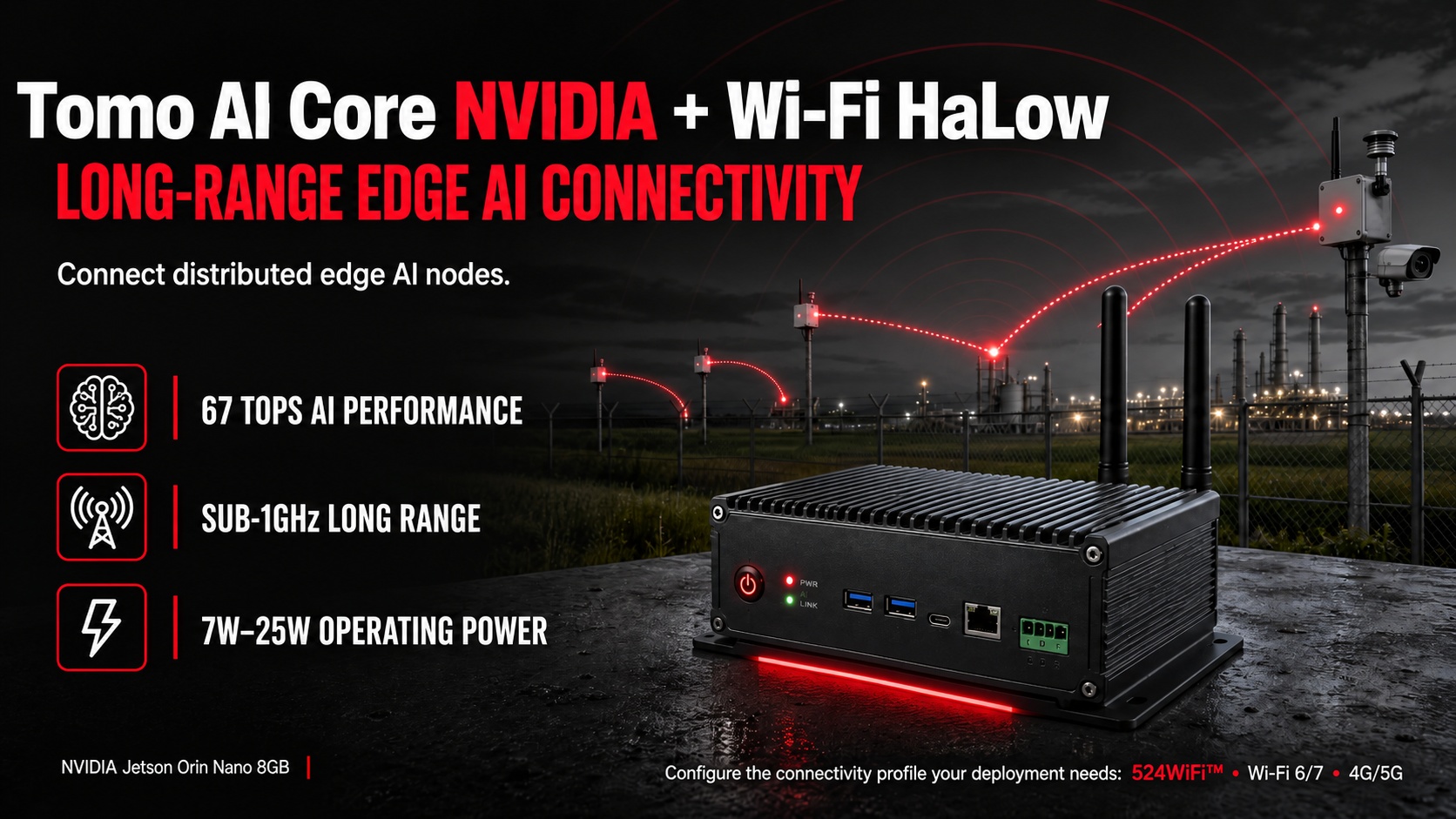
Tomo AI Core NVIDIA + Wi-Fi HaLow: Long-Range Edge AI Connectivity

524WiFi™ Tomo AI Core NVIDIA with Wi-Fi HaLow for distributed edge AI connectivity

Edge AI devices are only as useful as the network they run on. A vision model that can detect a defect or a person in real time is worthless if the data can’t get back to the control system — especially in outdoor, long-range, or power-constrained deployments where traditional 2.4GHz/5GHz Wi-Fi simply doesn’t reach. That’s the gap Wi-Fi HaLow (IEEE 802.11ah) is built to close, and it’s now available as a connectivity option for the 524WiFi™ Tomo AI Core NVIDIA, our NVIDIA Jetson Orin Nano-based edge AI platform.

What Is Wi-Fi HaLow and Why Does Edge AI Need It?

Wi-Fi HaLow operates in the sub-1GHz spectrum (900MHz ISM band in most regions) instead of the 2.4GHz/5GHz bands used by conventional Wi-Fi. Lower frequency signals travel farther and penetrate walls, foliage, and structural obstacles far more effectively — which is exactly why HaLow is positioned by the Wi-Fi Alliance for long-range, low-power IoT and sensor connectivity rather than high-bandwidth video streaming.

For edge AI deployments, this matters in a specific way: many Jetson-based inference nodes don’t need gigabit throughput — they need to reliably send detection results, telemetry, or compressed metadata back to a gateway from hundreds of meters away, often on battery or solar power. That’s a connectivity profile standard Wi-Fi and even LTE/5G aren’t always the right fit for, either on range, power draw, or cost.

How Wi-Fi HaLow Connects with the Tomo AI Core NVIDIA

The Tomo AI Core NVIDIA pairs an NVIDIA Jetson Orin Nano 8GB SOM (67 TOPS AI performance, 1024-core Ampere GPU, 6-core Arm Cortex-A78AE CPU) with a industrial carrier board built for industrial edge deployment — 5x Ethernet (including PoE), CAN FD, RS485, GPIO, and M.2 PCIe NVMe expansion.

Wi-Fi HaLow is integrated as a module option on that same carrier board, alongside the existing 2.4G/5.8G Wi-Fi and optional 4G/5G cellular paths. In practice this means a single AI Box can be configured for the connectivity profile the deployment actually needs: short-range high-bandwidth Wi-Fi for a warehouse, cellular for a mobile asset, or HaLow for a long-range, low-power sensor or camera node spread across an outdoor site.

Wi-Fi HaLow vs. Traditional Wi-Fi for Long-Range Edge AI

The two technologies solve different problems rather than competing head-to-head.

Range: traditional 2.4/5GHz Wi-Fi typically covers tens of meters indoors; Wi-Fi HaLow’s 900MHz band extends to hundreds of meters, up to roughly 1km line-of-sight.

Obstacle penetration: traditional Wi-Fi signal degrades quickly through walls and foliage; HaLow’s lower frequency travels through obstacles more effectively.

Power consumption: traditional Wi-Fi draws more power, which is fine for mains-powered devices; HaLow’s lower power draw suits battery- or solar-powered nodes that need to run for months between service visits.

Throughput: traditional Wi-Fi 6/7 scales up to multi-Gbps for video and high-bandwidth workloads; HaLow trades throughput for range and efficiency, which is enough for sensor telemetry and detection metadata but not for streaming video.

Best fit: traditional Wi-Fi suits dense, high-bandwidth environments like a multi-camera inspection line; HaLow suits long-range, low-power, distributed nodes like an outdoor perimeter or a field spread across acres.

A multi-camera vision inspection line still needs Wi-Fi 6/7 for bandwidth; a perimeter sensor network spread across a farm or port doesn’t — which is why the Tomo AI Core NVIDIA supports both as configurable options rather than picking one.

Edge AI Applications Enabled by Wi-Fi HaLow

  • Agriculture: Jetson-based cameras or sensor nodes spread across large fields, sending detection or telemetry data back to a central gateway without running cable or relying on cellular coverage.
  • Perimeter and outdoor security: long-range camera nodes in ports, campuses, or industrial yards where mesh Wi-Fi backhaul isn’t practical.
  • Logistics and asset tracking: distributed sensor nodes across a yard or warehouse exterior, where battery life matters more than throughput.
  • Smart infrastructure: environmental or condition-monitoring sensors feeding low-power edge AI nodes over long distances.

524WiFi™ Tomo AI Core NVIDIA + Wi-Fi HaLow: Hardware Summary

  • Compute: NVIDIA Jetson Orin Nano 8GB SOM (part of the Jetson Nano/Orin Nano product family), 67 TOPS AI performance, 1024-core Ampere GPU with 32 tensor cores, 6-core Arm Cortex-A78AE CPU, 8GB 128-bit LPDDR5
  • Connectivity options: Wi-Fi HaLow (long-range, sub-1GHz), onboard 2.4G/5.8G Wi-Fi, optional 4G/5G (Nano SIM), 5x Ethernet (1x independent PoE 48V RJ45 + 4x shared RJ45)
  • Interfaces: CAN FD, RS485, RS232, 4x USB 3.0, USB-OTG, 4x GPIO, HDMI 2.0, M.2 PCIe NVMe 2280
  • Power: 7W–25W operating range

If you’re evaluating long-range or low-power connectivity for a Jetson-based edge AI deployment, we’re happy to talk through whether Wi-Fi HaLow, industrial Wi-Fi 6/7, or a hybrid configuration fits your use case. Reach us at info at 524wifi.net or .com

Platform reference: DR Cube.
Posted on

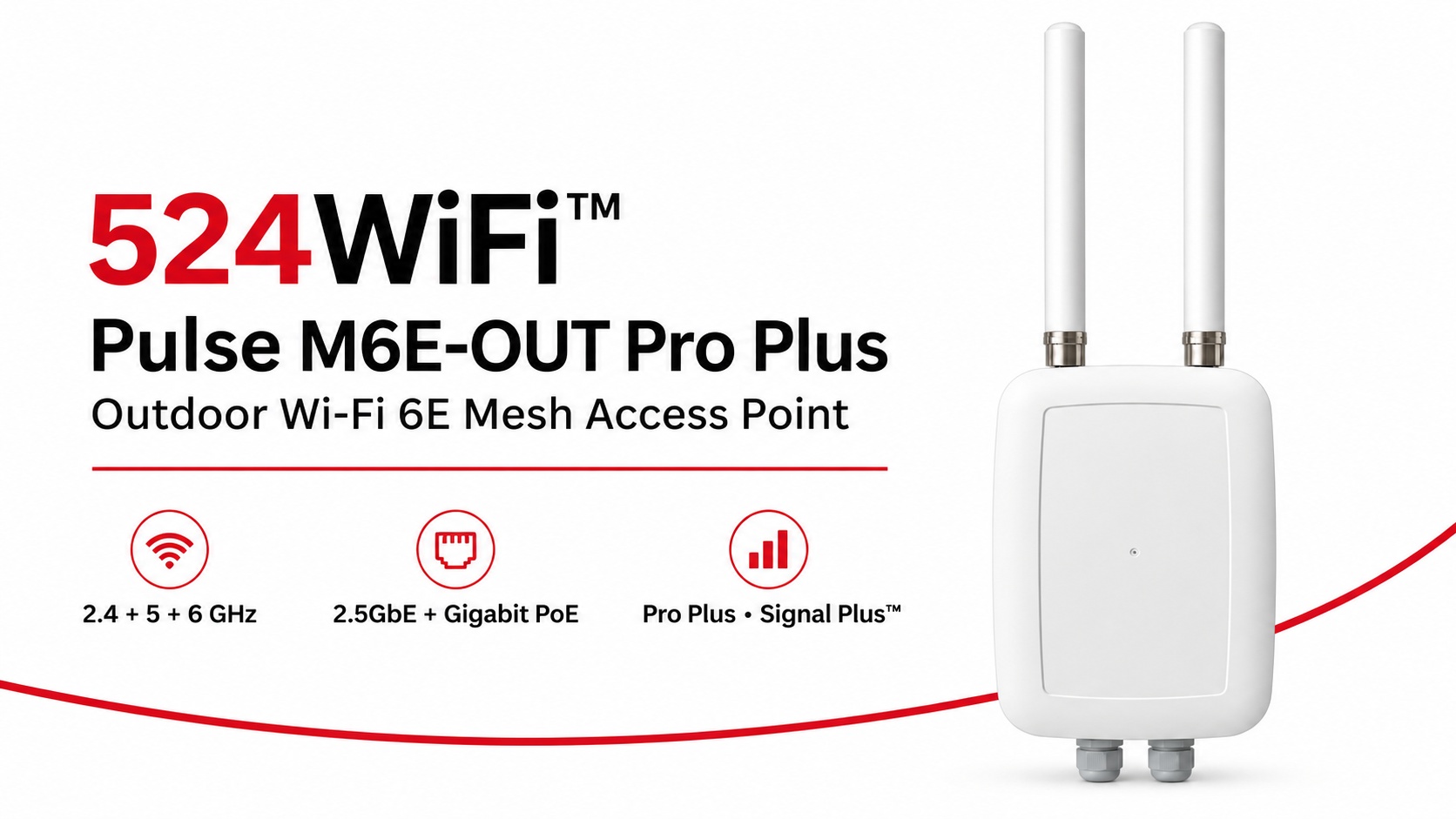
524WiFi™ Pulse M6E-OUT Pro Plus: Outdoor Wi-Fi 6E Mesh

524WiFi™ Pulse M6E-OUT Pro Plus outdoor Wi-Fi 6E mesh access point

524WiFi™ Pulse M6E-OUT Pro Plus brings the radio platform, outdoor enclosure and model-specific antenna assembly together for a professionally planned Wi-Fi 6E mesh installation. Start with a complete fixed network node and build coverage and inter-node links around the working area.

Three radio bands for the complete site network

Independent 2.4, 5 and 6 GHz radios give the installation three concurrent 2×2 radio paths. The Qualcomm IPQ5018 platform combines a dual-core ARM Cortex-A53 processor at 1.0 GHz with 512 MB DDR3L. A 2.5GbE interface supports the wired uplink, while a Gigabit Ethernet interface with PoE provides practical network and power integration.

The published theoretical PHY rates are up to 573 Mb/s at 2.4 GHz and 2,402 Mb/s each at 5 and 6 GHz. Channel widths reach 40 MHz at 2.4 GHz and 160 MHz on the two higher bands. Choose channels and radio roles around client traffic, the mesh topology and the operating country.

An antenna assembly matched to the outdoor node

The assembly combines two external 5 GHz omnidirectional antennas, two internal 2.4 GHz omnidirectional antennas and an internal directional 6 GHz panel serving the two 6 GHz RF paths. Aim the panel toward the intended link and keep its enclosure face clear of metalwork. This lets the installation use directional interconnection and local coverage deliberately.

Pro Plus and Signal Plus™ for deployment

Pro Plus combines our tuned product configuration, model-specific firmware selection and integration support. Signal Plus™ brings antenna placement, polarization, feed losses, radio roles and channel planning into the same RF system. Commission the complete node under the traffic and RF conditions of the actual site.

Fixed mesh nodes and moving clients

Use the M6E-OUT as a fixed outdoor infrastructure node. Pair it with Pulse M6E-IN for indoor infrastructure and Pulse R6-D2-IN or R6-T3-IN roaming clients on moving Ethernet-equipped machinery. Plan compatible firmware, authentication and RF overlap across the route. Mesh interconnection and moving-client roaming serve complementary roles in the complete network.

Explore the 524WiFi™ Pulse M6E-OUT Pro Plus specification and order configuration, or compare the Pulse product family.

Platform reference: DRWave-1000 / DR5018S.

Posted on

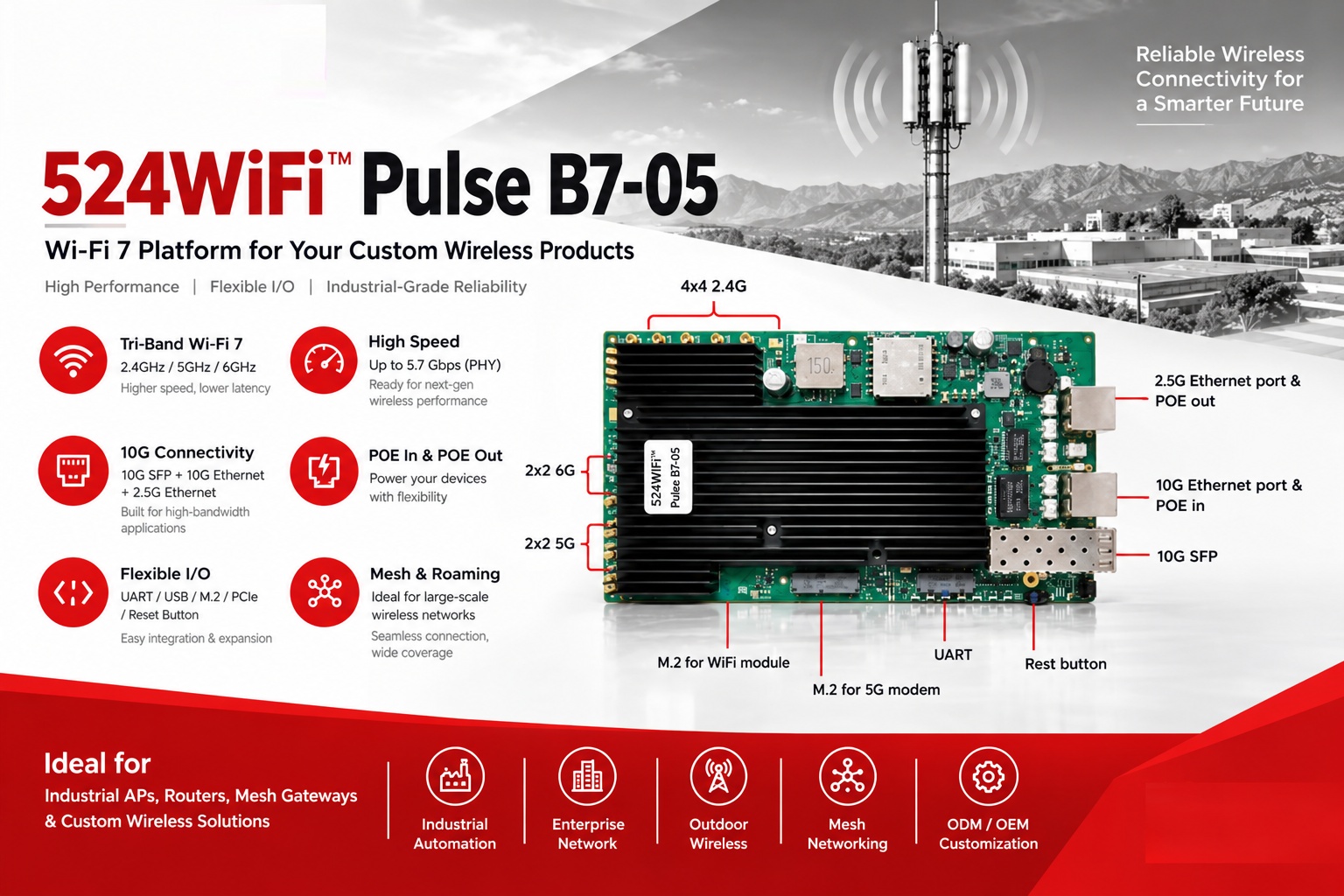
524WiFi™ Pulse B7-05: Wi-Fi 7 Platform for Custom Wireless Products

524WiFi™ Pulse B7-05 Wi-Fi 7 platform and hardware interfaces

524WiFi™ Pulse B7-05 is our tri-band (2.4/5/6GHz) Wi-Fi 7 platform for OEM/ODM projects, with 10G Ethernet, 10G SFP, and PoE in/out options on board.

It’s a good fit for:
→ Industrial APs
→ Enterprise routers
→ Mesh gateways
→ Outdoor wireless devices

We can help with hardware customization and software development, so you don’t have to build everything from scratch.

Have a project in mind? Let’s talk about whether 524WiFi™ Pulse B7-05 is the right fit – info at 524wifi.net or .com

Platform reference: DR5424S.

Posted on

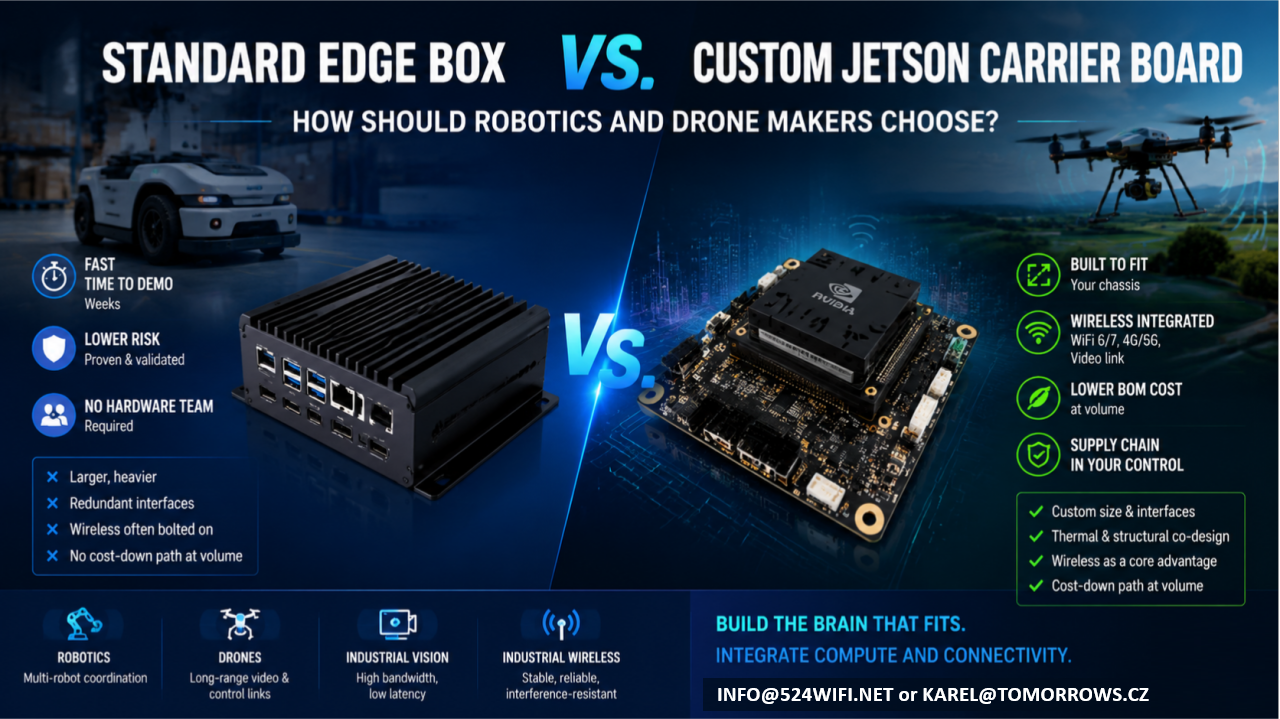
Standard Edge Computing Box vs. Custom Jetson Carrier Board: How Should Robotics and Drone Makers Choose?

If your team has already built the robot chassis or drone airframe, and what’s missing is the “brain” — an edge compute module that can run vision, navigation, and decision-making — you’re almost certainly weighing two paths:

Option A: Buy a standard edge computing box and bolt it onto your platform Option B: Design a custom carrier board around a Jetson module and integrate it directly into your product

Neither path is universally right. Each fits a different stage, scale, and product positioning. This article lays out the trade-offs so you can make the call with your eyes open.

The short version: it’s a trade between speed and long-term cost

  • A standard box trades a proven industrial design for development speed — at the cost of long-term compromises in cost, size, and reliability.
  • A custom carrier board trades a heavier upfront engineering investment for lasting product competitiveness.

Which one makes sense depends on where you are right now.

Option A: Standard Edge Box — Fast, but with a Low Ceiling

Off-the-shelf Jetson boxes — whether NVIDIA’s own dev-kit enclosures or third-party integrated industrial PCs — have one clear strength: speed.

Advantages

  • Fast time to demo: plug in power and network, and you’re running within weeks
  • Lower risk: standard products are already validated, so you’re not carrying hardware design risk
  • No hardware team required: your software team can get the system running without a dedicated hardware engineer

But the trade-offs are real

  1. Size and weight are the biggest problem. Standard boxes are built for broad compatibility and generic thermal margins, so they’re almost always bigger and heavier than what you actually need. For a drone, where every gram matters, that extra weight eats directly into flight time and payload. For a robot chassis that’s already been finalized, bolting on an external box often means re-tooling the enclosure and adding brackets — which breaks the industrial design you already locked in.
  2. Redundant interfaces you’re paying for. To serve “everyone,” standard boxes ship with a pile of ports you’ll never use — extra USB, HDMI, multiple Ethernet jacks. Each of those is both a cost line and a reliability liability: exposed connectors don’t hold up well against vibration and dust in industrial environments.
  3. Wireless connectivity is the most overlooked weak point of the bolt-on approach. Robots and drones need stable video links, control links, and multi-unit networking. The radios in standard boxes are usually consumer-grade, and they tend to drop connections and show latency jitter under the concurrent-device, high-interference conditions common in warehouses, farms, and industrial sites. That usually forces you to bolt on a second box — an industrial-grade wireless module — on top of the first. Now you’ve got a box on a box, with size, cabling, and power delivery spiraling out of control.
  4. No cost-down path at volume. Standard boxes are purchased per unit at a fixed price; the bigger your production run, the worse the economics get. And your supply chain sits entirely with someone else — you have no leverage if they raise prices or discontinue the part.

Who this fits: teams still in validation, prototypes or small batches (a few dozen units or fewer), teams that haven’t locked their final product form yet, or teams that just want to get the algorithm running before dealing with hardware.

Option B: Custom Jetson Carrier Board — Slower, but Built for Volume

A custom carrier board means keeping only the Jetson module itself and designing a new PCB around your actual product requirements — size, interfaces, power, wireless, thermal — so the compute unit is truly built into your chassis, not bolted on top of it.

Advantages

  1. The footprint follows your chassis, not the other way around. A carrier board can be shaped to fit into an arm, a body cavity, a drone gimbal bay — anywhere a standard box simply can’t go.
  2. Only the interfaces you actually need, with wireless (WiFi 6/7, 4G/5G, video links) integrated directly onto the same board instead of bolted on as a second module. One less board-to-board connection means one less failure point, plus far less cabling and structural volume to manage.
  3. Thermal and structural design can be co-engineered. The board can be designed to work with your chassis’s own thermal paths and metal structure, instead of carrying its own standalone fan or heatsink like a boxed unit does — critical for drones and sealed robot enclosures.
  4. Meaningfully lower BOM cost at volume, and your design assets and supply chain stay in your own hands, rather than being exposed to a single vendor’s pricing or discontinuation decisions.
  5. This is where wireless communication genuinely becomes part of your product’s competitive edge. Most customers who come to us asking for “a Jetson carrier board” eventually realize the real bottleneck is the wireless link — roaming latency during multi-robot coordination, interference resistance for video transmission, stability of long-range control links. Board-level integration lets you co-optimize the WiFi 6/7 RF front end, antenna placement, and EMC design together with the compute board in a single pass — something a box-plus-bolt-on-module combination can never achieve.

Trade-offs

  • Requires a proper design, prototyping, and validation cycle upfront (typically weeks to a few months, depending on complexity)
  • Requires a partner who understands both Jetson hardware design and RF engineering — teams with both skill sets aren’t common
  • At very small batch sizes (single digits to a few dozen units), the amortized development cost may not pencil out

Who this fits: teams whose product form is already locked and heading toward volume production (typically 100+ units), teams with hard requirements on size/weight/battery life, or teams for whom wireless performance — multi-robot coordination, long-range video, industrial-grade networking — is itself a core product differentiator.

Quick Decision Table

Dimension Standard Edge Box Custom Jetson Carrier Board Development timeline Weeks Weeks to months Upfront investment Low Medium-high (one-time) Per-unit cost at volume Fixed, no cost-down path Decreases with volume Size / weight Constrained by standard enclosure Fully customizable Wireless integration Usually bolted on, extra link in the chain Can be co-designed with the compute board Supply chain control Dependent on a single vendor Design assets owned in-house Best fit stage Validation / small batch Volume production / finalized product

What We Can Do for You

This is exactly what we do at 524WiFi and Wallys: custom carrier board design around Jetson modules, combined with our own track record in industrial-grade WiFi 6/7 and long-range wireless transmission — so compute and connectivity end up on a single board, instead of customers having to stitch together a “Jetson box + industrial wireless module” combo themselves.

If your team:

  • Already has a robot or drone product form and is weighing edge-compute options
  • Has validated a demo on a standard box and is now thinking about cost-down and miniaturization for volume production
  • Needs multi-robot coordination, long-range video transmission, or interference-resistant networking — not just raw compute

Reach out and let’s talk through your specific use case: info at 524wifi.net

We’re happy to start with a free assessment of your current setup to help you decide whether it’s time to keep iterating on a bolt-on box, or move straight to a fully integrated custom design.

Posted on

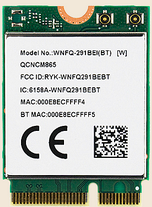
Sparklan WNFQ-291BEI BT

The Sparklan WNFQ-291BEI(BT) is everything a Wi-Fi enthusiast could ask for in a M.2 2230 key E format. Based on the Qualcomm Fastconnect 7800 platform, it comes with support for all the latest Wi-Fi 7 features, Bluetooth, a true industrial package and a highly capable Soft AP mode. If you’re looking for a solution that has it all – this is it.

WNFQ-291BEI

802.11be/ax/ac/a/b/g/n  Industrial Capable Tri-band WiFi Combo, M.2 2230 (E KEY) Module (WiFi 7), Qualcomm, 2T2R

Chipset: Qualcomm WCN7851 , Samples available for orders now.

  • Antenna: 2 x IPEX MHF4 connectors, 2T2R
  • Interface: PCIe: WLAN / USB
  • Supports Dual-Band Dual Concurrent Design
  • Support: Win11/Linux (Open Source) (TBD)

Categories: E Key, M.2Tags: 11be, 2T2R, Industrial Grade, Wifi 7

WNFQ-291BEI, first Qualcomm based WiFi-7 (802.11be) module in M.2 2230 E key formfactor, running PCIe (Wifi) and USB, supports DBDC (Dual-band, Dual-concurrent) mode, but with Tri-band capability (2.4GHz, 5GHz, and 6GHz). WNFQ-291BEI is able to concurrently run 2.4GHz with 5GHz, or 6GHz, and support full IEEE802.11 be/ax/ac/a/b/g/n protocol, up to 320MHz mode.

WNFQ-291BEI designed with 2 spatial streams (2T2R, or 2×2) in MU-MIMO mode. With a standard M.2 E key 2230 formfactor, WNFQ-291BEI can accommodate to all existing platform that has M.2 Adaptor pre-integrated, no extra work with platform design.

Software wise WNFQ-291BEI support Windows, with Linux (Open Source) in the near future. The module is capable to run on both x86 platform and ARM based platform, and supports STA mode and Soft AP Mode*, recommend to run on application includes: digital signage/POS, rugged computer / tablets, fanless automation PC and other industrial environment applications that requires high speed data transmission.

Applications include IPC/ Advertising machine/ OTT/ IPTV/ DVB/ STB / DV/ Mini Driving Recorder/ Intelligent Projector Pico/ VR/ AR terminal/ POS machine/ Vehicle mounted front/ Rear Terminal UAV/ Robot/ Intelligent Gateway/ Smart city and other electronic products.

ROHSReach
STANDARD
WI-FIIEEE 802.11be/ax/ac/a/b/g/n
ChipsetQualcomm WCN7851
Host InterfaceWLAN : PCIe / USB
RADIO
Antenna2 x IPEX MHF4 connectors
Operating Frequency802.11be/ax/ac/a/b/g/n ISM Band
2.400GHz~2.4835GHz5.150GHz~5.850GHz5.925GHz~7.125GHz*Subject to local regulations
MODULATIONS
802.11bDSSS (DBPSK, DQPSK, CCK)
802.11gOFDM (BPSK, QPSK, 16-QAM, 64-QAM)
802.11nOFDM (BPSK, QPSK, 16-QAM, 64-QAM)
802.11aOFDM (BPSK, QPSK, 16-QAM, 64-QAM)
802.11acOFDM (BPSK, QPSK, 16-QAM, 64-QAM, 256-QAM)
802.11axOFDMA (BPSK, QPSK, 16-QAM, 64-QAM, 256-QAM, 1024-QAM, 4096-QAM)
802.11beOFDMA (BPSK, QPSK, 16-QAM, 64-QAM, 256-QAM, 1024-QAM, 4096-QAM)
POWER & SENSITIVITY
WiFiPower – TX (± 2dBm)Sensitivity – RX
11b @ 11Mbps18 dBm≤ -91 dBm (TBD)
11g @ 54Mbps16 dBm≤ -77.5 dBm (TBD)
11gn HT20 @ MCS 716 dBm≤ -76.5 dBm (TBD)
11gn HT40 @ MCS 716 dBm≤ -74 dBm (TBD)
11a @ 54Mbps13 dBm≤ -76.5 dBm (TBD)
11an HT20 @ MCS 711.5 dBm≤ -76 dBm (TBD)
11an HT40 @ MCS 711 dBm≤ -73.5 dBm (TBD)
11ac VHT80 @ MCS 99.5 dBm≤ -64 dBm (TBD)
11ac VHT160 @ MCS 99.5 dBm≤ -62 dBm (TBD)
11ax 2.4GHz
11ax HE40 @ MCS 1112.5 dBm≤ -62 dBm (TBD)
11ax 5GHz
11ax HE20 @ MCS 119 dBm≤ -64 dBm (TBD)
11ax HE40 @ MCS 119 dBm≤ -61.5 dBm (TBD)
11ax HE80 @ MCS 119 dBm≤ -58.5 dBm (TBD)
11ax HE160 @ MCS 119 dBm≤ -55.5 dBm (TBD)
11ax 6GHz
11ax HE20 @ MCS 119 dBm≤ -63 dBm (TBD)
11ax HE40 @ MCS 119 dBm≤ -60.5 dBm (TBD)
11ax HE80 @ MCS 119 dBm≤ -57.5 dBm (TBD)
11ax HE160 @ MCS 119 dBm≤ -54.5 dBm (TBD)
11be 2.4GHz
11be EHT40 @ MCS 1311.5 dBm≤ -62 dBm (TBD)
11be 5GHz
11be EHT20 @ MCS 138.5 dBm≤ -64 dBm (TBD)
11be EHT40 @ MCS 138.5 dBm≤ -61.5 dBm (TBD)
11be EHT80 @ MCS 138.5 dBm≤ -58.5 dBm (TBD)
11be EHT160 @ MCS 138.5 dBm≤ -55.5 dBm (TBD)
11be 6GHz
11be EHT20 @ MCS 138.5 dBm≤ -63 dBm (TBD)
11be EHT40 @ MCS 138.5 dBm≤ -60.5 dBm (TBD)
11be EHT80 @ MCS 138.5 dBm≤ -57.5 dBm (TBD)
11ax EHT160 @ MCS 138.5 dBm≤ -54.5 dBm (TBD)
11be EHT320 @ MCS 137.5 dBm≤ -54.5 dBm (TBD)
POWER CONSUMPTION(TBD)
Continue TXTBD mA (MAX)
Continue RXTBD mA (MAX)
ENVIRONMENTAL
Operating VoltageDC 3.3V
Temperature Range-40~ +85°C (Operating) (TBD)-45 ~ 90°C (Storing) (TBD)
Humidity (Non-Condensing)5 ~ 90% (Operating)5 ~ 90% (Storing)
SIZE
Dimension (MM)30mm (±0.15mm) x 22mm (±0.15mm) x  mm (±0.3mm) (TBD)
Weight3.2g (TBD)
SOFTWARE
Driver (MM)Win 11/ Linux (Open Source) (TBD)
SecurityWPS2.0, WAPI, WPA, WPA2, WPA3
Miscellaneous
Warranty12 Month
HS Code8517620050
Posted on

SparkLAN Client Wi-Fi Modules

Premium Wi-Fi Modules in various form factors. SparkLAN delivers premium industrial Wi-Fi solutions in connectorized and LGA form factors with a focus on maintaining high quality and functionality. Whether you’re looking for an M.2, mPCIe, or solder down solution, cutting-edge Wi-Fi 7, or a reliable USB dongle, SparkLAN has got you covered. Plese contact us to test samples !

Explore : SPARKLAN PREMIUM WI-FI modules

Posted on

How Wi-Fi 7 Improves Industrial Connectivity: Low Latency, High Reliability

In the era of Industry 4.0, industries are increasingly relying on wireless networks to power automation, robotics, and intelligent systems. However, traditional Wi-Fi technologies often face challenges such as latency, interference, and limited bandwidth. Enter Wi-Fi 7 (IEEE 802.11be) — the next-generation wireless standard designed to deliver ultra-low latency, high reliability, and multi-gigabit speeds.

This breakthrough is reshaping industrial communication, making wireless connections as dependable as wired networks.


1. Low Latency for Real-Time Control

In industrial environments, even milliseconds matter. Robotic arms, sensors, and AGVs (Automated Guided Vehicles) require instant communication to maintain synchronization and avoid costly downtime.

Wi-Fi 7 introduces Multi-Link Operation (MLO) — a technology that allows simultaneous data transmission across multiple frequency bands (2.4 GHz, 5 GHz, and 6 GHz). This parallel data flow reduces latency to under 1 ms, ensuring real-time responsiveness for critical industrial applications.


2. High Throughput for Data-Intensive Applications

Factories today generate vast amounts of data — from machine vision cameras to AI-driven quality inspection systems. With 320 MHz channel bandwidth and 4096-QAM modulation, Wi-Fi 7 can reach speeds up to 46 Gbps, far beyond Wi-Fi 6.

This makes Wi-Fi 7 ideal for:

  • High-definition video streaming for monitoring and inspection
  • Edge computing systems that analyze data locally
  • AI and machine learning applications in manufacturing

3. Enhanced Reliability in Harsh Environments

Industrial facilities are notorious for electromagnetic interference, metal surfaces, and dense wireless traffic. Wi-Fi 7 tackles these challenges with Enhanced Puncturing and MLO redundancy, which allow stable connections even when certain channels face interference.

This ensures consistent, uninterrupted communication, vital for automated production lines, smart logistics, and industrial IoT (IIoT) devices.


4. Deterministic Networking for Industrial Automation

Wi-Fi 7 supports Time-Sensitive Networking (TSN), a key requirement for mission-critical industrial operations. TSN provides predictable latency and synchronized data transfer, ensuring that commands and responses are delivered exactly when needed.

This bridges the gap between traditional wired Ethernet and wireless networks — a game-changer for Industry 4.0.


5. Smooth Transition with Backward Compatibility

Adopting new technology doesn’t have to mean starting from scratch. Wi-Fi 7 devices are backward compatible with Wi-Fi 6/6E and Wi-Fi 5, enabling companies to upgrade their infrastructure gradually while maintaining interoperability with existing devices.


Conclusion

Wi-Fi 7 sets a new benchmark for industrial connectivity — blending ultra-low latency, high reliability, and extreme throughput. From smart factories and autonomous warehouses to AI-driven inspection systems, it enables a new level of efficiency and innovation in the industrial world.

Our latest Wi-Fi 7 boards, including the DR9574 (based on Qualcomm IPQ9574) and DR5332 (IPQ5332), are built for industrial environments that demand speed, reliability, and flexibility.

Posted on

The Impact of Quantum Computers on Traditional Encryption: Why Wi-Fi Technology Needs PQC Encryption

With the rapid advancement of quantum computing, traditional encryption standards are facing significant challenges. Quantum computers possess immense computational power, enabling them to break conventional encryption techniques in a fraction of the time. This poses a serious risk to many areas dependent on data security, including Wi-Fi communications. To protect future data transmissions, Wi-Fi technology urgently requires the implementation of Post-Quantum Cryptography (PQC) to address this emerging threat.

How Quantum Computing Threatens Existing Encryption Standards

  1. Weaknesses of Current Encryption Methods
    Currently, Wi-Fi encryption standards such as WPA2 and WPA3 rely on encryption algorithms like AES and RSA to secure data transmissions. These algorithms are based on the complexity of certain mathematical problems that traditional computers struggle to solve. However, quantum computers can leverage quantum bits’ parallel processing capabilities to crack these encryption methods swiftly. In particular, Shor’s algorithm can break RSA and ECC (Elliptic Curve Cryptography) methods, which rely on integer factorization and discrete logarithms, respectively. This exposes a critical vulnerability in today’s encryption protocols.
  2. Long-Term Risks to Data Security
    While quantum computers are not yet fully developed, the rapid progress of quantum technology means that, in the future, quantum computers could be powerful enough to crack the encrypted data we rely on today. Once this threshold is crossed, sensitive information transmitted over Wi-Fi networks—such as financial transactions and personal data—could be compromised. This is an urgent concern for both enterprises and individual users, particularly as Wi-Fi networks are used to transmit more sensitive and personal data.

PQC Encryption: Providing Quantum Resistance for Wi-Fi Technology

To address the threat of quantum computing, Post-Quantum Cryptography (PQC) has emerged as a new encryption solution. PQC algorithms are based on mathematical problems that remain secure even in the presence of quantum computing, such as lattice-based cryptography and multivariate equations. These new algorithms not only defend against quantum attacks but also provide additional security in today’s non-quantum computing environment.

  1. Enhanced Security for Wi-Fi Communications
    PQC can strengthen existing Wi-Fi encryption protocols (such as WPA3), ensuring that even if quantum attacks become a reality, data transmissions remain secure. This means that Wi-Fi users will continue to have secure and reliable network connections even in the quantum era.
  2. Protecting IoT Device Communications
    As more IoT devices connect to Wi-Fi networks, the need for robust security measures grows. PQC encryption can safeguard these devices’ communications from being compromised by attackers utilizing quantum computing capabilities, thereby ensuring the security of the entire IoT ecosystem.
  3. Mitigating Future Data Decryption Risks
    It’s essential to consider not only current threats but also future risks posed by quantum computing. PQC can protect encrypted data transmitted today, ensuring that even when quantum computers are fully operational, the data remains secure. This is crucial for industries that require long-term data storage, such as healthcare and finance.

Conclusion: The Future of Wi-Fi and PQC Encryption

As quantum computing technology evolves, Wi-Fi technology will face new challenges. Traditional encryption methods will no longer suffice, and the adoption of Post-Quantum Cryptography (PQC) will be essential to secure future data transmissions. At 524WiFi, we are committed to integrating PQC encryption into our Wi-Fi 7 solutions, ensuring robust security for future-proof data transmission and keeping your network safe from the quantum threat.

Posted on

How AP Controllers Simplify Industrial Wireless Network Management

In industrial environments, managing a wireless network is no small feat. The complex layout, high device density, and diverse use cases make ensuring seamless connectivity a challenging task. Fortunately, AP (Access Point) Controllers offer a centralized solution to manage, optimize, and secure industrial wireless networks efficiently.


The Complexity of Industrial Wireless Network Management

Industrial wireless networks must contend with a host of challenges, including:

  • High Device Density: Hundreds or even thousands of devices may need to connect simultaneously.
  • Dynamic Environments: Equipment relocation and layout changes require adaptive network configurations.
  • Security Risks: Critical operations demand robust security to prevent unauthorized access.

Manual management of individual APs becomes impractical in such scenarios. This is where AP controllers come in, providing a centralized and intelligent approach to network management.


Core Features of AP Controllers

AP controllers revolutionize network management with the following key functionalities:

1. Centralized Management

AP controllers enable administrators to manage multiple APs from a single interface.

  • Configure SSIDs, encryption settings, and channels simultaneously.
  • Simplify large-scale network deployments and reduce manual effort.

2. Wireless Optimization

Enhancing performance and reliability is a priority in industrial networks. AP controllers achieve this through:

  • Automatic Channel Selection: Reduces interference by dynamically assigning optimal channels.
  • Power Adjustment: Optimizes coverage by adjusting transmission power based on environmental conditions.
  • Load Balancing: Distributes devices evenly across APs to prevent overloads.(concept feature)

3. Enhanced Security Management

Industrial operations require stringent security protocols. AP controllers deliver:

  • Access Control: Employ whitelists, blacklists, or MAC-based ACLs to restrict access.
  • VLAN Isolation: Separate production, monitoring, and management traffic to ensure data integrity.
  • Wireless Firewalls: Detect and block unauthorized attempts to access the network.

Applications of AP Controllers

The versatility of AP controllers makes them essential in various industrial scenarios:

Factory Floors and Production Lines

  • Support seamless connectivity for IoT devices, sensors, and automated machinery.
  • Ensure low-latency communication for real-time monitoring and control.

Smart Cities and Public WiFi

  • Manage high-density user connections in public areas.
  • Optimize performance for diverse applications like public safety and urban planning.

Video Surveillance and Security Systems

  • Enable stable connections for high-resolution cameras.
  • Facilitate quick data transmission for immediate threat detection and response.

Why Wallystech’s AP Controllers Stand Out

Wallystech offers industry-leading AP controllers that excel in performance and adaptability:

1. Powered by IPQ6010

Our AP controllers leverage the Qualcomm IPQ6010 platform, providing robust performance and scalability for demanding industrial applications.

2. Simplified Expansion

With plug-and-play capabilities, new APs can be quickly integrated into the existing network. This reduces the time and cost associated with network upgrades.

3. Proactive Monitoring and Fault Management

Real-time monitoring detects and addresses AP issues promptly. Automatic fault recovery ensures network resilience in case of failures.

Posted on

524 WiFi 6 DR6018 for 5G Signal Tower and Controller Communication: Comparing Wired, Wireless, and Wi-Fi Solutions

dr6018

As 5G networks expand rapidly, effective communication between signal towers and controllers is essential for optimal network performance. This article examines the characteristics, challenges, costs, advantages, and market prospects of wired, wireless, and Wi-Fi transmission solutions.

Wired Transmission: Fiber Optic Connections

Fiber optic connections are the most widely used wired transmission solution, enabling high-speed and stable data transfer between 5G signal towers and controllers or core networks.

Advantages include:

  • High Bandwidth: Fiber optics provide exceptional bandwidth, accommodating the large data volumes required by 5G networks.
  • Low Latency: With minimal delay, fiber optics are ideal for applications needing real-time data transfer, such as telemedicine and autonomous driving.
  • Stability and Reliability: Fiber optics are highly stable and immune to electromagnetic interference, ensuring consistent performance across various environments.

Challenges include:

  • High Cost: The initial investment for fiber optics is substantial, covering materials, labor, and maintenance. Deployment can be particularly challenging in areas with complex geography or dense urban infrastructure.
  • Deployment Time: Installing fiber networks involves considerable construction work, which can extend the deployment timeline.

In the market, fiber optic transmission is a mature sector, widely adopted globally, especially in urban and densely populated areas. As 5G networks continue to grow, the demand for fiber optics is expected to rise, though high costs may limit its adoption in some regions.

Wireless Transmission: Microwave, Millimeter Wave, and Satellite

Wireless transmission solutions, including microwave and millimeter wave technologies, are commonly used, with satellite connections serving as a solution for extreme geographical conditions or where other methods are impractical.

Advantages include:

  • Deployment Flexibility: Wireless solutions do not require cable installation, allowing for quick deployment in challenging or remote areas.
  • Lower Initial Costs: Compared to fiber optics, wireless solutions have a lower initial deployment cost and are more adaptable to temporary or rapidly changing network needs.

Challenges include:

  • Bandwidth Limitations: Wireless transmission generally provides lower bandwidth compared to fiber optics, which might not meet the demands of high-performance 5G applications.
  • Environmental Impact: Wireless signals can be affected by environmental factors such as weather, terrain, and buildings, impacting stability and reliability.
  • Higher Latency and Interference: Wireless solutions can experience higher latency and are more susceptible to interference from other devices, especially in densely populated areas.

Wireless transmission solutions are seeing rapid growth in the market, particularly where fiber optic deployment is costly or time-sensitive. In remote and rural areas, the market potential for wireless solutions is significant, though long-term stability and performance issues need to be addressed.

Wi-Fi Transmission: Industrial-Grade Wi-Fi

Wi-Fi transmission solutions, especially those using industrial-grade equipment, are emerging as viable alternatives or complements to wired and traditional wireless methods. Advanced Wi-Fi 6 and Wi-Fi 7 technologies can efficiently handle high-performance data transfers over short distances, making them suitable for specific industrial applications.

Advantages:

  • Cost-Effectiveness: Wi-Fi solutions are generally more affordable and easier to install than fiber optics or microwave links.
  • Rapid Deployment: Wi-Fi networks can be quickly established and expanded, making them ideal for temporary or dynamic network requirements.
  • High Bandwidth and Low Latency: Wi-Fi 6 and Wi-Fi 7 offer enhanced bandwidth and reduced latency, suitable for industrial automation, smart cities, and other high-performance applications.

Challenges:

  • Limited Coverage Range: Wi-Fi is best suited for shorter distances and may not cover large areas as effectively as fiber optics.
  • Interference Issues: Wi-Fi signals can suffer from interference in high-density environments, impacting network stability and reliability.
  • High Security Requirements: For industrial applications, strong security measures are essential to protect data from breaches or attacks.

Solution Comparison and Market Trends

In terms of cost, fiber optic connections involve a high initial investment but offer lower long-term operational costs, making them suitable for high-capacity, high-reliability scenarios. Wireless solutions, with lower initial costs, may incur additional expenses over time due to equipment and frequency needs. Wi-Fi solutions provide notable advantages in initial cost and deployment speed but are limited by range and potential interference.

Application Scenarios:

  • Fiber optics are optimal for urban areas or situations requiring high bandwidth and low latency.
  • Wireless solutions are better for remote areas or scenarios requiring rapid deployment.
  • Wi-Fi is ideal for specific industrial applications or short-distance high-bandwidth needs.

Looking ahead, a hybrid approach combining fiber optics, wireless, and Wi-Fi might become prevalent, balancing cost, flexibility, and performance. As technology advances, the capacity and reliability of wireless and Wi-Fi solutions are expected to improve, broadening their market potential.

524 WiFi 6 DR6018 Solution: Shijiazhuang 5G Base Station and Controller Wireless Transmission Application

The DR6018 has proven effective in delivering stable wireless transmission between 5G base stations and controllers. For practical applications and more details about our DR6018-outdoor solution, visit our DR6018-Outdoor Solution page.

DR6018-Outdoor mounted outdoor
Topology of the WiFi Transmission
5G Base Station