
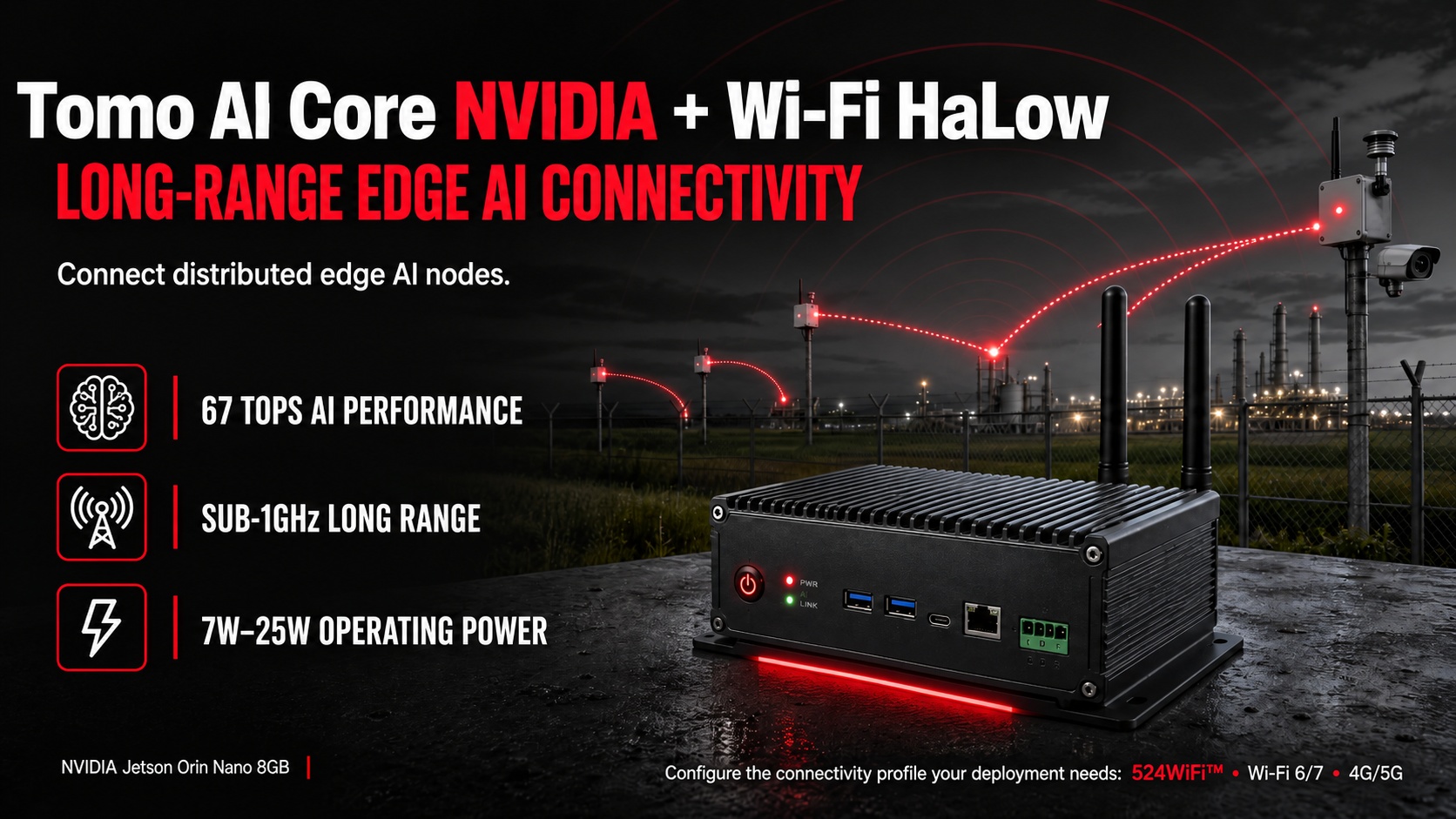
Edge AI devices are only as useful as the network they run on. A vision model that can detect a defect or a person in real time is worthless if the data can’t get back to the control system — especially in outdoor, long-range, or power-constrained deployments where traditional 2.4GHz/5GHz Wi-Fi simply doesn’t reach. That’s the gap Wi-Fi HaLow (IEEE 802.11ah) is built to close, and it’s now available as a connectivity option for the 524WiFi™ Tomo AI Core NVIDIA, our NVIDIA Jetson Orin Nano-based edge AI platform.
What Is Wi-Fi HaLow and Why Does Edge AI Need It?
Wi-Fi HaLow operates in the sub-1GHz spectrum (900MHz ISM band in most regions) instead of the 2.4GHz/5GHz bands used by conventional Wi-Fi. Lower frequency signals travel farther and penetrate walls, foliage, and structural obstacles far more effectively — which is exactly why HaLow is positioned by the Wi-Fi Alliance for long-range, low-power IoT and sensor connectivity rather than high-bandwidth video streaming.
For edge AI deployments, this matters in a specific way: many Jetson-based inference nodes don’t need gigabit throughput — they need to reliably send detection results, telemetry, or compressed metadata back to a gateway from hundreds of meters away, often on battery or solar power. That’s a connectivity profile standard Wi-Fi and even LTE/5G aren’t always the right fit for, either on range, power draw, or cost.
How Wi-Fi HaLow Connects with the Tomo AI Core NVIDIA
The Tomo AI Core NVIDIA pairs an NVIDIA Jetson Orin Nano 8GB SOM (67 TOPS AI performance, 1024-core Ampere GPU, 6-core Arm Cortex-A78AE CPU) with a industrial carrier board built for industrial edge deployment — 5x Ethernet (including PoE), CAN FD, RS485, GPIO, and M.2 PCIe NVMe expansion.
Wi-Fi HaLow is integrated as a module option on that same carrier board, alongside the existing 2.4G/5.8G Wi-Fi and optional 4G/5G cellular paths. In practice this means a single AI Box can be configured for the connectivity profile the deployment actually needs: short-range high-bandwidth Wi-Fi for a warehouse, cellular for a mobile asset, or HaLow for a long-range, low-power sensor or camera node spread across an outdoor site.
Wi-Fi HaLow vs. Traditional Wi-Fi for Long-Range Edge AI
The two technologies solve different problems rather than competing head-to-head.
Range: traditional 2.4/5GHz Wi-Fi typically covers tens of meters indoors; Wi-Fi HaLow’s 900MHz band extends to hundreds of meters, up to roughly 1km line-of-sight.
Obstacle penetration: traditional Wi-Fi signal degrades quickly through walls and foliage; HaLow’s lower frequency travels through obstacles more effectively.
Power consumption: traditional Wi-Fi draws more power, which is fine for mains-powered devices; HaLow’s lower power draw suits battery- or solar-powered nodes that need to run for months between service visits.
Throughput: traditional Wi-Fi 6/7 scales up to multi-Gbps for video and high-bandwidth workloads; HaLow trades throughput for range and efficiency, which is enough for sensor telemetry and detection metadata but not for streaming video.
Best fit: traditional Wi-Fi suits dense, high-bandwidth environments like a multi-camera inspection line; HaLow suits long-range, low-power, distributed nodes like an outdoor perimeter or a field spread across acres.
A multi-camera vision inspection line still needs Wi-Fi 6/7 for bandwidth; a perimeter sensor network spread across a farm or port doesn’t — which is why the Tomo AI Core NVIDIA supports both as configurable options rather than picking one.
Edge AI Applications Enabled by Wi-Fi HaLow
- Agriculture: Jetson-based cameras or sensor nodes spread across large fields, sending detection or telemetry data back to a central gateway without running cable or relying on cellular coverage.
- Perimeter and outdoor security: long-range camera nodes in ports, campuses, or industrial yards where mesh Wi-Fi backhaul isn’t practical.
- Logistics and asset tracking: distributed sensor nodes across a yard or warehouse exterior, where battery life matters more than throughput.
- Smart infrastructure: environmental or condition-monitoring sensors feeding low-power edge AI nodes over long distances.
524WiFi™ Tomo AI Core NVIDIA + Wi-Fi HaLow: Hardware Summary
- Compute: NVIDIA Jetson Orin Nano 8GB SOM (part of the Jetson Nano/Orin Nano product family), 67 TOPS AI performance, 1024-core Ampere GPU with 32 tensor cores, 6-core Arm Cortex-A78AE CPU, 8GB 128-bit LPDDR5
- Connectivity options: Wi-Fi HaLow (long-range, sub-1GHz), onboard 2.4G/5.8G Wi-Fi, optional 4G/5G (Nano SIM), 5x Ethernet (1x independent PoE 48V RJ45 + 4x shared RJ45)
- Interfaces: CAN FD, RS485, RS232, 4x USB 3.0, USB-OTG, 4x GPIO, HDMI 2.0, M.2 PCIe NVMe 2280
- Power: 7W–25W operating range
If you’re evaluating long-range or low-power connectivity for a Jetson-based edge AI deployment, we’re happy to talk through whether Wi-Fi HaLow, industrial Wi-Fi 6/7, or a hybrid configuration fits your use case. Reach us at info at 524wifi.net or .com
Plan your project with Tomo AI Automation
Bring your application, enclosure, interfaces, power requirements, software environment and expected quantity into one project brief. Tomorrow Systems® and 524WiFi™ can review the engineering scope with you.
Put your automation project into motion
Have a defined machine vision, edge AI or connected-device project? Specify the task, inputs, required outputs and acceptance criteria for a focused technical feasibility review.