Before a WiFi network is deployed, there’s one thing that must happen first: The client needs to understand what you’re actually building.
Whether you’re rolling out WiFi 6 or WiFi 7, no matter how advanced the technology, if your customer can’t clearly visualize how the system works — you may never even get to the pilot stage.
Sound familiar? Your technical team presents the specs, performance data, and reliability benchmarks… But when the client asks, “Can you show me how everything connects?” — you scramble to explain, show a basic diagram, or open a cluttered device list.
It’s not that your solution lacks value. It’s that the value isn’t visible.
🧩 What Clients Really Want to See
In complex network rollouts — especially those involving WiFi 6 and WiFi 7 — the client doesn’t just want performance. They want clarity, structure, and confidence.
They want to know:
Who controls what in the network?
How are the APs connected?
What devices are attached where?
What does scaling up look like?
And most importantly: Can you show them the answer in under 3 minutes?
✅ Turning Confusion into Confidence: 524WIFI Wallys AP Controller’s New Topology Tool
At 524WiFi and Wallys, we’ve worked with integrators across smart cities, industrial deployments, and telecom infrastructure. We noticed something: the better the demo, the faster the deal.
So we added a Topology Visualization Tool into our AP Controller — not just for device management, but for clear, visual storytelling.
Here’s what it lets you do:
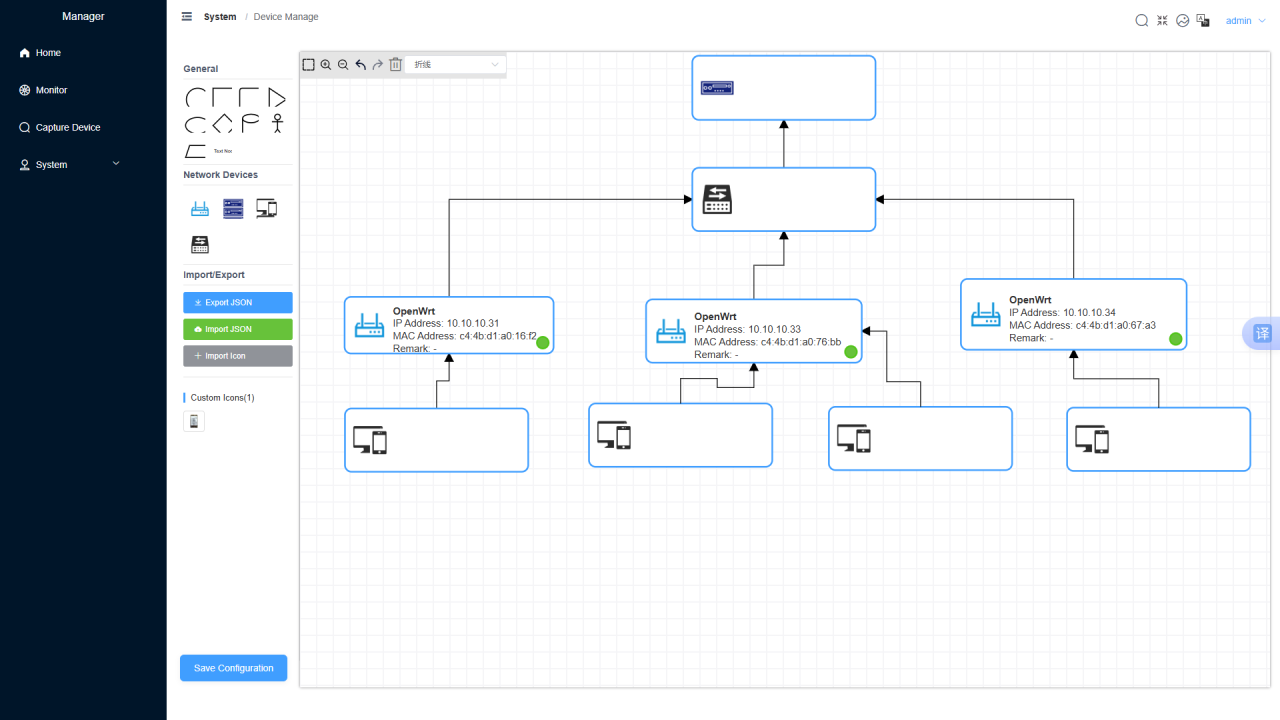
🔹 Auto-generate live topology diagrams – Including manager, switch, Wallys APs, and connected client devices
🎨 Upload your own product images – Replace generic icons with your branded hardware visuals
📤 One-click export/import of diagrams – Perfect for proposals, documentation, or internal team alignment
⚙️ Built for WiFi 6 / WiFi 7 networks – Works seamlessly with Wallys boards like IPQ4019,IPQ5018, IPQ5332, IPQ9574, and more
Wallys AP Controller
🧠 Why It Matters More Than You Think
In every meeting, there’s a make-or-break moment. A client will ask: “Can you show me what the network will look like?”
If you hesitate, explain vaguely, or need another meeting to follow up — trust starts slipping.
But if you open a visual, intuitive, branded diagram that shows how the network is built, what controls what, and how it scales — you’re not just delivering tech. You’re delivering confidence.
👋 Want Your Clients to Understand Your Network Instantly?
Whether you’re deploying a high-density venue network, smart industrial APs, or city-wide coverage, 524WiFi and Wallys help you move beyond specs — to real communication.
In the rapidly evolving world of wireless networking, the MT7915 stands out as a powerful and versatile solution for modern connectivity needs. Designed to deliver high performance, reliability, and flexibility, this WiFi 6 chip is ideal for a wide range of applications, from industrial IoT to enterprise networking. In this article, we’ll take a deep dive into the features and benefits of the MT7915, and explore why it’s a top choice for next-gen wireless solutions.
Key Features of the MT7915
1. WiFi 6 Technology
The MT7915 supports 802.11ax (WiFi 6), the latest wireless standard that offers significant improvements over previous generations. With features like OFDMA (Orthogonal Frequency Division Multiple Access) and MU-MIMO (Multi-User Multiple Input Multiple Output), it enables faster speeds, lower latency, and better performance in high-density environments.
2. Dual-Band Support
The MT7915 operates on both 2.4GHz and 5GHz bands, providing flexibility for various networking scenarios. Whether you need broader coverage or higher throughput, this chip delivers optimal performance.
3. High Throughput
With support for 2T2R (2 Transmit, 2 Receive) streams, the MT7915 offers impressive data rates, making it suitable for bandwidth-intensive applications like video streaming, online gaming, and industrial automation.
4. OpenWRT Compatibility
The MT7915 is compatible with OpenWRT, a popular open-source operating system for routers and networking devices. This allows for greater customization and flexibility, enabling developers to tailor the solution to their specific needs.
5. Mini PCIe and M.2 keay A+E or B+M Form Factor
The MT7915 comes in a Mini PCIe or m.2 module, making it easy to integrate into a wide range of devices, from routers and access points to industrial equipment and IoT devices.
6. Industrial-Grade Reliability
Designed for harsh environments, the MT7915 operates reliably in extreme temperatures and conditions, making it ideal for industrial applications.
Benefits of the MT7915
1. Enhanced Performance
The MT7915 delivers faster speeds and lower latency compared to previous-generation WiFi chips, ensuring a seamless user experience even in high-density environments.
2. Cost-Effective Solution
With its high performance and flexibility, the MT7915 offers excellent value for money, making it a cost-effective choice for businesses and developers.
3. Future-Proof Technology
By supporting WiFi 6, the MT7915 ensures that your network is ready for the future, with the ability to handle increasing data demands and new applications.
4. Easy Integration
The Mini PCIe form factor and OpenWRT compatibility make the MT7915 easy to integrate into existing systems, reducing development time and costs.
5. Versatility
From smart homes and offices to industrial IoT and smart cities, the MT7915 is suitable for a wide range of applications, providing reliable connectivity wherever it’s needed.
Applications of the MT7915
1. Industrial IoT
The MT7915’s industrial-grade reliability and high throughput make it ideal for industrial IoT applications, such as factory automation, remote monitoring, and smart logistics.
2. Enterprise Networking
With its support for WiFi 6 and high-density environments, the MT7915 is perfect for enterprise networks, providing fast and reliable connectivity for offices, campuses, and data centers.
3. Smart Homes
The MT7915’s dual-band support and high performance make it a great choice for smart home devices, ensuring seamless connectivity for streaming, gaming, and smart appliances.
4. Public WiFi
The MT7915’s ability to handle high-density environments makes it suitable for public WiFi hotspots, such as airports, malls, and stadiums.
Why Choose Mediatek MT7915 Solution?
At 524WiFi, we offer various MT7915 and MT7916 WiFi 6 / 6E module based on the Mediatek chip, designed to meet the needs of modern wireless networks. Our solution includes:
High-quality hardware: Built for durability and performance.
OpenWRT support: Enabling customization and flexibility.
Expert support: Our team is available to assist with integration and optimization.
The MT7915 is a powerful and versatile WiFi 6 chip that offers high performance, reliability, and flexibility for a wide range of applications. Whether you’re building an industrial IoT system, an enterprise network, or a smart home solution, the MT7915 is a future-proof choice that delivers exceptional value.
Unlocking High-Performance Wireless Connectivity for Next-Gen Intelligent Systems
Introduction
As AIoT ( Artificial Intelligence of Things ) and autonomous robotics continue to transform industries — from smart factories to unmanned logistics and surveillance systems — high-performance wireless connectivity has become a mission-critical requirement. Advanced machines need real-time data exchange, seamless remote control, and ultra-reliable low-latency communication (URLLC). This is exactly where WiFi 6 and WiFi 7 modules powered by Qualcomm’s IPQ5018 and IPQ9574 shine.
Why Wireless Connectivity Matters for AIoT & Autonomous Robots
1. Real-Time Sensor Fusion
Robots in smart warehouses, delivery drones, and autonomous patrol vehicles rely on multiple sensors, including cameras, LiDAR, and radar. These sensors generate vast amounts of data that need to be transmitted to central controllers or edge processing nodes in real time.
2. Collaborative Operations
Swarm robotics (groups of robots working together) demand synchronized communication to coordinate movements, object handling, and obstacle avoidance — requiring high bandwidth and low latency.
3. Mobile AI Processing
For AIoT devices in industrial and outdoor environments, real-time data streaming between edge AI processors and cloud systems is crucial to optimize performance using advanced analytics and machine learning models.
Meet the Power Duo: IPQ5018 and IPQ9574
📡 IPQ5018 — Optimized WiFi 6 Solution for Cost-Effective Performance
Ideal for Mid-Range AIoT and Autonomous Devices
Feature Specification : Wireless StandardWiFi 6 802.11ax Bands 2.4GHz + 5GHz Dual-band Data Rate Up to 3Gbps CPU Dual-core ARM Cortex A53 Security WPA3, Secure Boot, Trusted Execution Environment (TEE)Target Applications Drones, AGVs, Smart Cameras, Industrial Sensors
🚀 IPQ9574 — High-Performance WiFi 7 Solution for Next-Level Intelligence
Designed for High-End Robotics and AIoT Hubs
Feature Specification: Wireless StandardWiFi 7 802.11be Bands Tri-band (2.4GHz + 5GHz + 6GHz) Data Rate Up to 21Gbps CPU Quad-core ARM Cortex A73 MLO (Multi-Link Operation)✅ Supported Target Applications Autonomous Vehicles, Smart Manufacturing, Large-Scale Sensor Networks
Key Benefits for AIoT and Autonomous Robotics
✅ Ultra-Low Latency Control
With OFDMA and MLO (in WiFi 7), these modules significantly reduce wireless communication delays, which is essential for real-time remote control and mission-critical data feedback.
✅ High Throughput for AI Workloads
AI-driven devices, particularly those with onboard vision processing or collaborative SLAM (Simultaneous Localization and Mapping), generate vast streams of data. WiFi 6/7 ensures uninterrupted, high-bandwidth transmission.
✅ Interference Mitigation in Dense Environments
AIoT ecosystems often operate in challenging RF environments — factories, ports, or urban areas — where multiple devices compete for bandwidth. Features like BSS Coloring and MU-MIMO (in both WiFi 6 & 7) guarantee efficient channel sharing.
✅ Future-Proof Connectivity
With WiFi 7’s 320 MHz channels and 4096-QAM, autonomous robots and AIoT nodes can benefit from unprecedented wireless speeds, supporting emerging workloads like real-time AI inference streaming or collaborative deep learning updates.
Application Scenarios
Use Case WiFi Module Recommendation Autonomous Mobile Robots (AMR) IPQ5018 Smart Drones IPQ5018 High-Speed AGVs in Warehouses IPQ9574 Remote AI Surveillance Towers IPQ9574 AIoT Sensor Networks in Smart Cities IPQ5018 Large-Scale Robotic Fleets IPQ9574
Why Choose DR5018S & DR9574 Modules
At 524WiFi andWallys Communications, we specialize in developing cutting-edge wireless hardware tailored for industrial applications. Our DR5018S (IPQ5018) and DR9574 (IPQ9574) modules offer:
✅ Industrial-grade durability for harsh environments
✅ Full support for OpenWRT and customizable firmware
✅ Compact form factors perfect for integration into AIoT devices
✅ Strong RF performance with advanced antenna design support
✅ Flexible customization — from hardware interfaces to security features
Final Thoughts
As AIoT and autonomous robots become smarter and more connected, choosing the right wireless solution becomes a strategic decision. Whether you’re building the next-gen delivery robot or deploying a real-time AI sensor network in a smart factory, 524WiFi’s IPQ5018 and IPQ9574-based modules ensure your devices communicate reliably and efficiently — today and into the future.
In the rapidly evolving world of wireless technology, selecting the right hardware platform can make or break your project. Today, we’re putting two industry powerhouses head-to-head: IPQ5332 and IPQ8072. Both come from Qualcomm, both deliver impressive performance — but they’re built for slightly different missions. Let’s dive in.
Meet the Contenders
🔹 IPQ5332 — Compact Power Meets WiFi 7
The IPQ5332 is part of Qualcomm’s latest WiFi 7 lineup, designed to deliver multi-gigabit speeds, ultra-low latency, and enhanced spectrum flexibility. It’s a natural fit for next-generation industrial APs, CPEs, and IoT gateways, where size and performance need to go hand-in-hand.
DR5322 (IPQ5332) Key Features:
✅ Quad-Core Cortex-A53 @ 1.5GHz processor
✅ Onboard 2×2 2.4GHz radio, up to 573Mbps physical data rate
✅ Supports 2×2 5GHz & 2×2 6GHz via QCN9274/QCN6274 WiFi 7 modules, delivering up to 5764Mbps
✅ 4 x 2.5GbE ports + 1 x 10Gbps SFP port for versatile high-speed networking
✅ Full MLO (Multi-Link Operation) support for faster, more reliable wireless connections
🔹 IPQ8072 — Battle-Tested WiFi 6 Powerhouse
The IPQ8072 is a proven leader in the WiFi 6 era, with a strong track record in enterprise APs, public hotspots, and carrier-grade wireless equipment. Its powerful RF design and multi-user optimization make it ideal for handling congested environments with high device density.
DR8072 (IPQ8072) Key Features:
✅ Qualcomm Atheros IPQ8072A Quad-Core ARM Cortex-A53 @ 2.2GHz
✅ Onboard 5GHz radio, up to 2475Mbps physical data rate
✅ Onboard 2.4GHz radio, up to 1147Mbps physical data rate
✅ Memory: 8MB NOR Flash + 256MB NAND Flash (expandable to 1GB NAND)
✅ Supports 11ax TX Beamforming, 11ac/ax MU-MIMO DL/UL, and OFDMA DL/UL ✅ Dynamic Frequency Selection (DFS) support for optimal spectrum use
✅ 1GB DDR3L RAM (expandable to 2GB DDR3L)
✅ M.2 connector for external module expansion, including support for QCN9074
Technology Insights
🌐 WiFi 7’s Secret Weapon: MLO
The IPQ5332 (DR5322) fully supports Multi-Link Operation (MLO), allowing devices to aggregate traffic across multiple bands simultaneously (2.4GHz + 5GHz + 6GHz). This translates to:
✅ Faster real-world speeds
✅ Lower latency
✅ Greater reliability in challenging RF conditions
For real-time applications like video surveillance, industrial automation, and low-latency remote control, this is a game changer.
🚀 IPQ8072’s Strength: Multi-User Optimization
The IPQ8072 (DR8072) excels in environments where many devices are connected at once, such as:
✅ Large offices
✅ Shopping malls
✅ Transportation hubs
✅ Smart cities
With its 4×4 MU-MIMO and OFDMA capabilities, it efficiently handles concurrent traffic from dozens of users, delivering consistently reliable performance.
Which One Fits Your Project?
Use Case Recommended Solution
Building for WiFi 7 future?✅ IPQ5332 (DR5322)
Industrial APs or IoT hubs?✅ IPQ5332 (DR5322)
High-density public WiFi?✅ IPQ8072 (DR8072)
Upgrading existing WiFi 6?✅ IPQ8072 (DR8072)
Conclusion
For those planning next-generation deployments, especially in industrial, smart city, or IoT-focused networks, the IPQ5332 (DR5322) is the perfect choice. Its MLO, WiFi 7 support, and 10Gbps SFP uplink make it a future-proof powerhouse.
For large-scale public access and enterprise WiFi 6 deployments, the IPQ8072 (DR8072) remains an outstanding option, with its high-density optimization and reliable performance already proven in the field.
As industrial networks grow more complex, the need for high-performance, efficient wireless connectivity becomes more critical. Qualcomm’s QCN9274 (Wi-Fi 7) and QCN9024 (Wi-Fi 6) are both top-tier chipsets that power industrial wireless solutions, but each is optimized for different needs. In this article, we’ll compare the QCN9274 and QCN9024, focusing on their speed, efficiency, and application suitability, to help you determine which chipset is best for your industrial Wi-Fi network.
Overview of QCN9274 and QCN9024
QCN9274 – The Power of Wi-Fi 7
The QCN9274 is Qualcomm’s latest offering featuring Wi-Fi 7 (802.11be). Wi-Fi 7 brings revolutionary improvements to speed, latency, and capacity compared to previous generations. With Wi-Fi 7, the QCN9274 is designed to handle extremely high-demand environments, making it the perfect choice for future-proofing large-scale industrial networks, AI and IoT applications, and high-bandwidth use cases.
Key Features of QCN9274:
Wi-Fi 7 (802.11be) Support: Provides ultra-fast speeds and advanced features like Multi-Link Operation (MLO) and Enhanced QAM (Quadrature Amplitude Modulation).
Data Rates up to 5.8Gbps: The QCN9274 supports significantly faster speeds than its predecessors, ideal for large data transfers and demanding applications.
Reduced Latency: With Wi-Fi 7, the QCN9274 is optimized for ultra-low latency, which is crucial for real-time industrial applications.
Higher Capacity: Enhanced support for more simultaneous connections without sacrificing performance.
Advanced Features: Includes MLO for simultaneous operation on multiple channels, reducing congestion and improving network reliability.
524WiFi Dream QCN9274 Modules
QCN9024 – The Reliability of Wi-Fi 6
The QCN9024, based on Wi-Fi 6 (802.11ax), delivers faster speeds and improved efficiency compared to previous Wi-Fi standards like Wi-Fi 5. It supports OFDMA (Orthogonal Frequency Division Multiple Access) and MU-MIMO (Multi-User, Multiple Input Multiple Output), which optimize the use of available spectrum, making it ideal for crowded environments with multiple connected devices. While Wi-Fi 6 doesn’t offer the same level of performance as Wi-Fi 7, the QCN9024 still provides excellent performance in most industrial settings.
Key Features of QCN9024:
Wi-Fi 6 (802.11ax) Support: Provides faster speeds and improved efficiency compared to Wi-Fi 5, though it lacks the advancements found in Wi-Fi 7.
Data Rates up to 2.4Gbps: Offers strong throughput for most industrial applications, though not as high as Wi-Fi 7.
Improved Efficiency: Supports OFDMA and MU-MIMO for better use of available bandwidth.
Good for High-Density Environments: While it doesn’t scale as well as Wi-Fi 7 in extremely dense environments, it still offers excellent performance in smaller to mid-sized applications.
Speed and Throughput Comparison
QCN9274: Unmatched Speed with Wi-Fi 7
The QCN9274 supports Wi-Fi 7, delivering data rates up to 5.8Gbps. This makes it ideal for high-demand applications such as 4K/8K video streaming, virtual reality (VR), augmented reality (AR), and large-scale industrial automation systems. The advanced capabilities of Wi-Fi 7, such as Multi-Link Operation (MLO), allow the chipset to utilize multiple channels simultaneously, improving throughput and reducing network congestion.
Wi-Fi 7 offers dramatic speed improvements over Wi-Fi 6, enabling faster data transfers, better device density handling, and the ability to operate seamlessly in congested environments.
DR9274 6G SPEED THOUGHPUT TEST
QCN9024: Excellent Wi-Fi 6 Performance
On the other hand, QCN9024 supports Wi-Fi 6, with data rates up to 2.4Gbps. While this is more than sufficient for many industrial applications, it doesn’t match the ultra-high speeds of Wi-Fi 7. Wi-Fi 6 excels in dense environments with many devices, offering improved network efficiency and reduced latency compared to older Wi-Fi standards like Wi-Fi 5.
However, for environments with extreme data throughput requirements, Wi-Fi 7 offers significant improvements in both speed and efficiency.
DR9074(QCN9074)-6E SPEED THOUGHPUT TEST
Efficiency and Capacity
QCN9274: Higher Efficiency for Dense, High-Traffic Environments
The QCN9274, supporting Wi-Fi 7, offers significantly higher capacity and better efficiency compared to Wi-Fi 6. With the help of MLO and Wider Channel Bandwidth, it can handle multiple data streams simultaneously, making it perfect for high-density environments. This is a critical feature in industrial networks, where many devices (IoT sensors, automated machines, etc.) need to operate concurrently.
Wi-Fi 7 is specifically designed for environments that require simultaneous handling of multiple high-bandwidth applications, ensuring that each device gets sufficient bandwidth without causing congestion.
QCN9024: Efficient but Less Scalable
The QCN9024, based on Wi-Fi 6, performs well in dense environments, but it has limitations when scaling up to larger networks. It does support OFDMA and MU-MIMO, which helps in efficient spectrum use and ensures that the network can handle more devices without slowing down. However, compared to Wi-Fi 7, Wi-Fi 6 does not have the same level of capacity or congestion mitigation.
While the QCN9024 is highly efficient in environments with moderate device density, Wi-Fi 6 has its limits in large-scale, high-density industrial deployments.
Latency and Real-Time Applications
QCN9274: Ultra-Low Latency with Wi-Fi 7
One of the key benefits of Wi-Fi 7 is its ultra-low latency, crucial for real-time applications in industrial environments. The QCN9274 is designed for instantaneous communication, which is essential for applications like real-time monitoring, automated systems, and video surveillance. Wi-Fi 7 improves upon Wi-Fi 6 with reduced delay and more predictable performance, even in busy environments.
QCN9024: Reliable but Slightly Higher Latency
The QCN9024, with its Wi-Fi 6 capabilities, also provides low latency, making it suitable for most industrial applications. However, when compared to Wi-Fi 7, the latency is slightly higher, especially in large-scale environments where many devices are connected simultaneously. This might be noticeable in highly time-sensitive applications.
Which Chipset is Right for Your Industrial Wi-Fi Network?
Choose QCN9274 if:
You need ultra-fast speeds and high data throughput for demanding applications.
Your industrial network requires low latency for real-time monitoring, automation, and control.
You have a large number of devices connected to the network and need a future-proof solution.
You want to take advantage of Wi-Fi 7‘s advanced features, such as MLO and wider channels for optimal performance in dense environments.
Choose QCN9024 if:
Your network has a moderate number of devices and Wi-Fi 6 is sufficient for your current needs.
You don’t need the latest Wi-Fi 7 features but still require high-speed connectivity for industrial applications.
You are looking for a reliable, cost-effective solution for environments that do not demand extreme speeds or massive scalability.
Conclusion
Both the QCN9274 and QCN9024 are excellent choices, but they cater to different needs. The QCN9274 with Wi-Fi 7 is ideal for high-performance, large-scale, and future-proof industrial networks, while the QCN9024 with Wi-Fi 6 is a great option for environments where Wi-Fi 6’s capabilities are more than adequate. Ultimately, the right choice depends on your network’s requirements—whether it’s speed, efficiency, capacity, or future scalability.
By selecting the right chipset, you can ensure your industrial Wi-Fi network delivers the performance, reliability, and efficiency required for success.
X86 Industrial Computer + QCN9024 DR9024 MINI PCIE Interface 1v1 and 1v100 Performance Test Report:
Test purpose: Test the performance of QCN9024 network card with industrial computer 1v1 and 1v10 Test tool: Ixchariot 6.7 Test equipment: X86 industrial computer + MINI PCIE QCN9024 DR9024 module
X86 as STA test environment:
Self-developed equipment as AP, X86 industrial computer as STA
Chariot traffic test Test 1: STA to AP traffic, throughput 2145Mbps
Test 2: AP sends traffic to STA, throughput 2318Mbps
Test 3: AP and STA bidirectional traffic, throughput 2660Mbps
X86 as AP test environment:
Self-developed equipment as STA, X86 industrial computer as AP
Chariot traffic test Test 1: AP to STA traffic, throughput 2215Mbps
Test 2: STA sends data to AP, throughput 2271Mbps
Test 3: AP and STA bidirectional traffic, throughput 2603Mbps
X86 Industrial Computer + QCN9024 DR9024 MINI PCIE Interface 1v1 and 1v100 Performance Test Report:
Test purpose: Test the performance of QCN9024 network card with industrial computer 1v1 and 1v10 Test tool: Ixchariot 6.7 Test equipment: X86 industrial computer + MINI PCIE QCN9024 DR9024 module
In today’s fast-paced digital landscape, the demand for robust and efficient wireless connectivity has never been greater. Mediatek’s cutting-edge Wi-Fi 6, Wi-Fi 6E, and Wi-Fi 7 modules are designed to meet these demands, providing seamless integration with various AI Linux PCs, including popular distributions like Debian, Ubuntu, Fedora, and more. These modules are set to revolutionize how users experience connectivity across multiple platforms.
Key Features of 524WiFi MIDIATEK’s Wi-Fi Modules
Wi-Fi 6 (802.11ax): This standard introduces significant improvements in speed, capacity, and efficiency. With features like Orthogonal Frequency Division Multiple Access (OFDMA) and Multi-User Multiple Input Multiple Output (MU-MIMO), Wi-Fi 6 can handle multiple devices simultaneously without compromising performance. This is particularly beneficial in environments with high device density, such as offices or public spaces.
Wi-Fi 6E: Expanding on the capabilities of Wi-Fi 6, Wi-Fi 6E operates in the newly available 6 GHz band. This additional spectrum allows for more channels, reducing congestion and enabling higher data rates for bandwidth-intensive applications like streaming and gaming. The increased capacity ensures that users can enjoy uninterrupted connectivity even in crowded environments.
Wi-Fi 7 (802.11be): As the latest advancement in wireless technology, Wi-Fi 7 promises even faster speeds and lower latency through features like 320 MHz channels and enhanced MU-MIMO capabilities. This will be a game-changer for applications requiring real-time data transmission, such as augmented reality (AR) and virtual reality (VR).
Compliance and Certifications
524WiFi’s commitment to quality and safety is underscored by its extensive certifications. Most of their modules have passed rigorous testing and obtained certifications from recognized international bodies, including:
FCC (Federal Communications Commission): Ensuring compliance with U.S. regulations for electronic devices.
CE (Conformité Européenne): Certifying that products meet European health, safety, and environmental protection standards.
IC (Industry Canada): Meeting Canadian regulatory requirements for communication devices.
RCM (Regulatory Compliance Mark): Compliance with Australian electrical safety standards.
NCC (National Communications Commission): Adhering to Taiwanese communication regulations.
These certifications emphasize the performance and reliability of 524WiFi’s products while demonstrating their dedication to creating a seamlessly connected IoT landscape.
Compatibility with Linux Distributions
Mediatek’s Wi-Fi modules are designed with compatibility in mind, ensuring that they work seamlessly across various Linux distributions:
Debian/Ubuntu: Users can easily install drivers through package managers or compile from source if necessary.
Fedora/CentOS: The modules support the latest kernels available in these distributions, providing out-of-the-box functionality for most users.
Arch Linux/OpenSUSE/Manjaro: These distributions often have up-to-date kernel support, allowing users to take advantage of the latest features offered by Mediatek’s modules.
Red Hat Enterprise Linux/Oracle/Linux Mint/Gentoo/Slackware: These distributions may require additional configuration but are fully capable of supporting Mediatek’s Wi-Fi technology with the right drivers.
Enhanced Performance for AI Applications
The integration of Mediatek’s Wi-Fi modules into AI-driven Linux PCs enhances performance significantly. The high throughput and low latency provided by these technologies enable faster data processing and improved communication between devices. This is crucial for applications such as machine learning models that require large datasets to be transmitted quickly and efficiently.Moreover, the power efficiency of Wi-Fi 6 and beyond means that devices can maintain longer operational times without frequent recharging or energy consumption concerns. This is particularly important for IoT devices that rely on continuous connectivity.
Conclusion
Mediatek’s Wi-Fi 6, 6E, and 7 modules represent a significant leap forward in wireless technology. Their compatibility with a wide range of Linux distributions makes them an ideal choice for users looking to enhance their AI Linux PC experience. With faster speeds, increased capacity, improved efficiency, and compliance with international standards, these modules are poised to transform how we connect in an increasingly digital world. Embrace the future of connectivity with 524WiFi’s innovative solutions today!
IPQ 5018 DR5018S: A Powerful Network Device with 2.4G, 5G, and 6G Support, CE-UKCA-FCC Certifications
The router board DR5018S is an innovative network device based on Qualcomm’s IPQ5018 SOC chipset, designed to meet the high demands of various commercial and industrial applications. With its powerful performance and multifunctional configuration, it stands out as one of the leading Wi-Fi 6 solutions in the industry. Below, we provide a detailed analysis of the DR5018S’s features and advantages, offering a comprehensive understanding of this exceptional device.
Core Hardware: IPQ5018 SOC Chipset
The DR5018S is powered by Qualcomm’s IPQ5018 chipset, a leader in Wi-Fi 6 technology. This chipset delivers higher transmission speeds, lower latency, and more stable connections, excelling at handling multi-device connections and high-bandwidth demands. It is ideal for both commercial and industrial environments, managing a large number of simultaneous device connections while maintaining network stability and performance.
Multi-Band Support: 2.4G, 5G, and 6G
A standout feature of the DR5018S is its support for three frequency bands: 2.4GHz, 5GHz, and 6GHz. This tri-band support provides a flexible network solution for various application scenarios. In crowded Wi-Fi environments, selecting the right frequency band helps avoid interference, ensuring faster speeds and higher stability.
2.4GHz: Ideal for wider coverage, though with lower speeds. Best for devices with low bandwidth needs.
5GHz: Offers higher speeds, making it suitable for modern devices requiring higher bandwidth and low latency.
6GHz: As part of Wi-Fi 6E, 6GHz offers clearer channels with less interference, perfect for high-density environments and bandwidth-intensive applications.
This tri-band support allows the DR5018S to deliver outstanding performance, addressing different connection needs across various environments.
Available Versions for Customization
The DR5018S is available in multiple versions to meet your specific project needs:
The DR5018S is equipped with built-in GPS functionality, making it ideal for applications requiring precise location tracking. This feature is especially useful in asset management, fleet tracking, and location-based services. Whether in smart transportation, logistics, or other industries that require accurate positioning, the DR5018S provides robust support.
Global Certifications: CE, UKCA, FCC
The DR5018S holds multiple global certifications, including CE (European Union), UKCA (United Kingdom), and FCC (United States), ensuring compliance with regulatory standards across major international markets. These certifications guarantee that the DR5018S meets high-performance and safety standards, allowing seamless use across regions without legal or regulatory issues.
CE Certification: Complies with health, safety, and environmental standards for the European market.
UKCA Certification: Meets UK market requirements, ensuring smooth access to the UK market.
FCC Certification: Ensures compliance with wireless communication requirements in the U.S., preventing excessive wireless interference.
These certifications are essential for the sale and use of electronic products globally, allowing the DR5018S to be easily promoted and deployed in international markets.
Comprehensive Advantages
Powerful Processing Capability: The IPQ5018 chipset offers strong network processing, handling high volumes of device connections with ease.
Tri-Band Support: Supports 2.4GHz, 5GHz, and 6GHz frequency bands for flexible and efficient network services.
Built-In GPS Functionality: Strong support for location-based applications, expanding use cases.
Global Certifications: With CE, UKCA, and FCC certifications, the DR5018S meets regulatory requirements for global markets.
Stability and Compatibility: Wi-Fi 6 technology ensures excellent performance in high-density environments, offering greater adaptability.
Conclusion
The DR5018S is a highly integrated, high-performance network device that combines Wi-Fi 6 technology, tri-band support, built-in GPS functionality, and global certifications, making it suitable for a wide range of applications. Whether for commercial offices, industrial networks, or smart device applications requiring precise location tracking, the DR5018S ensures stable, reliable network connections and accurate positioning services. With its global certifications, it can be deployed confidently across international markets, expanding your business reach.
The DR5018S is not just a technologically advanced product; it’s a standout solution in the global network connectivity space.
If you’re looking for a powerful and flexible wireless communication solution, the QCA based DR6018 Router Board, powered by the Qualcomm IPQ6018 CPU, and paired with the DR9074 network card (featuring the QCN9074 chip), offers exceptional performance for industrial applications. Whether you’re setting up a wireless network for IoT devices, smart factories, or remote monitoring systems, this combination provides the speed, reliability, and scalability you need.
Key Features of the DR6018 Router Board with IPQ6018 and DR9074 Network Card
Powerful Qualcomm IPQ6018 CPU
The Qualcomm IPQ6018 is a high-performance quad-core processor designed for Wi-Fi 6 (802.11ax) solutions. This powerful CPU ensures that your router board can handle high traffic and multiple simultaneous connections without compromising performance, making it perfect for demanding industrial and enterprise networks.
Flexible Wireless Connectivity with DR9074 Network Card
The DR9074 network card features the QCN9074 chip, which supports Wi-Fi 6 and offers high-speed wireless performance. Wallys’ DR9074 card comes with multiple radio options—2.4GHz, 5GHz, and even 6GHz—allowing you to choose the most suitable band for your specific application.
Wi-Fi 6 for Faster, More Efficient Networks
Wi-Fi 6 brings a host of advantages, including faster speeds, better range, and improved efficiency, especially in crowded networks. The DR6018 Router Board combined with the DR9074 network card ensures that your system can handle multiple devices, with the ability to prioritize traffic and reduce latency, making it ideal for high-demand environments like smart manufacturing, IoT systems, and enterprise networking.
Scalability with Multiple Radio Options
With the DR9074 network card, you can select between 2.4GHz, 5GHz, and 6GHz radios depending on your needs:2.4GHz: Great for long-range communication, even through obstacles, with decent speeds.5GHz: Ideal for fast, high-throughput applications like video streaming, data-intensive tasks, and real-time monitoring.6GHz: The latest in Wi-Fi technology, offering the fastest speeds, least congestion, and low latency for high-density environments.
Enhanced Network Security
With the latest WPA3 encryption standard, your DR6018 Router Board and DR9074 network card ensure that your data remains secure, protecting sensitive information and ensuring safe communication across your network.
Applications for the DR6018 Router Board with DR9074 Network Card
Industrial IoT (IIoT)
The DR6018 Router Board with the DR9074 card is ideal for IIoT applications where reliability and real-time data transmission are crucial. Whether you’re managing smart sensors, automated machinery, or monitoring systems, this combination ensures your devices stay connected with minimal downtime.
Smart Factories
In smart manufacturing environments, the DR6018 Router Board delivers fast and reliable wireless communication, supporting machine-to-machine (M2M) communication, predictive maintenance, and data analysis. The Wi-Fi 6 capabilities and flexible radio options ensure smooth operation in a fast-paced industrial setting.
Enterprise Networking
For enterprise applications requiring high-speed and high-capacity networks, the DR6018 Router Board provides the performance needed to handle large amounts of data, multi-user connectivity, and high-density environments, ensuring your business operations run smoothly.
Smart Cities
The DR6018 Router Board and DR9074 network card are perfect for smart city applications like traffic management systems, public safety monitoring, and environmental monitoring networks. The flexibility of the Wi-Fi 6 technology and different radio options makes it easy to deploy high-performance networks across urban environments.
Wireless Access Points
Whether you’re upgrading existing infrastructure or setting up new wireless access points in an industrial setting, the DR6018 Router Board with the DR9074 network card offers reliable, high-speed connectivity. The multiple radio options make it adaptable to different use cases, from wide-area coverage to high-speed, low-latency communication.
Why Choose the DR6018 Router Board with DR9074 Network Card?
High Performance: Powered by the Qualcomm IPQ6018 CPU and Wi-Fi 6 technology, this solution offers exceptional speed and capacity for high-demand industrial networks.
Flexible Wireless Options: With the DR9074 network card, you can select the best radio for your environment—2.4GHz, 5GHz, or 6GHz—for optimal performance.
Scalable: Easily scale your network as your needs grow, with multiple wireless channels and a modular design.
Reliability: Designed for industrial environments, this solution ensures continuous, stable communication even in challenging conditions.
Security: Built-in WPA3 encryption ensures that your network is secure and your data is protected from unauthorized access.
Conclusion
The DR6018 Router Board, powered by the Qualcomm IPQ6018 CPU and paired with the DR9074 network card, offers a comprehensive and flexible solution for industrial wireless communication. With support for Wi-Fi 6 and multiple radio options, this platform ensures your systems remain fast, reliable, and secure, no matter how demanding the environment.
If you’re looking to enhance your industrial network with high-speed wireless communication, contact 524WiFi team to learn more about our products and how we can tailor a solution for your needs.
IPQ6010 IPQ6018 Router Board with 1GbE + 2.5GbE Support: A High-Performance WiFi 6 Solution
With the growing demand for high-speed wireless connectivity in industrial and enterprise applications, the IPQ6010 IPQ6018 Router Board stands out as a powerful WiFi 6 solution. Designed with 1GbE + 2.5GbE ports, this board provides ultra-fast data transfer rates, making it ideal for networking, IoT, and AI applications.
Dual Ethernet Ports – Supports 1GbE and 2.5GbE, allowing for high-speed wired connections.
Dual-Band WiFi 6 Support – Operates on 2.4GHz and 5GHz bands, offering improved coverage and speed.
MU-MIMO & OFDMA – Enhances network efficiency in high-density environments.
OpenWRT & SDK Support – Enables developers to customize firmware and optimize performance.
Why 2.5GbE Matters for Modern Networking
Traditional 1GbE Ethernet has been the industry standard for years, but with the increasing demand for higher bandwidth, 2.5GbE is becoming a must-have feature for:
High-speed data centers
Cloud applications & AI workloads
4K/8K video streaming
IoT and smart city networks
By integrating a 2.5GbE port, the IPQ6010 IPQ6018 router board ensures future-proof networking, providing faster wired connectivity without requiring expensive infrastructure upgrades.
Ideal Use Cases for the IPQ6010 IPQ6018 Router Board
Enterprise WiFi 6 Networks – Supports high-speed internet for offices and commercial buildings.
Industrial IoT (IIoT) Applications – Reliable connectivity for manufacturing and automation.
Smart Cities & Surveillance Systems – Handles real-time video streaming and AI-powered analytics.
Mesh Networking & Wireless ISP – Ideal for large-scale deployments.
with SFP version
Conclusion
The IPQ6010 IPQ6018 Router Board with 1GbE + 2.5GbE support is a game-changer in WiFi 6 networking. Whether you are building next-gen enterprise solutions, upgrading industrial networks, or deploying high-performance IoT applications, this router board delivers exceptional speed, reliability, and flexibility.