Posted on — Leave a comment

Qualcomm FastConnect 8800: A Wi‑Fi 8 Hardware Planning Guide for Embedded Module Teams

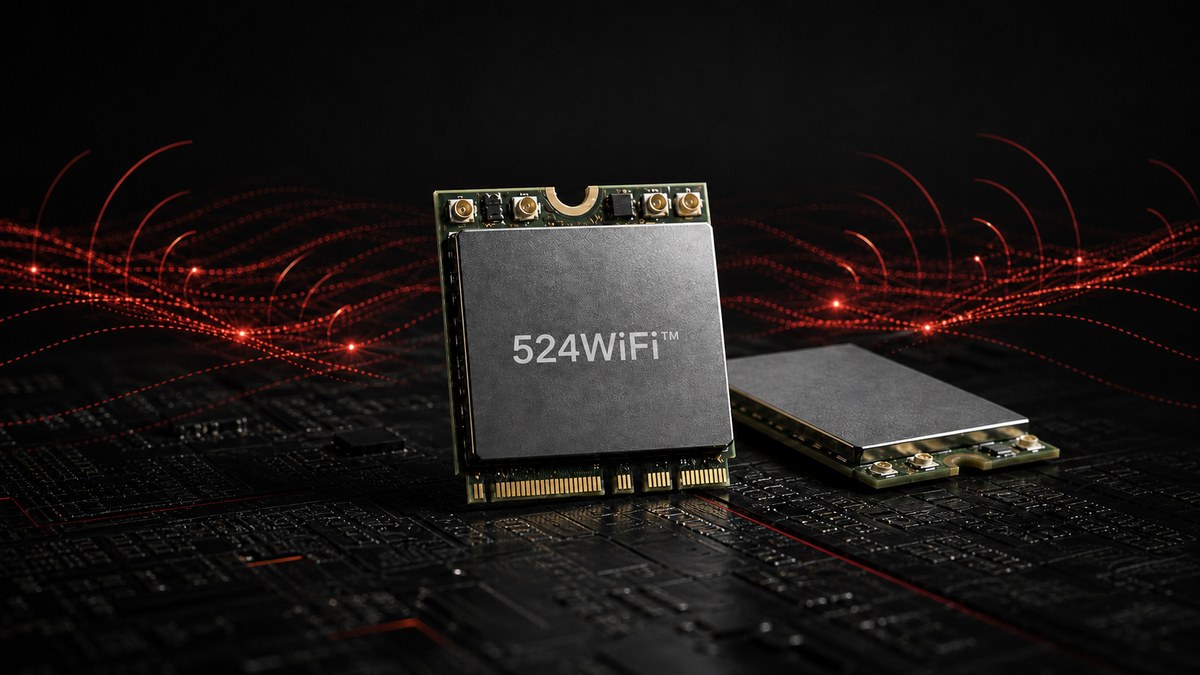
524WiFi™ Wi‑Fi 8 wireless module centered for the FastConnect 8800 engineering guide

Wi‑Fi 8 is now a hardware-planning issue, not just a standards roadmap. On 2 March 2026, Qualcomm Technologies introduced the Qualcomm® FastConnect™ 8800 Mobile Connectivity System alongside its wider Wi‑Fi 8 portfolio. For embedded-device and wireless-module teams, the most important news is not simply the headline PHY rate. It is the move to a 4×4 mobile radio architecture and the resulting impact on antennas, host bandwidth, power, heat and coexistence.

This engineering guide from 524WiFi.net™ translates the announcement into practical design questions for teams planning laptops, tablets, robots, edge-AI systems and other compact connected products.

FastConnect 8800 specifications at a glance

Qualcomm describes FastConnect 8800 as a single-chip, 6 nm connectivity system that combines Wi‑Fi 8, Bluetooth® High Data Throughput, Ultra-Wideband and Thread. The published Wi‑Fi specifications include:

  • a 4×4 radio configuration;
  • a peak PHY rate of up to 11.6 Gbps;
  • 2.4 GHz, 5 GHz and 6 GHz operation;
  • channels up to 320 MHz and 4K QAM;
  • High Band Simultaneous Multi-Link, uplink and downlink MU-MIMO, and OFDMA;
  • Wi‑Fi 8 Extended Long Range (ELR); and
  • support for earlier Wi‑Fi 7, Wi‑Fi 6E and Wi‑Fi 6 generations.

Qualcomm also reports up to three times longer gigabit range than its previous generation under the company’s stated 4×4, 320 MHz, RF front-end and ELR test conditions. Both the speed and range figures are platform claims rather than guaranteed product-level results: enclosure design, antennas, drivers, regional spectrum rules and the peer device will determine real performance.

Why a 4×4 mobile radio changes the integration plan

Four useful RF paths must fit inside the product

A four-stream radio needs more than four connectors on a schematic. Each path must remain useful after the module is installed in the final enclosure. Antenna spacing, polarization, cable loss, ground-plane interaction and isolation all matter across 2.4, 5 and 6 GHz. Metalwork, displays, batteries and edge-compute boards can detune antennas or create asymmetric paths that erase the expected 4×4 benefit.

Teams should reserve antenna volume early and validate the complete mechanical assembly, not only an open-bench reference setup. This is especially important for robots and industrial systems, where orientation and nearby machinery can change rapidly.

The host interface cannot be an afterthought

An 11.6 Gbps PHY rate is not the same as application throughput, but it still raises the ceiling for every subsystem around the radio. PCIe lane configuration, memory bandwidth, interrupt handling, CPU load, DMA behavior and driver architecture must be considered together. A next-generation radio connected through a constrained host path will deliver a constrained result.

Before freezing a carrier board, define realistic simultaneous traffic targets and include protocol overhead, multi-link scheduling and bidirectional workloads. Our Wi‑Fi 5 to Wi‑Fi 7 module selection guide shows why host compatibility and software support already matter as much as radio specifications.

Power delivery and thermal behavior need system-level testing

More RF chains, wider channels and concurrent links can increase peak power demand. The module, voltage regulators, connector and PCB must tolerate short bursts without instability, while the enclosure must prevent sustained workloads from triggering thermal throttling. Average consumption alone is not enough: measure peak current, rail noise and temperature under worst-case traffic, ambient conditions and antenna mismatch.

Coexistence becomes a product feature

FastConnect 8800 integrates Wi‑Fi, Bluetooth, UWB and Thread, and Qualcomm’s Proximity AI concept combines Wi‑Fi Ranging, UWB and Bluetooth Channel Sounding for direction and distance awareness. Integration reduces component count, but it also makes coexistence planning more important. Antenna topology, filtering, clocking and firmware scheduling should be tested with multiple radios active at once.

Wi‑Fi 8 changes the target from peak speed to dependable performance

Wi‑Fi 7 brought 320 MHz channels and multi-link operation into current high-performance designs. Wi‑Fi 8, based on IEEE 802.11bn, is being positioned around more reliable performance, useful range and predictable behavior under load. That shift is relevant to edge AI, autonomous machines and industrial links, where a stable latency envelope may be more valuable than a laboratory maximum.

The design question therefore changes from “Which radio has the highest number?” to “Which complete platform maintains the required throughput and latency in the real enclosure, spectrum environment and thermal budget?” Our article on tri-band Wi‑Fi for edge-AI platforms provides a practical baseline for systems being built today.

A practical Wi‑Fi 8 readiness checklist

  1. Reserve RF and mechanical space. Plan four antenna paths, isolation targets and connector access before the enclosure is fixed.
  2. Budget host throughput. Check the real PCIe configuration, CPU and memory path against bidirectional application traffic.
  3. Design for peak power. Validate transient current, rail stability and worst-case thermal conditions.
  4. Test concurrent radios. Include Wi‑Fi, Bluetooth, UWB and Thread coexistence in the validation matrix.
  5. Confirm the software path. Driver availability, operating-system support, firmware maturity and regulatory features remain deployment gates.
  6. Separate roadmap claims from production requirements. Use measured application performance and certified configurations as release criteria.

What product teams should do in 2026

Qualcomm says FastConnect 8800 is sampling to customers and expects commercial products later in 2026. That makes Wi‑Fi 8 relevant for new platform architecture, but it does not make proven Wi‑Fi 6E and Wi‑Fi 7 modules obsolete. Designs entering production now should still be selected according to available drivers, lifecycle, certification, regional 6 GHz rules and the throughput the application can actually use.

524WiFi™ and Tomorrow Systems® are following Wi‑Fi 8 module development with the same criteria applied to current hardware: stable software, credible RF design and repeatable performance outside the test bench. Browse our current wireless network modules while planning the transition path for your next platform.

Primary sources: Qualcomm Technologies, “Qualcomm Debuts AI-Native Wi‑Fi 8 Portfolio”, and the Qualcomm® FastConnect™ 8800 product page, both published 2 March 2026. Peak-rate and range statements above are Qualcomm claims; peak speed refers to PHY rate and actual results depend on implementation, configuration and network conditions.

Posted on

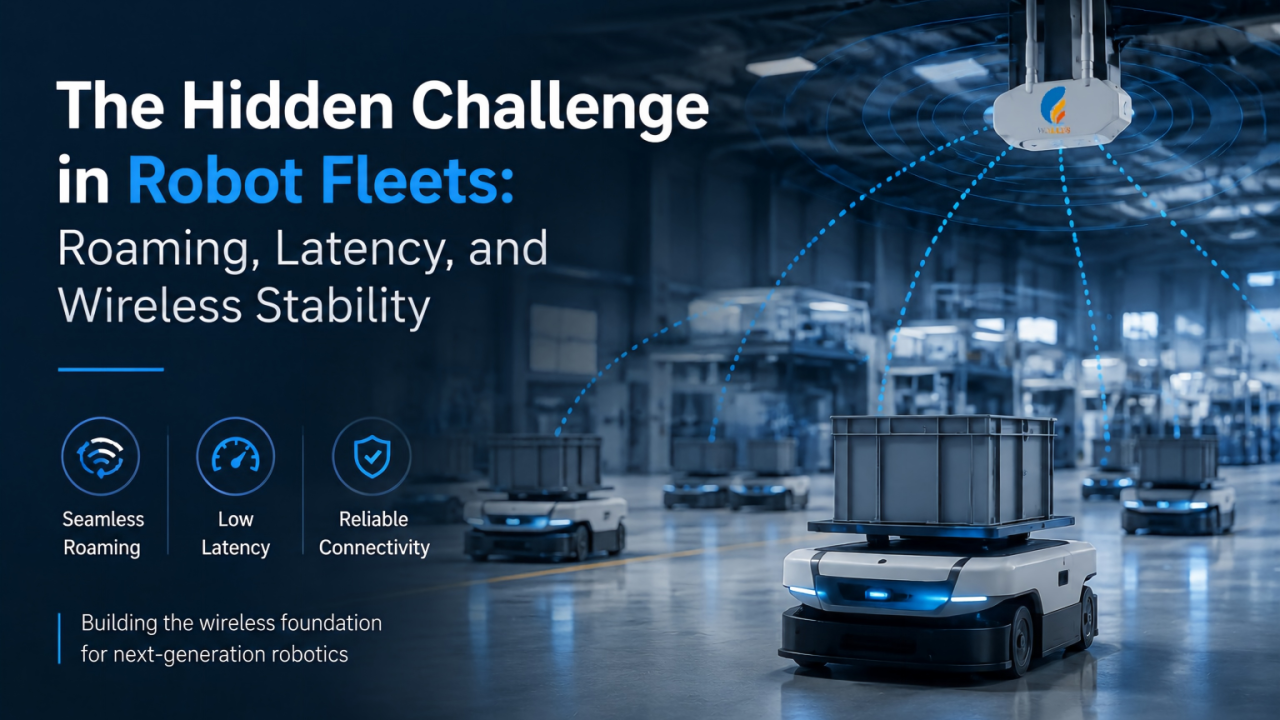
The Hidden Challenge in Robot Fleets: Roaming, Latency, and Wireless Stability

When people talk about autonomous robots, the conversation usually focuses on AI models, sensors, cameras, and navigation algorithms.

But there is another critical layer that often determines whether a robot system succeeds in real-world deployment:

Wireless connectivity.

A robot can have advanced AI capabilities, but without reliable communication, even the smartest robot may struggle in a dynamic industrial environment.

For large-scale robot fleets, connectivity is no longer just a networking feature. It becomes part of the robot’s operational reliability.

The Reality of Wireless Challenges in Robot Deployments

In warehouses, factories, farms, and outdoor industrial environments, robots are constantly moving.

An AMR (Autonomous Mobile Robot), for example, may need to:

  • Move across different areas with changing RF conditions
  • Maintain real-time communication with control systems
  • Upload high-resolution camera data
  • Receive navigation and task instructions
  • Coordinate with other robots in the same environment

During these operations, wireless networks face several challenges:

1. Roaming: Staying Connected While Moving

A robot moving through a large facility often needs to transition between multiple access points.

A poor roaming experience can cause:

  • Packet loss
  • Video interruption
  • Control delays
  • Temporary disconnection

For industrial robots, even a short communication interruption can affect efficiency and safety.

Advanced roaming mechanisms such as 802.11k/v/r help devices make faster and smarter roaming decisions by improving network awareness and reducing handover time.

However, successful roaming also depends on:

  • Proper RF planning
  • AP deployment strategy
  • Client behavior optimization
  • Network management

2. Latency: Every Millisecond Matters

Many industrial robot applications require real-time communication.

Examples include:

  • Remote monitoring
  • Vision-based inspection
  • Autonomous navigation
  • Robot fleet coordination

High latency can impact:

  • Motion control
  • Response time
  • Task execution efficiency

The challenge is not only achieving high throughput.

A network can provide high speed but still suffer from unstable latency due to:

  • Network congestion
  • Interference
  • Poor link quality
  • Inefficient routing

Reliable industrial wireless networks need predictable performance, not just peak speed.

3. Wireless Stability in Complex Environments

Industrial environments are very different from homes or offices.

Factories and outdoor deployments may include:

  • Metal structures causing reflections
  • Moving equipment blocking signals
  • Multiple wireless networks creating interference
  • Large numbers of connected devices

A robot fleet may experience changing wireless conditions every moment.

This requires networks that can adapt dynamically.

Important capabilities include:

  • Intelligent channel management
  • Interference detection
  • Dynamic path optimization
  • Mesh networking
  • Traffic prioritization

Why Traditional Wi-Fi Approaches Are Not Always Enough

A standard Wi-Fi deployment may work well for static users.

However, robot fleets introduce new requirements:

  • Mobility
  • High device density
  • Continuous connectivity
  • Low latency
  • Reliable uplink performance

The network needs to be designed around the robots’ movement and operational workflow.

Building the Wireless Foundation for Next-Generation Robots

The future of autonomous systems will depend on the combination of:

AI + Robotics + Reliable Connectivity

Advanced wireless technologies such as Wi-Fi 6 and Wi-Fi 7 bring important improvements:

  • Higher capacity
  • Better multi-device performance
  • Lower latency
  • Multi-band operation with MLO
  • Improved reliability in demanding environments

But technology alone is not enough.

Successful industrial deployments require:

  • The right wireless architecture
  • Proper RF optimization
  • Reliable hardware platforms
  • Long-term firmware support
  • Real-world validation

Final Thoughts

Autonomous robots are becoming smarter every day.

But intelligence alone does not guarantee successful deployment.

Behind every reliable robot fleet is a reliable communication infrastructure.

The next generation of industrial automation will not only depend on better AI algorithms — it will depend on wireless networks that can keep robots connected, responsive, and operational in the real world.

Reliable connectivity is the foundation that allows autonomous robots to truly become autonomous.

Posted on

Physical AI Connectivity – AI Robots Don’t Run on AI Alone. They Run on Connectivity.

Every week, we see exciting breakthroughs in robotics.

Smarter vision models. Faster inference. More powerful edge AI hardware.

But when robots leave the lab and enter factories, warehouses, farms, or outdoor environments, something interesting happens.

The biggest challenge often isn’t AI.  It’s connectivity !

An autonomous robot may have enough computing power to understand its surroundings, but it still needs to:

  • Receive sensor data in real time
  • Stream video reliably
  • Exchange information with other robots
  • Connect to edge servers and cloud platforms
  • Roam seamlessly across large facilities without interruption

If the wireless network becomes unstable, even the most advanced AI model can’t perform as intended.

In real-world deployments, we’ve learned that customers rarely complain about TOPS or benchmark scores.

Instead, they ask questions like:

• Can the connection stay stable after days or weeks of continuous operation?

• Will roaming interrupt navigation?

• How does the network perform in environments with heavy RF interference?

• Can hundreds of devices operate simultaneously without impacting latency?

These are deployment questions—not benchmark questions.

As Physical AI continues to evolve, networking is no longer just supporting the system.

It is becoming part of the AI infrastructure itself.

The future of intelligent robots won’t be built by AI alone.

It will be built by the combination of:

  • AI Computing
  • Reliable Wireless Connectivity

⚡ Edge Networking

  • Seamless Mobility

The industry has spent years optimizing AI models.

Perhaps it’s time we give the same attention to the networks that keep those models connected.

AI may be the brain.  Connectivity is the nervous system.

I’d love to hear your perspective:

What has been the biggest networking challenge in your robotics or Edge AI deployments?

Posted on

Why Edge AI Hardware Is Becoming the Next Competitive Advantage

Artificial Intelligence has evolved at an incredible pace over the past few years. From large language models to computer vision and predictive analytics, AI software has become increasingly powerful and accessible.

But as AI adoption accelerates, I’ve noticed a shift in conversations with customers and partners.

The discussion is no longer just about models.

It’s about deployment.

AI Doesn’t Create Value Until It Reaches the Edge

Training an AI model is only part of the journey. Real business value is created when AI runs where decisions need to be made—inside factories, warehouses, vehicles, retail stores, hospitals, and smart cities.

For many applications, relying entirely on cloud computing creates several challenges:

  • High latency
  • Expensive bandwidth
  • Privacy concerns
  • Unstable network connectivity
  • Ongoing cloud operating costs

This is why Edge AI has become one of the fastest-growing segments of the AI industry.

Processing data locally enables faster responses, better reliability, and greater control over sensitive information.

The New Bottleneck Isn’t Software

Five years ago, companies asked:

“Which AI framework should we use?”

Today they ask:

“Which hardware platform should we build on?”

Many AI startups have exceptional software teams, yet hardware development often delays commercialization.

Designing an embedded AI system involves far more than selecting a processor. Teams must address thermal management, power optimization, connectivity, storage, operating system support, long-term component availability, manufacturing, and certification.

For companies whose core strength lies in AI algorithms or industry expertise, developing custom hardware from scratch may not be the best use of resources.

Why OEM and ODM Partnerships Matter More Than Ever

Instead of reinventing the hardware platform, many companies are choosing to collaborate with experienced OEM and ODM manufacturers.

This approach allows engineering teams to focus on what truly differentiates their products:

  • AI applications
  • Software platforms
  • User experience
  • Industry-specific solutions

Meanwhile, hardware partners provide mature platforms that reduce development risk and shorten time-to-market.

In today’s competitive environment, launching six months earlier can be more valuable than achieving marginal improvements in hardware performance.

Flexibility Is Becoming More Important Than Raw Performance

The AI industry often focuses on TOPS, GPU cores, and benchmark scores.

While computing power certainly matters, customers increasingly ask different questions:

  • Can this platform be customized?
  • Does it support industrial environments?
  • Can wireless connectivity be added?
  • Is storage expandable?
  • Will the platform still be available in three years?
  • Can it scale from prototype to mass production?

These practical considerations often determine whether a product succeeds in the market.

Performance attracts attention.

Flexibility wins projects.

Looking Ahead

Edge AI is no longer an emerging trend—it is becoming the standard architecture for many intelligent devices.

Whether it’s machine vision, robotics, industrial automation, transportation, or smart retail, demand for reliable, customizable AI hardware continues to grow.

I believe the next wave of innovation won’t come solely from more powerful AI models.

It will come from making AI easier to deploy in real-world environments.

Companies that can combine intelligent software with reliable, scalable hardware will be best positioned to deliver practical AI solutions.

As someone working closely with Edge AI platforms, it’s exciting to see how quickly the industry is evolving.

I’m curious to hear your perspective.

What do you think will become the biggest challenge for Edge AI over the next five years—computing power, deployment, cost, or something else?

Let’s discuss.

Posted on

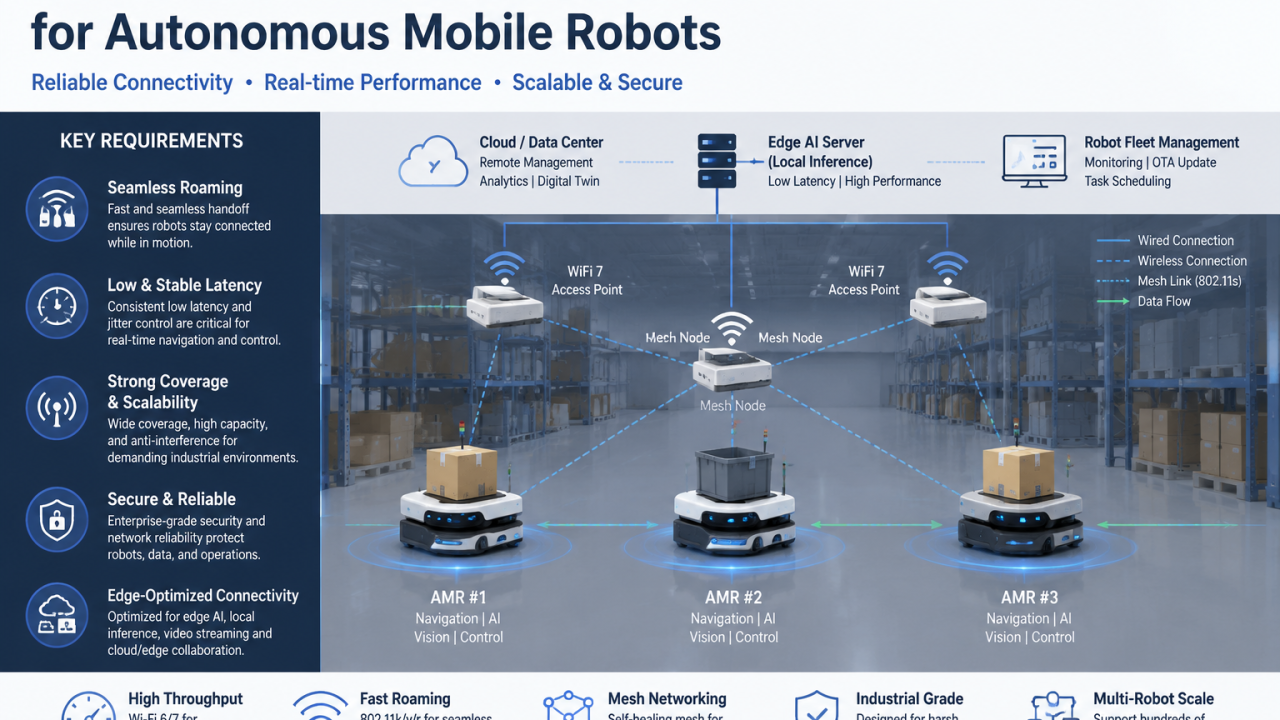
How to Build Reliable Wireless Infrastructure for Autonomous Mobile Robots?

When companies deploy autonomous mobile robots (AMRs) in real environments, the biggest challenge is often not the robot itself.

It is the network that keeps the robot connected.

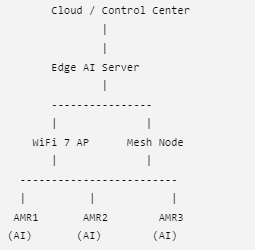
An AMR depends on continuous communication for:

– Real-time navigation

  • Vision data transmission

⚡ Edge AI inference

– Fleet coordination

☁️ Cloud and remote management

A short network interruption may result in:

  • Navigation delays
  • Video stream drops
  • Task interruptions
  • Reduced operational efficiency

So, what does a reliable wireless infrastructure for AMRs require?

1. Seamless Roaming

AMRs continuously move through different areas.

A reliable network must allow robots to switch between access points without interrupting communication.

2. Low and Stable Latency

For autonomous systems, average speed is not enough.

What matters is consistent response time.

Network jitter and packet loss can directly impact robot performance.

3. Strong Coverage and Scalability

Factories and warehouses often have:

  • Large areas
  • Metal structures
  • RF interference
  • Hundreds of connected devices

A scalable wireless architecture is essential.

4. Edge-Optimized Connectivity

Modern robots combine:

– AI computing – Wireless communication – Sensors ⚙️ Real-time control

Email: [email protected] or [email protected]

The wireless network is no longer just an access layer.

It becomes part of the AI system.

As Physical AI moves from laboratories into factories, warehouses, and outdoor environments, reliable connectivity will become a key factor determining whether autonomous systems can scale.

AI gives robots intelligence.

Connectivity gives robots the ability to operate.

What challenges have you experienced when deploying wireless networks for autonomous robots?

Building the next generation of AI-powered edge devices requires reliable connectivity. Explore how WallysTech helps robotics, AI vision, and industrial applications achieve stable wireless performance.

Article content
Posted on

Wi-Fi 7 for AIoT: How IPQ9574 and QCN9274 Enable Real-Time Edge AI

When we talk about Wi-Fi 7 (802.11be), most discussions focus on its impressive speed upgrades — and rightly so. But beneath the surface, Wi-Fi 7 is quietly becoming a critical enabler for Artificial Intelligence (AI) and AIoT (Artificial Intelligence of Things). It’s not just about faster wireless — it’s about making intelligent devices truly efficient, real-time, and scalable.

🚀 What Makes Wi-Fi 7 Different?

Wi-Fi 7 introduces groundbreaking features like:

  • Multi-Link Operation (MLO) — enabling devices to connect across multiple bands simultaneously, improving reliability and reducing latency.
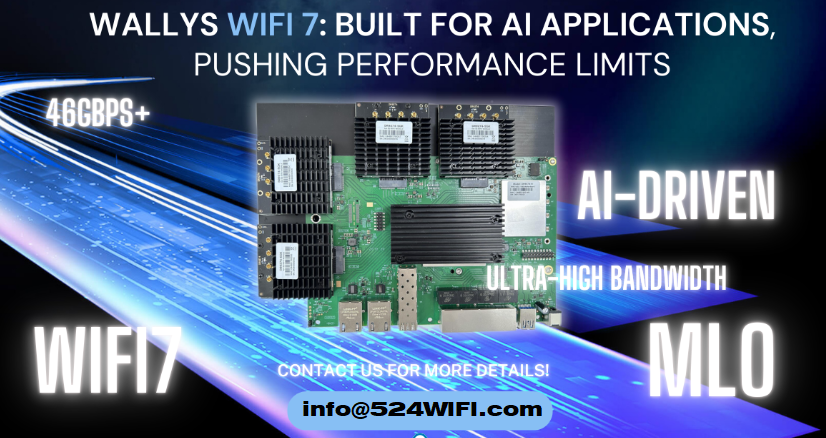
  • Higher throughput — supporting up to 46 Gbps, ideal for high-data AI workloads.
  • Lower latency — essential for real-time AI inference.
  • Improved concurrency — allowing more smart devices to communicate simultaneously without congestion.

These capabilities make Wi-Fi 7 a natural fit for the AI revolution — both in the cloud and at the edge.


🧠 AI + Wi-Fi 7: A Perfect Match

1. Faster Real-Time Inference at the Edge

Edge AI devices like smart cameras, traffic sensors, or inspection drones require:

  • Constant data streams
  • Real-time decision-making
  • High connection reliability

Wi-Fi 7 ensures ultra-low latency and high bandwidth — perfect for AI models processing data in real time, directly on edge devices.

📍 Example: In smart manufacturing, a defect detection system running AI vision models can send high-resolution images instantly over Wi-Fi 7 for sub-second inference.


2. Scalable AIoT Networks

AIoT means connecting and managing hundreds or thousands of smart devices, often with edge AI capabilities.

Wi-Fi 7 supports:

  • Massive device concurrency
  • Dynamic bandwidth allocation
  • Superior QoS (Quality of Service)

This allows factories, campuses, or smart buildings to scale up their AIoT systems without overloading the network.

📍 Example: A smart office can deploy hundreds of AI-enabled occupancy sensors and environmental monitors — all reporting in real time — without lag.


3. Wireless Edge AI Gateways

Many AIoT systems use a local AI gateway that:

  • Aggregates data from various sensors
  • Runs local AI models
  • Connects wirelessly to the cloud or central system

Wi-Fi 7’s multi-band capabilities ensure that these gateways maintain stable, high-speed connections — even in noisy RF environments.

📍 Example: In a hospital, an AI-powered patient monitoring system can use a Wi-Fi 7-enabled gateway to transmit continuous multi-sensor data with minimal delay or risk of interruption.


🌐 AI-Powered Devices Need a Smarter Network — That’s Wi-Fi 7

As AI models become more complex and real-time applications more common, the network needs to evolve as well. Wi-Fi 7 is not just keeping up — it’s paving the way forward.

Whether it’s in:

  • Retail analytics
  • Autonomous vehicles
  • Healthcare monitoring
  • Smart agriculture
  • or Industrial robotics…

AI + Wi-Fi 7 is the new power couple for connected intelligence.


🔧 524WiFi and Wallys Wi-Fi 7 Hardware: Designed for AI and AIoT Deployments

At 524WiFi and Wallys, we offer industrial-grade Wi-Fi 7 solutions based on Qualcomm platforms such as IPQ9574 and QCN9274. Our high-performance router boards and wireless modules are ideal for:

  • AI-enabled edge computing devices
  • Custom AIoT gateways
  • High-bandwidth data streaming systems

🔹 DR9574 Router Board – (CPU:Qualcomm IPQ9574) Perfect for AI gateways with multiple high-speed interfaces

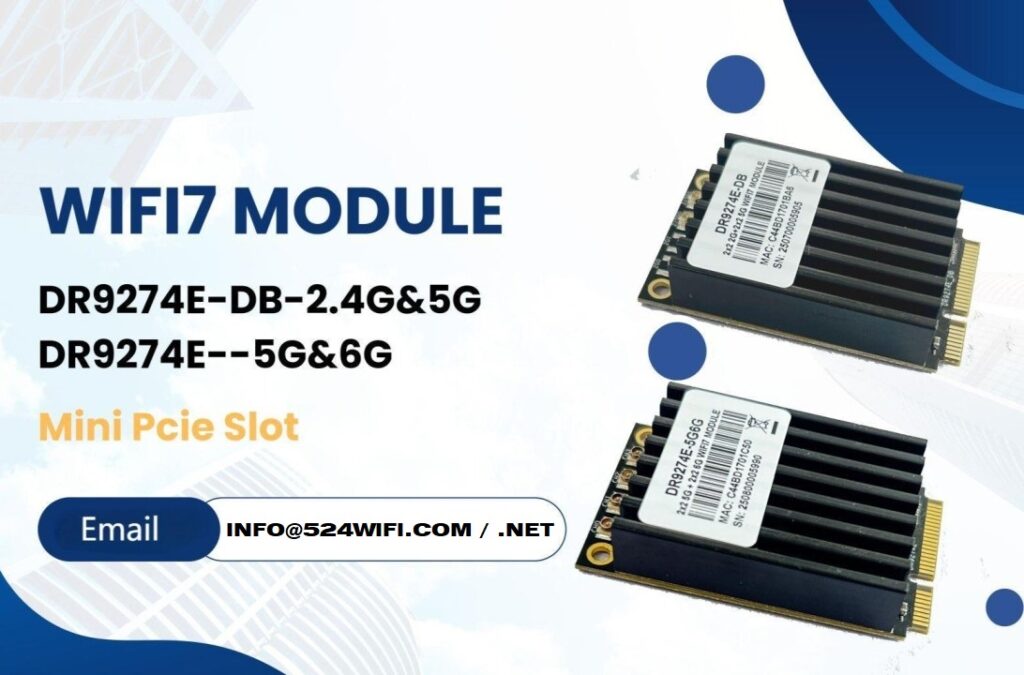
🔹 DR9274 Mini PCIe Module – (CPU:Qualcomm QCN9274/QCN6274) Compact and powerful Wi-Fi 7 module for embedded AI system

🔹 Custom ODM/OEM support – Tailor-made solutions for your AI product roadmap

👉 Contact our team at info@524wifi dor net or com to discuss your AI project and how Wi-Fi 7 can help you scale it smarter and faster.