Posted on

524WiFi™ Pulse B7-05: Wi-Fi 7 Platform for Custom Wireless Products

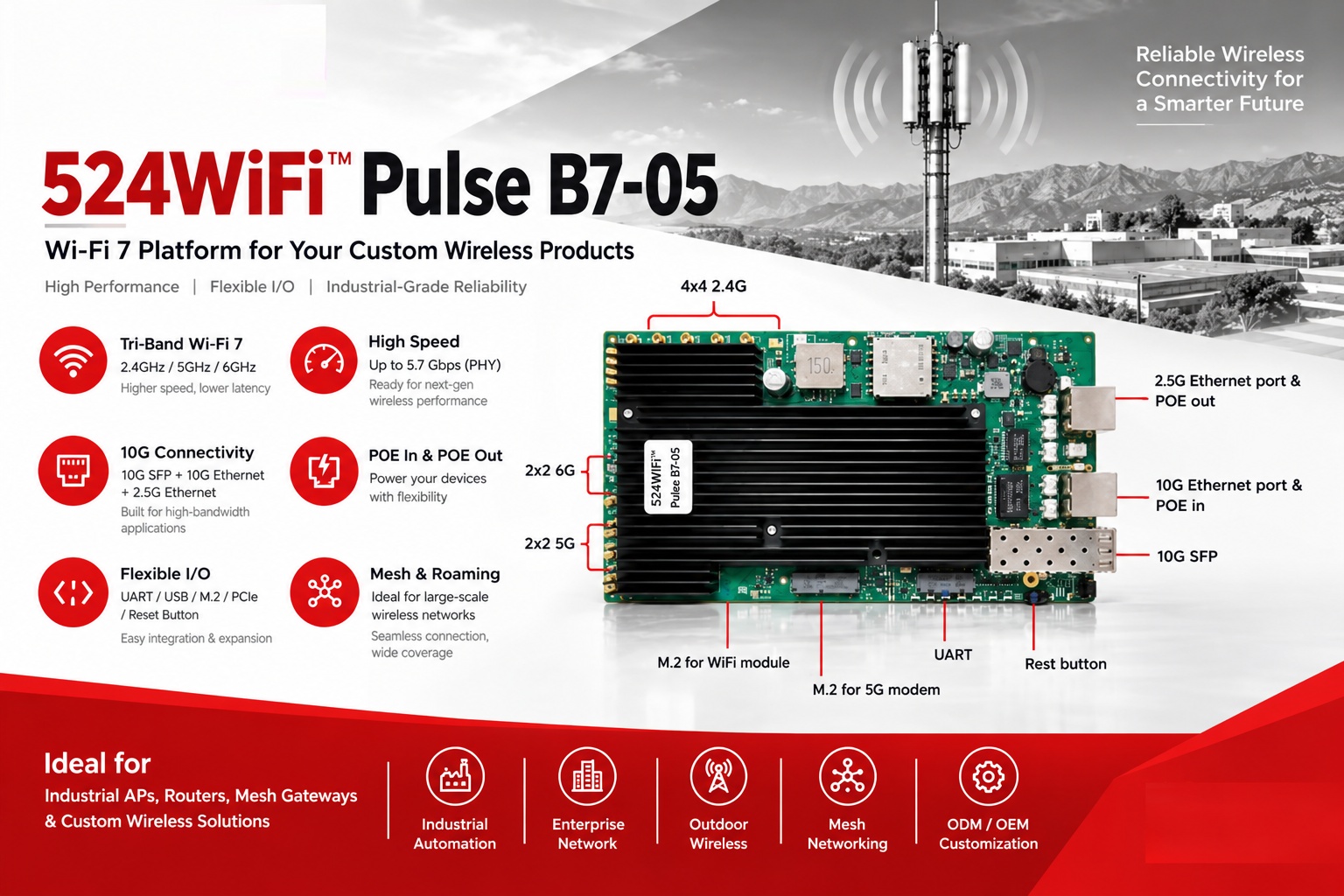
524WiFi™ Pulse B7-05 Wi-Fi 7 platform and hardware interfaces

524WiFi™ Pulse B7-05 is our tri-band (2.4/5/6GHz) Wi-Fi 7 platform for OEM/ODM projects, with 10G Ethernet, 10G SFP, and PoE in/out options on board.

It’s a good fit for:
→ Industrial APs
→ Enterprise routers
→ Mesh gateways
→ Outdoor wireless devices

We can help with hardware customization and software development, so you don’t have to build everything from scratch.

Have a project in mind? Let’s talk about whether 524WiFi™ Pulse B7-05 is the right fit – info at 524wifi.net or .com

Platform reference: DR5424S.

Posted on

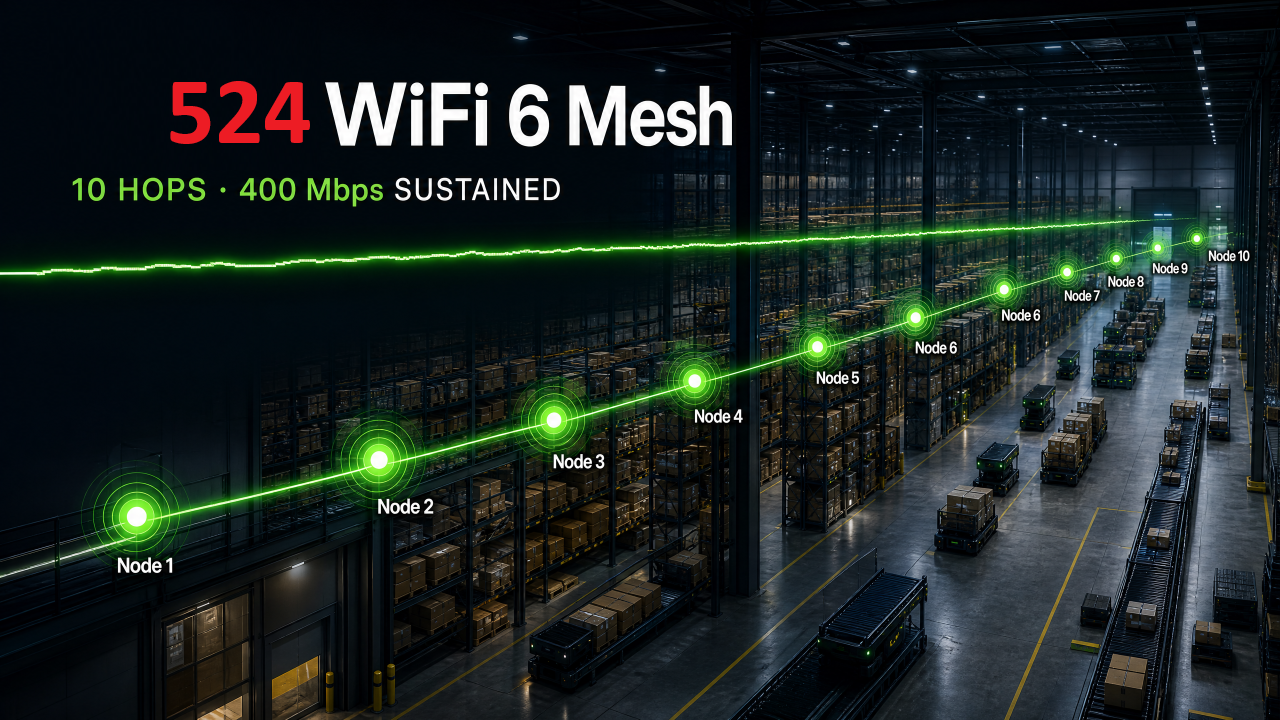
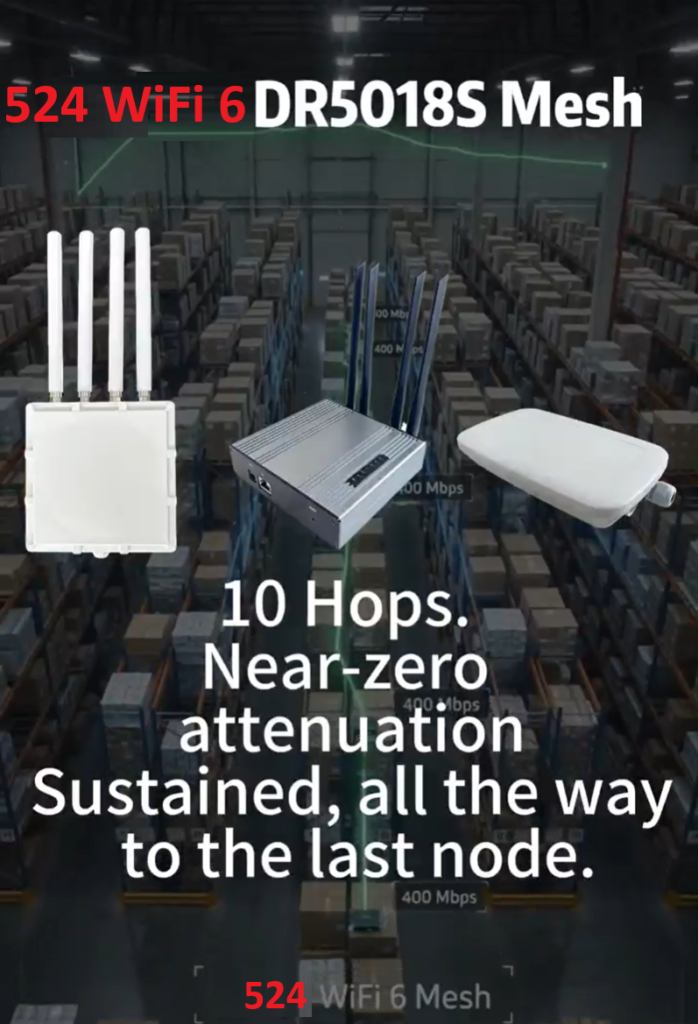
DR5018S 524 WiFi 6 MESH|10 Hops. Zero Compromise. 400Mbps

10 Hops. Near-zero attenuation. 400Mbps.

Most industrial mesh networks start choking after 3-4 hops — latency spikes, throughput collapses, and your robots lose their control link exactly when you need it most.

We just wrapped a 10-hop mesh stress test on our WiFi 6 platform, and the results speak for themselves: near-zero attenuation across all 10 hops, with sustained throughput of 400Mbps at the final node.

Article content
524WiFI mesh 10 hops testing environment

For AMR fleets, warehouse automation, and multi-robot deployments, this isn’t a lab number — it’s the difference between a robot that stays connected across a 50,000 sq ft facility and one that drops out the moment it turns a corner.

Article content
From PC1 to PC2 10 HOPS THROUGHPUT TEST RESULTS

No more compromising on coverage. No more babysitting mesh hops. Just reliable, high-throughput connectivity that scales with your facility, not against it — no need for WiFi 7 to get there.

Complete DR5018S MESh product family : https://524wifi.net/?s=mesh&post_type=product

Want the full test report or a demo on your floor plan? Please feel fre to contact us !

Posted on

When Robots Move Beyond Wi-Fi Coverage: Why Mesh Matters

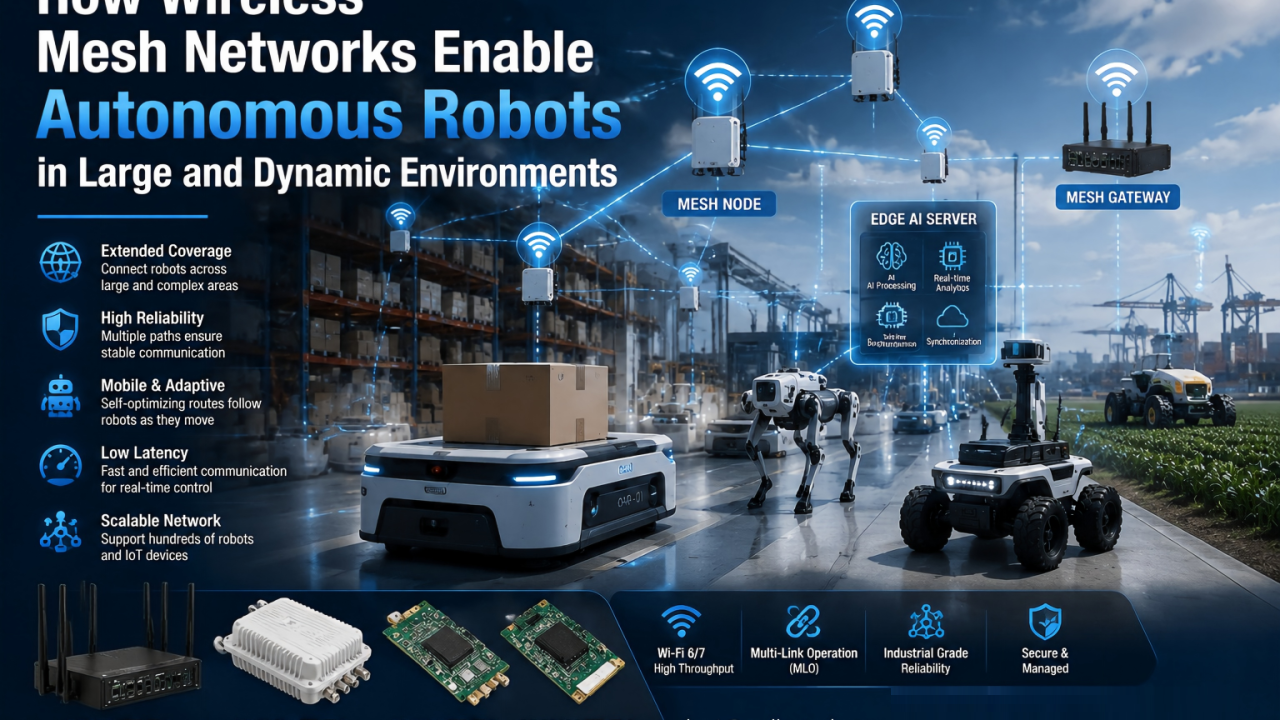
How Wireless Mesh Networks Enable Autonomous Robots in Large and Dynamic Environments

The future of robotics is moving beyond controlled spaces.

Autonomous robots are no longer limited to laboratory demonstrations or small indoor environments.

Today, robots are being deployed in:

  • Large warehouses
  • Smart factories
  • Outdoor farms
  • Ports and logistics centers
  • Mining sites
  • Industrial inspection areas
  • Hospitals and commercial buildings

As robot deployment expands, one challenge becomes increasingly important:

How do we maintain reliable connectivity when robots move beyond traditional Wi-Fi coverage?

The answer is not simply adding more access points.

The future of autonomous robotics requires a more flexible and intelligent wireless infrastructure.

This is where wireless mesh networking becomes increasingly important.


Autonomous Robots Need Connectivity Everywhere They Operate

A robot is only autonomous when it can continuously:

  • Sense its environment
  • Process information
  • Communicate with other systems
  • Receive updates
  • Report status

Connectivity enables critical robot functions:

  • Navigation assistance
  • Remote monitoring
  • Fleet management
  • Mission updates
  • Data synchronization
  • Safety communication

For a fixed device, losing wireless connectivity may be inconvenient.

For an autonomous robot, connectivity loss can impact the entire operation.

A warehouse robot that loses connection may stop.

An inspection robot that disconnects may fail to complete a mission.

A farming robot operating in a large field may become unreachable.

Reliable wireless communication is not an optional feature.

It is operational infrastructure.


The Limitation of Traditional Wi-Fi Networks

Traditional Wi-Fi deployments are usually designed around fixed infrastructure:

Access Point → Client Device

This works well for:

  • Offices
  • Small factories
  • Indoor environments

However, robotics introduces new challenges.

1. Large Operating Areas

Many robotic applications cover large spaces:

  • Warehouses with thousands of square meters
  • Outdoor industrial sites
  • Agricultural fields
  • Logistics yards

Installing wired access points everywhere may become:

  • Expensive
  • Difficult to maintain
  • Limited by infrastructure availability

2. Dynamic Robot Movement

Robots are constantly moving.

Their communication environment changes every second.

A robot may travel:

  • From one building to another
  • Through different production areas
  • Around obstacles and machinery

The wireless network must adapt dynamically.


3. Rapid Deployment Requirements

Many robotics deployments need flexibility.

For example:

A logistics company may expand warehouse operations.

A factory may redesign production lines.

An agricultural operation may deploy robots across changing areas.

A wireless solution should not require rebuilding the entire network every time the environment changes.


What Is Wireless Mesh Networking?

A traditional Wi-Fi network depends mainly on wired access points connected to a central network.

A wireless mesh network creates multiple communication paths.

Instead of:

Robot → Access Point → Network

A mesh environment can support:

Robot → Robot → Mesh Node → Network

or:

Robot → Mesh Node → Mesh Node → Gateway

Each node can help extend network coverage and improve flexibility.


Why Mesh Matters for Autonomous Robots

1. Extending Coverage Across Large Areas

Robots often operate in places where complete wired infrastructure is difficult.

Examples:

Smart Agriculture

Autonomous agricultural robots may operate across:

  • Fields
  • Orchards
  • Greenhouses

Mesh networking can help extend connectivity across larger areas without requiring extensive cabling.


Industrial Sites

Factories and industrial facilities often include:

  • Metal structures
  • Moving equipment
  • Complex layouts

Mesh networks can provide more flexible coverage.


Warehouses

Large warehouses may contain:

  • High shelves
  • Multiple zones
  • Moving inventory systems

A flexible wireless architecture helps robots maintain communication while navigating different areas.


2. Improving Network Resilience

One of the biggest advantages of mesh networking is redundancy.

In traditional networks:

If one access point fails:

Connected devices may lose communication.

In a mesh network:

Multiple paths may exist.

If one route becomes unavailable, the network can potentially find another path.

For autonomous robots, this means:

  • Higher availability
  • Better reliability
  • Reduced downtime

A robot fleet should not depend on a single communication point.


3. Supporting Mobile Robot Fleets

Robotics is moving toward multi-robot collaboration.

A warehouse may have:

  • Hundreds of AMRs
  • Multiple autonomous forklifts
  • Robotic arms
  • AI vision systems

These machines need continuous communication.

Mesh networking can provide a more adaptable communication layer for:

  • Robot-to-network communication
  • Robot-to-robot communication
  • Edge computing connectivity

Mesh Networking and Edge AI Robotics

The growth of Edge AI makes connectivity even more important.

A modern autonomous robot may follow this architecture:

Sensors

↓

Camera / LiDAR / Vision Data

↓

Wireless Network

↓

Edge AI Server

↓

Decision Making

↓

Robot Control

If communication between these layers becomes unstable, the entire AI workflow is affected.

Mesh networking helps create a more flexible communication foundation for distributed AI systems.


The Role of Wi-Fi 6 and Wi-Fi 7 in Industrial Mesh

Modern robotics applications require more than coverage.

They need:

  • High bandwidth
  • Low latency
  • High reliability
  • Multiple device support

Wi-Fi 6 introduces important capabilities:

  • OFDMA
  • Improved efficiency in dense environments
  • Better support for many connected devices

Wi-Fi 7 further expands possibilities with:

Multi-Link Operation (MLO)

Multiple frequency links can improve reliability and latency.

Higher Throughput

Supports demanding applications such as:

  • Multi-camera robots
  • AI vision systems
  • Remote operation

Better Network Performance

Helps support increasingly complex robotic environments.


Challenges: Mesh Networks Must Be Designed for Robotics

Not all mesh networks are suitable for autonomous robots.

Robotics requires careful engineering.

Important considerations include:

Low Latency Routing

A robot cannot wait several seconds for network decisions.

Fast Path Optimization

The network should select efficient communication paths.

Mobility Support

Routes must adapt as robots move.

Network Management

Large fleets require visibility and control.


From Connected Robots to Connected Robot Ecosystems

The future factory will not contain isolated robots.

It will contain an ecosystem:

  • Autonomous mobile robots
  • AI cameras
  • Edge servers
  • Industrial sensors
  • Cloud platforms

All these systems require reliable communication.

Mesh networking provides a path toward more flexible and scalable robot infrastructure.


Conclusion: Mesh Is Becoming Part of the Robot Infrastructure

Autonomous robots are moving into larger, more complex environments.

As deployment expands, traditional wireless coverage models become insufficient.

Robots need communication systems that can:

  • Follow them as they move
  • Adapt to changing environments
  • Maintain reliable connections
  • Support large-scale operations

Wireless mesh networking is becoming an important technology for building the connected infrastructure behind autonomous machines.

The future of robotics is not only about making robots smarter.

It is about creating the wireless systems that allow them to operate anywhere.

AI is the brain. Sensors are the eyes. Connectivity is the nervous system.

And mesh networking helps build that nervous system at scale.

How 524WiFi and Wallys Support Autonomous Robot Connectivity

At 524WiFi and Wallys, we focus on building reliable wireless infrastructure for the next generation of intelligent machines.

Our industrial Wi-Fi solutions support robotics applications that require:

  • High-performance wireless communication
  • Low-latency connectivity
  • Flexible deployment
  • Scalable mesh networking

By combining Wi-Fi 6/Wi-Fi 7 technology with industrial-grade hardware, Wallys helps robotics companies create reliable connectivity between:

Autonomous Robots → Edge AI Systems → Industrial Networks

Because smarter robots need more than intelligence.

They need a reliable wireless nervous system.

Posted on

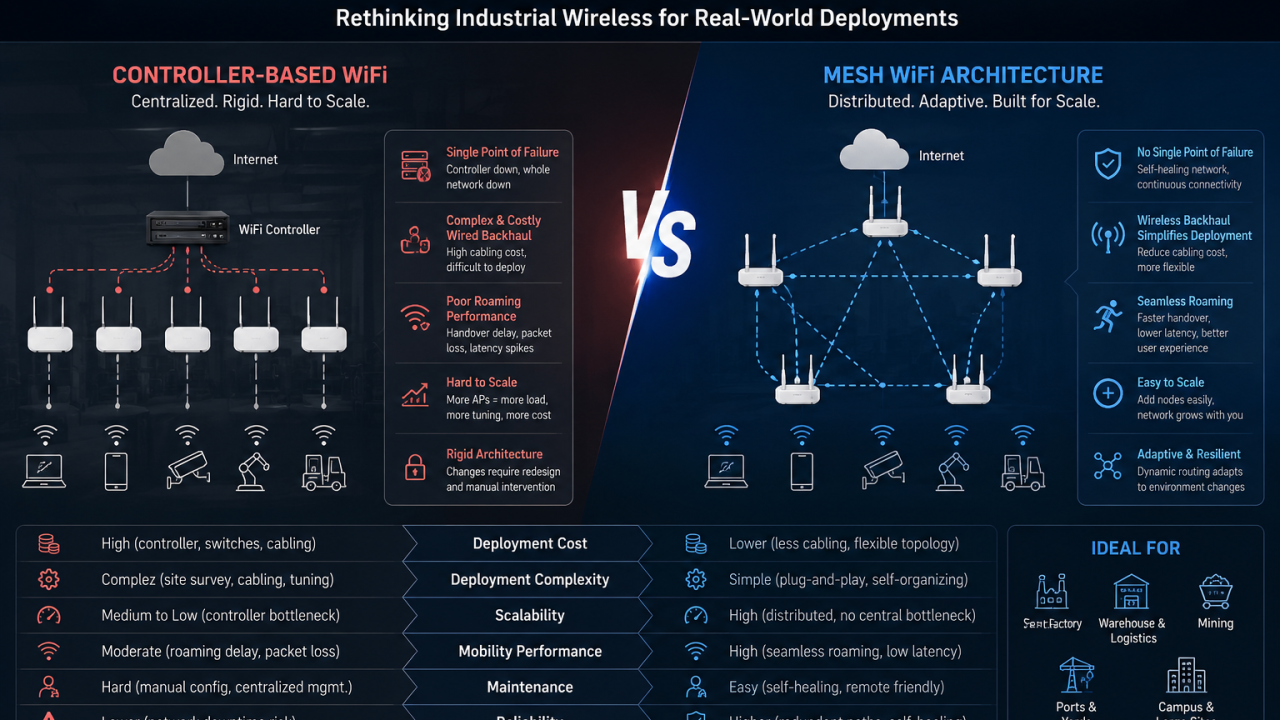
Why Controller-Based Industrial WiFi Is Breaking in Real Deployments

Most industrial WiFi networks are still built on a controller-based architecture.

And in controlled lab environments, it works.

But in real industrial deployments, the story is very different.

Factories, mines, ports, and warehouses are not static environments. They are dynamic, noisy, and constantly changing systems.

And that’s exactly where controller-based WiFi starts to fail.


The Hidden Assumption Behind Controller WiFi

Traditional enterprise WiFi is built on one assumption:

A centralized controller can efficiently manage the entire network.

That assumption only holds when the environment is predictable.

Industrial environments are not.

Once you scale into real deployment scenarios, WiFi becomes less about “AP management” and more about:

  • mobility
  • interference
  • topology changes
  • real-time traffic behavior

And centralized control starts becoming a limitation rather than an advantage.


Where Controller-Based WiFi Fails in Practice

1. Roaming is still not truly seamless

Even with controller-based optimization:

  • handover delay still exists
  • packet loss happens during movement
  • latency spikes under load are unavoidable

This is especially critical for AGVs, mobile robots, and real-time monitoring systems.


2. Wired backhaul limits deployment flexibility

Controller-based architectures heavily depend on wired infrastructure.

But industrial sites are:

  • expensive to cable
  • frequently reconfigured
  • physically difficult to retrofit

This creates a gap between “ideal network design” and “real deployment reality”.


3. Scaling introduces complexity, not simplicity

Adding more APs does not mean linear scalability.

Instead, it introduces:

  • higher controller load
  • complex RF planning
  • continuous tuning effort
  • increased operational cost

At scale, the network becomes harder to manage, not easier.


4. Centralized failure domains are too rigid

In controller-based systems:

  • architecture is tightly coupled
  • dependencies are centralized
  • failure impact can cascade

A small issue can affect a disproportionately large part of the network.


Why Mesh Architecture Is Gaining Real Adoption

Mesh WiFi is not new—but industrial requirements are forcing a structural shift.

Instead of forcing traffic through a central controller, Mesh builds a distributed network where nodes collaborate dynamically.

Key advantages include:

Distributed control

No single point of dependency for network decisions.

Self-healing topology

Traffic dynamically adapts when nodes fail or conditions change.

Flexible expansion

New nodes can be added without redesigning the entire system.

This aligns far better with how industrial environments actually evolve.


Important Reality Check: Mesh Is Not a Silver Bullet

Mesh does NOT eliminate RF physics.

In real deployments, you still need to consider:

  • interference in industrial environments
  • bandwidth sharing between backhaul and access
  • multi-hop latency trade-offs
  • proper RF planning

But the key difference is:

Mesh adapts to real-world constraints instead of fighting against them.


The Real Shift in Industrial WiFi

This is not a feature comparison between Mesh and Controller WiFi.

It is a structural shift in architecture thinking:

  • From centralized control → distributed intelligence
  • From static topology → adaptive topology
  • From planned deployments → evolving networks

Industrial WiFi is no longer about perfect design.

It is about surviving real-world complexity.


Final Thought

Controller-based WiFi still works in controlled enterprise environments like offices and campuses.

But in industrial deployments, the question is no longer:

“How powerful is your controller?”

It becomes:

“Why are you still forcing a centralized architecture into a distributed environment?”


If you are building industrial networking products…

If you are currently working on:

  • Industrial routers
  • Mesh WiFi systems
  • OEM/ODM networking platforms
  • Edge connectivity devices
  • WiFi solutions for AGVs, robotics, or smart factories

and are facing challenges such as roaming instability, deployment complexity, or scalability limitations—

We can share practical architecture insights based on real-world industrial WiFi deployments, including Qualcomm-based WiFi 6 Mesh platform designs.

Feel free to connect or message me to discuss your project.

Article content
Posted on

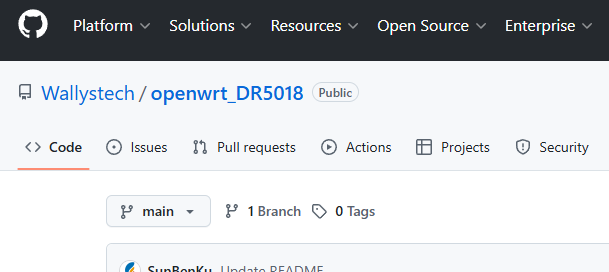
Wi-Fi 6 Mesh Development with IPQ5018 & IPQ5010: WallysTech DR5018S Source Code Now on GitHub

🚀 WallysTech Releases Open-Source DR5018S Mesh Solution on GitHub!

We’re excited to announce that the DR5018S Mesh solution — optimized, tested, and production-ready — has now been fully open-sourced on GitHub.
Built on OpenWrt and enhanced through extensive real-world deployments, this solution is designed for teams working on Wi-Fi 6 / ath11k Mesh networks.

🔍 Why We Open-Sourced It

Mesh networking is essential in industrial IoT, outdoor coverage, enterprise networking, and large-scale distributed systems.
Yet many teams still struggle with:
• Unstable links
• Slow backhaul recovery
• Performance drops in high-density environments
• Limited ath11k Mesh reference designs

After deep testing and tuning in our own projects, we’ve created a stable, engineering-grade Mesh implementation — and we want to share it with the community.

⭐ What’s Inside

✔ Optimized Mesh link logic
✔ Faster reconnection & self-healing
✔ Lower latency during link interruptions
✔ NSS-accelerated forwarding
✔ Mesh configs, tuning parameters, and deployment guides
✔ Driver & firmware-related adjustments for ath11k

💡 About DR5018S

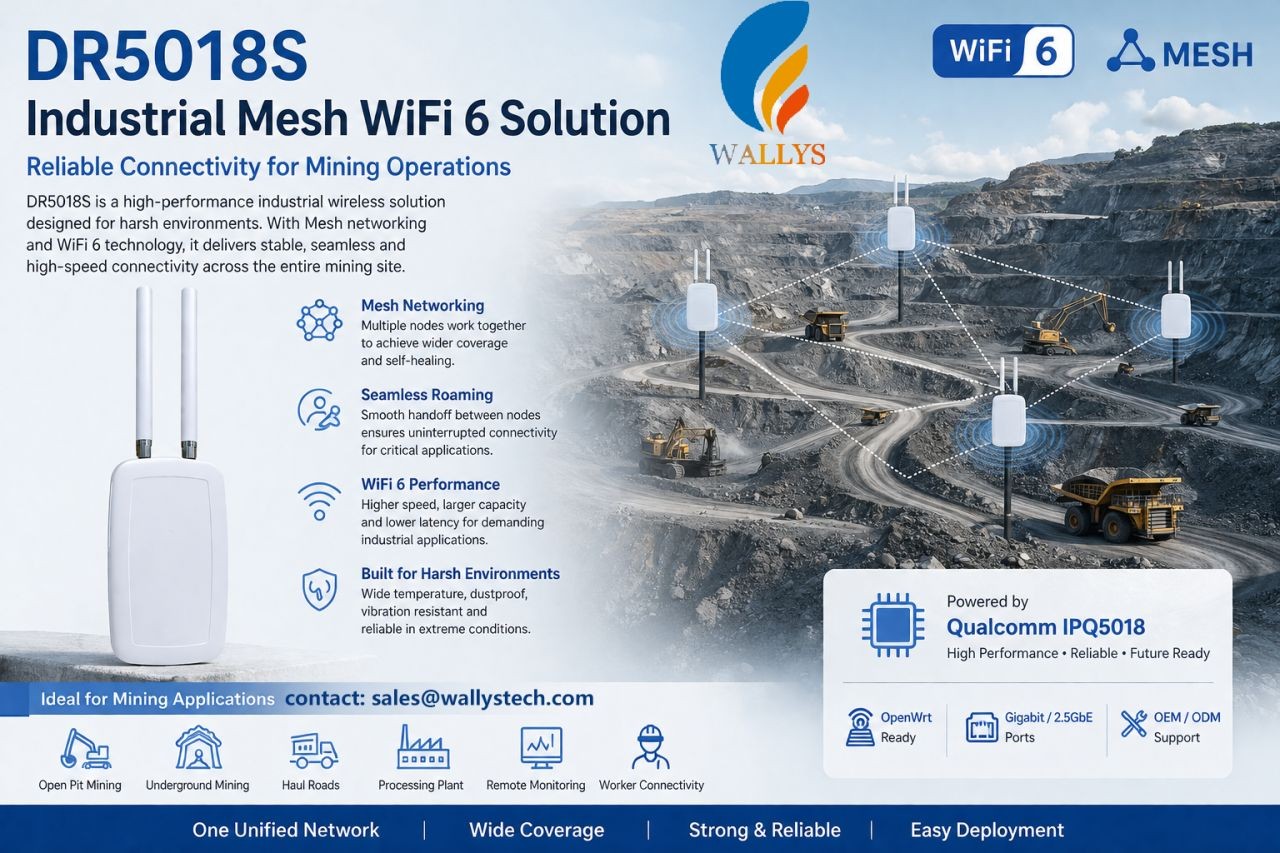
Powered by the Qualcomm IPQ5018 Wi-Fi 6 SoC, DR5018S is proven in harsh environments such as mines, oil fields, campuses, smart cities, and enterprise networks.
It supports flexible roles as both access and backhaul nodes — and is available with an industrial IP68 outdoor enclosure.

📦 GitHub Repository

🔗 [ GitHub link]

We’ve included examples, configs, debugging tips, and FAQs to help teams go from “it works” to “it works reliably.”

🤝 Join the Mesh Open-Source Community

If you’re building on Wi-Fi 6 or ath11k Mesh, we invite you to try the solution, share feedback, open issues, or submit PRs.
For large-scale deployments or custom requirements, our team is happy to support — just reach out.

Let’s build the next generation of Mesh networks together. 💡🌐

🚀 Key Features

1. High-Performance Platform Based on IPQ5018

  • Qualcomm IPQ5018 chip, dual-core ARM Cortex-A53 @ 1.0GHz
  • 512MB DDR3L system memory, 128MB NAND Flash storage
  • Hardware NAT acceleration supporting high-concurrency network connections

2. Complete Mesh Network Support

  • Natively integrated B.A.T.M.A.N. Advanced Mesh protocol
  • Supports multi-hop routing and dynamic topology discovery
  • Automatic link quality assessment and routing optimization

3. Enterprise-Level Functions

  • Supports WPA3 enterprise-grade security encryption
  • VLAN isolation and multi-SSID management
  • Centralized network management and monitoring
  • Supports Captive Portal and billing systems

DR5018S Mesh product family : https://524wifi.net/?s=mesh&post_type=product

Posted on

Seamless Connectivity, Smarter Networks — The Power Behind 524WIFI WallysTech DR5018S

Conceptual illustration of mesh infrastructure and roaming, not a measured performance result

As industries evolve toward automation and intelligent infrastructure, connectivity has become the invisible backbone of every operation. From smart factories to autonomous logistics, reliable wireless communication defines success. And when the network must cover kilometers, handle hundreds of devices, and stay always online — DR5018S delivers.


⚙️ Powered by Qualcomm IPQ5018 — Designed for Industrial Mesh Intelligence

At the heart of the 524WiFi WallysTech DR5018S lies the Qualcomm IPQ5018 dual-core processor, paired with QCN6102 (5GHz) and QCN6122 (6GHz) radios. This tri-band WiFi 6 architecture enables true Mesh networking — where every node communicates, learns, and heals automatically.

✅ Auto-discovery & self-organization ✅ Dynamic mesh joining without manual setup ✅ Instant rerouting when nodes fail

It’s not just a router board — it’s an intelligent wireless ecosystem that keeps your network alive, aware, and adaptive.


🚶♂️ 802.11k/v/r Seamless Roaming — Stay Connected Without Thinking About It

Imagine walking through a smart factory or logistics park while streaming video or managing AGVs. With DR5018S, your devices switch between access points instantly, thanks to advanced roaming support:

  • 802.11k — Finds nearby APs faster
  • 802.11v — Guides clients to the best AP
  • 802.11r — Enables fast handover with no dropouts

From office corridors to outdoor yards, DR5018S keeps your network uninterrupted — wherever you move.


🏭 Industrial-Grade Reliability — Built for the Harshest Environments

The DR5018S is more than powerful — it’s purpose-built for tough conditions:

  • 🌧 IP68 waterproof & dustproof
  • 🌡 Wide temperature tolerance
  • ⚡ PoE power input for flexible deployment
  • 📍 Integrated GPS for tracking and synchronization

Whether it’s a mining site, oil field, logistics base, or city infrastructure, DR5018S is engineered to stay online where others fail.


🌐 Fully Open Platform — OpenWRT & OpenWiFi Ready

Developers and integrators love flexibility. That’s why DR5018S is fully open-source friendly, supporting OpenWRT and OpenWiFi. It’s ideal for:

  • Custom control logic
  • Centralized controller management
  • Cloud-based applications
  • Integration with third-party systems

Build your own network intelligence on top of a proven industrial foundation.


🧩 Mesh × Roaming × WiFi 6 = Smarter, Stronger, Seamless

The next generation of wireless isn’t just about speed — it’s about continuity. The 524WiFi WallysTech DR5018S combines Qualcomm’s IPQ5018 performance with Mesh and Roaming intelligence, giving industries the one thing that matters most: unbreakable connectivity.

Posted on

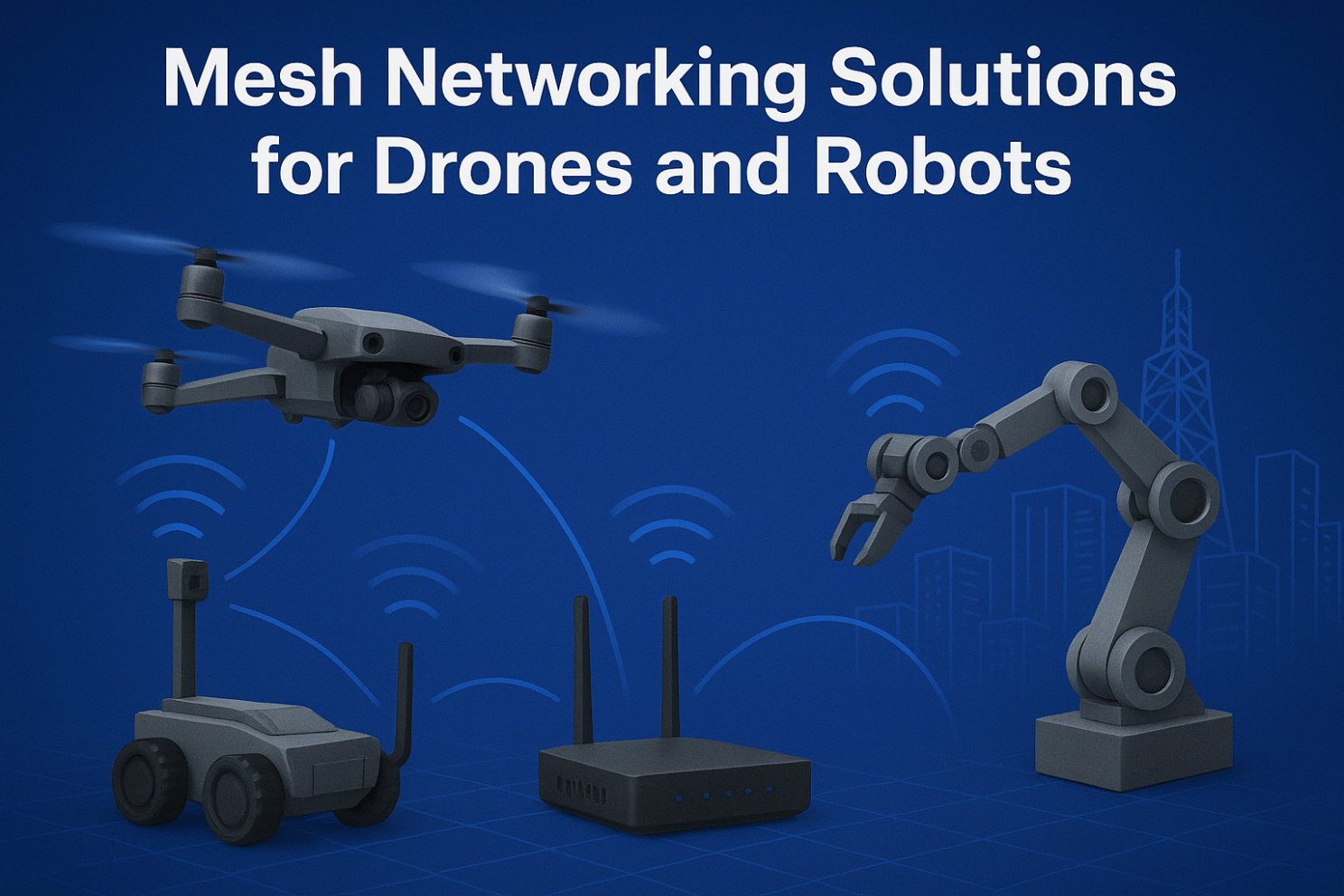
Mesh Networking Solutions for Drones and Robots

Mesh Networking Solutions for Drones and Robots

1. Introduction: Why Mesh for Drones and Robots?

Traditional wireless setups (AP + client) often fail in dynamic, mobile, and large-scale environments. Drones and robots require:

  • Low-latency links for real-time control
  • Resilient communication when nodes move or fail
  • Flexible scalability for adding new devices instantly

This is where Mesh networking shines — offering self-healing, self-configuring, and adaptive connectivity.


2. Mesh Networking for Drones

  • Formation Flying & Swarm Operations Drones in formation need constant synchronization of GPS, sensor, and video feeds. Mesh ensures each drone acts as a node, maintaining real-time links.
  • Emergency Response & Disaster Recovery In areas without cellular coverage, drones can instantly deploy a Mesh network, relaying data back to the command center for faster rescue operations.
  • Beyond Line-of-Sight Missions Mesh allows drones to extend their communication range via relays, enabling operators to control them far beyond visual range.

3. Mesh Networking for Robots

  • Smart Warehouses & Industrial Automation Robots need to stay connected across large spaces with moving inventory. Mesh avoids single-point AP failures and supports seamless roaming.
  • Security & Patrol Robots Continuous connectivity is essential for live video streaming and real-time threat detection. Mesh keeps robots online without service drops.
  • Collaborative Swarm Robots Multiple robots can share sensory data, distribute tasks, and adapt dynamically using Mesh as their backbone.

4. Key Technical Aspects of Drone & Robot Mesh

  • Dynamic Routing Protocols (OLSR, B.A.T.M.A.N, HWMP) ensure optimal paths in mobile networks.
  • Frequency Bands:
  • 2.4 GHz for longer range
  • 5 GHz / 6 GHz for high throughput
  • Wi-Fi 6/7 with MLO for ultra-stable multi-link performance
  • Security: WPA3, AES encryption, and private protocols protect mission-critical data.
  • Low Latency Optimization: Necessary for navigation and collision avoidance in autonomous systems.

5. Real-World Use Cases

  • Drone Relay Networks for Search & Rescue
  • Mesh-Enabled Warehouse Robots for Amazon-like Logistics
  • Hybrid Mesh + 5G Networks for Smart City Patrols

6. Future Trends

  • Wi-Fi 7 with Multi-Link Operation (MLO): Brings reliability and speed to swarms of robots and drones.
  • Integration with 6G & Edge AI: Mesh networks will work hand-in-hand with edge computing for local decision-making.
  • Larger-Scale Autonomous Systems: From 5 drones to 500 robots, Mesh will scale efficiently.

Mesh networking is transforming how drones and robots communicate in real time. Whether for industrial automation, emergency missions, or smart city deployments, Mesh provides the backbone for reliability and scalability.

👉 At 524WiFi and Wallys, we design industrial-grade router boards and network cards (IPQ5018, IPQ9574, QCN9074, etc.) that support advanced Mesh networking. Our hardware enables drone and robotics developers to build custom, robust, and scalable Mesh solutions.

Article content
Posted on

IPQ4019 IPQ4029 Mesh Networking Setup: DR4019 Router Boards in Action

Learn how to set up and test a robust mesh network using three Wallystech DR4019 router boards. Watch as we:

Upgrade firmware with Wallys OpenWrt Mesh. Configure unique IPs for seamless communication.

Test network resilience, proving reliable data transmission even during power disruptions.

Perfect for smart cities, IoT, and industrial applications!

You can also read previous article How to Upgrade DR4019 with OpenWrt 23.05 – Simple Steps! Enjoy.

Posted on

IPQ5018 Chipset-Powered DR5018S: A Tri-Band Network Device with GPS and CE/UKCA/FCC Certifications

IPQ 5018 DR5018S: A Powerful Network Device with 2.4G, 5G, and 6G Support, CE-UKCA-FCC Certifications

The router board DR5018S is an innovative network device based on Qualcomm’s IPQ5018 SOC chipset, designed to meet the high demands of various commercial and industrial applications. With its powerful performance and multifunctional configuration, it stands out as one of the leading Wi-Fi 6 solutions in the industry. Below, we provide a detailed analysis of the DR5018S’s features and advantages, offering a comprehensive understanding of this exceptional device.

Core Hardware: IPQ5018 SOC Chipset

The DR5018S is powered by Qualcomm’s IPQ5018 chipset, a leader in Wi-Fi 6 technology. This chipset delivers higher transmission speeds, lower latency, and more stable connections, excelling at handling multi-device connections and high-bandwidth demands. It is ideal for both commercial and industrial environments, managing a large number of simultaneous device connections while maintaining network stability and performance.

Multi-Band Support: 2.4G, 5G, and 6G

A standout feature of the DR5018S is its support for three frequency bands: 2.4GHz, 5GHz, and 6GHz. This tri-band support provides a flexible network solution for various application scenarios. In crowded Wi-Fi environments, selecting the right frequency band helps avoid interference, ensuring faster speeds and higher stability.

  • 2.4GHz: Ideal for wider coverage, though with lower speeds. Best for devices with low bandwidth needs.
  • 5GHz: Offers higher speeds, making it suitable for modern devices requiring higher bandwidth and low latency.
  • 6GHz: As part of Wi-Fi 6E, 6GHz offers clearer channels with less interference, perfect for high-density environments and bandwidth-intensive applications.

This tri-band support allows the DR5018S to deliver outstanding performance, addressing different connection needs across various environments.

Available Versions for Customization

The DR5018S is available in multiple versions to meet your specific project needs:

  1. DR5018S-5G:Supports 5G;1G Ethernet & POE;No GPS
  2. DR5018S:2.4GHz, 5GHz, 6GHz support;2.5G + 1G Ethernet & POE;Includes GPS
  3. DR5018-DB:2.4GHz, 5GHz support;1G Ethernet & POE;No GPS

GPS Functionality

The DR5018S is equipped with built-in GPS functionality, making it ideal for applications requiring precise location tracking. This feature is especially useful in asset management, fleet tracking, and location-based services. Whether in smart transportation, logistics, or other industries that require accurate positioning, the DR5018S provides robust support.

Global Certifications: CE, UKCA, FCC

The DR5018S holds multiple global certifications, including CE (European Union), UKCA (United Kingdom), and FCC (United States), ensuring compliance with regulatory standards across major international markets. These certifications guarantee that the DR5018S meets high-performance and safety standards, allowing seamless use across regions without legal or regulatory issues.

  • CE Certification: Complies with health, safety, and environmental standards for the European market.
  • UKCA Certification: Meets UK market requirements, ensuring smooth access to the UK market.
  • FCC Certification: Ensures compliance with wireless communication requirements in the U.S., preventing excessive wireless interference.

These certifications are essential for the sale and use of electronic products globally, allowing the DR5018S to be easily promoted and deployed in international markets.

Comprehensive Advantages

  • Powerful Processing Capability: The IPQ5018 chipset offers strong network processing, handling high volumes of device connections with ease.
  • Tri-Band Support: Supports 2.4GHz, 5GHz, and 6GHz frequency bands for flexible and efficient network services.
  • Built-In GPS Functionality: Strong support for location-based applications, expanding use cases.
  • Global Certifications: With CE, UKCA, and FCC certifications, the DR5018S meets regulatory requirements for global markets.
  • Stability and Compatibility: Wi-Fi 6 technology ensures excellent performance in high-density environments, offering greater adaptability.

Conclusion

The DR5018S is a highly integrated, high-performance network device that combines Wi-Fi 6 technology, tri-band support, built-in GPS functionality, and global certifications, making it suitable for a wide range of applications. Whether for commercial offices, industrial networks, or smart device applications requiring precise location tracking, the DR5018S ensures stable, reliable network connections and accurate positioning services. With its global certifications, it can be deployed confidently across international markets, expanding your business reach.

The DR5018S is not just a technologically advanced product; it’s a standout solution in the global network connectivity space.

Posted on

IPQ6010 IPQ6018 Router Board with 1GbE + 2.5GbE Support: A High-Performance WiFi 6 Solution

IPQ6010 IPQ6018 Router Board with 1GbE + 2.5GbE Support: A High-Performance WiFi 6 Solution

With the growing demand for high-speed wireless connectivity in industrial and enterprise applications, the IPQ6010 IPQ6018 Router Board stands out as a powerful WiFi 6 solution. Designed with 1GbE + 2.5GbE ports, this board provides ultra-fast data transfer rates, making it ideal for networking, IoT, and AI applications.

Key Features of IPQ6010 IPQ6018 Router Board

  1. Qualcomm IPQ6010 IPQ6018 SoC – A high-performance WiFi 6 (802.11ax) processor.
  2. Dual Ethernet Ports – Supports 1GbE and 2.5GbE, allowing for high-speed wired connections.
  3. Dual-Band WiFi 6 Support – Operates on 2.4GHz and 5GHz bands, offering improved coverage and speed.
  4. MU-MIMO & OFDMA – Enhances network efficiency in high-density environments.
  5. OpenWRT & SDK Support – Enables developers to customize firmware and optimize performance.

Why 2.5GbE Matters for Modern Networking

Traditional 1GbE Ethernet has been the industry standard for years, but with the increasing demand for higher bandwidth, 2.5GbE is becoming a must-have feature for:

  • High-speed data centers
  • Cloud applications & AI workloads
  • 4K/8K video streaming
  • IoT and smart city networks

By integrating a 2.5GbE port, the IPQ6010 IPQ6018 router board ensures future-proof networking, providing faster wired connectivity without requiring expensive infrastructure upgrades.

Ideal Use Cases for the IPQ6010 IPQ6018 Router Board

  1. Enterprise WiFi 6 Networks – Supports high-speed internet for offices and commercial buildings.
  2. Industrial IoT (IIoT) Applications – Reliable connectivity for manufacturing and automation.
  3. Smart Cities & Surveillance Systems – Handles real-time video streaming and AI-powered analytics.
  4. Mesh Networking & Wireless ISP – Ideal for large-scale deployments.
with SFP version

Conclusion

The IPQ6010 IPQ6018 Router Board with 1GbE + 2.5GbE support is a game-changer in WiFi 6 networking. Whether you are building next-gen enterprise solutions, upgrading industrial networks, or deploying high-performance IoT applications, this router board delivers exceptional speed, reliability, and flexibility.

DR6018