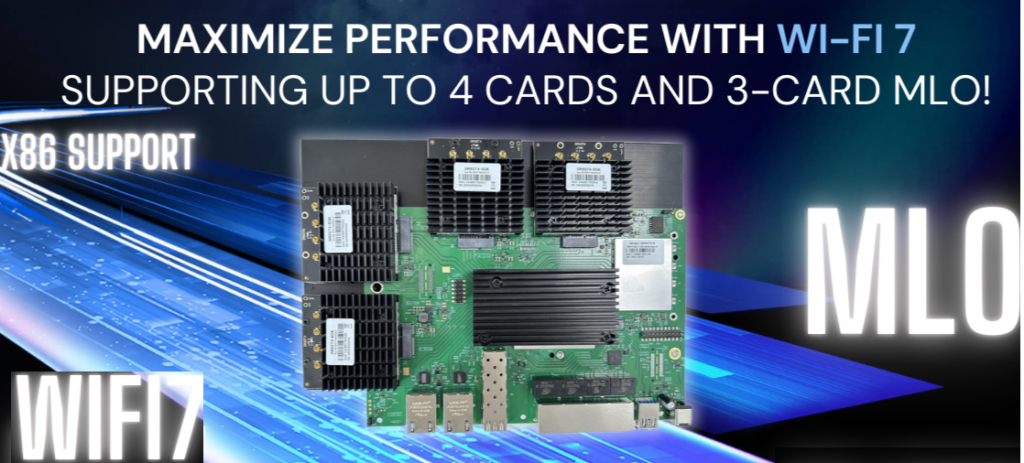
As industrial and enterprise wireless demand skyrockets, the need for extreme throughput, multi-link flexibility, and custom firmware capabilities has never been more critical. At the heart of this new era? Qualcomm’s flagship WiFi 7 combo: QCN9274 + IPQ9574.
But what if you could get WiFi 7 performance in a more compact, power-efficient design?
Introducing a sneak peek at the upcoming IPQ5424 — Qualcomm’s Quad-Core ARM Cortex-A55 SoC, clocked at 1.8GHz, and part of the Marina series. Wallys is actively prototyping boards based on this chip.
⚡ QCN9274 (DR9274): The WiFi 7 Gold Standard
Qualcomm WiFi 7 radio (successor to QCN9074)
4096-QAM, 320 MHz channels
4×4 MU-MIMO support
Ultra-fast 5/6GHz performance
Multi-Link Operation (MLO) ready
WPA3, DFS, and industrial-grade reliability
Paired with boards like the Wallys DR9574, it’s ideal for future-proof enterprise APs, smart logistics, and ultra-reliable long-range bridges.
🧠 IPQ9574: The Brains Behind Next-Gen Routing
High-performance quad-core ARM architecture
Native support for QCN9274 in tri-band setups
Integrated WiFi 6 radio for unified design
Designed for OpenWrt/QSDK 12+
Suitable for high-end router boards like DR9574
Perfect for OEMs building advanced gateways, CPEs, or edge routers — capable of handling gigabit WiFi + backhaul + edge computing in one.
👀 On the Radar: IPQ5424
Wallys is currently prototyping new boards based on the IPQ5424 “Marina” Series — a mid-tier SoC with:
Quad-core ARM Cortex-A55 @1.8GHz
Optimized for compact, efficient WiFi 7 deployments
Ideal for SMB routers, mesh APs, edge nodes
While IPQ9574 leads the pack, IPQ5424 fills the cost-performance gap — making WiFi 7 more accessible for scaled applications.
🔧 Compatible SoCs & Modules for QCN9274/QCN9024:
IPQ9574 — WiFi 7 flagship
IPQ8072/IPQ8074 — WiFi 6 platform
IPQ6010 — Mid-range WiFi 6
IPQ4019/IPQ4029 — Entry-level WiFi 5/6 bridges
Coming soon: DR5424 (IPQ5424-based board)
Wallys modules supporting these platforms include: DR9274–6E, DR9574, DR6018, and DR8074
Introduction: The Next Era of Enterprise Wireless Connectivity
The rapid evolution of Wi-Fi 7 (IEEE 802.11be) is revolutionizing enterprise networks, demanding hardware that combines cutting-edge performance with seamless integration. The 524WiFi DR9274 PCIe Wireless Card, powered by Qualcomm QCN9274/QCN6274 chips, emerges as a game-changer. Designed for x86 architecture and fully compatible with Ubuntu systems, this module delivers multi-gigabit speeds, industrial-grade reliability, and future-proof scalability — ideal for high-stakes environments like smart factories, dense office networks, and mission-critical IoT deployments.
5 Key Advantages of 524WiFi DR9274 Wi-Fi 7 Modules
1. x86 & Ubuntu Compatibility: Unleash Developer Flexibility
Native x86 Support: Seamlessly integrates with Intel/AMD-based servers, industrial PCs, and edge gateways, eliminating driver conflicts.
Ubuntu 22.04 LTS Optimization: Pre-certified drivers and SDKs enable rapid deployment on Linux environments, with full access to OpenWRT/OpenWiFi for custom network policies.
Use Case: Deploy as a software-defined access point (SDAP) or cloud-managed wireless controller on existing x86 infrastructure.
Wireless Backhaul: Replace fiber with 6GHz point-to-point links for 5G small cell aggregation.
Public Wi-Fi 7 Hotspots: Deploy in airports or malls with captive portals and AI-driven traffic shaping.
4. Defense & Mission-Critical Systems
Tactical Mesh Networks: Build self-healing wireless grids using MLO and 4K QAM.
Drone Command Centers: Stream 360° LiDAR data via 320MHz channels.
Conclusion: Future-Proof Your Wireless Infrastructure Today
The DR9274 Wi-Fi 7 PCIe Card transcends traditional wireless limitations by merging Qualcomm’s silicon excellence, x86/Ubuntu adaptability, and industrial resilience. Whether upgrading enterprise networks, automating factories, or building smart city backbones, this module delivers unparalleled speed, reliability, and control.
How 524WiFi’ WiFi 6/7 Modules Adapt to Different Robotic Applications
Robots are transforming industries, from manufacturing and logistics to agriculture. However, each type of robot—industrial, warehouse, and agricultural—operates in unique environments with distinct wireless connectivity requirements. Reliable, high-speed communication is critical for real-time control, data transmission, and seamless automation. 524WiFi’ WiFi 6/7 modules, such as the DR9074 and DR9574, are designed to meet these varying demands, ensuring optimal performance in different robotic applications.
Industrial Robots: Low Latency and High Reliability
Industrial robots work in highly automated factories, assembling products with precision. These environments require ultra-low latency and high-reliability wireless connections to support real-time data exchange between robots and control systems. 524WiFi’ WiFi 6/7 modules offer:
Multi-Link Operation (MLO): Reducing latency by transmitting data over multiple channels simultaneously.
MU-MIMO and OFDMA: Enhancing efficiency in high-density environments with multiple robots operating simultaneously.
Advanced Security Features: Protecting sensitive manufacturing data from cyber threats.
Warehouse Robots: Seamless Roaming and Scalability
Autonomous Mobile Robots (AMRs) and Automated Guided Vehicles (AGVs) in warehouses require stable connections as they move between access points. The DR9074 and DR9574 ensure:
Fast Roaming Support: Minimizing disruptions when transitioning between WiFi coverage zones.
High Throughput & Low Power Consumption: Maintaining efficiency for long operational hours.
Interference Mitigation: Ensuring smooth operation in environments with multiple wireless networks.
Agricultural Robots: Long-Range Connectivity and Rugged Performance
Drones and autonomous farming machines operate in vast, open fields with limited infrastructure. Wireless modules for these applications must provide long-range coverage and withstand harsh outdoor conditions. 524WiFi’ solutions offer:
Extended Coverage with Beamforming: Enhancing signal strength over long distances.
Rugged Design for Extreme Conditions: Operating reliably in dust, humidity, and temperature variations.
Low-Latency Video Streaming: Enabling real-time monitoring of crops and livestock.
Conclusion
From precise industrial automation to large-scale warehouse logistics and autonomous farming, different robotic applications demand tailored wireless solutions. 524′ WiFi 6/7 modules, including the DR9074 and DR9574, provide the speed, stability, and security needed to meet these challenges. As robotics continue to evolve, robust wireless connectivity will be key to unlocking their full potential.
Want to optimize your robotic applications with cutting-edge WiFi technology? Contact us today to learn more about our solutions!
With the rapid adoption of Wi-Fi 7, businesses and industrial applications require high-performance, multi-band networking platforms that deliver exceptional speed, low latency, and robust connectivity. The IPQ5322 + QCN9274 + QCN6274 solution is a powerful 10-stream Wi-Fi 7 networking platform, designed for next-generation routers, enterprise APs, and industrial wireless deployments.
Key Features of IPQ5322 + QCN9274 + QCN6274 Wi-Fi 7 Platform
🔹 Tri-Band Wi-Fi 7 with 10-Stream Configuration
IPQ5322: Dual-core networking SoC for high-speed processing
QCN9274 (5GHz 4×4 MIMO): High-performance Wi-Fi 7 radio
QCN6274 (6GHz 4×4 MIMO): Optimized for the new 6GHz band
Combines multiple frequency bands for lower latency
Supports 320MHz ultra-wide channels for faster throughput
🔹 High-Speed Connectivity & Low Latency
10Gbps+ total throughput, ideal for industrial networking
Reduced interference & congestion with 6GHz band support
🔹 Optimized for Enterprise & Industrial Wi-Fi Applications
Supports large-scale wireless deployments
Enhanced performance in smart factories, warehouses, and IoT networks
Why Choose IPQ5322 + QCN9274 + QCN6274 for Wi-Fi 7?
🚀 Superior Wi-Fi 7 Performance: Supports 10 streams for ultra-fast, low-latency wireless connectivity.
🔗 Enhanced MLO & MU-MIMO: Ensures seamless multi-device communication with high efficiency.
🏭 Industrial-Grade Reliability: Ideal for smart cities, industrial automation, and enterprise networking.
🛠 Customizable & Scalable: Flexible OEM/ODM options for tailored solutions.
Get Started with 524WiFi Wi-Fi 7 Solutions
524WiFi and Wallys provide a full range of Wi-Fi 7 networking platforms, including IPQ5322-based solutions with QCN9274 and QCN6274 modules. Whether you’re developing enterprise APs, industrial routers, or high-performance wireless systems, our custom hardware and software solutions can help accelerate your project.
Maximizing Wireless Performance with the Qualcomm IPQ9574: A Wi-Fi 7 Powerhouse
In today’s fast-paced digital world, industries are increasingly relying on advanced wireless technologies to support high-speed data transfer and seamless connectivity. The Qualcomm IPQ9574, a cutting-edge chipset powering the DR9574 router board, is revolutionizing wireless communication by supporting Wi-Fi 7 and offering industry-leading performance for demanding applications. This article delves into the key features and specifications of the IPQ9574 and DR9574, highlighting how they are shaping the future of wireless networking.
Why the Qualcomm IPQ9574 is a Game-Changer for Wi-Fi 7 Networks
The IPQ9574 chipset is at the heart of the DR9574, delivering unmatched wireless capabilities. It supports up to 4 Wi-Fi 7 cards, allowing flexibility for a variety of MLO (Multi-Link Operation) configurations, including compatibility with any 3-card MLO setup. This level of flexibility and performance ensures that industries can scale their networks to meet the growing demand for high-speed wireless communication.
Key Features of the IPQ9574-Based DR9574
Advanced Quad-Core ARM Processor: The IPQ9574 chipset is powered by a Quad-Core ARM-A73 processor running at 2.2GHz. This ensures high-speed processing for data-intensive tasks and complex networking functions.
Support for Wi-Fi 7: The IPQ9574 is designed to support the latest Wi-Fi 7 technology, providing faster speeds, better efficiency, and higher network capacity compared to its predecessors.
Multiple M.2 E Key Interfaces: The DR9574 offers 4 M.2 E Key interfaces with PCIe 3.0, enabling support for up to four Wi-Fi 7 cards. This flexibility is crucial for environments that require high-performance networking.
Excellent Power Efficiency: The board consumes 13W without the onboard Wi-Fi and up to 23W with Wi-Fi integrated, striking a balance between power efficiency and high-performance operation.
Broad Operating Range: With operating temperatures between -20°C to 70°C and storage temperatures from -40°C to 90°C, the DR9574 is built to endure harsh industrial environments.
Optimized for High-Speed Data: The 2.4GHz band supports 802.11b/g/n/ax standards, with data rates reaching 24dBm per chain, ensuring robust and fast wireless connections.
Key Hardware Specifications of the DR9574 Router Board
Power Consumption13W (Board only), 23W (with onboard Wi-Fi)
Temperature RangeOperating: -20°C to 70°C, Storage: -40°C to 90°C
Applications of the DR9574 in Industry
With its robust feature set and Wi-Fi 7 capabilities, the DR9574 is perfect for a variety of industries, including:
Smart Cities: The ability to support multiple Wi-Fi 7 cards and MLO configurations makes it ideal for managing the wireless backbone of smart cities, where high-speed and reliable communication are essential.
Industrial IoT (IIoT): As industrial applications increasingly rely on wireless technology for device communication, the DR9574 ensures reliable data transfer, low latency, and the ability to scale as the number of connected devices grows.
Telecommunications: The IPQ9574 chipset allows telecommunications providers to build next-generation infrastructures that offer superior performance and capacity.
Absolute Maximum Ratings for Reliable Operation
Parameter/RatingUnit
Operating Temperature-20 ~ 70ºC
Storage Temperature-40 ~ 90ºC
Operating Humidity5% ~ 95 (non-condensing)%
Storage Humidity0% ~ 90 (non-condensing)%
Conclusion: Future-Proof Your Network with IPQ9574 and DR9574
The Qualcomm IPQ9574 and DR9574 router board are poised to lead the charge in Wi-Fi 7 technology, providing businesses and industries with the high-performance, reliable, and scalable networking solutions they need. With support for multiple Wi-Fi 7 cards, MLO configurations, and the ability to operate in challenging environments, the DR9574 is an ideal choice for industries looking to upgrade their wireless networks for the future.
As Wi-Fi 7 continues to gain traction in the industry, the IPQ9574 is at the forefront of delivering the connectivity that next-gen applications demand, from industrial IoT to smart cities and beyond.
With the rapid adoption of Wi-Fi 7, businesses and industrial applications require high-performance, multi-band networking platforms that deliver exceptional speed, low latency, and robust connectivity. The IPQ5322 + QCN9274 + QCN6274 solution is a powerful 10-stream Wi-Fi 7 networking platform, designed for next-generation routers, enterprise APs, and industrial wireless deployments.
Key Features of IPQ5322 + QCN9274 + QCN6274 Wi-Fi 7 Platform
🔹 Tri-Band Wi-Fi 7 with 10-Stream Configuration
IPQ5322: Dual-core networking SoC for high-speed processing
QCN9274 (5GHz 4×4 MIMO): High-performance Wi-Fi 7 radio
QCN6274 (6GHz 4×4 MIMO): Optimized for the new 6GHz band
Combines multiple frequency bands for lower latency
Supports 320MHz ultra-wide channels for faster throughput
🔹 High-Speed Connectivity & Low Latency
10Gbps+ total throughput, ideal for industrial networking
Reduced interference & congestion with 6GHz band support
🔹 Optimized for Enterprise & Industrial Wi-Fi Applications
Supports large-scale wireless deployments
Enhanced performance in smart factories, warehouses, and IoT networks
Why Choose IPQ5322 + QCN9274 + QCN6274 for Wi-Fi 7?
🚀 Superior Wi-Fi 7 Performance: Supports 10 streams for ultra-fast, low-latency wireless connectivity.
🔗 Enhanced MLO & MU-MIMO: Ensures seamless multi-device communication with high efficiency.
🏭 Industrial-Grade Reliability: Ideal for smart cities, industrial automation, and enterprise networking.
🛠 Customizable & Scalable: Flexible OEM/ODM options for tailored solutions.
Get Started with Wallys’ Wi-Fi 7 Solutions
524WiFi provides a full range of Wi-Fi 7 networking platforms, including IPQ5322-based solutions with QCN9274 and QCN6274 modules. Whether you’re developing enterprise APs, industrial routers, or high-performance wireless systems, our custom hardware and software solutions can help accelerate your project.
Wi-Fi 7 with Multi-Link Operation (MLO) on X86 Devices: A New Era of Connectivity
As the world of wireless technology continues to evolve, the introduction of Wi-Fi 7 is nothing short of a game-changer. With its potential for significantly higher speeds, lower latency, and enhanced reliability, Wi-Fi 7 is set to revolutionize industries and applications ranging from industrial IoT to high-performance consumer devices. At Wallys, we’re always driven by customer needs, and as part of our commitment to offering cutting-edge solutions, we’re focused on expanding the possibilities for Wi-Fi 7 technology—specifically by enabling Multi-Link Operation (MLO) support on X86 platforms.
Expanding the Reach of Wi-Fi 7: A New Level of Compatibility
Last year, we introduced X86 driver support for our Wi-Fi 6 module, DR9074, which enabled seamless integration across a broader range of motherboard platforms, not just Qualcomm devices. This support empowered our customers to experience high-quality, stable Wi-Fi data transmission and opened the door for new applications that demand reliable and high-throughput wireless connections.
With the introduction of Wi-Fi 7, cross-platform compatibility becomes even more critical. Wi-Fi 7 brings with it a new set of features designed to push the boundaries of wireless connectivity, and one of the most significant is Multi-Link Operation (MLO). But to harness the full potential of MLO, we need to ensure that our solutions can operate on multiple platforms—something we’re excited to announce we’re working on with our DR9274 (QCN9274) and QCN6274 Wi-Fi 7 modules.
wifi6 vs wifi7
What is MLO? And Why Does It Matter?
Multi-Link Operation (MLO) is one of the standout features of Wi-Fi 7. MLO allows devices to transmit data across multiple frequency bands (like 2.4 GHz, 5 GHz, and 6 GHz) simultaneously. This multi-band transmission significantly improves throughput and reliability, while reducing latency and congestion, making it an ideal solution for environments that require high-speed and low-latency communication.
In simple terms, MLO will enable your devices to leverage the full bandwidth potential of Wi-Fi 7, resulting in faster speeds, more stable connections, and more efficient use of available spectrum.
Introducing the QCN9274 & QCN6274 Wi-Fi 7 Modules
To enable the full potential of MLO, we’re leveraging the power of QCN9274 and QCN6274—two of Qualcomm’s latest Wi-Fi 7 chipsets, both designed for high-performance applications.
QCN9274 (Waikiki)
QCN6274 (Waikiki)
MLO
These two powerful chipsets represent the future of Wi-Fi 7 and provide the foundation for expanding compatibility across a variety of platforms. With MLO support, both the QCN9274 and QCN6274 enable better utilization of the 2.4, 5, and 6 GHz bands, delivering faster speeds and more reliable connections.
wifi7 new features
What Will MLO Bring to Your X86 Devices?
By introducing MLO support for X86 devices, we’re pushing the envelope on what’s possible in wireless networking. Users of X86 platforms will now be able to tap into the full power of Wi-Fi 7, unlocking:
Higher Throughput: With MLO, data is split across multiple channels, leading to faster speeds and higher data rates, ideal for bandwidth-hungry applications like streaming, gaming, and industrial IoT.
Enhanced Reliability: MLO ensures that devices can maintain stable connections, even in environments with interference or congestion, by balancing traffic across different frequency bands.
Reduced Latency: Faster communication between devices can significantly reduce lag and improve the responsiveness of real-time applications, from virtual reality to autonomous systems.
The implications are significant. Wi-Fi 7, combined with MLO, could transform industries that rely on seamless, high-performance wireless connectivity—think smart cities, industrial automation, healthcare, and beyond.
At 524WiFi, we’re committed to ensuring that our solutions are as versatile and adaptable as possible. With the upcoming X86 driver support for DR9274 and MLO functionality, you’ll be able to take full advantage of Wi-Fi 7 speeds and unlock new potential for your devices.
Thoughtput testing:achieve 8Gbps+ speed
This new capability will open up new opportunities for a variety of applications, and we’re eager to see how our customers will integrate this powerful technology into their own use cases.
DR9274 wifi7 M.2 card
Are You Ready for the Future of Wireless Connectivity?
With Wi-Fi 7’s blazing-fast speeds and MLO’s game-changing capabilities, the possibilities are endless. How do you envision using Wi-Fi 7 with MLO on your X86 platforms? Whether it’s enhancing your industrial IoT devices, supporting next-gen gaming applications, or powering high-bandwidth communications, the potential is vast.
At 524WiFi, we’re excited to continue innovating and providing the tools you need to stay ahead in the rapidly evolving wireless landscape. If you’re interested in learning more about our Wi-Fi 7 solutions or how we can help with your next project, feel free to reach out to us.
How QCN9274 Supports Efficient Operation of Mesh Network Systems
With the increasing number of IoT devices and the growing demand for seamless connectivity, mesh network systems have become the preferred choice for modern homes, enterprises, and industrial networks. Qualcomm’s QCN9274 chip stands out with its high performance, low latency, and robust connectivity capabilities, providing essential support for the efficient operation of mesh networks. This article explores how QCN9274 enhances mesh networks through its key features and benefits.
1. Basics of Mesh Network Systems
Mesh networks use multiple routing nodes that connect with each other, expanding network coverage across larger areas. These nodes communicate, forming a self-healing, adaptive network that remains stable even if some nodes fail or encounter interference. This characteristic is essential in large-scale network deployments, such as smart homes, industrial parks, and office buildings.
2. Key Features of QCN9274 in Mesh Networks
The QCN9274, Qualcomm’s Wi-Fi 7 chip, has powerful network processing capabilities and advanced wireless features. Below are the core technologies and advantages QCN9274 brings to mesh network systems for efficient operation:
1. Multi-Link Operation (MLO) for Reliable Connectivity
QCN9274 supports Multi-Link Operation (MLO) technology in Wi-Fi 7, allowing mesh nodes to communicate over multiple bands, such as 6GHz, 5GHz, and 2.4GHz, simultaneously. MLO enables the network to switch dynamically to clearer frequencies when interference or congestion occurs, maintaining efficient data transmission and stable connections. This dynamic multi-link switching capability reduces latency and interruptions in the mesh network, enhancing overall efficiency.
2. Wider Channels and Advanced Modulation
The QCN9274 chip supports ultra-wide 320MHz channels and 4K QAM modulation, delivering multiple times the bandwidth and data rate compared to Wi-Fi 6 or Wi-Fi 5 standards. For mesh networks, this means multiple nodes can simultaneously transmit large volumes of data without compromising network quality or user experience. The wider channels and advanced modulation make the QCN9274 ideal for bandwidth-intensive applications such as video streaming, real-time gaming, and industrial automation.
3. MU-MIMO and OFDMA for Efficient Multi-User Connections
QCN9274 supports enhanced Multi-User Multiple-Input Multiple-Output (MU-MIMO) and Orthogonal Frequency Division Multiple Access (OFDMA) technologies, allowing mesh networks to handle multiple user devices more efficiently. MU-MIMO enables simultaneous service to multiple endpoints, while OFDMA can divide channel resources into sub-channels for flexible resource allocation. Together, these technologies enable high-quality connections for multiple devices within the mesh network, ideal for high-density device environments.
4. Low Latency and Adaptive Path Selection
Low latency is crucial for mesh networks to ensure rapid data transfer between nodes. QCN9274 features low-latency communication protocols and a powerful network processor for fast data exchange between nodes. Additionally, it has adaptive path selection, allowing real-time routing to the optimal communication path, avoiding congested areas and interference to improve data stability and speed.
5. Efficient Power Management for Long-Term Stability
Low power consumption is essential in large-scale mesh network deployments. QCN9274 integrates smart power management, maintaining high performance while minimizing power usage, allowing nodes to operate reliably for extended periods. This feature is especially valuable in industrial IoT, outdoor, and remotely managed mesh networks where devices need long-lasting and reliable functionality without frequent maintenance.
3. Real-World Applications of QCN9274 in Mesh Networks
Thanks to these technical advantages, QCN9274 excels in mesh network deployments in the following scenarios:
1. Smart Home Networks
In smart home environments with a wide range of Wi-Fi devices, such as smart speakers, cameras, and appliances, QCN9274’s MLO technology and MU-MIMO provide reliable connectivity for every room and area. Low latency and wide channel support also make streaming and video calls smoother, enhancing the user experience.
2. Enterprise and Office Networks
In enterprises, the stability and scalability of mesh networks are crucial, especially in open office spaces and meeting rooms with multiple users. QCN9274’s OFDMA and MU-MIMO capabilities ensure that multiple employees and devices connect seamlessly to the network, even during peak usage, maintaining efficient network performance for video conferencing, file sharing, and cloud storage applications.
3. Industrial IoT and Remote Monitoring
In industrial settings, mesh networks often need to cover large areas and support a high number of low-power, long-connected devices. QCN9274’s low power design and adaptive path selection allow industrial IoT devices to run reliably over long periods. MLO’s multi-link functionality ensures stable connections even in remote monitoring and data collection scenarios, where part of the mesh may encounter interference.
4. 524WiFi DR9274 Wi-Fi 7 Network Card
The 524WiFi and Wallys DR9274 network card, based on Qualcomm’s QCN9274 chip, is specifically designed for high-performance mesh networks. Supporting Wi-Fi 7 standards, it features a 320MHz ultra-wide channel and 4×4 MIMO configuration focused on the 6GHz single band. With its M.2 slot and compact design, it’s easily integrated into various devices, delivering exceptional network performance for smart homes, enterprise offices, and industrial IoT.
5. Conclusion
Qualcomm’s QCN9274 chip, with its support for Multi-Link Operation, wide channel capabilities, MU-MIMO, OFDMA, and low latency, provides strong support for efficient mesh network systems. These technologies ensure that mesh networks maintain stable performance and rapid response times even in complex network environments and with high device connection demands.
By incorporating the QCN9274, enterprises and users can experience a more stable, faster, and reliable mesh network, meeting current network needs and laying the groundwork for future expansion.
How Does 320MHz Bandwidth in the 6GHz Band Improve Data Transfer Speeds Compared to Previous WiFi Generations?
The world of wireless technology is rapidly evolving, and with the introduction of WiFi 7, we are entering a new era of high-speed, low-latency wireless connectivity. One of the standout features of WiFi 7, also known as 802.11be, is its support for a 320MHz channel width in the 6GHz band, doubling the 160MHz width available in WiFi 6E. This significant increase in bandwidth directly translates into faster data transfer rates and improved network performance. In this article, we will explore how this enhanced bandwidth in the 6GHz band boosts speeds and why WallysTech’s DR9274-6G module, equipped with Qualcomm’s latest QCN9274 and QCN6274 chips, is perfectly suited to take advantage of this technology.
Technical Features of the DR9274-6G
The DR9274-6G is a high-performance wireless network card designed for modern high-bandwidth, low-latency applications. It is fully compatible with the latest WiFi 7 (802.11be) standard, which offers substantial improvements over previous WiFi generations, particularly when it comes to speed and reliability.
1. WiFi 7 Standard Support
WiFi 7 offers several key advancements over its predecessor, WiFi 6E:
Higher Bandwidth Support: The channel width in WiFi 7 is increased to 320MHz, doubling the capacity from WiFi 6E’s 160MHz. This expanded bandwidth enables faster data transfer rates by allowing more data to be transmitted at once.
Multi-Link Operation (MLO): WiFi 7 introduces MLO technology, which aggregates multiple frequency bands into a single connection. This improves both bandwidth and connection reliability.
Enhanced 4K QAM: WiFi 7 supports 4096-QAM (Quadrature Amplitude Modulation), significantly increasing the efficiency of data transmission compared to the 1024-QAM used in WiFi 6E. This leads to better data throughput, especially in high-demand environments.
2. Cutting-Edge Chipset
The DR9274-6G uses Qualcomm’s QCN9274 and QCN6274 chips, which offer several advanced features:
4×4 MU-MIMO: This technology improves the module’s ability to handle multiple devices simultaneously, providing stable connections even in high-density environments.
Efficient Signal Processing: These chips feature advanced signal processing capabilities, reducing latency and ensuring stable connections in challenging conditions.
Power Efficiency: The DR9274-6G is designed for low power consumption, making it ideal for long-term deployments in industrial, IoT, and smart city applications.
3. Modular Design and Interfaces
The DR9274-6G is designed with flexibility in mind. It features an M.2 connector and supports PCI Express 3.0, making it easy to integrate into a wide range of devices. It also offers a choice of UFL or MMCX antenna interfaces, providing options for customization based on the application.
DR9274-6E 4X4 QCN9074 QCN9024 WIFI7
Application Scenarios
The DR9274-6G is well-suited for various use cases across different sectors. Its high bandwidth and low latency make it ideal for demanding applications:
Home and Business Networks: In homes, this network card offers ultra-fast wireless connections, supporting bandwidth-heavy activities like 4K/8K video streaming and online gaming. In business environments, it ensures stable and fast connections for numerous devices, making it ideal for high-density deployments such as conference rooms or large offices.
Industrial Internet of Things (IIoT): Industrial applications demand reliable, low-latency connectivity, and the DR9274-6G delivers just that, making it perfect for complex networking needs in IIoT environments.
Smart Cities and Public Spaces: Public WiFi hotspots and smart city deployments require support for many concurrent devices. The DR9274-6G, with its multi-band support and MU-MIMO technology, ensures stable connections even in high-traffic areas like public transportation hubs and city centers.
DR9274-6G
Advantages of WiFi 7
The leap from WiFi 6E to WiFi 7 brings numerous benefits to both individual users and large-scale network deployments:
Greater Channel Bandwidth (320 MHz): With double the bandwidth of WiFi 6E, WiFi 7 enables significantly faster data transfer rates, improving overall network performance.
Multi-Link Operation (MLO): This feature allows WiFi 7 devices to use multiple frequency bands for data transmission, which enhances both speed and connection stability.
Enhanced QAM (4096-QAM): The higher modulation density in WiFi 7 means better data efficiency, leading to faster, more reliable wireless communication.
Why 524WiFi’s DR9274-6G?
DR9274-6G wireless network card is at the forefront of WiFi 7 technology. Based on Qualcomm’s powerful QCN9274 and QCN6274 chips, this module fully supports the latest WiFi 7 standard, offering significant advantages in terms of bandwidth, latency, and device connectivity. Whether deployed in homes, businesses, industrial environments, or public spaces, the DR9274-6G ensures robust and stable network performance.
As WiFi 7 continues to gain traction and become the new standard in wireless communication, the DR9274-6G is poised to play a pivotal role in high-performance network deployments.
How to Choose the Right WiFi 7 Solution: An In-Depth Look at IPQ5332, QCN9274, and QCN6274 Chips
As wireless technology continues to advance, WiFi 7 is becoming a key driver for industrial and commercial applications. The IPQ5332, QCN9274, and QCN6274 chips, newly released by Qualcomm, offer high performance and a wide range of applications. However, with these options, users may face challenges in selecting the most suitable solution for their specific needs. In this article, we will explore the features and application scenarios of these chips, helping you make an informed decision.
1. IPQ5332: The Top WiFi 7 SoC for High-Density Environments
The IPQ5332 is a high-performance WiFi 7 SoC designed by Qualcomm to support multi-band, high bandwidth, and low latency applications. This chip integrates multi-core CPUs, acceleration engines, and advanced network processing capabilities, making it ideal for handling complex network demands in high-density user scenarios.
Needs: Users are looking for a SoC that can operate stably in high-density environments while supporting the latest WiFi 7 technology.
Challenges:How to ensure IPQ5332’s stability in high-interference environments?Are there ready-made development boards or modules available for rapid prototyping?How to achieve compatibility between the IPQ5332 and existing network devices?
Solutions
Performance Testing and Case Studies: We provide performance test data for the IPQ5332 in various environments, showcasing its superior performance in high-density and long-distance transmission scenarios.
Development Resources: Wallys offers development boards and modules based on the IPQ5332, complete with technical documentation and development support to help you quickly start your project.
2. QCN9274: The Ideal RF Solution for Multi-Band Wireless Communication
The QCN9274 is a multi-band RF chip that supports wideband, high-speed wireless communication, making it particularly suitable for demanding wireless transmission scenarios. Whether for industrial automation or large-scale enterprise wireless networks, the QCN9274 provides stable RF performance and low power consumption.
Learn more about the DR9274(QCN9274 RF chip) here.
User Needs and Challenges
Needs: Users are seeking an RF chip that can deliver optimal performance in multi-band, multi-user scenarios.
Challenges:How does the QCN9274 perform in complex environments?How to ensure seamless integration between the QCN9274 and the IPQ5332?Are there ready-made drivers or firmware available for custom development?
Solutions
Optimization Strategies: We demonstrate how the QCN9274 maintains stable connections in high-density, high-interference environments and provide the best combination solution with the IPQ5332.
Technical Support: We offer comprehensive driver and firmware support to ensure your development project runs smoothly.
3. QCN6274: The Low-Power Choice for IoT and Smart Home Applications
The QCN6274 is a low-power, high-performance RF chip designed specifically for IoT and smart home applications. This chip not only excels in transmission efficiency but also has extremely low power consumption, making it ideal for battery-powered devices.
User Needs and Challenges
Needs: Users need a low-power RF chip that can provide stable wireless connections in long-term operational environments.
Challenges:How effective is the QCN6274’s signal penetration?How to maintain signal stability while extending battery life?Does it support rapid integration into existing IoT solutions?
Solutions
Power Optimization: Through precise power management and optimization strategies, the QCN6274 can maintain stable wireless connections in long-running devices while extending battery life.
Integration Support: We provide detailed technical documentation and reference designs to help you quickly integrate the QCN6274 into your existing IoT and smart home devices.
4. How to Choose the Right WiFi 7 Chip Solution for You
The IPQ5332, QCN9274, and QCN6274 each have unique advantages, making them suitable for different application scenarios. Whether you are looking for a high-performance WiFi 7 SoC, a multi-band RF chip, or a low-power IoT solution, 524WiFi can provide you with the most appropriate hardware support and technical services.
Actionable Recommendations:
Learn More: Visit our product pages to learn more about the IPQ5332, and here for the QCN9274.
Contact Our Sales Team: If you have any technical questions or need a custom solution, feel free to reach out to our sales team at info at 524wifi.com and we will provide you with the best support.
By choosing the right chip, you can ensure that your project achieves optimal performance, stability, and power efficiency, helping you quickly reach your business goals.