Industrial-Grade WiFi Solutions: IPQ6010 with QCN9074 vs IPQ5332 with QCN9274
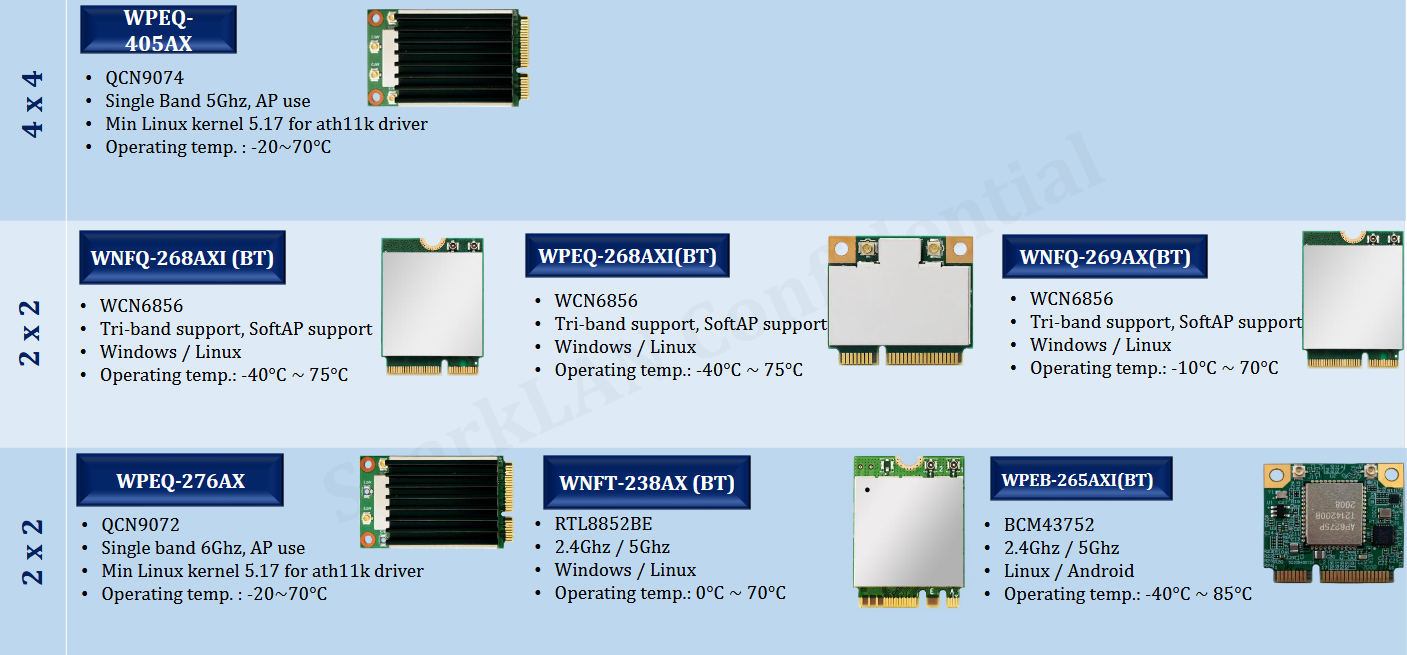
In industrial-grade applications, reliable and high-performance wireless solutions are critical. Here we compare two advanced options tailored for such demanding environments: the IPQ6010 with QCN9074 and the IPQ5332 with QCN9274. These solutions are designed to meet the rigorous standards of industrial settings, providing robust connectivity and performance.
IPQ6010 with QCN9074
The IPQ6010 chipset paired with the QCN9074 is a powerful WiFi 6E solution suitable for industrial applications. It supports enhanced network capacity and efficiency, making it ideal for environments that demand high performance and reliability.
Key Features:
Chipset: Qualcomm IPQ6010
Wireless Standard: WiFi 6E (802.11ax)
Wireless Configuration: 4×4 MIMO
Bands Supported: 2.4GHz, 5GHz, 6GHz
Ethernet Ports:Multiple 1Gbps and 2.5Gbps portsSFP interfaces for fiber connections
OFDMA Support: Yes
MU-MIMO Support: Yes
Power Options: Flexible POE support, DC power
Memory & Storage: Up to 512MB DDR, various Flash options
Advantages for Industrial Applications:
Robust Performance: Enhanced wireless performance with support for the 6GHz band.
Versatile Connectivity: Multiple Ethernet ports and SFP interfaces for diverse networking needs.
Backward Compatibility: Supports legacy WiFi standards for seamless integration.
Enhanced Efficiency: OFDMA and MU-MIMO support ensure efficient network traffic management.
IPQ5332 with QCN9274
The IPQ5332 chipset paired with the QCN9274 is a next-generation WiFi 7 solution designed for industrial-grade applications that require ultra-high-speed network connections with low latency. This setup is future-proof, ensuring top-notch performance for years to come.
Key Features:
Chipset: Qualcomm IPQ5332
Wireless Standard: WiFi 7 (802.11be)
Wireless Configuration:2×2 2.4GHz MIMO4x4 5GHz MIMO4x4 6GHz MIMO
Bands Supported: 2.4GHz, 5GHz, 6GHz
Ethernet Ports:Multiple 2.5Gbps ports10Gbps SFP interfaces for high-speed fiber connections
Future-Proof Technology: Cutting-edge WiFi 7 performance with high bandwidth and low latency.
High Capacity: Advanced MIMO configurations for efficient handling of multiple simultaneous connections.
Ultra-High-Speed Connectivity: Supports up to 10Gbps Ethernet and SFP interfaces for fiber optic connections.
Scalable and Reliable: Designed to meet the rigorous demands of industrial environments with scalable network options.
Comparative Table
Recommendation for Industrial-Grade Applications
For WiFi 6E Triband Solution: The IPQ6010 with QCN9074 is highly recommended. It provides robust performance and supports the new 6GHz band, making it ideal for industrial applications requiring enhanced capacity and efficiency.
For WiFi 7 Triband Solution: The IPQ5332 with QCN9274 is the best choice. It offers cutting-edge performance with high bandwidth and low latency, ensuring it meets the demands of high-performance industrial applications and is future-proof for upcoming wireless technology needs.
In the ever-evolving realm of wireless technology, the introduction of the 6 GHz band marks a significant milestone, promising a new era of enhanced connectivity and unlocking the potential for transformative advancements in various applications. This newly available frequency range, spanning between 5.925 GHz and 7.125 GHz, offers a plethora of benefits that far exceed those of its predecessors, the 2.4 GHz and 5 GHz bands. The addition of 6GHz into WiFi is poised to revolutionise wireless connectivity.
A Bandwidth Bonanza for Unfettered Data Flow
In today’s digital age, where data-intensive applications and high-resolution content reign supreme, the demand for bandwidth has skyrocketed. The 2.4 GHz and 5 GHz bands, the traditional workhorses of wireless connectivity, have struggled to keep pace with this ever-increasing demand, leading to frustrating congestion and sluggish performance.
At the heart of the 6 GHz band’s allure lies its expansive bandwidth, more than doubling the capacity of the 5 GHz band. This substantial increase in spectrum translates into significantly faster data speeds, enabling users to enjoy seamless video streaming in stunning 4K and 8K resolutions without encountering buffering or lag. Large file transfers can be completed in a fraction of the time, enabling efficient collaboration and data sharing. And immersive virtual reality experiences can be enjoyed without the hindrance of latency or choppy graphics.
Latency Triumphs over Distance: Real-time Applications Thrive
In the realm of real-time applications, where immediacy is paramount, latency, the time it takes for data to travel between devices, emerges as a critical factor. For applications like video conferencing, online gaming, and remote device control, even the slightest latency can lead to noticeable delays, glitches, and an overall diminished experience.
The 6 GHz band, the latest addition to the wireless spectrum, holds the key to conquering latency, offering a significant reduction in lag compared to its predecessors, the 2.4 GHz and 5 GHz bands. This latency reduction stems from several factors:
Wider Channels: The 6 GHz band supports wider data channels, allowing for more data to be transmitted in a single go, reducing the number of round trips required for data transfer.
Less Congestion: The 6 GHz band is less crowded than the 2.4 GHz and 5 GHz bands, minimising interference and ensuring that data packets reach their destination with minimal delays.
Enhanced Technology: The 6 GHz band utilises advanced technologies like Target Wake Time (TWT), which allows devices to negotiate sleep intervals, further reducing network overhead and improving latency.
The impact of reduced latency extends beyond consumer applications and into real-world scenarios that demand instantaneous responsiveness:
Autonomous Vehicles: The 6 GHz band is crucial for the development of autonomous vehicles, enabling real-time communication between the vehicle’s sensors, processors, and external infrastructure, ensuring safe and efficient operation.
Industrial Automation: In industrial settings, the 6 GHz band facilitates precise control of machinery and robotics, enabling seamless coordination and improved production efficiency.
Medical Robotics: Surgical robots, controlled remotely by surgeons, benefit significantly from reduced latency, ensuring accurate and life-saving procedures.
Embracing the Challenges: Navigating the Road Ahead
While the 6 GHz band presents a wealth of opportunities, it is not without its challenges. Device compatibility remains a hurdle, as not all devices currently support this new frequency range. Additionally, the 6 GHz band’s shorter range compared to its predecessors may require strategic router placement to ensure optimal coverage. Finally, regulatory approvals vary across countries, necessitating a cautious approach to deployment.
Despite these challenges, the 6 GHz band represents a significant leap forward in wireless technology, offering a combination of speed, reliability, security, and capacity that was previously unattainable. As device compatibility expands and regulatory approvals are granted, the 6 GHz band is poised to become the backbone of future wireless networks, shaping the way we work, play, and connect.
At Compex, we strive to provide the latest technology to our customers. Compex offers 6GHz WiFi solution for both WiFi 6E and WiFi 7 offering:
WLE3000H56: 4×4 wide band 5-7GHz WiFi 6E module. This is a good solution for customers who are aiming to offer their customers an option of either 5GHz or 6GHz backhaul.
WLE3000H6 (Filter version): 4×4 single band 6GHz WiFi 6E module. This filter version ensures that interference issue will not occur, when WiFi 6E module coexists with another 5GHz module. This is a perfect solution for customers who are aiming for tri-band implementation.
WLE7002E56: 2×2 dual band dual concurrent 5 + 6GHz WiFi 7 module. This is a cost effective solution for customers who need 5 + 6GHz in a single package. This is a good solution for low-cost tri-band WiFi 7 implementation.
All products mentioned above have samples readily available for your testing.
The future of connectivity is here with Compex! Wi-Fi 7 is set to revolutionize wireless connectivity with its lightning-fast speeds and seamless connectivity. The launch of Compex WLE7002E25D Wi-Fi 7 Dual-Band Dual Concurrent Module delivers enhanced wireless performance and reliability — all at Wi-Fi 6 prices!
Here’s a closer look on what you need to know about this new Wi-Fi Modules:
1. Dual- Band Dual-Concurrent Wi-Fi 7 Module
The new Compex WLE7002E25D is a Dual-Band Concurrent 2.4+5GHz WiFi 7 (802.11be) module, powered by Qualcomm’s QCN6224, QCN6274 or QCN9274 ‘Waikiki’ series radio chipsets, offering 2X2 MU-MIMO.
2. Stardard miniPCIe form factor
The new WLE7002E25D comes in a standard miniPCIe form factor. This means it is readily compatible with existing systems, particularly those devices that use Wi-Fi 4 or Wi-Fi 5 standard miniPCIe modules. This simplifies integration, reduces development costs and accelerates time-to-market.
3. Multi-Link Operation (MLO)
The new WLE7002E25D supports up to 4096 QAMs and features OFDMA and MLO. The new MLO allows devices to connect to the same access point (AP) across multiple channels and different frequency bands simultaneously, increasing throughput, lowering latency and enhancing reliability.
4. Cost-efficient diplexer design
Combines the 2.4GHz and 5GHz signals into a single dual-band antenna, reducing the need for multiple antennas and enhancing the performance and reliability of wireless devices.
5. Open Source Ath12K support
Compatible with Qualcomm and third-party platforms such as Marvell, NXP and x86 platform.
6. Enhanced wireless performance and reliability at Wi-Fi 6 prices
Ideal for enterprise, industrial, cybersecurity, transportation and SMB applications, offering enhanced wireless performance and reliability at competitive prices.
Key Takeaways for the Future
The new WLE7002E25D is an investment in the future. With its cutting-edge technology, comprehensive features and diverse application potential, it is set to redefine the standards of wireless connectivity.
The module is now available for order on our eshop.
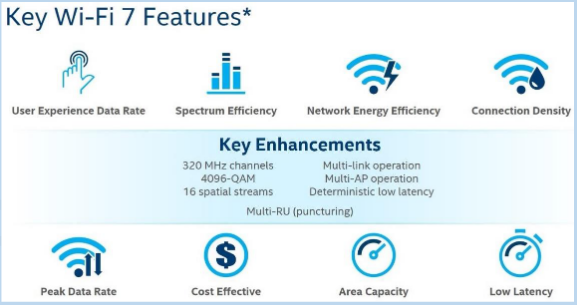
Wi-Fi 7 is set to revolutionize connectivity by supporting all three frequency bands—2.4GHz, 5GHz, and 6GHz—with 320MHz channels. With greater bandwidth and higher data density at 4096 Quadrature Amplitude Modulation (QAM), Wi-Fi 7 delivers lightning-fast speeds and seamless connectivity, enhancing wireless performance to redefine the user experience.
Beyond the significant leaps in speed and bandwidth that set Wi-Fi 7 apart from Wi-Fi 6/6E, Wi-Fi 7 introduces Multi-Link Operation (MLO). This powerful innovation allows devices to connect to the same access point (AP) across multiple channels and different frequency bands simultaneously. The all-new MLO increases throughput, lowers latency, and enhances reliability where speed and network stability matter.
Compex offers a comprehensive lineup of Wi-Fi 7 solutions, promising enhanced wireless performance and reliability at Wi-Fi 6 prices. By making advanced technology more accessible, we provide excellent value to ensure our customers stay ahead in an ever-evolving market.
Introducing: Two All-New Wi-Fi 7 Modules from Compex – WLE7002E25D and WLT7002E25D-E
WLE7002E25D
Powered by Qualcomm’s QCN6224, QCN6274, and QCN9274-I Waikiki series radio chipsets, the new WLE7002E25D is one of the first in the industry to feature a standard miniPCIe form factor offering dual-band dual-concurrent 2.4+5GHz. The module incorporates a cost-efficient diplexer design that combines the 2.4GHz and 5GHz signals into a single dual-band antenna, reducing the need for multiple antennas.
WLT7002E25D-E
The new WLT7002E25D-E is also a dual-band concurrent 2.4+5GHz Wi-Fi 7 (802.11be) module in M.2 E Key, powered by Qualcomm’s QCN6224, QCN6274, and QCN9274-I Waikiki series radio chipsets. This 2×2 MU-MIMO model also incorporates a diplexer design.
Designed to meet the growing demand for high-speed and reliable wireless communication, both modules are compatible with Qualcomm and third-party platforms, ideal for enterprise, industrial, cybersecurity, transportation and SMB applications.
Unveiling the Future of Connectivity: Introducing 524WiFi’ 2.4GHz WiFi 7 Module
In today’s rapidly evolving digital landscape, seamless connectivity is no longer a luxury but a necessity. As businesses and industries continue to embrace digital transformation, the demand for high-speed, reliable wireless communication solutions has never been greater. At 524WiFi, we are committed to driving innovation and empowering our customers with the tools they need to thrive in the digital age. That’s why we’re thrilled to announce the launch of our latest breakthrough: the 524WiFi 2.4GHz WiFi 7 Module.
The Next Generation of Wireless Technology
The 524WiFi 2.4GHz WiFi 7 Module represents the pinnacle of wireless technology, offering unparalleled performance, reliability, and versatility. Designed to meet the demands of modern connectivity, this module is powered by Qualcomm’s QCN9274 and QCN6274 ‘Waikiki’ series radio solutions, ensuring top-notch performance and compatibility.
Single Band vs. DBDC: Which One Fits Your Needs?
One of the key features of the Wallys 2.4GHz WiFi 7 Module is its availability in two versions: the Single Band and the DBDC (Dual Band Dual Concurrent). Each version offers unique advantages, allowing customers to choose the one that best suits their specific requirements.
– Single Band Version: Engineered for applications that demand robust connectivity within the 2.4GHz spectrum, the Single Band version delivers exceptional throughput and coverage. With its 4×4 MU-MIMO configuration, this version is ideal for high-density environments and data-intensive tasks.
– DBDC Version: Offering the added advantage of dual-band concurrent operation, the DBDC version supports both 2.4GHz and 5GHz frequencies simultaneously. With its 2×2 MU-MIMO configuration, this version provides versatility and flexibility, catering to diverse deployment scenarios and demanding applications.
With the 524WiFi 2.4GHz WiFi 7 Module, customers can stay ahead of the curve and embrace the next generation of wireless technology. Whether you prioritize performance and coverage within the 2.4GHz spectrum or need the flexibility to operate in both 2.4GHz and 5GHz bands simultaneously, we have the solution you need.
WiFi 7 modules from 524WiFi are available for testing. Unfortunately we just have the chip QCN6274, QCN9274 is short of the market. Leadtime for QCN 9274 chipset is 16-20 weeks now. Please check the differences bellow :
In our China factory we have these samples available now :
DR9274-5G (QCN6274) with UFL connectors 22pcs,with mmcx connectors 20pcs
DR9274-2.4G(QCN6274)with UFL connectors 15pcs
DR9274-6G(QCN6274)with mmcx connector 15pcs
All these our modules we can deliver for USD 99 each
COMPEX factory can ship these samples quickly :
WLW7000E5 8A0674S-TE 14pcs (QCN6274) WLW7000E6 8A0674S-TE 12pcs (QCN6274) WLW7002E25 8A0674S-TE 20pcs (QCN6274 2×2 mimo dual band 2,4+5GHz)
Price for COMPEX modules is USD 199 per one module.
If you are interested in WiFi 7 802.11bt modules, then please contact us and tell us more about your project, used HW and SW platform and we will recommend the best solution for you.
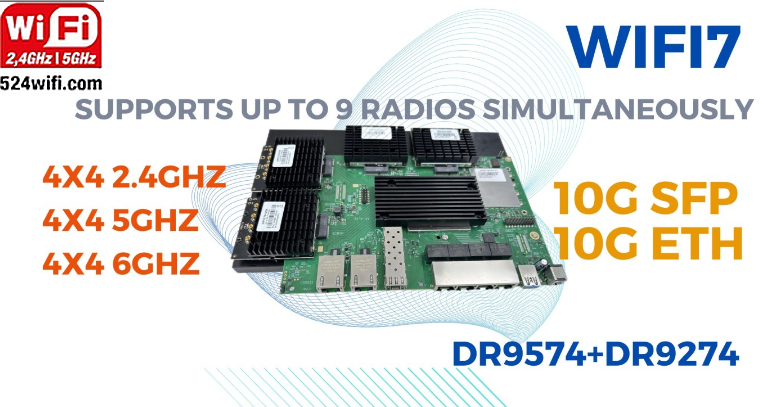
Imagine a scenario where an industrial-grade WiFi access point (AP) equipped with the capability to operate nine physical radios simultaneously is deployed across logistics, warehousing, ports, industries, and smart cities. Here’s what could happen:
1. Logistics Centers: In logistics centers, these APs could enable real-time tracking and management of goods. Each physical radio could connect to different sensors and devices, monitoring the location, temperature, humidity, and other information of goods. This data could be transmitted to a central control center over the network, enabling precise monitoring and management of logistics operations.
2. Warehousing Facilities: In warehousing facilities, these APs could optimize inventory management and goods allocation. Each physical radio could connect to different shelves or storage areas, synchronizing inventory information in real-time with warehouse management systems, improving inventory turnover rates, and operational efficiency.
3. Ports and Logistics Parks: In ports and logistics parks, these APs could facilitate real-time monitoring and dispatching of ships, containers, and transportation vehicles. Each physical radio could connect to different devices such as security cameras, sensors, and onboard equipment, transmitting data to a monitoring center over the network, ensuring the safe transport and efficient handling of goods.
4. Industrial Production: In industrial production, these APs could optimize the operation of production lines and equipment monitoring. Each physical radio could connect to different production equipment and sensors, transmitting equipment status and production data in real-time to production management systems, enabling automation and intelligence in the production process.
5. Smart Cities: In smart cities, these APs could enable intelligent management of city infrastructure and public services. Each physical radio could connect to different city facilities and sensors, monitoring information such as traffic flow, environmental pollution, energy consumption, and transmitting data to city operation centers over the network, enabling efficient utilization of city resources and sustainable development of the environment.
In summary, deploying an industrial-grade WiFi access point with nine physical radios across logistics, warehousing, ports, industries, and smart cities could lead to more efficient operations, smarter manufacturing, and intelligent city management.
In industrial Application
Configuring all nine radios as access points (APs) can bring several benefits:
1. Increased Device Connectivity: Industrial environments often require connectivity for numerous devices such as machinery, sensors, monitoring equipment, and mobile terminals. By utilizing nine APs, the network can accommodate a larger number of devices simultaneously, facilitating seamless communication and data exchange across various equipment and systems.
2. Enhanced Coverage and Reliability: Industrial facilities often have complex layouts and challenging environments, such as large warehouses, manufacturing floors, or outdoor areas. With multiple APs strategically deployed, the network coverage is extended, ensuring that devices throughout the facility can maintain a reliable connection with minimal dead zones or signal interference.
3. Load Balancing and Traffic Management: Distributing client connections across multiple APs allows for efficient load balancing and traffic management. This helps prevent network congestion and ensures that critical applications or devices receive sufficient bandwidth and priority access to resources, optimizing overall network performance.
4. Redundancy and Fault Tolerance: In industrial applications where uninterrupted operation is crucial, having redundant APs can provide fault tolerance and resilience against network failures. If one AP experiences issues or downtime, nearby devices can seamlessly connect to alternate APs, minimizing disruptions to critical operations.
5. Support for Mobile and IoT Devices: Many industrial processes rely on mobile terminals or IoT devices for data collection, monitoring, and control. With nine APs, the network can accommodate the growing number of wireless devices used in industrial automation, asset tracking, inventory management, and predictive maintenance applications.
Overall, configuring nine radios as APs in industrial environments enhances connectivity, coverage, reliability, and scalability, supporting the demanding requirements of modern industrial operations.
A Quick Overview for 524WiFi Dream WiFi7 modules
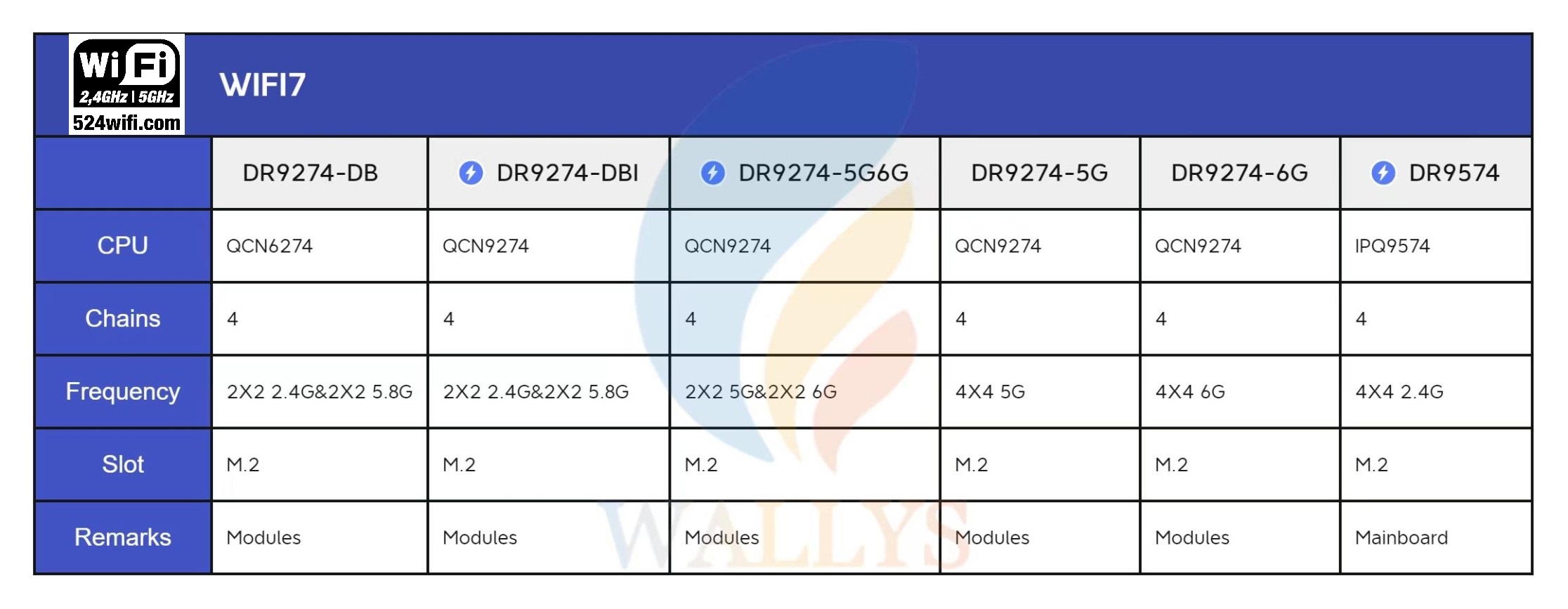
1. DR9274-QCN9274|QCN6274 WiFi7 Single Band 5G
2. DR9274-QCN9274|QCN6274 WiFi7 Single Band 6G
3. DR9274-QCN9274|QCN6274 WiFi7 Dual Band Dual Concurrent-2.4G&5G
4. DR9274-QCN9274|QCN6274 WiFi7 Dual Band Dual Concurrent-5G&6G
QCN9274: What is the throughput potential of WiFi7 cards?
Experience Lightning Fast Internet with Dream DR9274-5G and -6G
In the realm of WiFi routers, throughput serves as a key determinant of performance. A higher throughput signifies enhanced data transfer rates, enabling seamless connectivity for multiple devices concurrently. This capability proves invaluable for bandwidth-intensive tasks like high-definition video streaming, online gaming, and large file downloads.
Routers with high throughput capabilities offer not only stable connections but also expedited wireless transmissions, thereby elevating user experience significantly. Whether accommodating numerous devices or facilitating data-intensive operations, such routers are indispensable for meeting the demands of modern connectivity.
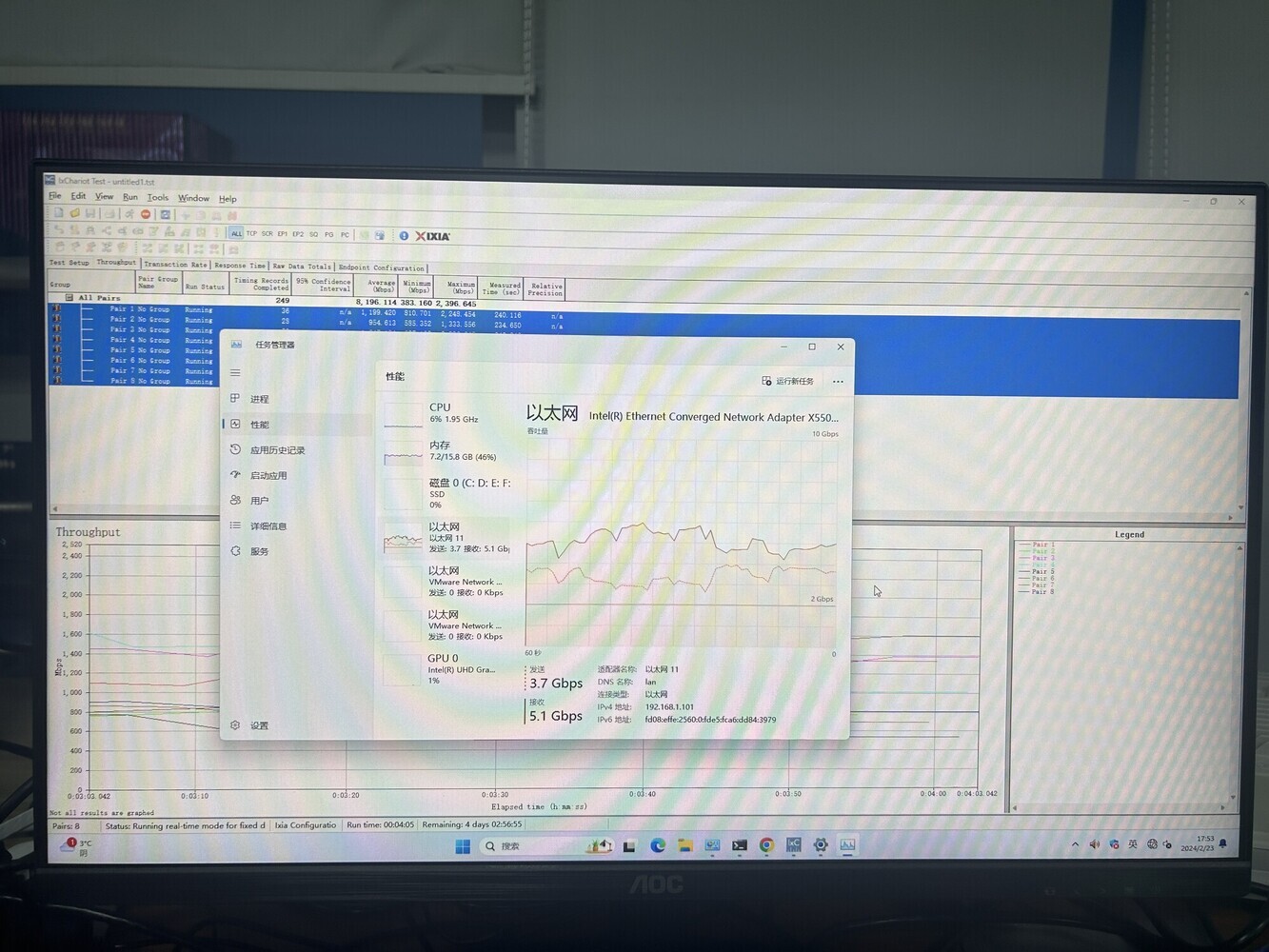
We have conducted tests on the throughput of its WiFi7 router, DR9574, and WiFi7 module, DR9274-6G, achieving remarkable speeds of up to 8.9G. Under optimal conditions, throughput may even reach 9G+, approaching the 10G mark. This demonstrates the exceptional performance potential of Wallys’ products in providing stable and high-speed wireless connections.
In summary, prioritizing routers with high throughput ensures optimal performance and reliability, particularly in environments with multiple interconnected devices and extensive data transfer requirements.
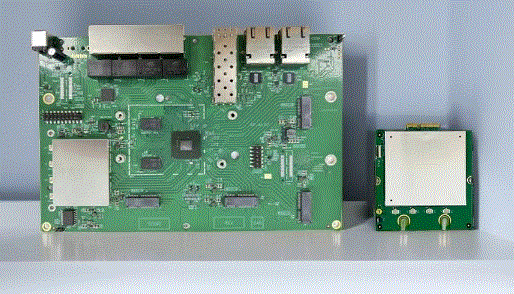
DR9574 routerboard
802.11be IPQ9574 4×4 2.4G 2x10G +4x1G Ethernet Port
Support WIFI7 card QCN9274-QCN6274
DBDC 2×2 2.4G& 2×2 5G
DBDC 2×2 5G& 2×2 6G
single band 4×4 5G
single band 4×4 6G
WLAN Host Interface:PCI Express 3.0 Interface
Frequency Range:2.4GHz: 2.412~2.472GHz
DR9274-6G
DR9274-6G based on QCN9274 Chipset is an enterprise wireless module integrated with 4×4 MU-MIMO single Band Wireless Module designed specifically to provide users with mobile access to high-bandwidth video streaming, voice, and data transmission for office and challenging RFenvironment in factories, warehouses establishment
4×4 6G MU-MIMO WiFi Module
WIFI7 M.2 card QCN9274
■ Qualcomm Atheros QCN9274 for Industrial Grade;
■ Maxim Tx power 22dBm per chain;
■ 4×4 6G MU-MIMO, up to 11530Mbps physical data rate;
■ Support up to 4096-QAM;
■ M.2 connector;
■ PCI Express 3 .0 Interface
524WiFi and Wallys software technology advantages:
Wallys has 10 years of experience in software development and is very experienced in uboot, Linux, wifi protocol, wifi performance, OS and other systems. It mainly uses Qualcomm chips to develop important software such as drivers and kernels, and has the ability to modify and compile to meet customers’ different wifi functional requirements. Meanwhile, it participates in openwrt organization and code development. wifi5 product DR40x9 has been officially supported by openwrt.
Hardware technology advantages:
We have a strong hardware design team, and experienced people know that the most difficult part of hardware design is RF circuit design, baseband, etc., while wallys team made 0 error to achieve signal integrity, such as frequency conversion of network card, from 2.4G to 900M, which is a technological breakthrough.
WiFi 7 in Q1-Q2 2024 – QCN 9574 boards and QCN 9274 / 6274 DBDC radio modules available for testing now !
QCN 9074 / 9024 / 6024 WiFi 6 / 6E 11ax 4×4 WiFi Modules and new Mediatek MT7915 / 7916 Wi-Fi 6 / 6E miniPCIE modules available now and tested successfully for mas production!
524WiFi the pioneers in connectivity solutions, introduces an array of advanced WiFi 7 modules designed to cater to diverse needs. Let’s delve into the details of 524WiFi WiFi 7 modules and compare their specifications through informative data sheets.A Quick Overview
1.DRiver 9274-5G|QCN9274/QCN6274 WIFI7 SINGLE BAND 5G
Tailored for single-band 5G applications,Powered by Qualcomm’s QCN9274 ‘Waikiki’ series,Features 4×4 MU-MIMO and supports up to 4096-QAM,Operating temperature ranges from -20°C to 70°C for commercial grade and -40°C to 85°C for industrial grade
Key Feature:
Qualcomm Atheros QCN9274 for Industrial Grade;
Qualcomm Atheros QCN6274 for Commercial Grade;
Maxim Tx power 20dBm per chain;
4×4 5G MU-MIMO, up to 5765Mbps physical data rate;
Support up to 4096-QAM;
M.2 connector;
PCI Express 3.0 Interface
2.DRIVER 9274-6G|QCN9274/QCN6274 WIFI7 SINGLE BAND 6G
Specifically designed for single-band 6G requirements,Utilizes Qualcomm’s QCN6274 ‘Waikiki’ series for robust performance,Boasts a 4T4R (4×4) MU-MIMO 6GHz solution,Achieves up to 11.530Gbps with 4 spatial streams.
Key Feature:
Qualcomm Atheros QCN9274 for Industrial Grade;
Maxim Tx power 22dBm per chain;
4×4 6G MU-MIMO, up to 11530Mbps physical data rate;
Support up to 4096-QAM;
M.2 connector;
PCI Express 3 .0 Interface
3.DRIVER 9274-DB|QCN9274/QCN6274 WIFI7 DUAL BAND DUAL CONCURRENT-2.4G&5G
Perfect for dual-band, dual-concurrent operation in both 2.4G and 5G,Employs Qualcomm’s QCN6274 ‘Waikiki’ series for exceptional connectivity,Supports both Access Point (AP) and Station (STA) modes simultaneously
Key Feature:
Qualcomm Atheros QCN6274;
Qualcomm Atheros QCN9274 for Industrial Grade;
Maxim Tx power 20dBm per chain;
2×2 2.4GHz MU-MIMO, up to 1376Mbps physical data rate;
2×2 5GHz MU-MIMO, up to 5765Mbps physical data rate;
Support up to 4096-QAM;
M.2 connector;
PCI Express 3 .0 Interface
4.DRIVER 9274-5G6G|QCN9274/QCN6274 WIFI7 DUAL BAND DUAL CONCURRENT-5G&6G
Tailored for dual-band, dual-concurrent operation in 5G and 6G frequencies,Utilizes Qualcomm’s QCN9274 ‘Waikiki’ series for reliable performance,Wide signal coverage with a 5V design
Key Feature:
Qualcomm Atheros QCN9274 for Industrial Grade;
Maxim Tx power 22dBm per chain;
2×2 5G & 2×2 6G MU-MIMO, up to 8,647Mbps physical data rate;
Support up to 4096-QAM;
M.2 connector;
PCI Express 3 .0 Interface
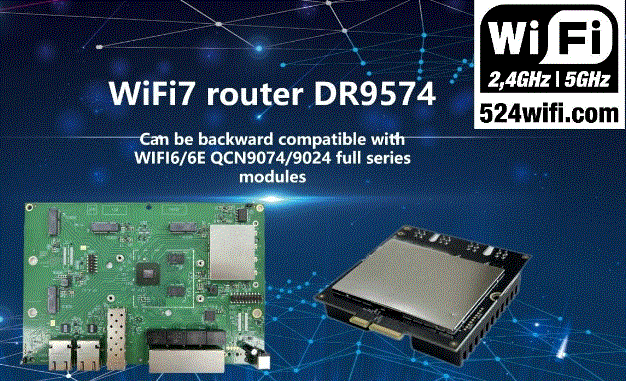
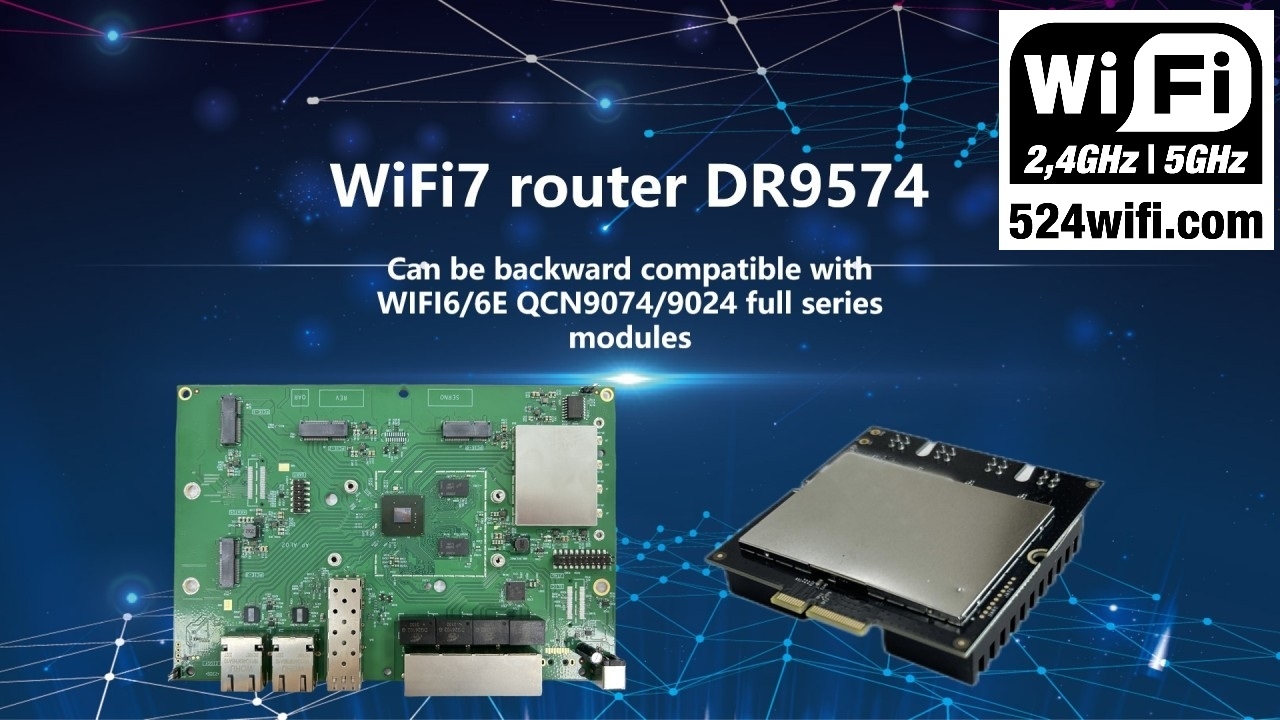
5.WIFI7 PLATFORM DRIVER 9574-IPQ9574
Support 11ax 2.4G 4×4 radio on board
A robust platform featuring the Qualcomm IPQ9574 or IPQ9554
Designed specifically for WiFi 7 applications Industrial
Backward compatible with WiFi6/6E QCN9074 QCN9024 full series modules
524WiFi WiFi 7 modules are engineered for versatility and reliability, making them ideal for Enterprise, Industrial, Cybersecurity, Transportation, and SMB applications. The modules support Multi-Link Operation (MLO) for reduced latency, Preamble Puncturing for improved spectral efficiency, and unique features like FIPS L2 for enhanced cryptographic protection.
Wi-Fi 7 samples from Compex available for orders
The latest Wi-Fi standard is brought to market by Compex with the new WLW7000 series, based on Qualcomm’s QCN6274 or QCN9274 chipsets for commercial and industrial versions respectively. The 5V design enables wider signal coverage along with all the benefits of the new standard such as preamble puncturing. The new series comes in 4 different configurations with one Dual-Band-Dual-Concurrent on the 2.4/5 GHz bands as well as 3 Single-Band versions for 2.4/5/6 GHz respectively, with the 6 GHz verison reaching theoretical speeds of over 11.5 Gbps.
WHAT’S WI-FI 7?
WI-FI 7 HAS THE FOLLOWING FEATURES:
– provide over 3 times faster data rates of 46 Gbps using a 320 MHz channel in the 6 GHz – one 160 MHz channel in the 5 GHz band with up to 4096-QAM (4K-QAM) modulation – 16 spatial streams MU-MIMO,
– New Multi-Link Operation (MLO) enables Wi-Fi 7 to combine several frequencies across bands into a single and steady connection.
Wi-Fi 7 is being designed to be optimized for these video applications like gaming, streaming, smart home devices and services, cloud computing, video conferencing , etc.
WI-FI 6E/7 COMPARISON
WI-FI 6E
IEEE 802.11ax Frequency 2.4GHz, 5GHz, 6GHz Channel bandwidth 160 MHz QAM 1024-QAM 4096-QAM Theoretical maximum speed 9.6 Gbps Spatial streams 16×16 MU-MIMO Application Ac cess point, high quality video streaming, etc.
WI-FI 7
802.11be EHT
Frequency 2.4GHz, 5GHz, 6GHz
Channel b-QAM
Theoreticaandwidth Up to 320 MHz
QAN 4096l maximum speed 46 Gbps
Spatial streams 16×16 MU-MIMO
Video applications like gaming, streaming, smart home devices, cloud computing, video conferencing, etc.
2023 NEW PRODUCTS – WIFI 7 QCA AP AND CLIENT SOLUTIONS FROM SPARKLAN:
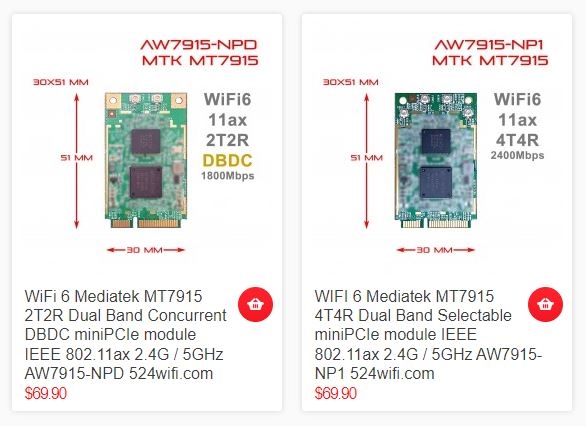
MEDIATEK WIFI 6 MINIPICE MODULES BASED ON MT7915 CHIPSET WITH WIDE LINUX AND OPENWRT DRIVERS SUPPORT
QCN9074 VS QCN9024 | WIFI6E IOT 4X4 TRIBAND 2.4G 5G 6G NETWORK CARD AND APPLICATION
WHAT ARE THE APPLICATIONS OF AN INDUSTRIAL TRI-BAND NETWORK CARD SUPPORTING 2.4GHZ, 5GHZ, AND 6GHZ?
Imagine the boundless possibilities that come with an industrial Tri-Band network card, seamlessly embracing the 2.4GHz, 5GHz, and lightning-fast 6GHz frequency bands. Here’s a glimpse into the exciting realms of its potential applications:
1. Smart Manufacturing & IoT Revolution: In the heart of smart manufacturing, these Tri-Band cards orchestrate a symphony of devices. From factory robots to floor sensors, they unite the Internet of Things (IoT) to make real-time data analytics and intelligent production a reality.
2. Robotic Precision & Automation: When it comes to industrial robots and automated machinery, precision and speed are paramount. Tri-Band network cards deliver high-speed data transfers and unwavering connections, ensuring uninterrupted automation.
3. Surveillance with Clarity: Industrial sites demand top-tier security. Tri-Band cards support high-definition video streams, fortifying security systems. They extend the eyes and ears of surveillance networks, enhancing vigilance.
4. Scientific Excellence: In the world of scientific research and high-performance computing, these network cards are the lifeline. They enable lightning-fast data transfer, facilitating experiments, simulations, and data analysis at astonishing speeds.
5. Connecting the Unreachable: When it’s about connecting distant devices in remote locations, Tri-Band cards are the bridge. They make remote monitoring, diagnostics, and maintenance a breeze, minimizing downtime.
6. Agriculture & Environmental Guardians: In the fields of agriculture and environmental monitoring, they enable large-scale sensor networks. These networks collect invaluable data for better decision-making, crop management, and environmental preservation.
7. Aerospace & Beyond: Think of satellite communications and aerospace ventures. Tri-Band cards empower high-speed data exchanges between spacecraft, satellites, and ground stations, venturing into the far reaches of the cosmos.
With the 6GHz band, an integral part of the WiFi 6E, industrial Tri-Band network cards offer an abundance of spectrum resources. They cater to the insatiable appetites of high bandwidth and low latency. The future of industrial connectivity shines brighter than ever before!
524WIFI 6E IOT 4X4 TRIBAND 2.4G 5G 6G NETWORK CARD:DR9074
Both the QCN9074 and QCN9024 are Qualcomm chips, and Wallys has chosen this platform for the development of Tri-Band card due to its exceptional stability and superior performance.
Let me share the fascinating story of its inception. Before the advent of the remarkable DR9074 Tri-Band Network card, Wallys had already pioneered single-band network cards like the DR9074-2.4G, DR9074-5G, and DR9074-6E, each earning a reputation for top-notch performance.
Then came an intriguing request from one of our valued customers: ‘The DR9074-5G and DR9074-6E deliver exceptional performance; do you have plans for a Tri-Band version of this card?’ As an innovation-centric company, this question ignited a spark among our engineers.
Fuelled by passion and driven by the pursuit of excellence, our engineers toiled day and night. And voilà, Wallys proudly presents the DR9074 Tri-Band Network card, a testament to our commitment to innovation and customer satisfaction.
Now, let’s dive into the exciting features of this groundbreaking card!
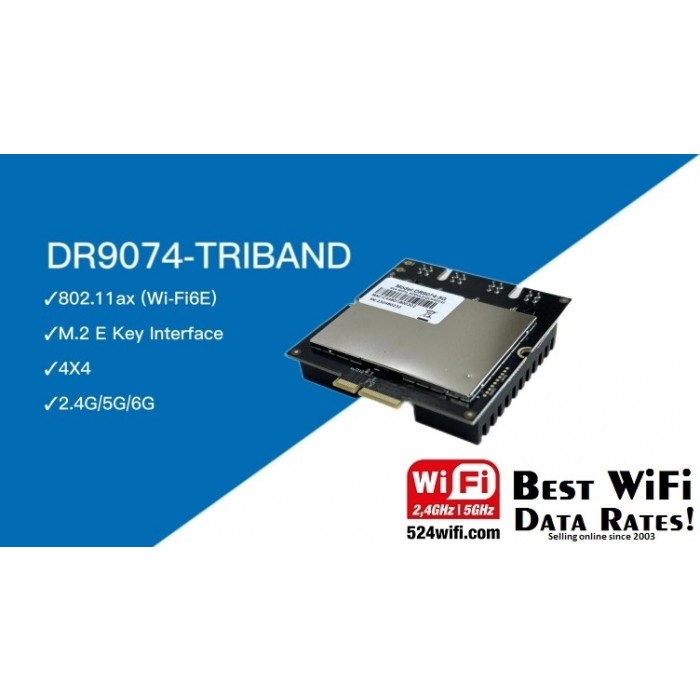
DR9074-TRIBAND
■ Qualcomm Atheros QCN9024
■ Maxim 23 dBm per chain,up to 4949Mbps
■ Data Rateup to 4949Mbps
■ Support Tri Band 2.4GHz&5GHz&6GHz 4×4 WiFi 6E (802.11ax)
■ 4 spatial streams (4SS)
■ M.2 E Key Interface
■ PCI Express 3 .0 Interface
Symbol/Parameter
Chipset:Qualcomm Atheros QCN9024
WLAN Host Interface:PCI Express 3.0 Interface
System Memory:2Mbit serial I²C bus EEPROM
Standard Operating Voltage:5V
Operating Systems:QSDK
Host Interface:M.2 E Key
Antenna Cable / Port:4 x MMCX Connectors,4T4R
Frequency Range:2.412GHz-2.472GHz & 5.18GHz-5.825GHz & 5.925GHz-7.125GHz
Data Rates for WALN:Maxim 23dBm per chain, up to 4949Mbps
Channel Spectrum Widths for WLAN:Support 20/40/80/160MHz
Get yourself some samples to test – availbe now ! Race towards the adoption of WiFi 6E in your wireless solution! – HOW WE MAKE QCA QCN9074 WLAN WIFI 6 MODULE DR9074 4X4 WORK ON X86 LINUX PLATFORM – PLEASE READ HERE.