Posted on

QCN6224 Wi-Fi 7 2×2 Module Overview for Cost-Optimized APs

Introduction

As Wi-Fi 7 (IEEE 802.11be) transitions from cutting-edge innovation to mainstream deployment, device manufacturers increasingly look for wireless solutions that balance performance, cost, and energy efficiency. The QCN6224 Wi-Fi 7 2×2 module delivers exactly that balance. It brings next-generation connectivity into cost-optimized access points (APs), routers, CPEs, and industrial gateways, without significantly increasing system complexity or bill-of-materials (BOM) costs.


What Is the QCN6224 Wi-Fi 7 Module?

The QCN6224 is a 2×2 MU-MIMO Wi-Fi 7 module designed for embedded networking equipment. Supporting dual-band or tri-band operation depending on design, the module introduces major Wi-Fi 7 enhancements such as higher throughput, improved spectral efficiency, and greater link reliability — all within a compact and power-efficient form factor. Compared with many high-end Wi-Fi 7 chipsets, the QCN6224 focuses on value-driven performance, making it ideal for mainstream devices rather than premium flagship systems.


Key Wi-Fi 7 Features of QCN6224

✔ 320 MHz Channel Support

The QCN6224 supports ultra-wide 320 MHz channels, enabling dramatically higher peak data rates. This capability reduces latency and improves user experience in applications such as HD and 4K video streaming, VR/AR, cloud gaming, and high-density enterprise networks.

✔ Multi-Link Operation (MLO)

MLO allows Wi-Fi devices to transmit data across multiple frequency bands at the same time. This improves reliability by minimizing interruption risks and delivers smoother, faster data transfers — especially valuable in congested wireless environments.

✔ 4K-QAM Modulation

With 4K-QAM support, the QCN6224 significantly increases spectral efficiency, packing more data into every transmission. This is ideal for environments with many users, such as offices, campuses, hotels, and public Wi-Fi deployments.

✔ 2×2 MU-MIMO Architecture

The 2×2 design provides the optimal balance between speed, power consumption, and hardware cost. It enables fast performance without requiring the more complex RF layouts or higher component costs seen in larger 4×4 or 8×8 systems.


Why the QCN6224 Is Ideal for Cost-Optimized APs
Manufacturers of cost-optimized access points face several key design requirements. They need low BOM cost, compact hardware, and efficient power consumption — without sacrificing network performance. The QCN6224 meets all these criteria.

Because it uses a 2×2 architecture, the module footprint is smaller and integration is simpler. At the same time, Wi-Fi 7-level features such as MLO and 4K-QAM ensure clear performance gains over Wi-Fi 6. Its low-power operation makes it especially suitable for PoE-powered APs and always-on devices. In addition, the QCN6224 is compatible with popular networking software ecosystems such as OpenWrt and QSDK (depending on vendor implementation), helping device makers bring products to market more quickly.


Typical Application Scenarios

The QCN6224 Wi-Fi 7 2×2 module is well-suited for:

  • Enterprise and SMB access points
  • Mid-range Wi-Fi 7 routers
  • ONT / FTTH gateway devices
  • Industrial networking equipment
  • Smart building and IoT controllers
  • Wireless video transmission systems

Its compact size and stable performance make it highly attractive for embedded and industrial environments where reliability and cost efficiency are critical.


QCN6224 vs. Higher-End Wi-Fi 7 Solutions

Compared with 4×4 and 8×8 Wi-Fi 7 chipsets, the QCN6224 focuses on value rather than maximum throughput. High-end chipsets deliver higher data rates but also require more complex RF layouts, significantly higher power consumption, and greater BOM costs — making them ideal for premium enterprise or carrier-class APs.

By contrast, the QCN6224 is optimized for mainstream Wi-Fi 7 devices. It delivers strong performance upgrades over Wi-Fi 6 while keeping both power and hardware costs at practical levels. This makes it an excellent choice for large-scale deployments, SMB networking, consumer broadband devices, and mid-range enterprise APs where cost-performance balance is essential.

In short, if your design goal is reliability, efficiency, and affordability, rather than extreme bandwidth, the QCN6224 stands out as a perfect match.


Benefits for OEMs and Device Manufacturers

Selecting QCN6224 brings multiple advantages:

  • Reduced BOM cost compared with larger Wi-Fi 7 solutions
  • Faster product development cycles
  • Lower thermal and power-supply requirements
  • Compatibility with established software stacks
  • Strong Wi-Fi 7 marketing value for product positioning

Manufacturers can upgrade Wi-Fi 6 designs to Wi-Fi 7 with minimal redesign effort — accelerating time-to-market.


Conclusion

The QCN6224 Wi-Fi 7 2×2 module is a powerful, efficient, and cost-optimized solution for next-generation wireless devices. Featuring MLO, 320 MHz channel support, 4K-QAM, and 2×2 MU-MIMO, it enables manufacturers to deliver Wi-Fi 7-class performance at highly competitive price points.

If your goal is to build compact, power-efficient, and scalable access points or gateways, the QCN6224 offers the ideal balance between technology advancement and commercial practicality.

Posted on

524WiFi 𝑨𝑾7990-𝑵𝑷𝑫: MediTatek Filogic 6 MT7990 𝑾𝒊-𝑭𝒊 7 𝑴𝒊𝒏𝒊 𝑷𝑪𝑰𝒆 𝑴𝒐𝒅𝒖𝒍𝒆


Infrastructure Preservation: Upgrade to 802.11be Without a PCB Redesign

In industrial computing, the lifecycle of your platform is critical. While the industry pivots to Wi-Fi 7, transitioning often necessitates a full-scale hardware overhaul—until the introduction of the 524WiFi AW7990-NPD Mediatek based module.

Technical Core & Strategic Advantages :

  • MediaTek Filogic 600 (MT7990) : Delivers BE3600 dual-band concurrent (DBDC) operation.
  • 4096-QAM Modulation : Achieves a 20% increase in peak data rates compared to Wi-Fi 6.
  • Multi-Link Operation (MLO) : Ensures deterministic latency and link reliability in congested environments.
  • Drop-In Upgrade : Bypasses R&D costs and time-to-market delays by utilizing the standard Mini PCIe form factor.

Optimized for Mission-Critical Verticals :

  • Industrial Robotics : High-bandwidth telemetry for AMRs/AGVs.
  • Edge AI Nodes : Rapid data synchronization for Smart Factory 4.0.
  • Security Gateways : High-throughput processing without thermal throttling.

AW7990-NPD: High-Performance Wi-Fi 7 BE3600 AP Module with MediaTek MT7990AN

AW7990-NPD is an Wi-Fi 7 AP module BE3600 by MediaTek MT7990AN chipset supports Wi-Fi 7 technology and feature IEEE802.11 a/ b/ g/ n/ ac/ ax/ be compliant, 2.4GHz 2×2, 5GHz
3×3 2ss BE3600 Wi-Fi subsystem. The MT7990AN offers feature-rich wireless connectivity at high standards and delivers reliable, cost-effective throughput from an extended distance.

The optimized Wi-Fi baseband algorithms provide superb performance. The intelligent MAC design deploys a highly efficient offload engine and hardware data processing accelerators,
which fully offload Wi-Fi task of the host processor. The MT7976CN is designed to support standard-based features in the areas of security, quality of service, and international regulations, giving end users the greatest performance at any time and in any circumstances.

Pre-certified with CE / FCC / IC, this solution helps accelerate product deployment while lowering certification cost and complexity.

Features

WLAN

  • Wi-Fi compliant
  • IEEE 802.11a, b, g, n, ac, ax, be compliant
  • 2.4GHz 20 and 40 MHz, 2×2
  • 5GHz: 20, 40, 80 and 160 MHz, 3×3 2ss
  • Dual-Band Dual Concurrent (DBDC) iFEM
  • Supports up to 4096-QAM
  • Data rate of up to 688Mbps for 40MHz channel in 2.4Ghz and 2882Mbps for 160MHz in 5GHz mode
  • Integrated power detector to support per packet Tx power control
  • Multi-user multiple input multiple output (MU-MIMO) for Tx and Rx
  • Multi-user Orthogonal Frequency-Division Multiple Access (MU-OFDMA) for Tx and Rx
  • Support STBC, LDPC, Tx beamformer and Rx beamformee
  • Support greenfield mode, mixed mode, and legacy mode

Platform

  • 32bit RISC-V MCU for Wi-Fi protocol and Wi-Fi offload
  • Embedded SRAM and ROM
  • PCIe3.0 interface

Security

  • WFA, WPA, WPA2, WPA3 personal, WPS 2.0

QoS

  • WFA WMM and WMM-PS

Standard

ChipsetMT7990AN with MT7976CN
Memory8M byte
Host InterfaceMini PCIe
Operating VoltageDC 3.3V ± 5%
Power Consumption11.5W
Wireless2.4GHz 2T2R 802.11b/g/n/ac/ax/be5GHz 3T3R 2ss 802.11a/n/ac/ax/be
Frequency Range2.4GHz: 2.412~2.472GHz5GHz: 5.15~5825GHz
Channel Spectrum WidthsSupports 20/40MHz at 2.4GHzSupports 20/40/80/160MHz at 5GHz
AntennaExternal Antenna connector (IPEX) x3
Operating SystemLinux
Environmental TemperatureOperating:-10°C to 70°C, Storage:-20°C to 90°C
Environmental HumidityOperating: 10% to 90%, Storage: Max. 90%
Dimensions (mm)30(W)*51(L)*5.1(H)mm
WeightTBD
CertificationTBD

Package with Heatsink 30x40x25mm Aluminum material

Power consumption maximum is 9W, average is 4 – 8W.
Main board Power Supply design please provide 3.3V 3A, minimum 3.3V 2.5A.

Additional information

Weight0.0255 kg
Dimensions9.5 × 6.5 × 1.5 cm
Posted on

The Quiet Revolution: How 5G RedCap is Unlocking a New Wave of Connected Devices

For years, the promise of 5G has been a tale of two extremes. On one end, high-speed smartphones and fixed wireless access demanding gigabit speeds. On the other, massive IoT sensors requiring years of battery life but minimal data. In the vast, fertile middle ground, a crucial category of devices has been left waiting for a cost-effective, power-efficient, yet capable wireless solution.

That wait is over. The arrival of 5G Reduced Capability (RedCap) is not just an incremental update; it’s the key that unlocks the full, diverse potential of the 5G ecosystem.

Bridging the 5G Divide: What is RedCap?

Think of the 5G spectrum as a highway system. You have the Formula 1 lanes for eMBB (enhanced Mobile Broadband) and the specialized, low-power bike paths for mMTC (massive Machine-Type Communications). RedCap effectively creates a new, smart “commuter lane”—perfectly balanced for devices that need more than a trickle of data but don’t require the expense and power drain of a full 5G modem.

Formally defined in the 3GPP Release 17 standard, 5G RedCap (also known as NR-Light) is a optimized version of 5G. It’s designed specifically for devices that fall between the high-performance and low-power extremes. By strategically reducing complexity, antenna count, and supported features, RedCap achieves a critical goal: it brings the inherent benefits of 5G—security, low latency, and mobility—to a much wider array of applications at a fraction of the cost and power consumption.

Source: https://www.ericsson.com/en/blog/2021/2/reduced-cap-nr

The Engineering Trade-Off: How RedCap “Slims Down”

RedCap isn’t a watered-down version of 5G; it’s a purpose-built one. It achieves its efficiency through several intelligent design choices:

  • Reduced Bandwidth: While high-end 5G can use up to 100 MHz in sub-7 GHz spectra, RedCap operates on a leaner 20 MHz. For most industrial sensors, health monitors, and wearables, this is more than sufficient and drastically cuts complexity.
  • Fewer Antennas: A flagship smartphone might have 4 receive antennas (4Rx). RedCap devices can operate with just 1 or 2 (1Rx or 2Rx). This simplification is a major driver behind reducing device size, cost, and power needs.
  • Half-Duplex FDD: This allows the device to either transmit or receive at a time, but not both simultaneously. By eliminating the need for a duplexer (a component that prevents interference), RedCap devices become significantly cheaper and more power-efficient. For many applications that send bursts of data, this slight trade-off is unnoticeable.
  • Lower Order Modulation: RedCap primarily uses 64 QAM instead of the 256 QAM found in high-end 5G. This is a more than capable modulation scheme that reduces power demands on the device’s power amplifier.

The Real-World Impact: RedCap’s Killer Applications

The theoretical benefits are clear, but where will we actually see RedCap make a difference? The answer is in three key verticals that have been hamstrung by the limitations of existing technologies.

  1. Industrial IoT 2.0: The factory floor is a perfect environment for RedCap. Think of wireless video surveillance cameras for safety and quality control, condition monitoring sensors on high-value machinery, and programmable logic controllers (PLCs). These devices need more bandwidth than a simple LPWAN sensor but can’t justify the cost of a full 5G module. RedCap fits perfectly, offering the reliable, low-latency connection needed for modern automation.
  2. The Next Generation of Wearables: While smartwatches today use a mix of 4G and proprietary technologies, RedCap paves the way for a new class of advanced wearables. Imagine high-performance augmented reality (AR) glasses for enterprise or rich video-streaming capabilities in a fitness band. RedCap provides the data throughput for these experiences while ensuring the device doesn’t overheat and has a usable battery life.
  3. A New Era for Video Surveillance: City-wide and industrial security systems require high-quality, real-time video streaming. RedCap modems are powerful enough to handle 1080p or even 4K video, and their native support for network slicing means a city can guarantee a secure, uninterrupted video feed for public safety, separate from consumer traffic on the same network.

The Road Ahead: Integration and Coexistence

The rollout of RedCap is a masterclass in seamless network integration. A key feature is its “fallback” capability. RedCap devices can connect to both modern 5G Standalone (SA) networks and older 4G LTE networks, ensuring broad coverage from day one. For network operators, enabling RedCap is often a simple software upgrade to existing 5G SA cellsites, making deployment swift and cost-effective.

Looking forward, RedCap doesn’t replace existing technologies like LTE-M or NB-IoT; it complements them. It fills a crucial performance and cost gap, creating a more complete and versatile connectivity portfolio. As we move toward 3GPP Releases 18 and beyond, we can expect further enhancements in power saving and integration, solidifying RedCap’s role as the backbone for the mid-tier IoT revolution.

In summary, 5G RedCap is the missing piece in the connectivity puzzle. By making a few smart engineering trade-offs, it brings the robust power of 5G to the devices that will define the next decade of innovation—from smarter factories to advanced wearables. The 5G revolution is no longer just about speed; it’s about intelligent, scalable, and efficient connectivity for everything. And with RedCap, that future is finally within reach.

Posted on

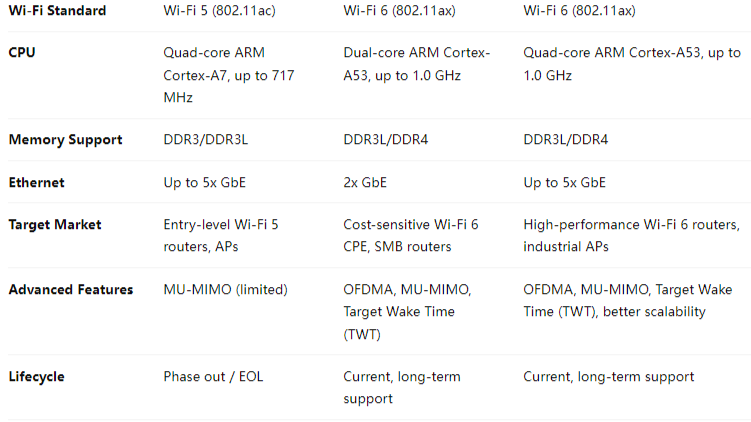
IPQ4019 IPQ4029 Phase Out Alert: Secure Your Upgrade Path with IPQ5018 IPQ5010

Introduction

The Qualcomm IPQ4019 and IPQ4029 chipsets have long been popular choices for cost-effective Wi-Fi 5 router boards and networking solutions. However, as Wi-Fi technology advances and demand for higher throughput, better efficiency, and longer product lifecycles grows, these chipsets are now entering the phase out stage.

For product developers and OEMs/ODMs who have built solutions around IPQ4019/IPQ4029, this shift raises a key question: What’s next?

The answer lies in Qualcomm’s next-generation IPQ5018 and IPQ5010 chipsets — designed to deliver superior Wi-Fi 6 performance while offering a cost-effective and future-proof path for industrial and enterprise networking solutions.


Why IPQ4019 / IPQ4029 Are Phasing Out

  • Wi-Fi 5 Limitations: With Wi-Fi 6 becoming the industry standard, Wi-Fi 5 chipsets like IPQ4019/4029 struggle to meet the growing requirements of high-density and high-throughput networks.
  • Lifecycle End
  • Market Demand: Clients now expect advanced features such as OFDMA, MU-MIMO, and improved energy efficiency — capabilities not fully supported by IPQ40xx chipsets.

Why Transition to IPQ5018 / IPQ5010?

1. Wi-Fi 6 Performance

  • Support for OFDMA and MU-MIMO, ensuring stable performance in dense environments.
  • Higher throughput and lower latency compared to IPQ4019/IPQ4029.

2. Cost-Effective Upgrade Path

  • IPQ5010 is ideal for entry-level Wi-Fi 6 solutions, providing a balance of performance and affordability.
  • IPQ5018 offers more robust capabilities for industrial and enterprise-grade products.

3. Extended Lifecycle

  • Qualcomm’s roadmap ensures that IPQ50xx series chipsets will receive long-term support, securing your product investments.

4. Industrial-Grade Applications

  • Rugged and reliable for deployments in smart cities, industrial Wi-Fi, surveillance, and long-distance outdoor networking.
  • Future-ready platform to support customized software development including OpenWrt and QSDK.

Our Solutions Based on IPQ5018/IPQ5010

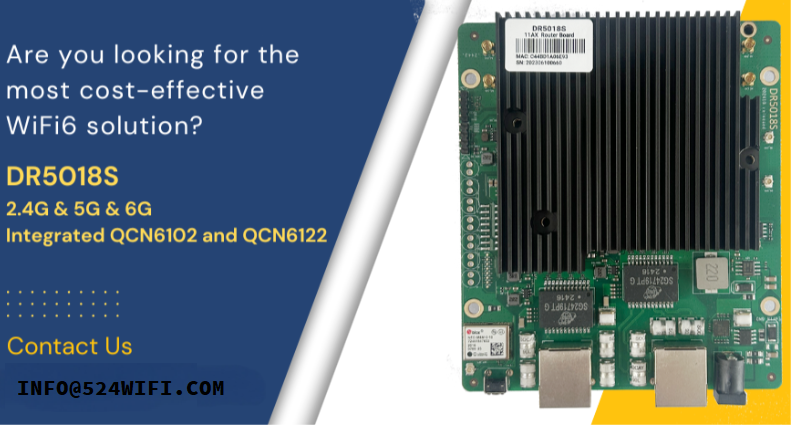
At 524WIFI and Wallys Communications (Suzhou) Co., Ltd., we have developed a range of router boards and wireless solutions built on the IPQ50xx series. Our latest product, the DR5018S, leverages the IPQ5018 chipset to deliver:

  • High-performance Wi-Fi 6 connectivity
  • Multiple Gigabit Ethernet ports
  • Support for industrial applications
  • Flexible OEM/ODM/JDM customization options

With strong hardware and software expertise, we ensures a smooth migration from IPQ40xx-based platforms to IPQ50xx solutions.


Conclusion

The phase-out of Qualcomm’s IPQ4019/IPQ4029 chipsets signals the end of an era — but also the beginning of a new one. By adopting the IPQ5018 and IPQ5010, businesses can secure a future-proof, cost-effective, and high-performance upgrade path that aligns with the growing demand for Wi-Fi 6 technology.

For more details on our IPQ5018/IPQ5010 solutions, or to discuss OEM/ODM opportunities, please visit www.524wifi.com / .net or contact us at info@524wifi dot com or net

Quick Review / More Info:

Both DR4019 and DR5018S support:

  • Wallys AP Controller
  • Hardware SOM version
  • VLAN functionality

The latest DR5018S VLAN configuration guide is first published here: Blog Article

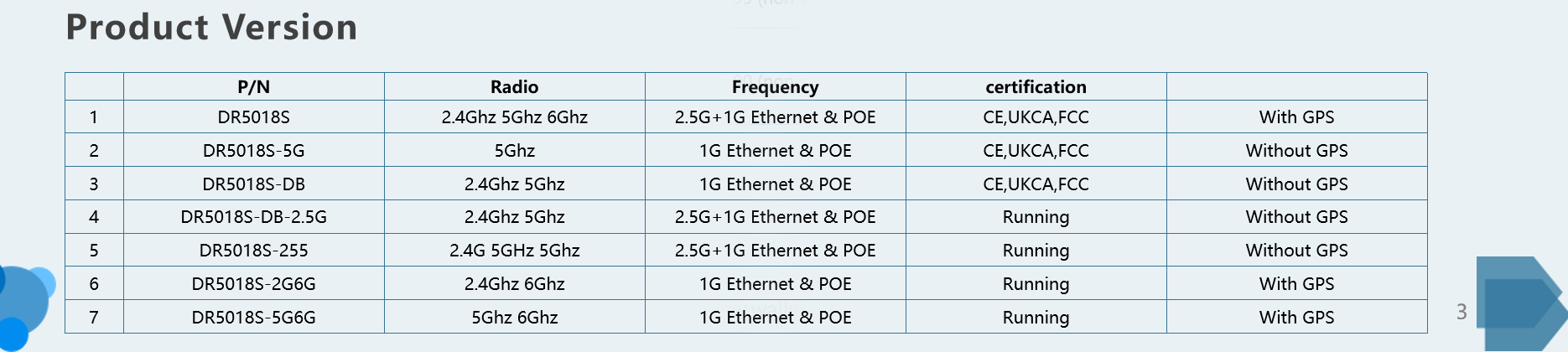
All available DR5018S Versions

Additional DR5018S features:

  • Mesh networking & seamless roaming
  • Long-range PTP over 30 km
  • GPS support
  • Tri-band option
  • FCC, CE, and UKCA certified
  • Proven performance: DR5018S-AP achieved a 14 km 5 GHz link test in Dongbei at 50 m height, with one-way throughput reaching 475 Mbps!
Posted on

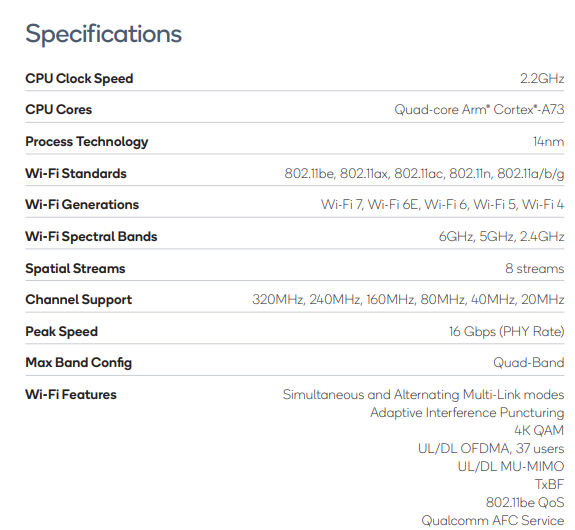
IPQ8072 vs IPQ9574: Why Upgrade to Wi-Fi 7 for Your Next Wireless Project

The Qualcomm IPQ8072 has long been a reliable choice for Wi-Fi 6 networking hardware. Many enterprise routers, carrier CPEs, and industrial access points are still powered by IPQ8072 due to its strong balance of cost and performance. However, with the rapid evolution of Wi-Fi 7 (802.11be), the Qualcomm IPQ9574 offers significant technical advantages that make it the logical upgrade path for next-generation solutions.

In this article, we compare IPQ8072 vs IPQ9574, highlighting the major differences and why developers should consider migrating to Wi-Fi 7 hardware.


Overview of IPQ8072 (Wi-Fi 6 SoC)

The Qualcomm IPQ8072 is part of the IPQ807x family, designed for Wi-Fi 6. It features:

  • Quad-core ARM Cortex-A53 processor
  • 8×8 MU-MIMO capability
  • Up to 160 MHz channel bandwidth
  • 1024-QAM modulation
  • Robust support for enterprise and carrier-grade networking

While still capable, the IPQ8072 has reached maturity, and limitations in throughput and latency become noticeable in demanding applications.


Overview of IPQ9574 (Wi-Fi 7 SoC)

The Qualcomm IPQ9574 represents the new generation of Wi-Fi 7 platforms, optimized for ultra-high throughput and low latency. Key features include:

  • Enhanced multi-core CPU architecture for higher processing power
  • 320 MHz channel bandwidth (double that of IPQ8072)
  • 4096-QAM modulation for higher spectral efficiency
  • Support for Multi-Link Operation (MLO)
  • Designed for advanced enterprise, industrial, and carrier networks

This makes IPQ9574 ideal for data-heavy applications such as 8K video streaming, AR/VR, industrial IoT, and low-latency control systems.


IPQ8072 vs IPQ9574 Technical Comparison

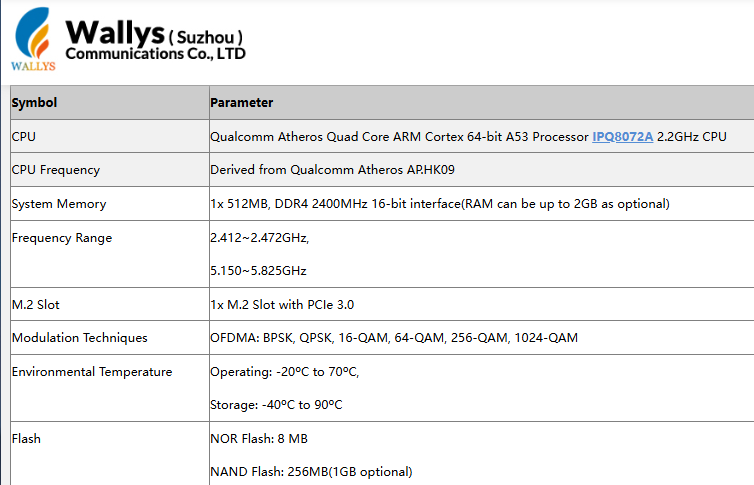
The Qualcomm IPQ8072 is a Wi-Fi 6 (802.11ax) SoC built with a quad-core Cortex-A53 processor. It supports channel bandwidths of up to 160 MHz and uses 1024-QAM modulation, making it a strong choice for enterprise routers, carrier CPE, and industrial APs.

Article content
Data from Wallys DR8072 Webpage

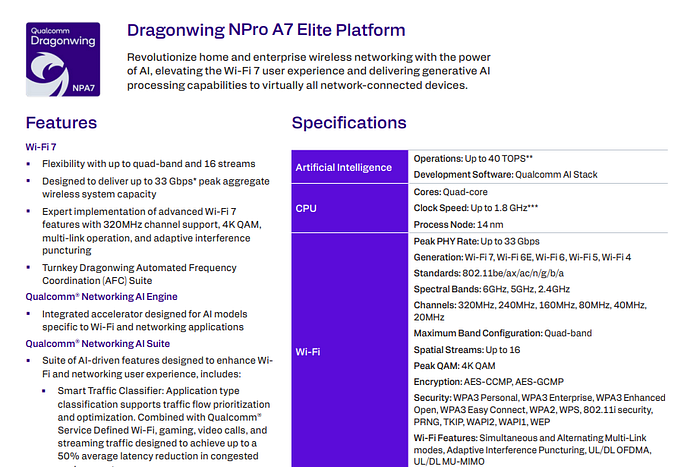
By contrast, the Qualcomm IPQ9574 belongs to the Wi-Fi 7 (802.11be) generation. It features a more advanced multi-core CPU architecture, supports 320 MHz channel bandwidth (double that of IPQ8072), and enables 4096-QAM modulation for higher spectral efficiency. Unlike IPQ8072, it also supports Multi-Link Operation (MLO), a Wi-Fi 7 feature that allows simultaneous use of multiple frequency bands to reduce latency and improve stability. These enhancements make IPQ9574 ideal for next-generation enterprise networks, industrial IoT deployments, low-latency applications, and high-density environments.

Article content
Data from Qualcomm IPQ9574 Datasheet

Why Upgrade from IPQ8072 to IPQ9574?

  1. Performance Leap – Wi-Fi 7 doubles available channel bandwidth and introduces 4096-QAM for significantly higher throughput.
  2. Ultra-Low Latency – MLO ensures faster and more reliable connectivity, critical for real-time applications.
  3. Future-Proofing – As Wi-Fi 6 hardware reaches end of lifecycle, Wi-Fi 7 ensures long-term product competitiveness.
  4. Scalability – IPQ9574’s stronger CPU supports more devices, traffic, and complex networking tasks.

524WiFi and Wallys’ IPQ9574 Router Board Solution

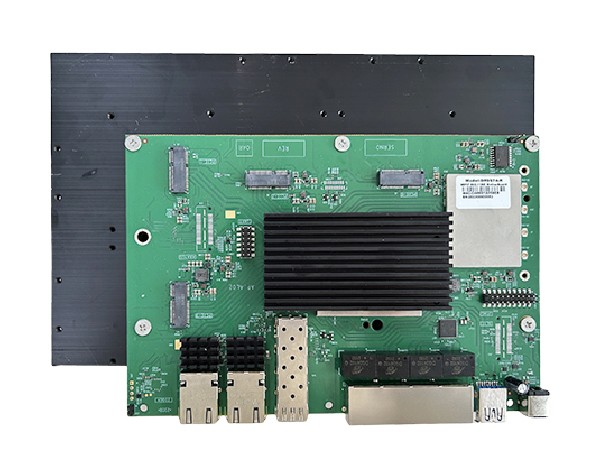
At 524WiFi, we provide hardware solutions based on Qualcomm IPQ9574, including the DR9574 Router Board, designed for Wi-Fi 7 networks. With strong processing power, advanced wireless features, and industrial-grade reliability, it is the perfect upgrade path for developers currently using IPQ8072-based designs.

Frequently Asked Questions (FAQ)

1. Is IPQ8072 still good in 2025?

Yes. The Qualcomm IPQ8072 is still a stable and cost-effective Wi-Fi 6 chipset, suitable for enterprise routers and industrial APs. However, for new projects that require higher throughput, lower latency, and longer product lifecycle, Wi-Fi 7 chipsets such as IPQ9574 are strongly recommended.

Article content
DR9574 board

2. What is the difference between IPQ8072 and IPQ9574?

The IPQ8072 is a Wi-Fi 6 (802.11ax) SoC, supporting up to 160 MHz bandwidth and 1024-QAM. The IPQ9574 is a Wi-Fi 7 (802.11be) SoC with 320 MHz bandwidth, 4096-QAM, and Multi-Link Operation (MLO), enabling much higher throughput and lower latency.

3. Why upgrade from Wi-Fi 6 to Wi-Fi 7?

Upgrading to Wi-Fi 7 provides faster data rates, reduced latency, and better efficiency in high-density environments. For applications such as AR/VR, 8K streaming, and industrial automation, Wi-Fi 7 ensures future-proof performance and competitiveness.

4. Does 524WiFi provide IPQ9574-based solutions?

Yes. 524WiFi and Wallys Communications offer router boards and network modules based on Qualcomm IPQ9574, including the DR9574 Router Board. These solutions are designed for enterprise, carrier, and industrial use cases that demand next-generation Wi-Fi 7 performance.

Posted on

Chipset Comparison: IPQ5322 vs IPQ5424-What’s the Difference and Which One Fits Your Project?

DR5332S vs DR5424: What’s the Difference and Which One Fits Your Project?

As Wi-Fi 7 enters the spotlight of next-gen wireless connectivity, developers and OEMs are seeking powerful, cost-effective router boards to power AIoT, edge computing, mesh networking, and enterprise-grade gateways. At Wallys, we provide two flagship tri-band Wi-Fi 7 router boards: the DR5332S and the DR5424. While they share a common mission — delivering ultra-reliable, high-throughput connectivity — they are built on different SoC platforms and tailored for slightly different project needs.

Let’s break down the differences and help you decide which one is the right fit for your application.

1. Chipset Comparison: IPQ5322 vs IPQ5424

CPU Architecture: A53 vs A55

  • The IPQ5424 uses a Cortex-A55 @1.8GHz, which is newer, more efficient, and more powerful than the Cortex-A53 @1.5GHz in IPQ5332.
  • A55 supports out-of-order execution, making it significantly better for multitasking and edge workloads.

IPQ5424 offers superior computing performance, making it ideal for intensive processing and multitasking at the edge.

AI Acceleration

  • IPQ5424 benefits from its more capable CPU architecture and overall system bandwidth for smoother AI task handling.
Article content

If you’re considering router boards such as Wallys DR5332S (IPQ5332) or DR5424 (IPQ5424):

  • 🧩 DR5332S + IPQ5332: Great for budget-sensitive, compact, quick-to-market solutions
  • 🚀 DR5424 + IPQ5424: Built for edge intelligence, multi-client environments, and future-proof mesh deployments

🔍 DR5424 offers higher performance and better power efficiency at the same time the costs will be higher than DR5322S.

Article content

2. Wireless Capabilities (Tri-Band Wi-Fi 7)

Both boards support tri-band (2.4GHz + 5GHz + 6GHz) Wi-Fi 7, including:

  • Multi-Link Operation (MLO) for increased stability
  • 320MHz bandwidth support on 6GHz band
  • 4096-QAM for enhanced throughput
  • Onboard radio modules for space-saving and simplified integration

However, DR5424 has more headroom for advanced use cases involving concurrent client management, AI inference at the edge, or industrial-grade networking.

3. Use Case Suitability

💡 Recommendation:

  • Choose DR5332S if your project prioritizes cost, compactness, and moderate throughput.
  • Choose DR5424 if you need higher computing power, better future-proofing, and support for intensive applications like edge inference, video analytics, or high-density mesh.

4. Hardware Interface & Customization

Both boards offer:

  • 2.5G Ethernet
  • Multiple UART, I2C, SPI
  • M.2 / USB3.0 / GPIO
  • Support for OpenWRT SDK
  • Optional expansion for LTE/5G/Storage modules

Customization and ODM services are available for both platforms.

5. Pricing & Availability

Both models are available for sampling, with volume support for OEM/ODM integration. DR5332S is generally more affordable and available sooner for entry-level or mid-range products, while DR5424 is geared for premium products with long-term lifecycle planning.

📬 For pricing, datasheets, or demo kits, contact us at: 📧 info@524wifi dot net or com

🧠 Final Thoughts

Whether you’re building a smart city gateway, an industrial mesh router, or a next-gen enterprise AP, 524WiFi and Wallys’ Wi-Fi 7 router boards offer flexible, powerful foundations.

  • DR5332S → Cost-effective, compact, fast-to-market
  • DR5424 → High-performance, future-ready, edge-AI capable

Need help choosing or customizing for your unique application? 

Posted on

IPQ4019 IPQ4029 Mesh Networking Setup: DR4019 Router Boards in Action

Learn how to set up and test a robust mesh network using three Wallystech DR4019 router boards. Watch as we:

Upgrade firmware with Wallys OpenWrt Mesh. Configure unique IPs for seamless communication.

Test network resilience, proving reliable data transmission even during power disruptions.

Perfect for smart cities, IoT, and industrial applications!

You can also read previous article How to Upgrade DR4019 with OpenWrt 23.05 – Simple Steps! Enjoy.

Posted on

Wallystech DR9574 with DR9274-2G DR9274-5G DR9274-6G Card 4×4 Triband MLO Configuration Tutorial

Welcome back to 524WiFi! In today’s video, we’ll walk you through the process of loading firmware and configuring MLO for the IPQ9574 board.

If you’re setting up advanced hardware, this guide will help you get everything up and running smoothly. Let’s dive in! First, we’ll connect the hardware.

You’ll need a UART cable, and here’s how to connect the pins:

GND connects to the black cable, TX to the white cable, RX to the green cable. Remember, VCC is not needed.

Once that’s connected, we can move on to the software configuration.

Next, we’ll load the firmware. Make sure the firmware file is in the same folder as tftpd32. Follow these steps:

Open the terminal and enter U-Boot mode. Modify the machid and configure the card slots.

If you’re using the DR9274-2G, DR9274-5G, and DR9274-6G modules, input the following commands: Open the tftpd32 tool and input the following command to re-flash the firmware:

Finally, input reset to reboot the system and proceed with AP configuration.

Now, we’ll configure the Access Points (AP). After the reboot, log in as root with the password asdf1234. Then, input the following command to edit the wireless configuration file: Modify the AP settings as needed.

Here’s an example configuration: Once done, press ESC, then shift+zz to save and exit.

To finalize the setup, enable the configuration by typing:wifi

Then, check if the radios are up by entering:iwconfig

And that’s it! Your APs are configured, and the new firmware has been successfully loaded! Next, we’ll be testing the DR9574kit’s MLO throughput performance. Stay tuned to our channel for the latest updates and test results. Don’t forget to hit the notification bell, so you don’t miss out! Thank you for watching this firmware loading and MLO configuration tutorial! If you found this video helpful, make sure to give us a thumbs up and subscribe to Wallystech for more technical guides and hardware tutorials. See you in the next video!

You can download related files here : https://wifi5.eu/dls/Wallys/DR9574/

Posted on

IPQ5018 IPQ5010 Wallys DR5018S WiFi 6 Router Board Now Supports Tcpdump — Network Diagnostics Just Got Easier

In the world of embedded networking, visibility is everything. Whether you’re an engineer troubleshooting a client deployment or a developer fine-tuning a custom OpenWrt-based application, packet-level insights can save hours — if not days — of guesswork.

We’re excited to announce that tcpdump is now fully supported on our DR5018S router board, bringing enterprise-grade packet analysis directly to your industrial WiFi 6 hardware.

🧰 Why Tcpdump Matters

Tcpdump is a powerful, command-line packet analyzer tool that allows users to:

  • Monitor live traffic on specific interfaces
  • Capture and filter packets based on IP, port, protocol, and more
  • Export logs for deeper analysis or compliance purposes
  • Debug intermittent network issues with precision

Now with tcpdump on DR5018S, you don’t need a separate laptop or tap device — your router board becomes the diagnostic tool.

Article content

📡 About DR5018S

The DR5018S is based on the Qualcomm IPQ5018 SoC, designed for advanced industrial WiFi 6 applications. It supports:

  • 2.4G/5G concurrent dual-band
  • M.2 slot for LTE/5G modem expansion
  • Optional PoE support
  • Flexible OpenWrt/QSDK firmware environment

By adding tcpdump support, we’re giving system integrators, OEMs, and network developers more control and clarity at the edge.

📝 Documentation & Access

An updated user manual with tcpdump usage examples, interface configurations, and filtering tips will be released shortly. In the meantime, you can check out the DR5018S hardware details here:

https://www.524wifi.com/index.php/catalogsearch/result/?q=5018

Posted on

Looking back at 2024 – the most interesting implemented projects

So, we had a very interesting and challenging year 2024, let us share the most interesting projects we have implemented.

Such a typical project for Wi-Fi or PON infrastructure has several parts, the preparatory part lasts a year or two before you move to the first installation phase, and then you spend several more years expanding the installations and maintaining them until the project’s lifetime. So it is key to choose the right solution at the beginning. And that is the essence of our work. Selecting and tuning suitable solutions with our partners.

We enjoy testing and tuning, but this first stage also includes lengthy and demanding certifications CE, FCC, IC, ISO, ROHS, REACH and others, as well as tedious filling out legislative forms regarding the non-use of prohibited and hazardous substances in production – SVHC (substances of very high concern), POP (persistent organic pollutants), Per-and Polyfluoroalkyl Substances – PFAS, LC-PFCAs (Long-chain perfluorocarboxylic acids), MCCP (Medium chain chlorinated paraffins), Chlorpyrifos (also known by the trade names Dursban, OMS 0971, Lorsban, Brodan, Killmaster, Pyrinex, Suscon, Coroban, Terial, Danusban, Durmet, and Eradex). There are new recently added fun forms regarding sustainability and carbon footprint. Yes, we can successfully fill that out too. And thanks to this, we helped our partners to obtain several interesting projects using EU subsidies. And even for projects in the USA and Canada, our certifications and forms went through a demanding approval process. Thanks to this, the difficult year 2024 was ultimately quite successful.

Europe is already quite crowded with Wi-Fi solutions such as hotspots and Wi-Fi connections for passengers and customers. There is probably not a single European country where our Wi-Fi modules have not been used for professional Wi-Fi connection solutions for many years. Our modules are used, for example, in trains and buses all over Europe. Of course, last year we also increased their number and added new projects using Wi-Fi 6. In particular, the Mediatek MT7915 and MT7916 modules have proven themselves for Wi-Fi applications for passengers and customers and, thanks to the new DBDC (dual band dual concurrent) functionality, they have saved implementation costs, as one module can create two independent Wi-Fi networks in the 2.4GHz and 5GHz bands and, newly, in the WiFi6E 6GHz band. These modules offer a very powerful HW AP mode with good signal coverage and support for a large number of simultaneously connected clients.

Our proven 802.11ac WiFi 5 modules with the QCA 9880 / 9882 chip have found application in projects even in faraway Asia. In cooperation with a partner, we successfully launched a Wi-Fi project for passengers on trains in Kazakhstan. This project was mainly interesting due to its relatively large scope and duration. That is why we were forced to ensure a stable supply of these good old proven chips until 2028. That was probably the hardest thing – but we managed to do it too. We can therefore continue to offer the proven 524WiFi 600VX and 900VX pro + modules to all interested parties without any supply restrictions.

These reliable and powerful miniPCIe modules are popular for use in drones due to their long range and sensitivity. And so one of the most important orders is now an arms order from the USA. WLE 900VX Wi-Fi modules will help to precisely and reliably control military drones. The installation of the industrial version of the 524WiFi 900VX Pro + into aircraft is still ongoing, and we are also working with a partner from the USA on this.

As you probably know, our modules can be found, for example, in wind farms, in drones, on ships, in both civil, aerobatic and military aircraft … on land, on water and in the air. NASA has also ordered samples, so the next goal is to get into space! And we worked on that in 2024. Newly, in cooperation with SpaceX, they are currently testing our Mediatek WiFi 6 and 6E modules.

Several projects with Smart city applications, Smart industrial control or AI powered industrial solutions are in the early stages of implementation. Many of them require powerful real time streaming, so we help our partners with the selection and testing of Wi-Fi 6E modules with the Qualcomm QCN 9074 chip. We are also now finalizing support for WiFi 7 modules QCN 9274, the use of which has so far been limited to the QCA IPQ processor platform. We will soon publish how to do it in Linux systems with open source ath12k drivers. So that is our task for the beginning of 2025. We know that the x86 platform with the Linux system or OpenWRT are the most important for our customers for the development of their applications. The OpenWiFi project is also very interesting, we started working with this platform last year and our new HW supports OpenWiFi firmware! You can read more in the individual articles on our blog.

Happy New Year 2025 and all the best from the 524WiFi team!

Ohlédnutí za rokem 2024 -nejzajímavější realizované projekty

Tak nám uplynul velmi zajímavý a náročný rok 2024, dovolte nám se podělit o nejzajímavější námi realizované projekty.

Takový typický projekt pro Wi-Fi či PON infrastrukturu má několik částí , přípravná část trvá i rok či dva než se posunete do fáze první instalace a pak několik dalších let věnujete rozšiřování instalací a údržbě do doby životnosti projektu. Je tedy klíčové si na začátku vybrat vhodné řešení. A to je právě podstata naší práce. Výběr a ladění vhodných řešení s našimi partnery.

Testování a ladění nás baví, ale do této první etapy spadají i zdlouhavé náročné certifikce CE, FCC, IC, ISO, ROHS, REACH a další a také úmorné vyplňování legislativních formulářů ohledně nepoužívání zakázaných a nebezpečných látek při výrobě – SVHC (substances of very high concern), POP (persistent organic pollutants), Per-and Polyfluoroalkyl Substances – PFAS, LC-PFCAs (Long-chain perfluorocarboxylic acids), MCCP (Medium chain chlorinated paraffins), Chlorpyrifos (also known by the trade names Dursban, OMS 0971, Lorsban, Brodan, Killmaster, Pyrinex, Suscon, Coroban, Terial, Danusban, Durmet, and Eradex). Nově nám přibyly zábavné formuláře ohledně udržitelnosti a uhlíkové stopy. Ano, i to umíme úspěšně vyplnit. A díky tomu jsme pomohli našim partnerům získat několik zajímavých projektů s využitím dotací z EU. A i pro projekty v USA a Kanadě naše certifikace a formuláře prošly náročným schvalovacím řízením. Díky tomu byl těžký rok 2024 nakonec celkem úspěšný.

Evropa je jíž Wi-Fi řešeními jako jsou hotspoty a Wi-Fi připojení pro cestující a zákazníky celkem přeplněna. Asi není ani jedna evropská země kde by naše Wi-Fi moduly již řadu let nesloužily pro profesionální řešení Wi-Fi připojení. Naše moduly jezdí například ve vlacích a autobusech po celé Evropě. Samozřejmě i v loňském roce jsem jejich počet navýšili a doplnili i nové projekty s využitím Wi-Fi 6. Zvláště Mediatek MT7915 a MT7916 moduly se osvědčily pro aplikaci Wi-Fi pro cestující a zákazníky a díky nové funkcionalitě DBDC (dual band dual concurrent) ušetřili náklady na implementaci, jeden modul totiž zvládne vytvořit dvě nezávislé Wi-Fi sítě v pásmu 2,4GHz i 5GHz a nově i v pásmu WiFi6E 6GHz. Tyto moduly nabízí velmi výkonný HW AP mod s dobrým pokrytím signálem a podporou velkého množství současně připojených klientů.

Naše osvědčené 802.11ac WiFi 5 moduly s čipem QCA 9880 / 9882 našly uplatnění v projektech i v daleké Asii. Ve spolupráci s partnerem jsem úspěšně zahájili projekt Wi-Fi pro cestující ve vlacích v Kazachstánu. Tento projekt byl hlavně zajímavý poměrně velkým rozsahem a délkou trvání. Proto jsme byly nuceni zajistit stabilní dodávku těchto starých dobrých osvědčeních čipů až do roku 2028. To bylo asi to nejtěžší – ale i to jsme snad zvládli. Můžeme proto všem zájemcům osvědčené moduly 524WiFi 600VX a 900VX pro + nabízet i nadále bez omezení dodávek.

Tyto spolehlivé a výkonné miniPCIe moduly jsou pro velký dosah a citlivost populární o pro použití v dronech. A tak jednou z nejvýznamnějších zakázek je nyní zbrojní zakázka z USA. WLE 900VX Wi-Fi moduly budou pomáhat přesně a spolehlivě ovládat vojenské drony. Stále pokračují i instalace průmyslové verze 524WiFi 900VX Pro+ do letadel, na tom spolupracujeme také s partnerem z USA.

Jak jistě víte tak naše moduly najdete například i ve větrných elektrárnách, v dronech, na lodích, v letadlech jak civilních, akrobatických tak i vojenských …na zemi, na vodě i ve vzduchu. I NASA si objednala vzorky, takže dalším cílem je dostat se do vesmíru! A i na tom jsme v roce 2024 pracovali. Nově ve spolupráci se SpaceX, aktuálně testují naše Mediatek WiFi 6 a 6E moduly.

V počátcích realizace je několik projektů s aplikací Smart city, Smart řízení v průmyslu či AI powered průmyslová řešení. Mnohé z nich vyžadují výkonný real time streaming , pomáháme tedy našim partnerům s výběrem a testování Wi-Fi 6E modulů s čipem Qualcomm QCN 9074. Nově dokončujeme i podporu pro WiFi 7 moduly QCN 9274 jejichž použití bylo zatím omezeno pro platformu QCA IPQ procesorů. Již brzy zveřejníme jak na to v Linuxových systémech s opensource drivery ath12k. Tak to je náš úkol na začátek roku 2025. Víme že x86 platforma s Linux systémem či OpenWRT jsou pro naše zákazníky nejdůležitější pro vývoj jejich aplikací. Velmi zajímavý je také projekt OpenWiFi , s touto platform jsme začali spolupracovat v loňském roce a náš nový HW podporuje OpenWiFi firmware! Více se dočtete v jednotlivých článcích na našem blogu.

Tak pěkný nový rok 2025 a jen to nejlepší všem přeje 524WiFi team !