Posted on

How to Use 524WiFi MEDIATEK Wi-Fi 5, 6, 6E, and Wi-Fi 7 Modules

A practical integration guide with a full 524WiFi MEDIATEK chipset based module overview.

524WiFi provides a complete portfolio of industrial-grade Wi-Fi modules covering Wi-Fi 5 (802.11ac), Wi-Fi 6 (802.11ax), Wi-Fi 6E (ax + 6 GHz), and Wi-Fi 7 (802.11be). These modules are widely used in routers, gateways, industrial IoT, smart cities, robotics, and embedded Linux systems.

This guide explains how to select, install, configure, and deploy AsiaRF Wi-Fi modules, followed by a full comparison table of current Wi-Fi 5/6/6E/7 models.

1. Choosing the Right MEDIATEK Wi-Fi Module

When selecting a module, consider:

  • Wi-Fi generation
    • Wi-Fi 5 → cost-effective, mature ecosystem
    • Wi-Fi 6 → higher efficiency, OFDMA, MU-MIMO
    • Wi-Fi 6E → access to clean 6 GHz spectrum
    • Wi-Fi 7 → ultra-low latency, multi-link operation (MLO)
  • Form factor
    • Mini-PCIe (industrial & networking equipment)
    • M.2 Key-A / Key-E (embedded systems & SBCs)
  • MIMO & throughput
    • 2×2 for compact/low-power designs
    • 4×4 for gateways, APs, and routers
2. Hardware Installation

Physical installation

  1. Insert the module into the Mini-PCIe or M.2 slot
  2. Secure with a screw
  3. Connect antennas using U.FL / MHF4 connectors
  4. Ensure antenna count matches RF chains (2×2 or 4×4)

Power & thermal

  • High-performance Wi-Fi 6/7 modules require:
    • Stable 3.3 V supply
    • Adequate ground plane
    • Optional heatsink or airflow for sustained throughput
3. Driver & OS Support

Linux / OpenWrt

524WiFi MT Mediatek Wi-Fi 6 / 6E / 7 modules are primarily based on MediaTek chipsets and are supported by:

Typical steps:

opkg update

opkg install kmod-mt76 hostapd iw

AP / STA configuration

  • Use hostapd for AP mode
  • Use wpa_supplicant for client mode
  • Configure regulatory domain:

iw reg set US # example

4. Antenna & RF Best Practices
  • Place antennas away from metal enclosures
  • Maintain proper antenna spacing for MIMO
  • Use low-loss coax for external antennas
  • Verify antenna tuning for 2.4 GHz / 5 GHz / 6 GHz
5. Regulatory & 6 GHz Considerations

For Wi-Fi 6E and Wi-Fi 7:

  • 6 GHz availability depends on country regulations
  • Ensure:
    • Correct country code
    • Proper EIRP limits
    • DFS compliance (5 GHz)
6. Validation & Testing

Recommended tests:

  • Throughput: iperf3
  • Stability: 24–72 hr stress test
  • Multi-client load test
  • Thermal monitoring under peak load
7. Full 524WiFI MEDIATEK Wi-Fi Module Table (Wi-Fi 5 → Wi-Fi 7)
ModelWi-Fi StandardBandsForm FactorMIMOChipset FamilyTypical Use Case
AW7615-NP1Wi-Fi 5 (802.11ac)2.4 / 5 GHzMini-PCIe4×4MediaTek MT7615Legacy routers, cost-optimized gateways
AW7915-NP1Wi-Fi 62.4 / 5 GHzMini-PCIe4×4MediaTek MT7915Industrial APs, enterprise gateways
AW7915-NPDWi-Fi 62.4 / 5 GHzMini-PCIe2×2MediaTek MT7915Embedded Linux platforms
AW7915-AE1Wi-Fi 62.4 / 5 GHzM.2 Key-A4×4MediaTek MT7915SBCs, edge computing
AW7915-AEDWi-Fi 62.4 / 5 GHzM.2 Key-E2×2MediaTek MT7915Compact embedded designs
AW7916-NPDWi-Fi 6E2.4 / 5 / 6 GHzMini-PCIe2×3MediaTek MT79166 GHz industrial gateways
✅ AW7916-AEDWi-Fi 6E2.4 / 5 / 6 GHzM.2 Key-E2×3MediaTek MT7916Compact Wi-Fi 6E embedded systems
AW7990-NPDWi-Fi 7 (BE)2.4 / 5 / 6 GHzMini-PCIe3×3MediaTek MT7990Wi-Fi 7 gateways & APs
✅ AW7990-AEDWi-Fi 7 (BE)2.4 / 5 / 6 GHzM.2 Key-E3×3MediaTek MT7990Next-gen embedded Wi-Fi 7 devices
✅ AW7991-AE2Wi-Fi 7 (BE)2.4 / 5 / 6 GHzM.2 Key-A/E3×3MediaTek MT7991High-efficiency Wi-Fi 7 platforms
8. Typical Application Scenarios
  • Industrial IoT gateways
  • Smart city infrastructure
  • AIoT edge devices
  • Enterprise & carrier-grade routers
  • Wi-Fi 7 next-generation APs
  • OpenWrt-based networking products
Conclusion

MEDIATEK Wi-Fi modules provide a clear upgrade path from Wi-Fi 5 to Wi-Fi 7, with consistent Linux/OpenWrt support, industrial-ready form factors, and scalable RF performance. By choosing the right module, following best practices for installation, and leveraging open-source drivers, system integrators can rapidly deploy reliable wireless solutions across diverse markets.

Posted on

SparkLAN Client Wi-Fi Modules

Premium Wi-Fi Modules in various form factors. SparkLAN delivers premium industrial Wi-Fi solutions in connectorized and LGA form factors with a focus on maintaining high quality and functionality. Whether you’re looking for an M.2, mPCIe, or solder down solution, cutting-edge Wi-Fi 7, or a reliable USB dongle, SparkLAN has got you covered. Plese contact us to test samples !

Explore : SPARKLAN PREMIUM WI-FI modules

Posted on

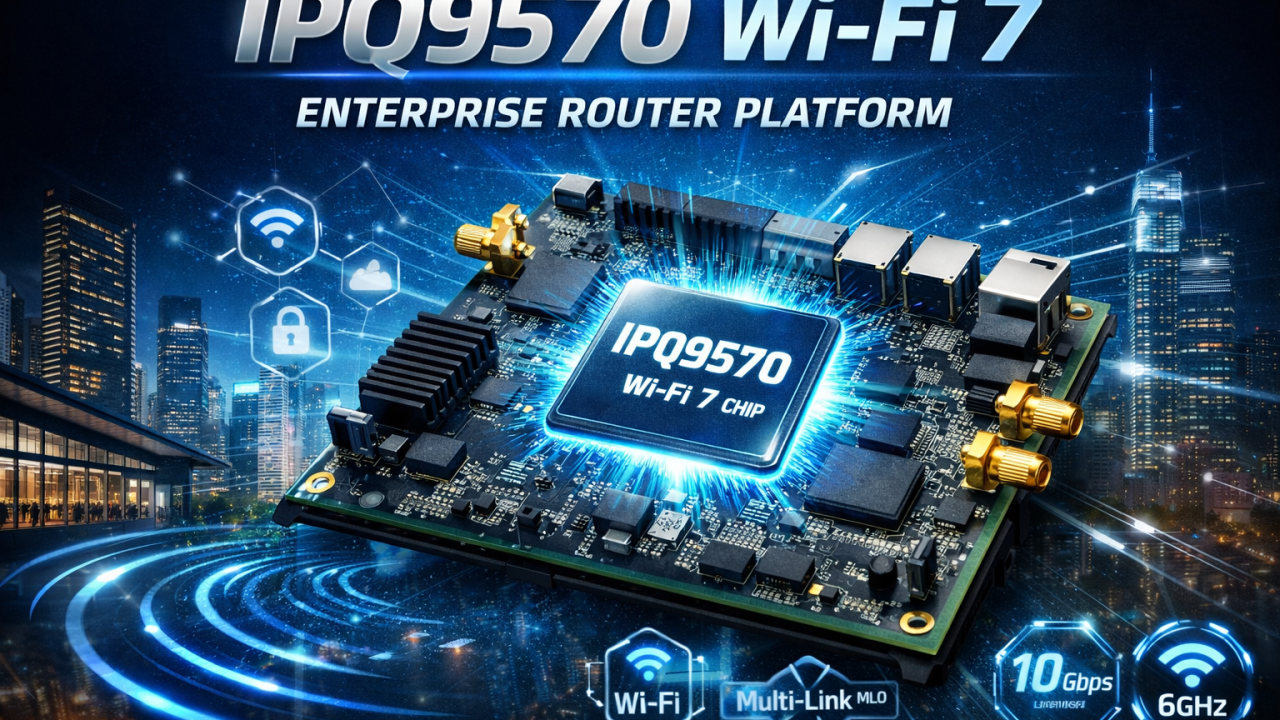
IPQ9570 Wi-Fi 7 Chip Overview: High-End Enterprise Router Platform

As Wi-Fi 7 (IEEE 802.11be) enters commercial deployment, enterprises and industrial users are demanding higher throughput, lower latency, stronger reliability, and scalable networking platforms. The Qualcomm IPQ9570 is designed precisely for these needs, positioning itself as a high-end Wi-Fi 7 router SoC for enterprise, industrial, and mission-critical networking applications.

This article provides a comprehensive overview of the IPQ9570 Wi-Fi 7 chipset, its key features, advantages, and typical application scenarios.

What Is IPQ9570?

The IPQ9570 is a flagship networking processor from Qualcomm’s Wi-Fi 7 router platform lineup. It targets enterprise-grade access points, high-performance gateways, and industrial routers, delivering advanced compute power, next-generation wireless capabilities, and rich wired connectivity.

Built for multi-gigabit networking, IPQ9570 is ideal for deployments where performance, stability, and long-term scalability are critical.

Key Features of IPQ9570 Wi-Fi 7 Platform

1. Wi-Fi 7 (802.11be) Support

IPQ9570 fully supports Wi-Fi 7, bringing major enhancements over Wi-Fi 6/6E:

  • 320 MHz channel bandwidth
  • Multi-Link Operation (MLO)
  • 4096-QAM
  • Significantly improved throughput and spectrum efficiency

These features enable ultra-fast wireless performance while maintaining stable connections in dense environments.

2. Multi-Link Operation (MLO)

One of the most important Wi-Fi 7 innovations, MLO, allows devices to transmit and receive data across multiple bands (2.4 GHz / 5 GHz / 6 GHz) simultaneously.

Benefits include:

  • Lower latency
  • Seamless roaming
  • Higher reliability
  • Reduced packet loss in mission-critical applications

This makes IPQ9570 particularly suitable for enterprise roaming, industrial mobility, and real-time communication systems.

3. High-Performance Quad-Core CPU

IPQ9570 integrates a high-performance quad-core processor, delivering strong computing capability for:

  • Advanced routing
  • Firewall and security services
  • VPN acceleration
  • Edge computing and traffic management

This ensures stable operation even under heavy traffic loads and complex network conditions.

4. Multi-Gigabit Ethernet Connectivity

To eliminate wired bottlenecks, IPQ9570 supports:

  • 2.5G / 5G / 10G Ethernet interfaces
  • High-speed LAN and WAN configurations

This enables full utilization of Wi-Fi 7 wireless speeds and supports modern enterprise network architectures.

5. Enterprise-Grade Security and Reliability

IPQ9570 is designed with enterprise and industrial reliability in mind, offering:

  • Hardware-accelerated security
  • Secure boot and encryption
  • Long-term platform support

It is well suited for 24/7 operation in demanding environments.

Typical Applications of IPQ9570

Thanks to its high-end positioning, IPQ9570 is widely applicable in:

  • Enterprise Wi-Fi 7 Access Points
  • High-performance Wi-Fi 7 Routers & Gateways
  • Industrial Wireless Routers
  • Smart Factories & Industrial Automation
  • Smart Ports, Airports, and Transportation Systems
  • Mesh & Seamless Roaming Networks
  • Edge Computing Gateways

IPQ9570 vs Previous-Generation Platforms

Compared with Wi-Fi 6/6E platforms, IPQ9570 offers:

  • Up to 2×–3× higher wireless throughput
  • Lower latency for real-time applications
  • Better performance in high-density environments
  • Improved future-proofing for next-generation devices

For enterprises planning long-term network upgrades, IPQ9570 provides a solid foundation.

Why Choose IPQ9570 for Wi-Fi 7 Projects?

Choosing IPQ9570 means investing in:

  • Future-ready Wi-Fi 7 performance
  • Enterprise-grade stability
  • Scalable hardware and software architecture
  • Support for advanced features like MLO and multi-gig Ethernet

It is an ideal solution for customers who require high reliability, customization flexibility, and long product lifecycle support.

Conclusion

The Qualcomm IPQ9570 stands out as a high-end Wi-Fi 7 router platform designed for enterprise and industrial applications. With support for Wi-Fi 7, MLO, multi-gigabit Ethernet, and strong processing power, IPQ9570 enables next-generation wireless networks that are faster, more reliable, and ready for the future.

For companies planning to deploy Wi-Fi 7 enterprise routers, industrial APs, or custom wireless solutions, IPQ9570 is a powerful and forward-looking choice.

524WiFi and Wallys IPQ9570 Router Board & ODM Services

We provide IPQ9570-based Wi-Fi 7 router boards and customized ODM solutions for enterprise and industrial applications.

With in-house R&D, manufacturing, and software customization capabilities, Wallys helps customers accelerate Wi-Fi 7 product development, from concept to mass production. Our IPQ9570 router board solutions support:

  • Wi-Fi 7 (802.11be) architecture with MLO support
  • Multi-gigabit Ethernet (2.5G / 5G / 10G) designs
  • Industrial-grade hardware options
  • Customized RF, antenna, and enclosure design
  • OpenWrt / Linux-based firmware customization
  • OEM / ODM / JDM project support

Whether you are building enterprise Wi-Fi 7 routers, industrial gateways, mesh & roaming systems, or customized wireless platforms, 524WiFi delivers flexible, reliable, and scalable solutions tailored to your project requirements.

Posted on

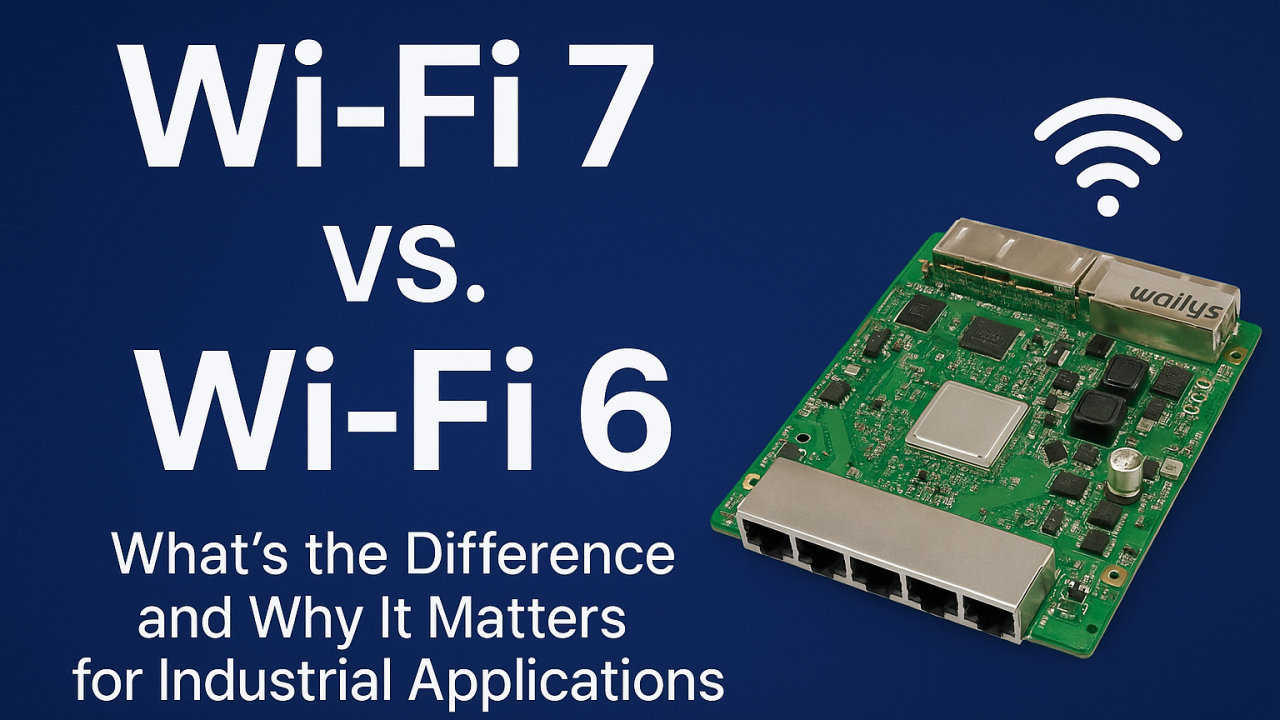
Wi-Fi 7 vs. Wi-Fi 6: What’s the Difference and Why It Matters for Industrial Applications?

As industrial environments become more automated, connected, and data-driven, the demand for a faster, more reliable wireless network continues to grow. Wi-Fi 6 has served industries well in recent years, but Wi-Fi 7 introduces features that fundamentally reshape performance, latency, and reliability—especially in mission-critical industrial applications.

Many factories, warehouses, and outdoor industrial sites are now evaluating whether upgrading to Wi-Fi 7 is worth it. The answer becomes clear once you understand the major improvements Wi-Fi 7 brings compared to Wi-Fi 6.


What’s New in Wi-Fi 7 Compared to Wi-Fi 6?

Wi-Fi 7 introduces several breakthroughs that directly benefit industrial environments:

Faster Speeds and Higher Throughput Wi-Fi 7 supports up to 320 MHz channels and 4K QAM, providing significantly higher bandwidth. This is especially beneficial for AI vision systems, 4K/8K video streams, and large volumes of sensor data in industrial scenarios.

Multi-Link Operation (MLO) This is the most important upgrade for industrial automation. MLO allows devices to connect to multiple Wi-Fi bands at the same time, dramatically enhancing:

  • Reliability
  • Latency
  • Roaming
  • Interference resistance

When one link experiences congestion or interference, data continues flowing through the other link—ideal for AGVs, AMRs, and robotic control systems.

Lower Latency for Real-Time Control Wi-Fi 7 reduces latency to sub-millisecond levels, enabling smoother machine-to-machine communication, PLC data exchange, and industrial robot coordination.

Better Performance in Noisy Industrial Environments Factories, ports, and warehouses contain many devices that create interference. Wi-Fi 7 handles these challenges through:

  • Intelligent multi-link scheduling
  • Faster channel switching
  • Improved OFDMA efficiency

This results in more stable wireless networks, even in heavily congested areas.


Why Wi-Fi 7 Matters for Industrial Applications

Enhanced Reliability for Smart Factories Real-time monitoring, predictive maintenance, and machine communication depend on uninterrupted connectivity. Wi-Fi 7 ensures stable links for sensors, controllers, and production lines.

Seamless Mobility for AGV and AMR Fleets Automated robots cannot afford Wi-Fi dead zones or packet loss. MLO supports smoother roaming, faster handovers, and high-precision navigation.

Better Edge Computing and AI Performance Industrial AI workloads often transmit large amounts of data for inference or analysis. Wi-Fi 7 accommodates high-throughput data without compromising stability.

Higher Density Support for IIoT Deployments Factories may have thousands of connected devices. Wi-Fi 7’s improved scheduling and wider channels support larger device ecosystems without congestion.

Strengthening Industrial Video Surveillance AI-enhanced cameras and real-time analytics benefit from Wi-Fi 7’s higher bitrate capacity and lower latency.


Real-World Industrial Use Cases for Wi-Fi 7

  • AGV/AMR navigation and fleet management
  • Smart logistics and warehouse management systems
  • Industrial video surveillance with AI analytics
  • Real-time sensor networks in smart factories
  • Wireless backhaul bridging for ports and outdoor sites
  • Edge computing devices with high data demands
  • Autonomous machines and robotics

Wi-Fi 7 enables smoother, safer, and more efficient industrial operations.


Why Choose 524WiFi and Wallys Wi-Fi 7 Routerboards?

We provide industrial-grade Wi-Fi 7 routerboards such as DR5322S (IPQ5322) and next-generation DR9574 (IPQ9574) that support:

  • Wi-Fi 7 + MLO
  • POE/POE Out
  • Long-distance transmission
  • Industrial temperature rating
  • Customizable hardware and firmware
  • Mesh & roaming solutions
  • OEM/ODM/JDM services for industry customers

Each board is optimized for harsh industrial deployment and supports custom configurations for automation, logistics, or edge computing projects.


Wi-Fi 7 is not just an incremental improvement over Wi-Fi 6—it’s a major leap designed for industries that require reliability, speed, and real-time responsiveness. For industrial automation companies planning future-proof networks, upgrading to Wi-Fi 7 can unlock significant performance and operational advantages.

For customized Wi-Fi 7 routerboards and industrial wireless solutions, contact us !

Posted on

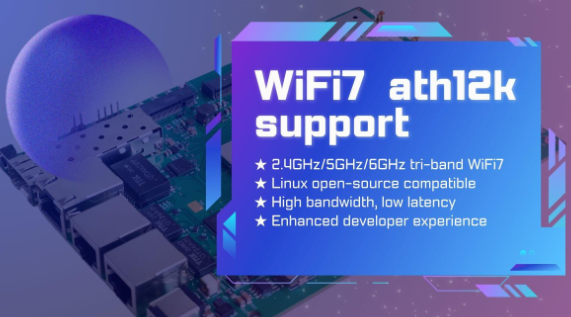
524 WiFi 7 modules from Wallys Now Fully Supports ath12k | Faster Performance & Open-Source Flexibility

524 WiFi 7 cards Now Fully Supports ath12k — Performance Unlocked, Connectivity Redefined

The evolution of WiFi 7 continues to accelerate, and open-source innovation is playing a key role in enabling faster development and deployment. We are excited to announce that our entire WiFi 7 product line now offers full compatibility with the ath12k driver — Qualcomm’s next-generation open-source wireless driver for Linux.

From high-performance router boards to enterprise-grade network cards, Wallys WiFi 7 platforms based on IPQ95xx, QCN92xx, and QCN62xx are now ready to take advantage of the powerful features and enhanced stability provided by ath12k.


Why ath12k Matters for WiFi 7 Development

As the successor to ath11k, the ath12k driver introduces major improvements tailored for WiFi 7’s advanced feature set. Developers, integrators, and enterprises gain stronger kernel support, increased flexibility, and a smoother path to building next-generation wireless systems.

Key Benefits of ath12k

  • Tri-band WiFi 7 support (2.4GHz / 5GHz / 6GHz) Supports core WiFi 7 technologies such as 4K-QAM, MLO, and Multi-Link Aggregation, unlocking higher throughput and reliability.
  • Deep compatibility with the Linux open-source ecosystem Ideal for companies building custom firmware or integrating WiFi 7 into specialized platforms.
  • Significant performance upgrades Improved speed, lower latency, and greater stability — perfect for enterprise networking, industrial IoT, MDUs, and outdoor deployments.
  • Developer-friendly architecture Open, flexible, and optimized for ODM/OEM workflows, reducing development time and increasing customization freedom.

WallysTech Products Now Supporting ath12k

With ath12k integration now complete across our WiFi 7 lineup, developers gain reliable and scalable platforms for their next wireless innovation.

1. DR9574 Series (IPQ9574)

A high-performance tri-band WiFi 7 router/AP mainboard designed for:

  • Enterprise WiFi networks
  • Industrial wireless systems
  • High-density environments
  • Multi-port, high-throughput applications

2. DR9274 & DR6274 WiFi 7 NICs (QCN9274 / QCN6274)

PCIe-based WiFi 7 network cards suitable for:

  • Custom Access Points
  • CPE devices
  • Industrial and outdoor wireless equipment
  • OEM/ODM hardware upgrades

3. Additional WiFi 7 SoC Mainboards

More WiFi 7 models are currently under development and will be added to the ath12k-enabled family soon, expanding options for integrators and solution providers.


Accelerating Real-World WiFi 7 Deployment

At 524WiFi and WallysTech, our mission is to deliver open, flexible, and production-ready wireless platforms to help customers shorten evaluation cycles and bring WiFi 7 products to market faster.

With full ath12k support, our WiFi 7 solutions now provide:

  • Greater openness for developers
  • Better compatibility with custom Linux systems
  • Improved performance for demanding use cases
  • A smoother upgrade path for companies transitioning to WiFi 7

Whether you’re building enterprise APs, industrial routers, outdoor IoT gateways, or custom wireless equipment, ours WiFi 7 platforms offer the performance and openness needed for next-generation deployments.

Article content

The integration of ath12k marks a major milestone for the WiFi 7 ecosystem. 524WiFi is proud to be among the first hardware solution providers to fully adopt the new driver across a broad product portfolio.

As WiFi 7 continues to redefine wireless performance, 524WiFi and WallysTech will keep delivering powerful, customizable, and future-ready solutions to help partners innovate with confidence.

Posted on

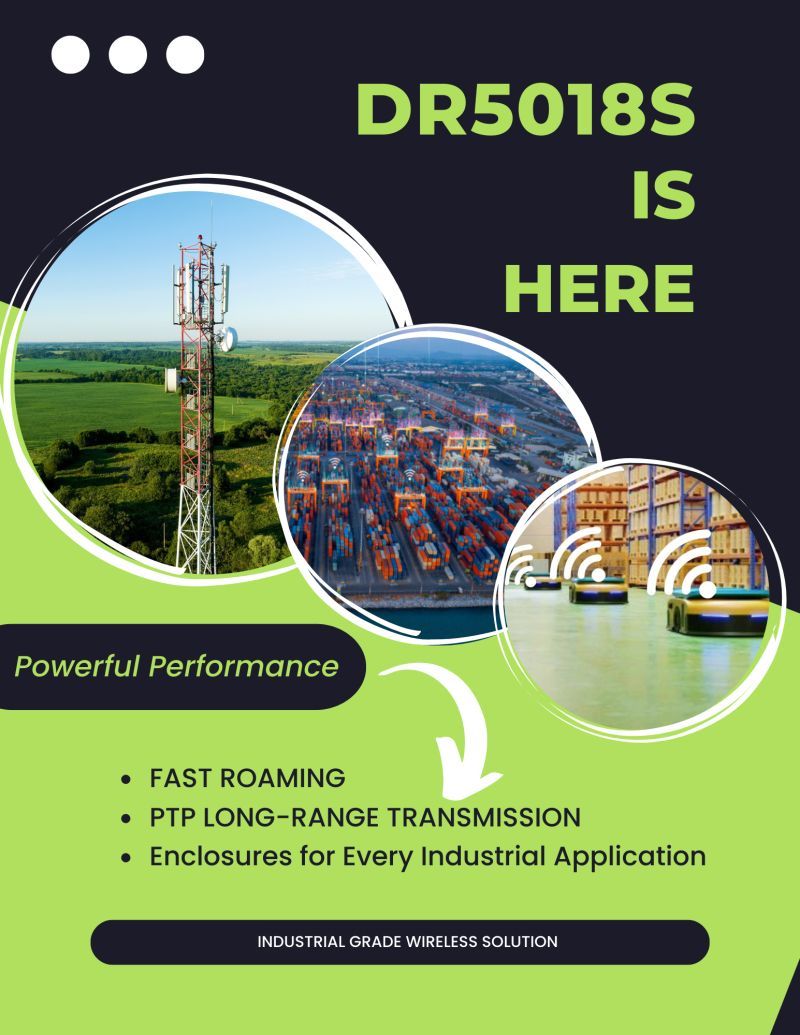
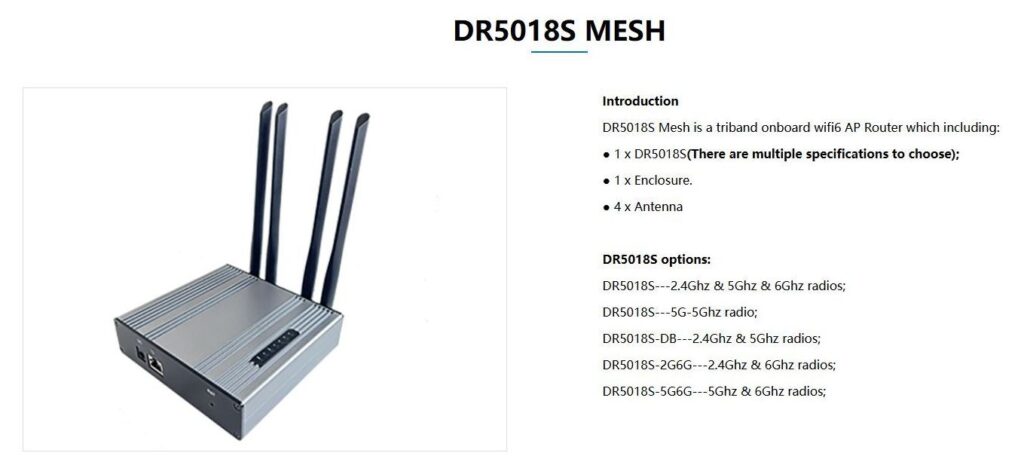
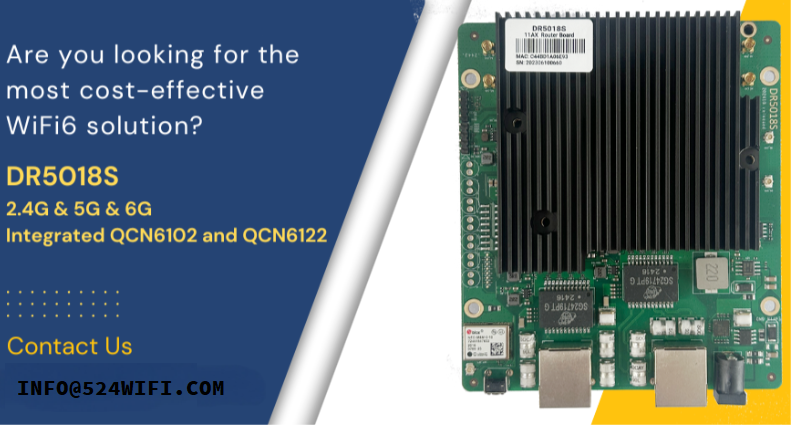
Introducing the DR5018S – Built for Industrial Grade Wireless – Qualcomm IPQ5018

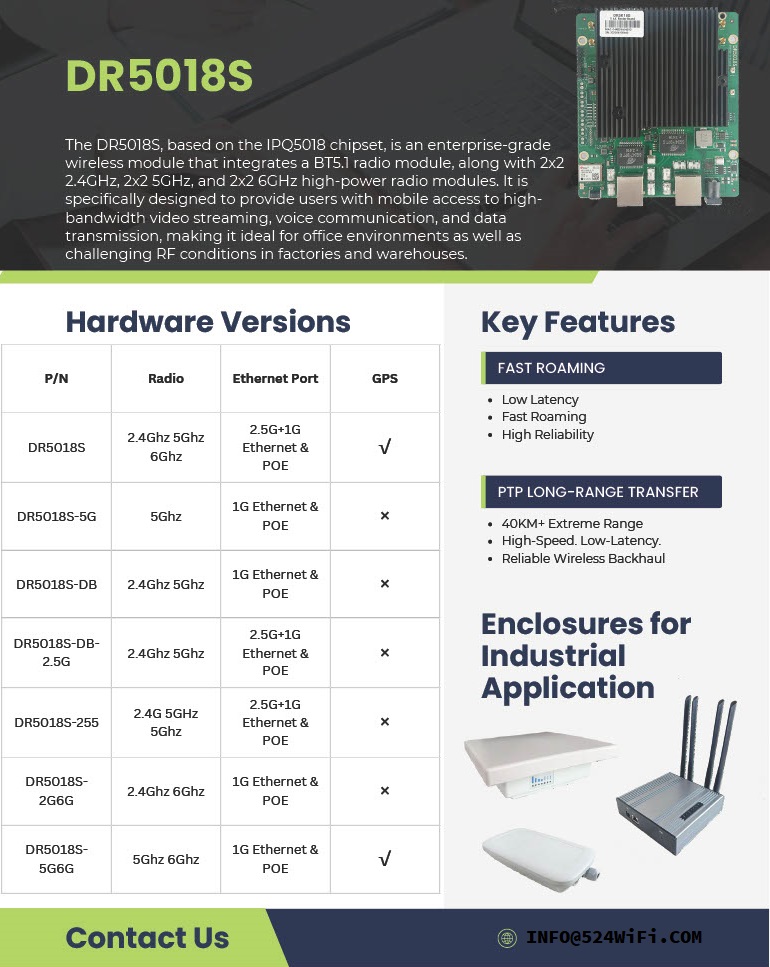
🚀 Introducing the DR5018S – Built for Industrial-Grade Wireless

From smart ports to logistics hubs to long-range PTP connections, the DR5018S is engineered to deliver:
✅ Fast Roaming
✅ 40km+ PTP Long-Range Transmission
✅ Flexible Enclosures for Any Industrial Application

Whether it’s powering connectivity in smart cities, transportation, or critical infrastructure, the DR5018S ensures powerful performance with reliability you can trust.

https://www.524wifi.com/index.php/catalogsearch/result/?q=5018s

xperience next-level WiFi 6 tri-band performance with the DR5018S Mesh – designed for industrial, enterprise, and large-scale applications. Seamless connectivity, EasyMesh support, and robust hardware all in one compact solution.
💡 Learn more and explore full specifications on our website:

https://524wifi.net/?s=dr5018s

: Introducing the DR5018S – Built for Industrial Grade Wireless – Qualcomm IPQ5018

🚀 When 5G NR Meets Mesh: Filling the Coverage Gaps

5G NR provides standardized, high-performance connectivity — but there are still scenarios where base station deployment is difficult or impractical:

Drone swarms requiring real-time coordination in remote airspace
Robots in underground mines where signals can’t penetrate
Military field operations demanding resilient, ad-hoc communication
In such environments, Mesh networks step in as a complementary layer, ensuring local connectivity even when 5G NR coverage is limited.

👉 Question for the community: Do you see Mesh as a temporary patch until 5G expands everywhere, or as a long-term complement to 3GPP 5G NR in mission-critical deployments?

Posted on

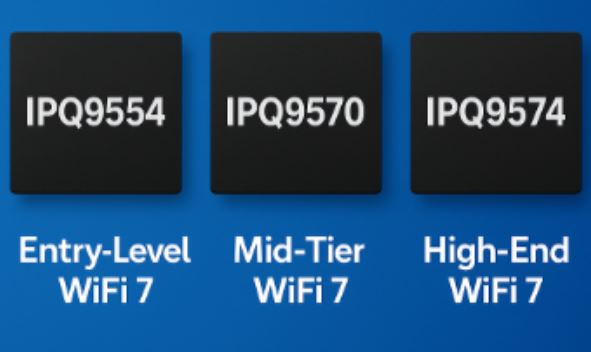
Qualcomm WiFi 7 Platforms Explained: IPQ9554, IPQ9570, and IPQ9574

WiFi 7 (802.11be) is the latest generation of wireless technology, designed to deliver unprecedented throughput, ultra-low latency, and improved reliability for both consumer and industrial applications. Qualcomm, as a leader in wireless innovation, has introduced several system-on-chip (SoC) platforms to power WiFi 7 devices—among them the IPQ9554, IPQ9570, and IPQ9574.

Though they all share the same WiFi 7 foundation, these three platforms are designed for different performance tiers and deployment scenarios.


1. Qualcomm IPQ9554 – Entry-Level WiFi 7 Platform

The IPQ9554 is positioned as an entry WiFi 7 solution, balancing performance and efficiency. It is suitable for devices that require reliable WiFi 7 functionality without the complexity of high-end designs.

Key Technical Points:

  • Supports Multi-Link Operation (MLO) and 4K QAM
  • Optimized for cost-effective and thermally efficient designs
  • Good fit for mainstream routers, small enterprise APs, and IoT gateways

2. Qualcomm IPQ9570 – Mid-Tier WiFi 7 Platform

The IPQ9570 is a step up from IPQ9554, offering stronger processing capabilities and enhanced wireless capacity. It is intended for environments with heavier traffic and multiple concurrent connections.

Key Technical Points:

  • Higher throughput and concurrency handling compared to IPQ9554
  • Designed for mesh networks and enterprise-grade deployments
  • Supports advanced WiFi 7 features such as enhanced MU-MIMO
  • Balanced between performance and power efficiency

3. Qualcomm IPQ9574 – High-End WiFi 7 Flagship

The IPQ9574 represents Qualcomm’s flagship WiFi 7 solution, designed for maximum performance in carrier-grade, enterprise, and industrial networks.

Key Technical Points:

  • Full WiFi 7 feature set: 320 MHz channels, MLO, 4K QAM, advanced MU-MIMO
  • High-capacity design for dense user environments
  • Optimized thermal management for sustained heavy workloads
  • Supports scalability in large enterprise networks, ISPs, and industrial deployments

4. Technical Comparison

Feature IPQ9554 IPQ9570 IPQ9574 Performance Tier Entry-Level Mid-Tier High-End Flagship WiFi 7 Support MLO, 4K QAMMLO, enhanced MU-MIMO Full WiFi 7 suite (MLO, 320 MHz, advanced MU-MIMO) Throughput Good Strong Excellent, highest Use Case SMB routers, small APsMesh, enterprise, industrialCarrier, enterprise, high-density deployments


5. Conclusion

Qualcomm’s WiFi 7 platforms are designed to cover the entire spectrum of networking needs:

  • IPQ9554 → A balanced entry for cost-sensitive designs.
  • IPQ9570 → A mid-tier option for enterprise and automation.
  • IPQ9574 → A flagship platform for maximum throughput and scalability.

By offering these three tiers, Qualcomm ensures that WiFi 7 technology can be applied across consumer, enterprise, and industrial networks, depending on performance and cost requirements.

Posted on

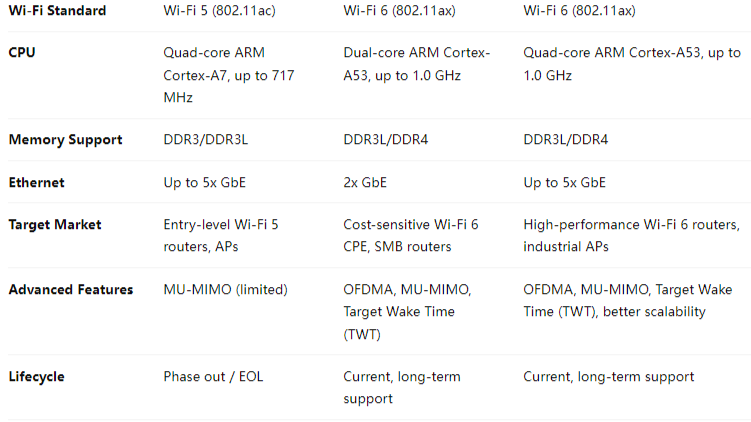
IPQ4019 IPQ4029 Phase Out Alert: Secure Your Upgrade Path with IPQ5018 IPQ5010

Introduction

The Qualcomm IPQ4019 and IPQ4029 chipsets have long been popular choices for cost-effective Wi-Fi 5 router boards and networking solutions. However, as Wi-Fi technology advances and demand for higher throughput, better efficiency, and longer product lifecycles grows, these chipsets are now entering the phase out stage.

For product developers and OEMs/ODMs who have built solutions around IPQ4019/IPQ4029, this shift raises a key question: What’s next?

The answer lies in Qualcomm’s next-generation IPQ5018 and IPQ5010 chipsets — designed to deliver superior Wi-Fi 6 performance while offering a cost-effective and future-proof path for industrial and enterprise networking solutions.


Why IPQ4019 / IPQ4029 Are Phasing Out

  • Wi-Fi 5 Limitations: With Wi-Fi 6 becoming the industry standard, Wi-Fi 5 chipsets like IPQ4019/4029 struggle to meet the growing requirements of high-density and high-throughput networks.
  • Lifecycle End
  • Market Demand: Clients now expect advanced features such as OFDMA, MU-MIMO, and improved energy efficiency — capabilities not fully supported by IPQ40xx chipsets.

Why Transition to IPQ5018 / IPQ5010?

1. Wi-Fi 6 Performance

  • Support for OFDMA and MU-MIMO, ensuring stable performance in dense environments.
  • Higher throughput and lower latency compared to IPQ4019/IPQ4029.

2. Cost-Effective Upgrade Path

  • IPQ5010 is ideal for entry-level Wi-Fi 6 solutions, providing a balance of performance and affordability.
  • IPQ5018 offers more robust capabilities for industrial and enterprise-grade products.

3. Extended Lifecycle

  • Qualcomm’s roadmap ensures that IPQ50xx series chipsets will receive long-term support, securing your product investments.

4. Industrial-Grade Applications

  • Rugged and reliable for deployments in smart cities, industrial Wi-Fi, surveillance, and long-distance outdoor networking.
  • Future-ready platform to support customized software development including OpenWrt and QSDK.

Our Solutions Based on IPQ5018/IPQ5010

At 524WIFI and Wallys Communications (Suzhou) Co., Ltd., we have developed a range of router boards and wireless solutions built on the IPQ50xx series. Our latest product, the DR5018S, leverages the IPQ5018 chipset to deliver:

  • High-performance Wi-Fi 6 connectivity
  • Multiple Gigabit Ethernet ports
  • Support for industrial applications
  • Flexible OEM/ODM/JDM customization options

With strong hardware and software expertise, we ensures a smooth migration from IPQ40xx-based platforms to IPQ50xx solutions.


Conclusion

The phase-out of Qualcomm’s IPQ4019/IPQ4029 chipsets signals the end of an era — but also the beginning of a new one. By adopting the IPQ5018 and IPQ5010, businesses can secure a future-proof, cost-effective, and high-performance upgrade path that aligns with the growing demand for Wi-Fi 6 technology.

For more details on our IPQ5018/IPQ5010 solutions, or to discuss OEM/ODM opportunities, please visit www.524wifi.com / .net or contact us at info@524wifi dot com or net

Quick Review / More Info:

Both DR4019 and DR5018S support:

  • Wallys AP Controller
  • Hardware SOM version
  • VLAN functionality

The latest DR5018S VLAN configuration guide is first published here: Blog Article

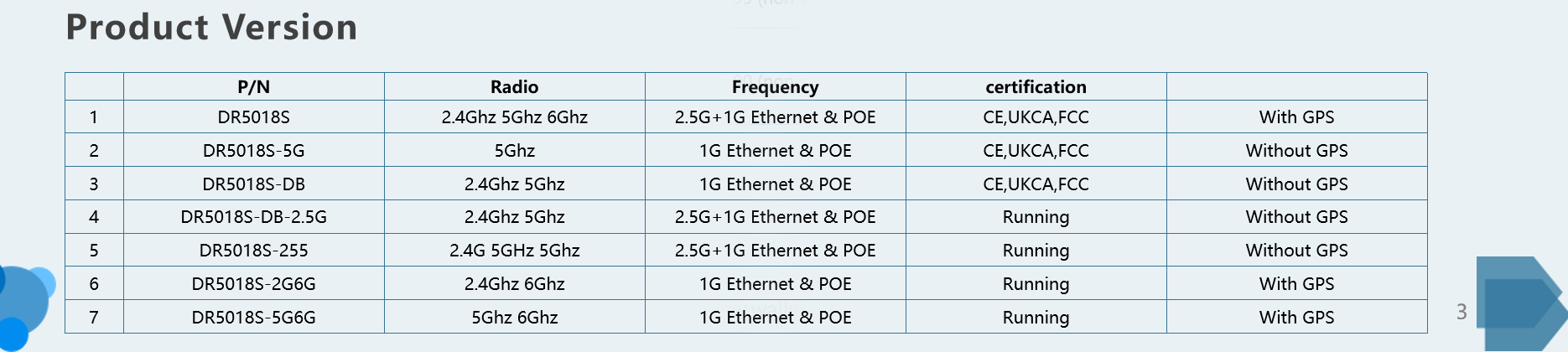
All available DR5018S Versions

Additional DR5018S features:

  • Mesh networking & seamless roaming
  • Long-range PTP over 30 km
  • GPS support
  • Tri-band option
  • FCC, CE, and UKCA certified
  • Proven performance: DR5018S-AP achieved a 14 km 5 GHz link test in Dongbei at 50 m height, with one-way throughput reaching 475 Mbps!
Posted on

IPQ8072 vs IPQ9574: Why Upgrade to Wi-Fi 7 for Your Next Wireless Project

The Qualcomm IPQ8072 has long been a reliable choice for Wi-Fi 6 networking hardware. Many enterprise routers, carrier CPEs, and industrial access points are still powered by IPQ8072 due to its strong balance of cost and performance. However, with the rapid evolution of Wi-Fi 7 (802.11be), the Qualcomm IPQ9574 offers significant technical advantages that make it the logical upgrade path for next-generation solutions.

In this article, we compare IPQ8072 vs IPQ9574, highlighting the major differences and why developers should consider migrating to Wi-Fi 7 hardware.


Overview of IPQ8072 (Wi-Fi 6 SoC)

The Qualcomm IPQ8072 is part of the IPQ807x family, designed for Wi-Fi 6. It features:

  • Quad-core ARM Cortex-A53 processor
  • 8×8 MU-MIMO capability
  • Up to 160 MHz channel bandwidth
  • 1024-QAM modulation
  • Robust support for enterprise and carrier-grade networking

While still capable, the IPQ8072 has reached maturity, and limitations in throughput and latency become noticeable in demanding applications.


Overview of IPQ9574 (Wi-Fi 7 SoC)

The Qualcomm IPQ9574 represents the new generation of Wi-Fi 7 platforms, optimized for ultra-high throughput and low latency. Key features include:

  • Enhanced multi-core CPU architecture for higher processing power
  • 320 MHz channel bandwidth (double that of IPQ8072)
  • 4096-QAM modulation for higher spectral efficiency
  • Support for Multi-Link Operation (MLO)
  • Designed for advanced enterprise, industrial, and carrier networks

This makes IPQ9574 ideal for data-heavy applications such as 8K video streaming, AR/VR, industrial IoT, and low-latency control systems.


IPQ8072 vs IPQ9574 Technical Comparison

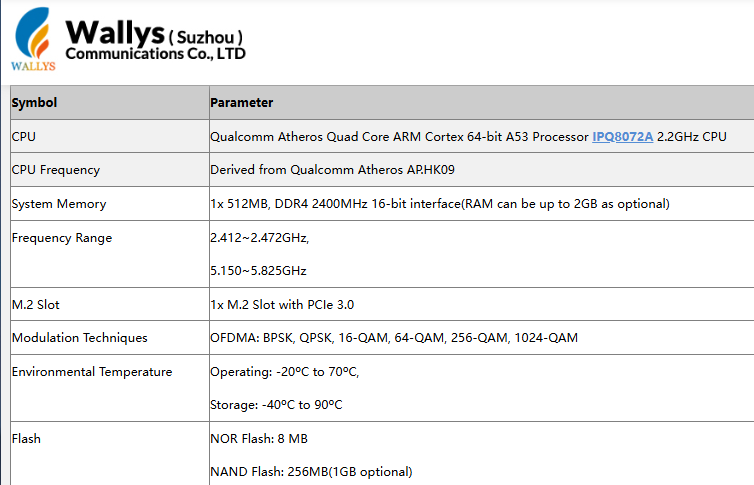
The Qualcomm IPQ8072 is a Wi-Fi 6 (802.11ax) SoC built with a quad-core Cortex-A53 processor. It supports channel bandwidths of up to 160 MHz and uses 1024-QAM modulation, making it a strong choice for enterprise routers, carrier CPE, and industrial APs.

Article content
Data from Wallys DR8072 Webpage

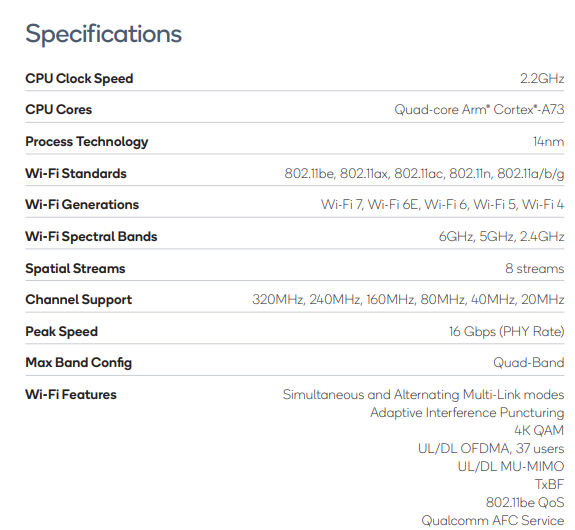
By contrast, the Qualcomm IPQ9574 belongs to the Wi-Fi 7 (802.11be) generation. It features a more advanced multi-core CPU architecture, supports 320 MHz channel bandwidth (double that of IPQ8072), and enables 4096-QAM modulation for higher spectral efficiency. Unlike IPQ8072, it also supports Multi-Link Operation (MLO), a Wi-Fi 7 feature that allows simultaneous use of multiple frequency bands to reduce latency and improve stability. These enhancements make IPQ9574 ideal for next-generation enterprise networks, industrial IoT deployments, low-latency applications, and high-density environments.

Article content
Data from Qualcomm IPQ9574 Datasheet

Why Upgrade from IPQ8072 to IPQ9574?

  1. Performance Leap – Wi-Fi 7 doubles available channel bandwidth and introduces 4096-QAM for significantly higher throughput.
  2. Ultra-Low Latency – MLO ensures faster and more reliable connectivity, critical for real-time applications.
  3. Future-Proofing – As Wi-Fi 6 hardware reaches end of lifecycle, Wi-Fi 7 ensures long-term product competitiveness.
  4. Scalability – IPQ9574’s stronger CPU supports more devices, traffic, and complex networking tasks.

524WiFi and Wallys’ IPQ9574 Router Board Solution

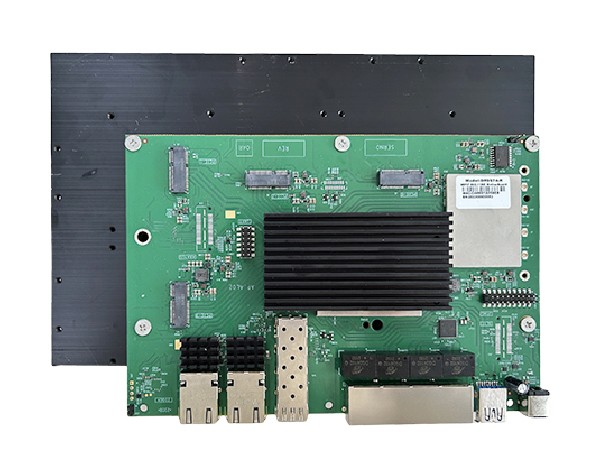
At 524WiFi, we provide hardware solutions based on Qualcomm IPQ9574, including the DR9574 Router Board, designed for Wi-Fi 7 networks. With strong processing power, advanced wireless features, and industrial-grade reliability, it is the perfect upgrade path for developers currently using IPQ8072-based designs.

Frequently Asked Questions (FAQ)

1. Is IPQ8072 still good in 2025?

Yes. The Qualcomm IPQ8072 is still a stable and cost-effective Wi-Fi 6 chipset, suitable for enterprise routers and industrial APs. However, for new projects that require higher throughput, lower latency, and longer product lifecycle, Wi-Fi 7 chipsets such as IPQ9574 are strongly recommended.

Article content
DR9574 board

2. What is the difference between IPQ8072 and IPQ9574?

The IPQ8072 is a Wi-Fi 6 (802.11ax) SoC, supporting up to 160 MHz bandwidth and 1024-QAM. The IPQ9574 is a Wi-Fi 7 (802.11be) SoC with 320 MHz bandwidth, 4096-QAM, and Multi-Link Operation (MLO), enabling much higher throughput and lower latency.

3. Why upgrade from Wi-Fi 6 to Wi-Fi 7?

Upgrading to Wi-Fi 7 provides faster data rates, reduced latency, and better efficiency in high-density environments. For applications such as AR/VR, 8K streaming, and industrial automation, Wi-Fi 7 ensures future-proof performance and competitiveness.

4. Does 524WiFi provide IPQ9574-based solutions?

Yes. 524WiFi and Wallys Communications offer router boards and network modules based on Qualcomm IPQ9574, including the DR9574 Router Board. These solutions are designed for enterprise, carrier, and industrial use cases that demand next-generation Wi-Fi 7 performance.