Posted on

The Impact of Quantum Computers on Traditional Encryption: Why Wi-Fi Technology Needs PQC Encryption

With the rapid advancement of quantum computing, traditional encryption standards are facing significant challenges. Quantum computers possess immense computational power, enabling them to break conventional encryption techniques in a fraction of the time. This poses a serious risk to many areas dependent on data security, including Wi-Fi communications. To protect future data transmissions, Wi-Fi technology urgently requires the implementation of Post-Quantum Cryptography (PQC) to address this emerging threat.

How Quantum Computing Threatens Existing Encryption Standards

  1. Weaknesses of Current Encryption Methods
    Currently, Wi-Fi encryption standards such as WPA2 and WPA3 rely on encryption algorithms like AES and RSA to secure data transmissions. These algorithms are based on the complexity of certain mathematical problems that traditional computers struggle to solve. However, quantum computers can leverage quantum bits’ parallel processing capabilities to crack these encryption methods swiftly. In particular, Shor’s algorithm can break RSA and ECC (Elliptic Curve Cryptography) methods, which rely on integer factorization and discrete logarithms, respectively. This exposes a critical vulnerability in today’s encryption protocols.
  2. Long-Term Risks to Data Security
    While quantum computers are not yet fully developed, the rapid progress of quantum technology means that, in the future, quantum computers could be powerful enough to crack the encrypted data we rely on today. Once this threshold is crossed, sensitive information transmitted over Wi-Fi networks—such as financial transactions and personal data—could be compromised. This is an urgent concern for both enterprises and individual users, particularly as Wi-Fi networks are used to transmit more sensitive and personal data.

PQC Encryption: Providing Quantum Resistance for Wi-Fi Technology

To address the threat of quantum computing, Post-Quantum Cryptography (PQC) has emerged as a new encryption solution. PQC algorithms are based on mathematical problems that remain secure even in the presence of quantum computing, such as lattice-based cryptography and multivariate equations. These new algorithms not only defend against quantum attacks but also provide additional security in today’s non-quantum computing environment.

  1. Enhanced Security for Wi-Fi Communications
    PQC can strengthen existing Wi-Fi encryption protocols (such as WPA3), ensuring that even if quantum attacks become a reality, data transmissions remain secure. This means that Wi-Fi users will continue to have secure and reliable network connections even in the quantum era.
  2. Protecting IoT Device Communications
    As more IoT devices connect to Wi-Fi networks, the need for robust security measures grows. PQC encryption can safeguard these devices’ communications from being compromised by attackers utilizing quantum computing capabilities, thereby ensuring the security of the entire IoT ecosystem.
  3. Mitigating Future Data Decryption Risks
    It’s essential to consider not only current threats but also future risks posed by quantum computing. PQC can protect encrypted data transmitted today, ensuring that even when quantum computers are fully operational, the data remains secure. This is crucial for industries that require long-term data storage, such as healthcare and finance.

Conclusion: The Future of Wi-Fi and PQC Encryption

As quantum computing technology evolves, Wi-Fi technology will face new challenges. Traditional encryption methods will no longer suffice, and the adoption of Post-Quantum Cryptography (PQC) will be essential to secure future data transmissions. At 524WiFi, we are committed to integrating PQC encryption into our Wi-Fi 7 solutions, ensuring robust security for future-proof data transmission and keeping your network safe from the quantum threat.

Posted on

IPQ9574 + QCN9274 From AGVs to Cobots: How WiFi 7 Optimizes Industrial Automation Communication

In the era of Industry 4.0, Automated Guided Vehicles (AGVs), Autonomous Mobile Robots (AMRs), and Collaborative Robots (Cobots) are transforming industrial operations, boosting efficiency and flexibility. Behind this revolution, wireless communication plays a crucial role.

Traditional WiFi struggles in industrial environments due to high latency, interference, and unstable connections, limiting the full potential of automation. However, WiFi 7 (802.11be) is here to change the game. 📡


🚀 Why Is WiFi 7 the Future of Industrial Automation?

WiFi 7 introduces four key breakthroughs that optimize industrial communication:

✅ Multi-Link Operation (MLO): Parallel Transmission, Ultra-Low Latency

  • Traditional WiFi operates on a single link, making it prone to congestion.
  • WiFi 7’s MLO technology enables 2.4GHz + 5GHz + 6GHz simultaneous transmission, ensuring seamless connectivity.
  • For AGVs and cobots, this means millisecond-level response times, preventing delays in automated workflows.

✅ 320MHz Bandwidth & 4096-QAM: Blazing-Fast Data Transmission

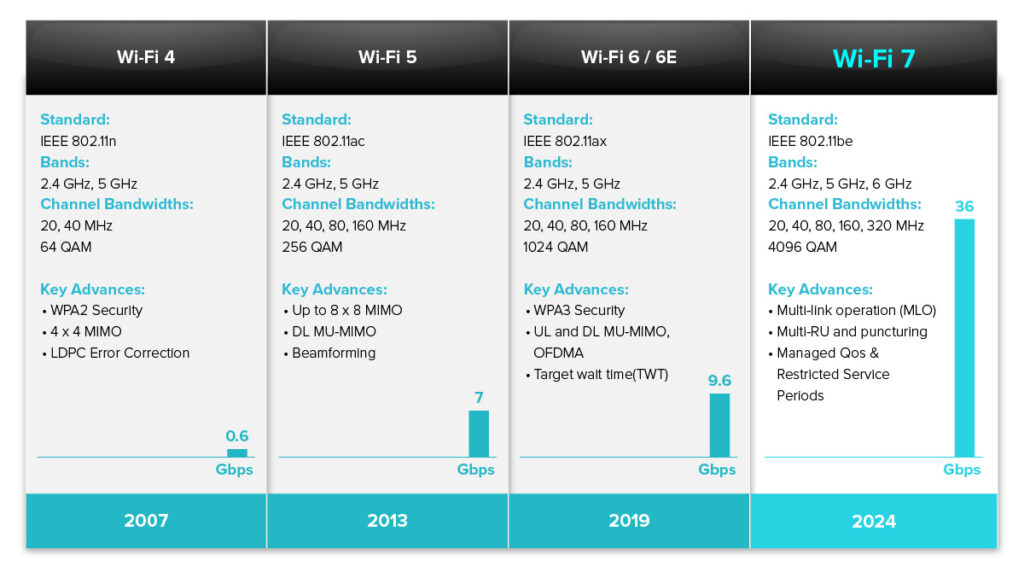
  • WiFi 7 doubles the bandwidth (160MHz → 320MHz), achieving 30Gbps+ speeds.
  • Industrial AI, real-time quality inspection, and robotic vision require high-speed data processing, which WiFi 7 easily supports.

✅ Ultra-Low Latency for Real-Time Control

  • Traditional WiFi latency is 10–30ms, causing robotic systems to lag.
  • WiFi 7 reduces latency to below 1ms, making it ideal for real-time industrial IoT, smart factories, and remote operations.

✅ Superior Interference Resistance for Industrial Stability

  • WiFi congestion in factories often leads to network dropouts.
  • WiFi 7’s dedicated 6GHz band reduces interference, ensuring AGVs, AMRs, and cobots operate without disruptions.

🔧 WiFi 7 in AGV & Cobot Applications

📦 1. AGVs & AMRs in Smart Warehousing

✅ Scenario:

  • AGVs navigate warehouses to transport goods autonomously, but unstable WiFi often causes navigation failures or stops.

✅ WiFi 7 Solution:

  • MLO ensures continuous, low-latency connections, even when AGVs move between different zones.
  • <1ms latency enables real-time obstacle avoidance, improving efficiency and safety.

🤖 2. Cobots in Smart Manufacturing

✅ Scenario:

  • Cobots work alongside human operators in electronics assembly and automotive manufacturing, requiring high precision.

✅ WiFi 7 Solution:

  • 30Gbps+ speeds enable seamless AI-powered quality control and robotic vision.
  • Dedicated 6GHz band ensures stable cloud connectivity, preventing cobots from experiencing data lag.

🏭 3. Industrial IoT & Remote Monitoring

✅ Scenario:

  • Factories deploy IoT sensors for temperature, pressure, and machine health monitoring.

✅ WiFi 7 Solution:

  • Ultra-wide bandwidth & low latency allow instant cloud updates, improving predictive maintenance.
  • Massive device connectivity supports thousands of IoT sensors simultaneously.

🌟 524WiFi WiFi 7 Solutions 🌟

🔥 Wallys DR9574 WiFi 7 Router Board

  • Qualcomm IPQ9574 + QCN9274 chipset
  • Supports 2.4G / 5G / 6G bands, optimized for industrial automation
  • QSDK 12.5 support for industrial Linux applications
  • long-range transmission, ideal for large-scale industrial deployments
Wallys WiFi 7 Solutions


3 Key Transformations WiFi 7 Brings to Industrial Automation

✅ Near-zero latency, enabling real-time AGV and robotic operations

✅ Higher bandwidth, supporting AI-powered vision, video streaming, and smart monitoring

✅ Stronger interference resistance, ensuring stable communication in complex environments

💡 WiFi 7 isn’t just an upgrade—it’s the ultimate game-changer for Industry 4.0! 🚀 With 524WiFi’ WiFi 7 solutions, smart factories, automated logistics, and cobots are stepping into a new era!

📢 Where else do you think WiFi 7 will revolutionize industrial applications? Let’s discuss!

Posted on

AIoT & Robotics Boom: How WiFi 6/7 Enables Seamless Wireless Networks

The rapid rise of AIoT (Artificial Intelligence of Things) and robotics is transforming industries, from smart manufacturing and autonomous logistics to healthcare and consumer robotics. As robots become more intelligent and interconnected, the need for high-speed, low-latency, and reliable wireless communication is greater than ever. WiFi 6 and WiFi 7 are emerging as key enablers of seamless connectivity in the AIoT-driven robotics revolution.

Challenges in Wireless Communication for AIoT and Robotics

AI-powered robots rely heavily on real-time data exchange, cloud processing, and collaborative operations. However, traditional wireless networks face several challenges in meeting these demands:

  • High Latency: Robotics applications, such as autonomous mobile robots (AMRs) and industrial automation, require ultra-low latency to ensure precise control and real-time decision-making.
  • Interference & Congestion: Dense industrial environments often experience significant wireless interference, affecting communication reliability.
  • Bandwidth Limitations: High-resolution sensors, AI-driven vision systems, and cloud-based data processing generate massive data streams that require high-throughput connectivity.
  • Seamless Roaming: Robots moving within factories, warehouses, or hospitals need smooth network transitions without disruptions.

How WiFi 6 and WiFi 7 Solve These Challenges

WiFi 6 and WiFi 7 introduce groundbreaking advancements that make them ideal for AIoT and robotic applications:

1. Ultra-Low Latency for Real-Time Control

  • WiFi 6: Features OFDMA (Orthogonal Frequency Division Multiple Access) and MU-MIMO, allowing multiple devices to communicate simultaneously, reducing latency.
  • WiFi 7: Introduces Multi-Link Operation (MLO), enabling robots to use multiple frequency bands simultaneously, further reducing latency and ensuring stable connectivity.

2. Enhanced Interference Resistance in Industrial Environments

  • WiFi 6: Uses BSS (Basic Service Set) Coloring to minimize co-channel interference, improving efficiency in dense environments.
  • WiFi 7: Supports Adaptive Preamble Puncturing, allowing devices to avoid interference dynamically and maintain high-speed connections.

3. High Bandwidth for AI-Driven Applications

  • WiFi 6: Expands channel width up to 160 MHz, supporting high-throughput applications like AI-powered vision systems.
  • WiFi 7: Doubles the bandwidth with 320 MHz channels, significantly boosting data rates for real-time AI processing and high-resolution sensor data transmission.

4. Seamless Roaming for Mobile Robots

  • WiFi 6 & 7: Both support enhanced roaming protocols, ensuring robots moving within large-scale environments (factories, warehouses, hospitals) maintain uninterrupted connectivity.

524WiFi’ WiFi 6/7 Solutions for Robotics & AIoT

524WiFi and Wallys, a leading providers of industrial wireless solutions, offers a range of high-performance WiFi 6 and WiFi 7 modules and router boards designed for AIoT and robotic applications. Key products include:

  • DR5018S (WiFi 6) – A robust router board featuring Qualcomm IPQ5018, optimized for low-latency and high-speed industrial connectivity.
  • DR9574 (WiFi 7) – A next-gen WiFi 7 router board powered by IPQ9574, delivering exceptional performance with Multi-Link Operation and 320MHz bandwidth.
  • DR9074 Network Card – A high-speed WiFi 6E module for seamless AIoT data transmission in robotic applications.

Conclusion: WiFi 6 & 7—The Future of AIoT and Robotics Connectivity

As AIoT and robotics continue to evolve, reliable and high-performance wireless networks will be the backbone of their success. WiFi 6 and WiFi 7 provide the speed, low latency, and seamless connectivity required for next-generation robotic applications. By integrating cutting-edge WiFi solutions, businesses can unlock the full potential of AI-powered automation and create truly intelligent, interconnected environments.

Posted on

Robotics + Edge Computing: How WiFi 7 Enhances Data Transmission Efficiency

Introduction

The rapid advancements in robotics and edge computing have revolutionized industries such as manufacturing, healthcare, logistics, and smart cities. However, these innovations require ultra-fast, low-latency, and highly reliable wireless communication to function effectively. Enter WiFi 7 (802.11be)—the next-generation wireless standard that significantly improves data transmission efficiency, making it an ideal solution for robotics and edge computing applications.

Challenges in Robotics and Edge Computing Connectivity

Robotic systems and edge devices process vast amounts of data in real time, often in environments with high device density, dynamic movement, and complex networking needs. Some of the key connectivity challenges include:

  • High Bandwidth Demand – Robots generate and transmit high-resolution sensor data, video feeds, and AI computations, requiring ultra-fast wireless speeds.
  • Low Latency Requirement – Real-time control, decision-making, and autonomous navigation depend on millisecond-level latency.
  • Interference & Network Congestion – Industrial and urban environments are packed with multiple wireless devices, leading to potential signal interference and congestion.
  • Seamless Handover & Reliability – Mobile robots, drones, and AGVs (Automated Guided Vehicles) need consistent connectivity without dropouts when moving across different network zones.

How WiFi 7 Enhances Data Transmission Efficiency for Robotics & Edge Computing

1. Multi-Link Operation (MLO) for Lower Latency & Higher Reliability

WiFi 7 introduces Multi-Link Operation (MLO), allowing devices to simultaneously transmit and receive data over multiple frequency bands (2.4 GHz, 5 GHz, and 6 GHz). This enhances:

  • Lower latency by dynamically selecting the best path with minimal interference.
  • Increased reliability by enabling seamless switching between channels, preventing disruptions in robotic control systems.

2. Wider Channel Bandwidth (Up to 320 MHz) for Faster Data Transmission

WiFi 7 supports 320 MHz channel bandwidth (double that of WiFi 6), offering significantly higher data transfer speeds. For edge AI applications and real-time video analytics, this means:

  • Faster data exchange between robotic sensors and edge servers.
  • Reduced congestion in high-density environments such as smart factories or hospitals.

3. 4K QAM Modulation for Increased Data Throughput

WiFi 7 introduces 4096-QAM (4K QAM), compared to 1024-QAM in WiFi 6, boosting the amount of data transmitted per signal. This results in:

  • Up to 20% higher throughput, making it ideal for transmitting high-resolution images, LIDAR data, and AI-driven commands in real-time.
  • Improved efficiency for multi-robot coordination and cloud-edge communication.

4. Better Performance in Congested Environments

With features like Preamble Puncturing, WiFi 7 can efficiently utilize spectrum even in noisy environments, preventing bandwidth wastage. This is especially useful in:

  • Industrial automation, where multiple machines operate wirelessly.
  • Smart cities, where multiple sensors, cameras, and edge devices coexist.

5. Deterministic Latency for Time-Sensitive Operations

WiFi 7 introduces deterministic latency mechanisms, ensuring that time-sensitive robotic tasks are completed with predictable timing. This is crucial for:

  • Robotic surgery and medical robotics, where even slight delays can impact outcomes.
  • Autonomous vehicles and drone networks, where real-time decision-making is critical.

Real-World Applications of WiFi 7 in Robotics & Edge Computing

🔹 Smart Manufacturing

  • WiFi 7 enables real-time monitoring and control of robotic arms and AGVs in factories.
  • High-speed connectivity ensures seamless data exchange between sensors, AI models, and cloud platforms.

🔹 Healthcare & Medical Robotics

  • Enhances low-latency video streaming for remote robotic surgeries and AI-driven diagnostics.
  • Supports real-time data analytics in hospitals with multiple edge AI applications.

🔹 Autonomous Vehicles & Drones

  • WiFi 7’s high throughput and MLO allow faster V2X (Vehicle-to-Everything) communication for autonomous driving.
  • Drones used in agriculture, surveillance, and delivery services benefit from more reliable long-range communication.

Conclusion

WiFi 7 is a game-changer for robotics and edge computing, providing the necessary speed, reliability, and efficiency to support next-generation AI-driven applications. As industries adopt autonomous systems, real-time AI processing, and IoT, WiFi 7 will be at the core of ensuring seamless and intelligent connectivity.

Looking for a WiFi 7 hardware solution for your robotics or edge computing project? Contact us for industrial-grade WiFi 7 router boards, network cards, and custom solutions.

Posted on

The New Era of Wi-Fi 7: Elevating the Network to the Next Level – MediaTek MT7996

In the ever-evolving landscape of wireless communication, 524WiFi has once again asserted its commitment to innovation by diving headfirst into the realm of Wi-Fi 7 technology. As the demand for faster and more reliable connectivity continues to surge, 524WiFi’s strategic move positions the company at the forefront of the next generation of wireless networking.

524WiFi’s Wi-Fi 7 technology, utilizing MediaTek MT7996, leverages MediaTek’s distinctive 4T5R technology platform with advanced receiver diversity techniques and MRC (Multiple Receive Chains). This boosts throughput in the 6GHz frequency for indoor use, delivering wider coverage, top-notch performance, and a stable, efficient 6GHz mesh backhaul. As a manufacturer committed to maximizing MediaTek’s capabilities, AsiaRF strives to collaboratively craft an enhanced connectivity experience for Wi-Fi 7.

What is Wi-Fi 7

WiFi 7, based on the new IEEE 802.11be standard, operates in three frequency bands: 2.4 GHz, 5 GHz, and 6 GHz. With a maximum bandwidth of 320 MHz in the 6 GHz band, it significantly boosts data transfer rates, addressing the need for faster and more efficient wireless communication in modern networks.

Advantages of Wi-Fi 7 Technology

  • Ultra-High Speed:

Wi-Fi 7 operates on the 6GHz spectrum, enabling the use of channels as wide as 320Hz, further enhancing transmission speeds and achieving a threefold increase compared to the previous generation.

  • Low Latency:

Wi-Fi 7 technology reduces latency, offering more real-time connectivity suitable for applications with stringent low-latency requirements, such as video conferencing.

  • Multi-Link Operation (MLO):

Using Multiple Link Operation (MLO), Wi-Fi 7 enables devices to transmit and receive data across different frequency bands and channels simultaneously, enhancing throughput and reducing latency.

  • Reliable Connectivity:

The use of advanced modulation techniques and signal processing in Wi-Fi 7 enhances the reliability of wireless connections, reducing the likelihood of signal interference and disruptions in enterprise environments.

In summary, Wi-Fi 7, as the next-generation wireless technology, with its enhanced speed and performance, is set to redefine our online experience. 524WiFi is at the forefront of innovation, gearing up to launch high-performance Wi-Fi 7 products, including system platforms and modules. These products will elevate our connectivity experience to higher levels. Anticipate the exciting advancements that Wi-Fi 7 and 524WiFi´s upcoming products promise to bring, leading us into a new era of seamless and superior wireless connectivity.

Posted on

Qualcomm IPQ5312 WiFi 7 SoC for Industrial Use Cases

Qualcomm IPQ5312 WiFi 7 SoC for Industrial Use Cases

The rapid evolution of wireless communication technologies has paved the way for groundbreaking solutions in industrial applications. Qualcomm’s IPQ5312 WiFi 7 SoC is one such innovation, offering unparalleled performance and versatility tailored to meet the unique demands of industrial use cases. In this article, we explore the key features of the IPQ5312 SoC and its potential impact on industrial sectors.

Key Features of Qualcomm IPQ5312

1. WiFi 7 Technology

The IPQ5312 leverages the latest WiFi 7 advancements, including Multi-Link Operation (MLO), 320 MHz channel support, and enhanced modulation schemes like 4K-QAM. These features deliver ultra-high throughput, low latency, and robust connectivity, even in challenging environments.

2. High Integration for Industrial Applications

Designed with industrial-grade reliability, the IPQ5312 integrates powerful CPU cores and network accelerators, making it suitable for applications like smart factories, automated logistics, and industrial IoT. The integration of multiple interfaces ensures seamless connectivity across diverse systems.

3. Enhanced Security

Industrial deployments demand high levels of security. The IPQ5312 includes advanced encryption and secure boot features to protect against cyber threats, ensuring reliable and safe operations.

4. Energy Efficiency

Energy efficiency is critical in industrial settings to reduce operational costs. The IPQ5312 is optimized for low power consumption without compromising performance, making it ideal for applications requiring 24/7 operation.

Industrial Use Cases

1. Smart Manufacturing

With its ability to handle high device density and provide low-latency communication, the IPQ5312 is ideal for smart manufacturing setups. It can connect sensors, machinery, and control systems in real-time, enabling predictive maintenance and operational efficiency.

2. Warehouse Automation

Automated guided vehicles (AGVs) and robotic systems rely on uninterrupted connectivity to perform their tasks efficiently. The IPQ5312’s robust WiFi 7 capabilities ensure smooth data transmission, even in environments with heavy interference.

3. Smart Ports

Ports require seamless communication between cranes, vehicles, and control centers. The IPQ5312 supports long-range, high-speed communication, streamlining operations and improving safety in port logistics.

4. Industrial IoT (IIoT)

The IPQ5312’s high throughput and low latency make it an excellent choice for IIoT applications, where real-time data collection and processing are critical.

Why Choose Qualcomm IPQ5312?

Qualcomm’s legacy in wireless technology innovation ensures that the IPQ5312 offers the reliability, performance, and scalability required for industrial applications. Its comprehensive feature set and focus on security, efficiency, and connectivity make it a standout choice for industries aiming to adopt next-generation wireless solutions.

Conclusion

The Qualcomm IPQ5312 WiFi 7 SoC represents a significant leap forward for industrial wireless communication. Its advanced capabilities align perfectly with the evolving needs of industries seeking to enhance productivity, security, and connectivity. As the industrial landscape becomes increasingly digital, solutions like the IPQ5312 will play a pivotal role in shaping the future.

For more information about industrial-grade WiFi solutions, visit 524WiFi 7 DR5322 Router Board

Posted on

Access Controller + AP vs. Mesh Networking: Which Offers Better Coverage for Your Industrial Setup?

AC+AP Networking vs. Mesh Networking

In today’s rapidly advancing wireless technologies, networking has evolved significantly to meet the growing demand for faster and more reliable internet connectivity. Two popular methods for expanding Wi-Fi coverage in various environments are AC+AP and Mesh networking. While both methods aim to improve the coverage and performance of wireless networks, they differ in their architecture and functionality.

What is AC+AP Networking?

AC+AP Networking refers to a traditional approach in which an Access Point (AP) is connected to a central device, such as a router or a wireless controller (AC). This setup is often used in larger environments where multiple APs are deployed to extend Wi-Fi coverage, particularly in enterprise settings.

  • Access Point (AP): An AP is a device that allows wireless devices to connect to a wired network. It acts as a bridge between the wired network and wireless clients.
  • Access Controller (AC): The AC is a centralized device that manages multiple APs, providing a single point of control for wireless network configuration, security settings, and performance optimization.

The AC+AP solution works well for environments where there is a need for extensive control over the network, such as in large office buildings, campuses, or industrial sites. However, the key challenge with this setup is that the coverage area might be limited by the range of each individual AP, and users may experience interruptions when moving between APs.

What is Mesh Networking?

On the other hand, Mesh Networking is a more modern approach that involves multiple wireless nodes working together as a network. Each node in a Mesh network communicates with the others to create a seamless, self-healing Wi-Fi coverage area. This method is particularly effective in environments where extended coverage is required, such as homes, large enterprises, or industrial spaces with complex layouts.

  • Nodes: Mesh networks consist of multiple nodes (which can function as both APs and routers) that collaborate with one another to extend coverage.
  • Self-Healing: One of the key benefits of a Mesh network is that if one node fails, the others can automatically adjust to maintain network stability without interruptions.
  • Seamless Roaming: Mesh networks offer seamless connectivity, allowing users to move freely between nodes without experiencing connectivity drops or network handoffs.

Mesh networks are ideal for environments with complex, large-scale spaces, and they are particularly useful in overcoming dead zones that traditional Wi-Fi setups may fail to cover.

Wallys’ Mesh and AC+AP Solutions

At Wallys, we understand the need for high-performance wireless solutions that cater to diverse networking environments. Whether you’re looking for robust connectivity for industrial environments or home office setups, our solutions can meet your needs.

  • Wallys AC+AP Solutions: Our AC+AP systems are designed for large-scale, enterprise-level networks where centralized control and extensive coverage are essential. With features like high-speed throughput, efficient roaming, and seamless integration, our AC+AP solutions offer a reliable, cost-effective way to expand network coverage without compromising performance.
  • Wallys Mesh Solutions: Wallys’ Mesh networking solutions offer flexibility, ease of setup, and seamless connectivity across large, complex spaces. Our Mesh systems are designed to handle high-density environments, ensuring stable connections across multiple devices. These solutions are ideal for industrial settings, smart cities, large homes, and office networks. With Wallys’ Mesh solutions, you can ensure consistent performance, even in challenging environments with multiple obstructions.

Both AC+AP and Mesh solutions are fully customizable to meet your specific needs, whether you’re deploying them in industrial, commercial, or residential environments.

Contact Us for Testing

We invite you to explore the power and flexibility of Wallys’ networking solutions. Our team is ready to assist you with testing our AC+AP and Mesh products to ensure they meet your requirements. For more information and to schedule a test, please get in touch with us

Posted on

Is It Time to Upgrade? IPQ5018 and IPQ5010 vs. IPQ4019 and IPQ4029 Performance Breakdown

WIFI 7 IS HERE, ARE YOU STILL STUCK WITH WIFI 5?

With the rapid evolution of wireless communication, industries relying on stable and high-performance connectivity must stay ahead. If you’re still using WiFi 5 solutions, it’s time to explore the new generation of industrial networking with 524WiFi’ DR5018S router board powered by IPQ5018 / IPQ5010.


Where Are the Application Scenarios?

Industrial WiFi demands reliability, long-range coverage, and high bandwidth. The DR5018S series is designed for applications such as:

  • Smart factories
  • Security surveillance
  • Industrial automation
  • Outdoor deployments
  • IoT & edge computing networks

These environments require low latency, enhanced throughput, and better multi-device connectivity, making WiFi 6 a necessity.


The Former Advantages of DR4019

The DR4019, based on IPQ4019, has long been a go-to solution for many industrial applications due to its stability, affordability, and performance in WiFi 5 networks. It has served well in demanding environments, offering a balance between cost and capability. However, as connectivity demands grow, an upgrade is essential.


Why Upgrade to WiFi 6?

WiFi 6 offers significant improvements over WiFi 5, such as:

  • Higher speeds – Increased data rates for better efficiency.
  • Lower latency – Ideal for real-time applications.
  • Improved device handling – Supports a higher number of connected devices efficiently.
  • Better power efficiency – Crucial for IoT applications.
  • OFDMA & MU-MIMO – Ensures smooth data transmission in congested environments.

These advantages make WiFi 6 an obvious choice for next-gen industrial applications.


Is Industrial WiFi 6 Much More Expensive Than WiFi 5?

One common concern is pricing. While WiFi 6 solutions may have a slightly higher upfront cost, they offer long-term benefits such as improved performance, extended lifespan, and reduced operational costs. With 524WiFi, you get cost-effective WiFi 6 solutions tailored for industrial use.


When Should I Choose WiFi 6 and When Should I Opt for WiFi 7?

  • Choose WiFi 6 (IPQ5018/IPQ5010) if you need a reliable, cost-effective, and high-performance upgrade from WiFi 5.
  • Consider WiFi 7 when you require multi-link operation (MLO), extremely high throughput, and lower interference in advanced applications.

For most industrial needs today, WiFi 6 remains the best balance of performance and cost.


Why Choose us?

524WiFi and Wallys provide end-to-end industrial wireless solutions, combining hardware and software expertise:

  • Custom Hardware & Firmware Development – Tailored solutions for specific applications.
  • Advanced WiFi Protocol Optimization – Specialized features for industrial use.
  • OEM/ODM Services – Fully customized manufacturing options.
  • Expert Software Support – In-house development for specialized industrial protocols.
  • Strong After-Sales & Technical Support – Ensuring smooth deployments and long-term reliability.

The DR5018S Series – Tailored Industrial Solutions

524WiFi and Wallys have launched three models of the DR5018S router board to meet diverse industrial requirements:

Please check more informations : https://524wifi.net/?s=5018s and https://524wifi.net/?s=4029

Posted on

Why IPQ5322 is the Ideal Choice for Wi-Fi 7 IoT Networks

As the demand for faster, more reliable wireless connectivity continues to grow, the need for advanced networking solutions has never been greater. One of the standout solutions for next-generation wireless networks is the IPQ5322 chip, which supports Wi-Fi 7 (802.11be). Developed by Qualcomm, the IPQ5322 is optimized to deliver exceptional performance, efficiency, and scalability, making it the perfect choice for IoT (Internet of Things) applications that require high-speed, low-latency connections. In this article, we’ll explore why the IPQ5322 is the ideal solution for Wi-Fi 7 IoT networks.

1. Wi-Fi 7: The Future of Connectivity

The IPQ5322 is built to support Wi-Fi 7, the latest Wi-Fi standard offering several key enhancements over its predecessors. Wi-Fi 7 introduces wider channels, faster data transfer speeds, and lower latency, providing a significantly better user experience. With Wi-Fi 7, the IPQ5322 is capable of supporting multi-gigabit speeds and seamless, stable connections even in high-demand environments. This is particularly crucial for IoT devices that need to transfer large amounts of data quickly and reliably.

2. High-Speed Data Transfer for IoT Devices

One of the main advantages of Wi-Fi 7, and by extension the IPQ5322, is its ability to handle higher bandwidth and support more devices simultaneously. This is essential for IoT networks where devices like sensors, cameras, and smart devices are constantly communicating with each other. The increased data transfer rates provided by Wi-Fi 7 enable faster communication between devices, which is crucial for time-sensitive applications like industrial automation, smart cities, and healthcare monitoring.

With the IPQ5322, IoT networks can experience high-speed data transfer without sacrificing reliability, allowing devices to operate smoothly and efficiently even in crowded environments with many connected devices.

3. Low Latency for Real-Time IoT Applications

Latency is a critical factor for many IoT applications that require real-time communication. The IPQ5322 supports low-latency operation thanks to the improvements in Wi-Fi 7, ensuring that data is transmitted with minimal delay. This makes the chip ideal for mission-critical IoT applications, such as autonomous vehicles, remote surgery, or smart grids, where milliseconds matter.

The low latency offered by the IPQ5322 ensures that data is transmitted quickly, helping to reduce any potential delays that could compromise the performance of these real-time systems.

4. Efficient Use of Spectrum with Multi-Link Operation (MLO)

Wi-Fi 7 introduces Multi-Link Operation (MLO), a feature that enables devices to use multiple frequency bands simultaneously, improving throughput, reliability, and reducing interference. The IPQ5322 fully supports MLO, making it possible to aggregate 2.4GHz, 5GHz, and 6GHz bands for more efficient and flexible use of the wireless spectrum.

This feature is particularly valuable in IoT environments where devices may be spread across large areas, or where interference from other networks can degrade performance. MLO ensures that devices stay connected and operate at optimal speeds, no matter where they are located within the network.

5. Enhanced Network Efficiency and Scalability

IoT networks are typically large-scale systems consisting of many interconnected devices. The IPQ5322 excels in supporting large, scalable IoT networks by enabling devices to operate with optimal efficiency. With Wi-Fi 7’s advanced modulation techniques, the chip can handle high-density environments, where a large number of devices are simultaneously transmitting and receiving data.

The increased capacity of Wi-Fi 7 ensures that IoT networks can grow without sacrificing performance. Whether it’s a smart home with hundreds of devices or an industrial setting with thousands of sensors and machines, the IPQ5322 can scale to meet the needs of the network.

6. Improved Security for IoT Applications

Security is a top priority in IoT networks, where devices often handle sensitive data. The IPQ5322 integrates advanced security features to protect IoT devices from threats. Wi-Fi 7 includes enhanced encryption protocols and more secure authentication methods, ensuring that data transmitted over the network remains safe from unauthorized access.

The IPQ5322’s security features are critical for industries that require high levels of data integrity, such as healthcare, finance, and critical infrastructure. With the IPQ5322, IoT devices can communicate securely, safeguarding both user data and network integrity.

7. Energy Efficiency for Long-Lasting IoT Devices

While Wi-Fi 7 provides superior performance, it also maintains energy efficiency, which is crucial for IoT devices that run on batteries or need to minimize power consumption. The IPQ5322’s power-efficient design ensures that devices can operate for longer periods without frequent charging, making it ideal for battery-powered IoT devices deployed in remote or hard-to-reach locations.

8. Cost-Effective for Mass Deployment

Despite its high-end performance, the IPQ5322 offers a cost-effective solution for deploying Wi-Fi 7 IoT networks at scale. The chip’s affordability, combined with its advanced capabilities, makes it an attractive choice for businesses and organizations looking to deploy large-scale IoT solutions without exceeding their budgets.

DR5322 Product Information

The DR5322 is a powerful wireless solution based on the Qualcomm IPQ5322 chip, designed to meet the growing demands of modern IoT networks. Here are some key features and applications of the DR5322:

DR5322 Features

  • Qualcomm IPQ5322 Quad-Core Cortex-A53 @ 1.5GHz processor for robust performance.
  • 2×2 on-board 2.4GHz radio, offering up to 573Mbps physical data rate for reliable connectivity.
  • Supports 2×2 5GHz & 2×2 6GHz QCN9274/QCN6274 Wi-Fi 7 modules, delivering up to 5764Mbps physical data rate for high-speed wireless transmission.
  • Equipped with 4 x 2.5Gbps Ethernet ports and 1x 10Gbps SFP port, providing fast and flexible wired connectivity options.

Applications

  • 802.11be MU-MIMO OFDMA Access Point: Ideal for high-demand wireless environments with multiple devices.
  • Internet of Things (IoT): Perfect for large-scale IoT networks that require high-speed, low-latency connectivity.
  • HD Streaming and Gaming: Supports high-definition content streaming and low-latency gaming, making it suitable for entertainment applications.

The DR5322 is a versatile, high-performance solution for IoT, smart homes, industrial applications, and more, offering next-generation Wi-Fi 7 capabilities with advanced features for seamless connectivity and optimal performance.

Posted on

Exploring the Potential of # ath12k in Industrial, Home, and Enterprise Settings

In the rapidly advancing world of wireless technology, ath12k is emerging as a focal point thanks to its exceptional connectivity capabilities and open architecture. It has shown remarkable value across various application scenarios.

🏭 Industrial Applications: In complex industrial environments, ath12k stands out with its robust performance, supporting more stable device connectivity, optimizing production processes, and achieving more efficient automation.

🏠 Home Networking: For modern households, ath12k, with its support for WiFi 6 and 6E technology, meets high bandwidth demands, enhances the seamless operation of smart home devices, and improves the experience of streaming high-definition videos and online gaming.

🏢 Enterprise Solutions: In corporate settings, ath12k’s low-latency characteristics in high-density environments make video conferencing and large data transfers more efficient, thereby boosting team collaboration and workflow efficiency.

🔜 We are excited to announce that 524WiFi and Wallys are developing ath12k solutions with WiFi 7 support, expected to be available soon! We believe this will further enhance user experience and drive the advancement of wireless technology.

🤝 We invite you to share your thoughts or experiences with ath12k applications in the comments, and let us know what you expect from the upcoming WiFi 7 support! We look forward to engaging with you and advancing technology together.