

From IPQ8074 to IPQ9574: How Wi-Fi 7 Redefines Wireless Performance
As wireless networks evolve, the leap from Qualcomm’s IPQ8074 (Wi-Fi 6/6E) to the next-generation IPQ9574 (Wi-Fi 7) represents one of the most significant performance shifts in recent years. For industrial, enterprise, and high-density environments, this upgrade isn’t just incremental—it’s transformational. In this article, we break down what changes with Wi-Fi 7, why IPQ9574 is a major step forward, and how it unlocks new possibilities for advanced wireless solutions.
1. The Legacy of IPQ8074: A Strong Wi-Fi 6 Foundation
Qualcomm’s IPQ8074 helped establish Wi-Fi 6/6E in demanding applications by offering:
- High throughput via 8×8 5 GHz + 4×4 2.4 GHz capabilities
- OFDMA and MU-MIMO for better multi-user efficiency
- Enhanced reliability through higher modulation and optimized scheduling
- Support for 6 GHz (Wi-Fi 6E) in many deployments
This platform has been widely used in enterprise APs, outdoor CPEs, industrial gateways, and operator-grade devices. But growing demand for ultra-low latency, multi-link performance, and higher spectrum efficiency set the stage for the next leap: Wi-Fi 7.
2. Enter IPQ9574: Qualcomm’s Wi-Fi 7 Powerhouse
The IPQ9574 brings a new architecture, improved RF design, and cutting-edge Wi-Fi 7 features. Key upgrades include:
✔ 320 MHz Channel Support
Wi-Fi 7 doubles the maximum channel width from 160 MHz (Wi-Fi 6) to 320 MHz, enabling much higher peak throughput.
✔ Multi-Link Operation (MLO)
One of the biggest breakthroughs:
- Devices can simultaneously use multiple bands
- Improved reliability, near-zero latency, and seamless failover
- Ideal for industrial and mission-critical networks
✔ Higher Modulation: 4096-QAM
Compared to IPQ8074’s 1024-QAM, Wi-Fi 7 pushes spectral efficiency even further.
✔ Enhanced OFDMA & Preamble Puncturing
Better resource allocation in congested spectrum environments.
✔ Multi-RU Capability
More flexible scheduling across users and channels.
3. Performance Comparison: IPQ8074 vs IPQ9574
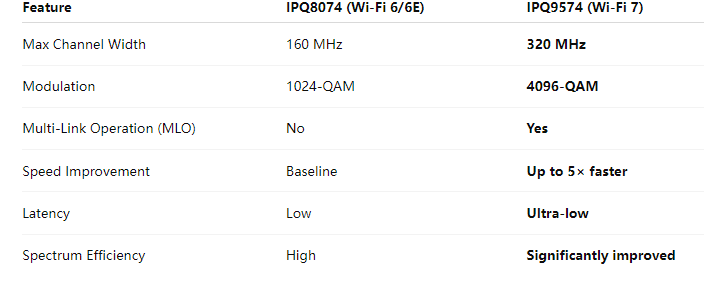
The IPQ9574 isn’t just faster—it is more stable, adaptive, and efficient, especially in congested or industrial environments.
4. Real-World Impact: Why the Upgrade Matters
✔ Industrial IoT
- Stable multi-link communication
- Reduced packet loss in noisy RF environments
- Higher throughput for camera streams, sensors, and gateway devices
✔ Enterprise and Public Networks
- Better performance in stadiums, airports, shopping malls
- Improved roaming and handoff with MLO
✔ Outdoor Wireless & WISP
- Stronger long-range performance
- Less interference due to flexible spectrum use
✔ AI, Edge Computing & Real-Time Apps
- Consistent high-speed connection
- Enabling latency-sensitive applications such as robotics and AR/VR
5. Hardware Evolution: DR8074 → DR9574
As the chipset evolves, so do high-performance hardware platforms. Our DR9574 brings the full power of the IPQ9574 Wi-Fi 7 SoC into a production-ready board designed for:
- 2× 10G Ethernet + 4× 1G Ethernet
- 4× M.2 slots for QCN9274/6274 Wi-Fi 7 radios
- Industrial-grade operation
- High-power RF design for long-range wireless
- Customizable firmware and OpenWrt/QSDK support
It is an ideal upgrade path for users currently deploying DR8074/IPQ8074 platforms but looking to move into Wi-Fi 7 performance levels.
6. Conclusion: Wi-Fi 7 Redefines What’s Possible
The transition from IPQ8074 to IPQ9574 is more than a chipset upgrade—it is a shift to a new era of wireless networking:
- Faster speeds
- Lower latency
- Higher reliability
- Better performance in crowded environments
- New capabilities through MLO and 320 MHz channels
For industrial, enterprise, and high-density deployments, adopting Wi-Fi 7 solutions such as the IPQ9574-based DR9574 creates a stronger, more scalable wireless infrastructure ready for the future.