Posted on — Leave a comment

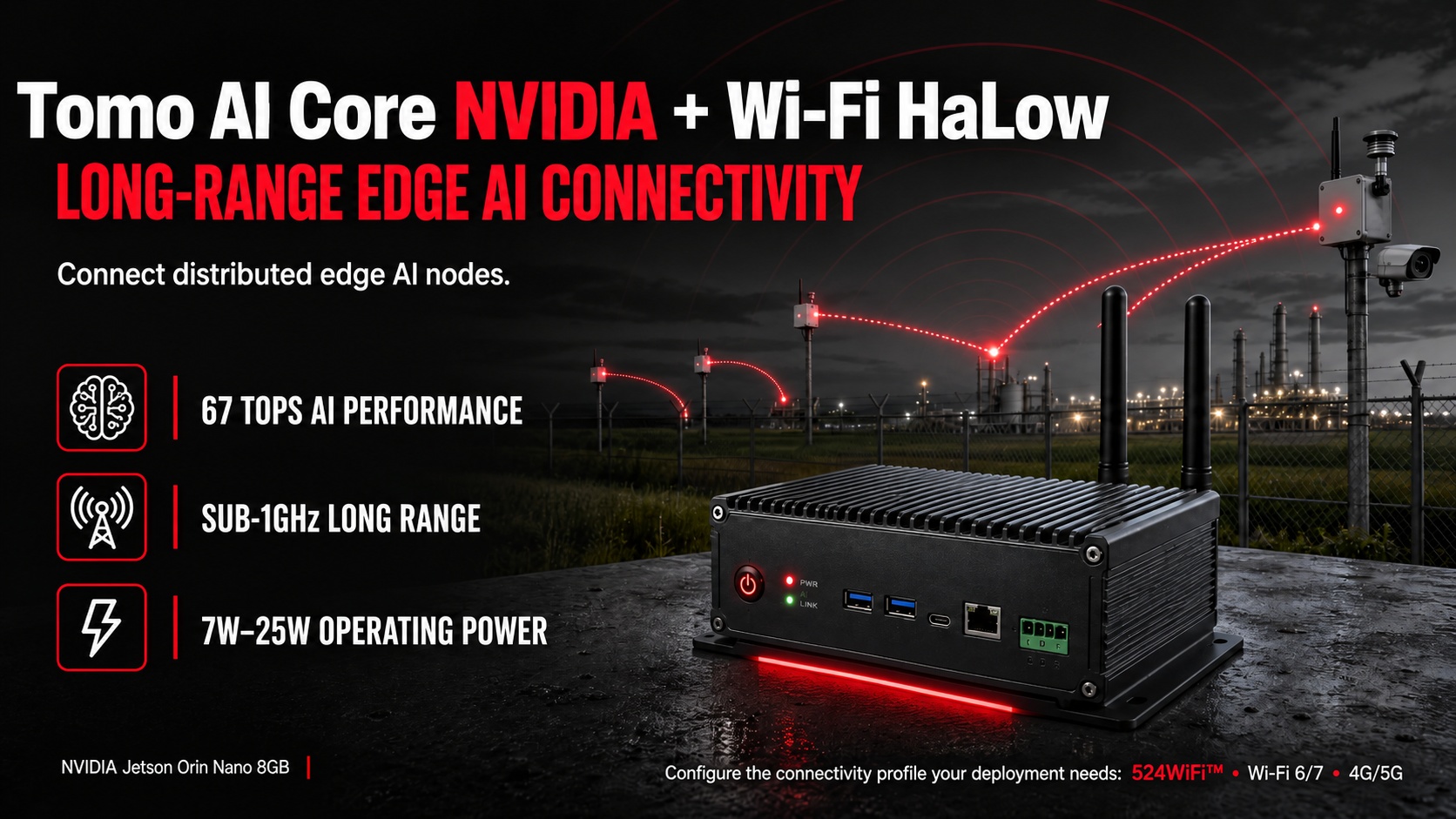
Tomo AI Core NVIDIA + Wi-Fi HaLow: Long-Range Edge AI Connectivity

524WiFi™ Tomo AI Core NVIDIA with Wi-Fi HaLow for distributed edge AI connectivity

Edge AI devices are only as useful as the network they run on. A vision model that can detect a defect or a person in real time is worthless if the data can’t get back to the control system — especially in outdoor, long-range, or power-constrained deployments where traditional 2.4GHz/5GHz Wi-Fi simply doesn’t reach. That’s the gap Wi-Fi HaLow (IEEE 802.11ah) is built to close, and it’s now available as a connectivity option for the 524WiFi™ Tomo AI Core NVIDIA, our NVIDIA Jetson Orin Nano-based edge AI platform.

What Is Wi-Fi HaLow and Why Does Edge AI Need It?

Wi-Fi HaLow operates in the sub-1GHz spectrum (900MHz ISM band in most regions) instead of the 2.4GHz/5GHz bands used by conventional Wi-Fi. Lower frequency signals travel farther and penetrate walls, foliage, and structural obstacles far more effectively — which is exactly why HaLow is positioned by the Wi-Fi Alliance for long-range, low-power IoT and sensor connectivity rather than high-bandwidth video streaming.

For edge AI deployments, this matters in a specific way: many Jetson-based inference nodes don’t need gigabit throughput — they need to reliably send detection results, telemetry, or compressed metadata back to a gateway from hundreds of meters away, often on battery or solar power. That’s a connectivity profile standard Wi-Fi and even LTE/5G aren’t always the right fit for, either on range, power draw, or cost.

How Wi-Fi HaLow Connects with the Tomo AI Core NVIDIA

The Tomo AI Core NVIDIA pairs an NVIDIA Jetson Orin Nano 8GB SOM (67 TOPS AI performance, 1024-core Ampere GPU, 6-core Arm Cortex-A78AE CPU) with a industrial carrier board built for industrial edge deployment — 5x Ethernet (including PoE), CAN FD, RS485, GPIO, and M.2 PCIe NVMe expansion.

Wi-Fi HaLow is integrated as a module option on that same carrier board, alongside the existing 2.4G/5.8G Wi-Fi and optional 4G/5G cellular paths. In practice this means a single AI Box can be configured for the connectivity profile the deployment actually needs: short-range high-bandwidth Wi-Fi for a warehouse, cellular for a mobile asset, or HaLow for a long-range, low-power sensor or camera node spread across an outdoor site.

Wi-Fi HaLow vs. Traditional Wi-Fi for Long-Range Edge AI

The two technologies solve different problems rather than competing head-to-head.

Range: traditional 2.4/5GHz Wi-Fi typically covers tens of meters indoors; Wi-Fi HaLow’s 900MHz band extends to hundreds of meters, up to roughly 1km line-of-sight.

Obstacle penetration: traditional Wi-Fi signal degrades quickly through walls and foliage; HaLow’s lower frequency travels through obstacles more effectively.

Power consumption: traditional Wi-Fi draws more power, which is fine for mains-powered devices; HaLow’s lower power draw suits battery- or solar-powered nodes that need to run for months between service visits.

Throughput: traditional Wi-Fi 6/7 scales up to multi-Gbps for video and high-bandwidth workloads; HaLow trades throughput for range and efficiency, which is enough for sensor telemetry and detection metadata but not for streaming video.

Best fit: traditional Wi-Fi suits dense, high-bandwidth environments like a multi-camera inspection line; HaLow suits long-range, low-power, distributed nodes like an outdoor perimeter or a field spread across acres.

A multi-camera vision inspection line still needs Wi-Fi 6/7 for bandwidth; a perimeter sensor network spread across a farm or port doesn’t — which is why the Tomo AI Core NVIDIA supports both as configurable options rather than picking one.

Edge AI Applications Enabled by Wi-Fi HaLow

  • Agriculture: Jetson-based cameras or sensor nodes spread across large fields, sending detection or telemetry data back to a central gateway without running cable or relying on cellular coverage.
  • Perimeter and outdoor security: long-range camera nodes in ports, campuses, or industrial yards where mesh Wi-Fi backhaul isn’t practical.
  • Logistics and asset tracking: distributed sensor nodes across a yard or warehouse exterior, where battery life matters more than throughput.
  • Smart infrastructure: environmental or condition-monitoring sensors feeding low-power edge AI nodes over long distances.

524WiFi™ Tomo AI Core NVIDIA + Wi-Fi HaLow: Hardware Summary

  • Compute: NVIDIA Jetson Orin Nano 8GB SOM (part of the Jetson Nano/Orin Nano product family), 67 TOPS AI performance, 1024-core Ampere GPU with 32 tensor cores, 6-core Arm Cortex-A78AE CPU, 8GB 128-bit LPDDR5
  • Connectivity options: Wi-Fi HaLow (long-range, sub-1GHz), onboard 2.4G/5.8G Wi-Fi, optional 4G/5G (Nano SIM), 5x Ethernet (1x independent PoE 48V RJ45 + 4x shared RJ45)
  • Interfaces: CAN FD, RS485, RS232, 4x USB 3.0, USB-OTG, 4x GPIO, HDMI 2.0, M.2 PCIe NVMe 2280
  • Power: 7W–25W operating range

If you’re evaluating long-range or low-power connectivity for a Jetson-based edge AI deployment, we’re happy to talk through whether Wi-Fi HaLow, industrial Wi-Fi 6/7, or a hybrid configuration fits your use case. Reach us at info at 524wifi.net or .com

Platform reference: DR Cube.
Posted on — Leave a comment

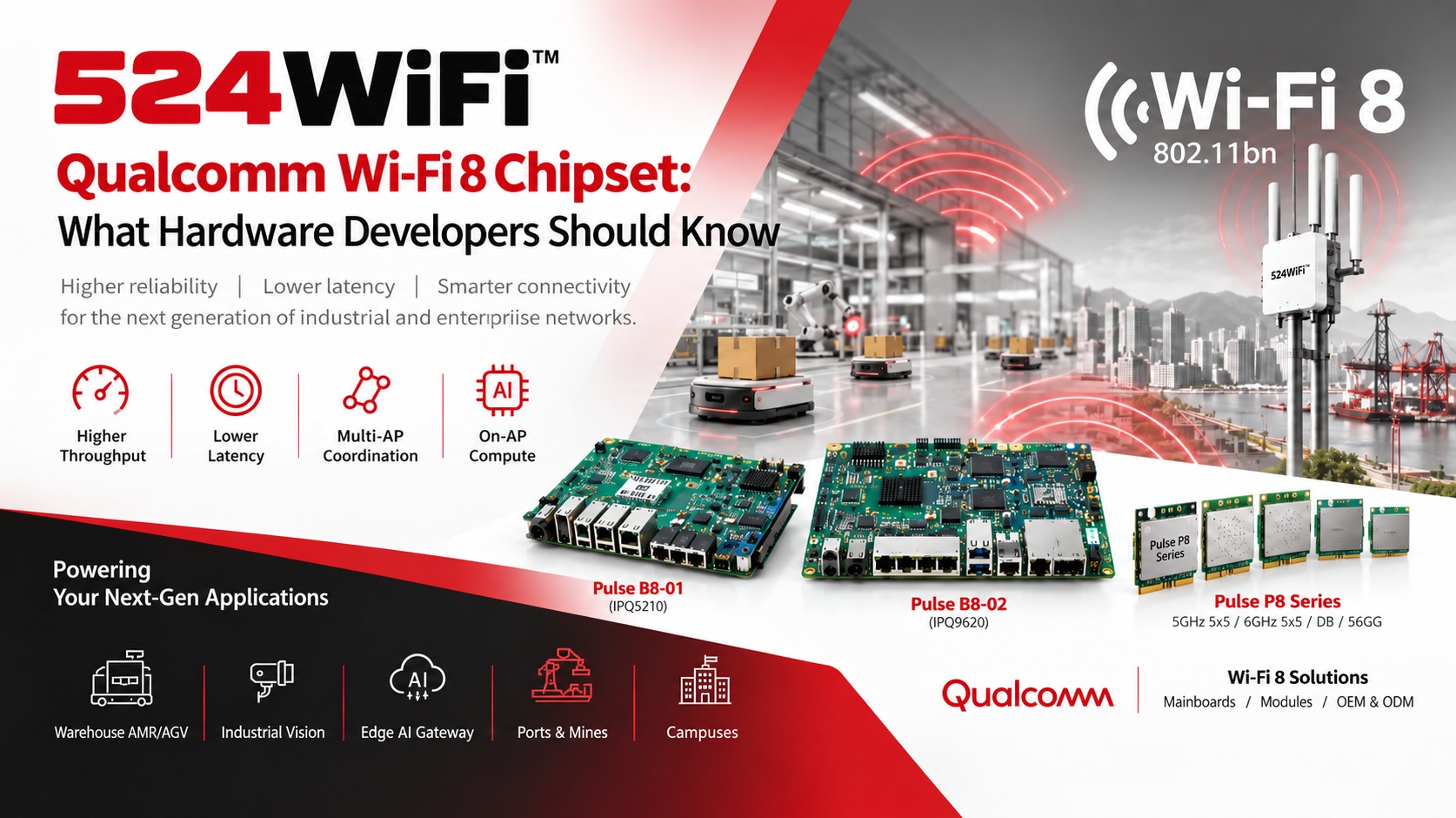
Qualcomm Wi-Fi 8 Chipset: What Hardware Developers Should Know

524WiFi™ Pulse B8 mainboards and Pulse P8 radio modules on Qualcomm Wi-Fi 8 technology

Wi-Fi 8 (IEEE 802.11bn) has moved from a standards discussion into silicon you can design around. Qualcomm’s MWC 2026 launch gave hardware teams a concrete platform to plan against. Here is what matters for developers building routers, industrial APs, gateways and robot connectivity.

What Is Qualcomm’s Wi-Fi 8 Platform, and Why Does It Matter?

Qualcomm launched a Wi-Fi 8 portfolio with a mobile chip (FastConnect 8800) and new Dragonwing networking platforms aimed at broadband gateways, enterprise access points and fixed wireless equipment. The infrastructure flagship is the Dragonwing NPro A8 Elite, part of the IPQ96 family. rcrwireless

The headline specs from Qualcomm’s materials:

  • A 5×5 Wi-Fi 8 radio system, with up to 40% more throughput at typical distances, 2.5x lower latency at peak usage, and up to 30% lower daily energy use than the previous generation techpowerup
  • A penta-core CPU up to 2.0 GHz, a Hexagon NPU, and a peak PHY rate of up to 33 Gbps qualcomm
  • Capacity for up to 1,500 clients in infrastructure gear dev

The design goal is reliability, not just peak speed. Wi-Fi 8 is meant to be about reliability rather than raw speed. For hardware developers, latency consistency, roaming behavior and performance under load matter more than the 33 Gbps figure, which is a peak PHY rate, not a throughput you will measure in the field. wifinowglobal

How Does Wi-Fi 8 Change Hardware Design?

1. Compute moves onto the access point. The NPro A8 Elite integrates an NPU and a packet processing engine. Your AP can run containerized services and network-optimization models locally instead of relying on a controller or the cloud.

2. Uplinks become the bottleneck. With PHY rates in the tens of Gbps, a 1G port will not do. Plan for 2.5G and 10G copper or SFP, and check your PoE budget. Qualcomm’s own IPQ96 documentation lists 2.5GbE and 25GbE-class interfaces, so board-level power, thermal and switch design need a fresh look.

3. 6 GHz becomes core, not optional. Wide channels and multi-radio designs put your antenna layout, RF shielding and connector choices (U.FL vs. MMCX) under more pressure than on Wi-Fi 6.

4. Roaming changes. Wi-Fi 8’s multi-AP coordination features, including the Single Mobility Domain (SMD) concept for seamless roaming without repeated re-authentication, target moving clients such as AMRs. Client-side support will be the limiting factor early on, so validate with real client devices.

Wi-Fi 8 vs. Wi-Fi 7: What Is Actually Different?

524WiFi™ Wi-Fi 8 and Wi-Fi 7 architecture comparison

Should you skip Wi-Fi 7? No. Wi-Fi 7 platforms such as IPQ9574 and IPQ5424 are shipping and stable, with mature software. Wi-Fi 8 makes sense when your product roadmap spans 2027 and beyond, or when roaming and latency in dense multi-robot environments are your main pain points.

Which Applications Benefit Most?

  • Warehouse AMR/AGV fleets: consistent latency and better roaming matter more than raw Gbps.
  • Industrial vision: multi-camera streams need stable uplinks and predictable performance under load.
  • Edge AI gateways: on-AP compute can pre-process data before it reaches an edge server.
  • Ports, mines and campuses: dense clients, mobile endpoints and harsh RF environments.

Where 524WiFi™ Fits: Wi-Fi 8 Hardware in Development

We are preparing Wi-Fi 8 routerboards and modules built on Qualcomm silicon. The modular platform roadmap combines dedicated mainboards and radio modules. The planned lineup:

Mainboards (no onboard radio, radios added via M.2 E-key):

  • Pulse B8-01 (IPQ5210): DDR4, NOR + NAND, 2× M.2 E-key, 1× 10G copper, 5× 2.5G, 12V
  • Pulse B8-02 (IPQ9620): DDR4, NOR + NAND, 3× M.2 E-key, 2× 10G copper, 4× 2.5G, 12V

Pulse P8 Series Wi-Fi 8 modules:

  • 5 GHz 5×5
  • 6 GHz 5×5
  • DB: 2×2 2.4 GHz + 3×3 5 GHz
  • 5G6G: 3×3 5 GHz + 2×2 6 GHz (VB only)

Connector options: VA = U.FL, VB = MMCX.

The mainboard-plus-module approach lets OEMs choose their radio configuration and enclosure, indoor or outdoor, without a full board respin. The same system planning can pair Qualcomm-based connectivity with Tomo AI Core NVIDIA for Jetson-based edge compute.

Quick Checklist for Hardware Teams

  1. Define whether you need peak throughput or reliability and roaming. The answer decides Wi-Fi 7 vs. Wi-Fi 8.
  2. Budget for 2.5G/10G uplinks, PoE and thermal headroom.
  3. Confirm client-device support before promising end-to-end Wi-Fi 8 gains.
  4. Get regulatory and certification timelines early, as Wi-Fi 8 products are new to test labs.
  5. Choose a modular architecture so you can upgrade radios without redesigning the mainboard.

Planning a Wi-Fi 8 or Wi-Fi 7 product? Talk to our engineering team about mainboards, modules and custom designs : info at 524wifi.net or .com

Platform references: DR5210_VA, DR9650_VA and DR9575.

Posted on

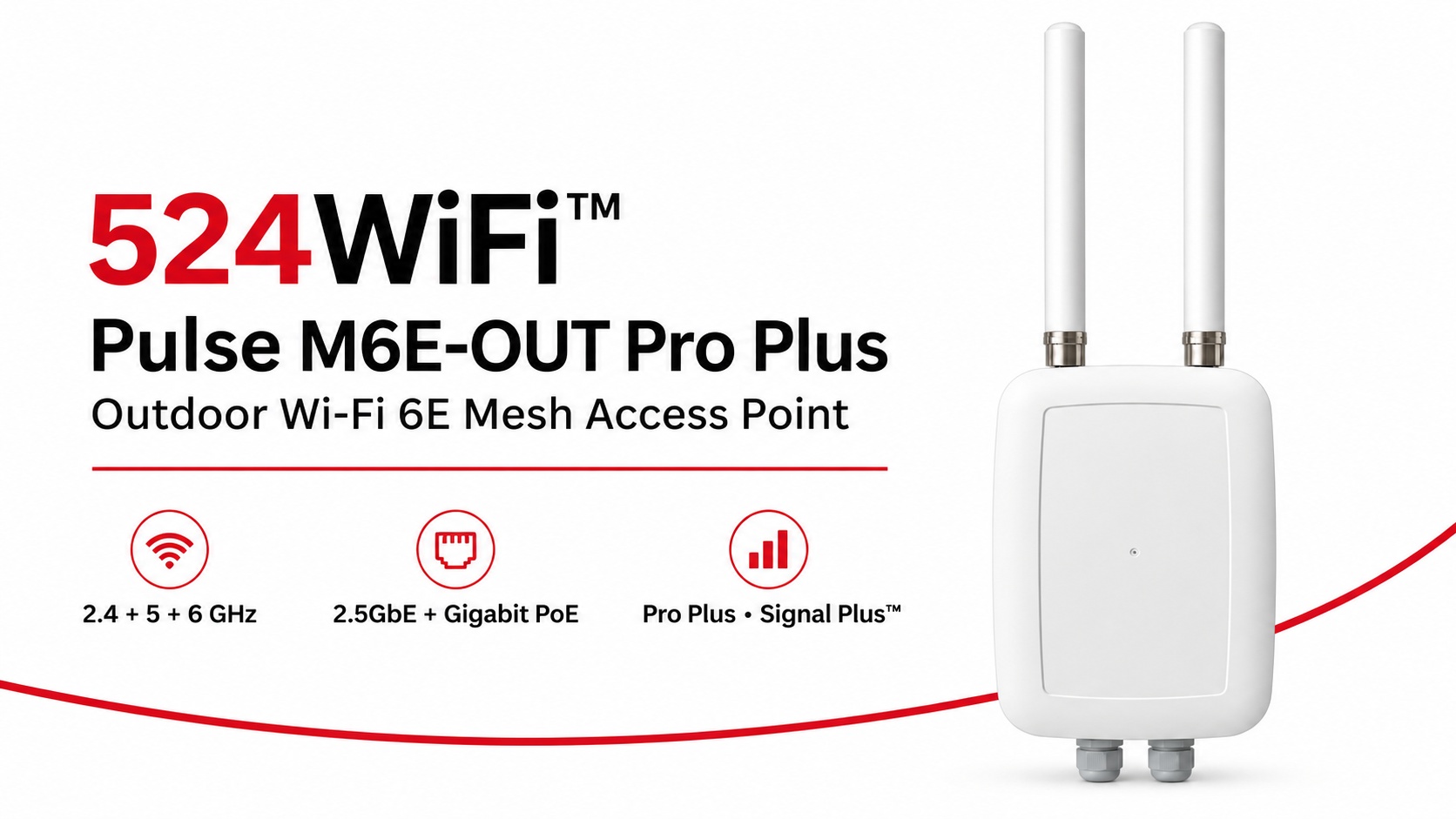
524WiFi™ Pulse M6E-OUT Pro Plus: Outdoor Wi-Fi 6E Mesh

524WiFi™ Pulse M6E-OUT Pro Plus outdoor Wi-Fi 6E mesh access point

524WiFi™ Pulse M6E-OUT Pro Plus brings the radio platform, outdoor enclosure and model-specific antenna assembly together for a professionally planned Wi-Fi 6E mesh installation. Start with a complete fixed network node and build coverage and inter-node links around the working area.

Three radio bands for the complete site network

Independent 2.4, 5 and 6 GHz radios give the installation three concurrent 2×2 radio paths. The Qualcomm IPQ5018 platform combines a dual-core ARM Cortex-A53 processor at 1.0 GHz with 512 MB DDR3L. A 2.5GbE interface supports the wired uplink, while a Gigabit Ethernet interface with PoE provides practical network and power integration.

The published theoretical PHY rates are up to 573 Mb/s at 2.4 GHz and 2,402 Mb/s each at 5 and 6 GHz. Channel widths reach 40 MHz at 2.4 GHz and 160 MHz on the two higher bands. Choose channels and radio roles around client traffic, the mesh topology and the operating country.

An antenna assembly matched to the outdoor node

The assembly combines two external 5 GHz omnidirectional antennas, two internal 2.4 GHz omnidirectional antennas and an internal directional 6 GHz panel serving the two 6 GHz RF paths. Aim the panel toward the intended link and keep its enclosure face clear of metalwork. This lets the installation use directional interconnection and local coverage deliberately.

Pro Plus and Signal Plus™ for deployment

Pro Plus combines our tuned product configuration, model-specific firmware selection and integration support. Signal Plus™ brings antenna placement, polarization, feed losses, radio roles and channel planning into the same RF system. Commission the complete node under the traffic and RF conditions of the actual site.

Fixed mesh nodes and moving clients

Use the M6E-OUT as a fixed outdoor infrastructure node. Pair it with Pulse M6E-IN for indoor infrastructure and Pulse R6-D2-IN or R6-T3-IN roaming clients on moving Ethernet-equipped machinery. Plan compatible firmware, authentication and RF overlap across the route. Mesh interconnection and moving-client roaming serve complementary roles in the complete network.

Explore the 524WiFi™ Pulse M6E-OUT Pro Plus specification and order configuration, or compare the Pulse product family.

Platform reference: DRWave-1000 / DR5018S.

Posted on

Wi-Fi 7 + Jetson: A New Architecture for Mobile Robots

524WiFi™ mobile robot architecture with Tomo AI Core NVIDIA and Pulse Wi-Fi 7 platforms

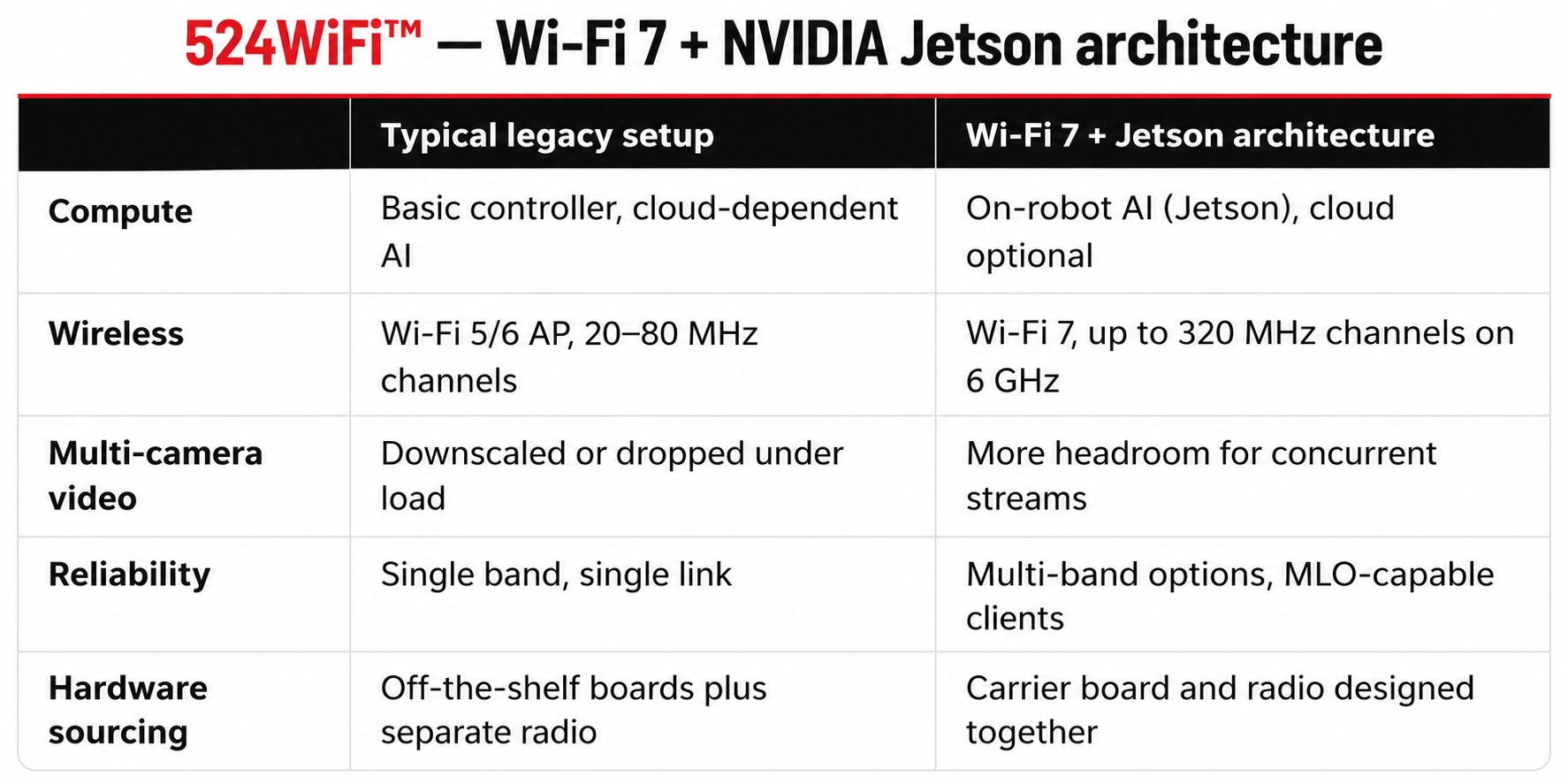
Mobile robots used to be limited mainly by batteries and mechanics. Increasingly, the limit is data movement. A modern AMR or UGV carries multiple cameras, LiDAR, and depth sensors. It runs perception models on board, and it has to stay connected while roaming across a warehouse, port, or factory floor. Compute has advanced quickly with NVIDIA Jetson. The wireless link has often stayed one generation behind.

Pairing Jetson-class edge compute with a Wi-Fi 7 network is one practical way to close that gap.

Why Jetson and Wi-Fi 7 belong in the same architecture

Jetson runs perception, localization, and navigation on the robot itself, so the robot does not depend on the network for real-time decisions. But the network still carries the data that matters at fleet level:

  • Compressed multi-camera streams for remote monitoring and teleoperation
  • Map and model updates pushed to many robots at once
  • Fleet telemetry, task dispatch, and OTA firmware
  • Handover of the robot’s connection between access points while moving

Wi-Fi 7 (IEEE 802.11be) addresses these directly. Channels of up to 320 MHz in the 6 GHz band raise per-link capacity. 4K-QAM raises spectral efficiency. Multi-Link Operation (MLO) lets a client use more than one band to improve reliability and reduce latency variation. Multi-RU scheduling helps when many small clients share a channel, which is the typical multi-robot case.

How the pieces fit together: 524WiFi™ edge platform

At 524WiFi™, we treat the robot’s compute and its radio as one design problem rather than two separate purchases.

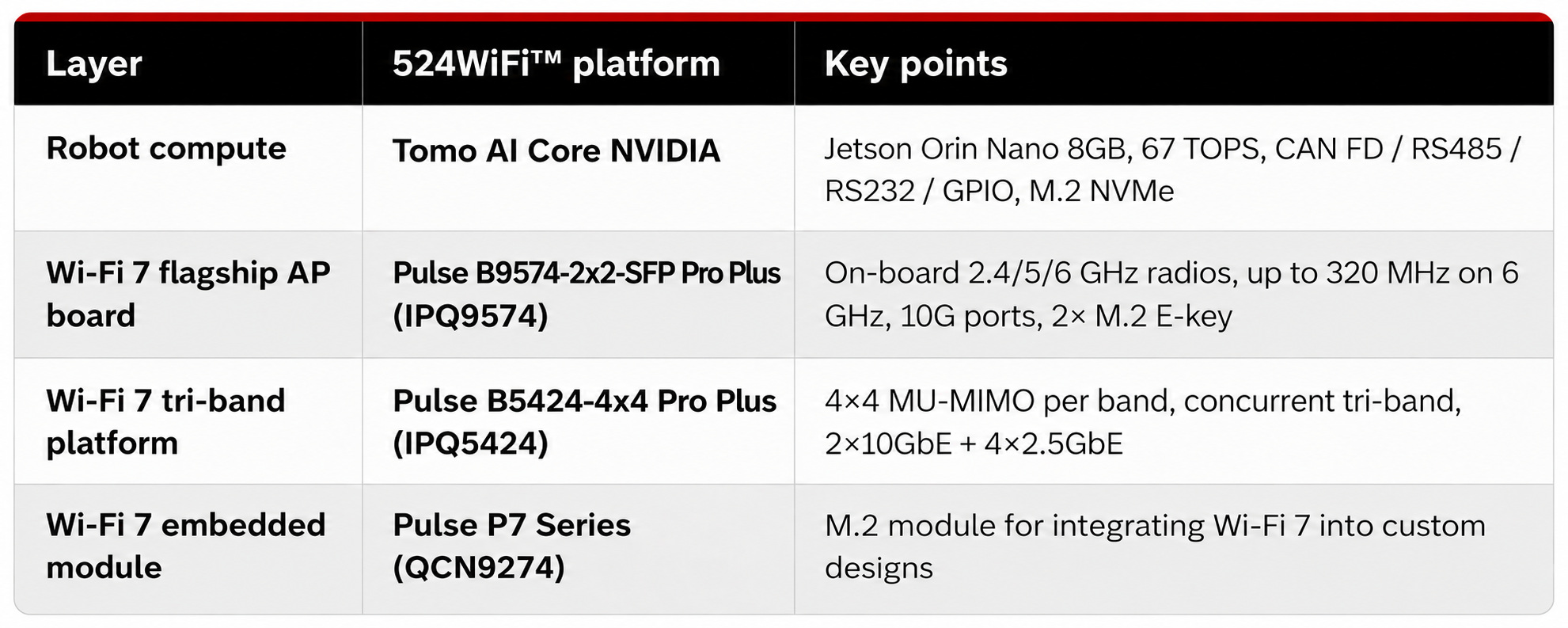
On the robot: the Tomo AI Core NVIDIA is built on the NVIDIA Jetson Orin Nano 8GB module with an industrial carrier board. It offers 67 TOPS of AI performance. Connectivity includes Gigabit Ethernet (one port with 48V PoE), optional Wi-Fi, and optional 4G/5G. Robot-side I/O includes CAN FD, RS485, RS232, GPIO, USB 3.0, and an M.2 NVMe slot. Select the compute, carrier I/O and wireless configuration around the requirements of the robot application.

On the infrastructure side: Wi-Fi 7 platforms based on Qualcomm silicon serve as the access point layer. Examples are the Pulse B9574-2×2-SFP Pro Plus (IPQ9574), the Pulse B5424-4×4 Pro Plus (IPQ5424), and the Pulse P7 Series M.2 modules (QCN9274) for embedding Wi-Fi 7 into your own hardware.

One point worth stating clearly: tri-band does not always mean the same thing. On the Pulse B5424-4×4 Pro Plus and Pulse B9574-2×2-SFP Pro Plus, the 2.4 GHz, 5 GHz, and 6 GHz radios are three independent chains running concurrently. Some tri-band cards are tri-band switchable, meaning one radio moves between bands to avoid interference. Both approaches are useful, but they suit different designs, so check which one a product actually is before planning around it.

Compared with the usual approach

Wi-Fi 7 is not a magic fix. Real roaming performance still depends on AP placement, channel planning, and client support. But the higher-capacity link and the multi-band tools give the network more room to work with.

Where this architecture applies

  • Warehouse and logistics AMRs: dense multi-robot fleets with steady roaming and continuous telemetry
  • Port and yard vehicles: long-range coverage with camera-based monitoring
  • Machine vision on the move: multi-camera, high-resolution image transfer to inspection systems
  • Inspection and security robots: live video plus on-board detection
  • Agricultural and field robotics: long-range control and video links, with custom transmission software where needed

Hardware summary

Talk to us

If you are building mobile robots on Jetson and would rather not develop the wireless hardware yourself, we can supply the modules, routerboards, and custom carrier boards, and discuss the application software and transmission requirements of the complete system.

Explore Pulse B9574-2×2-SFP Pro Plus, Pulse B5424-4×4 Pro Plus and Pulse P7 radio modules.

Platform references: DR Cube, DR9574S, DR5424 and DR9274.

Posted on

Quectel RM520N-GL deliver blazing-fast connectivity.

With downlink speeds up to 4.7 Gbps and uplink speeds up to 1.25 Gbps, the RM520N-GL is ideal for applications requiring ultra-low latency and high throughput, such as industrial automation, CPE routers, telematics, video surveillance, and AR/VR platforms.

Among the most sold 5G NR modules out there, the Quectel RM520N-GL is engineered to deliver blazing-fast connectivity for next-generation broadband applications. Supporting both 5G NR (SA/NSA) and fallback to high-speed LTE and 3G, this module ensures reliable coverage and seamless global deployment.

RM520N-Gl m.2 module available in stock and ready for quick delivery. Please also check the available accessory designed for this module – https://www.524wifi.com/catalogsearch/result/?q=520n

SA or NSA? This module doesn’t care

Your device will connect to 5G. But will it be Standalone or Non-Standalone? The answer depends on the network, and the Quectel RM520N-GL handles both. With fallback to LTE and 3G, it keeps devices connected wherever they are deployed.

That flexibility is one reason it’s among the best-selling 5G NR modules available. Add up to 4.7 Gbps downlink and 1.25 Gbps uplink, and it’s a proven choice for CPE routers, industrial automation, telematics and video surveillance.

Posted on

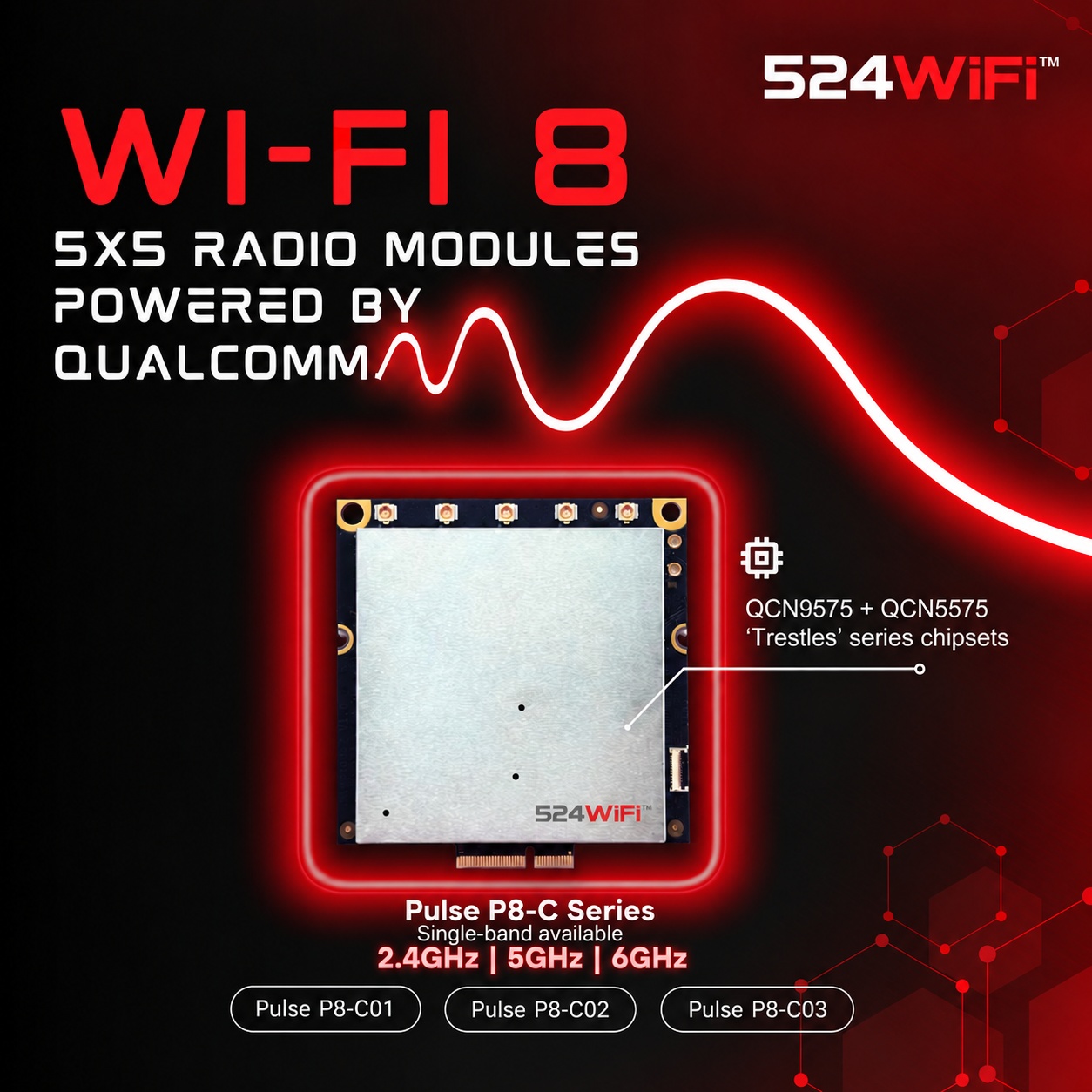
QCN9575 and QCN5575 Wi-Fi 8 5×5 Radio Modules

524WiFi™ Pulse P8-C single-band Wi-Fi 8 5×5 radio module architecture

Key takeaways

  • The upcoming family targets single-band 2.4, 5 and 6 GHz configurations for focused RF design.
  • A 5×5 radio architecture is aimed at high-density industrial and edge AI connectivity requirements.
  • The 802.11bn standard remains in development, so availability and final feature support must follow the production release.

524WiFi™ is preparing a new family of Wi-Fi 8 radio modules based on Qualcomm QCN9575 and QCN5575 “Trestles” series chipsets. The planned modules bring a 5×5 radio architecture to product teams developing high-density industrial access points, edge AI systems and next-generation wireless platforms.

Planned single-band Wi-Fi 8 configurations

The initial family is planned around dedicated single-band modules:

  • Pulse P8-C01: 2.4 GHz configuration
  • Pulse P8-C02: 5 GHz configuration
  • Pulse P8-C03: 6 GHz configuration

Separating the bands into focused module options gives system designers a clearer path for antenna selection, RF filtering, enclosure design and regulatory planning. It also lets a platform use the band configuration that matches its actual deployment instead of carrying unnecessary radio complexity.

Why 5×5 radio architecture matters

Industrial wireless design is increasingly shaped by client density, interference and mobility rather than peak throughput alone. A 5×5 radio architecture provides an additional spatial dimension for platform designers evaluating capacity, diversity and coordinated operation in demanding RF environments. The final performance will still depend on the complete system: chipset firmware, antenna layout, thermal design, host interface and network configuration.

Designed for industrial and edge AI platforms

The new module family is intended for applications such as industrial access points, robotics networks, machine-vision systems, edge AI gateways and other products that need reliable high-density wireless connectivity. These environments benefit from the reliability-first direction of IEEE 802.11bn, including coordinated network operation and more efficient use of available spectrum.

Development status

Wi-Fi 8 and IEEE 802.11bn remain under development. The QCN9575/QCN5575 module family is coming soon, and final specifications, supported features and availability will be confirmed with the production release. Engineering teams can use the current announcement to begin architecture, RF and integration planning without treating draft-stage capabilities as final certification.

For module planning and early project discussions, contact [email protected].

Module references: WLW8000U2, WLW8000U5 and WLW8000U6.

Posted on

IPQ9574 vs IPQ5424 vs IPQ5322: Full Comparison

524WiFi™ comparison of Qualcomm IPQ9574, IPQ5424 and IPQ5322 wireless platforms

Key takeaways

  • Platform choice depends on radio topology and I/O as much as CPU performance.
  • 524WiFi™ Pulse B9574-2×2-SFP Pro Plus emphasizes CPU headroom and expansion; 524WiFi™ Pulse B5424-4×4 Pro Plus emphasizes 4×4 tri-band capacity and Ethernet density.
  • 524WiFi™ Pulse B7-04 uses a different upper-band module architecture that must be included in BOM and RF planning.

Most comparisons of these three chips treat them as a simple good/better/best tri-band lineup. The datasheets say otherwise. CPU architecture, radio topology and wired interfaces distinguish the selected board configurations. And IPQ5322 isn’t actually a tri-band SoC on its own: 5GHz/6GHz only exist on a 524WiFi™ Pulse B7-04 board because of an added QCN9274/QCN6274 module, not because the chip integrates them. This breakdown goes through the datasheet numbers for 524WiFi™ Pulse B9574-2×2-SFP Pro Plus (IPQ9574), 524WiFi™ Pulse B5424-4×4 Pro Plus (IPQ5424), and 524WiFi™ Pulse B7-04 (IPQ5322) — CPU, radio chains, channel width, and I/O — so the platform choice is based on what’s actually on the silicon.

CPU and Reference Design

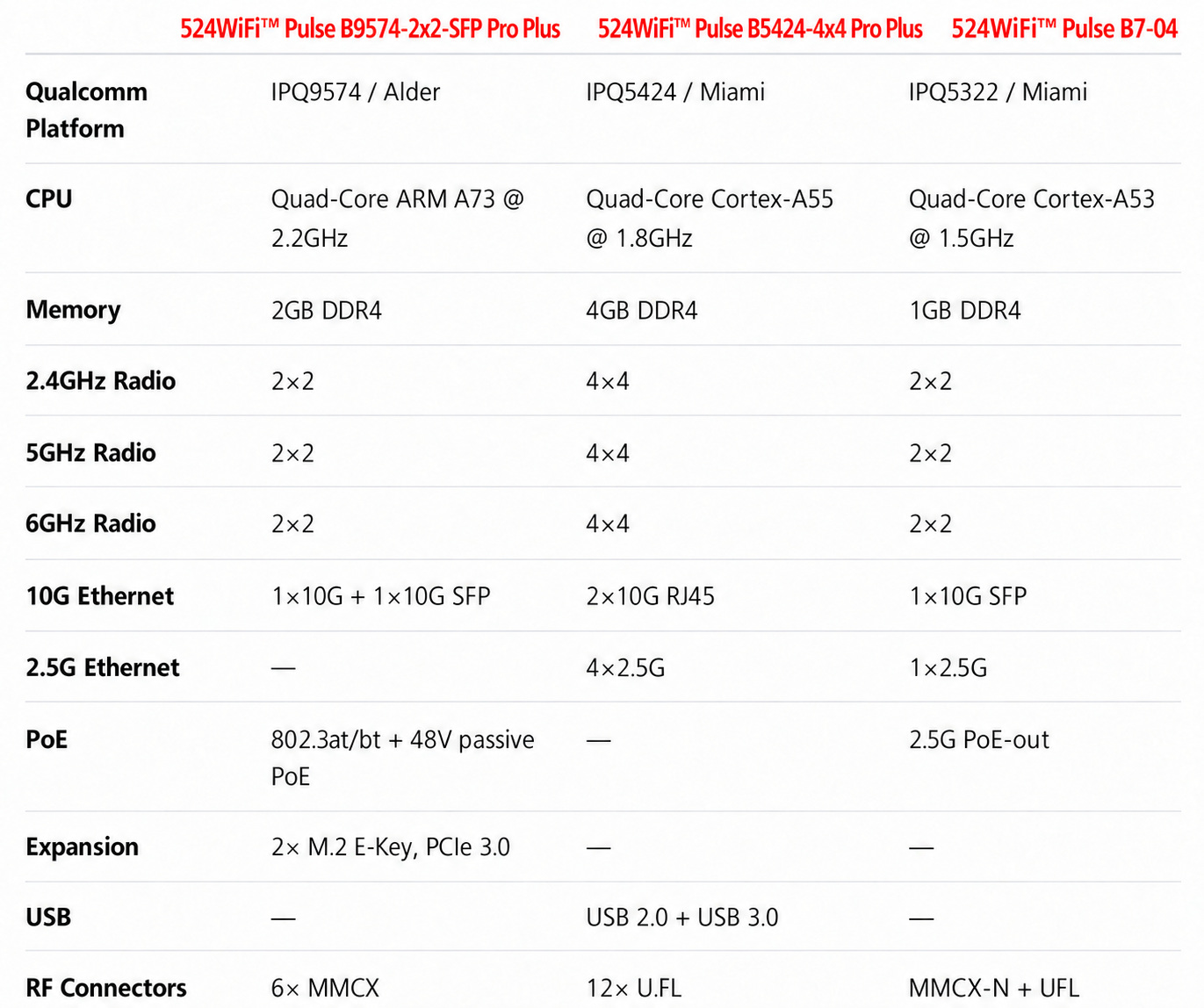
524WiFi™ Pulse B9574-2x2-SFP, Pulse B5424-4x4 and Pulse B7-04 platform technical comparison

Pulse B9574-2×2-SFP Pro Plus uses a quad-core ARM Cortex-A73 at 2.2 GHz. The current Pulse B5424-4×4 Pro Plus configuration uses a quad-core ARM Cortex-A55 at 1.8 GHz with 4 GB DDR4. The IPQ5322 platform described for Pulse B7-04 uses a quad-core Cortex-A53 at 1.5 GHz with 1 GB DDR4. Select the board around its complete compute, radio and I/O architecture.

Radio Topology — the Part That Determines System Design

This is where the three platforms actually diverge, and it’s not just “more bands = better”:

524WiFi™ Pulse B9574-2×2-SFP Pro Plus (IPQ9574): three independent on-board radios, 2×2 each — 2.4GHz (up to 573.6Mbps PHY), 5GHz (up to 2882Mbps PHY), 6GHz (up to 5765Mbps PHY). All three run concurrently.

524WiFi™ Pulse B5424-4×4 Pro Plus (IPQ5424): three independent on-board radios, but 4×4 MU-MIMO on each band — 2.4GHz (802.11b/g/n/ax/be, 23dBm/chain max), 5GHz (802.11a/n/ac/ax/be, 21dBm/chain max), 6GHz (802.11ax/be, 19dBm/chain max), all concurrent. 12× U.FL antenna connectors reflect the 4×4-per-band chain count.

524WiFi™ Pulse B7-04 (IPQ5322): only 2×2 2.4GHz is on-board. There is no native 5GHz or 6GHz radio on the IPQ5322 SoC itself — 5/6GHz coverage requires adding a separate QCN9274 or QCN6274 WiFi 7 module. This is a structurally different platform from the other two: 524WiFi™ Pulse B9574-2×2-SFP Pro Plus and 524WiFi™ Pulse B5424-4×4 Pro Plus are integrated tri-band SoCs; 524WiFi™ Pulse B7-04 is a 2.4GHz baseband platform designed to pair with an external WiFi 7 radio module for the upper bands.

If your BOM assumption was “IPQ5322 = cheaper tri-band chip,” that’s incorrect at the silicon level — the tri-band capability on a 524WiFi™ Pulse B7-04 design is a module-add, not an on-die feature. Budget and BOM planning should treat it accordingly.

Channel Width and Modulation

524WiFi™ Pulse B5424-4×4 Pro Plus supports 240MHz on 5GHz, a step beyond 524WiFi™ Pulse B9574-2×2-SFP Pro Plus’s 160MHz ceiling on that band — relevant if you’re doing 5GHz-heavy backhaul rather than leaning on 6GHz for the wide channels.

I/O and Interfaces

524WiFi™ Pulse B9574-2×2-SFP Pro Plus is the only one of the three with M.2 E-key PCIe 3.0 expansion slots — relevant if your design needs an add-in card (cellular, additional radio) beyond what’s on-board. 524WiFi™ Pulse B5424-4×4 Pro Plus carries the heaviest native Ethernet backhaul (2×10GbE + 4×2.5GbE), which lines up with its role as a high-density AP/gateway aggregation point rather than an edge client device.

Selection Guidance

  • Need three genuinely concurrent radios with maximum per-band throughput and PCIe expansion: 524WiFi™ Pulse B9574-2×2-SFP Pro Plus. The 2.2GHz A73 CPU and M.2 slots also make it the better fit if you’re layering additional compute or a cellular module onto the same board.
  • Need three concurrent radios with more antenna chains (4×4) and heavier Ethernet backhaul, at a lower CPU clock: 524WiFi™ Pulse B5424-4×4 Pro Plus. This is the platform for high-density AP deployments where per-band MIMO order matters more than raw CPU headroom.
  • Building a cost-optimized 2.4GHz-anchor design and adding WiFi 7 upper-band coverage via an external QCN9274/QCN6274 module: 524WiFi™ Pulse B7-04. Don’t spec this as a drop-in tri-band replacement for 524WiFi™ Pulse B5424-4×4 Pro Plus — the radio architecture is fundamentally different, and your BOM needs to account for the module separately.

Platform references: DR9574S, DR5424 and DR5322S.

Posted on

Wi-Fi 8 for Engineers: 802.11bn in Industrial Robotics

524WiFi™ Wi-Fi 8 for industrial and robotics networks using Dynamic Sub-band Operation

Key takeaways

  • IEEE 802.11bn targets tail latency, packet loss and reliability under difficult real-world conditions.
  • Multi-AP coordination and dynamic channel use reshape network architecture beyond single-link performance.
  • Modular mainboards and radios provide flexibility while Wi-Fi 8 silicon and the draft continue to mature.

What Is Wi-Fi 8, and Why Does It Matter for Engineers?

Wi-Fi 8 is the market name for IEEE 802.11bn, the standard succeeding Wi-Fi 7 (802.11be). Unlike previous generations, which were sold primarily on peak throughput, 802.11bn’s official designation is Ultra High Reliability (UHR) — the standard is built to make wireless connections more consistent and predictable in difficult real-world RF conditions rather than simply chasing higher headline speeds.

For engineers, this reframing is the story. Industry research on 802.11bn targets at least 25% better throughput, 25% lower 95th-percentile latency, and 25% lower packet loss compared to Wi-Fi 7 under real conditions — the kind of tail-latency and drop-rate improvement that matters far more than peak Mbps when you’re running AMR fleets, machine vision links, or multi-robot warehouse networks.

As of mid-2026, the 802.11bn task group has draft work underway covering spectrum from 1 GHz to 7.25 GHz, with final IEEE ratification projected for 2028, though chipset vendors are moving early — Broadcom has announced Wi-Fi 8 silicon (BCM4918 APU, BCM6714/6719 radios) and MediaTek has previewed its Filogic 8000 chip series, with early hardware expected to run on draft specifications ahead of full ratification.

Key Technical Features Engineers Should Track

802.11bn introduces several mechanisms that directly reshape multi-AP network design:

  • Multi-AP Coordination (MAPC): access points coordinate airtime, spatial reuse, and transmissions instead of behaving as independent, competing radios — a shift from Wi-Fi 7’s Multi-Link Operation, which optimizes a single AP-client link rather than the whole deployment.
  • Coordinated Spatial Reuse and Coordinated Beamforming: neighboring APs share scheduling information to transmit on the same channel without stepping on each other, and align antenna patterns to cut interference.
  • Dynamic Subchannel Operation and Non-Primary Channel Access: wide channels are used more flexibly, so a busy primary channel no longer blocks all traffic on that link.
  • Single Mobility Domain behavior: 802.11bn is expected to allow a client to associate with multiple access points simultaneously (and vice versa), fundamentally changing roaming and airtime management compared to 802.11be.

Together these features are what actually deliver the reliability gains — not a new modulation scheme, but coordination logic across the AP layer.

How This Integrates With 524WiFi™’ Wi-Fi 8 Platform

524WiFi™ Wi-Fi 8 lineup is already moving from prototype to production, built around Qualcomm’s next-generation platforms:

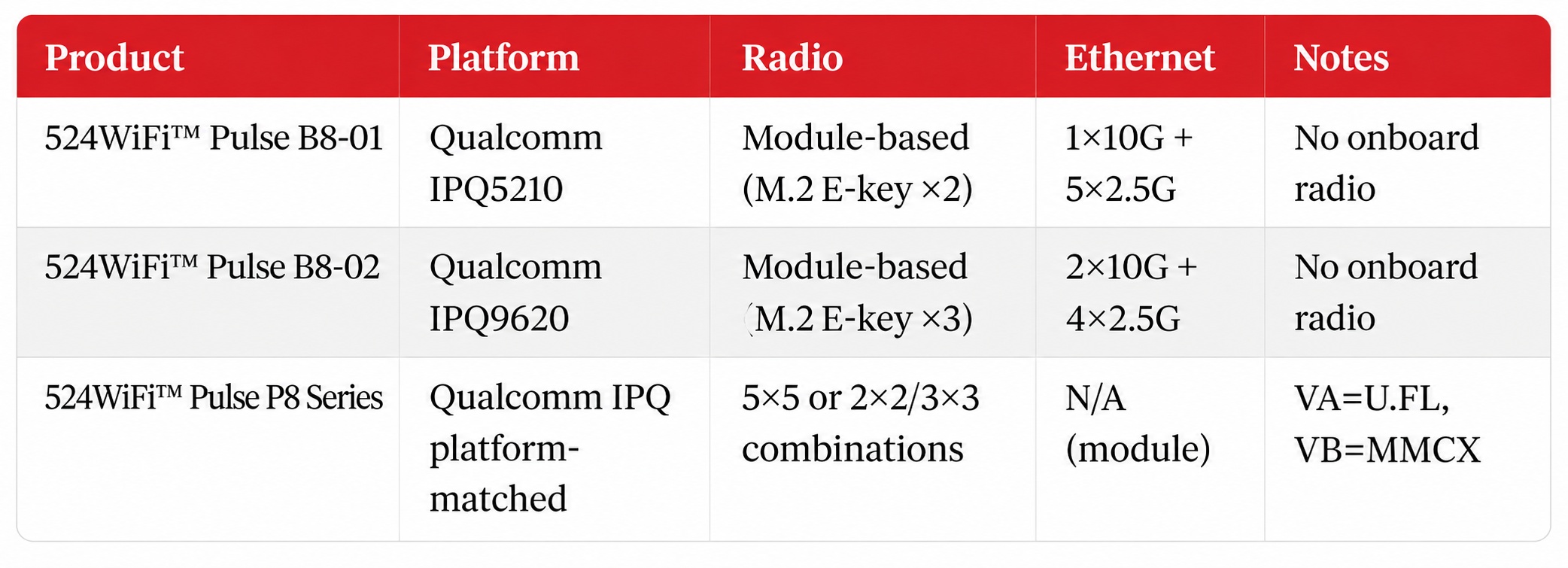
  • 524WiFi™ Pulse B8-01 — IPQ5210-based mainboard, DDR4 + NOR/NAND flash, 2× M.2 E-key slots, 1× 10G copper + 5× 2.5G Ethernet, 12V input, no onboard radio (module-based design).
  • 524WiFi™ Pulse B8-02 — IPQ9620-based mainboard, DDR4 + NOR/NAND flash, 3× M.2 E-key slots, 2× 10G copper + 4× 2.5G Ethernet, 12V input, also module-based.
  • 524WiFi™ Pulse P8 Series module family — 5×5 5GHz, 5×5 6GHz, dual-band (2×2 2.4GHz + 3×3 5GHz), and a 5G/6G combo variant (3×3 5GHz + 2×2 6GHz, VB connector only). VA boards use U.FL connectors; VB variants use MMCX.

The modular mainboard-plus-radio-module architecture matters here specifically because of MAPC and coordinated spatial reuse: a fixed single-radio AP can’t easily be re-tuned as the 802.11bn draft evolves, but a mainboard that accepts interchangeable M.2 radio modules can be re-radioed as Wi-Fi 8 chipsets mature — relevant given the standard won’t be fully ratified until 2028.

Wi-Fi 8 vs. Wi-Fi 7: What Actually Changes

524WiFi™ comparison of Wi-Fi 8 and Wi-Fi 7 roaming, reliability and continuity

This is a distinct axis from the tri-band switchable vs. concurrent distinction that matters for current Wi-Fi 7 hardware selection — Wi-Fi 8’s coordination features operate at the network-topology level, above the radio-chain level.

Applications Enabled: Where UHR Actually Pays Off

  • Multi-robot warehouse fleets: coordinated multi-AP scheduling and reduced tail latency directly address the roaming-drop and airtime-contention problems that show up once you have more than a handful of AMRs sharing a floor.
  • Industrial vision networks: camera links tolerate throughput variance poorly; UHR’s packet-loss reduction target is more relevant here than raw peak bandwidth.
  • Port, mining, and campus deployments: environments already using seamless-roaming Wi-Fi 6 APs (like our 524WiFi™ Pulse R6 roaming series series) are the natural upgrade path once Wi-Fi 8 silicon matures, since the underlying pain point — clean handoff between APs — is exactly what MAPC targets.

Hardware Summary – future products coming soon

524WiFi™ Pulse B8-01, Pulse B8-02 and Pulse P8 Wi-Fi 8 platform comparison

Posted on

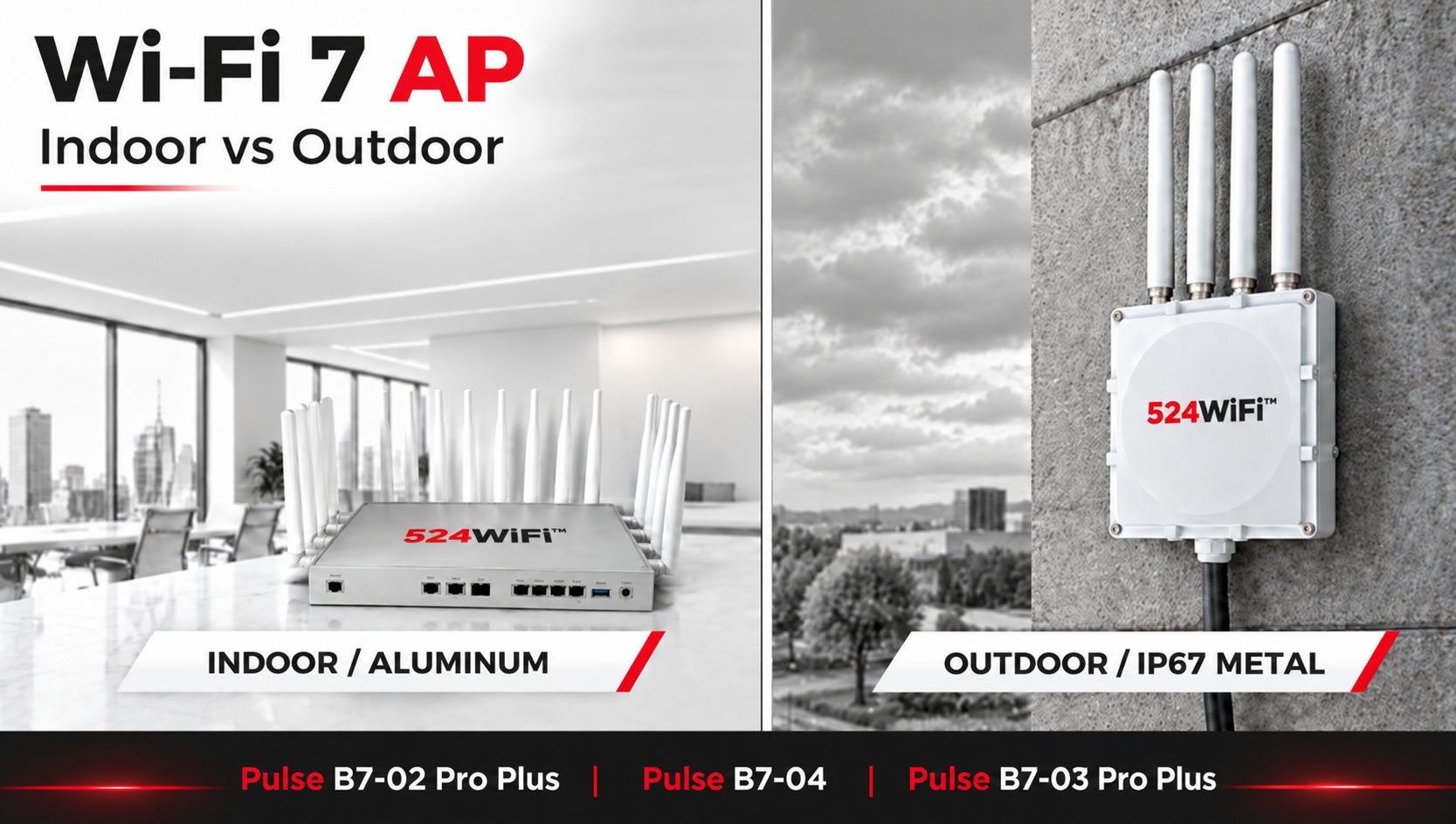
How to Choose a Wi-Fi 7 AP: Indoor vs Outdoor

524WiFi™ Pulse B7 platforms for indoor and outdoor access point designs

Key takeaways

  • Indoor and outdoor access points need different enclosure, thermal, antenna and environmental designs.
  • 524WiFi™ Pulse B9574-2×2-SFP Pro Plus, 524WiFi™ Pulse B5424-4×4 Pro Plus and 524WiFi™ Pulse B7-04 provide distinct CPU, radio, Ethernet and expansion starting points.
  • A production AP combines the platform with power, antennas, firmware, mechanics and validation.

A Wi-Fi 7 AP is more than a Wi-Fi 7 chipset.

For a finished access point, the hardware platform, wireless configuration, Ethernet interfaces, enclosure, power design, and deployment environment all affect the final product.

524WiFi™ provides several Wi-Fi 7 AP platforms that can be combined with indoor aluminum enclosures or outdoor IP67-rated metal enclosures.

Under the enclosure, customers can choose from three hardware platforms: 524WiFi™ Pulse B9574-2×2-SFP Pro Plus, 524WiFi™ Pulse B5424-4×4 Pro Plus, and 524WiFi™ Pulse B7-04.

The three platforms are designed for different system requirements rather than being simple variations of the same AP.

What Do You Need to Consider When Building a Wi-Fi 7 AP?

There are three basic questions:

1. Where will the AP be deployed?

Indoor or outdoor?

2. What wireless and processing capacity does the application require?

2×2 or 4×4 radios? More CPU resources? More memory?

3. What wired interfaces does the product need?

2.5G, 10G, SFP, PoE, USB, or customized interfaces?

The answer to these questions determines which Wi-Fi 7 platform and enclosure combination makes sense.


Indoor or Outdoor Wi-Fi 7 AP?

The first decision is the enclosure.

Indoor Wi-Fi 7 AP

For indoor applications, 524WiFi™ offers an aluminum enclosure.

It is suitable for deployments such as:

  • Enterprise networks
  • Offices and commercial buildings
  • High-density indoor wireless
  • Industrial facilities
  • Warehouses
  • Smart buildings

The enclosure provides a practical platform for thermal management while keeping the AP suitable for indoor installation.

Outdoor Wi-Fi 7 AP

Outdoor deployments require a different mechanical design.

524WiFi™ offers an IP67-rated metal enclosure for outdoor Wi-Fi 7 AP applications.

It is designed for environments where the equipment needs protection against dust and water, including:

  • Outdoor wireless networks
  • Industrial connectivity
  • Warehouses and logistics yards
  • Outdoor surveillance
  • Campus and infrastructure networks
  • Outdoor wireless backhaul

The enclosure is therefore not simply an external housing choice. It is part of the AP’s deployment architecture.


Which Wi-Fi 7 Platform Should You Choose?

The Pulse family provides two catalogue platforms and a compact IPQ5322 platform for project planning:

524WiFi™ Pulse B9574-2×2-SFP Pro Plus, 524WiFi™ Pulse B5424-4×4 Pro Plus, and 524WiFi™ Pulse B7-04.

They use different Qualcomm platforms and provide different combinations of CPU resources, wireless configuration, Ethernet connectivity, memory, and expansion interfaces.

The important difference is not simply CPU speed.

Each platform gives you a different starting point for the final AP architecture.


524WiFi™ Pulse B9574-2×2-SFP Pro Plus: When CPU and Expansion Matter

The 524WiFi™ Pulse B9574-2×2-SFP Pro Plus is based on the Qualcomm IPQ9574 platform, with a quad-core ARM A73 processor running at 2.2GHz.

It combines:

  • 2GB DDR4
  • 1× 10Gbps Ethernet
  • 1× 10Gbps SFP
  • 2× 1Gbps Ethernet
  • Active PoE 802.3at/bt
  • 48V passive PoE
  • 2× M.2 E-Key interfaces with PCIe 3.0
  • 2×2 radios on 2.4GHz, 5GHz, and 6GHz
  • 6× MMCX connectors

The two M.2 E-Key interfaces provide additional expansion possibilities for projects that need more than the standard wireless configuration.

This makes 524WiFi™ Pulse B9574-2×2-SFP Pro Plus a suitable starting point for Wi-Fi 7 APs and gateways where CPU resources, 10G connectivity, PoE, or hardware expansion are important.


524WiFi™ Pulse B5424-4×4 Pro Plus: When Wireless Capacity and Ethernet Density Matter

The 524WiFi™ Pulse B5424-4×4 Pro Plus takes a different approach.

It combines 4×4 radios on 2.4GHz, 5GHz, and 6GHz with multiple multi-Gigabit Ethernet interfaces.

The platform provides:

  • 4GB DDR4 in the current Pulse B5424-4×4 configuration
  • 4×4 2.4GHz radio
  • 4×4 5GHz radio
  • 4×4 6GHz radio
  • 2× 10Gbps RJ45
  • 4× 2.5Gbps RJ45
  • USB 2.0
  • USB 3.0
  • 12× U.FL connectors

It supports up to 320MHz channel width on 6GHz and up to 240MHz on 5GHz according to the platform specification.

This makes 524WiFi™ Pulse B5424-4×4 Pro Plus a platform for applications where wireless capacity and wired network density are both important.

For example, a high-density AP or gateway may need multiple 2.5G connections for local devices while using 10G Ethernet for aggregation or backhaul.


524WiFi™ Pulse B7-04: When the Design Needs to Stay Compact

The 524WiFi™ Pulse B7-04 uses the Qualcomm IPQ5322 platform with a quad-core Cortex-A53 processor at 1.5GHz and 1GB DDR4.

Its wireless configuration includes:

  • 2×2 2.4GHz
  • 2×2 5GHz
  • 2×2 6GHz
  • 2× MMCX-N connectors for 5GHz
  • 2× MMCX-N connectors for 6GHz
  • 2×2 2.4GHz antenna interfaces

For wired connectivity, it provides:

  • 1× 2.5Gbps Ethernet
  • 1× 2.5G PoE-out Ethernet
  • 1× 10G SFP
  • JTAG
  • GPIO interfaces
  • Reset button

The platform is therefore different from 524WiFi™ Pulse B5424-4×4 Pro Plus.

Instead of maximizing the number of Ethernet ports and using 4×4 radios, 524WiFi™ Pulse B7-04 provides a more compact 2×2 tri-band Wi-Fi 7 architecture with 2.5G, 10G SFP, and PoE-out connectivity.

This can be useful when the project does not require multiple 2.5G LAN ports but still needs multi-Gigabit connectivity.


How Do You Choose Between the Three Platforms?

A simple way to start is with the system requirement.

Need more CPU resources and expansion options?

→ 524WiFi™ Pulse B9574-2×2-SFP Pro Plus

Need 4×4 tri-band Wi-Fi 7 with multiple 10G and 2.5G Ethernet ports?

→ 524WiFi™ Pulse B5424-4×4 Pro Plus

Need a more compact 2×2 tri-band platform with 2.5G, 10G SFP, and PoE-out?

→ 524WiFi™ Pulse B7-04

The platform can then be combined with the appropriate enclosure and interface configuration.

In other words:

Wi-Fi 7 platform → Wireless configuration → Ethernet interfaces → Enclosure → Power → Customization


Can the Wi-Fi 7 AP Interfaces Be Customized?

Yes.

For OEM/ODM projects, the AP does not have to remain a fixed off-the-shelf configuration.

524WiFi™ can work with customers to customize the hardware around specific project requirements, including:

  • Ethernet interfaces
  • Network port configuration
  • Power interfaces
  • PoE requirements
  • RF and antenna connections
  • Other project-specific hardware interfaces
  • Mechanical and enclosure requirements

This is useful when a customer already has a product specification but cannot find an off-the-shelf Wi-Fi 7 AP that matches it.

Instead of changing the project around an existing product, the hardware can be adapted around the application.


From Wi-Fi 7 Platform to a Finished AP

A development board is only the starting point.

A production Wi-Fi 7 AP also needs:

Wireless platform + enclosure + antennas + interfaces + thermal design + power design + firmware + production configuration

This is why the same Wi-Fi 7 platform can be turned into different products depending on the target market.

For example:

Indoor Enterprise AP

→ 524WiFi™ Pulse B9574-2×2-SFP Pro Plus / 524WiFi™ Pulse B5424-4×4 Pro Plus → Aluminum enclosure → Multi-Gigabit Ethernet → Customized antenna configuration

Outdoor Industrial AP

→ 524WiFi™ Pulse B9574-2×2-SFP Pro Plus / 524WiFi™ Pulse B7-04 → IP67 metal enclosure → PoE → Outdoor antenna configuration → Customized interfaces

Compact Wi-Fi 7 AP

→ 524WiFi™ Pulse B7-04 → Compact enclosure → 2.5G + 10G SFP → Customized mechanical design

The platform stays relatively consistent, while the final product can be adapted to the application.


Wi-Fi 7 APs for OEM/ODM Projects

524WiFi™ provides Wi-Fi 7 hardware platforms for customers developing their own AP, gateway, or wireless networking products.

The available approach includes:

  • 524WiFi™ Pulse B9574-2×2-SFP Pro Plus / IPQ9574
  • 524WiFi™ Pulse B5424-4×4 Pro Plus / IPQ5424
  • 524WiFi™ Pulse B7-04 / IPQ5322
  • Indoor aluminum enclosure
  • Outdoor IP67 metal enclosure
  • Different wireless configurations
  • Multi-Gigabit Ethernet options
  • PoE options
  • Interface customization
  • OEM/ODM hardware customization

The goal is to shorten the path from a Wi-Fi 7 platform to a finished, application-specific wireless product.

Summary

Choosing a Wi-Fi 7 AP is not only about choosing a Wi-Fi 7 chipset.

The right configuration depends on where the AP will be deployed, how much wireless and CPU performance is required, what Ethernet interfaces are needed, and how much customization the project requires.

524WiFi™ provide multiple Wi-Fi 7 platforms, enclosure options, and hardware customization possibilities so that customers can build a Wi-Fi 7 AP around their application instead of adapting their application to a fixed product.

Interested in Wi-Fi 7 samples or a customized AP configuration?

Pulse B9574-2×2-SFP Pro Plus and Pulse B5424-4×4 Pro Plus are available in our catalogue. Pulse B7-04 is the name for the IPQ5322 platform under evaluation.

Platform references: DR9574S, DR5424 and DR5322S.

Posted on

Zbtlink Firmware Vulnerability: Our Protection Explained

Key takeaways

  • The reported issue concerns Zbtlink factory firmware and should be evaluated at the firmware-supply-chain level.
  • 524WiFi™ customer systems use a separate firmware and control path described in this advisory.
  • Secure deployment still depends on controlled images, updates, credentials and network configuration.

Dear Customers and Business Partners,

A major security discovery has emerged in the field of network security affecting popular routers manufactured by Zbtlink. Security analysts at VulnCheck have uncovered a critical vulnerability in the factory software of these devices that functions as a persistent backdoor.

We want to immediately reassure all our clients that your networks and devices are completely unaffected by this risk. As a trusted systems integrator and network solutions provider, we do not deploy these devices with their factory software. Instead, we have long standardly replaced it with the secure, verified, and open-source ROOter Golden Orb firmware.

⚠️ The Threat: “ENDLESSDOORS” Backdoor (CVE-2026-66747)

Security experts have identified an embedded malicious implant dubbed ENDLESSDOORS. This backdoor is present across virtually every published build of the Zbtlink factory firmware across their entire product range (including WE, WG, and CPE series models).

How does this backdoor operate?

  • Process Masking: The malicious code triggers immediately upon system boot and runs under the name kworker. This is a deliberate attempt to blend in with legitimate Linux kernel threads and evade basic detection.
  • Phone-Home Beaconing: The device does not open any external listening ports that a firewall might flag. Instead, it actively initiates an unencrypted TCP connection to a hardcoded Command-and-Control (C2) server roughly every 35 seconds.
  • Full Root Control: When the remote C2 server responds, it grants the attacker an interactive shell with the highest possible privileges (root/uid=0). Because the communication channel is entirely unauthenticated and unencrypted, anyone capable of intercepting or hijacking the network path can easily gain full remote code execution on the router.

Due to the severity of this design flaw, the vulnerability has been assigned a near-maximum severity rating of CVSS 9.3 (Critical).


✅ Why Our Customers Are 100% Protected

Our core philosophy is to deliver solutions that are not only high-performing but fundamentally secure. For this exact reason, our provisioning process always involves completely wiping the factory software from the hardware.

In its place, we flash the advanced ROOter Golden Orb firmware:

  1. Zero Malicious Footprint: ROOter Golden Orb is built on top of a clean, community-vetted OpenWrt base. It completely eliminates all proprietary, closed-source Zbtlink software packages—including the compromised librctl.so binary responsible for the ENDLESSDOORS implant.
  2. Total Transparency: Every process running within our deployed firmware is fully transparent and auditable. There are no hidden “phone-home” routines communicating with external third-party servers.
  3. Enhanced Performance & Features: Beyond absolute security, Golden Orb provides our clients with vastly superior cellular (LTE/5G) modem management, advanced routing capabilities, and rock-solid long-term stability.

💡 Summary

If your router was purchased, configured, and deployed by our team with Rooter firmware, then you do not need to take any action or worry about this vulnerability. Your device was fully immunized against this factory flaw before it ever connected to your network. If you run the factory OpenWRT firmware, then please replace it by Rooter firmware immediately. It is availabel for free for download or we can send it to you upon request.

Should you have any technical questions regarding this advisory or wish to verify the firmware status of a specific deployment, please do not hesitate to reach out to our technical support team.