Posted on

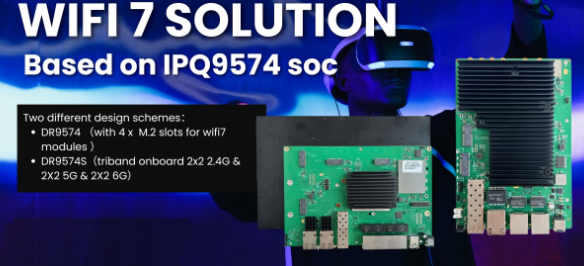
DR9574S: Building WiFi 7 Industrial APs with Qualcomm IPQ9574

The next generation of industrial wireless networks is not only about faster WiFi speeds.

For industrial applications, wireless infrastructure needs to deliver:

  • High-capacity connectivity
  • Reliable performance under heavy traffic
  • Low-latency communication
  • Multi-device scalability
  • Long-term platform stability

This is where WiFi 7 is becoming a key technology for the future of industrial networking.

However, transforming WiFi 7 technology into a reliable industrial product requires more than just a powerful chipset.

It requires a complete hardware platform, optimized RF design, thermal management, and industrial deployment experience.

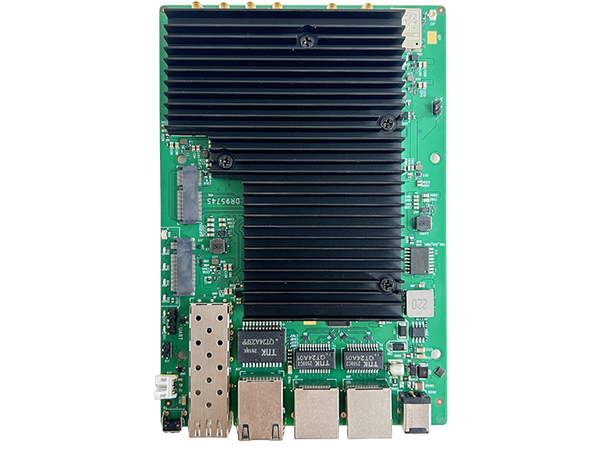
Introducing DR9574S — A WiFi 7 Industrial AP Platform Powered by Qualcomm IPQ9574

DR9574S is built around the Qualcomm IPQ9574 networking platform, designed for high-performance enterprise and industrial wireless applications.

With advanced WiFi 7 capabilities, DR9574S provides a strong foundation for customers developing:

  • Industrial access points
  • Enterprise WiFi systems
  • Smart factory networks
  • AI edge connectivity solutions
  • Outdoor wireless infrastructure
  • Customized OEM/ODM wireless products
Article content

WiFi7 DR9574S

Why WiFi 7 Matters for Industrial Networks

Traditional WiFi upgrades mainly focus on higher throughput.

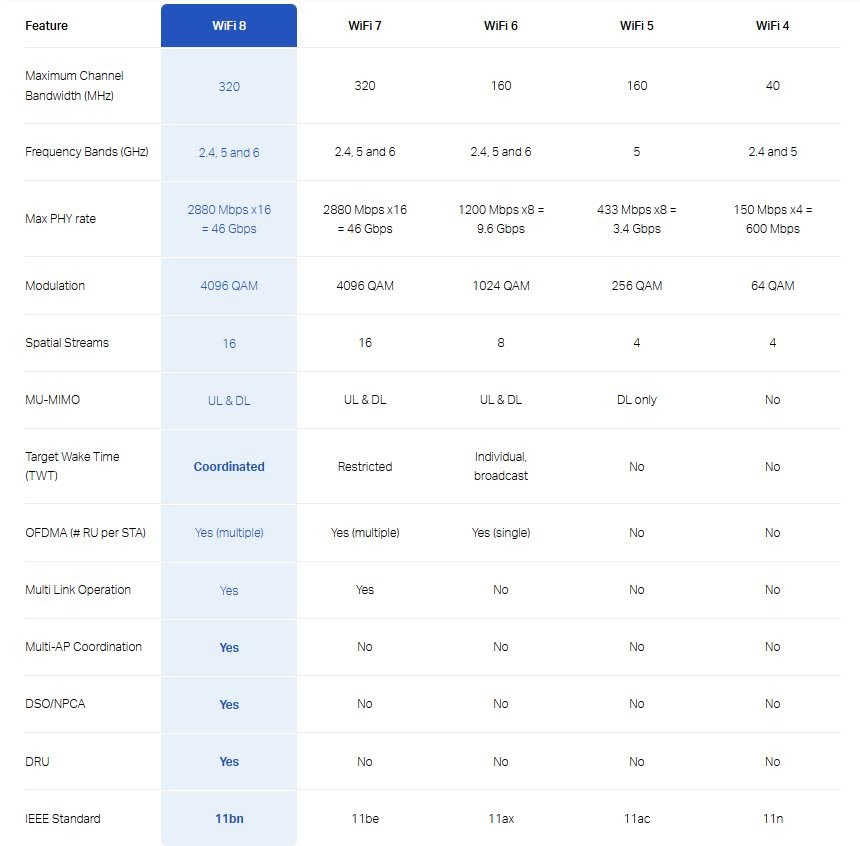
WiFi 7 introduces several technologies that improve not only speed, but also network efficiency and reliability.

1. Multi-Link Operation (MLO)

MLO allows devices to use multiple wireless links simultaneously.

Benefits include:

  • Higher throughput
  • Better connection stability
  • Improved latency performance
  • More reliable wireless communication

For industrial environments with robots, cameras, sensors, and mobile devices, maintaining stable connectivity is often more important than peak speed.

2. 320MHz Channel Support

WiFi 7 doubles channel bandwidth compared with previous generations.

This enables:

  • Higher wireless capacity
  • Better support for high-bandwidth applications
  • More efficient network utilization

Applications such as industrial vision inspection, AI cameras, and real-time data transmission can benefit from this increased capacity.

3. 4096-QAM

Higher-order modulation improves data efficiency, allowing more data transmission within the same spectrum conditions.

This helps maximize wireless performance in modern high-density networks.


Built for Industrial Product Development

DR9574S is designed for companies that need a reliable WiFi 7 hardware foundation without starting from zero.

Wallys provides:

Hardware Platform

  • Qualcomm IPQ9574 platform
  • WiFi 7 architecture
  • High-performance CPU processing
  • Enterprise-level wireless capability
  • Flexible hardware customization

Development Support

Our engineering team supports:

  • Hardware customization
  • Antenna optimization
  • Thermal design
  • Firmware integration
  • OEM/ODM/JDM projects

Helping customers accelerate their product development cycle.


WiFi 7 + Industrial AI: The Next Connectivity Era

As AI moves from the cloud to the edge, wireless networks are becoming a critical infrastructure component.

Future applications such as:

  • Autonomous mobile robots (AMR)
  • Industrial automation
  • AI vision systems
  • Smart factories
  • Drones
  • Edge computing devices

will require wireless networks that are faster, more stable, and more intelligent.

WiFi 7 is not just an upgrade in speed.

It is becoming the foundation for next-generation industrial connectivity.


Build Your Next WiFi 7 Product with 524WiFi

Whether you are developing an industrial AP, enterprise wireless solution, or customized networking product, DR9574S provides a powerful Qualcomm-based platform to accelerate your innovation.

Contact 524WiFi to explore your next WiFi 7 project!

Posted on

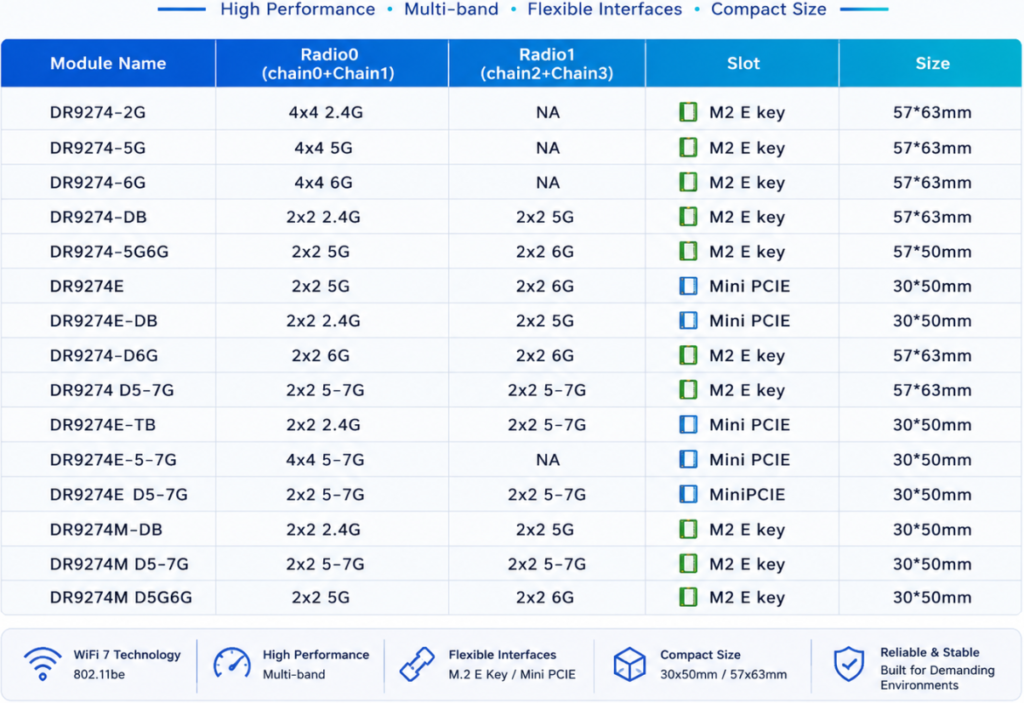
List of our Qualcomm WiFi 7 modules – new populer versions !

Module NameBDwlanRadio0
(chain0+Chain1)
Radio1
(chain2+Chain3)
SlotStatusNote
DR9274-2GB00014×4 2.4GNAM2 E keyavailable 
DR9274-5GB00024×4 5GNAM2 E keyavailableB0015
DR9274-6GB00044×4 6GNAM2 E keyavailableB0016
DR9274-DBB10032×2 2.4G2×2 5GM2 E keyavailable 
DR9274-5G6GB10062×2 5G2×2 6GM2 E keyavailable 
DR9274-5GKB00114×4 5GNAM2 E keyavailablebdwlanKCT.b0002
DR9274-6GKB00134×4 6GNAM2 E keyavailablebdwlanKCT.b0004
DR9274EB10182×2 5G2×2 6GMini PCIEavailableNew bdwlan
DR9274E-DBB10172×2 2.4G2×2 5GMini PCIEavailableNew bdwlan
DR9274-D6GB10192×2 6G2×2 6GM2 E keyavailableNew bdwlan
DR9274 D5-7GB100d2×2 5-7G2×2 5-7GM2 E keyavailableNew bdwlan
DR9274E-TBB100e2×2 2.4G2×2 5-7GMini PCIEComing soonNew bdwlan
DR9274E-5-7G 4×4 5-7GNAMini PCIEComing soon 
DR9274E D5-7G 2×2 5-7G2×2 5-7GMini PCIEComing soon 

Why Wi-Fi 7 Matters for Robotics

Wi-Fi 7 introduces several capabilities that directly address the requirements of next-generation robotics.

1. Higher Throughput for AI Data Streams

With features such as:

  • 320MHz channel bandwidth
  • 4096-QAM modulation
  • Multi-Link Operation (MLO)

Wi-Fi 7 significantly improves wireless capacity.

This enables robots to transmit and receive more data, supporting applications such as:

  • Real-time HD/4K video analysis
  • Multi-camera perception
  • Digital twin visualization
  • Remote robot operation

For industrial environments, higher bandwidth means more robots can operate simultaneously without creating network bottlenecks.


2. Lower Latency for Real-Time Control

Latency is critical for autonomous systems.

A delayed wireless connection can impact:

  • Robot navigation
  • Collision avoidance
  • Remote control
  • Human-machine collaboration

Wi-Fi 7’s Multi-Link Operation allows devices to utilize multiple frequency bands simultaneously, improving connection stability and reducing congestion.

For mobile robots operating in complex environments, maintaining a consistent connection is often more important than achieving maximum peak speed.


3. Better Connectivity in High-Density Environments

Future factories and warehouses may contain:

  • Hundreds of autonomous mobile robots (AMRs)
  • AI cameras
  • Industrial sensors
  • Wireless controllers
  • Edge computing nodes

A wireless infrastructure designed only for consumer environments may not be enough.

Industrial Wi-Fi requires:

  • Stable roaming
  • RF optimization
  • Enterprise-level management
  • Long-term hardware reliability

Wi-Fi 7 provides a stronger foundation for these high-density deployments.


Edge AI + Wi-Fi 7: Bringing Intelligence Closer to Machines

While cloud computing remains important, many robotic applications are moving toward edge AI.

Why?

Because robots need:

  • Faster response times
  • Reduced dependence on cloud connectivity
  • Better privacy protection
  • More reliable operation in industrial environments

Edge AI platforms process data locally, allowing robots to make decisions in real time.

But edge intelligence requires a powerful communication layer.

The relationship is simple:

Edge AI provides the intelligence. Wi-Fi 7 provides the nervous system.

Together, they enable robots to:

  • Understand their environment faster
  • Coordinate with other machines
  • Adapt to changing conditions
  • Operate autonomously at scale

Beyond Speed: Industrial Wireless Requires Reliability

A common misunderstanding is that the future of industrial wireless is simply about faster Wi-Fi.

In reality, industrial applications require much more:

Reliable roaming

Mobile robots need seamless handover between access points while moving across large facilities.

Stable performance under interference

Factories often contain metal structures, machinery, and RF noise.

Long-term platform support

Industrial customers expect hardware platforms that can operate reliably for years.

Flexible deployment options

Different environments require different designs:

  • Indoor industrial APs
  • Outdoor wireless bridges
  • Embedded Wi-Fi modules
  • Custom router platforms

The Future: AI Robots Need AI-Ready Networks

As robotics continues to evolve, wireless connectivity will become a strategic infrastructure layer.

The next generation of robots will not work alone.

They will communicate with:

  • Other robots
  • Edge servers
  • AI vision systems
  • Factory automation platforms
  • Cloud management systems

A powerful AI model without reliable connectivity cannot deliver its full value.

The future belongs to systems where:

AI intelligence + Edge computing + Advanced wireless connectivity work together.

Wi-Fi 7 is not just a faster wireless standard.

It is becoming the communication backbone for intelligent machines.


Building the Industrial Wireless Foundation for Tomorrow

At 524WiFi and Wallys, we are exploring the next generation of industrial wireless platforms by combining:

  • Qualcomm-based Wi-Fi 6 / Wi-Fi 7 solutions
  • Industrial-grade router boards
  • High-performance wireless modules
  • Edge AI application platforms
  • OEM/ODM customization capability

Our goal is to help robotics companies, AI developers, and industrial solution providers build reliable wireless infrastructure for the intelligent world.

Because the future of robotics will not only depend on smarter machines.

It will depend on how well those machines can communicate.

Posted on

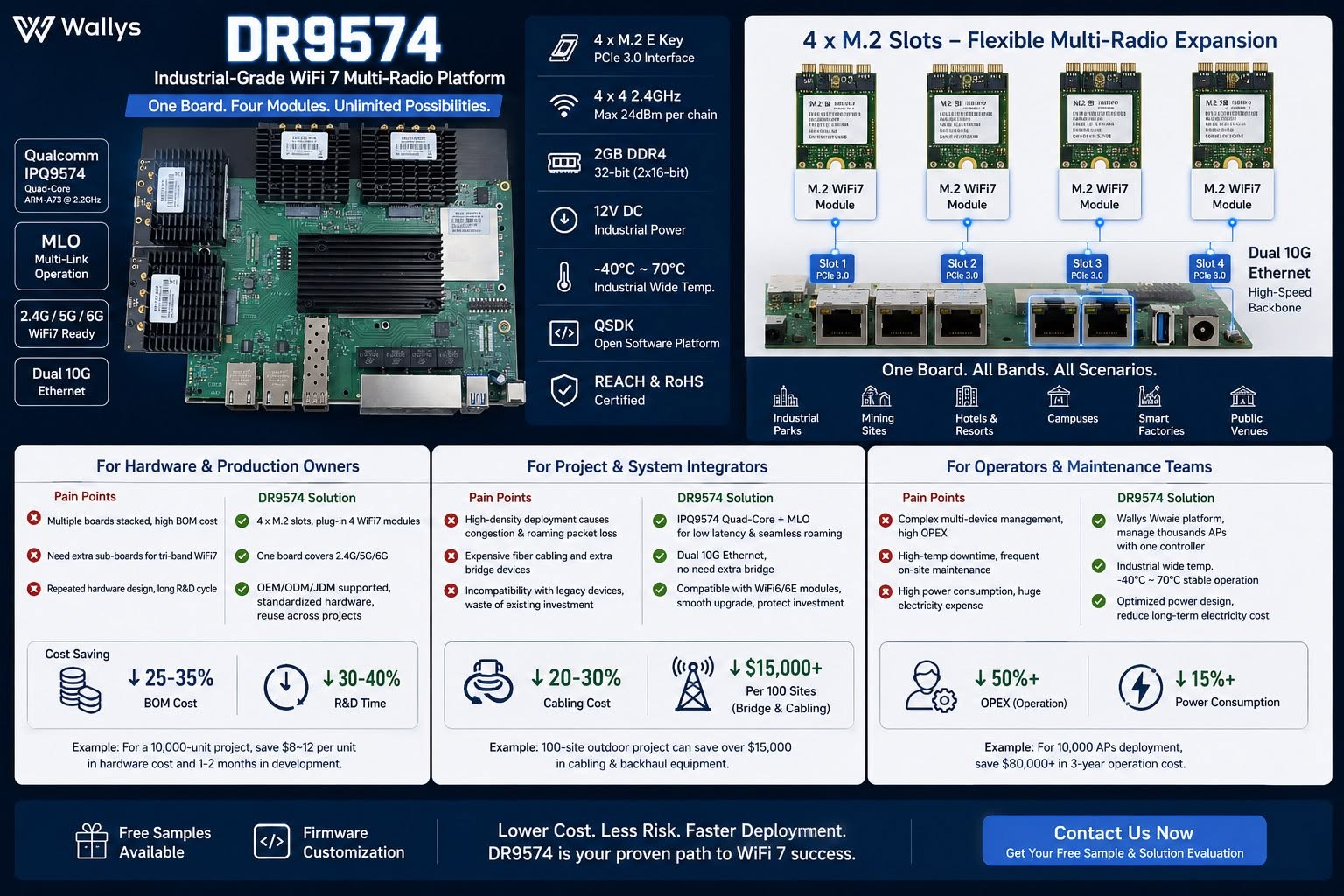
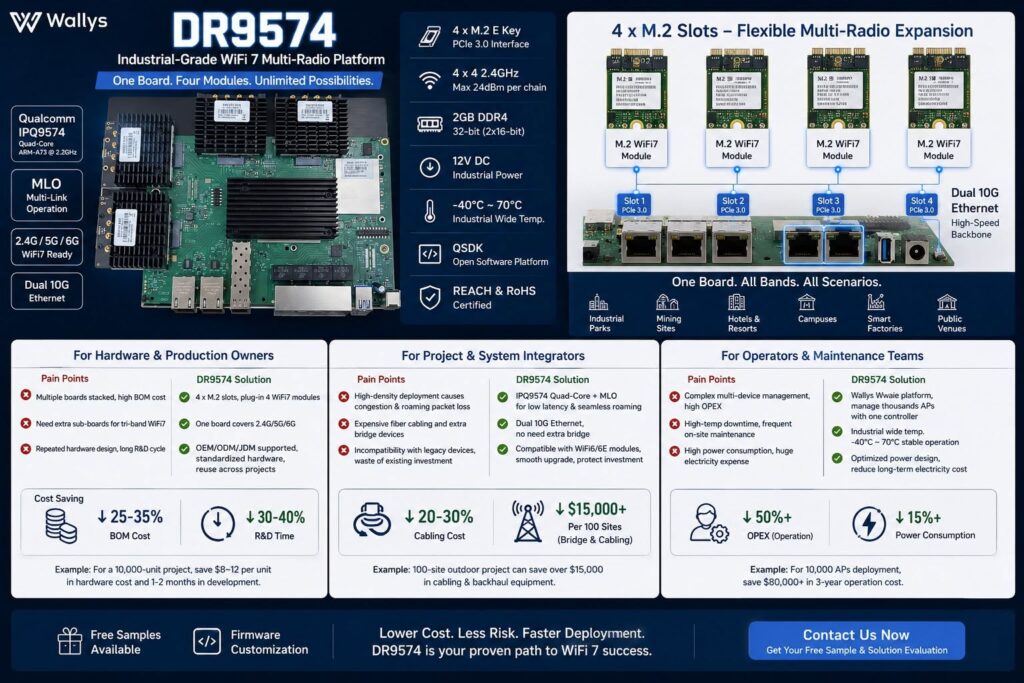
Qualcomm IPQ9574 with MLO support, dual 10G Ethernet, wide temperature industrial design – DR9574 support QSDK and OpenWRT 3 band MLO

DR9574 Industrial WiFi7 Multi-Radio Board – One board, four M.2 radio modules, unlimited wireless deployment possibilities.

Built on Qualcomm IPQ9574 with MLO support, dual 10G Ethernet, wide temperature industrial design.

Lower BOM, less cabling cost, fewer maintenance workloads & power consumption for mass AP projects.

Ideal for system integrators, OEM hardware makers & wireless operators serving campuses, mining, smart factory & hospitality networks.

Testing samples & firmware customization available – DM to get your solution evaluation!

QSDK based firmware with QCA drivers is available , 3 card 3 band MLO support !! 4×4 MU MIMO or 2×2 MU MIMO configuration for 3 band MLO available.

https://wifi5.eu/dls/Wallys/DR9574

OpenWRT support available too !!

— working mainline OpenWrt port (10G + Wi-Fi 7 MLO)

Over the past few weeks we’ve brought the board up on a fully mainline stack — mainline Linux 6.12 + OpenWrt + ath12k, no QSDK and no out-of-tree datapath driver — and it now cold-boots from NAND into a working router/AP with both:

– 10G USXGMII ethernet (the AQR113C ports) bringing up a link and passing traffic with a DHCP lease, and
– a 3-link Wi-Fi 7 AP-MLD (one SSID across 6 / 5 / 2.4 GHz, WPA3-SAE) on mainline ath12k, with a real client associating and passing iperf traffic.

Getting the 10G working on mainline required root-causing and fixing an actual upstream kernel bug — a per-port clock that was left at the 10G rate regardless of the negotiated link speed. It’s a small, clean patch I’m preparing for the netdev mailing list, and it should help any IPQ95xx board with an Aquantia USXGMII PHY, not just this one.

Everything is public and reproducible here:
https://codeberg.org/insalata-fresca/openwrt-dr9574
(device tree, the patch set, and a write-up of the root cause.)

Why we think this could be interesting for you : a mainline-based firmware track means a current kernel with ongoing security fixes, an auditable, blob-minimal stack, and upstreamable patches — a strong story for customers who need long support windows, as a complement to the QSDK option.

W've pushed the mainline port further: the four 2.5G QCA8084 LAN ports are now the focus. The four copper PHYs come up and answer on mainline, and the 10G/USXGMII uplink and the 3-link Wi-Fi 7 MLO already work. But the 2.5G ports don't pass traffic yet,and I've traced it to one specific, well-understood gap.

In short: the QCA8084's internal XPCS never becomes reachable over MDIO. The chip's security-control config space (0xC90F000, which holds WORK_MODE and the SerDes/XPCS MDIO address fix-up) is readable but appears write-locked in our mainline bring-up. The driver writes the correct values (work mode 0x2f, XPCS MDIO address 7), but they don't take - so the XPCS stays at a default address, answers nowhere, and everything downstream (per-channel config, link, traffic) is blocked behind it. We are working on the final solution now.


The full write-up and the exact register evidence are on a public WIP page:

Status and the open question:
https://codeberg.org/insalata-fresca/openwrt-dr9574/src/branch/wip-qca8084-2p5g/docs/qca8084-2p5g-status.md

Register evidence (the actual readouts):
https://codeberg.org/insalata-fresca/openwrt-dr9574/src/branch/wip-qca8084-2p5g/docs/qca8084-2p5g-register-evidence.md

Repo root (device tree, 10G and Wi-Fi 7 patches):
https://codeberg.org/insalata-fresca/openwrt-dr9574

Posted on

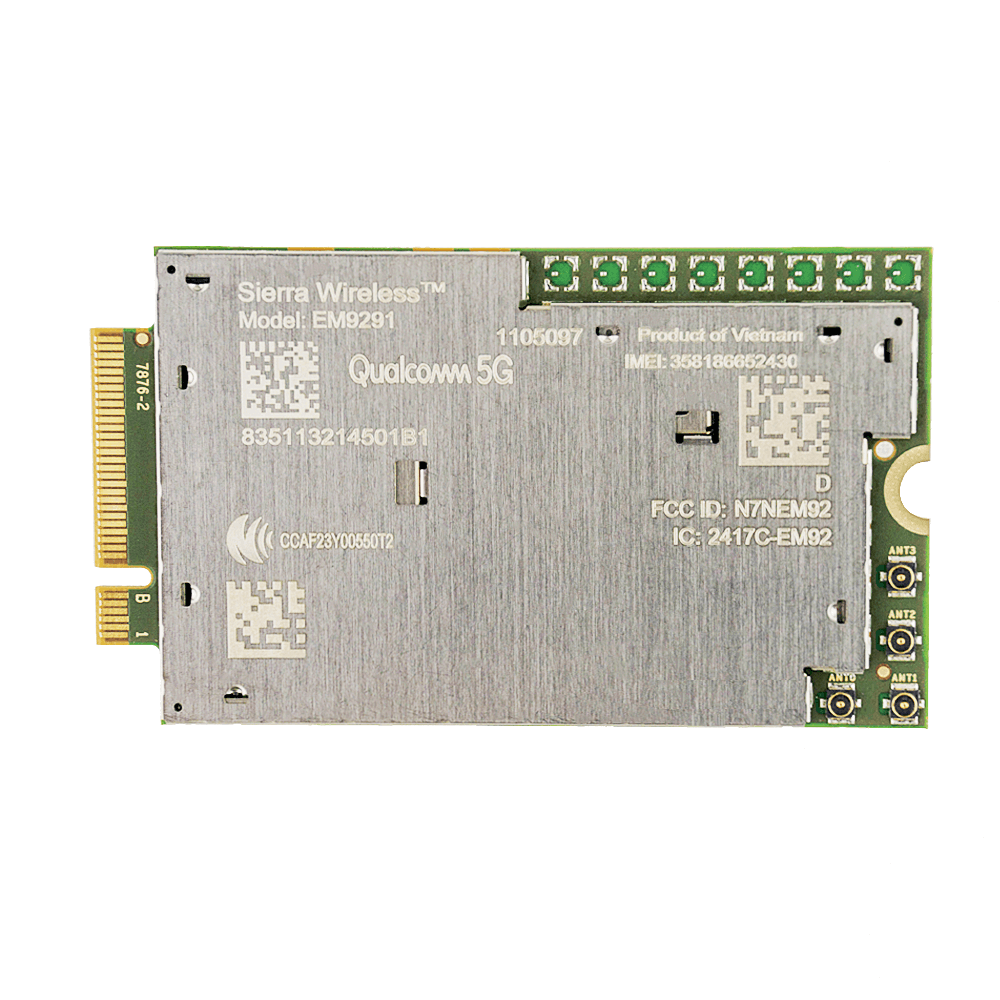
Semtech EM9295 5G NR sub6 M.2 Global module – 5G eMBB highlight

Powered by the Qualcomm X61 modem, the Semtech EM9295 brings cost-optimized 5G connectivity in the well known M.2 30x52mm form factor. It supports 3GPP Release 16 and downlink speeds reaching up to 2.5 Gbps. This latest addition to Semtech’s portfolio hits a sweetspot between capability and affordability.

Whether you’re deploying routers, industrial gateways, or edge computing platforms, the EM9295 delivers the right balance of speed, functionality, and cost – making 5G a practical choice for value-driven projects where every design decision matters. Get your sample today, or reach out to our experts to discuss your project needs.

Semtech EM9295 5G sub6 M.2 3052 Global is an

5G NR Sub-6 GHz embedded module delivers up to 4.9Gbps downlink speed and 660Mbps uplink speed. With automatic 4G and 3G fallback networks and integrated GNSS receiver (GPS, GLONASS, BeiDou, and Galileo satellite systems supported), the EM9295 is applicable to a wide range of IoT applications such as industrial routers, home gateways, industrial and consumer laptops, rugged tablet PCs, video surveillance and digital signage.

Key Benefits

  • Worldwide coverage on a single module
  • Dual Sim Single Standby (DSSS)
  • Industrial grade
  • Optional Embedded Consumer eUICC to simplify and add flexibility to IoT deployment

Posted on

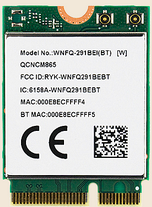
Sparklan WNFQ-291BEI BT

The Sparklan WNFQ-291BEI(BT) is everything a Wi-Fi enthusiast could ask for in a M.2 2230 key E format. Based on the Qualcomm Fastconnect 7800 platform, it comes with support for all the latest Wi-Fi 7 features, Bluetooth, a true industrial package and a highly capable Soft AP mode. If you’re looking for a solution that has it all – this is it.

WNFQ-291BEI

802.11be/ax/ac/a/b/g/n  Industrial Capable Tri-band WiFi Combo, M.2 2230 (E KEY) Module (WiFi 7), Qualcomm, 2T2R

Chipset: Qualcomm WCN7851 , Samples available for orders now.

  • Antenna: 2 x IPEX MHF4 connectors, 2T2R
  • Interface: PCIe: WLAN / USB
  • Supports Dual-Band Dual Concurrent Design
  • Support: Win11/Linux (Open Source) (TBD)

Categories: E Key, M.2Tags: 11be, 2T2R, Industrial Grade, Wifi 7

WNFQ-291BEI, first Qualcomm based WiFi-7 (802.11be) module in M.2 2230 E key formfactor, running PCIe (Wifi) and USB, supports DBDC (Dual-band, Dual-concurrent) mode, but with Tri-band capability (2.4GHz, 5GHz, and 6GHz). WNFQ-291BEI is able to concurrently run 2.4GHz with 5GHz, or 6GHz, and support full IEEE802.11 be/ax/ac/a/b/g/n protocol, up to 320MHz mode.

WNFQ-291BEI designed with 2 spatial streams (2T2R, or 2×2) in MU-MIMO mode. With a standard M.2 E key 2230 formfactor, WNFQ-291BEI can accommodate to all existing platform that has M.2 Adaptor pre-integrated, no extra work with platform design.

Software wise WNFQ-291BEI support Windows, with Linux (Open Source) in the near future. The module is capable to run on both x86 platform and ARM based platform, and supports STA mode and Soft AP Mode*, recommend to run on application includes: digital signage/POS, rugged computer / tablets, fanless automation PC and other industrial environment applications that requires high speed data transmission.

Applications include IPC/ Advertising machine/ OTT/ IPTV/ DVB/ STB / DV/ Mini Driving Recorder/ Intelligent Projector Pico/ VR/ AR terminal/ POS machine/ Vehicle mounted front/ Rear Terminal UAV/ Robot/ Intelligent Gateway/ Smart city and other electronic products.

ROHSReach
STANDARD
WI-FIIEEE 802.11be/ax/ac/a/b/g/n
ChipsetQualcomm WCN7851
Host InterfaceWLAN : PCIe / USB
RADIO
Antenna2 x IPEX MHF4 connectors
Operating Frequency802.11be/ax/ac/a/b/g/n ISM Band
2.400GHz~2.4835GHz5.150GHz~5.850GHz5.925GHz~7.125GHz*Subject to local regulations
MODULATIONS
802.11bDSSS (DBPSK, DQPSK, CCK)
802.11gOFDM (BPSK, QPSK, 16-QAM, 64-QAM)
802.11nOFDM (BPSK, QPSK, 16-QAM, 64-QAM)
802.11aOFDM (BPSK, QPSK, 16-QAM, 64-QAM)
802.11acOFDM (BPSK, QPSK, 16-QAM, 64-QAM, 256-QAM)
802.11axOFDMA (BPSK, QPSK, 16-QAM, 64-QAM, 256-QAM, 1024-QAM, 4096-QAM)
802.11beOFDMA (BPSK, QPSK, 16-QAM, 64-QAM, 256-QAM, 1024-QAM, 4096-QAM)
POWER & SENSITIVITY
WiFiPower – TX (± 2dBm)Sensitivity – RX
11b @ 11Mbps18 dBm≤ -91 dBm (TBD)
11g @ 54Mbps16 dBm≤ -77.5 dBm (TBD)
11gn HT20 @ MCS 716 dBm≤ -76.5 dBm (TBD)
11gn HT40 @ MCS 716 dBm≤ -74 dBm (TBD)
11a @ 54Mbps13 dBm≤ -76.5 dBm (TBD)
11an HT20 @ MCS 711.5 dBm≤ -76 dBm (TBD)
11an HT40 @ MCS 711 dBm≤ -73.5 dBm (TBD)
11ac VHT80 @ MCS 99.5 dBm≤ -64 dBm (TBD)
11ac VHT160 @ MCS 99.5 dBm≤ -62 dBm (TBD)
11ax 2.4GHz
11ax HE40 @ MCS 1112.5 dBm≤ -62 dBm (TBD)
11ax 5GHz
11ax HE20 @ MCS 119 dBm≤ -64 dBm (TBD)
11ax HE40 @ MCS 119 dBm≤ -61.5 dBm (TBD)
11ax HE80 @ MCS 119 dBm≤ -58.5 dBm (TBD)
11ax HE160 @ MCS 119 dBm≤ -55.5 dBm (TBD)
11ax 6GHz
11ax HE20 @ MCS 119 dBm≤ -63 dBm (TBD)
11ax HE40 @ MCS 119 dBm≤ -60.5 dBm (TBD)
11ax HE80 @ MCS 119 dBm≤ -57.5 dBm (TBD)
11ax HE160 @ MCS 119 dBm≤ -54.5 dBm (TBD)
11be 2.4GHz
11be EHT40 @ MCS 1311.5 dBm≤ -62 dBm (TBD)
11be 5GHz
11be EHT20 @ MCS 138.5 dBm≤ -64 dBm (TBD)
11be EHT40 @ MCS 138.5 dBm≤ -61.5 dBm (TBD)
11be EHT80 @ MCS 138.5 dBm≤ -58.5 dBm (TBD)
11be EHT160 @ MCS 138.5 dBm≤ -55.5 dBm (TBD)
11be 6GHz
11be EHT20 @ MCS 138.5 dBm≤ -63 dBm (TBD)
11be EHT40 @ MCS 138.5 dBm≤ -60.5 dBm (TBD)
11be EHT80 @ MCS 138.5 dBm≤ -57.5 dBm (TBD)
11ax EHT160 @ MCS 138.5 dBm≤ -54.5 dBm (TBD)
11be EHT320 @ MCS 137.5 dBm≤ -54.5 dBm (TBD)
POWER CONSUMPTION(TBD)
Continue TXTBD mA (MAX)
Continue RXTBD mA (MAX)
ENVIRONMENTAL
Operating VoltageDC 3.3V
Temperature Range-40~ +85°C (Operating) (TBD)-45 ~ 90°C (Storing) (TBD)
Humidity (Non-Condensing)5 ~ 90% (Operating)5 ~ 90% (Storing)
SIZE
Dimension (MM)30mm (±0.15mm) x 22mm (±0.15mm) x  mm (±0.3mm) (TBD)
Weight3.2g (TBD)
SOFTWARE
Driver (MM)Win 11/ Linux (Open Source) (TBD)
SecurityWPS2.0, WAPI, WPA, WPA2, WPA3
Miscellaneous
Warranty12 Month
HS Code8517620050
Posted on

The Wi-Fi 7 Revolution: Beyond Speed to Industrial Reliability and MLO

In the world of Industrial IoT, legacy wireless standards are more than just slow—they are bottlenecks. In high-density environments, waiting for a single free channel is a luxury enterprises can no longer afford. This is why Wi-Fi 7 MLO (Multi-Link Operation) is the true game-changer.

At 524WiFi, we view Wi-Fi 7 not just as a speed upgrade, but as an infrastructure overhaul. Imagine a congested highway: MLO doesn’t just increase the speed limit; it adds multiple lanes across 5GHz and 6GHz bands simultaneously, ensuring data flows without interruption.

We recognize that many of our clients are at a crossroads: you need Wi-Fi 7 performance but are locked into existing Mini PCIe architectures.

To bridge this gap, 524WiFi has introduced the AW7990-NPD, the world’s first Wi-Fi 7 BE3600 Mini PCIe module. Powered by the MediaTek MT7990 chipset, this module is specifically engineered to bring enterprise-grade connectivity to industrial robotics, edge computing, and security gateways—without requiring a total system overhaul.

Technical Core & Strategic Advantages :

  • Sub-1GHz Efficiency : Operating in the Sub-1GHz spectrum to ensure superior wall penetration and minimized interference.
  • 1KM+ Transmission : Achieves long-range connectivity exceeding 1 kilometer, ideal for remote sensor monitoring and agricultural IoT.
  • Plug-and-Play Integration : A versatile USB interface that simplifies the addition of Wi-Fi HaLow capabilities to existing gateways, PCs, or embedded controllers.
  • IEEE 802.11ah Standard : Optimized for high-density IoT networks, supporting thousands of nodes with significantly lower power consumption than traditional Wi-Fi.

Why the AW7990-NPD is a Strategic Asset:

  • Extreme Throughput : Leveraging BE3600 dual-band concurrency and 4096-QAM for unprecedented data density.
  • Deterministic Latency : MLO technology ensures a stable, “wire-like” connection even in the most crowded RF environments.
  • Industrial Heritage : A standard Mini PCIe form factor designed for the rigors of high-performance  industrial applications.

We know the industry’s open secret: great hardware is often crippled by poor drivers. At AsiaRF, we don’t just build modules; we build development platforms.

Our MediaTek-powered Wi-Fi 7 solutions are highly optimized for Linux and OpenWrt. We provide the robust software foundation your custom Enterprise APs demand, so your engineering team can stop debugging drivers and start building legendary systems.

Our growth is fueled by a single principle: Stability is everything. We are committed to being the reliable partner you need for the next generation of industrial deployment.

🔗 Explore 𝗼𝘂𝗿 𝗪𝗶-𝗙𝗶 𝟳 𝗰𝗼𝗹𝗹𝗲𝗰𝘁𝗶𝗼𝗻

Posted on

524WiFi 𝑨𝑾7990-𝑵𝑷𝑫: MediTatek Filogic 6 MT7990 𝑾𝒊-𝑭𝒊 7 𝑴𝒊𝒏𝒊 𝑷𝑪𝑰𝒆 𝑴𝒐𝒅𝒖𝒍𝒆


Infrastructure Preservation: Upgrade to 802.11be Without a PCB Redesign

In industrial computing, the lifecycle of your platform is critical. While the industry pivots to Wi-Fi 7, transitioning often necessitates a full-scale hardware overhaul—until the introduction of the 524WiFi AW7990-NPD Mediatek based module.

Technical Core & Strategic Advantages :

  • MediaTek Filogic 600 (MT7990) : Delivers BE3600 dual-band concurrent (DBDC) operation.
  • 4096-QAM Modulation : Achieves a 20% increase in peak data rates compared to Wi-Fi 6.
  • Multi-Link Operation (MLO) : Ensures deterministic latency and link reliability in congested environments.
  • Drop-In Upgrade : Bypasses R&D costs and time-to-market delays by utilizing the standard Mini PCIe form factor.

Optimized for Mission-Critical Verticals :

  • Industrial Robotics : High-bandwidth telemetry for AMRs/AGVs.
  • Edge AI Nodes : Rapid data synchronization for Smart Factory 4.0.
  • Security Gateways : High-throughput processing without thermal throttling.

AW7990-NPD: High-Performance Wi-Fi 7 BE3600 AP Module with MediaTek MT7990AN

AW7990-NPD is an Wi-Fi 7 AP module BE3600 by MediaTek MT7990AN chipset supports Wi-Fi 7 technology and feature IEEE802.11 a/ b/ g/ n/ ac/ ax/ be compliant, 2.4GHz 2×2, 5GHz
3×3 2ss BE3600 Wi-Fi subsystem. The MT7990AN offers feature-rich wireless connectivity at high standards and delivers reliable, cost-effective throughput from an extended distance.

The optimized Wi-Fi baseband algorithms provide superb performance. The intelligent MAC design deploys a highly efficient offload engine and hardware data processing accelerators,
which fully offload Wi-Fi task of the host processor. The MT7976CN is designed to support standard-based features in the areas of security, quality of service, and international regulations, giving end users the greatest performance at any time and in any circumstances.

Pre-certified with CE / FCC / IC, this solution helps accelerate product deployment while lowering certification cost and complexity.

Features

WLAN

  • Wi-Fi compliant
  • IEEE 802.11a, b, g, n, ac, ax, be compliant
  • 2.4GHz 20 and 40 MHz, 2×2
  • 5GHz: 20, 40, 80 and 160 MHz, 3×3 2ss
  • Dual-Band Dual Concurrent (DBDC) iFEM
  • Supports up to 4096-QAM
  • Data rate of up to 688Mbps for 40MHz channel in 2.4Ghz and 2882Mbps for 160MHz in 5GHz mode
  • Integrated power detector to support per packet Tx power control
  • Multi-user multiple input multiple output (MU-MIMO) for Tx and Rx
  • Multi-user Orthogonal Frequency-Division Multiple Access (MU-OFDMA) for Tx and Rx
  • Support STBC, LDPC, Tx beamformer and Rx beamformee
  • Support greenfield mode, mixed mode, and legacy mode

Platform

  • 32bit RISC-V MCU for Wi-Fi protocol and Wi-Fi offload
  • Embedded SRAM and ROM
  • PCIe3.0 interface

Security

  • WFA, WPA, WPA2, WPA3 personal, WPS 2.0

QoS

  • WFA WMM and WMM-PS

Standard

ChipsetMT7990AN with MT7976CN
Memory8M byte
Host InterfaceMini PCIe
Operating VoltageDC 3.3V ± 5%
Power Consumption11.5W
Wireless2.4GHz 2T2R 802.11b/g/n/ac/ax/be5GHz 3T3R 2ss 802.11a/n/ac/ax/be
Frequency Range2.4GHz: 2.412~2.472GHz5GHz: 5.15~5825GHz
Channel Spectrum WidthsSupports 20/40MHz at 2.4GHzSupports 20/40/80/160MHz at 5GHz
AntennaExternal Antenna connector (IPEX) x3
Operating SystemLinux
Environmental TemperatureOperating:-10°C to 70°C, Storage:-20°C to 90°C
Environmental HumidityOperating: 10% to 90%, Storage: Max. 90%
Dimensions (mm)30(W)*51(L)*5.1(H)mm
WeightTBD
CertificationTBD

Package with Heatsink 30x40x25mm Aluminum material

Power consumption maximum is 9W, average is 4 – 8W.
Main board Power Supply design please provide 3.3V 3A, minimum 3.3V 2.5A.

Additional information

Weight0.0255 kg
Dimensions9.5 × 6.5 × 1.5 cm
Posted on

Used tested cheap EOC coax modems for sale – AR 7410 700Mbps HomePlugAV

Hi all EOC Ethernet over coax cable users,

We offer used older device removed from a working network after switching to PON optics. Tested, working, 3 month warranty

Both – EOC head end (Master) and client modem (slave) are available. Atheros chipset – AR7 410 / 7411 with real 350Mbps trouhput. HomePlugAV technology. Occupies the Low Frequency Band under 7.5~65MHz . Standard – compatible with other manufacturers.

Please have a look on full product description :

https://www.524wifi.com/index.php/wodasign-eoc-indoor-master-eoc1121l-700mbps-2-lan-2-f-web-management.html

https://www.524wifi.com/index.php/wodasign-eoc-slave-eoc1121r4-700mbps-4-lan-2-f-web-management.html

EOC Technology description :

Posted on

How to Use 524WiFi MEDIATEK Wi-Fi 5, 6, 6E, and Wi-Fi 7 Modules

A practical integration guide with a full 524WiFi MEDIATEK chipset based module overview.

524WiFi provides a complete portfolio of industrial-grade Wi-Fi modules covering Wi-Fi 5 (802.11ac), Wi-Fi 6 (802.11ax), Wi-Fi 6E (ax + 6 GHz), and Wi-Fi 7 (802.11be). These modules are widely used in routers, gateways, industrial IoT, smart cities, robotics, and embedded Linux systems.

This guide explains how to select, install, configure, and deploy AsiaRF Wi-Fi modules, followed by a full comparison table of current Wi-Fi 5/6/6E/7 models.

1. Choosing the Right MEDIATEK Wi-Fi Module

When selecting a module, consider:

  • Wi-Fi generation
    • Wi-Fi 5 → cost-effective, mature ecosystem
    • Wi-Fi 6 → higher efficiency, OFDMA, MU-MIMO
    • Wi-Fi 6E → access to clean 6 GHz spectrum
    • Wi-Fi 7 → ultra-low latency, multi-link operation (MLO)
  • Form factor
    • Mini-PCIe (industrial & networking equipment)
    • M.2 Key-A / Key-E (embedded systems & SBCs)
  • MIMO & throughput
    • 2×2 for compact/low-power designs
    • 4×4 for gateways, APs, and routers
2. Hardware Installation

Physical installation

  1. Insert the module into the Mini-PCIe or M.2 slot
  2. Secure with a screw
  3. Connect antennas using U.FL / MHF4 connectors
  4. Ensure antenna count matches RF chains (2×2 or 4×4)

Power & thermal

  • High-performance Wi-Fi 6/7 modules require:
    • Stable 3.3 V supply
    • Adequate ground plane
    • Optional heatsink or airflow for sustained throughput
3. Driver & OS Support

Linux / OpenWrt

524WiFi MT Mediatek Wi-Fi 6 / 6E / 7 modules are primarily based on MediaTek chipsets and are supported by:

Typical steps:

opkg update

opkg install kmod-mt76 hostapd iw

AP / STA configuration

  • Use hostapd for AP mode
  • Use wpa_supplicant for client mode
  • Configure regulatory domain:

iw reg set US # example

4. Antenna & RF Best Practices
  • Place antennas away from metal enclosures
  • Maintain proper antenna spacing for MIMO
  • Use low-loss coax for external antennas
  • Verify antenna tuning for 2.4 GHz / 5 GHz / 6 GHz
5. Regulatory & 6 GHz Considerations

For Wi-Fi 6E and Wi-Fi 7:

  • 6 GHz availability depends on country regulations
  • Ensure:
    • Correct country code
    • Proper EIRP limits
    • DFS compliance (5 GHz)
6. Validation & Testing

Recommended tests:

  • Throughput: iperf3
  • Stability: 24–72 hr stress test
  • Multi-client load test
  • Thermal monitoring under peak load
7. Full 524WiFI MEDIATEK Wi-Fi Module Table (Wi-Fi 5 → Wi-Fi 7)
ModelWi-Fi StandardBandsForm FactorMIMOChipset FamilyTypical Use Case
AW7615-NP1Wi-Fi 5 (802.11ac)2.4 / 5 GHzMini-PCIe4×4MediaTek MT7615Legacy routers, cost-optimized gateways
AW7915-NP1Wi-Fi 62.4 / 5 GHzMini-PCIe4×4MediaTek MT7915Industrial APs, enterprise gateways
AW7915-NPDWi-Fi 62.4 / 5 GHzMini-PCIe2×2MediaTek MT7915Embedded Linux platforms
AW7915-AE1Wi-Fi 62.4 / 5 GHzM.2 Key-A4×4MediaTek MT7915SBCs, edge computing
AW7915-AEDWi-Fi 62.4 / 5 GHzM.2 Key-E2×2MediaTek MT7915Compact embedded designs
AW7916-NPDWi-Fi 6E2.4 / 5 / 6 GHzMini-PCIe2×3MediaTek MT79166 GHz industrial gateways
✅ AW7916-AEDWi-Fi 6E2.4 / 5 / 6 GHzM.2 Key-E2×3MediaTek MT7916Compact Wi-Fi 6E embedded systems
AW7990-NPDWi-Fi 7 (BE)2.4 / 5 / 6 GHzMini-PCIe3×3MediaTek MT7990Wi-Fi 7 gateways & APs
✅ AW7990-AEDWi-Fi 7 (BE)2.4 / 5 / 6 GHzM.2 Key-E3×3MediaTek MT7990Next-gen embedded Wi-Fi 7 devices
✅ AW7991-AE2Wi-Fi 7 (BE)2.4 / 5 / 6 GHzM.2 Key-A/E3×3MediaTek MT7991High-efficiency Wi-Fi 7 platforms
8. Typical Application Scenarios
  • Industrial IoT gateways
  • Smart city infrastructure
  • AIoT edge devices
  • Enterprise & carrier-grade routers
  • Wi-Fi 7 next-generation APs
  • OpenWrt-based networking products
Conclusion

MEDIATEK Wi-Fi modules provide a clear upgrade path from Wi-Fi 5 to Wi-Fi 7, with consistent Linux/OpenWrt support, industrial-ready form factors, and scalable RF performance. By choosing the right module, following best practices for installation, and leveraging open-source drivers, system integrators can rapidly deploy reliable wireless solutions across diverse markets.