If you’ve ever been in a packed venue or a bustling office, you know how crucial it is to have a reliable WiFi connection. With more devices than ever connecting to the network, WiFi is under pressure. That’s where WiFi 6 and WiFi 7 come into play, offering some impressive upgrades for high-density environments. Here’s the lowdown:
🔹 WiFi 6 (802.11ax): OFDMA: This tech slices up the channel into smaller chunks so multiple devices can communicate simultaneously. It means less congestion and faster speeds! MU-MIMO: This lets multiple devices send and receive data at the same time, cutting down on wait times and improving performance. TWT: Target Wake Time schedules when devices wake up, reducing network congestion and saving battery life.
🔹 WiFi 7 (802.11be): Faster Speeds: With wider channels and more spatial streams, WiFi 7 delivers even higher speeds and better performance. Enhanced OFDMA: It’s like WiFi 6’s OFDMA but turbocharged, optimizing how resources are used. Better MU-MIMO: Handles even more users at once, making it ideal for ultra-crowded environments. Lower Latency: Improvements here mean less lag, which is great for real-time applications like AR/VR. Whether you’re thinking of upgrading or just curious about the latest in wireless tech, both WiFi 6 and WiFi 7 are worth your attention. WiFi 7 is set to lead the way with its higher speeds and lower latency, but WiFi 6 is still a fantastic option for current needs.
💡 Got questions about WiFi solutions or need advice? Feel free to reach out!
Industrial-Grade WiFi Solutions: IPQ6010 with QCN9074 vs IPQ5332 with QCN9274
In industrial-grade applications, reliable and high-performance wireless solutions are critical. Here we compare two advanced options tailored for such demanding environments: the IPQ6010 with QCN9074 and the IPQ5332 with QCN9274. These solutions are designed to meet the rigorous standards of industrial settings, providing robust connectivity and performance.
IPQ6010 with QCN9074
The IPQ6010 chipset paired with the QCN9074 is a powerful WiFi 6E solution suitable for industrial applications. It supports enhanced network capacity and efficiency, making it ideal for environments that demand high performance and reliability.
Key Features:
Chipset: Qualcomm IPQ6010
Wireless Standard: WiFi 6E (802.11ax)
Wireless Configuration: 4×4 MIMO
Bands Supported: 2.4GHz, 5GHz, 6GHz
Ethernet Ports:Multiple 1Gbps and 2.5Gbps portsSFP interfaces for fiber connections
OFDMA Support: Yes
MU-MIMO Support: Yes
Power Options: Flexible POE support, DC power
Memory & Storage: Up to 512MB DDR, various Flash options
Advantages for Industrial Applications:
Robust Performance: Enhanced wireless performance with support for the 6GHz band.
Versatile Connectivity: Multiple Ethernet ports and SFP interfaces for diverse networking needs.
Backward Compatibility: Supports legacy WiFi standards for seamless integration.
Enhanced Efficiency: OFDMA and MU-MIMO support ensure efficient network traffic management.
IPQ5332 with QCN9274
The IPQ5332 chipset paired with the QCN9274 is a next-generation WiFi 7 solution designed for industrial-grade applications that require ultra-high-speed network connections with low latency. This setup is future-proof, ensuring top-notch performance for years to come.
Key Features:
Chipset: Qualcomm IPQ5332
Wireless Standard: WiFi 7 (802.11be)
Wireless Configuration:2×2 2.4GHz MIMO4x4 5GHz MIMO4x4 6GHz MIMO
Bands Supported: 2.4GHz, 5GHz, 6GHz
Ethernet Ports:Multiple 2.5Gbps ports10Gbps SFP interfaces for high-speed fiber connections
Future-Proof Technology: Cutting-edge WiFi 7 performance with high bandwidth and low latency.
High Capacity: Advanced MIMO configurations for efficient handling of multiple simultaneous connections.
Ultra-High-Speed Connectivity: Supports up to 10Gbps Ethernet and SFP interfaces for fiber optic connections.
Scalable and Reliable: Designed to meet the rigorous demands of industrial environments with scalable network options.
Comparative Table
Recommendation for Industrial-Grade Applications
For WiFi 6E Triband Solution: The IPQ6010 with QCN9074 is highly recommended. It provides robust performance and supports the new 6GHz band, making it ideal for industrial applications requiring enhanced capacity and efficiency.
For WiFi 7 Triband Solution: The IPQ5332 with QCN9274 is the best choice. It offers cutting-edge performance with high bandwidth and low latency, ensuring it meets the demands of high-performance industrial applications and is future-proof for upcoming wireless technology needs.
Wi-Fi 7 is set to revolutionize connectivity by supporting all three frequency bands—2.4GHz, 5GHz, and 6GHz—with 320MHz channels. With greater bandwidth and higher data density at 4096 Quadrature Amplitude Modulation (QAM), Wi-Fi 7 delivers lightning-fast speeds and seamless connectivity, enhancing wireless performance to redefine the user experience.
Beyond the significant leaps in speed and bandwidth that set Wi-Fi 7 apart from Wi-Fi 6/6E, Wi-Fi 7 introduces Multi-Link Operation (MLO). This powerful innovation allows devices to connect to the same access point (AP) across multiple channels and different frequency bands simultaneously. The all-new MLO increases throughput, lowers latency, and enhances reliability where speed and network stability matter.
Compex offers a comprehensive lineup of Wi-Fi 7 solutions, promising enhanced wireless performance and reliability at Wi-Fi 6 prices. By making advanced technology more accessible, we provide excellent value to ensure our customers stay ahead in an ever-evolving market.
Introducing: Two All-New Wi-Fi 7 Modules from Compex – WLE7002E25D and WLT7002E25D-E
WLE7002E25D
Powered by Qualcomm’s QCN6224, QCN6274, and QCN9274-I Waikiki series radio chipsets, the new WLE7002E25D is one of the first in the industry to feature a standard miniPCIe form factor offering dual-band dual-concurrent 2.4+5GHz. The module incorporates a cost-efficient diplexer design that combines the 2.4GHz and 5GHz signals into a single dual-band antenna, reducing the need for multiple antennas.
WLT7002E25D-E
The new WLT7002E25D-E is also a dual-band concurrent 2.4+5GHz Wi-Fi 7 (802.11be) module in M.2 E Key, powered by Qualcomm’s QCN6224, QCN6274, and QCN9274-I Waikiki series radio chipsets. This 2×2 MU-MIMO model also incorporates a diplexer design.
Designed to meet the growing demand for high-speed and reliable wireless communication, both modules are compatible with Qualcomm and third-party platforms, ideal for enterprise, industrial, cybersecurity, transportation and SMB applications.
DR5018M: High-Performance WiFi 6 Routerboard for Industrial Applications
In modern industrial settings, the demand for reliable and high-speed wireless communication is ever-increasing. Wallys Communications offers the DR5018M, a WiFi 6 routerboard designed to meet these needs. This board integrates Qualcomm’s IPQ5018 chipset, providing robust performance and advanced features tailored for challenging industrial environments.
Key Features of the DR5018M
Advanced Processor
The DR5018M is powered by the Qualcomm IPQ5018, a dual-core ARM 64-bit A53 processor clocked at 1.0GHz. This ensures high processing power for handling multiple tasks and maintaining stable connections under heavy loads.
Exceptional Wireless Performance
The routerboard supports 2×2 MU-MIMO and OFDMA technologies, which enhance data transmission efficiency and network capacity. With onboard 2.4GHz radio, it delivers up to 573Mbps physical data rate, suitable for high-bandwidth applications like video streaming and data transmission in factories and warehouses.
Long-Distance PTP Transmission
The DR5018M excels in long-distance Point-to-Point (PTP) transmission:
3.3KM Test:5GHz: 949Mbps6GHz: 821Mbps
1.5KM Test:5GHz: 1.5Gbps6GHz: 1Gbps
These capabilities make it ideal for large industrial sites requiring extensive wireless coverage.
Flexible Connectivity Options
The DR5018M includes multiple M.2 slots for various radio cards (QCN9074 for WiFi 6E, QCN6122 for 6GHz, and QCN6102 for 5GHz), providing flexibility to meet different frequency band requirements. Additionally, it features a 1Gbps Ethernet port, USB 3.0, and PCIe 3.0 interfaces for versatile connectivity.
Enhanced Security with WPA3
Security is a top priority in industrial networks. The DR5018M supports WPA3 encryption, offering:
Stronger encryption protocols for enhanced data security.
Improved protection against brute-force attacks.
Secure, individualized encryption for each device on the network.
Rugged Design for Industrial Use
Designed to withstand harsh industrial conditions, the DR5018M operates within a wide temperature range (-40°C to 70°C) and humidity levels (5% to 95% non-condensing), ensuring reliability in various environments.
Industrial Applications
Factory Automation
The DR5018M provides stable, high-speed wireless connections for automated production lines, supporting real-time data transmission and control.
Smart Warehousing
It enables efficient operation in smart warehouses by supporting numerous concurrent connections and high data throughput.
Industrial Surveillance
With its robust wireless performance, the DR5018M supports high-definition video streaming and real-time monitoring, essential for surveillance systems.
Remote Monitoring and Control
The long-distance PTP capabilities make it perfect for remote monitoring and control applications, ensuring reliable communication across vast industrial sites.
Conclusion
DR5018M routerboard combines high-performance wireless technology with robust security features, making it an ideal choice for industrial applications. Its powerful IPQ5018 processor, excellent long-distance transmission capabilities, and support for WPA3 encryption ensure that it meets the demanding needs of modern industrial environments.
For more information or to inquire about our products, please contact us .
WiFi 7 modules from 524WiFi are available for testing. Unfortunately we just have the chip QCN6274, QCN9274 is short of the market. Leadtime for QCN 9274 chipset is 16-20 weeks now. Please check the differences bellow :
In our China factory we have these samples available now :
DR9274-5G (QCN6274) with UFL connectors 22pcs,with mmcx connectors 20pcs
DR9274-2.4G(QCN6274)with UFL connectors 15pcs
DR9274-6G(QCN6274)with mmcx connector 15pcs
All these our modules we can deliver for USD 99 each
COMPEX factory can ship these samples quickly :
WLW7000E5 8A0674S-TE 14pcs (QCN6274) WLW7000E6 8A0674S-TE 12pcs (QCN6274) WLW7002E25 8A0674S-TE 20pcs (QCN6274 2×2 mimo dual band 2,4+5GHz)
Price for COMPEX modules is USD 199 per one module.
If you are interested in WiFi 7 802.11bt modules, then please contact us and tell us more about your project, used HW and SW platform and we will recommend the best solution for you.
NEW 524 WIFI DUAL BAND TRI-BAND DR9074 WIFI 6/6E MODULES INFO – “WE CAN HELP OUR CUSTOMERS DEVELOP ATH11K TO BE USED WITH DR9074 CARDS” :
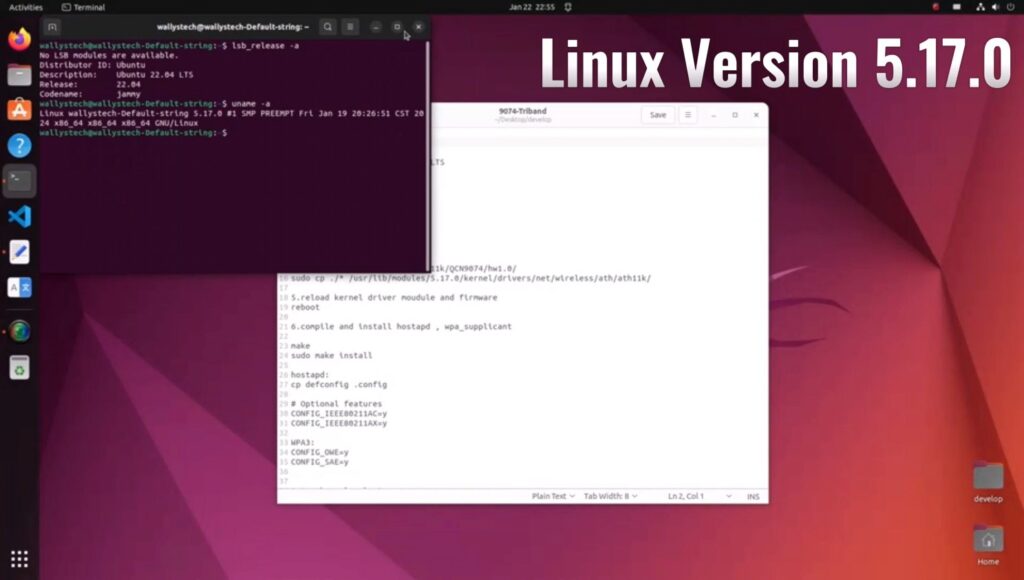
Informations regarding Linux and OpenWRT drivers – The ath11k code from github can’t support the dual / tri band card now, it needs modification. Wallystech and 524WiFi did some changes and applied in Linux kernel version 5.17.0 – if you use different kernel version, then 524WiFi will do some work for you. That is a Linux issue, there are some incompatible with different kernel versions. So the Customer need tell us the kernel version, then we release the ath11k and board-2.bin, bdf and amss.bin to customer – all is binary. Jason, chief of development, told us : “We will build it based on the Customer’s Linux version, The kernel should be 5.17 up. The Card can be AP or Client mode on x86. We do it better than others, DR9074 Triband and Dualband cards are very good and its is powerful opportunity for all customers developing WiFi6 devices. We have software engineers and we we have resources to support all Customers tu use our WiFI6 modules“
If The Customer has big volume order, then we can open the ath11k code to the customer customer based on NDA, SLA.
HOW TO USE 524WIFI 6 DR9074-TRIBAND M.2 WIFI MODULE TOGETHER WITH WALLYS ROUTER PCBA OR A THIRD PARTY X86 ECOSYS LIKE UBUNTU? AND LOADING QCN9024 QCN9074 – DR9074-TRIBAND DRIVER ON LINUX 5.17.0 – STEP-BY-STEP GUIDE !
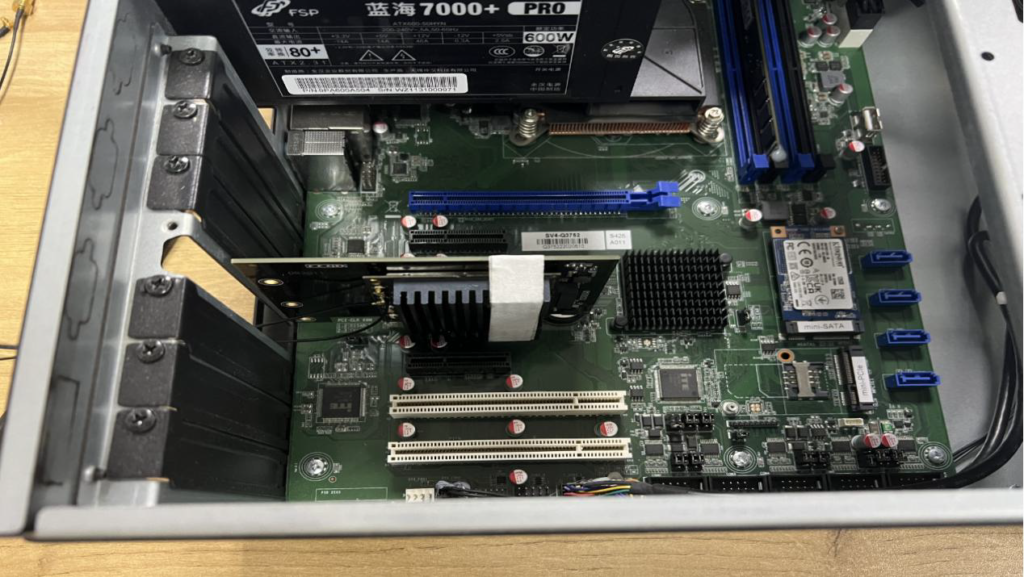
As you know, 524WiFI recently has launched two new unique Wifi modules DR9074-Triband M.2 and DR9074E – Dual Band miniPCIe,Today, this article will present how to use the module together with target platform. OpenWRT systems also use ath11k, so the information above is same for OpenWRT users.
(1) USAGE WITH WALLYS ROUTER PCBA WITH QCA IPQ 6018 CPU AND QSDK FIRMWARE :
DR6018 PCBA x1 (the board has to be pre-flashed with an exclusive version of firmware which we developed via QSDK and bootargs has been pre-set under U-boot CLI to ensure the correct board_id for the module ) DR9074-Triband M.2 wifi module x1
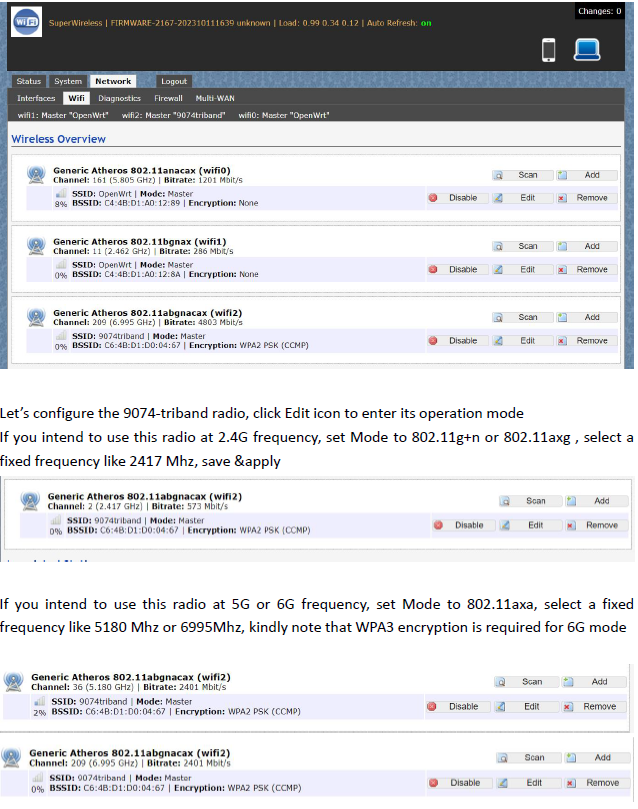
After we plug the module onboard and power on, we can access to the GUI webpage via board’s default ip address 192.168.1.1, login (admin / asdf1234)
Network>Wifi, at this section, as we can see, there are three radios available, they are Wifi0(2.4G radio),Wifi1(2.4G radio), Wifi2(9074-triband selectable radio)
Let’s configure the 9074-triband radio, click Edit icon to enter its operation mode. If you intend to use this radio at 2.4G frequency, set Mode to 802.11g+n or 802.11axg , select a fixed frequency like 2417 Mhz, save &apply
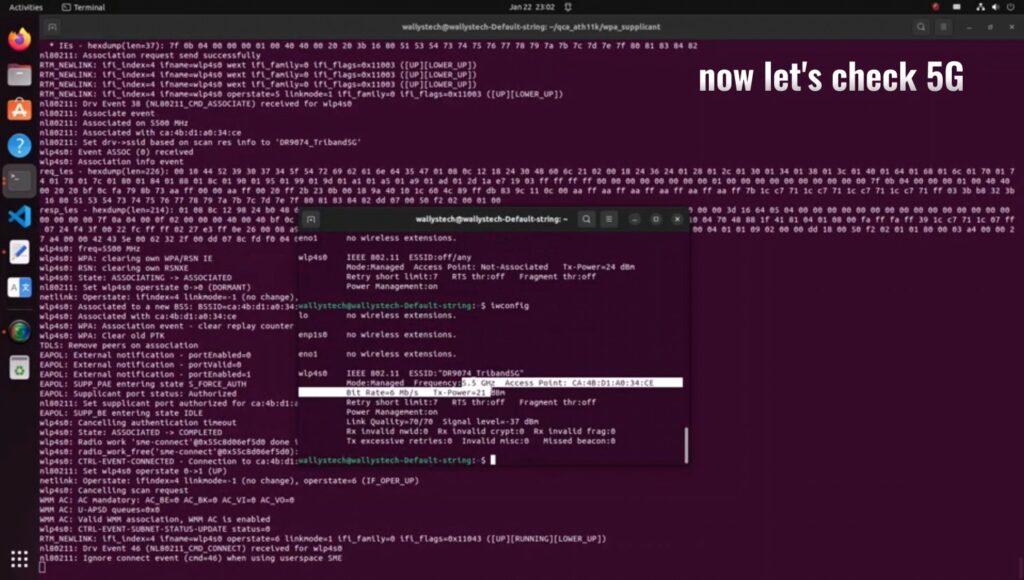
If you intend to use this radio at 5G or 6G frequency, set Mode to 802.11axa, select a fixed frequency like 5180 Mhz or 6995Mhz, kindly note that WPA3 encryption is required for 6G mode
Bitrate can be up to 4803Mbit/s under 160Mhz channel spectrum width, both 5G and 6G mode support 160Mhz channel spectrum width. And the 9074-triband module can work under both ap and sta mode
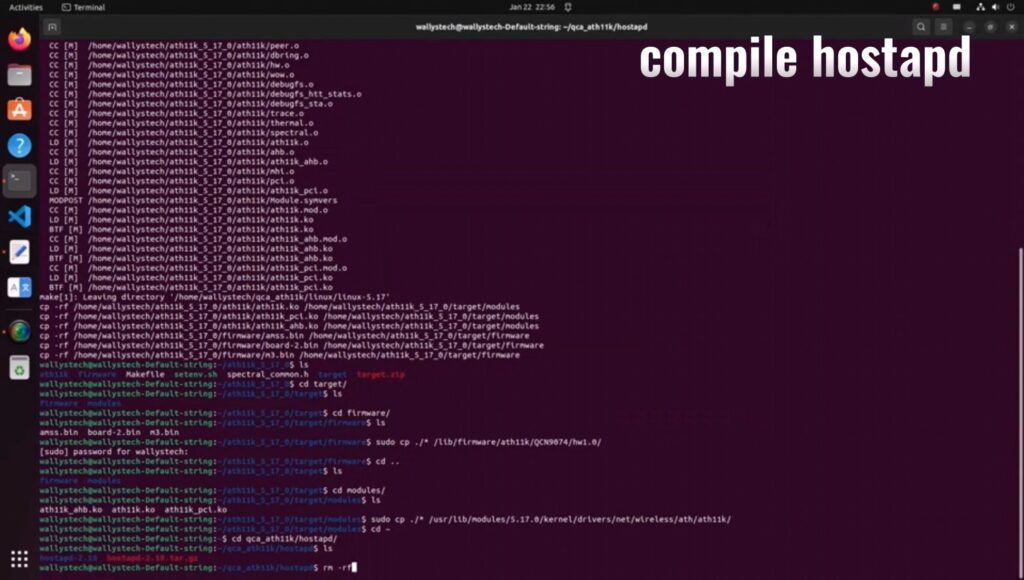
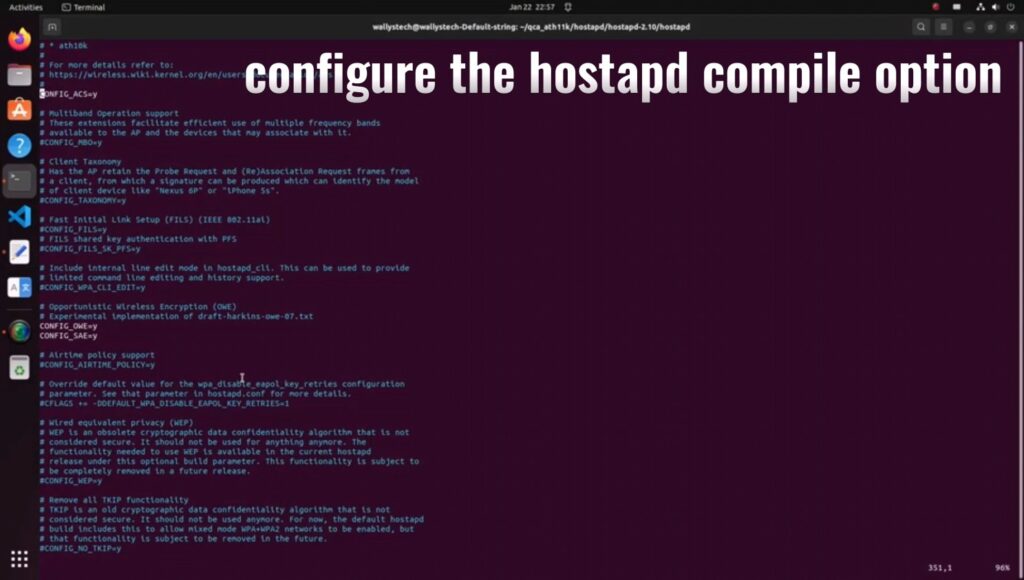
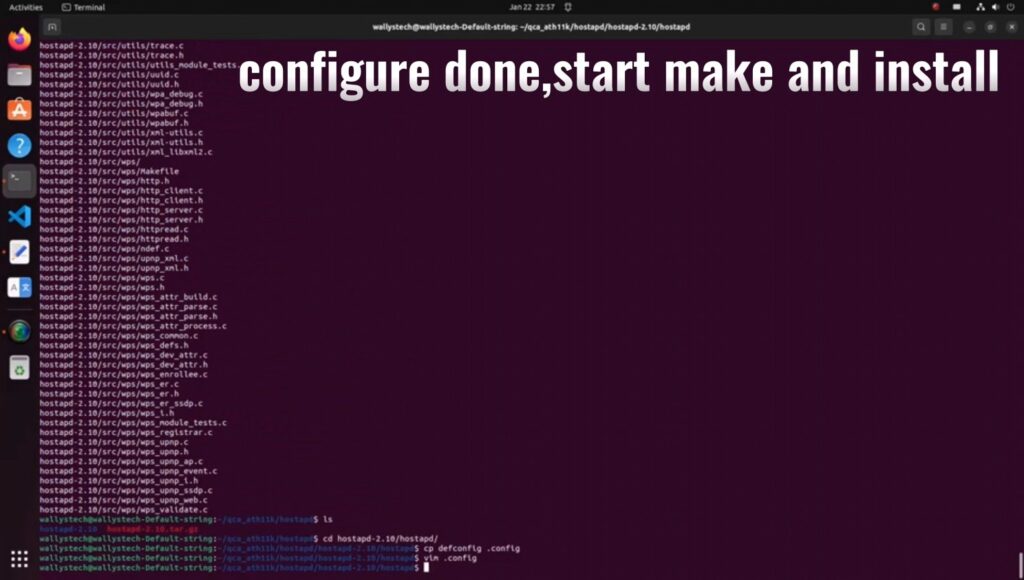
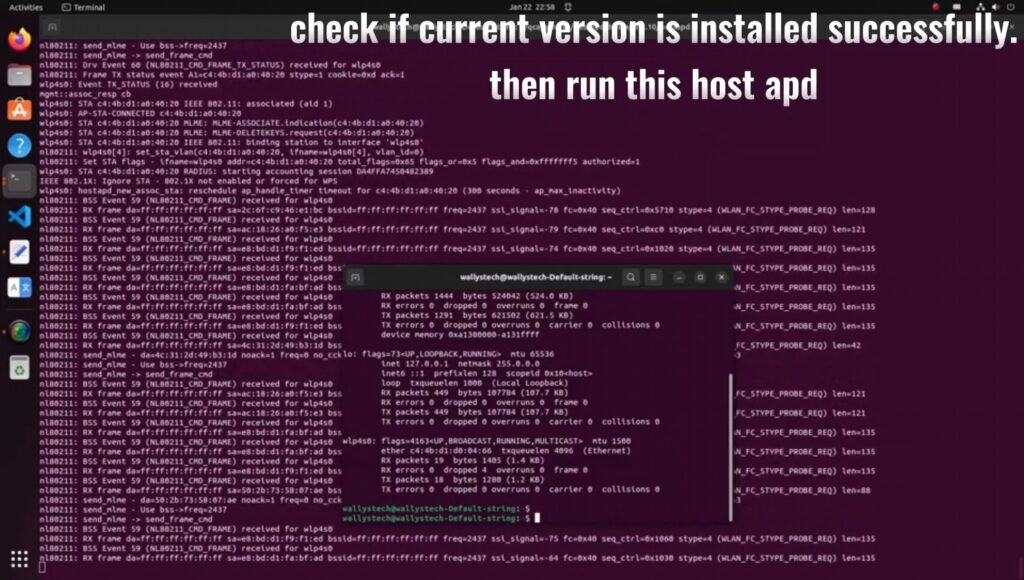
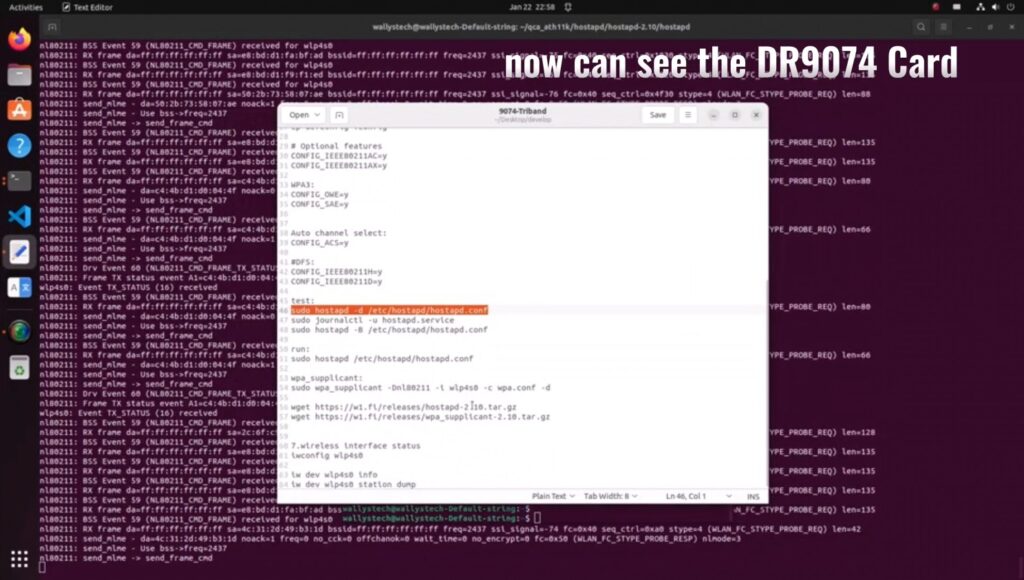
The kernel version is 5.17.0 which integrated ath11k driver Use this command ‘sudo hostapd -dd /etc/hostapd/hostapd.conf ’to enable the module under AP mode
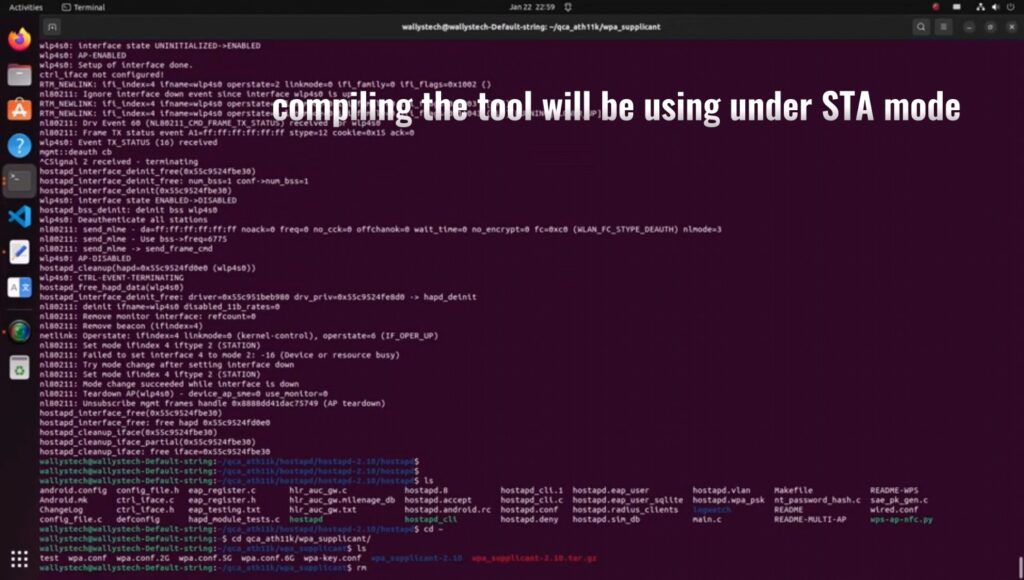
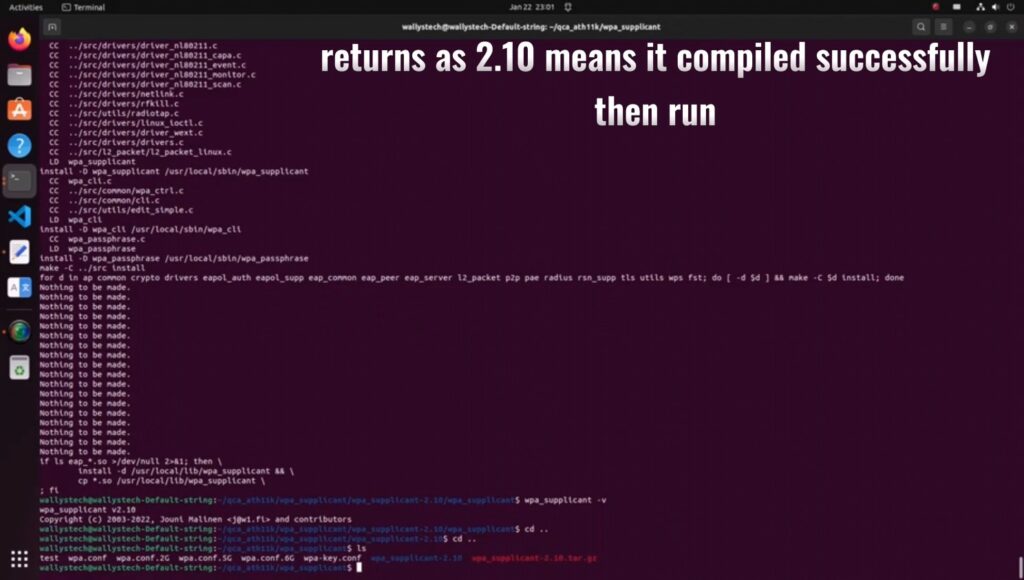
The module can work under STA mode as well, and this command need to be run ‘ sudo wpa_supplicant -Dnl80211 -i wlp4s0 -c wpa.conf’ If you are interested in the product or have any technical questions, feel free to reach out 524WiFi or Wallys team
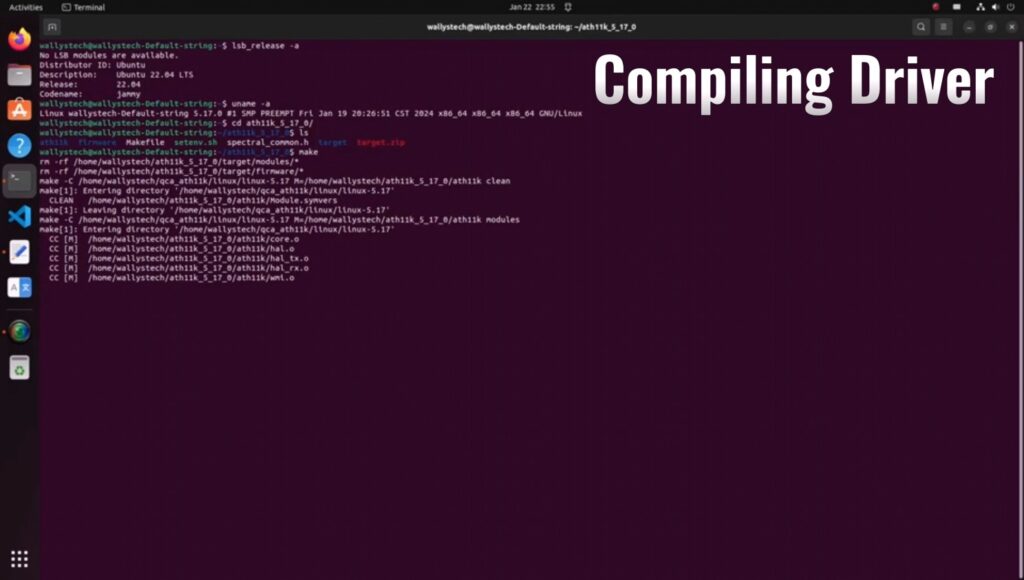
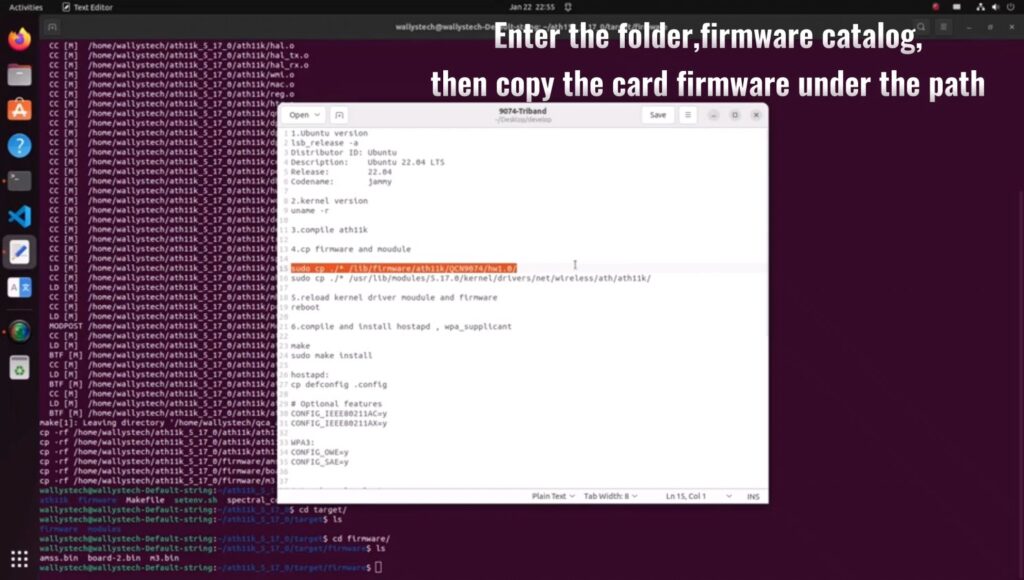
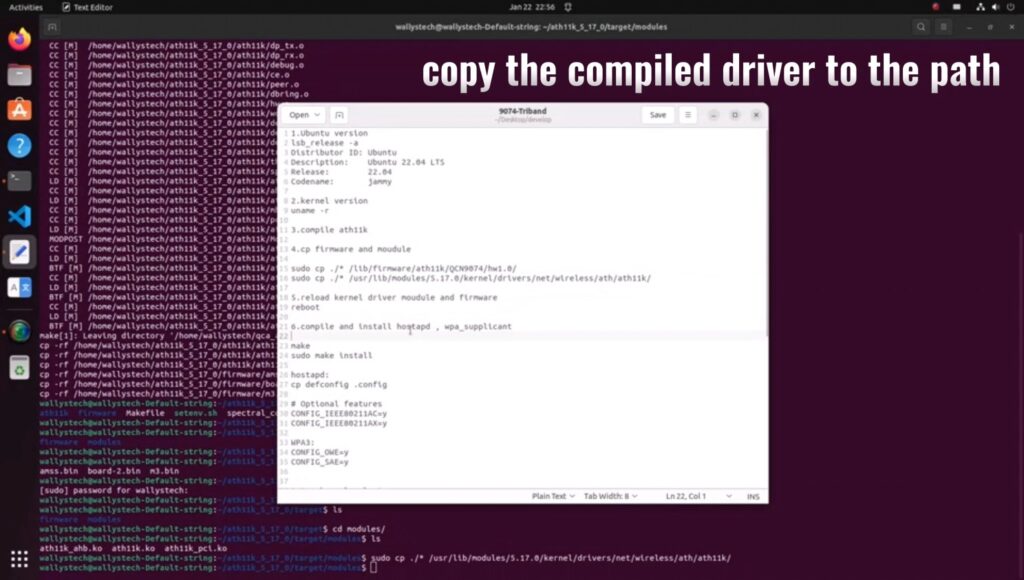
QCN9024 QCN9074 | LOADING DR9074-TRIBAND DRIVER ON LINUX 5.17.0 – STEP-BY-STEP GUIDE
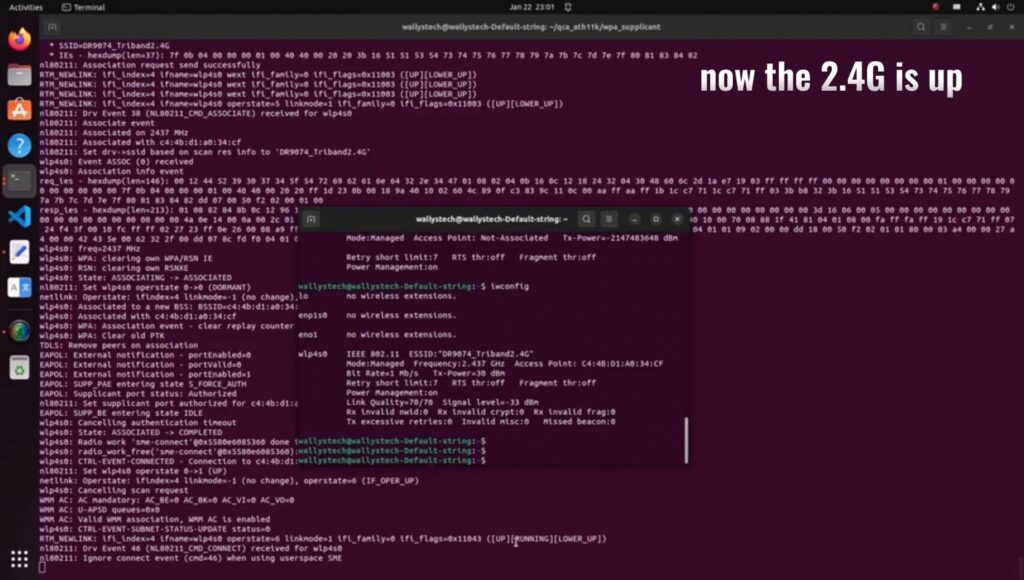
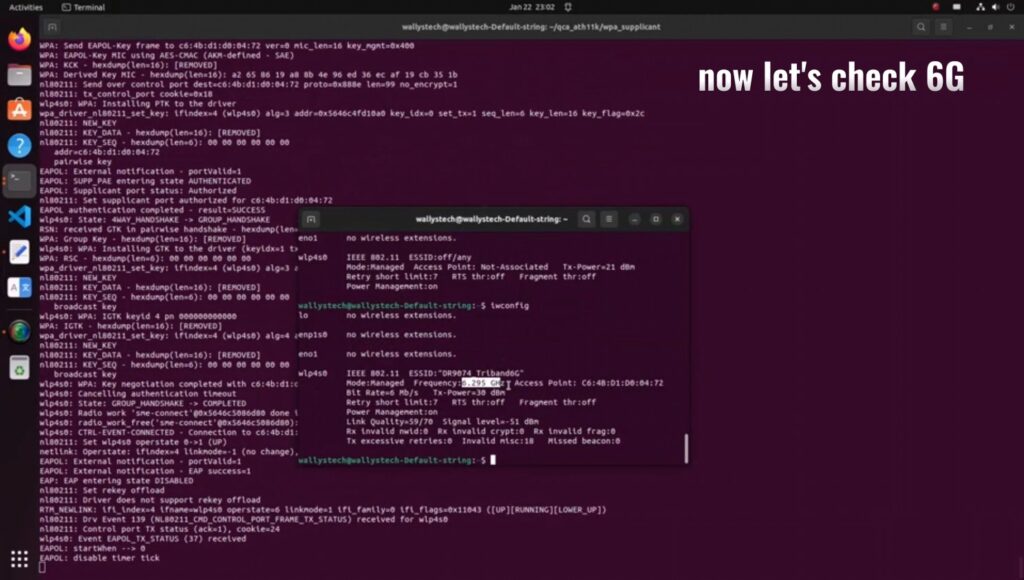
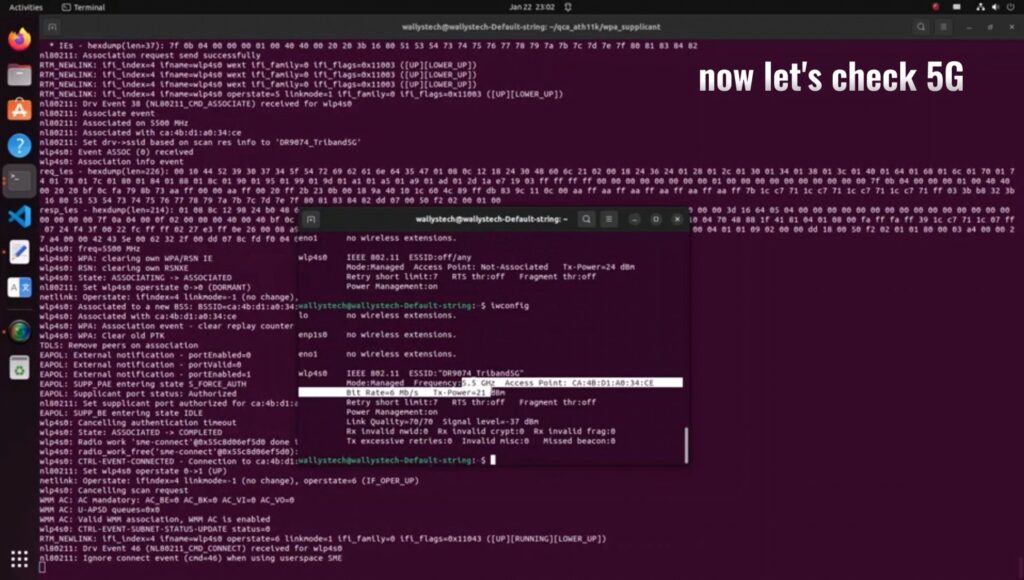
Wallys recently announced the compatibility of DR9074-TRIBAND with ATH11K on Linux, expanding its support beyond Qualcomm platforms to various Linux embedded systems, including Ubuntu. In this guide, we’ll walk you through the process of loading the driver for DR9074-Triband on Linux 5.17.0, demonstrating its seamless integration with ath11k. The module is showcased to function effectively in both AP (Access Point) and STA (Station) modes across the 2.4GHz, 5GHz, and 6GHz bands.
INTRODUCTION TO DR9074 (QCN9024):
DR9074-Triband equipped with the Qualcomm Atheros QCN9024 chipset, is an advanced enterprise wireless module. It incorporates a 4×4 MU-MIMO Dual Band Wireless Module, tailored for mobile access in high-bandwidth applications such as video streaming, voice communication, and data transmission. Key features include a maximum power of 23 dBm per chain, supporting data rates up to 4949Mbps. Operating in Tri-Band (2.4GHz, 5GHz, and 6GHz) with 4×4 WiFi 6E (802.11ax) and 4 spatial streams, it features an M.2 E Key Interface and PCI Express 3.0 Interface. Applications span security surveillance, commercial radio coverage, hotel wireless setups, and specialized scenarios.
Device Specifications:
Chipset: Qualcomm Atheros QCN9024
WLAN Host Interface: PCI Express 3.0
Frequency Range: 2.412GHz-2.472GHz & 5.18GHz-5.825GHz & 5.925GHz-7.125GHz