
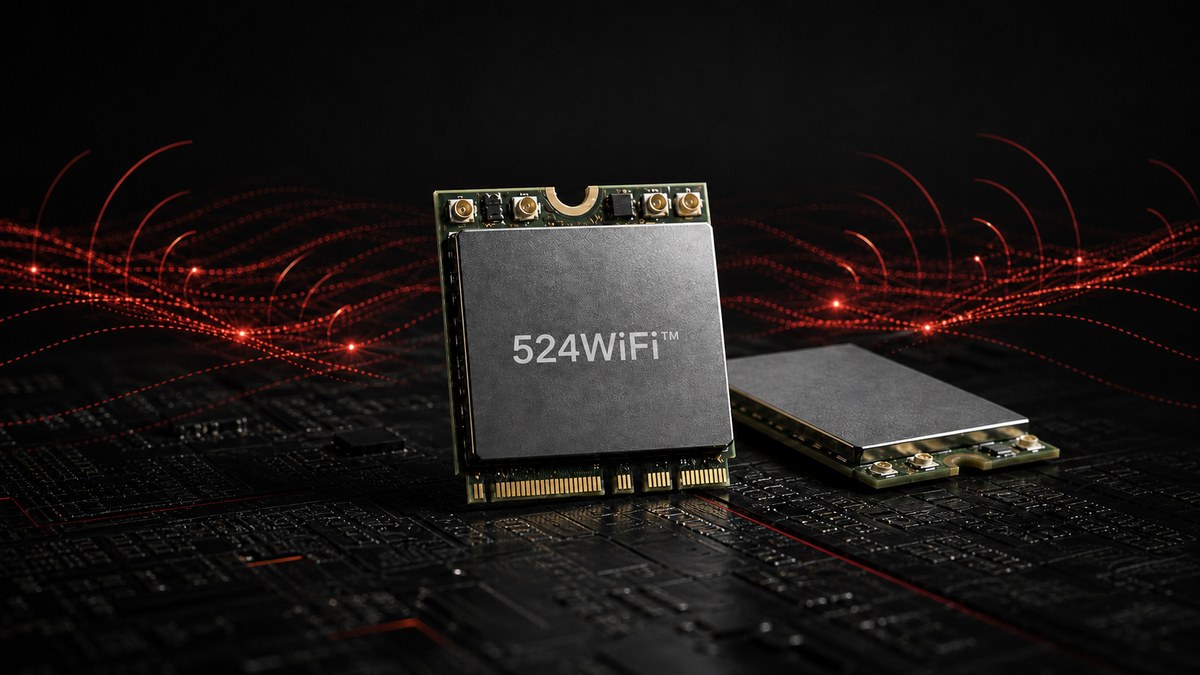
Wi‑Fi 8 is now a hardware-planning issue, not just a standards roadmap. On 2 March 2026, Qualcomm Technologies introduced the Qualcomm® FastConnect™ 8800 Mobile Connectivity System alongside its wider Wi‑Fi 8 portfolio. For embedded-device and wireless-module teams, the most important news is not simply the headline PHY rate. It is the move to a 4×4 mobile radio architecture and the resulting impact on antennas, host bandwidth, power, heat and coexistence.
This engineering guide from 524WiFi.net™ translates the announcement into practical design questions for teams planning laptops, tablets, robots, edge-AI systems and other compact connected products.
FastConnect 8800 specifications at a glance
Qualcomm describes FastConnect 8800 as a single-chip, 6 nm connectivity system that combines Wi‑Fi 8, Bluetooth® High Data Throughput, Ultra-Wideband and Thread. The published Wi‑Fi specifications include:
- a 4×4 radio configuration;
- a peak PHY rate of up to 11.6 Gbps;
- 2.4 GHz, 5 GHz and 6 GHz operation;
- channels up to 320 MHz and 4K QAM;
- High Band Simultaneous Multi-Link, uplink and downlink MU-MIMO, and OFDMA;
- Wi‑Fi 8 Extended Long Range (ELR); and
- support for earlier Wi‑Fi 7, Wi‑Fi 6E and Wi‑Fi 6 generations.
Qualcomm also reports up to three times longer gigabit range than its previous generation under the company’s stated 4×4, 320 MHz, RF front-end and ELR test conditions. Both the speed and range figures are platform claims rather than guaranteed product-level results: enclosure design, antennas, drivers, regional spectrum rules and the peer device will determine real performance.
Why a 4×4 mobile radio changes the integration plan
Four useful RF paths must fit inside the product
A four-stream radio needs more than four connectors on a schematic. Each path must remain useful after the module is installed in the final enclosure. Antenna spacing, polarization, cable loss, ground-plane interaction and isolation all matter across 2.4, 5 and 6 GHz. Metalwork, displays, batteries and edge-compute boards can detune antennas or create asymmetric paths that erase the expected 4×4 benefit.
Teams should reserve antenna volume early and validate the complete mechanical assembly, not only an open-bench reference setup. This is especially important for robots and industrial systems, where orientation and nearby machinery can change rapidly.
The host interface cannot be an afterthought
An 11.6 Gbps PHY rate is not the same as application throughput, but it still raises the ceiling for every subsystem around the radio. PCIe lane configuration, memory bandwidth, interrupt handling, CPU load, DMA behavior and driver architecture must be considered together. A next-generation radio connected through a constrained host path will deliver a constrained result.
Before freezing a carrier board, define realistic simultaneous traffic targets and include protocol overhead, multi-link scheduling and bidirectional workloads. Our Wi‑Fi 5 to Wi‑Fi 7 module selection guide shows why host compatibility and software support already matter as much as radio specifications.
Power delivery and thermal behavior need system-level testing
More RF chains, wider channels and concurrent links can increase peak power demand. The module, voltage regulators, connector and PCB must tolerate short bursts without instability, while the enclosure must prevent sustained workloads from triggering thermal throttling. Average consumption alone is not enough: measure peak current, rail noise and temperature under worst-case traffic, ambient conditions and antenna mismatch.
Coexistence becomes a product feature
FastConnect 8800 integrates Wi‑Fi, Bluetooth, UWB and Thread, and Qualcomm’s Proximity AI concept combines Wi‑Fi Ranging, UWB and Bluetooth Channel Sounding for direction and distance awareness. Integration reduces component count, but it also makes coexistence planning more important. Antenna topology, filtering, clocking and firmware scheduling should be tested with multiple radios active at once.
Wi‑Fi 8 changes the target from peak speed to dependable performance
Wi‑Fi 7 brought 320 MHz channels and multi-link operation into current high-performance designs. Wi‑Fi 8, based on IEEE 802.11bn, is being positioned around more reliable performance, useful range and predictable behavior under load. That shift is relevant to edge AI, autonomous machines and industrial links, where a stable latency envelope may be more valuable than a laboratory maximum.
The design question therefore changes from “Which radio has the highest number?” to “Which complete platform maintains the required throughput and latency in the real enclosure, spectrum environment and thermal budget?” Our article on tri-band Wi‑Fi for edge-AI platforms provides a practical baseline for systems being built today.
A practical Wi‑Fi 8 readiness checklist
- Reserve RF and mechanical space. Plan four antenna paths, isolation targets and connector access before the enclosure is fixed.
- Budget host throughput. Check the real PCIe configuration, CPU and memory path against bidirectional application traffic.
- Design for peak power. Validate transient current, rail stability and worst-case thermal conditions.
- Test concurrent radios. Include Wi‑Fi, Bluetooth, UWB and Thread coexistence in the validation matrix.
- Confirm the software path. Driver availability, operating-system support, firmware maturity and regulatory features remain deployment gates.
- Separate roadmap claims from production requirements. Use measured application performance and certified configurations as release criteria.
What product teams should do in 2026
Qualcomm says FastConnect 8800 is sampling to customers and expects commercial products later in 2026. That makes Wi‑Fi 8 relevant for new platform architecture, but it does not make proven Wi‑Fi 6E and Wi‑Fi 7 modules obsolete. Designs entering production now should still be selected according to available drivers, lifecycle, certification, regional 6 GHz rules and the throughput the application can actually use.
524WiFi™ and Tomorrow Systems® are following Wi‑Fi 8 module development with the same criteria applied to current hardware: stable software, credible RF design and repeatable performance outside the test bench. Browse our current wireless network modules while planning the transition path for your next platform.
Primary sources: Qualcomm Technologies, “Qualcomm Debuts AI-Native Wi‑Fi 8 Portfolio”, and the Qualcomm® FastConnect™ 8800 product page, both published 2 March 2026. Peak-rate and range statements above are Qualcomm claims; peak speed refers to PHY rate and actual results depend on implementation, configuration and network conditions.