Introduction
In the robotics and edge AI industry, there is a common assumption:
If the AI model works, the product is ready.
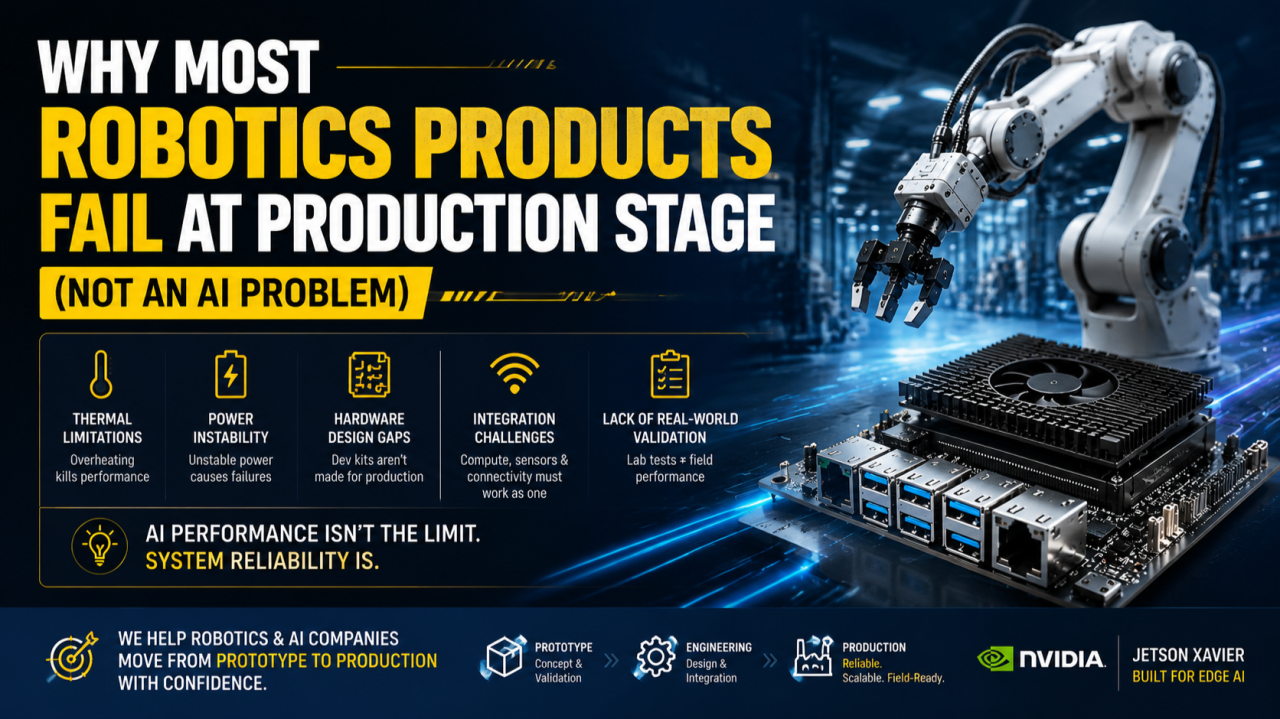
But in reality, many robotics products fail not because of AI algorithms — but because of system-level engineering challenges that only appear in real-world deployment.
After working with industrial wireless systems and edge AI hardware platforms, we consistently observe the same pattern:
The gap between prototype and production is where most products break.
1. The real problem is not AI — it is system engineering
Most robotics teams are strong in:
- Computer vision
- Deep learning models
- Path planning / autonomy algorithms
However, production environments introduce constraints that are often underestimated:
- Continuous workload (not short demos)
- Temperature variations
- Power fluctuations
- Mechanical constraints
- Interference in wireless environments
These are not AI problems — they are system integration problems.
2. Why Jetson-based systems still fail in production
Even with powerful platforms like Jetson Xavier, many teams encounter issues when scaling:
❌ Thermal limitations
AI workloads in production run continuously, not intermittently like in lab tests.
❌ Power instability
Robotics platforms often operate in environments with fluctuating power conditions.
❌ Carrier board limitations
Development kits are not designed for enclosure integration or mass manufacturing.
❌ System integration gaps
Compute, sensors, and wireless modules are often designed separately, leading to instability.
❌ Lack of production validation
Many systems are never tested under real industrial conditions before deployment.
3. Prototype vs Production gap
In prototype stage:
- Functionality is the focus
- Short test cycles
- Controlled environment
In production stage:
- Reliability becomes critical
- Continuous operation
- Real-world environmental stress
This transition is where many robotics products fail.
4. The missing layer: system-level engineering
Successful robotics products require more than AI models.
They require:
✔ Production-grade hardware design
✔ Thermal and power system engineering
✔ Embedded system optimization
✔ Wireless + compute integration
✔ Field deployment validation
Without these, even the most advanced AI system will struggle in real-world environments.
5. Key insight
Robotics success is not determined by AI capability alone, but by how well the entire system is engineered for reality.
6. How we approach this problem
We work with robotics and AI vision companies to help bridge the gap between prototype and production by supporting:
- Edge AI hardware platform design
- Carrier board development
- System integration for industrial deployment
- Wireless + embedded system architecture optimization
- Production readiness engineering
Our focus is on helping teams move from concept validation to scalable real-world products.
Conclusion
The future of robotics will not be defined only by better AI models.
It will be defined by systems that are:
- Reliable
- Scalable
- Deployable in real environments
Because in the real world:
AI that works in demo is not enough — it must work in production.