
Wireless is usually the last spec finalized on an edge AI hardware design and the first thing that becomes a bottleneck in the field. Worth a closer technical look before your next carrier board revision locks in.
The RF problem, precisely
Dual-band designs (2.4GHz + 5GHz) share spectrum with every consumer device, AP, and IoT sensor in range. In dense deployments — multi-robot fleets, factory floors, warehouses — this shows up as elevated retransmission rates, unpredictable jitter, and tail latency spikes under contention. For a control loop or a real-time inference pipeline streaming sensor data upstream, tail latency is what actually breaks the system, not average throughput.
WiFi 7 (802.11be) addresses this at the PHY/MAC level in three ways relevant to edge AI hardware:
- 6GHz band access — largely unlicensed spectrum with far lower device density than 2.4/5GHz today, meaning lower channel contention and more predictable airtime
- 320MHz channel bandwidth (vs. 160MHz max on WiFi 6) — higher raw throughput ceiling per link
- Multi-Link Operation (MLO) — the ability to aggregate or fail over across bands simultaneously, so a device isn’t fully dependent on the health of a single channel
For an edge AI box pushing multi-camera streams, sensor fusion data, and periodic model/OTA updates concurrently, MLO plus 6GHz access is the difference between throughput that holds up under real RF load and throughput that only looks good on an open-air bench test.
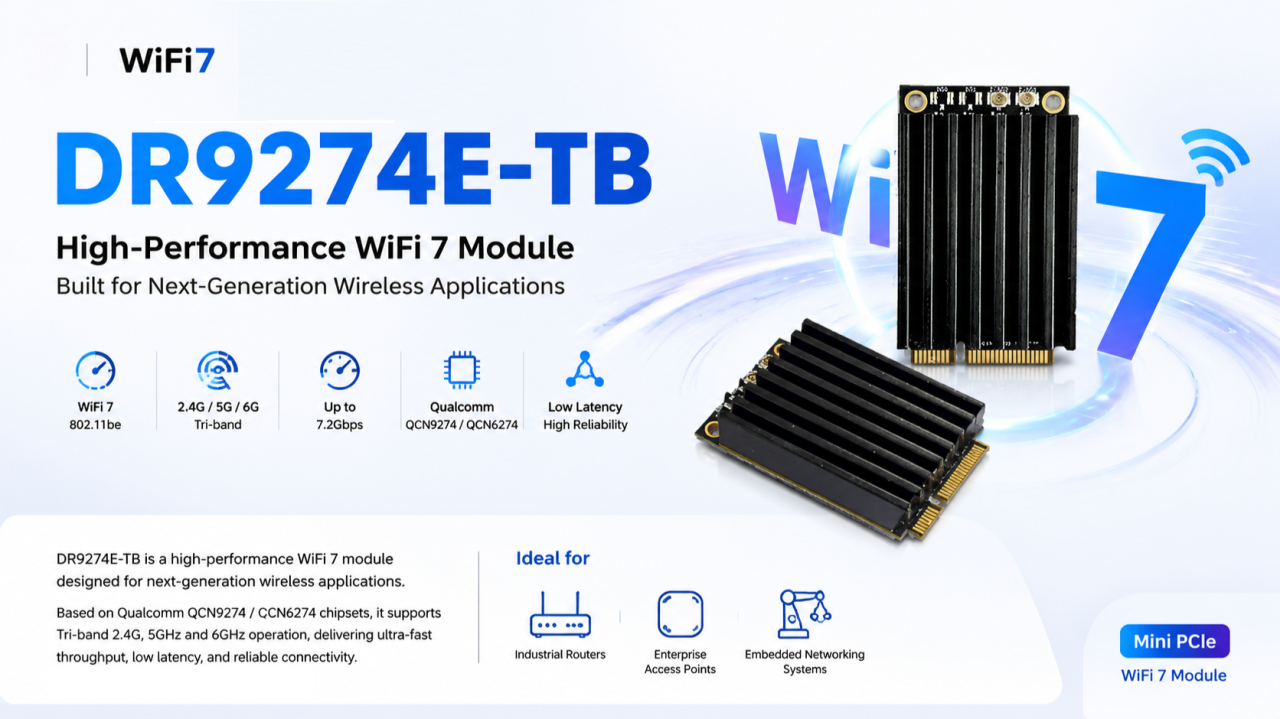
Module-level implementation: DR9274E-TB
We built the DR9274E-TB around this exact requirement — a Mini PCIe WiFi 7 module for teams integrating wireless into embedded and industrial platforms rather than designing RF from scratch.
Specs:
- Chipset: Qualcomm QCN9274 (5G/6G radio) + QCN6274 (2.4GHz radio) — Qualcomm’s WiFi 7 platform, not a rebadged WiFi 6E part
- Band support: Tri-band, 2.4GHz / 5GHz / 6GHz
- Antenna config: 2×2 MIMO
- Interface: Mini PCIe — integrates without a carrier board redesign on most existing embedded platforms
- OS support: Linux-compatible — relevant if your stack runs on JetPack, Yocto, or a custom embedded distro
- Build: Industrial-grade components rated for continuous operation, not consumer-grade parts pushed into an industrial enclosure
Where the tri-band architecture actually matters
Not every application needs 6GHz. It matters specifically where you have:
- High device density (multi-robot fleets, dense AP deployments)
- Latency-sensitive control or telemetry loops
- Concurrent high-bandwidth streams (multi-camera vision, sensor fusion payloads)
- Environments where 2.4/5GHz spectrum is already saturated by other systems
That covers most edge AI computing platforms, industrial routers/IoT gateways, enterprise APs in high-density environments, outdoor CPE/wireless bridges, and mesh networking nodes.
The engineering takeaway
Specifying wireless the way you did for a WiFi 5/6 design — pick a dual-band module, move on — leaves latency and reliability headroom on the table that your compute stack has already outgrown. Tri-band WiFi 7 with MLO isn’t a marketing checkbox; it’s a direct answer to the contention and jitter problems that show up specifically under production RF conditions, not lab conditions.
Happy to go deeper on channel planning, MLO configuration, or driver-level integration for teams currently specifying wireless for a Jetson-based or other edge AI carrier board.
📩 Reach out to 524WiFi for datasheets, samples, or OEM customization.