Posted on

Why Your Next Edge AI Platform Needs a Tri-Band WiFi 7 Module, Not Just Dual-Band

Wireless is usually the last spec finalized on an edge AI hardware design and the first thing that becomes a bottleneck in the field. Worth a closer technical look before your next carrier board revision locks in.

The RF problem, precisely

Dual-band designs (2.4GHz + 5GHz) share spectrum with every consumer device, AP, and IoT sensor in range. In dense deployments — multi-robot fleets, factory floors, warehouses — this shows up as elevated retransmission rates, unpredictable jitter, and tail latency spikes under contention. For a control loop or a real-time inference pipeline streaming sensor data upstream, tail latency is what actually breaks the system, not average throughput.

WiFi 7 (802.11be) addresses this at the PHY/MAC level in three ways relevant to edge AI hardware:

  • 6GHz band access — largely unlicensed spectrum with far lower device density than 2.4/5GHz today, meaning lower channel contention and more predictable airtime
  • 320MHz channel bandwidth (vs. 160MHz max on WiFi 6) — higher raw throughput ceiling per link
  • Multi-Link Operation (MLO) — the ability to aggregate or fail over across bands simultaneously, so a device isn’t fully dependent on the health of a single channel

For an edge AI box pushing multi-camera streams, sensor fusion data, and periodic model/OTA updates concurrently, MLO plus 6GHz access is the difference between throughput that holds up under real RF load and throughput that only looks good on an open-air bench test.

Module-level implementation: DR9274E-TB

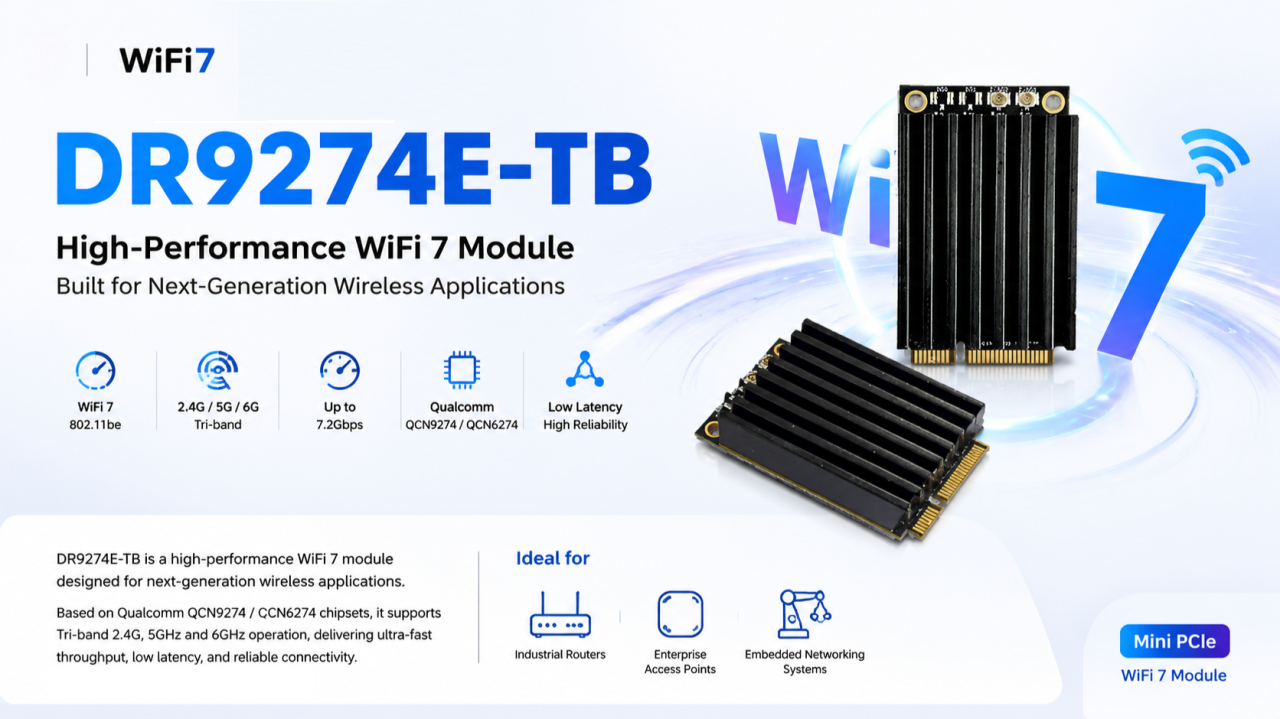
We built the DR9274E-TB around this exact requirement — a Mini PCIe WiFi 7 module for teams integrating wireless into embedded and industrial platforms rather than designing RF from scratch.

Specs:

  • Chipset: Qualcomm QCN9274 (5G/6G radio) + QCN6274 (2.4GHz radio) — Qualcomm’s WiFi 7 platform, not a rebadged WiFi 6E part
  • Band support: Tri-band, 2.4GHz / 5GHz / 6GHz
  • Antenna config: 2×2 MIMO
  • Interface: Mini PCIe — integrates without a carrier board redesign on most existing embedded platforms
  • OS support: Linux-compatible — relevant if your stack runs on JetPack, Yocto, or a custom embedded distro
  • Build: Industrial-grade components rated for continuous operation, not consumer-grade parts pushed into an industrial enclosure

Where the tri-band architecture actually matters

Not every application needs 6GHz. It matters specifically where you have:

  • High device density (multi-robot fleets, dense AP deployments)
  • Latency-sensitive control or telemetry loops
  • Concurrent high-bandwidth streams (multi-camera vision, sensor fusion payloads)
  • Environments where 2.4/5GHz spectrum is already saturated by other systems

That covers most edge AI computing platforms, industrial routers/IoT gateways, enterprise APs in high-density environments, outdoor CPE/wireless bridges, and mesh networking nodes.

The engineering takeaway

Specifying wireless the way you did for a WiFi 5/6 design — pick a dual-band module, move on — leaves latency and reliability headroom on the table that your compute stack has already outgrown. Tri-band WiFi 7 with MLO isn’t a marketing checkbox; it’s a direct answer to the contention and jitter problems that show up specifically under production RF conditions, not lab conditions.

Happy to go deeper on channel planning, MLO configuration, or driver-level integration for teams currently specifying wireless for a Jetson-based or other edge AI carrier board.

📩 Reach out to 524WiFi for datasheets, samples, or OEM customization.

Posted on — Leave a comment

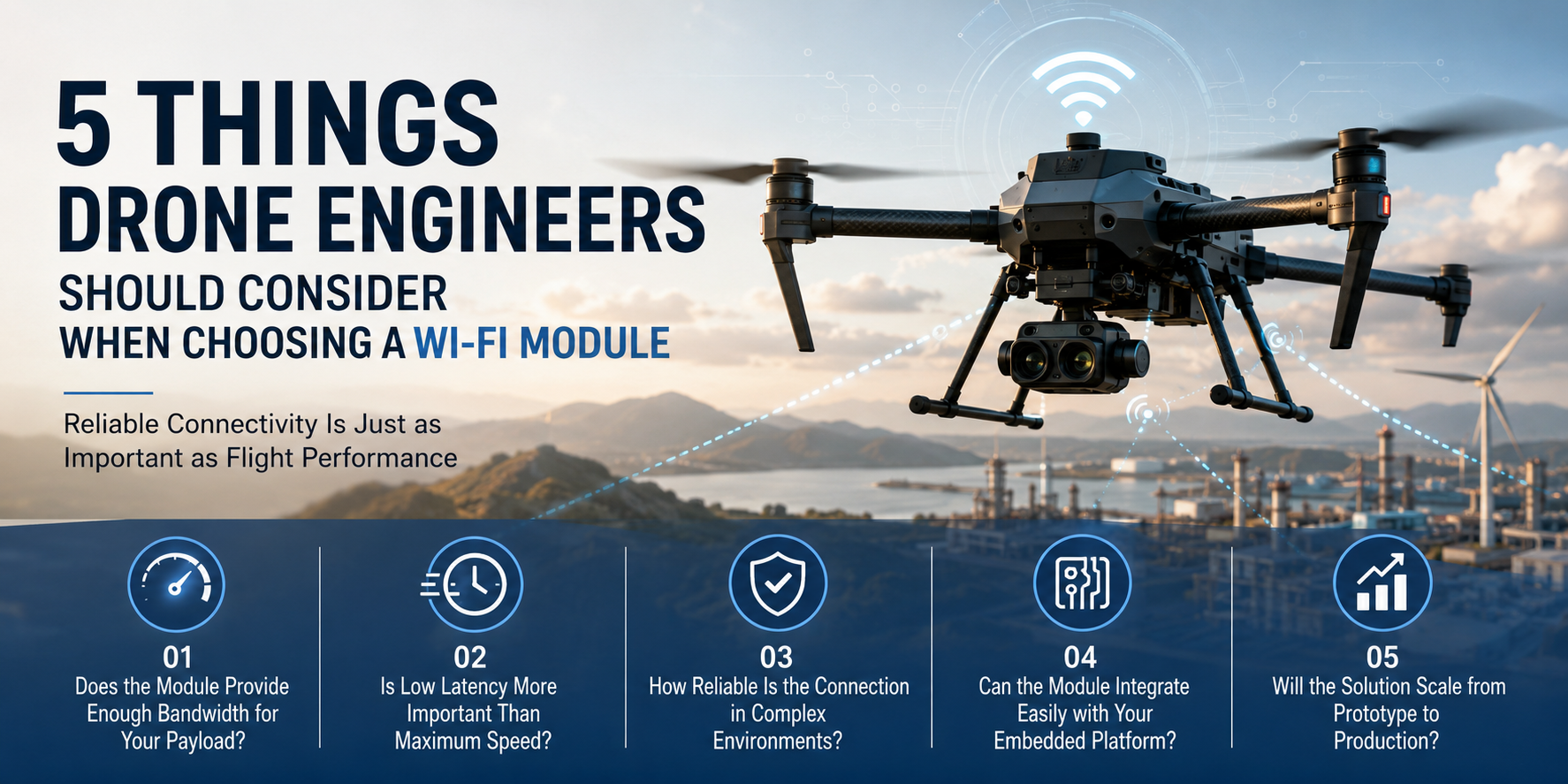
5 Things Drone Engineers Should Consider When Choosing a Wi-Fi Module

Reliable Connectivity Is Just as Important as Flight Performance

Modern drones are becoming far more than flying cameras.

Today, drones are used for:

  • Infrastructure inspection
  • Precision agriculture
  • Public safety
  • Mapping and surveying
  • Warehouse inventory
  • Mining operations
  • Industrial monitoring

At the same time, onboard computing is evolving rapidly. AI processors, multiple cameras, LiDAR, thermal imaging, and edge computing are becoming standard components of professional UAV platforms.

While engineers often spend months selecting flight controllers, sensors, and AI hardware, one component is frequently underestimated:

The wireless communication module.

Article content

A poorly chosen Wi-Fi module can become the bottleneck of an otherwise excellent drone design.

Here are five key factors every drone engineer should evaluate before selecting a wireless communication solution.


1. Does the Module Provide Enough Bandwidth for Your Payload?

Not every drone transmits the same type of data.

A basic inspection drone may only send telemetry and compressed video.

An AI-powered drone may simultaneously transmit:

  • Multiple HD video streams
  • AI inference results
  • Telemetry data
  • Sensor information
  • Remote control commands

As payloads become more sophisticated, wireless bandwidth quickly becomes a limiting factor.

When evaluating a Wi-Fi module, consider:

  • Maximum throughput
  • Number of spatial streams
  • Channel bandwidth
  • Support for Wi-Fi 6 or Wi-Fi 7

Higher bandwidth doesn’t simply improve video quality—it also creates more capacity for future upgrades.


2. Is Low Latency More Important Than Maximum Speed?

Many engineers focus on peak data rates.

However, drones often benefit more from consistent low latency than from maximum theoretical throughput.

For applications such as:

  • Remote piloting
  • Autonomous navigation
  • AI-assisted obstacle avoidance
  • Real-time monitoring

Stable communication is far more valuable than occasional bursts of high speed.

Look beyond the headline specifications and evaluate how the wireless solution performs under continuous, real-world workloads.


3. How Reliable Is the Connection in Complex Environments?

Drones rarely operate in ideal radio environments.

They may fly near:

  • Buildings
  • Metal structures
  • Industrial equipment
  • Trees
  • Utility infrastructure

These environments introduce interference, signal reflections, and changing link conditions.

A reliable Wi-Fi module should support features that help maintain stable communication under challenging conditions.

Modern technologies such as Wi-Fi 6 and Wi-Fi 7 introduce significant improvements in efficiency, interference management, and overall reliability compared with earlier generations.

For industrial UAVs, connection stability is often more important than achieving the highest benchmark speeds.


4. Can the Module Integrate Easily with Your Embedded Platform?

Selecting a Wi-Fi module is not only about radio performance.

Engineers should also consider integration.

Questions worth asking include:

  • Does it support Linux or OpenWrt?
  • Are software drivers actively maintained?
  • Is the hardware interface compatible with your design?
  • Is documentation readily available?
  • Can the module integrate with NVIDIA Jetson or other edge AI platforms?

Reducing development complexity can significantly shorten time-to-market.

Choosing a well-supported platform often saves more engineering time than selecting a module based solely on specifications.


5. Will the Solution Scale from Prototype to Production?

Many wireless solutions perform well during prototyping.

Production introduces different challenges:

  • Long-term availability
  • Industrial reliability
  • Certification requirements
  • Thermal performance
  • Supply chain stability

Choosing a communication platform with a clear product roadmap helps avoid redesigns later in the project lifecycle.

Engineers should think beyond the first prototype and evaluate whether the wireless solution can support future production volumes and product evolution.


Connectivity Is Becoming Part of the Drone Architecture

Modern drones are evolving into flying edge computing platforms.

A typical professional UAV now combines:

  • Flight control systems
  • AI processors
  • Vision sensors
  • Navigation systems
  • High-speed wireless communication

Each subsystem depends on the others.

Even the most advanced AI algorithms become less effective if communication is unstable.

Reliable wireless connectivity is no longer just another hardware component.

It has become part of the overall system architecture.


Looking Ahead

The next generation of drones will continue to demand:

  • Higher bandwidth
  • Lower latency
  • More reliable wireless links
  • Better support for AI workloads
  • Faster integration with embedded computing platforms

Selecting the right Wi-Fi module today is not simply about improving communication performance.

It is about building a platform that can support the future of autonomous aerial systems.

As drones become smarter, wireless connectivity will play an increasingly important role in enabling safe, efficient, and scalable operations.

Because in autonomous systems, intelligence may guide the mission—but connectivity keeps it flying.


What factors matter most when your team selects a wireless communication solution for UAV projects?

I’d be interested to hear how other drone engineers approach this decision.