

For many robotics companies, the NVIDIA Jetson Development Kit is the first step when building a new product.
It allows engineers to quickly evaluate system concepts, connect peripherals, test software, and verify whether the hardware platform can support their application.
However, after the prototype stage, many teams face a different challenge:
The development kit is not the final product.
A development board is designed for flexibility and evaluation.
A commercial product needs to be designed for:
- Specific mechanical dimensions
- Required interfaces
- Stable power supply
- Thermal conditions
- Manufacturing process
- Long-term availability
This transition from evaluation platform to production hardware is where many engineering teams start facing challenges.
The question changes from:
“Can we make the prototype work?”
to:
“Can we build thousands of units with consistent quality?”
Development Kit Is Only the Beginning
A Jetson Development Kit is an excellent engineering tool.
It helps teams quickly verify:
- Processor performance
- Camera connection
- Sensor integration
- Software environment
- Application functionality
During early development, engineers usually focus on functionality.
They may connect:
- USB cameras
- External sensors
- Network devices
- Additional modules
Everything works on the lab desk.
But when moving into a real product, these temporary solutions often become limitations.
A production device cannot simply place a development kit inside an enclosure.
What Changes When Moving to Production?
1. The hardware needs to fit the product
One of the first challenges is mechanical integration.
A development kit has fixed:
- Size
- Connector locations
- Mounting structure
But the final product may have strict requirements.
For example:
A mobile robot may need all electronics installed inside a compact chassis.
An industrial inspection device may require a specific enclosure.
A customized carrier board allows engineers to redesign the hardware around the actual product.
2. Interfaces need to match the application
Different products require different hardware configurations.
A development kit provides general interfaces.
A production system often needs customized combinations.
Examples:
- Multiple camera inputs
- Ethernet ports
- CAN interface
- RS232/RS485
- GPIO control
- Sensor interfaces
- Storage expansion
Instead of adding external conversion boards, a custom carrier board can integrate the required functions directly.
This reduces:
- System complexity
- Cable connections
- Assembly difficulty
3. Power design becomes more important
Power is often underestimated during prototype development.
A desktop environment provides stable power.
A production device has different conditions.
Engineers need to consider:
- Input voltage range
- Power distribution
- Protection circuits
- Power consumption
- Startup sequence
For industrial products, unstable power design can create reliability problems that are difficult to diagnose.
4. Thermal design cannot be ignored
Higher computing performance also creates thermal challenges.
During prototype testing, engineers may use:
- Open-air environments
- Standard heatsinks
- Development accessories
Production products require:
- Designed heat dissipation
- Enclosure consideration
- Long-term operating stability
Thermal design needs to happen together with mechanical design.
Common Challenges During Custom Board Development
Based on our experience working on embedded hardware projects, several challenges appear frequently.
Challenge 1:
Prototype works, but the design is difficult to manufacture
A prototype may use:
- Evaluation boards
- Additional modules
- Manual wiring
This is acceptable for engineering verification.
However, mass production requires:
- Optimized PCB design
- Simplified assembly
- Stable component sourcing
- Manufacturing testing
The production design needs to consider the entire lifecycle.
Challenge 2:
Balancing performance and cost
The highest specification is not always the best product design.
Engineers need to balance:
- Computing requirements
- Hardware cost
- Power consumption
- Manufacturing complexity
The right design depends on the application.
Challenge 3:
From prototype samples to stable production
A few working prototypes do not mean the product is ready.
Before production, companies usually need to complete:
- Hardware verification
- Reliability testing
- Manufacturing validation
- Quality control process
This stage requires cooperation between engineering and manufacturing teams.
Key Considerations When Designing a Jetson Production Platform
1. Start hardware planning early
Many companies first focus on software development.
However, hardware decisions made later can affect:
- Product size
- Cost
- Schedule
- Manufacturing
Early hardware planning can reduce redesign cycles.
2. Select the right development partner
A production hardware project involves multiple disciplines:
- Hardware design
- PCB layout
- Embedded software
- Testing
- Manufacturing
A partner with both engineering and production experience can help shorten the transition.
3. Think about future product versions
A good hardware platform should consider future needs:
- Interface expansion
- Component availability
- Product upgrades
The first production design often becomes the foundation for future products.
Tomo AI Automation: From Concept to Production
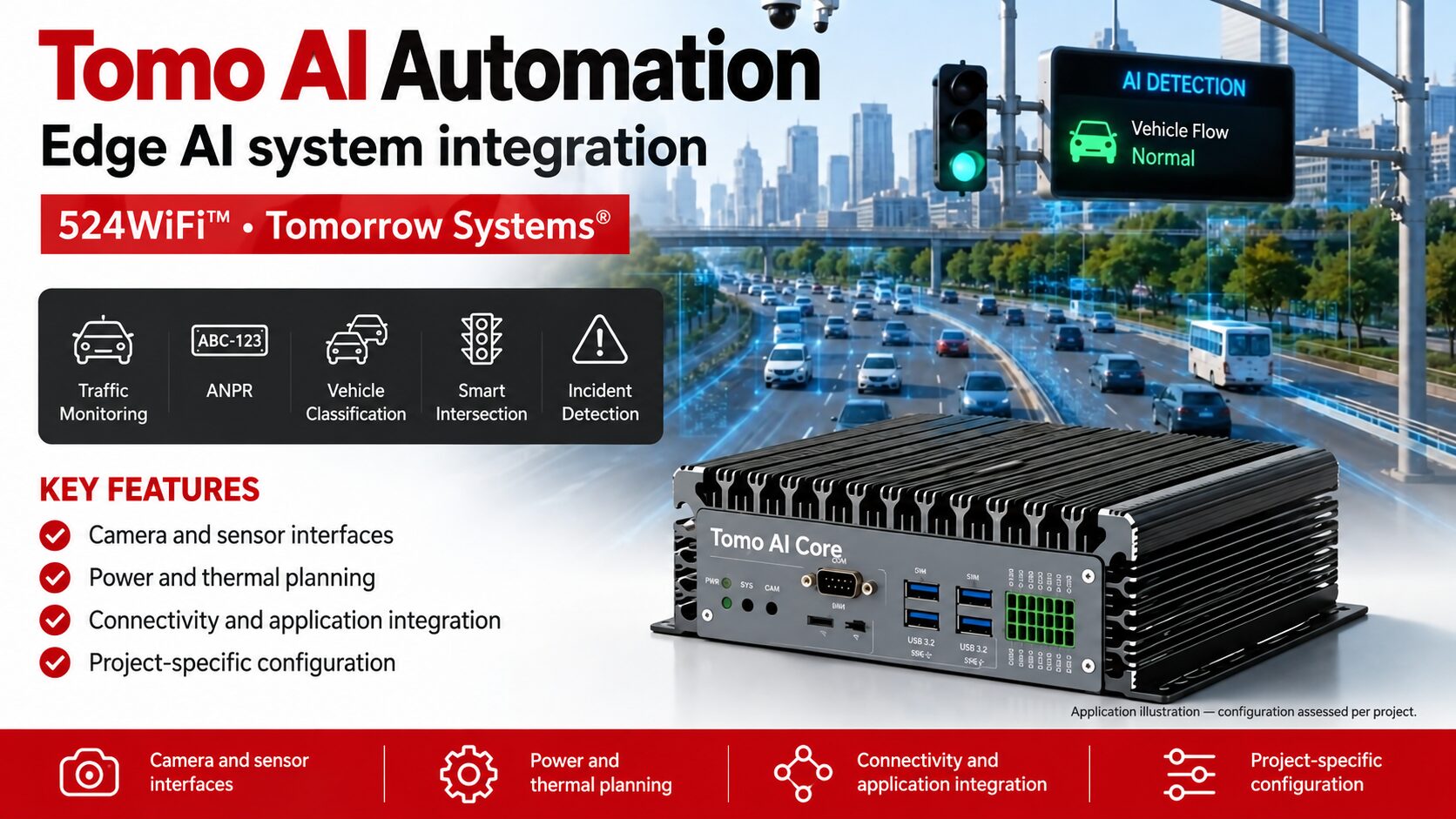
Tomo AI Automation is the automation branch of Tomorrow Systems® and 524WiFi™. We bring embedded hardware, wireless connectivity and application integration together around the requirements of your industrial project.
Our engineering capabilities include:
- Hardware design
- PCB development
- Embedded system integration
- Prototype validation
- Production support
- OEM/ODM/JDM services
With the increasing adoption of NVIDIA Jetson platforms in industrial applications, we are expanding our hardware development capability to support companies that need customized Jetson-based platforms.
Our focus is the complete development path: requirements, prototype validation, integration and production planning.
It is helping engineering teams move from:
Concept → Prototype → Production
through practical hardware design and manufacturing experience.
Conclusion
The NVIDIA Jetson Development Kit provides engineers with a fast way to start development.
But successful products require much more than selecting a computing module.
The transition to production requires careful consideration of:
- Hardware customization
- Interface design
- Power management
- Thermal solution
- Manufacturing requirements
For robotics and industrial equipment companies, the biggest challenge is often not proving that the technology works.
It is turning a working prototype into a reliable product.
What challenges have you experienced when moving from development boards to production hardware?
Plan your project with Tomo AI Automation
Bring your application, enclosure, interfaces, power requirements, software environment and expected quantity into one project brief. Tomorrow Systems® and 524WiFi™ can review the engineering scope with you.