
The future of drones is no longer only about flying.
Modern drones are becoming intelligent platforms equipped with:
- AI vision systems
- Autonomous navigation
- Real-time data processing
- Advanced sensors
- Edge AI computing capabilities
But behind every smart drone, there is one critical infrastructure that is often overlooked:
Reliable wireless connectivity.
Because even the most advanced AI system becomes limited when the connection is unstable.
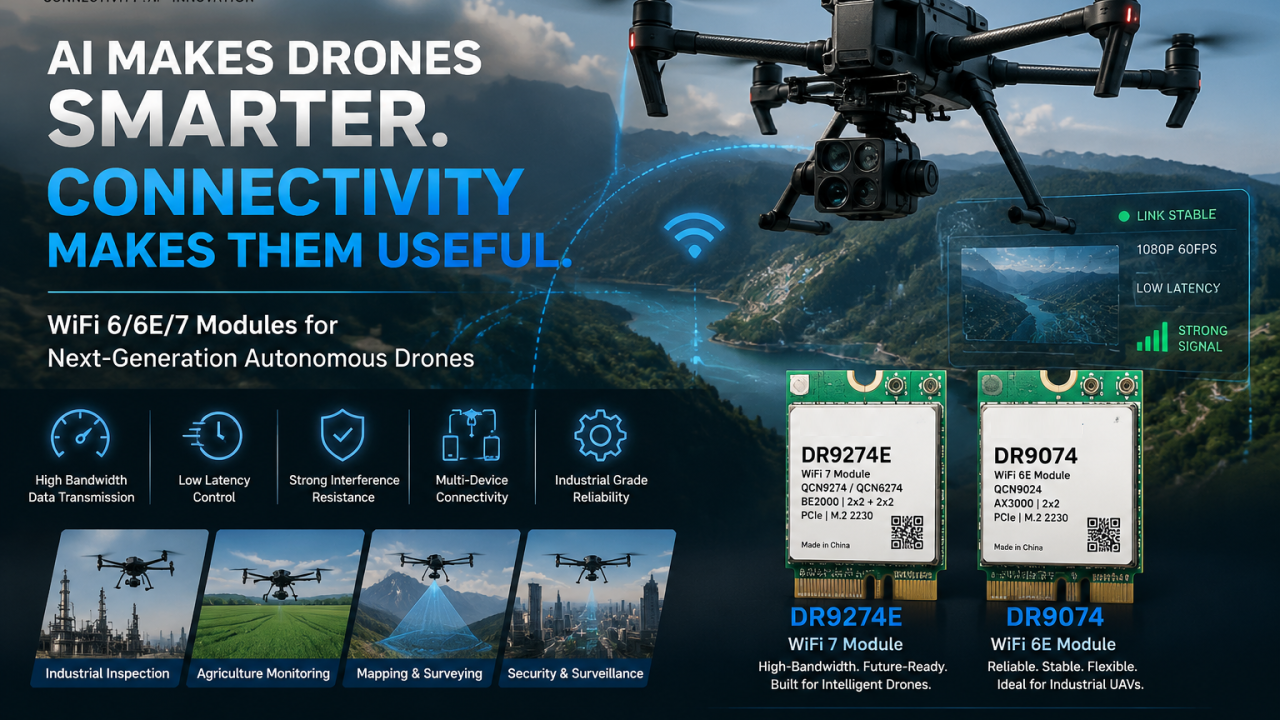
AI Makes Drones Smarter. Connectivity Makes Them Useful.
A drone performing industrial inspection, mapping, agriculture monitoring, or security missions needs to continuously exchange large amounts of data.
It needs to:
- Stream high-resolution video in real time
- Transfer sensor and vision data
- Maintain low-latency control communication
- Stay connected during high-speed movement
The wireless link is no longer just a communication channel.
It becomes the nervous system of an autonomous flying machine.
Why Drone Applications Need More Than Traditional Wireless Connectivity
Many UAV applications operate in challenging environments:
- Long-range communication
- High-speed mobility
- Complex RF environments
- Multiple drones working simultaneously
- High-bandwidth AI data transmission
For these scenarios, peak speed alone is not enough.
A professional drone platform requires:
- Stable connectivity
- Low-latency response
- Strong interference resistance
- Reliable performance during long operation cycles
WiFi 6 and WiFi 7: Building the Wireless Foundation for Next-Generation UAVs
As drones become more intelligent, wireless technology must evolve to support higher demands.
Advanced WiFi platforms enable:
High-bandwidth AI applications
Real-time video streaming, multi-camera systems, and edge AI processing require fast and reliable data transmission.
Low-latency autonomous control
Faster response helps support autonomous navigation and mission-critical operations.
Multi-device communication
Future drone fleets and collaborative robotic systems will require efficient wireless networking.
524WiFi Industrial WiFi Modules for Intelligent Drone Platforms
For drone developers, selecting a wireless module is not only about maximum throughput.
Important considerations include:
- Industrial-grade chipset platform
- Driver and software support
- Thermal stability
- Flexible integration options
- Long-term supply availability
Based on Qualcomm wireless platforms, Wallys provides WiFi solutions designed for industrial and AI-driven applications.
DR9274E WiFi 7 Module: Enabling Next-Generation Autonomous Drones
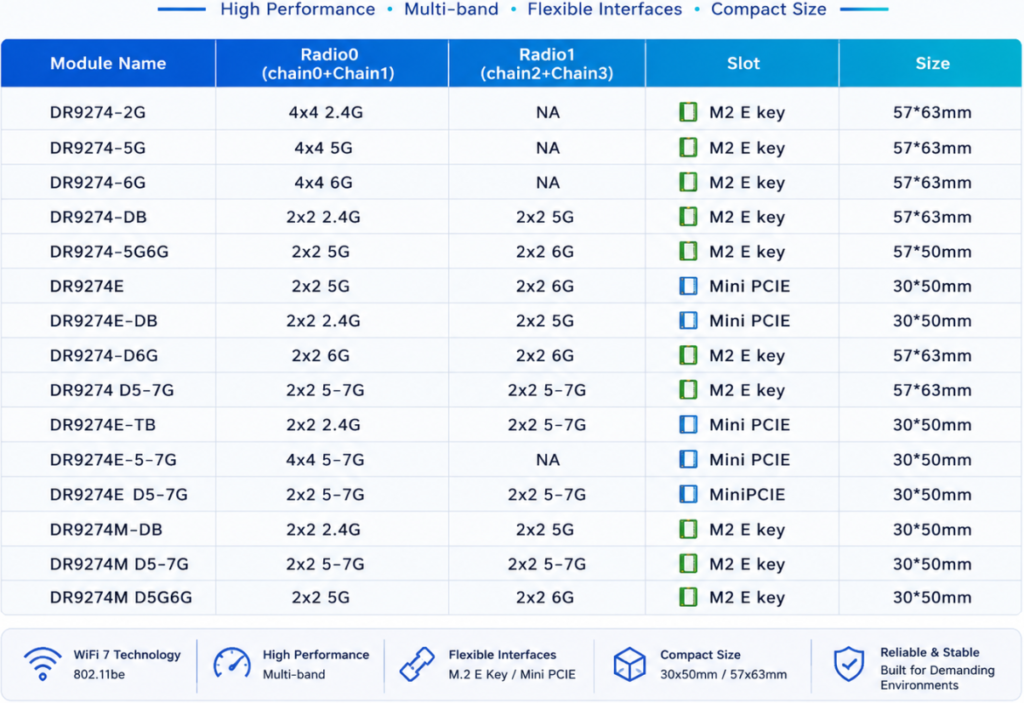
Powered by Qualcomm QCN9274 and QCN6274 platforms, the DR9274E WiFi 7 module is designed for applications requiring higher bandwidth, advanced connectivity, and future-ready wireless performance.
Potential applications include:
- AI vision drones
- Autonomous aerial robots
- Industrial inspection UAVs
- High-resolution video transmission systems
With WiFi 7 capabilities, it provides a powerful wireless foundation for intelligent devices requiring faster data exchange and more reliable connections.

DR9074 WiFi 6E Module: Reliable Connectivity for Industrial UAV Applications
Based on Qualcomm QCN9024, the DR9074 supports Tri-Band WiFi 6E operation across 2.4GHz, 5GHz, and 6GHz.
It is designed for applications requiring:
- Stable wireless links
- High-performance data transmission
- Flexible frequency selection
- Industrial deployment reliability
Suitable for:
- Inspection drones
- Mapping systems
- Smart agriculture UAVs
- Edge AI devices
Connecting the Future of Autonomous Flight
The future of drones will not only depend on better AI algorithms.
It will depend on the complete technology ecosystem:
AI provides intelligence. Sensors provide perception. Wireless connectivity enables action.
A smarter drone still needs a stronger wireless link.
At 524WiFi and Wallys, we are committed to providing Qualcomm-based WiFi 6 and WiFi 7 platforms for the next generation of drones, robotics, and edge AI applications.
The future of autonomous flight will not only be smarter.
It will be better connected.