


The Qualcomm IPQ8072 has long been a reliable choice for Wi-Fi 6 networking hardware. Many enterprise routers, carrier CPEs, and industrial access points are still powered by IPQ8072 due to its strong balance of cost and performance. However, with the rapid evolution of Wi-Fi 7 (802.11be), the Qualcomm IPQ9574 offers significant technical advantages that make it the logical upgrade path for next-generation solutions.
In this article, we compare IPQ8072 vs IPQ9574, highlighting the major differences and why developers should consider migrating to Wi-Fi 7 hardware.
Overview of IPQ8072 (Wi-Fi 6 SoC)
The Qualcomm IPQ8072 is part of the IPQ807x family, designed for Wi-Fi 6. It features:
- Quad-core ARM Cortex-A53 processor
- 8×8 MU-MIMO capability
- Up to 160 MHz channel bandwidth
- 1024-QAM modulation
- Robust support for enterprise and carrier-grade networking
While still capable, the IPQ8072 has reached maturity, and limitations in throughput and latency become noticeable in demanding applications.
Overview of IPQ9574 (Wi-Fi 7 SoC)
The Qualcomm IPQ9574 represents the new generation of Wi-Fi 7 platforms, optimized for ultra-high throughput and low latency. Key features include:
- Enhanced multi-core CPU architecture for higher processing power
- 320 MHz channel bandwidth (double that of IPQ8072)
- 4096-QAM modulation for higher spectral efficiency
- Support for Multi-Link Operation (MLO)
- Designed for advanced enterprise, industrial, and carrier networks
This makes IPQ9574 ideal for data-heavy applications such as 8K video streaming, AR/VR, industrial IoT, and low-latency control systems.
IPQ8072 vs IPQ9574 Technical Comparison
The Qualcomm IPQ8072 is a Wi-Fi 6 (802.11ax) SoC built with a quad-core Cortex-A53 processor. It supports channel bandwidths of up to 160 MHz and uses 1024-QAM modulation, making it a strong choice for enterprise routers, carrier CPE, and industrial APs.
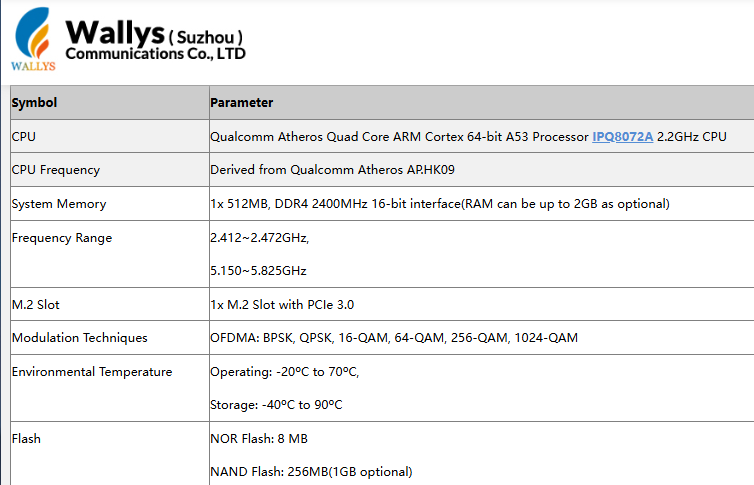
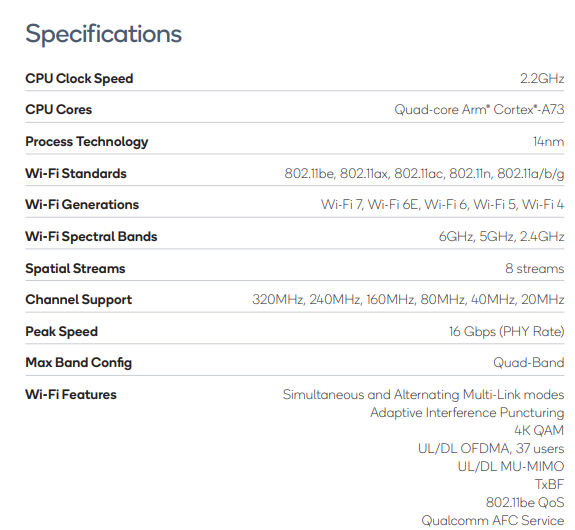
By contrast, the Qualcomm IPQ9574 belongs to the Wi-Fi 7 (802.11be) generation. It features a more advanced multi-core CPU architecture, supports 320 MHz channel bandwidth (double that of IPQ8072), and enables 4096-QAM modulation for higher spectral efficiency. Unlike IPQ8072, it also supports Multi-Link Operation (MLO), a Wi-Fi 7 feature that allows simultaneous use of multiple frequency bands to reduce latency and improve stability. These enhancements make IPQ9574 ideal for next-generation enterprise networks, industrial IoT deployments, low-latency applications, and high-density environments.
Why Upgrade from IPQ8072 to IPQ9574?
- Performance Leap – Wi-Fi 7 doubles available channel bandwidth and introduces 4096-QAM for significantly higher throughput.
- Ultra-Low Latency – MLO ensures faster and more reliable connectivity, critical for real-time applications.
- Future-Proofing – As Wi-Fi 6 hardware reaches end of lifecycle, Wi-Fi 7 ensures long-term product competitiveness.
- Scalability – IPQ9574’s stronger CPU supports more devices, traffic, and complex networking tasks.
524WiFi and Wallys’ IPQ9574 Router Board Solution
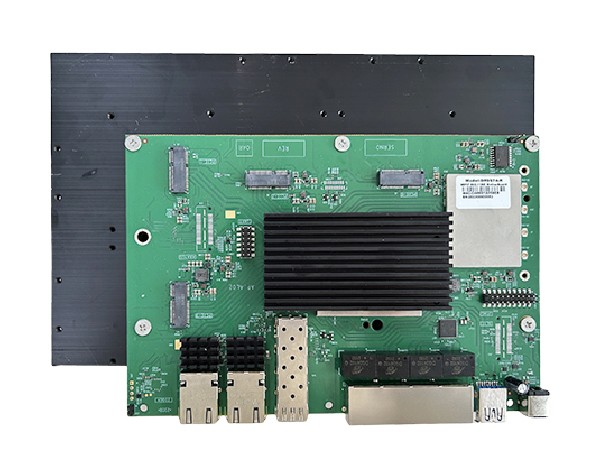
At 524WiFi, we provide hardware solutions based on Qualcomm IPQ9574, including the DR9574 Router Board, designed for Wi-Fi 7 networks. With strong processing power, advanced wireless features, and industrial-grade reliability, it is the perfect upgrade path for developers currently using IPQ8072-based designs.
Frequently Asked Questions (FAQ)
1. Is IPQ8072 still good in 2025?
Yes. The Qualcomm IPQ8072 is still a stable and cost-effective Wi-Fi 6 chipset, suitable for enterprise routers and industrial APs. However, for new projects that require higher throughput, lower latency, and longer product lifecycle, Wi-Fi 7 chipsets such as IPQ9574 are strongly recommended.
2. What is the difference between IPQ8072 and IPQ9574?
The IPQ8072 is a Wi-Fi 6 (802.11ax) SoC, supporting up to 160 MHz bandwidth and 1024-QAM. The IPQ9574 is a Wi-Fi 7 (802.11be) SoC with 320 MHz bandwidth, 4096-QAM, and Multi-Link Operation (MLO), enabling much higher throughput and lower latency.
3. Why upgrade from Wi-Fi 6 to Wi-Fi 7?
Upgrading to Wi-Fi 7 provides faster data rates, reduced latency, and better efficiency in high-density environments. For applications such as AR/VR, 8K streaming, and industrial automation, Wi-Fi 7 ensures future-proof performance and competitiveness.
4. Does 524WiFi provide IPQ9574-based solutions?
Yes. 524WiFi and Wallys Communications offer router boards and network modules based on Qualcomm IPQ9574, including the DR9574 Router Board. These solutions are designed for enterprise, carrier, and industrial use cases that demand next-generation Wi-Fi 7 performance.