Optical network for fast internet and smart HD TV in your community with a total cost below the $ 4000? It’s coming!
Services: Internet-222Mbps symmetrically and clever internet HD TV with recording and reflux by watching
Typical of the agglomeration with the new housing is the ideal solution for choosing G EPON technology. The density and the number of connected end-customers choose this cheaper uploaded wodaplug technology (due to the capabilities of the services provided and obtained speeds) with a shared optical cable.The great advantage is also a simple implementation and configuration of the Ethernet standard. And input costs? “Overall, including a 1 GB connection and distribution nepřesáhli when using wodaplug optical technology lines 100 USD”, says co-owner of the company that provides complete services in the field of data transmission and Patrik Prešl RETE applications.
And how to do it, then?
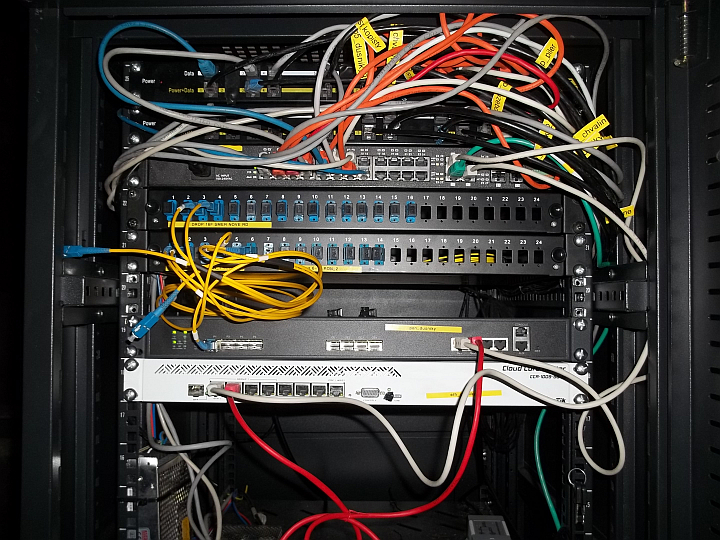
As an input for the municipality article was established in-band microwave link 80 GHz 1 Gb full duplex, for whose location was voted the highest building in the village school. Network and service management with the old router preconfigured ISP services (HD TV, internet, etc. According to local requirements) and then followed by the EPON OLT Wodaplug WDS1U4PGE control unit, which has a dimension of 1U rack placement. 4 Gigabit EPON ports wodaplug WDS5441H-C (H) 3AL with range up to 20 km (in real terms) are more than adequate to cover all potential customers, in case of increase can be used 8-i port license unit. On each port can connect up to 64 end units, but in order to ensure sufficient speed for the final user to connect up to 32 is optimal the units on a single port.
For the OLT unit therefore follows the optical tub with PLC spliters that divide a shared optical fiber into each of the branches toward the end customers. As appropriate, we chose the first 4:1 PLC spliterem, and then the next PLC spliter 8:1 (that is, 4 * 8 = 32 end ONU for end-customers). The school, therefore, are based on 4 optical lines which are then further divided towards the houses of customers.
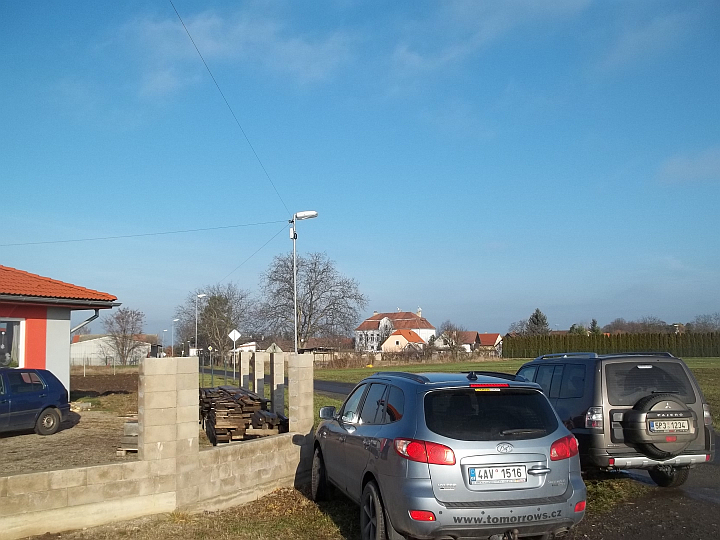
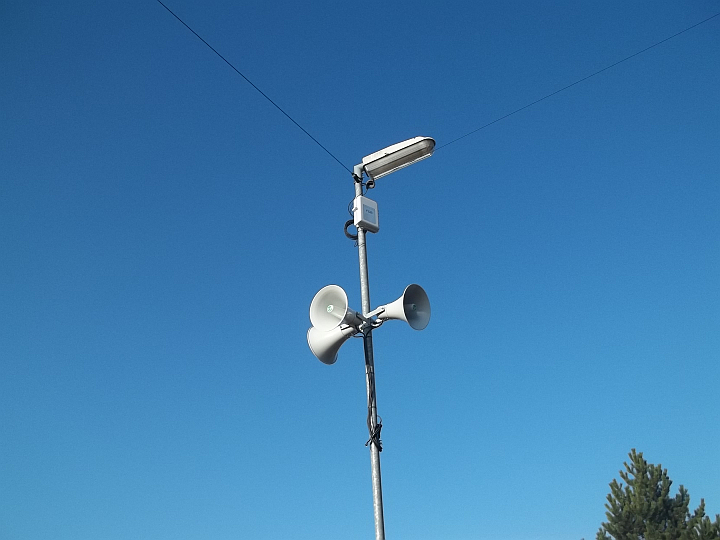
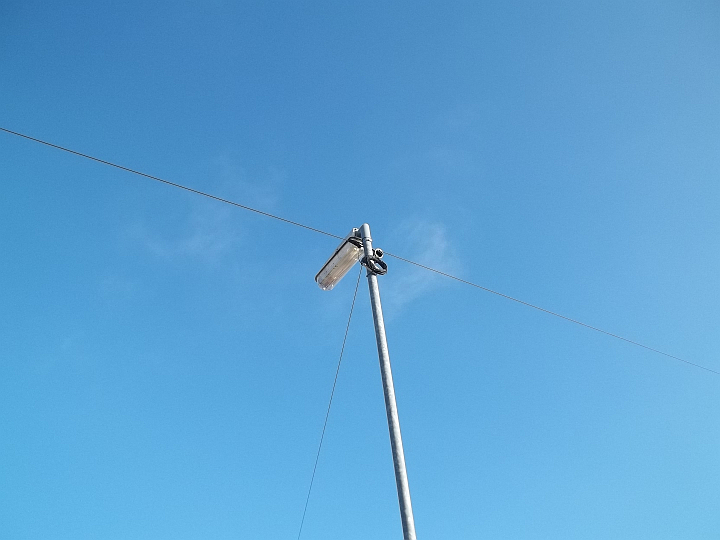
For the distribution network after the village we chose a combination of outdoor optical cable (16 threads in one) with the use of curtains on public lighting (non-standard, but cheap and perfect solutions for wiring in the already finished zones without having to interfere with the structures of communities) and in the new buildings then save the optical cable to the sidewalks. Optical fiber that we used for outdoor divorce, has 16 fibers in a single cable, there is also provision for a further increase in the number of trailing units. After adding an additional SFP module into the port PON OLT unit, simply use the same cable and its not yet unused thread come to life and will bring the signal to other stores. It will therefore be possible realistically without further significant cost to connect a total of 4 * 32 = 128 users (4 PON ports and 32 ONU on each).
Similar to how we have chosen and for the realization of all-optical networks in the other, a larger satellite town, where we already had customers connected over Wi-Fi. The transition from Wi-Fi to the optical network with elements of wodaplug was due to previous experience very simple, unpretentious, the costs outweighed the disappearance having paid reliably (e.g. outreach), and customers appreciate noticeable improvement services and stability. For a denser buildings, we chose the distribution of splitery in the 8:1 ratio running two in succession, the signal to us that once again came out optimally.
In General
Optical network behaves transparently as a smart switch, you can configure the VLANs are for individual ports end the. The configuration is simple thanks to the front of the programmed cutter path diameter of templates such as. previous installations. clone installation (when the 4 and 8 port OLT unit wodaplug offers template management!), so the newly connected the downloaded configuration according to the preset templates (provisioning ). Configuration of the OLT unit via the included configuration software EMS – central management (based on SNMP and mySQL and other needs to install SW on PC), or by using telnet and the CLI (command line interface). They also support protocol SNMP (mibs).
The competitive advantages of hardware
EPON OLT unit WDS1U4PGE are fitted with branded chipset Cortina CS8032, their performance and signal level is thus at a very high level and ensure wide coverage for your network stable signal and a varied range of deployable technology already proven services in practical deployments. For example, heat resistance was also tested in real conditions at temperatures much over 40C.
The great advantage is also DUAL POWER supply, that is, the units have two redundant sources!
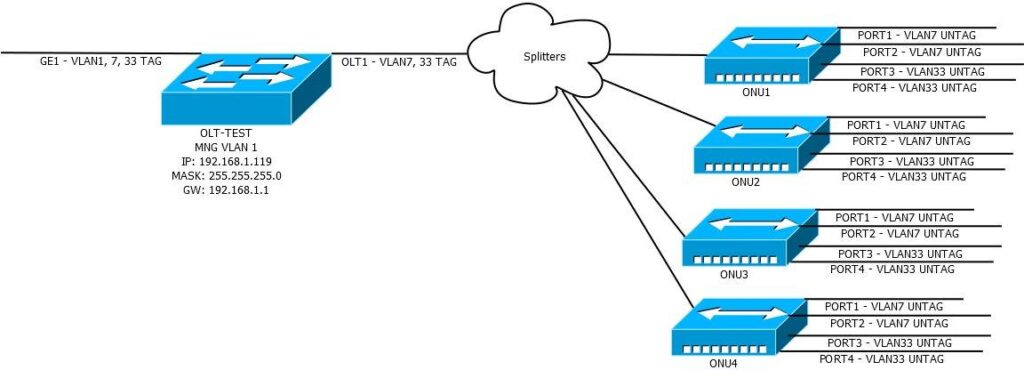
DIAGRAM of standard network configuation for an ISP with IPTV service (VLAN segmentation)
Atention – not use VLAN 1 and 3, VLAN 3 is used for internal communication of Cortina chipset and is prohibited! VLAN1 use for management only!
Example of CLI configuration of an OLT unit Wodaplug for this scenario using templates – provisioning
1. Config the OLT uplink port vlan:
epon# swport ge1
epon(GE-1)# vlan
epon(GE-1)# vlan add 7 tag
epon(GE-1)# vlan add 33 tag
2. Config the OLT pon port vlan:
epon# swport ge5
epon(GE-5)# vlan add 7 tag
epon(GE-5)# vlan add 33 tag
3. Config OLT manage ip address:
epon# system ipconfig inband 192.168.1.119 255.255.255.0
epon# system ipconfig gateway 192.168.1.1
4. Enable the vlan function:
epon# swmode vlan enable
5. Config the ONU template and apply to all onu,the template config will apply to the ONU.
This template is for the 4port ONU (FD104GH or FD104HC), FD104HW is just 2port(eth1 and eth2) for the ONU and another 2port(lan1 and lan2) is for the wifi port – this ONU needs local web configuratio.
epon# system onu-template-config-user 2
epon(onu-template-2)# config capacity 0 4 0 test
epon(onu-template-2)# config uni 1 ctc vlan-mode tag 0x8100 0 7
epon(onu-template-2)# config uni 2 ctc vlan-mode tag 0x8100 0 7
epon(onu-template-2)# config uni 3 ctc vlan-mode tag 0x8100 0 33
epon(onu-template-2)# config uni 4 ctc vlan-mode tag 0x8100 0 33
epon(onu-template-2)# apply-to-all-onu 2
epon# system save all
Done …this is all …easy, right? Connected ONUs will lease configuration based on this template.
The word for the end:
1. Your network stands and fall on quality of products you used to build up your network.
2. Precision and doublechecks saves days of work.
3. Calculate before connecting.
as much as you getting in your hand probably best EOC/optical technology possible for this price tier level with many years of experiences in practical field, s**** may always happend, and thats why we here to help. Do not hesitate to contact us in any need of help, as matter of fact, many of our today customers are willing to help, if you beggining or face problems already known.
We have team possibly eager to help on place of instalation (exept north and south pole areas )
QCN9274: What is the throughput potential of WiFi7 cards?
Experience Lightning Fast Internet with Dream DR9274-5G and -6G
In the realm of WiFi routers, throughput serves as a key determinant of performance. A higher throughput signifies enhanced data transfer rates, enabling seamless connectivity for multiple devices concurrently. This capability proves invaluable for bandwidth-intensive tasks like high-definition video streaming, online gaming, and large file downloads.
Routers with high throughput capabilities offer not only stable connections but also expedited wireless transmissions, thereby elevating user experience significantly. Whether accommodating numerous devices or facilitating data-intensive operations, such routers are indispensable for meeting the demands of modern connectivity.
We have conducted tests on the throughput of its WiFi7 router, DR9574, and WiFi7 module, DR9274-6G, achieving remarkable speeds of up to 8.9G. Under optimal conditions, throughput may even reach 9G+, approaching the 10G mark. This demonstrates the exceptional performance potential of Wallys’ products in providing stable and high-speed wireless connections.
In summary, prioritizing routers with high throughput ensures optimal performance and reliability, particularly in environments with multiple interconnected devices and extensive data transfer requirements.
DR9574 routerboard
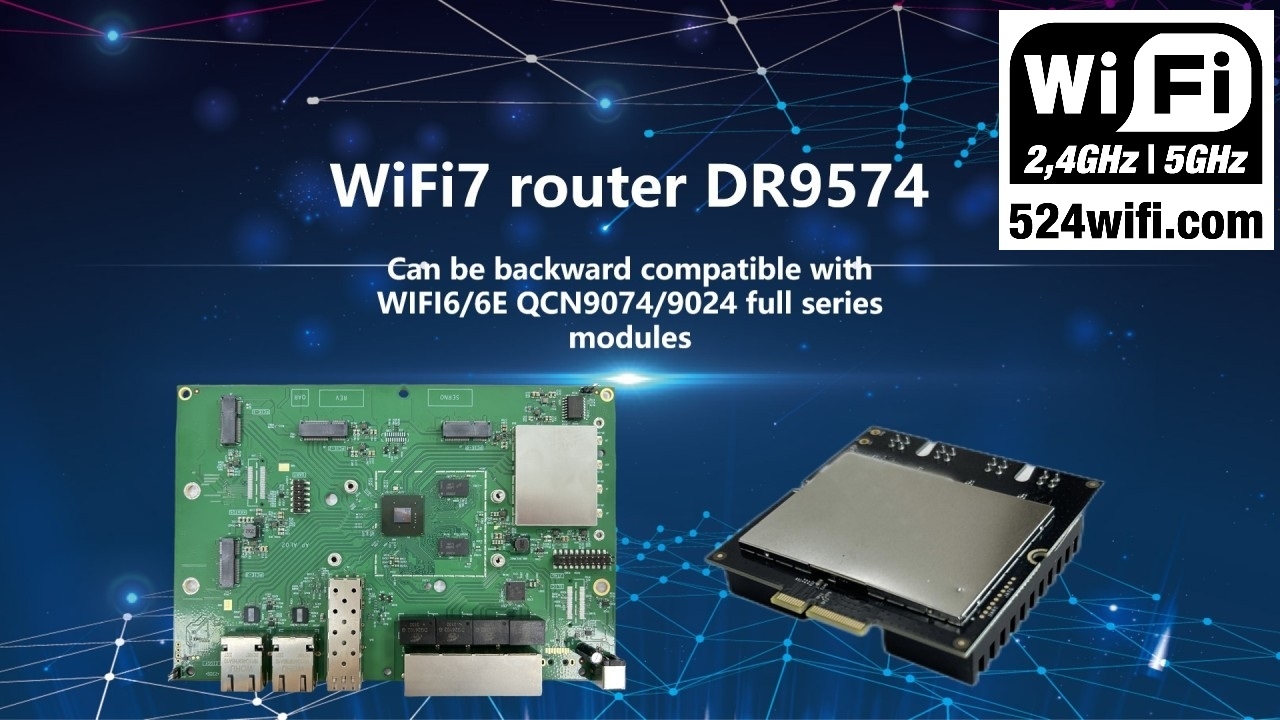
802.11be IPQ9574 4×4 2.4G 2x10G +4x1G Ethernet Port
Support WIFI7 card QCN9274-QCN6274
DBDC 2×2 2.4G& 2×2 5G
DBDC 2×2 5G& 2×2 6G
single band 4×4 5G
single band 4×4 6G
WLAN Host Interface:PCI Express 3.0 Interface
Frequency Range:2.4GHz: 2.412~2.472GHz
DR9274-6G
DR9274-6G based on QCN9274 Chipset is an enterprise wireless module integrated with 4×4 MU-MIMO single Band Wireless Module designed specifically to provide users with mobile access to high-bandwidth video streaming, voice, and data transmission for office and challenging RFenvironment in factories, warehouses establishment
4×4 6G MU-MIMO WiFi Module
WIFI7 M.2 card QCN9274
■ Qualcomm Atheros QCN9274 for Industrial Grade;
■ Maxim Tx power 22dBm per chain;
■ 4×4 6G MU-MIMO, up to 11530Mbps physical data rate;
■ Support up to 4096-QAM;
■ M.2 connector;
■ PCI Express 3 .0 Interface
524WiFi and Wallys software technology advantages:
Wallys has 10 years of experience in software development and is very experienced in uboot, Linux, wifi protocol, wifi performance, OS and other systems. It mainly uses Qualcomm chips to develop important software such as drivers and kernels, and has the ability to modify and compile to meet customers’ different wifi functional requirements. Meanwhile, it participates in openwrt organization and code development. wifi5 product DR40x9 has been officially supported by openwrt.
Hardware technology advantages:
We have a strong hardware design team, and experienced people know that the most difficult part of hardware design is RF circuit design, baseband, etc., while wallys team made 0 error to achieve signal integrity, such as frequency conversion of network card, from 2.4G to 900M, which is a technological breakthrough.
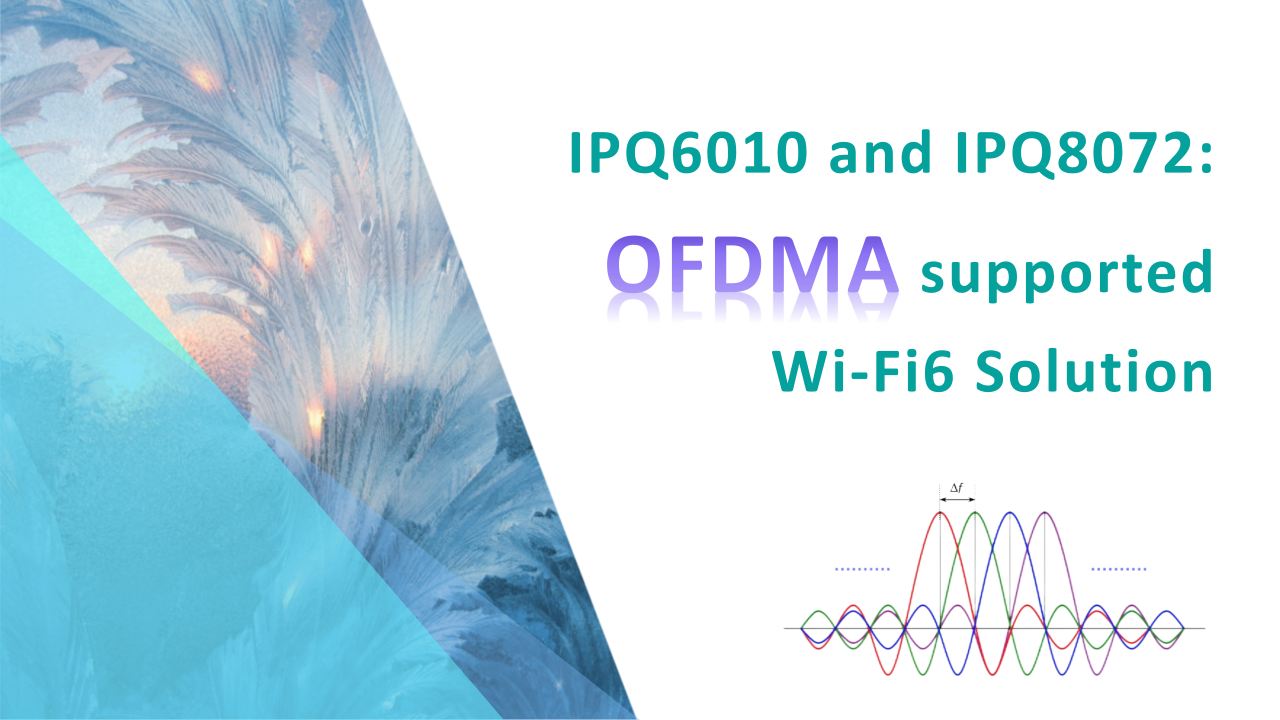
IPQ6010 and IPQ8072:OFDMA support in Wifi6 Solution
Introduction:
In the dynamic landscape of wireless communication, the techniques employed play a crucial role in optimizing data transmission and overcoming challenges. Two key technologies, FDMA (Frequency Division Multiple Access) and OFDMA (Orthogonal Frequency Division Multiple Access), are pivotal in this context. This blog aims to unravel the disparities between FDMA and OFDMA, shedding light on their applications and significance in mitigating multipath interference, particularly in the realm of Wi-Fi.
The Need for Multiple Carrier Technologies:
To comprehend the essence of OFDMA, it’s imperative to first delve into the concept of OFDM (Orthogonal Frequency Division Multiplexing). OFDM is a multicarrier modulation technique designed to combat multipath interference encountered in wireless communication. Multipath interference occurs when radio waves encounter obstacles, causing reflections and refractions. This phenomenon results in multiple versions of the same signal reaching the receiver, leading to what is known as multipath interference.
The Challenge of Inter-Symbol Interference:
Multipath interference directly contributes to intersymbol interference (ISI). In the realm of wireless communication, ISI poses a challenge where, for a given set of serial signals, the receiver encounters difficulty distinguishing between them. This challenge arises when the time delay between two identical signals is less than the signal’s transmission interval. The outcome is known as inter-symbol interference, making it arduous for the receiver to accurately decipher the intended signals.
OFDM as a Solution:
OFDM addresses this issue by transforming high-speed serial data into parallel low-speed data streams, thereby reducing inter-symbol interference. However, OFDM comes with its own set of drawbacks. In Wi-Fi 4/5, where communication is single-user-centric, each data transmission occupies all available subcarriers. This results in inefficiencies when small data packets, such as instant messages or web browsing, are transmitted, as the entire bandwidth is underutilized.
Introduction of OFDMA:
In response to this inefficiency, Wi-Fi 6 introduced OFDMA, borrowing a page from 5G’s playbook. OFDMA, despite its name’s resemblance to OFDM, is fundamentally a multiple access technique. Multiple access techniques distinguish different users, and common methods include FDMA, TDMA, and CDMA.
FDMA vs. OFDMA:
FDMA relies on allocating different frequency channels to different users. In the analogy of a gathering, it’s akin to separating rooms for distinct conversations. On the other hand, OFDMA divides the channel into Resource Units (RUs), each orthogonal to the others. In our gathering analogy, OFDMA creates individual compartments within a room, facilitating multiple conversations simultaneously.
Enhancing Efficiency with OFDMA:
OFDMA optimizes spectral efficiency by scheduling users in specific resource units instead of utilizing the entire channel for a single user, as seen in traditional OFDM. It introduces a more flexible approach, akin to efficiently utilizing a delivery vehicle by allocating designated compartments for different recipients.
Conclusion:
In summary, while OFDM successfully addresses multipath interference by transforming data streams, OFDMA takes a step further by introducing an innovative multiple access technique. By adopting OFDMA, Wi-Fi 6 has elevated efficiency in point-to-multipoint communication, ensuring that a single cycle completes communication with multiple users. This evolution underscores the dynamic nature of wireless communication technologies, continually adapting to enhance performance and meet the demands of evolving applications.
Here are some of Wallys’ 802.11ax products support OFDMA
524WiFi, a trailblazer in connectivity solutions, unveils a range of cutting-edge Wi-Fi 6 router boards tailored to meet various requirements. Now, let’s explore the intricacies of WiFi 6 router boards and analyze their specifications with informative data sheets.
A Quick Overview
1.DR5018-IPQ5018 WiFi 6 Routerboard with 2.4GHz and BT5.1 Support
2.DR6018-IPQ6010 WiFi 6 Routerboard with Dual-Band Support
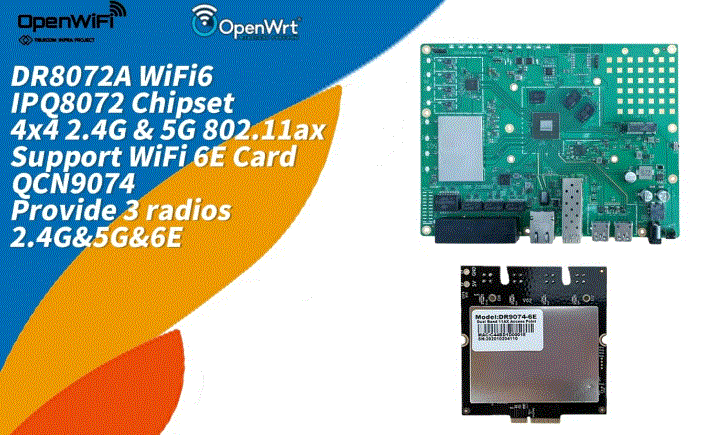
3.DR8072-IPQ8072 Dual-Band WiFi 6 Routerboard
4.DR8074-IPQ8074 WiFi 6 Routerboard with 2.4GHz Support
1.DRiver 5018-IPQ5018 WiFi 6 Routerboard with 2.4GHz and BT5.1 Support
The DR5018 is an enterprise-grade wireless module designed for high-bandwidth applications in challenging environments. Key features include:
BT5.1 Radio module integration
2×2 2.4GHz high-power Radio module
Dual-core ARM 64bit A53 processor clocked at 1.0GHz
512MB DDR L3L system memory
4MB NOR Flash and 128MB NAND Flash storage
Onboard 2.4GHz radio supporting up to 573Mbps data rates
M.2 card slots for QUECTEL RM 500Q-GL 5G module and QCN9074 WiFi 6E card
Openwifi support for enhanced flexibility and compatibility
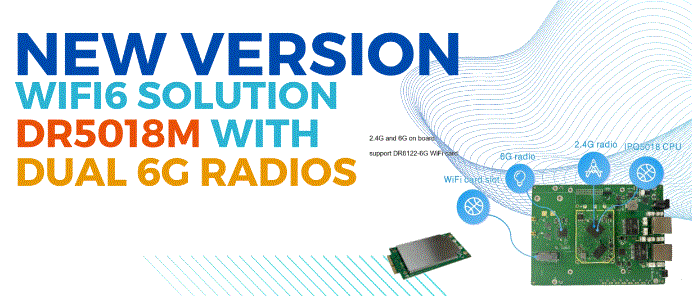
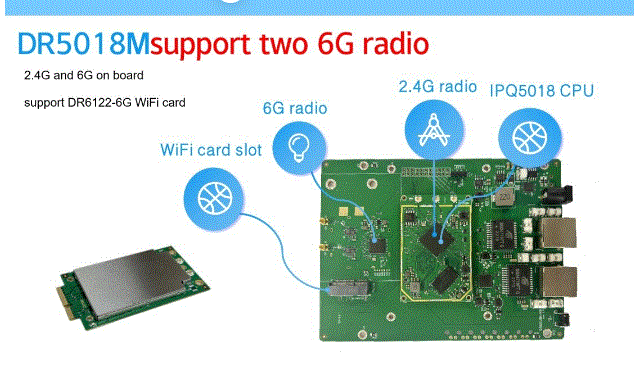
This routerboard also have a SOM version:DR5018M
2.DRiver 6018-IPQ6010 WiFi 6 Routerboard with Dual-Band Support
The DR6018 is a high-performance router board equipped with advanced features for seamless connectivity. Key features include:
Qualcomm-Atheros IPQ6010 chipset
Quad-core ARM 64bit A53 processor running at 1.8GHz
1GB DDRL3L system memory for efficient multitasking
32MB NOR Flash and 256MB NAND Flash storage for data storage
Supports Dynamic Frequency Selection (DFS) for optimized wireless performance
2×2 On-board 2.4GHz radio with up to 573Mbps physical data rate
2×2 On-board 5GHz radio with up to 1201Mbps physical data rate
Compatibility with QUECTEL RM500Q-GL for 5G connectivity
Support for QCN9074 WiFi 6E Card for enhanced wireless capabilities
Openwifi support for flexibility and compatibility
The DR8072 boasts powerful features for robust connectivity. Key highlights include:
Qualcomm Atheros IPQ8072A AR Quad Core CPU for efficient processing
On-board 5GHz radio with up to 2475 Mbps physical data rate
On-board 2.4GHz radio with up to 1147Mbps physical data rate
8 MB NOR Flash and 256MB NAND Flash storage (Optional NAND Flash upgrade to 1GB)
Support for 11ax TX Beamforming, MU-MIMO DL and UL, and OFDMA DL and UL for optimized wireless performance
Dynamic Frequency Selection (DFS) support for improved spectrum utilization
1GB DDR3L system memory (Optional DDR3L upgrade to 2GB)
M.2 connector compatibility for QCN9074 production module support
4.DRiver DR8074-IPQ8074 WiFi 6 Routerboard with 2.4GHz Support
The DR8074 is a high-performance router board designed for demanding networking applications. Key features include:
Qualcomm Atheros IPQ8074A AR Quad Core CPU for robust processing power
On-board 5GHz radio with up to 4804Mbps physical data rate
On-board 2.4GHz radio with up to 1147Mbps physical data rate
Support for 11ax TX Beamforming for enhanced signal strength
Support for 11ac/ax MU-MIMO DL and UL for efficient multi-user communication
Support for OFDMA DL and UL for improved spectral efficiency
Tri-band support with 5G SBS (4×4/5GHz + 4×4/5GHz) + 4×4/2.4GHz for versatile connectivity options
Dynamic Frequency Selection (DFS) support for optimized wireless performance
524WiFi Wallys WiFi 6 routerboard are engineered for versatility and reliability, making them ideal for Enterprise, Industrial, Cybersecurity, Transportation, and SMB applications.
Inquiries:
Wallys is dedicated to continuous innovation, constantly pushing the boundaries of WiFi technology. In addition to its hardware products, Wallys also offers a range of ODM/OEM services, including:
Customization: Wallys can customize its WiFi 6 products and embedded boards to meet the specific needs of its customers.
Combining the DR5018M with the DR6122-6G card creates a perfect synergy for achieving higher performance in your WiFi project!
Key Features:
High-speed data transmission: The IPQ5018 motherboard, with its powerful processing capabilities and network acceleration functions, coupled with the high-speed Wi-Fi 6E connection of the QCN6122-6G card, ensures high-speed data transmission suitable for scenarios requiring large data transmission, such as high-definition video streaming and online gaming.
Large-scale device connection: The QCN6122-6G card supports MU-MIMO and OFDMA technology, effectively managing connections of multiple devices. The processing power of the IPQ5018 motherboard supports large-scale device connections, making it suitable for environments with numerous terminal devices, such as corporate offices, schools, and hotels.
Stable and reliable network performance: The IPQ5018 motherboard integrates rich network acceleration and security functions for stable and reliable network performance. The high-speed Wi-Fi connection of the QCN6122-6G card ensures wireless network stability, ideal for scenarios with high performance requirements, such as corporate networks and video surveillance systems.
Wallys’ Software:
With 10 years of experience in software development, Wallys excels in uboot, Linux, WiFi protocols, performance optimization, and operating systems. Specializing in Qualcomm chips, Wallys develops crucial software like drivers and kernels, tailoring them to meet customers’ diverse WiFi functional requirements. Additionally, Wallys actively contributes to the OpenWRT organization and code development, with its WiFi5 product DR40x9 being officially supported by OpenWRT.
Wallys’ Hardware:
Backed by a robust hardware design team, Wallys achieves technological breakthroughs in RF circuit design and baseband. Achieving 0 errors to ensure signal integrity, such as in the frequency conversion of the network card from 2.4G to 900M, demonstrates Wallys’ excellence in hardware innovation.
Upgrade to Wallys’ DR5018M and DR6122-6G combination today to experience enhanced WiFi performance and reliability!
WiFi Protected Access 3 (WPA3) represents the latest security protocol for Wireless Networks, offering heightened protection against cyber threats. A notable feature of WPA3 is Simultaneous Authentication of Equals (SAE), a robust authentication method that replaces the outdated pre-shared key system. This advancement significantly mitigates security risks, particularly when dealing with vulnerable passwords.
For individuals seeking to harness the 6 GHz band with WiFi 6E devices, WPA3 adoption is imperative. Therefore, if you possess devices capable of supporting WiFi 6E and wish to utilize the 6 GHz band for connectivity, transitioning to WPA3 encryption is crucial.
Wallys offers a comprehensive range of products equipped with WPA3 support, catering to various user requirements. Some noteworthy offerings include:
DR5018-IPQ5018 WiFi 6 Routerboard with 2.4GHz and BT5.1 Support:Tailored for high-bandwidth applications in demanding environmentsIntegration of BT5.1 Radio moduleDual-core ARM 64bit A53 processorOnboard 2.4GHz radio supporting up to 573Mbps data ratesM.2 card slots for 5G modules and WiFi 6E cardsOpenwifi support for enhanced flexibility
DR6018-IPQ6010 WiFi 6 Routerboard with Dual-Band Support:Equipped with Qualcomm-Atheros IPQ6010 chipsetQuad-core ARM 64bit A53 processorSupports Dynamic Frequency Selection (DFS) for optimized wireless performanceCompatibility with 5G connectivity and WiFi 6E cardsQSDK support for development and customization
DR8072-IPQ8072 Dual-Band WiFi 6 Routerboard:Powered by Qualcomm Atheros IPQ8072A AR Quad Core CPUSupports 11ax TX Beamforming, MU-MIMO DL and UL, and OFDMA DL and ULDynamic Frequency Selection (DFS) support for improved spectrum utilization
DR8074-IPQ8074 WiFi 6 Routerboard with 2.4GHz Support:Features Qualcomm Atheros IPQ8074A AR Quad Core CPUSupports 11ax TX Beamforming and MU-MIMO DL and ULTri-band support for versatile connectivity options
In addition to WiFi 6 offerings, 524WiFi also provides WiFi 7 solutions tailored to meet evolving wireless networking demands. Notable offerings in this category include:
DR9274-QCN9274|QCN6274 WiFi7 Single Band 5G:Customized for single-band 5G applicationsSupports up to 4×4 MU-MIMO and 4096-QAMWide temperature operating range for industrial and commercial grades
DR9274-QCN9274|QCN6274 WiFi7 Single Band 6G:Specifically designed for single-band 6G requirementsBoasts a 4T4R (4×4) MU-MIMO 6GHz solution
DR9274-QCN9274|QCN6274 WiFi7 Dual Band Dual Concurrent-2.4G&5G:Ideal for dual-band, dual-concurrent operation in both 2.4G and 5G frequencies
DR9274-QCN9274|QCN6274 WiFi7 Dual Band Dual Concurrent-5G&6G:Tailored for dual-band, dual-concurrent operation in 5G and 6G frequencies
WiFi7 Platform DR9574-IPQ9574:A robust platform featuring the Qualcomm IPQ9574, designed specifically for industrial WiFi 7 router applications
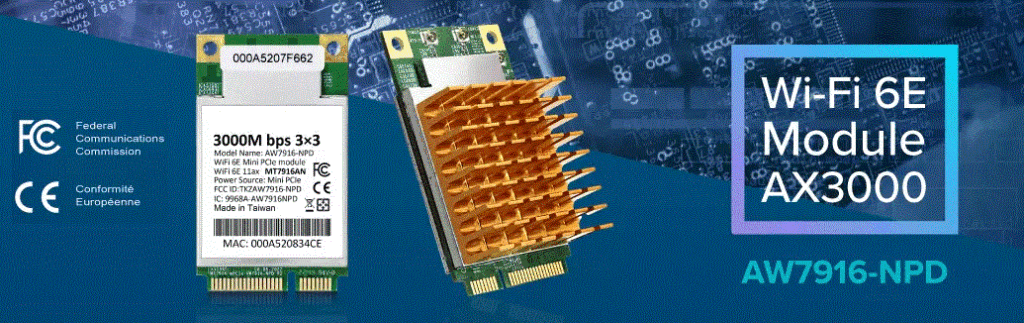
The Wi-Fi 6E Module AW7916-NPD is a highly advanced Mini PCIe module with Wi-Fi 6E 3000 capabilities. It features G-band 2T2R + A-band 3T3R 2ss dual-band concurrent technology, providing a transmission efficiency of 3000 Mbps. With support for Wi-Fi 6E, even in densely crowded environments, the Wi-Fi 6E Module AW7916-NPD delivers efficient network performance while accommodating a greater number of Wi-Fi users. Its wider spectrum and increased capacity ensure smooth operations, reducing latency and interruptions.
Features:
BUS Interface: Mini PCIe / M.2 AE Key
IEEE 802.11 a/b/g/n/ac/ax compliant
High-Performance Dual-Band Connectivity: G-band 2T2R + A-band 3T3R 2ss, Dual-band concurrent with PHY rate up to 3000Mbps
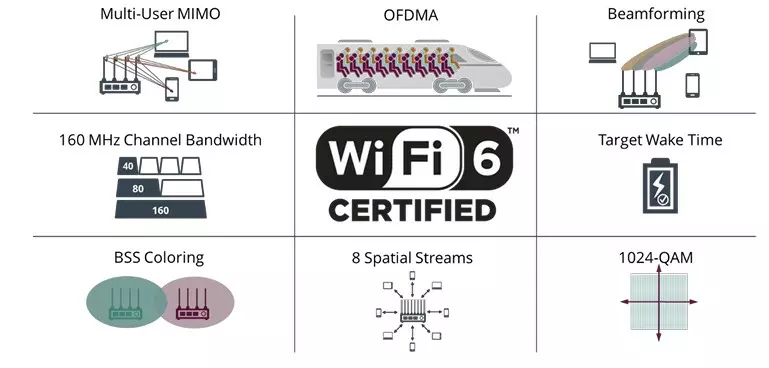
Flexible Bandwidth Support: Support 20/40MHz bandwidth in G-band, and 20/40/80/160MHz bandwidth in A-band
Robust Security Features: Security support for WFA WPA/WPA2/WPA3 personal, WPS2.0
Support MU-OFDMA TX/RX
Support MU-MIMO TX/RX
Compatibility with Diverse Modes: Support greenfield, mixed mode, legacy modes
Based on Mediatek MT7916AN.
The expanded spectrum delivers astonishing performance.
The Wi-Fi 6E Module AW7916-NPD provides a more powerful experience for high-bandwidth applications. By utilizing up to 14 additional 80MHz channels or 7 extra ultra-wide 160MHz channels in the 6GHz frequency band, it supports smooth and high-definition video calls and can handle large-scale data transmission.
Wi-Fi 6E moudle AW7916-NPD Mesh+Security
A mesh system can provide offices and enterprises with a more reliable network connection, covering a wide area, and allowing numerous devices to connect to the network, offering better performance in densely populated device areas. Even as users move to different areas, their devices can smoothly switch to the strongest Wi-Fi access point without the need for manual reconnection or experiencing disconnection.
The Wi-Fi 6E Module AW7916-NPD adopts the latest WPA3 security protocol, safeguarding users from unauthorized access and data breaches, addressing security threats in modern wireless networks.
Accurate and fast remote operation
Compared to the past, Wi-Fi 6E enables remote operations with higher precision. This advancement is expected to drive the progress of remote medical services and open up possibilities for practical applications of remote surgeries in the medical field. With Wi-Fi 6E, healthcare professionals can perform surgeries with greater precision and less invasiveness, marking a significant breakthrough in the field of medical services. Additionally, in manufacturing and logistics, technologies such as robotic arms and drones can execute tasks more swiftly and accurately, reducing the likelihood of errors. This technology also fosters progress in smart and automated systems, bringing forth more innovations and efficiency for businesses.
Wi-Fi 6E is driving several world trends and technological advancements
At the end of 2022, the University of Michigan in the United States underwent a revolutionary change by deploying over 16,000 Wi-Fi access points across 225 buildings and outdoor areas on campus. This remarkable achievement allowed the university to support up to 70,000 device connections simultaneously. Through this extensive Wi-Fi infrastructure, the University of Michigan can meet the growing data demands, enhance teaching and campus management efficiency, and foster the application and development of smart devices on campus. This will have a positive impact on various aspects of academic research, student learning, and campus life.
Wi-Fi 6E is a significant trend in the current wireless network market. With continuous technological advancements and increasing data demands, Wi-Fi 6E has become the representation of the next-generation wireless network technology and is gaining widespread attention and adoption in the market.
QCN9274: WHAT IS THE THROUGHPUT POTENTIAL OF WIFI7 CARDS?
In the realm of WiFi routers, throughput serves as a key determinant of performance. A higher throughput signifies enhanced data transfer rates, enabling seamless connectivity for multiple devices concurrently. This capability proves invaluable for bandwidth-intensive tasks like high-definition video streaming, online gaming, and large file downloads.
Routers with high throughput capabilities offer not only stable connections but also expedited wireless transmissions, thereby elevating user experience significantly. Whether accommodating numerous devices or facilitating data-intensive operations, such routers are indispensable for meeting the demands of modern connectivity.
524WiFi has conducted tests on the throughput of Qualcomm WiFi7 router, IPQ 9574, and 524WiFi WiFi7 module, DRiver 9274-6G, achieving remarkable speeds of up to 8.9G. Under optimal conditions, throughput may even reach 9G+, approaching the 10G mark. This demonstrates the exceptional performance potential of 524WiFi products in providing stable and high-speed wireless connections.
In summary, prioritizing routers with high throughput ensures optimal performance and reliability, particularly in environments with multiple interconnected devices and extensive data transfer requirements.
DRiver 9574 ROUTERBOARD (QUALCOMM ADLER)
802.11be IPQ9574 4×4 2.4G 2x10G +4x1G Ethernet Port
Support WIFI7 card QC9274-QCN6274
DBDC 2×2 2.4G& 2×2 5G
DBDC 2×2 5G& 2×2 6G
single band 4×4 5G
single band 4×4 6G
WLAN Host Interface:PCI Express 3.0 Interface
Frequency Range:2.4GHz: 2.412~2.472GHz
524WIFI 7 DRiver 9274-6G
DRiver 9274-6G based on QCN9274 Chipset is an enterprise wireless module integrated with 4×4 MU-MIMO single Band Wireless Module designed specifically to provide users with mobile access to high-bandwidth video streaming, voice, and data transmission for office and challenging RFenvironment in factories, warehouses establishment
4×4 6G MU-MIMO WiFi Module
WIFI7 M.2 card QCN9274
■ Qualcomm Atheros QCN9274 for Industrial Grade;
■ Maxim Tx power 22dBm per chain;
■ 4×4 6G MU-MIMO, up to 11530Mbps physical data rate;
■ Support up to 4096-QAM;
■ M.2 connector;
■ PCI Express 3 .0 Interface
WHAT’S WI-FI 7?
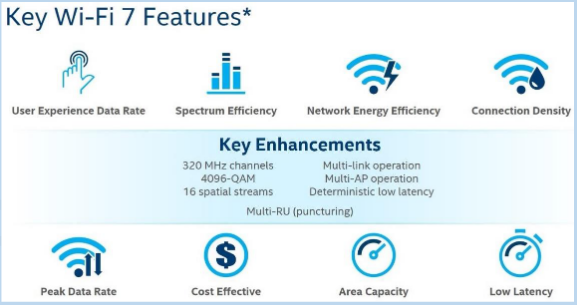
Wi-Fi 7 has the following features: *provide over 3 times faster data rates of 46 Gbps using a 320 MHz channel in the 6 GHz *one 160 MHz channel in the 5 GHz band with up to 4096-QAM (4K-QAM) modulation *16 spatial streams MU-MIMO, New Multi-Link Operation (MLO) enables Wi-Fi 7 to combine several frequencies across bands into a single and steady connection.
Wi-Fi 7 is being designed to be optimized for these video applications like gaming, streaming, smart home devices and services, cloud computing, video conferencing , etc.
WI-FI 6E/7 COMPARISON
Wi-Fi 6E
IEEE 802.11ax Frequency 2.4GHz, 5GHz, 6GHz Channel bandwidth 160 MHz QAM 1024-QAM 4096-QAM Theoretical maximum speed 9.6 Gbps Spatial streams 16×16 MU-MIMO Application Ac cess point, high quality video streaming, etc.
Wi-Fi 7
802.11be EHT
Frequency 2.4GHz, 5GHz, 6GHz
Channel b-QAM
Theoreticaandwidth Up to 320 MHz
QAN 4096l maximum speed 46 Gbps
Spatial streams 16×16 MU-MIMO
Video applications like gaming, streaming, smart home devices, cloud computing, video conferencing, etc.
NEW 11AX BOARDS BASED ON QUALCOMM WITH MU-MIMO 802.11AX OFDMA WIFI 6 RADIO ON BOARD! NOW WE SUPPORT 4G / 5G LTE GSM MODEMS! QCA CP01 C4 REFERENCE DESIGN FOR DEVELOPMENT !
– For wifi 6, we have developed the long distance function, in France our customer can run 10km link! This function needs to modify the core of wifi protocol. We just find that only 524WiFi.COM Wallys DR6018 QCA IPQ6018 boards can get the wifi6 to run on 3-10km distance!
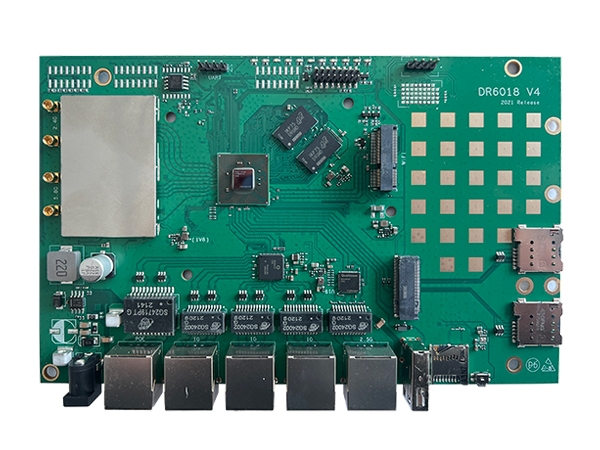
Quad-core ARM 64bit [email protected] Processor 1GB DDRL3L System Memory 8MB NOR Flash, 256MB NAND Flash Supports Dynamic Frequency Selection (DFS 2x2On-board2.4GHz radio,upto 573Mbps physical Data Rate 2x2On-board 5GHz radio,upto 1201Mbps physical Data Rate
Support: QCN9074 WiFi 6E Card in M.2 slot
Product Description
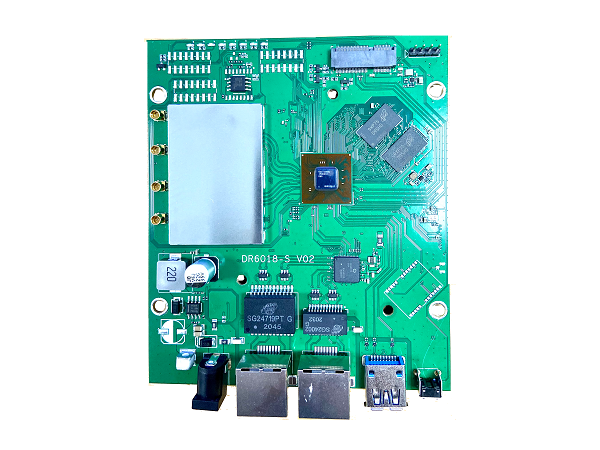
DR6018-S based on IPQ6010 chipset is an enterprise wireless module integrated with 2×2 5G high power Radio module and 2×2 2.4G high power Radio module designed specifically to provide users with mobile access to high-bandwidth video streaming, voice, and data transmission for office and challenging RF environment in factories, warehouses establishment. Passive POE 24-48V supported, DC jack 24-48V. If you need 802.3af/bt active POE support , then please order DR6018-S HV version.
DR6018v4 board is QCA CP01 – C4 reference design board ideal for your development ! 11AX MU-MIMO OFDMA DUAL BAND DUAL CONCURRENT EMBEDDED BOARD
– For wifi 6, we have developed the long distance function, in France our customer can run 10km link! This function needs to modify the core of wifi protocol. We just find that only 524WiFi.COM Wallys DR6018 QCA IPQ6018 boards can get the wifi6 to run on 3-10km distance!
PQ6010 AND IPQ8072:OFDMA SUPPORT IN WIFI6 SOLUTION
Introduction:
In the dynamic landscape of wireless communication, the techniques employed play a crucial role in optimizing data transmission and overcoming challenges. Two key technologies, FDMA (Frequency Division Multiple Access) and OFDMA (Orthogonal Frequency Division Multiple Access), are pivotal in this context. This blog aims to unravel the disparities between FDMA and OFDMA, shedding light on their applications and significance in mitigating multipath interference, particularly in the realm of Wi-Fi.
The Need for Multiple Carrier Technologies:
To comprehend the essence of OFDMA, it’s imperative to first delve into the concept of OFDM (Orthogonal Frequency Division Multiplexing). OFDM is a multicarrier modulation technique designed to combat multipath interference encountered in wireless communication. Multipath interference occurs when radio waves encounter obstacles, causing reflections and refractions. This phenomenon results in multiple versions of the same signal reaching the receiver, leading to what is known as multipath interference.
The Challenge of Inter-Symbol Interference:
Multipath interference directly contributes to intersymbol interference (ISI). In the realm of wireless communication, ISI poses a challenge where, for a given set of serial signals, the receiver encounters difficulty distinguishing between them. This challenge arises when the time delay between two identical signals is less than the signal’s transmission interval. The outcome is known as inter-symbol interference, making it arduous for the receiver to accurately decipher the intended signals.
OFDM as a Solution:
OFDM addresses this issue by transforming high-speed serial data into parallel low-speed data streams, thereby reducing inter-symbol interference. However, OFDM comes with its own set of drawbacks. In Wi-Fi 4/5, where communication is single-user-centric, each data transmission occupies all available subcarriers. This results in inefficiencies when small data packets, such as instant messages or web browsing, are transmitted, as the entire bandwidth is underutilized.
Introduction of OFDMA:
In response to this inefficiency, Wi-Fi 6 introduced OFDMA, borrowing a page from 5G’s playbook. OFDMA, despite its name’s resemblance to OFDM, is fundamentally a multiple access technique. Multiple access techniques distinguish different users, and common methods include FDMA, TDMA, and CDMA.
FDMA vs. OFDMA:
FDMA relies on allocating different frequency channels to different users. In the analogy of a gathering, it’s akin to separating rooms for distinct conversations. On the other hand, OFDMA divides the channel into Resource Units (RUs), each orthogonal to the others. In our gathering analogy, OFDMA creates individual compartments within a room, facilitating multiple conversations simultaneously.
Enhancing Efficiency with OFDMA:
OFDMA optimizes spectral efficiency by scheduling users in specific resource units instead of utilizing the entire channel for a single user, as seen in traditional OFDM. It introduces a more flexible approach, akin to efficiently utilizing a delivery vehicle by allocating designated compartments for different recipients.
Conclusion:
In summary, while OFDM successfully addresses multipath interference by transforming data streams, OFDMA takes a step further by introducing an innovative multiple access technique. By adopting OFDMA, Wi-Fi 6 has elevated efficiency in point-to-multipoint communication, ensuring that a single cycle completes communication with multiple users. This evolution underscores the dynamic nature of wireless communication technologies, continually adapting to enhance performance and meet the demands of evolving applications.
Here are some of 524wifi and Wallys’ 802.11ax products support OFDMA
DR6018:
Qualcomm-Atheros IPQ6010
Quad-core ARM 64bit A53 @1.8GHz Processor
1GB DDRL3L System Memory
32MB NOR Flash, 256MB NAND Flash
Supports Dynamic Frequency Selection (DFS)
2×2 On-board 2.4GHz radio, up to 573Mbps physical Data Rate
2×2 On-board 5GHz radio, up to 1201Mbps physical Data Rate
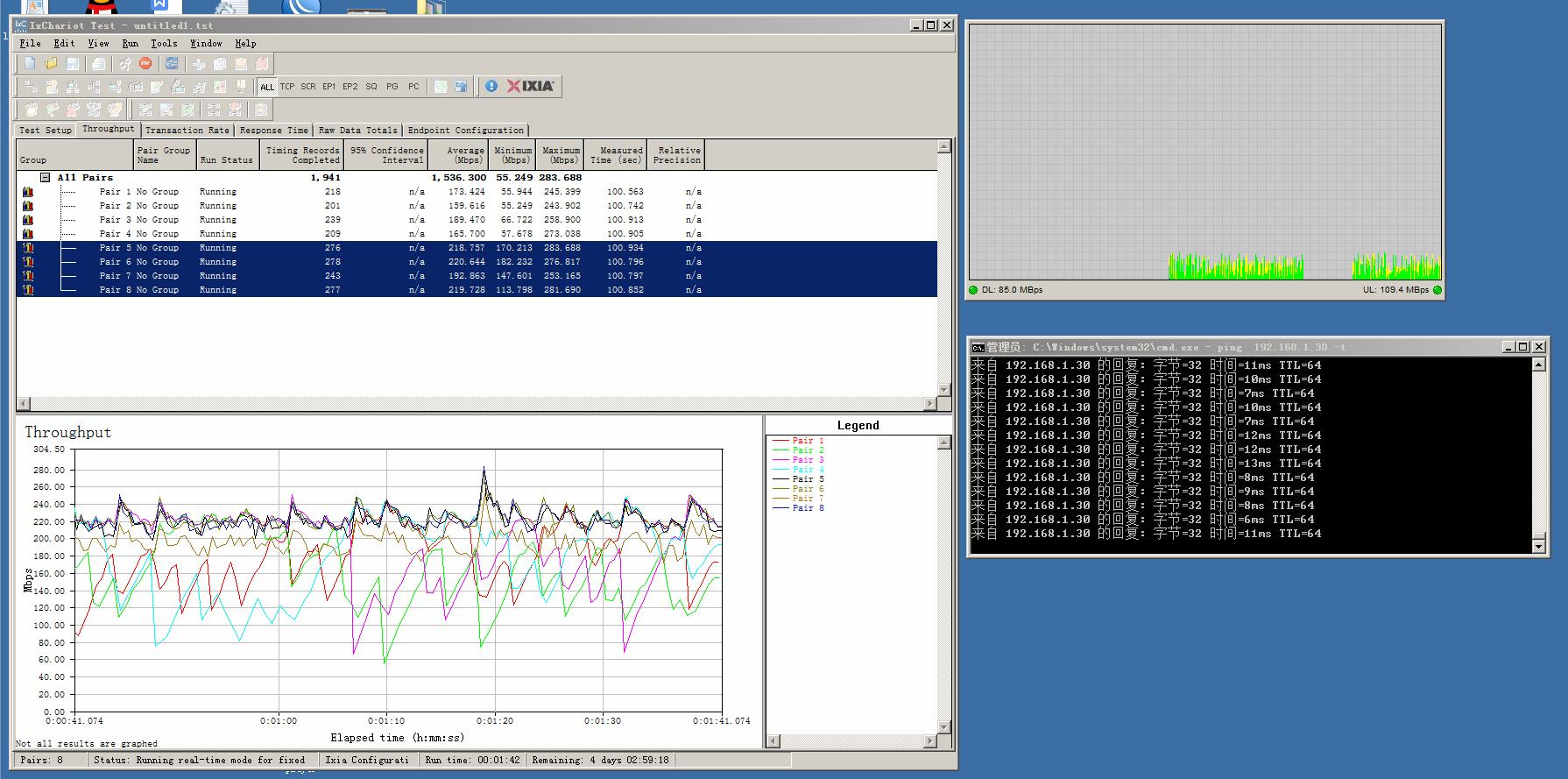
QCN9074-6E WITH DR6018 PLATFORM: ACHIEVING 1.5GBPS SPEED IN THROUGHPUT TEST!
QCN9074-6E THROUGHPUT TEST REPORT IN DR6018
Are you curious about the performance capabilities of the QCN9074-6E network card in the DR6018?
Look no further! In this blog, we’ll walk you through the hardware you’ll need, how to set up one board as an Access Point (AP) and the other as a Station (STA), and perform a throughput test. Plus, we’ll share our exciting conclusions.
HARDWARE REQUIRED:
DR6018 x2
DR9074-6E x2
SETTING UP THE TEST:
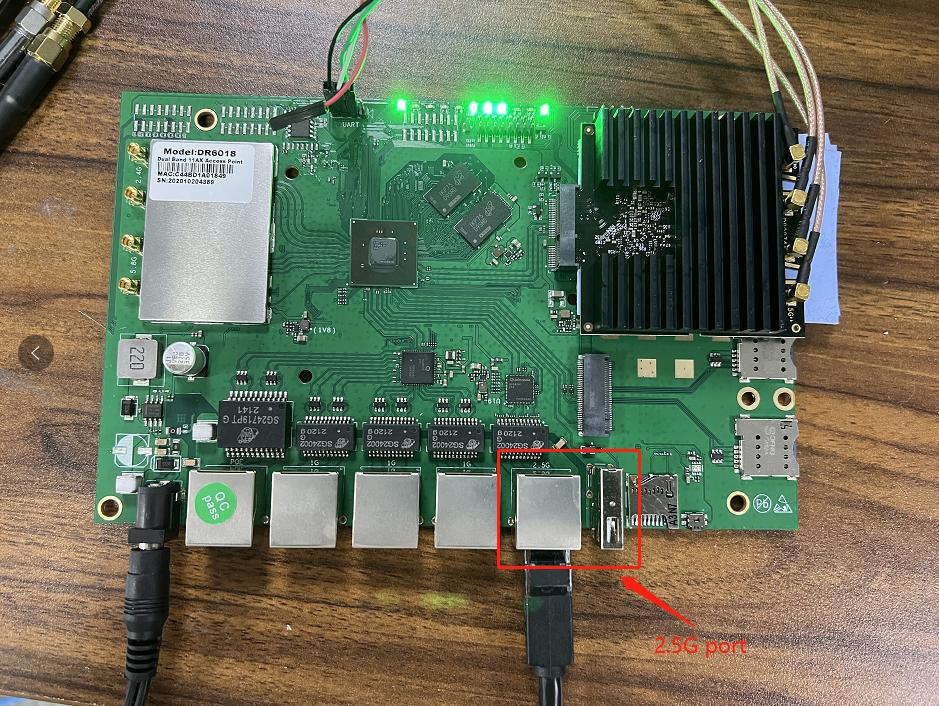
Board Configuration: Install two DR6018 boards and two DR9074-6E network cards.
Role Assignment: Set one DR9074-6E card as the Access Point (AP) and the other as the Station (STA).
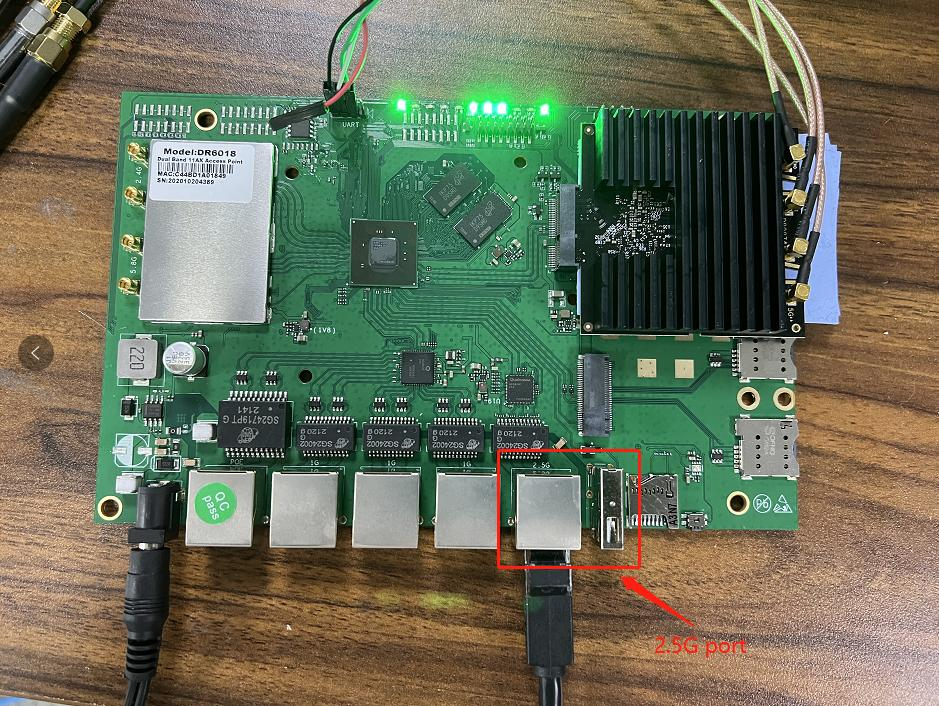
Network Connection: Utilize the onboard 2.5G Ethernet port for connectivity.
PERFORMING THE THROUGHPUT TEST:
Once the radios are linked, it’s time to assess the performance:
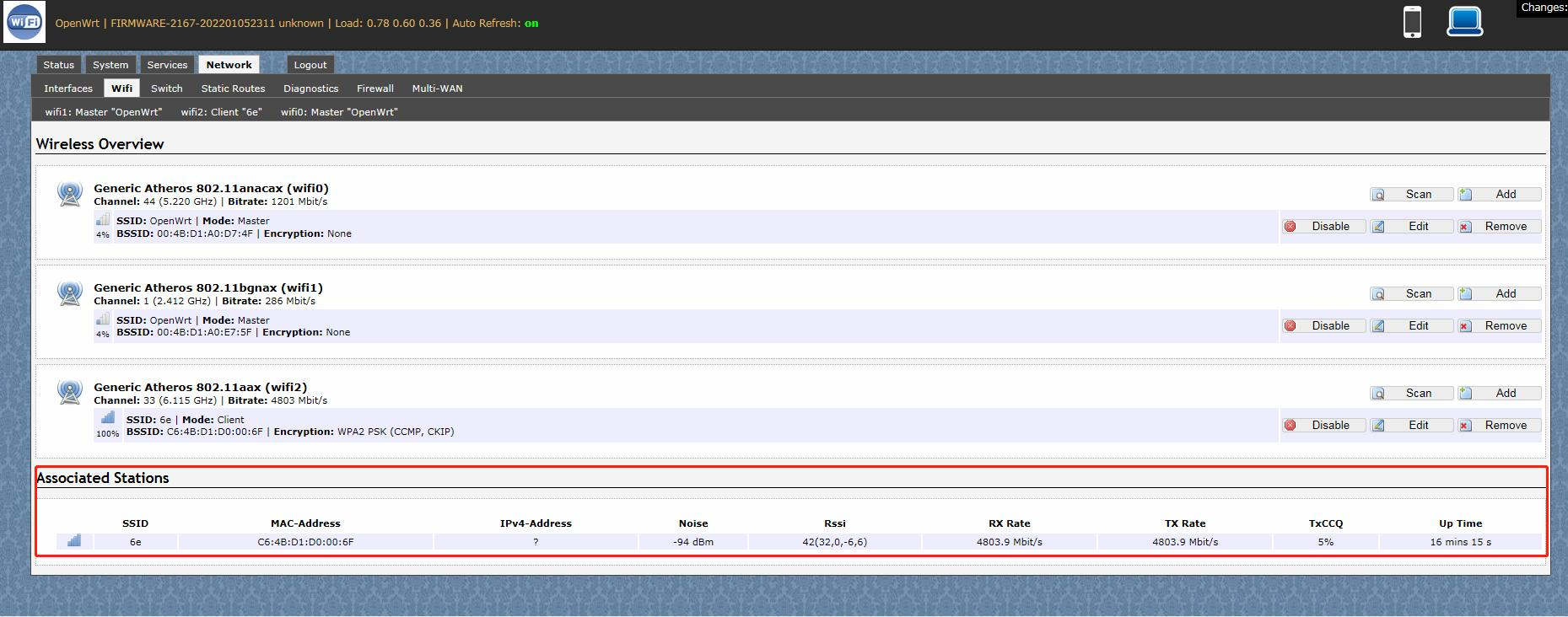
CONCLUSION:
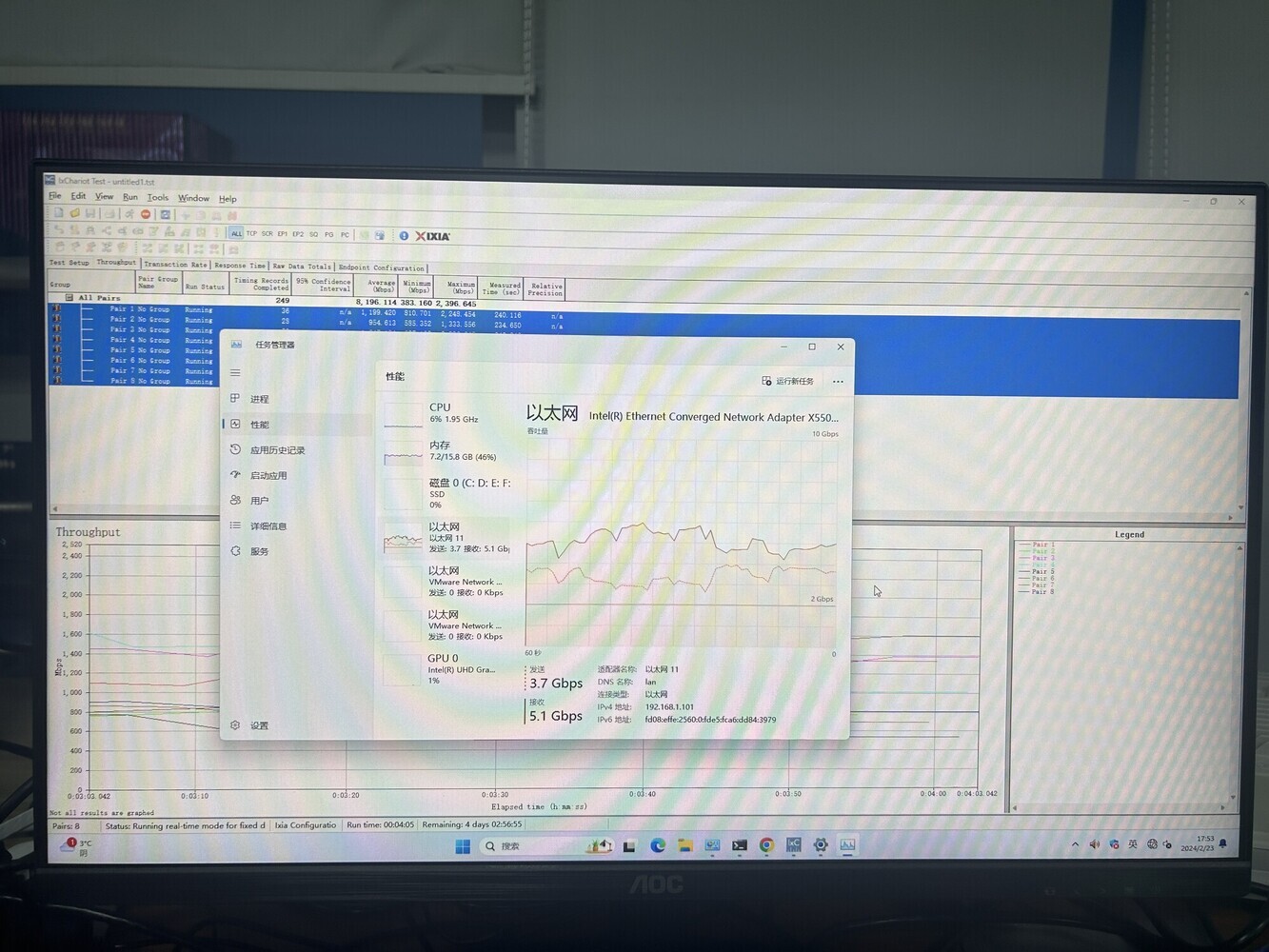
The results are nothing short of impressive. On average, the QCN9074-6E network card in the DR6018 achieves a remarkable speed of up to 1500 Mbps. This speed can be even faster in better environments or when used with the IPQ8072/8074 platform.
In summary, the QCN9074-6E in the DR6018 proves to be a high-performance choice for wireless connectivity. These results showcase the potential of our products, and we’re thrilled to provide you with reliable and speedy wireless solutions.
QCN9074 VS QCN9024 | WIFI6E IOT 4X4 TRIBAND 2.4G 5G 6G NETWORK CARD AND APPLICATION
WHAT ARE THE APPLICATIONS OF AN INDUSTRIAL TRI-BAND NETWORK CARD SUPPORTING 2.4GHZ, 5GHZ, AND 6GHZ?
Imagine the boundless possibilities that come with an industrial Tri-Band network card, seamlessly embracing the 2.4GHz, 5GHz, and lightning-fast 6GHz frequency bands. Here’s a glimpse into the exciting realms of its potential applications:
1. Smart Manufacturing & IoT Revolution: In the heart of smart manufacturing, these Tri-Band cards orchestrate a symphony of devices. From factory robots to floor sensors, they unite the Internet of Things (IoT) to make real-time data analytics and intelligent production a reality.
2. Robotic Precision & Automation: When it comes to industrial robots and automated machinery, precision and speed are paramount. Tri-Band network cards deliver high-speed data transfers and unwavering connections, ensuring uninterrupted automation.
3. Surveillance with Clarity: Industrial sites demand top-tier security. Tri-Band cards support high-definition video streams, fortifying security systems. They extend the eyes and ears of surveillance networks, enhancing vigilance.
4. Scientific Excellence: In the world of scientific research and high-performance computing, these network cards are the lifeline. They enable lightning-fast data transfer, facilitating experiments, simulations, and data analysis at astonishing speeds.
5. Connecting the Unreachable: When it’s about connecting distant devices in remote locations, Tri-Band cards are the bridge. They make remote monitoring, diagnostics, and maintenance a breeze, minimizing downtime.
6. Agriculture & Environmental Guardians: In the fields of agriculture and environmental monitoring, they enable large-scale sensor networks. These networks collect invaluable data for better decision-making, crop management, and environmental preservation.
7. Aerospace & Beyond: Think of satellite communications and aerospace ventures. Tri-Band cards empower high-speed data exchanges between spacecraft, satellites, and ground stations, venturing into the far reaches of the cosmos.
With the 6GHz band, an integral part of the WiFi 6E, industrial Tri-Band network cards offer an abundance of spectrum resources. They cater to the insatiable appetites of high bandwidth and low latency. The future of industrial connectivity shines brighter than ever before!
524WIFI 6E IOT 4X4 TRIBAND 2.4G 5G 6G NETWORK CARD:DR9074
Both the QCN9074 and QCN9024 are Qualcomm chips, and Wallys has chosen this platform for the development of Tri-Band card due to its exceptional stability and superior performance.
Let me share the fascinating story of its inception. Before the advent of the remarkable DR9074 Tri-Band Network card, Wallys had already pioneered single-band network cards like the DR9074-2.4G, DR9074-5G, and DR9074-6E, each earning a reputation for top-notch performance.
Then came an intriguing request from one of our valued customers: ‘The DR9074-5G and DR9074-6E deliver exceptional performance; do you have plans for a Tri-Band version of this card?’ As an innovation-centric company, this question ignited a spark among our engineers.
Fuelled by passion and driven by the pursuit of excellence, our engineers toiled day and night. And voilà, Wallys proudly presents the DR9074 Tri-Band Network card, a testament to our commitment to innovation and customer satisfaction.
NOW, LET’S DIVE INTO THE EXCITING FEATURES OF THIS GROUNDBREAKING CARD!
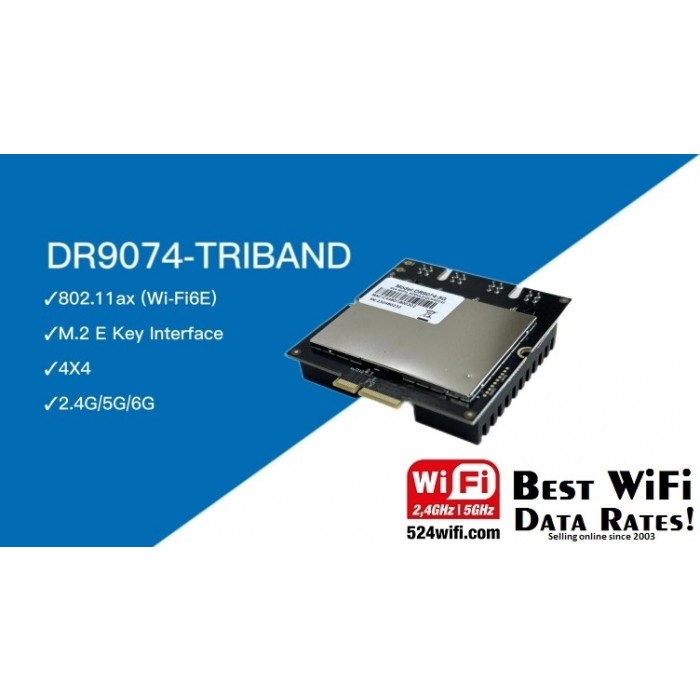
DR9074-TRIBAND
■ Qualcomm Atheros QCN9024
■ Maxim 23 dBm per chain,up to 4949Mbps
■ Data Rateup to 4949Mbps
■ Support Tri Band 2.4GHz&5GHz&6GHz 4×4 WiFi 6E (802.11ax)
■ 4 spatial streams (4SS)
■ M.2 E Key Interface
■ PCI Express 3 .0 Interface
Symbol/Parameter
Chipset:Qualcomm Atheros QCN9024
WLAN Host Interface:PCI Express 3.0 Interface
System Memory:2Mbit serial I²C bus EEPROM
Standard Operating Voltage:5V
Operating Systems:QSDK
Host Interface:M.2 E Key
Antenna Cable / Port:4 x MMCX Connectors,4T4R
Frequency Range:2.412GHz-2.472GHz & 5.18GHz-5.825GHz & 5.925GHz-7.125GHz
Data Rates for WALN:Maxim 23dBm per chain, up to 4949Mbps
Channel Spectrum Widths for WLAN:Support 20/40/80/160MHz
4×4 MU-MIMO WIFI 6 MODULE FOR THE 5GHZ BAND, MINI PCIE MODULE, QUALCOMM ATHEROS QCN9074, 4T4R
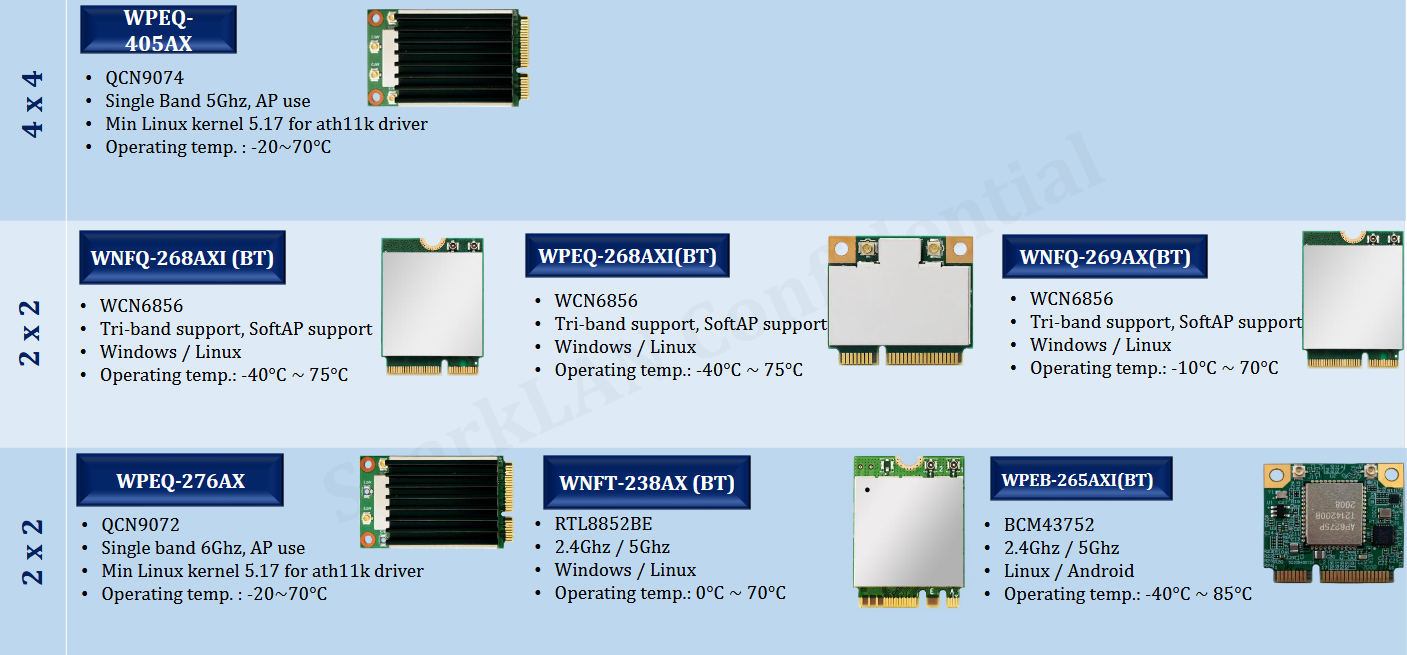
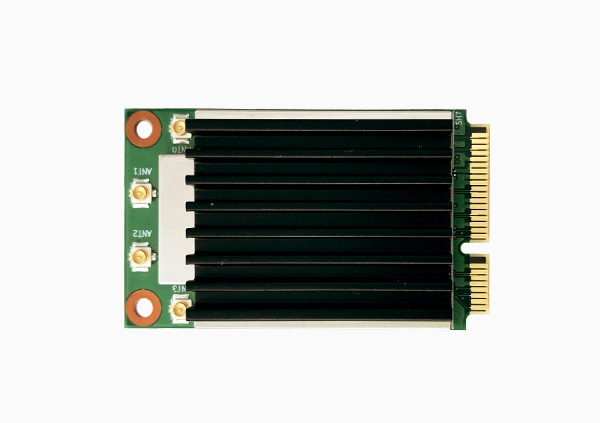
The first WiFi-6 (802.11ax) Qualcomm based AP solution on module formfactor from SparkLAN. WPEQ-405AX, is based on QCN9074 chipset solution. This is a true enterprise based wireless module that powers 4T4R (4×4) MU-MIMO, in 5Ghz Single band mode, hitting a theoretical speed of up to 4.8Gbps with 160MHz support.
Unlike typical Qualcomm reference design around QCN9074 (PN02.1), WPEQ-405AX shrink the traditional 50mmx50mm M.2 E-Key design to a more popular Mini PCIe Full size formfactor of just 50mm x 30mm, run at 3.3V voltage. Provides a greater versatility to use on more common seen design.
WPEQ-405AX performs both AP and STA functionality with 4 spatial streams, although recommended more for hardware AP applications as it supports 4096-QAM, OFDMA technology, makes it perfect for heavy lifting applications such as Enterprise grade AP, UTM, public & transportation Hotspot, and other industrial capable Access Points.
Wallys DR9074 5G , 6E dual band and Triband modules and available for order ! And special promo price for partners with MOQ100pcs is USD 80 per module only ! Nokia, facebook and many more already started to use this card to develop own WiFi 6 / WiFi 6E devices!
– HOW WE MAKE QCA QCN9074 WLAN WIFI 6 MODULE DR9074 4X4 WORK ON X86 LINUX PLATFORM – PLEASE READ HERE.
Pine Series WiFi Module from Wallys:Introducing Qualcomm’s 4×4 11ax AP mode enabled radio module! Based on Pine series QCN 9074 / 9024 chipset, radio modules supporting 2.4GHz, 5GHz as well as the lately approved WiFi 6E is now available from Wallys ! Hop on the newly approved spectrum, increase the number of channels your clients can hop on, at 160MHz bandwidth!
QCN9074 VS QCN9024 | WIFI6E IOT 4X4 TRIBAND 2.4G 5G 6G NETWORK CARD AND APPLICATION
WHAT ARE THE APPLICATIONS OF AN INDUSTRIAL TRI-BAND NETWORK CARD SUPPORTING 2.4GHZ, 5GHZ, AND 6GHZ?
Imagine the boundless possibilities that come with an industrial Tri-Band network card, seamlessly embracing the 2.4GHz, 5GHz, and lightning-fast 6GHz frequency bands. Here’s a glimpse into the exciting realms of its potential applications:
1. Smart Manufacturing & IoT Revolution: In the heart of smart manufacturing, these Tri-Band cards orchestrate a symphony of devices. From factory robots to floor sensors, they unite the Internet of Things (IoT) to make real-time data analytics and intelligent production a reality.
2. Robotic Precision & Automation: When it comes to industrial robots and automated machinery, precision and speed are paramount. Tri-Band network cards deliver high-speed data transfers and unwavering connections, ensuring uninterrupted automation.
3. Surveillance with Clarity: Industrial sites demand top-tier security. Tri-Band cards support high-definition video streams, fortifying security systems. They extend the eyes and ears of surveillance networks, enhancing vigilance.
4. Scientific Excellence: In the world of scientific research and high-performance computing, these network cards are the lifeline. They enable lightning-fast data transfer, facilitating experiments, simulations, and data analysis at astonishing speeds.
5. Connecting the Unreachable: When it’s about connecting distant devices in remote locations, Tri-Band cards are the bridge. They make remote monitoring, diagnostics, and maintenance a breeze, minimizing downtime.
6. Agriculture & Environmental Guardians: In the fields of agriculture and environmental monitoring, they enable large-scale sensor networks. These networks collect invaluable data for better decision-making, crop management, and environmental preservation.
7. Aerospace & Beyond: Think of satellite communications and aerospace ventures. Tri-Band cards empower high-speed data exchanges between spacecraft, satellites, and ground stations, venturing into the far reaches of the cosmos.
With the 6GHz band, an integral part of the WiFi 6E, industrial Tri-Band network cards offer an abundance of spectrum resources. They cater to the insatiable appetites of high bandwidth and low latency. The future of industrial connectivity shines brighter than ever before!
Both the QCN9074 and QCN9024 are Qualcomm chips, and Wallys has chosen this platform for the development of Tri-Band card due to its exceptional stability and superior performance.
Let me share the fascinating story of its inception. Before the advent of the remarkable DR9074 Tri-Band Network card, Wallys had already pioneered single-band network cards like the DR9074-2.4G, DR9074-5G, and DR9074-6E, each earning a reputation for top-notch performance.
Then came an intriguing request from one of our valued customers: ‘The DR9074-5G and DR9074-6E deliver exceptional performance; do you have plans for a Tri-Band version of this card?’ As an innovation-centric company, this question ignited a spark among our engineers.
Fuelled by passion and driven by the pursuit of excellence, our engineers toiled day and night. And voilà, Wallys proudly presents the DR9074 Tri-Band Network card, a testament to our commitment to innovation and customer satisfaction.
Now, let’s dive into the exciting features of this groundbreaking card!
DR9074-TRIBAND
■ Qualcomm Atheros QCN9024
■ Maxim 23 dBm per chain,up to 4949Mbps
■ Data Rateup to 4949Mbps
■ Support Tri Band 2.4GHz&5GHz&6GHz 4×4 WiFi 6E (802.11ax)
■ 4 spatial streams (4SS)
■ M.2 E Key Interface
■ PCI Express 3 .0 Interface
Symbol/Parameter
Chipset:Qualcomm Atheros QCN9024
WLAN Host Interface:PCI Express 3.0 Interface
System Memory:2Mbit serial I²C bus EEPROM
Standard Operating Voltage:5V
Operating Systems:QSDK
Host Interface:M.2 E Key
Antenna Cable / Port:4 x MMCX Connectors,4T4R
Frequency Range:2.412GHz-2.472GHz & 5.18GHz-5.825GHz & 5.925GHz-7.125GHz
Data Rates for WALN:Maxim 23dBm per chain, up to 4949Mbps
Channel Spectrum Widths for WLAN:Support 20/40/80/160MHz
– NEW 11AX BOARDS BASED ON QUALCOMM WITH MU-MIMO 802.11AX WIFI 6 RADIO ON BOARD! NOW WE SUPPORT 4G / 5G LTE GSM MODEMS!
– FOR WIFI 6 WE HAVE DEVELOPED THE LONG DISTANCE FUNCTION, IN FRANCE OUR CUSTOMER CAN RUN 10KM LINK! THIS FUNCTION NEED MODIFY THE CORE OF WIFI PROTOCOL. WE JUST FIND ONLY 524WIFI.COM WALLYS DR6018 QCA IPQ6018 BOARDS GET THE WIFI6 RUN ON 3-10KM DISTANCE!
Quad-core ARM 64bit [email protected] Processor 1GB DDRL3L System Memory 8MB NOR Flash, 256MB NAND Flash Supports Dynamic Frequency Selection (DFS 2x2On-board2.4GHz radio,upto 573Mbps physical Data Rate 2x2On-board 5GHz radio,upto 1201Mbps physical Data Rate
Support: QCN9074 WiFi 6E Card in M.2 slot
Product Description
DR6018-S based on IPQ6010 chipset is an enterprise wireless module integrated with 2×2 5G high power Radio module and 2×2 2.4G high power Radio module designed specifically to provide users with mobile access to high-bandwidth video streaming, voice, and data transmission for office and challenging RF environment in factories, warehouses establishment. Passive POE 24-48V supported, DC jack 24-48V. If you need 802.3af/bt active POE support , then please order DR6018-S HV version.
– FOR WIFI 6 WE HAVE DEVELOPED THE LONG DISTANCE FUNCTION, IN FRANCE OUR CUSTOMER CAN RUN 10KM LINK! THIS FUNCTION NEED MODIFY THE CORE OF WIFI PROTOCOL. WE JUST FIND ONLY 524WIFI.COM WALLYS DR6018 QCA IPQ6018 BOARDS GET THE WIFI6 RUN ON 3-10KM DISTANCE!
QCN9074-6E WITH DR6018 PLATFORM: ACHIEVING 1.5GBPS SPEED IN THROUGHPUT TEST!
QCN9074-6E THROUGHPUT TEST REPORT IN DR6018
Are you curious about the performance capabilities of the QCN9074-6E network card in the DR6018?
Look no further! In this blog, we’ll walk you through the hardware you’ll need, how to set up one board as an Access Point (AP) and the other as a Station (STA), and perform a throughput test. Plus, we’ll share our exciting conclusions.
HARDWARE REQUIRED:
DR6018 x2
DR9074-6E x2
SETTING UP THE TEST:
Board Configuration: Install two DR6018 boards and two DR9074-6E network cards.
Role Assignment: Set one DR9074-6E card as the Access Point (AP) and the other as the Station (STA).
Network Connection: Utilize the onboard 2.5G Ethernet port for connectivity.
PERFORMING THE THROUGHPUT TEST:
Once the radios are linked, it’s time to assess the performance:
CONCLUSION:
The results are nothing short of impressive. On average, the QCN9074-6E network card in the DR6018 achieves a remarkable speed of up to 1500 Mbps. This speed can be even faster in better environments or when used with the IPQ8072/8074 platform.
In summary, the QCN9074-6E in the DR6018 proves to be a high-performance choice for wireless connectivity. These results showcase the potential of our products, and we’re thrilled to provide you with reliable and speedy wireless solutions.
IPQ6010 AND IPQ8072:OFDMA SUPPORT IN WIFI6 SOLUTION
Introduction:
In the dynamic landscape of wireless communication, the techniques employed play a crucial role in optimizing data transmission and overcoming challenges. Two key technologies, FDMA (Frequency Division Multiple Access) and OFDMA (Orthogonal Frequency Division Multiple Access), are pivotal in this context. This blog aims to unravel the disparities between FDMA and OFDMA, shedding light on their applications and significance in mitigating multipath interference, particularly in the realm of Wi-Fi.
The Need for Multiple Carrier Technologies:
To comprehend the essence of OFDMA, it’s imperative to first delve into the concept of OFDM (Orthogonal Frequency Division Multiplexing). OFDM is a multicarrier modulation technique designed to combat multipath interference encountered in wireless communication. Multipath interference occurs when radio waves encounter obstacles, causing reflections and refractions. This phenomenon results in multiple versions of the same signal reaching the receiver, leading to what is known as multipath interference.
The Challenge of Inter-Symbol Interference:
Multipath interference directly contributes to intersymbol interference (ISI). In the realm of wireless communication, ISI poses a challenge where, for a given set of serial signals, the receiver encounters difficulty distinguishing between them. This challenge arises when the time delay between two identical signals is less than the signal’s transmission interval. The outcome is known as inter-symbol interference, making it arduous for the receiver to accurately decipher the intended signals.
OFDM as a Solution:
OFDM addresses this issue by transforming high-speed serial data into parallel low-speed data streams, thereby reducing inter-symbol interference. However, OFDM comes with its own set of drawbacks. In Wi-Fi 4/5, where communication is single-user-centric, each data transmission occupies all available subcarriers. This results in inefficiencies when small data packets, such as instant messages or web browsing, are transmitted, as the entire bandwidth is underutilized.
Introduction of OFDMA:
In response to this inefficiency, Wi-Fi 6 introduced OFDMA, borrowing a page from 5G’s playbook. OFDMA, despite its name’s resemblance to OFDM, is fundamentally a multiple access technique. Multiple access techniques distinguish different users, and common methods include FDMA, TDMA, and CDMA.
FDMA vs. OFDMA:
FDMA relies on allocating different frequency channels to different users. In the analogy of a gathering, it’s akin to separating rooms for distinct conversations. On the other hand, OFDMA divides the channel into Resource Units (RUs), each orthogonal to the others. In our gathering analogy, OFDMA creates individual compartments within a room, facilitating multiple conversations simultaneously.
Enhancing Efficiency with OFDMA:
OFDMA optimizes spectral efficiency by scheduling users in specific resource units instead of utilizing the entire channel for a single user, as seen in traditional OFDM. It introduces a more flexible approach, akin to efficiently utilizing a delivery vehicle by allocating designated compartments for different recipients.
Conclusion:
In summary, while OFDM successfully addresses multipath interference by transforming data streams, OFDMA takes a step further by introducing an innovative multiple access technique. By adopting OFDMA, Wi-Fi 6 has elevated efficiency in point-to-multipoint communication, ensuring that a single cycle completes communication with multiple users. This evolution underscores the dynamic nature of wireless communication technologies, continually adapting to enhance performance and meet the demands of evolving applications.
Here are some of 524WiFi 802.11ax products support OFDMA:
Support Tri Band 2.4GHz&5GHz&6GHz 4×4 WiFi 6E (802.11ax)
4 spatial streams (4SS)
M.2 E Key Interface
PCI Express 3 .0 Interface
524WiFi is dedicated to continuous innovation, constantly pushing the boundaries of WiFi technology. In addition to its hardware products, 524WiFi + Wallys also offer a range of ODM/OEM services, including:
Customization: 524WiFi and Wallys can customize their WiFi 5/6/7 modules and embedded boards to meet the specific needs of its customers.



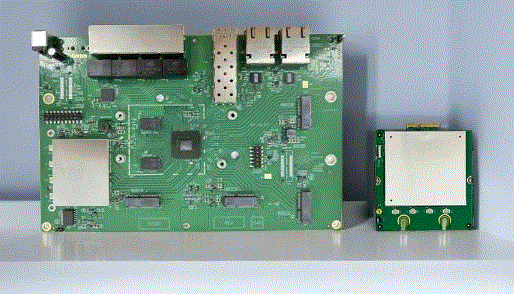










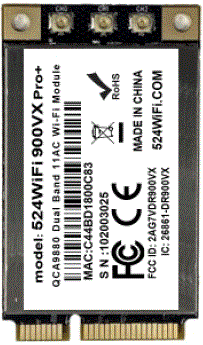
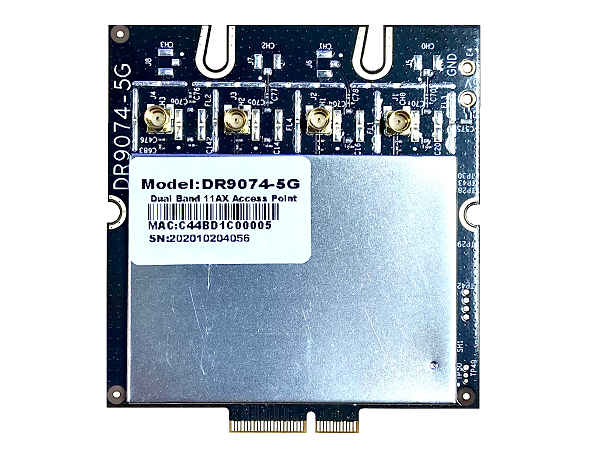 Introducing Qualcomm’s 4×4 11ax AP mode enabled radio module! Based on Pine series QCN 9074 / 9024 chipset, radio modules supporting 2.4GHz, 5GHz as well as the lately approved WiFi 6E is now available from Wallys ! Hop on the newly approved spectrum, increase the number of channels your clients can hop on, at 160MHz bandwidth!