


What if your next Wi-Fi 7 board gets rejected, not because it’s too slow, but because you can’t legally ship it, patch it, or deploy it outdoors?
Most OEM spec sheets still compete on one number: peak PHY rate. Two regulatory changes, both easy to miss, are shifting what a good platform choice looks like.
1. The U.S. is opening 6 GHz to outdoor, higher-power use
In January 2026 the FCC voted to authorize a new category of 6 GHz devices that can operate outdoors and at higher power. The category is called Geofenced Variable Power (GVP), and it relies on smart power management to protect radars and radio-astronomy sites. harvardimagazine
6 GHz used to mean “indoor Wi-Fi.” For ports, mines, campuses, and outdoor mesh, it is becoming a real outdoor band.
2. The EU’s Cyber Resilience Act has already started
Reporting duties for actively exploited vulnerabilities and major incidents begin on 11 September 2026, with an early warning within 24 hours and a follow-up within 72 hours. From the end of 2027, products that don’t meet the Act’s requirements can’t be sold in the EU, and Wi-Fi routers are explicitly in scope. Fines can reach €15 million or 2.5% of global annual revenue. A draft standard, EN 304 627, is being developed for routers, modems, and switches, including products aimed at industrial OT environments. EU Cyber Resilience Act raises compliance requirements for connected devices +3
For anyone building industrial gateways, APs, or OEM routers, the question is no longer only “how fast?” It is “who can patch this board in five years?”
What this means for your hardware
- Real 6 GHz silicon, not a bolt-on. You want a dedicated 6 GHz radio with 320 MHz channels, ready for outdoor deployments as rules open up.
- Region flexibility without a redesign. Band plans differ across the U.S., EU, and Asia, so a swappable radio option makes one board work across markets.
- A platform you can maintain. A mainstream Qualcomm SoC with OEM-level software customization gives you something you can keep updating.
A board doesn’t make you compliant. Certification and CRA obligations sit with the product maker. But the platform you pick decides how hard that job is.
Meet the DR9574S
The 524WiFi DR9574S is a Wi-Fi 7 routerboard built on the Qualcomm IPQ9574 (quad-core Arm Cortex-A73 @ 2.2 GHz).
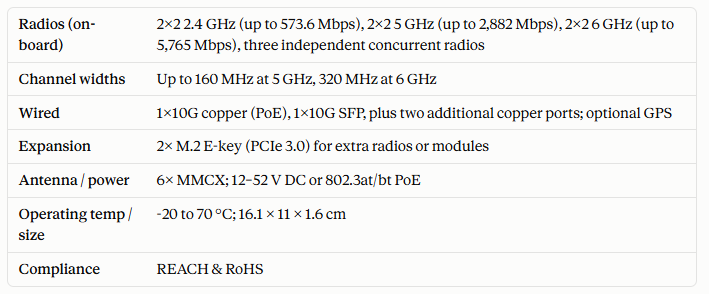
It comes in six radio variants, including 2×2 + 2×2 5–7 GHz (DR9574S-2-57-57), 5 GHz-only, 6 GHz-only, and 4×4 single-radio options. That lets you match the regional band plan without changing the board.
Typical uses are outdoor and industrial APs, port and campus coverage, multi-robot and AMR networks, and OEM/ODM router platforms. Wallys also offers hardware, software, antenna, and enclosure customization.
Product page: https://www.524wifi.com/catalogsearch/result/?q=9574
Planning a Wi-Fi 7 product for 2027? Tell us your target region and deployment (indoor, outdoor, or mobile robots) and we’ll suggest the matching DR9574S variant.