
Posted on

The incredibly powerful AP Controller has evolved again! It’s even better than before!

For those serious about industrial network management, the 524WiFi Wallys AP Controller has always been a reliable tool. However, as with any great software, there are constant improvements and updates, and this latest version is no exception. After facing some common issues that are often seen with less durable solutions, 524WiFi Wallys AP Controller has evolved, and it’s now better than ever!

Let’s take a deeper look at what’s new, and why this tool should be your go-to for seamless network management.

What’s New in This Version of 524WiFi Wallys AP Controller?

524WiFi Wallys AP Controller has evolved to include essential features that will transform how you manage your network, especially in large environments like factories or campuses.

  • Group Management Functionality: The new version introduces group management features, allowing you to organize and manage AP devices across different network segments. Imagine you’re managing a large factory where the warehouse and office building are on separate subnets. Previously, the AP controller could only manage one subnet per instance, but now, you can seamlessly handle devices across multiple network segments from a single interface.
Group Management Functionality
  • Batch Settings and Categorization: With the group management feature, you can now batch set notes for your AP devices. These notes help you categorize devices based on their location or function, making it easy to filter and manage them accordingly. This means you can quickly find and apply settings to a specific group of devices, whether it’s for firmware upgrades, Wi-Fi configurations, or other tasks.
Batch Configure Equipment Notes
Building A
Building B
Warehouse
  • Batch Firmware Upgrades: The batch firmware upgrade feature has been enhanced, enabling you to upgrade the firmware of multiple devices at once, saving you time and ensuring consistency across your network.
Batch Firmware Upgrades
  • Wi-Fi Configuration: Now, you can batch configure Wi-Fi settings, including SSIDs and security protocols, across different groups of devices, making network setup and management even more efficient.
Wi-Fi Configuration
  • Bulk Command Execution: A standout feature of this update is the bulk command execution capability. This new feature is incredibly useful when troubleshooting or debugging. For example, you can select multiple devices and issue commands to make their LEDs flash, helping you quickly identify and isolate devices that might not be functioning properly. This makes network issues much more visual and easier to diagnose.
Bulk Command Execution

What Can You Manage with 524WiFi Wallys AP Controller?

With the 524WiFi Wallys AP Controller, you can manage a variety of tasks to keep your network running smoothly:

  • Upgrading Device Firmware: Keep all your devices up to date with the latest firmware, ensuring optimal performance and security across your entire network.
  • Configure Wi-Fi: Easily configure Wi-Fi settings across all connected devices, including SSID, security protocols, and bandwidth management for optimal performance.
  • Deleting Offline Devices: Remove offline or inactive devices from your network to maintain efficiency and ensure only active devices are consuming resources.
  • Update Equipment Notes: Add or update equipment notes for each device to track changes, configurations, or any specific requirements for your network management.
  • Importing Whitelist: Import a whitelist of authorized devices to prevent unauthorized access and keep your network secure.
  • Execute Commands: Execute custom commands across multiple devices simultaneously to streamline tasks like troubleshooting, configuration changes, or system resets.

Why Choose AP Controller from 524WiFi and Wallys?

The 524WiFi Wallys AP Controller has become a truly powerful tool for managing large-scale, multi-segment networks. With new features like group management, batch firmware upgrades, Wi-Fi configuration, and bulk command execution, it’s never been easier to keep your network in check.

If you’re managing a large facility or complex network, this upgraded 524WiFi Wallys AP Controller is the ideal solution to streamline your tasks and make troubleshooting easier.

For project inquiries or to schedule a sample test, contact our sales team. We’re here to help you tailor the perfect solution for your needs.

Two Version for Option

WL-AC1000-E
WL-AC1000-1U
Posted on

Access Controller + AP vs. Mesh Networking: Which Offers Better Coverage for Your Industrial Setup?

AC+AP Networking vs. Mesh Networking

In today’s rapidly advancing wireless technologies, networking has evolved significantly to meet the growing demand for faster and more reliable internet connectivity. Two popular methods for expanding Wi-Fi coverage in various environments are AC+AP and Mesh networking. While both methods aim to improve the coverage and performance of wireless networks, they differ in their architecture and functionality.

What is AC+AP Networking?

AC+AP Networking refers to a traditional approach in which an Access Point (AP) is connected to a central device, such as a router or a wireless controller (AC). This setup is often used in larger environments where multiple APs are deployed to extend Wi-Fi coverage, particularly in enterprise settings.

  • Access Point (AP): An AP is a device that allows wireless devices to connect to a wired network. It acts as a bridge between the wired network and wireless clients.
  • Access Controller (AC): The AC is a centralized device that manages multiple APs, providing a single point of control for wireless network configuration, security settings, and performance optimization.

The AC+AP solution works well for environments where there is a need for extensive control over the network, such as in large office buildings, campuses, or industrial sites. However, the key challenge with this setup is that the coverage area might be limited by the range of each individual AP, and users may experience interruptions when moving between APs.

What is Mesh Networking?

On the other hand, Mesh Networking is a more modern approach that involves multiple wireless nodes working together as a network. Each node in a Mesh network communicates with the others to create a seamless, self-healing Wi-Fi coverage area. This method is particularly effective in environments where extended coverage is required, such as homes, large enterprises, or industrial spaces with complex layouts.

  • Nodes: Mesh networks consist of multiple nodes (which can function as both APs and routers) that collaborate with one another to extend coverage.
  • Self-Healing: One of the key benefits of a Mesh network is that if one node fails, the others can automatically adjust to maintain network stability without interruptions.
  • Seamless Roaming: Mesh networks offer seamless connectivity, allowing users to move freely between nodes without experiencing connectivity drops or network handoffs.

Mesh networks are ideal for environments with complex, large-scale spaces, and they are particularly useful in overcoming dead zones that traditional Wi-Fi setups may fail to cover.

Wallys’ Mesh and AC+AP Solutions

At Wallys, we understand the need for high-performance wireless solutions that cater to diverse networking environments. Whether you’re looking for robust connectivity for industrial environments or home office setups, our solutions can meet your needs.

  • Wallys AC+AP Solutions: Our AC+AP systems are designed for large-scale, enterprise-level networks where centralized control and extensive coverage are essential. With features like high-speed throughput, efficient roaming, and seamless integration, our AC+AP solutions offer a reliable, cost-effective way to expand network coverage without compromising performance.
  • Wallys Mesh Solutions: Wallys’ Mesh networking solutions offer flexibility, ease of setup, and seamless connectivity across large, complex spaces. Our Mesh systems are designed to handle high-density environments, ensuring stable connections across multiple devices. These solutions are ideal for industrial settings, smart cities, large homes, and office networks. With Wallys’ Mesh solutions, you can ensure consistent performance, even in challenging environments with multiple obstructions.

Both AC+AP and Mesh solutions are fully customizable to meet your specific needs, whether you’re deploying them in industrial, commercial, or residential environments.

Contact Us for Testing

We invite you to explore the power and flexibility of Wallys’ networking solutions. Our team is ready to assist you with testing our AC+AP and Mesh products to ensure they meet your requirements. For more information and to schedule a test, please get in touch with us

Posted on

Is It Time to Upgrade? IPQ5018 and IPQ5010 vs. IPQ4019 and IPQ4029 Performance Breakdown

WIFI 7 IS HERE, ARE YOU STILL STUCK WITH WIFI 5?

With the rapid evolution of wireless communication, industries relying on stable and high-performance connectivity must stay ahead. If you’re still using WiFi 5 solutions, it’s time to explore the new generation of industrial networking with 524WiFi’ DR5018S router board powered by IPQ5018 / IPQ5010.


Where Are the Application Scenarios?

Industrial WiFi demands reliability, long-range coverage, and high bandwidth. The DR5018S series is designed for applications such as:

  • Smart factories
  • Security surveillance
  • Industrial automation
  • Outdoor deployments
  • IoT & edge computing networks

These environments require low latency, enhanced throughput, and better multi-device connectivity, making WiFi 6 a necessity.


The Former Advantages of DR4019

The DR4019, based on IPQ4019, has long been a go-to solution for many industrial applications due to its stability, affordability, and performance in WiFi 5 networks. It has served well in demanding environments, offering a balance between cost and capability. However, as connectivity demands grow, an upgrade is essential.


Why Upgrade to WiFi 6?

WiFi 6 offers significant improvements over WiFi 5, such as:

  • Higher speeds – Increased data rates for better efficiency.
  • Lower latency – Ideal for real-time applications.
  • Improved device handling – Supports a higher number of connected devices efficiently.
  • Better power efficiency – Crucial for IoT applications.
  • OFDMA & MU-MIMO – Ensures smooth data transmission in congested environments.

These advantages make WiFi 6 an obvious choice for next-gen industrial applications.


Is Industrial WiFi 6 Much More Expensive Than WiFi 5?

One common concern is pricing. While WiFi 6 solutions may have a slightly higher upfront cost, they offer long-term benefits such as improved performance, extended lifespan, and reduced operational costs. With 524WiFi, you get cost-effective WiFi 6 solutions tailored for industrial use.


When Should I Choose WiFi 6 and When Should I Opt for WiFi 7?

  • Choose WiFi 6 (IPQ5018/IPQ5010) if you need a reliable, cost-effective, and high-performance upgrade from WiFi 5.
  • Consider WiFi 7 when you require multi-link operation (MLO), extremely high throughput, and lower interference in advanced applications.

For most industrial needs today, WiFi 6 remains the best balance of performance and cost.


Why Choose us?

524WiFi and Wallys provide end-to-end industrial wireless solutions, combining hardware and software expertise:

  • Custom Hardware & Firmware Development – Tailored solutions for specific applications.
  • Advanced WiFi Protocol Optimization – Specialized features for industrial use.
  • OEM/ODM Services – Fully customized manufacturing options.
  • Expert Software Support – In-house development for specialized industrial protocols.
  • Strong After-Sales & Technical Support – Ensuring smooth deployments and long-term reliability.

The DR5018S Series – Tailored Industrial Solutions

524WiFi and Wallys have launched three models of the DR5018S router board to meet diverse industrial requirements:

Please check more informations : https://524wifi.net/?s=5018s and https://524wifi.net/?s=4029

Posted on

Unlock Next-Gen WiFi with QCN9074: The Ideal Choice for Your Project

Unlock Next-Gen WiFi with QCN9074: The Ideal Choice for Your Project

When it comes to selecting the best components for your wireless network, the Qualcomm QCN9074 stands out as a game-changer. Whether you’re building an industrial-grade access point or upgrading your existing infrastructure, QCN9074 offers the performance, reliability, and advanced features you need for today’s demanding applications.

Unparalleled Performance

The QCN9074 is engineered to deliver exceptional WiFi performance. Supporting the latest WiFi 6E standard, it operates in the 6 GHz band, providing:

  • Higher Throughput: Speeds up to 4804 Mbps, ideal for high-density environments.
  • Maximum Power: Up to 23 dBm per chain, ensuring robust signal strength.
  • Reduced Latency: Ensures smoother connectivity for applications like video streaming, IoT devices, and industrial automation.
  • Multi-User MIMO (MU-MIMO): Efficient data handling for multiple simultaneous users.

Enhanced Security

With built-in WPA3 support, QCN9074 enhances your network’s security against cyber threats. This is crucial for industries where data protection is paramount, such as healthcare, finance, and manufacturing.

Wide Application Compatibility

The QCN9074’s versatile design makes it suitable for various applications, including:

  • Smart Cities: Ensures seamless connectivity for large-scale IoT networks.
  • Industrial IoT: Robust enough for harsh environments and mission-critical operations.
  • Enterprise Solutions: High-performance WiFi for offices and campuses.

Key Features of QCN9074

  1. WiFi 6E Compatibility: Access to the 6 GHz spectrum for reduced interference and faster speeds.
  2. 160 MHz Channel Support: Wider bandwidth for greater data throughput.
  3. Advanced Beamforming: Improved signal strength and range.
  4. Power Efficiency: Optimized for reduced power consumption, crucial for energy-conscious projects.

Why QCN9074 Outshines Competitors

While there are other WiFi chipsets available, the QCN9074 excels due to its:

  • Cutting-Edge Technology: Qualcomm’s expertise in wireless innovation.
  • Flexibility: Easy integration into various hardware designs.
  • Future-Ready: Support for the Wifi6E wireless standards ensures longevity for your projects.

Discover Wallys’ DR9074 Module

To fully unlock the potential of the QCN9074, consider Wallys’ DR9074 wireless module. Designed for industrial applications, the DR9074 module integrates QCN9074 and offers:

  • Linux Ubuntu 22.04 Support: Seamless software integration.
  • Robust Hardware: Built for demanding environments.
  • Customizable Options: Tailored to meet your specific project requirements.

Conclusion

Choosing the QCN9074 for your next WiFi project means investing in cutting-edge technology that delivers superior performance, enhanced security, and versatile applications. Pair it with 524WiFi´ DR9074 module for an unbeatable solution.

Contact Us Today! Reach out to our sales team to learn more about the QCN9074 and our tailored solutions. Let’s elevate your WiFi project to the next level!

524 WiFi 6 DR9074-6E
Posted on

QCN9074 and Smart Cities: Enabling the Future of Connectivity

As urban areas continue to expand, the concept of Smart Cities is gaining importance. These cities leverage advanced technologies to improve infrastructure, enhance public services, and create more sustainable environments. At the heart of this transformation is connectivity, and the QCN9074 is playing a pivotal role in enabling the future of Smart Cities.

The Role of Connectivity in Smart Cities

Connectivity is the backbone of Smart Cities, facilitating real-time data exchange between devices, infrastructure, and services. It enables various applications such as intelligent transportation systems, energy-efficient buildings, smart healthcare, and enhanced public safety. High-performance wireless solutions are essential to support these applications, ensuring seamless communication and data processing.

Introducing QCN9074

The QCN9074 is a high-performance Wi-Fi 6E (802.11ax) chipset designed to meet the demanding needs of modern wireless networks. With its advanced features, the QCN9074 is poised to revolutionize connectivity in Smart Cities.

  1. Extended Frequency Range: The QCN9074 supports the 6 GHz band in addition to the traditional 2.4 GHz and 5 GHz bands. This increased spectrum availability reduces congestion and enhances network performance, enabling robust and reliable connections in densely populated urban environments.
  2. High Data Throughput: With support for MU-MIMO technology and high data rates, the QCN9074 can handle multiple simultaneous connections efficiently. This capability is crucial for Smart Cities, where numerous sensors and devices are constantly communicating.
  3. Improved Efficiency and Low Latency: The QCN9074’s OFDMA technology improves network efficiency by allowing multiple devices to share channels simultaneously. This reduces latency and ensures smooth data transmission, essential for real-time applications like autonomous vehicles and smart traffic management.
  4. Enhanced Security: The QCN9074 includes advanced security features to protect sensitive data and maintain privacy. This is vital for Smart Cities, where the security of data is paramount.

Enabling Smart City Applications

The QCN9074’s advanced capabilities empower a wide range of Smart City applications:

  • Smart Transportation: Real-time traffic monitoring and management systems rely on the QCN9074 for efficient data exchange, reducing congestion and improving public transportation services.
  • Energy Management: Smart grids and energy-efficient buildings use QCN9074-enabled networks to monitor and control energy usage, promoting sustainability and reducing costs.
  • Public Safety: Surveillance systems and emergency response services benefit from the QCN9074’s high-speed connectivity, enabling rapid data transmission and improving situational awareness.
  • Healthcare Services: Telemedicine and remote patient monitoring require reliable connectivity, which the QCN9074 provides, enhancing healthcare delivery in urban areas.

Product Introduction: 524WiFi 6 DR9074

524WiFi 6 DR9074 is a tri-band Wi-Fi 6E network card based on the Qualcomm QCN9074, supporting the 2.4G, 5G, and 6GHz bands with a 4T4R M.2 E Key interface, compliant with the 802.11ax standard. This product is designed for high-performance and reliability in wireless network applications, making it particularly suitable for various scenarios in Smart Cities.

For more information on how the DR9074 can be integrated into your Smart City projects, please visit our product page: DR9074 Product Details. We are committed to providing innovative solutions to help you achieve your connectivity goals.

Posted on

Why IPQ5322 is the Ideal Choice for Wi-Fi 7 IoT Networks

As the demand for faster, more reliable wireless connectivity continues to grow, the need for advanced networking solutions has never been greater. One of the standout solutions for next-generation wireless networks is the IPQ5322 chip, which supports Wi-Fi 7 (802.11be). Developed by Qualcomm, the IPQ5322 is optimized to deliver exceptional performance, efficiency, and scalability, making it the perfect choice for IoT (Internet of Things) applications that require high-speed, low-latency connections. In this article, we’ll explore why the IPQ5322 is the ideal solution for Wi-Fi 7 IoT networks.

1. Wi-Fi 7: The Future of Connectivity

The IPQ5322 is built to support Wi-Fi 7, the latest Wi-Fi standard offering several key enhancements over its predecessors. Wi-Fi 7 introduces wider channels, faster data transfer speeds, and lower latency, providing a significantly better user experience. With Wi-Fi 7, the IPQ5322 is capable of supporting multi-gigabit speeds and seamless, stable connections even in high-demand environments. This is particularly crucial for IoT devices that need to transfer large amounts of data quickly and reliably.

2. High-Speed Data Transfer for IoT Devices

One of the main advantages of Wi-Fi 7, and by extension the IPQ5322, is its ability to handle higher bandwidth and support more devices simultaneously. This is essential for IoT networks where devices like sensors, cameras, and smart devices are constantly communicating with each other. The increased data transfer rates provided by Wi-Fi 7 enable faster communication between devices, which is crucial for time-sensitive applications like industrial automation, smart cities, and healthcare monitoring.

With the IPQ5322, IoT networks can experience high-speed data transfer without sacrificing reliability, allowing devices to operate smoothly and efficiently even in crowded environments with many connected devices.

3. Low Latency for Real-Time IoT Applications

Latency is a critical factor for many IoT applications that require real-time communication. The IPQ5322 supports low-latency operation thanks to the improvements in Wi-Fi 7, ensuring that data is transmitted with minimal delay. This makes the chip ideal for mission-critical IoT applications, such as autonomous vehicles, remote surgery, or smart grids, where milliseconds matter.

The low latency offered by the IPQ5322 ensures that data is transmitted quickly, helping to reduce any potential delays that could compromise the performance of these real-time systems.

4. Efficient Use of Spectrum with Multi-Link Operation (MLO)

Wi-Fi 7 introduces Multi-Link Operation (MLO), a feature that enables devices to use multiple frequency bands simultaneously, improving throughput, reliability, and reducing interference. The IPQ5322 fully supports MLO, making it possible to aggregate 2.4GHz, 5GHz, and 6GHz bands for more efficient and flexible use of the wireless spectrum.

This feature is particularly valuable in IoT environments where devices may be spread across large areas, or where interference from other networks can degrade performance. MLO ensures that devices stay connected and operate at optimal speeds, no matter where they are located within the network.

5. Enhanced Network Efficiency and Scalability

IoT networks are typically large-scale systems consisting of many interconnected devices. The IPQ5322 excels in supporting large, scalable IoT networks by enabling devices to operate with optimal efficiency. With Wi-Fi 7’s advanced modulation techniques, the chip can handle high-density environments, where a large number of devices are simultaneously transmitting and receiving data.

The increased capacity of Wi-Fi 7 ensures that IoT networks can grow without sacrificing performance. Whether it’s a smart home with hundreds of devices or an industrial setting with thousands of sensors and machines, the IPQ5322 can scale to meet the needs of the network.

6. Improved Security for IoT Applications

Security is a top priority in IoT networks, where devices often handle sensitive data. The IPQ5322 integrates advanced security features to protect IoT devices from threats. Wi-Fi 7 includes enhanced encryption protocols and more secure authentication methods, ensuring that data transmitted over the network remains safe from unauthorized access.

The IPQ5322’s security features are critical for industries that require high levels of data integrity, such as healthcare, finance, and critical infrastructure. With the IPQ5322, IoT devices can communicate securely, safeguarding both user data and network integrity.

7. Energy Efficiency for Long-Lasting IoT Devices

While Wi-Fi 7 provides superior performance, it also maintains energy efficiency, which is crucial for IoT devices that run on batteries or need to minimize power consumption. The IPQ5322’s power-efficient design ensures that devices can operate for longer periods without frequent charging, making it ideal for battery-powered IoT devices deployed in remote or hard-to-reach locations.

8. Cost-Effective for Mass Deployment

Despite its high-end performance, the IPQ5322 offers a cost-effective solution for deploying Wi-Fi 7 IoT networks at scale. The chip’s affordability, combined with its advanced capabilities, makes it an attractive choice for businesses and organizations looking to deploy large-scale IoT solutions without exceeding their budgets.

DR5322 Product Information

The DR5322 is a powerful wireless solution based on the Qualcomm IPQ5322 chip, designed to meet the growing demands of modern IoT networks. Here are some key features and applications of the DR5322:

DR5322 Features

  • Qualcomm IPQ5322 Quad-Core Cortex-A53 @ 1.5GHz processor for robust performance.
  • 2×2 on-board 2.4GHz radio, offering up to 573Mbps physical data rate for reliable connectivity.
  • Supports 2×2 5GHz & 2×2 6GHz QCN9274/QCN6274 Wi-Fi 7 modules, delivering up to 5764Mbps physical data rate for high-speed wireless transmission.
  • Equipped with 4 x 2.5Gbps Ethernet ports and 1x 10Gbps SFP port, providing fast and flexible wired connectivity options.

Applications

  • 802.11be MU-MIMO OFDMA Access Point: Ideal for high-demand wireless environments with multiple devices.
  • Internet of Things (IoT): Perfect for large-scale IoT networks that require high-speed, low-latency connectivity.
  • HD Streaming and Gaming: Supports high-definition content streaming and low-latency gaming, making it suitable for entertainment applications.

The DR5322 is a versatile, high-performance solution for IoT, smart homes, industrial applications, and more, offering next-generation Wi-Fi 7 capabilities with advanced features for seamless connectivity and optimal performance.

Posted on

IPQ5018 WiFi 6 Router Solution: DR5018S with Tri-Band Connectivity for High-Speed Networks

DR5018S: A WiFi 6 Router Solution Powered by IPQ5018 for Tri-Band Excellence

WallysTech’s DR5018S is a high-performance WiFi 6 router board built to meet the growing demands for fast, reliable, and expansive network connectivity. Powered by Qualcomm’s IPQ5018 chip and integrated with advanced components like the QCN6102 and QCN6122, the DR5018S ensures seamless tri-band (2.4G, 5G, and 6G) wireless performance for modern homes and businesses.


1. IPQ5018: The Engine Driving WiFi 6 Performance

At the core of the DR5018S is the Qualcomm IPQ5018 chip, a powerful and efficient solution tailored for WiFi 6. It offers:

  • High throughput: Optimized for large-scale data transfers and low-latency operations.
  • Multi-device support: Handles multiple simultaneous connections without performance drops.
  • Stability under heavy traffic: Perfect for high-demand environments, from residential setups to enterprise networks.

The IPQ5018’s capabilities ensure the DR5018S delivers unmatched performance, reliability, and efficiency.


2. Seamless 5G Connectivity with QCN6102

The integration of the QCN6102 chip enhances 5GHz band connectivity, offering:

  • Faster data speeds: Ideal for streaming, gaming, and cloud computing.
  • Wide coverage: Stable connections with minimal interference.
  • Enhanced user experience: Ensures smooth performance even in crowded networks.

3. Future-Ready with 6G Support via QCN6122

The QCN6122 chip ensures that the DR5018S is ready for the next wave of wireless technology. Its support for the 6GHz band offers:

  • Ultra-fast speeds: Perfect for data-heavy applications like AR, VR, and IoT deployments.
  • Low latency: Ensures real-time responsiveness for emerging technologies.
  • Future-proofing: Keeps networks ahead of the curve as 6G adoption grows.

4. Integrated Tri-Band Connectivity Without Expansion Cards

Unlike traditional solutions, the DR5018S eliminates the need for separate hardware to enable tri-band functionality. Benefits include:

  • Simplified installation: A compact design streamlines deployment.
  • Cost efficiency: Reduces the total cost of ownership.
  • Improved performance: Enhanced network optimization and reduced interference.

5. Advanced GPS Functionality

The DR5018S includes built-in GPS support, with software currently under development. This opens opportunities for:

  • Location-based services (LBS): Enable applications like smart home automation and vehicle navigation.
  • Enhanced versatility: Ideal for geographic tracking and mobile deployments.

6. Open-Source Flexibility: OpenWRT and OpenWiFi Support

The DR5018S supports open-source platforms like OpenWRT and OpenWiFi, providing:

  • Customization: Developers can optimize settings for security and performance.
  • Scalability: Tailored configurations for advanced networking needs.
  • Enhanced management: Streamline WiFi deployment and control across networks.

With open-source compatibility, the DR5018S is perfect for developers and engineers who need a flexible and powerful platform.


Applications of DR5018S with IPQ5018

Home Networks

  • High-speed internet for streaming, gaming, and smart home devices.
  • Reliable connections for multiple users and devices.

Enterprise Environments

  • Stable and secure connectivity for offices, co-working spaces, and retail businesses.
  • Scalable network solutions for growing needs.

Industrial IoT and Smart Technologies

  • Low-latency applications like AR/VR and IoT integration.
  • High-bandwidth environments such as manufacturing and logistics.

Conclusion: Why Choose DR5018S?

The WallysTech DR5018S combines the power of IPQ5018, the speed of QCN6102, and the future-proofing of QCN6122 to deliver cutting-edge WiFi 6 performance. With tri-band support, GPS functionality, and open-source compatibility, the DR5018S is a comprehensive solution for high-bandwidth, low-latency applications.

DR5018S

Transform your wireless network with a reliable, efficient, and future-ready router solution.

Posted on

How AP Controllers Simplify Industrial Wireless Network Management

In industrial environments, managing a wireless network is no small feat. The complex layout, high device density, and diverse use cases make ensuring seamless connectivity a challenging task. Fortunately, AP (Access Point) Controllers offer a centralized solution to manage, optimize, and secure industrial wireless networks efficiently.


The Complexity of Industrial Wireless Network Management

Industrial wireless networks must contend with a host of challenges, including:

  • High Device Density: Hundreds or even thousands of devices may need to connect simultaneously.
  • Dynamic Environments: Equipment relocation and layout changes require adaptive network configurations.
  • Security Risks: Critical operations demand robust security to prevent unauthorized access.

Manual management of individual APs becomes impractical in such scenarios. This is where AP controllers come in, providing a centralized and intelligent approach to network management.


Core Features of AP Controllers

AP controllers revolutionize network management with the following key functionalities:

1. Centralized Management

AP controllers enable administrators to manage multiple APs from a single interface.

  • Configure SSIDs, encryption settings, and channels simultaneously.
  • Simplify large-scale network deployments and reduce manual effort.

2. Wireless Optimization

Enhancing performance and reliability is a priority in industrial networks. AP controllers achieve this through:

  • Automatic Channel Selection: Reduces interference by dynamically assigning optimal channels.
  • Power Adjustment: Optimizes coverage by adjusting transmission power based on environmental conditions.
  • Load Balancing: Distributes devices evenly across APs to prevent overloads.(concept feature)

3. Enhanced Security Management

Industrial operations require stringent security protocols. AP controllers deliver:

  • Access Control: Employ whitelists, blacklists, or MAC-based ACLs to restrict access.
  • VLAN Isolation: Separate production, monitoring, and management traffic to ensure data integrity.
  • Wireless Firewalls: Detect and block unauthorized attempts to access the network.

Applications of AP Controllers

The versatility of AP controllers makes them essential in various industrial scenarios:

Factory Floors and Production Lines

  • Support seamless connectivity for IoT devices, sensors, and automated machinery.
  • Ensure low-latency communication for real-time monitoring and control.

Smart Cities and Public WiFi

  • Manage high-density user connections in public areas.
  • Optimize performance for diverse applications like public safety and urban planning.

Video Surveillance and Security Systems

  • Enable stable connections for high-resolution cameras.
  • Facilitate quick data transmission for immediate threat detection and response.

Why Wallystech’s AP Controllers Stand Out

Wallystech offers industry-leading AP controllers that excel in performance and adaptability:

1. Powered by IPQ6010

Our AP controllers leverage the Qualcomm IPQ6010 platform, providing robust performance and scalability for demanding industrial applications.

2. Simplified Expansion

With plug-and-play capabilities, new APs can be quickly integrated into the existing network. This reduces the time and cost associated with network upgrades.

3. Proactive Monitoring and Fault Management

Real-time monitoring detects and addresses AP issues promptly. Automatic fault recovery ensures network resilience in case of failures.

Posted on

IPQ5322: Your Key to Wi-Fi 7 Superiority

IPQ5322: Your Key to Wi-Fi 7 Superiority

As technology continues to advance at an unprecedented pace, the demand for faster, more reliable, and efficient wireless connectivity has never been higher. Enter Wi-Fi 7, the next-generation wireless standard set to revolutionize how we connect and communicate. At the heart of this transformation is the IPQ5322, a cutting-edge chipset designed to unlock the full potential of Wi-Fi 7.

The Promise of Wi-Fi 7

Wi-Fi 7, also known as 802.11be, is the latest evolution in wireless technology, promising significant improvements in speed, capacity, and latency compared to its predecessors. With support for wider channels, more spatial streams, and advanced modulation techniques, Wi-Fi 7 is poised to deliver unmatched performance for both consumer and enterprise applications.

Introducing the IPQ5322

The IPQ5322 is a state-of-the-art chipset engineered to harness the capabilities of Wi-Fi 7, offering a superior connectivity experience. Designed with the future in mind, the IPQ5322 is set to become the backbone of next-generation networking solutions.

Key Features of the IPQ5322

  1. Blazing Fast Speeds
  2. Increased Network Capacity
  3. Ultra-Low Latency
  4. Enhanced Reliability
  5. Advanced Security Features

The Future of Connectivity

The IPQ5322 is more than just a chipset; it’s a gateway to the future of connectivity. By embracing Wi-Fi 7, users can look forward to a world where limitations on speed, capacity, and reliability are a thing of the past. Whether you’re a consumer looking to enhance your home network or a business aiming to future-proof your operations, the IPQ5322 offers the performance and flexibility needed to stay ahead.

Conclusion

The IPQ5322 and Wi-Fi 7 together represent a significant leap forward in wireless technology. With its unparalleled speed, capacity, and reliability, the IPQ5322 is set to redefine the standards of connectivity, making it an essential component for anyone looking to achieve Wi-Fi 7 superiority.

Posted on

Industrial AI Integration with Tomo AI Automation

Tomo AI Automation · 524WiFi™ · Tomorrow Systems® — industrial application and integration illustration

Tomo AI Automation is the automation branch of Tomorrow Systems® and 524WiFi™. We bring local AI workloads, industrial interfaces and wireless connectivity into one project brief, with the delivery scope and acceptance test agreed for the application.

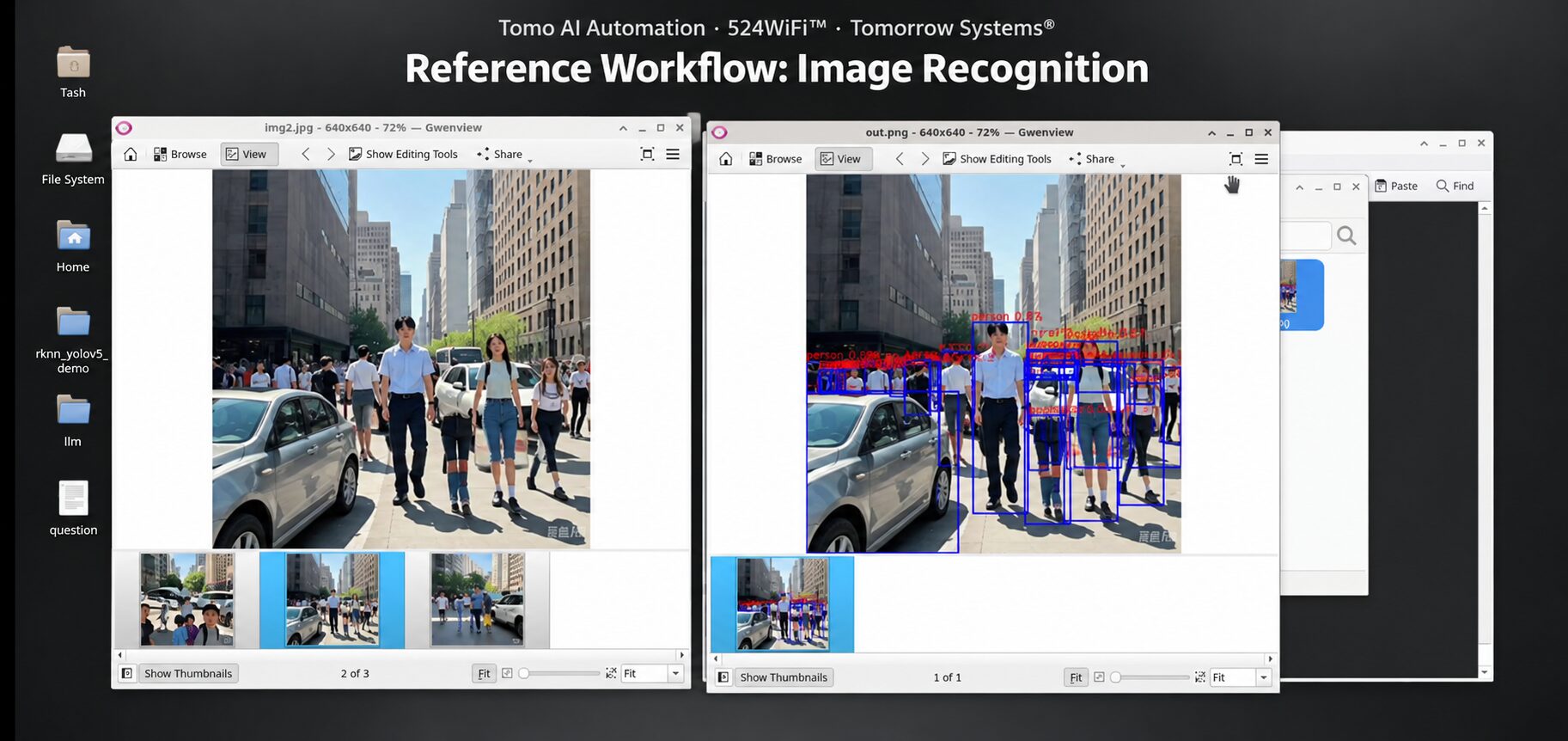
Machine vision and image processing: Define the objects or events to detect, camera inputs, operating conditions and the action required from the result. The example image-recognition workflow illustrates a software approach; project performance is established with representative inputs on the selected system.

Tomo AI Automation · 524WiFi™ · Tomorrow Systems® — illustrative reference image-recognition workflow
Illustration of a reference image-recognition workflow; application acceptance is measured on the selected project configuration.

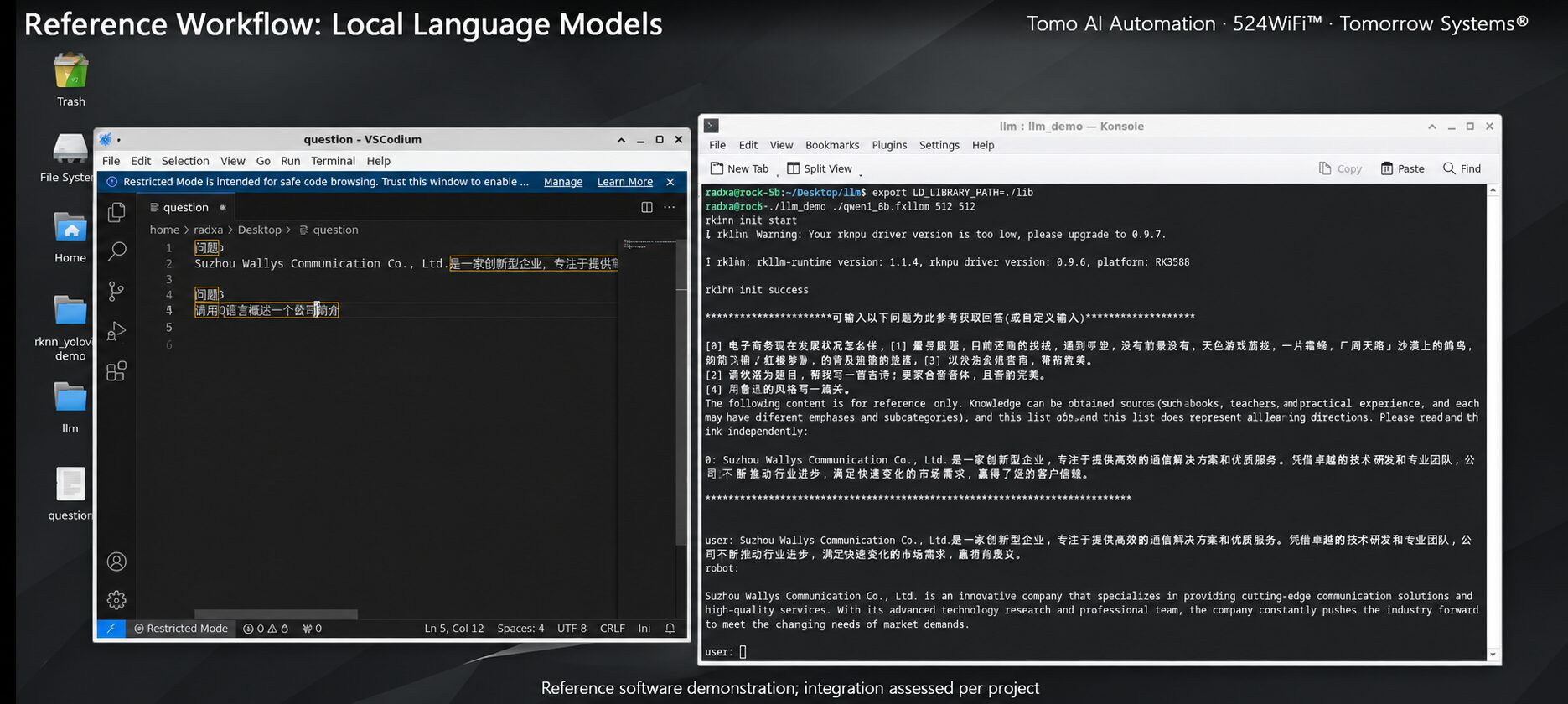
Local language-model integration: Describe the source documents, intended questions, language requirements and required outputs. The reference demonstration below illustrates a local software workflow; model, runtime and validation are selected for the project.

Tomo AI Automation · 524WiFi™ · Tomorrow Systems® — illustrative reference language-model workflow
Illustration of a reference language-model workflow, with source-company text retained as an example input.

Wireless integration: 524WiFi™ Pulse P9024-4×4-TB-M2E Pro Plus — Qualcomm QCN9024 Wi-Fi 6E 4×4 Tri-Band-Capable M.2 E-Key Radio Module, 2.4/5/6 GHz is the own-brand QCN9024 radio option for the corresponding tri-band-capable platform. Match the supported radio profile, host interface, driver, firmware and antenna system to the installation.

Tomo AI Automation · 524WiFi™ · Tomorrow Systems® — industrial application and integration illustration
Tomo AI Automation — industrial automation and wireless integration.

Tomorrow Systems® and 524WiFi™ assess the complete installation: computing, application software, network, interfaces, enclosure, power and acceptance requirements.

Reference AI Workflow with Ubuntu and a Separately Selected Pulse Radio

Reference hardware used in a software demonstration; it is distinct from the separately selected Pulse radio module.

🔗 Ready to take the next step in AI integration? Let’s connect with us! Describe the software workflow and connectivity requirements in the project form:

524WiFi™ Pulse Options for Your Project

These are separate own-brand product variants. Select the model and configuration against your host, software, antenna system and operating requirements.

Plan your project with Tomo AI Automation

Bring your application, enclosure, interfaces, power requirements, software environment and expected quantity into one project brief. Tomorrow Systems® and 524WiFi™ can review the engineering scope with you.

Explore the automation project hub and request form →