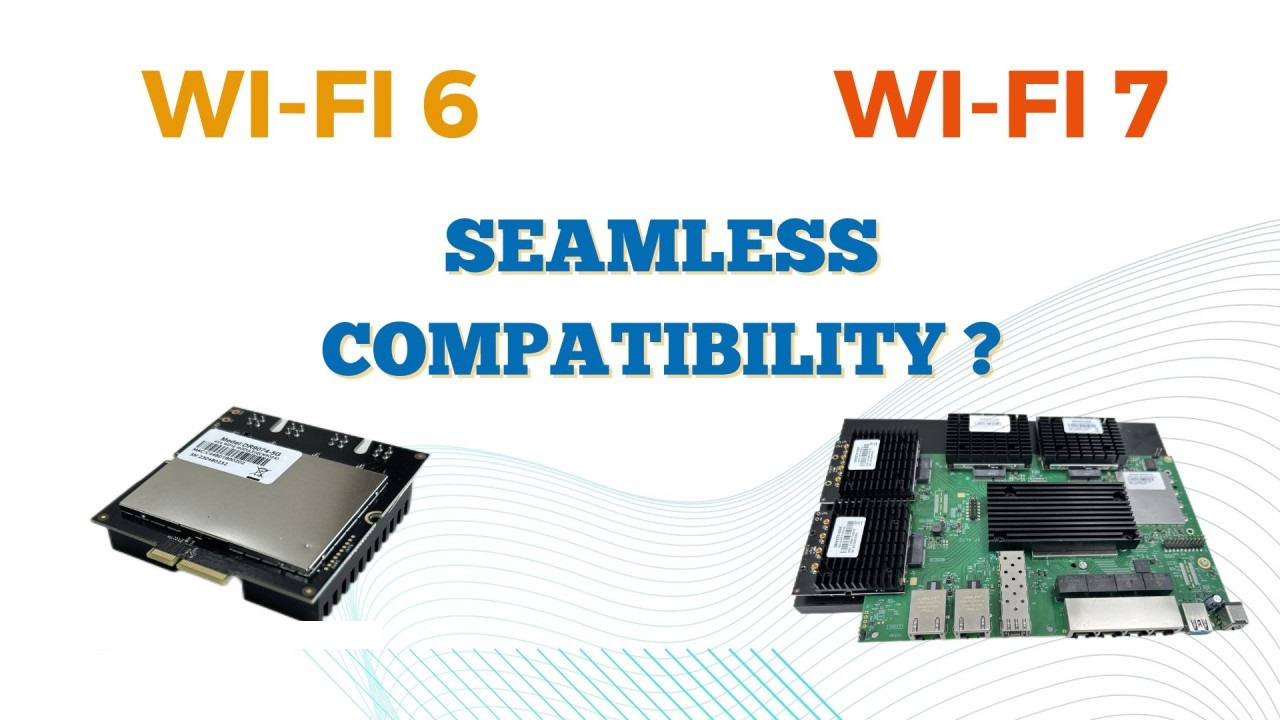
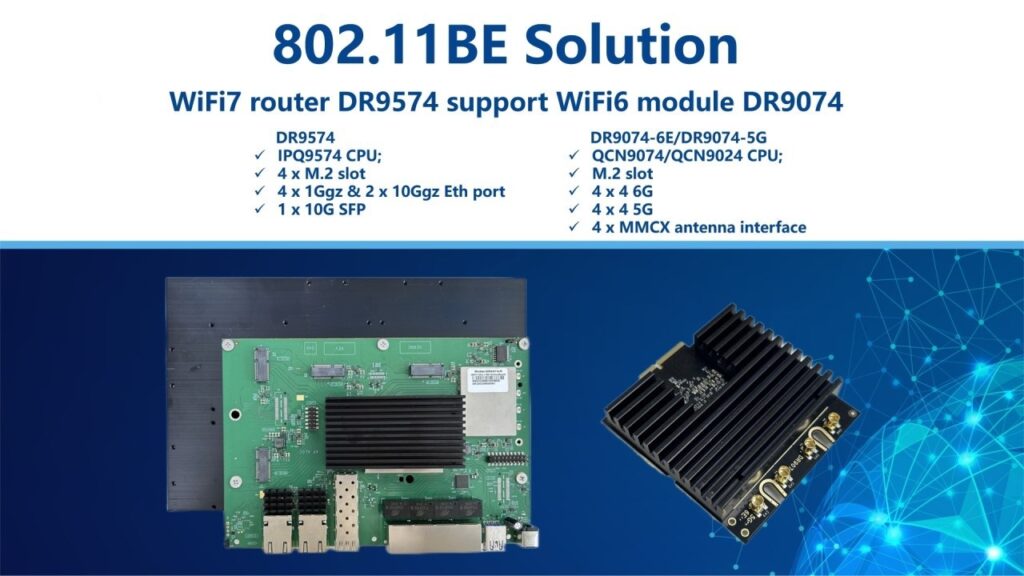
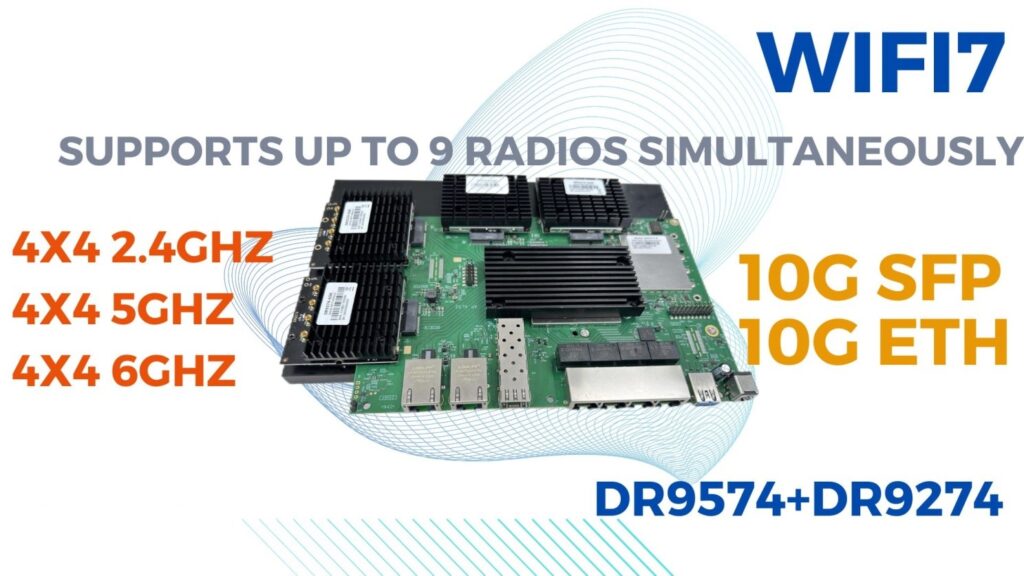
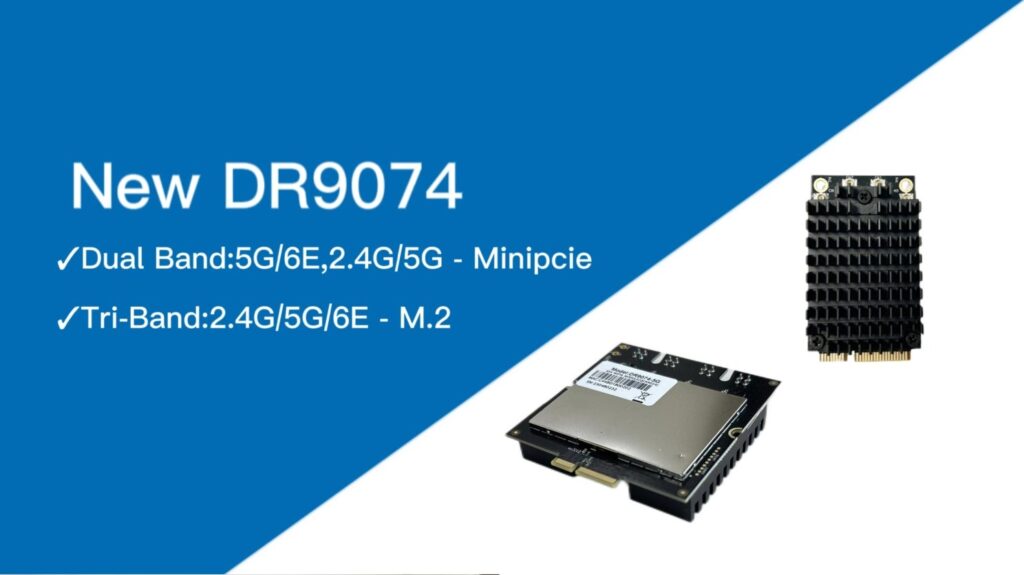
In the realm of wireless networking, compatibility is key to ensuring smooth transitions and optimal performance. With the emergence of the WiFi7 platform DR9574 featuring the powerful IPQ9574 chipset alongside the versatile QCN9074, many wonder: does this cutting-edge platform support backward compatibility with WiFi6 cards like the DR9074? Let’s delve into this compatibility aspect.
Exploring Compatibility with WiFi6 Card DR9074
The DR9574 WiFi7 platform by Wallys, powered by the robust IPQ9574 chipset and complemented by the QCN9074, represents a pinnacle of wireless technology innovation. But what about its compatibility with WiFi6 cards such as the DR9074?
524WiFi engineering prowess ensures that the DR9574 WiFi7 platform seamlessly integrates with WiFi6 cards like the DR9074. Through meticulous optimization and firmware enhancements, Wallys’ software team has facilitated backward compatibility, allowing customers to leverage existing WiFi6 infrastructure alongside the latest WiFi7 advancements.
By supporting backward compatibility with WiFi6 cards like the DR9074, the DR9574 WiFi7 platform empowers customers with unparalleled versatility and flexibility in their network deployments. Whether upgrading to WiFi7 or expanding existing WiFi6 networks, customers can seamlessly integrate both technologies to meet their evolving connectivity needs.
With the DR9574 WiFi7 platform’s backward compatibility with WiFi6 cards like the DR9074, Wallys enables customers to unlock new capabilities and possibilities in their wireless networks. Whether it’s enhancing throughput, extending coverage, or improving network efficiency, the seamless integration of WiFi6 and WiFi7 technologies opens doors to new opportunities for innovation and growth.
How to configure the DR9074(QCN9074) card on DR9574(IPQ9574) platform?
if you want use DR9074-6G, should change 0xa0 to 0xa2.
In the ever-evolving landscape of wireless networking, seamless compatibility between different generations of technology is essential. With the DR9574 WiFi7 platform’s backward compatibility with WiFi6 cards like the DR9074, Wallys reaffirms its commitment to providing customers with cutting-edge solutions that seamlessly integrate with existing infrastructure while embracing the advancements of tomorrow.
524WiFi is dedicated to continuous innovation, constantly pushing the boundaries of WiFi technology. In addition to its hardware products, Wallys also offers a range of ODM/OEM services, including:
Customization: Wallys can customize its WiFi 5/6/7 products and embedded boards to meet the specific needs of its customers.
IPQ9574 with QCN9274 Solution in Industrial Communication | Wi-Fi 6 and Wi-Fi 7: Leading the Way in Industrial Communication Innovation
As the demand for efficient and reliable communication in the industrial sector continues to grow, wireless communication technology is evolving rapidly. Wi-Fi 6 and Wi-Fi 7, as the latest generations of wireless communication standards, bring about a series of revolutionary changes, offering new possibilities for industrial communication applications.
Innovations of Wi-Fi 6 and Wi-Fi 7
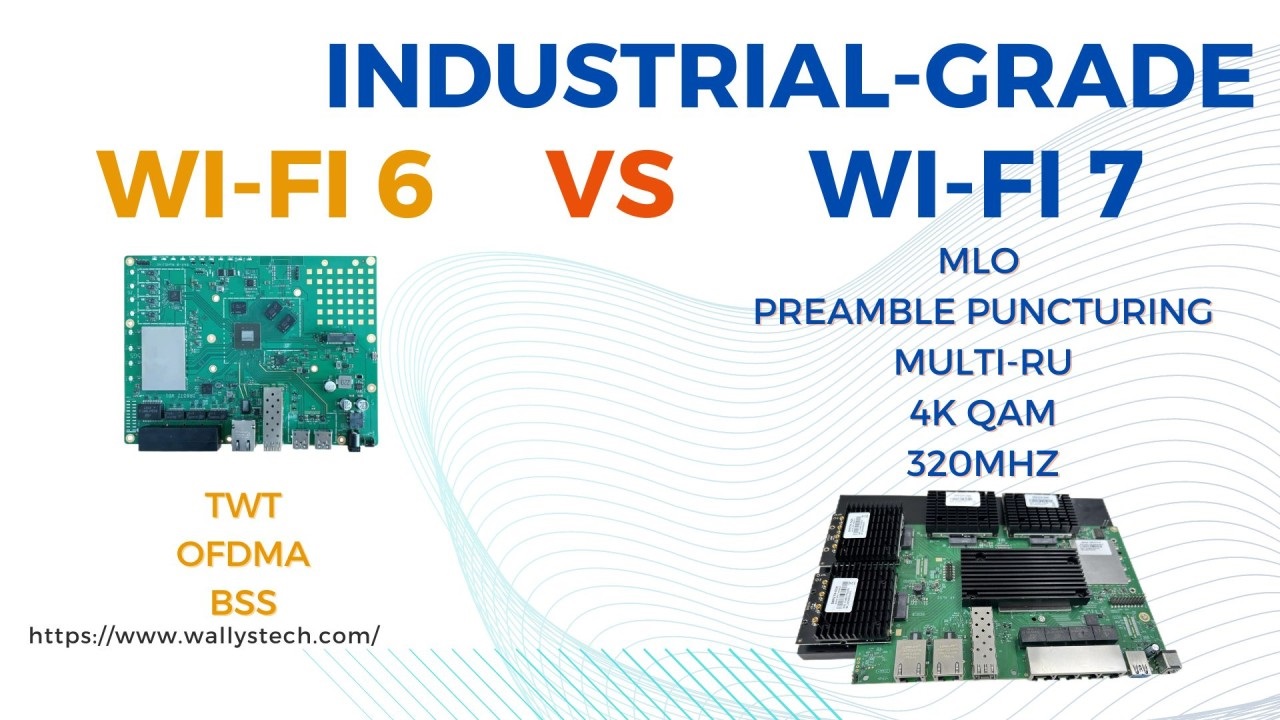
The Wi-Fi 6 standard (802.11ax) and Wi-Fi 7 standard (802.11be) have made significant advancements in the field of wireless communication. Compared to previous Wi-Fi standards, they deliver higher data transfer rates, lower latency, and increased network capacity. Specifically:
– Wi-Fi 6 supports data transfer rates of up to 9.6 Gbps, nearly 50% faster than its predecessor Wi-Fi 5. It introduces numerous new features such as OFDMA (Orthogonal Frequency Division Multiple Access), BSS Color, TWT (Target Wake Time), significantly enhancing network performance and stability.
– Wi-Fi 7 represents a groundbreaking leap forward. With a theoretical maximum data transfer rate of 46 Gbps, it surpasses Wi-Fi 6 by several folds. Additionally, Wi-Fi 7 reduces latency to 1/100th of Wi-Fi 6, offering greater network capacity and enhanced connectivity stability.
New Possibilities for Industrial Communication
The emergence of Wi-Fi 6 and Wi-Fi 7 brings forth a multitude of new possibilities for industrial communication applications. Firstly, the high-speed, low-latency connectivity enables efficient data exchange and control in industrial automation systems, IoT devices, and smart manufacturing applications.
Moreover, the increased network capacity and improved connectivity stability allow industrial sensors and monitoring devices to transmit data more reliably, facilitating smarter production and management. For instance, in smart warehousing and logistics systems, Wi-Fi 6 and Wi-Fi 7 enable real-time data monitoring and control, enhancing warehouse efficiency and logistics accuracy.
Future Outlook
In the future, as Wi-Fi 6 and Wi-Fi 7 technologies mature and become more widespread, we can anticipate further innovations and developments in industrial communication applications. For example, smart manufacturing systems will achieve more efficient production process control, smart logistics systems will realize more accurate inventory management, and smart building systems will implement more intelligent energy management.
Wallys’ Wi-Fi 5, 6, 7 Solutions
As a leading provider of wireless communication solutions, Wallys is committed to offering advanced Wi-Fi technology and services. Our Wi-Fi 5, 6, 7 solutions not only deliver leading performance and stability but also support a wide range of industrial applications, providing reliable communication connections and intelligent solutions for our customers.
At Wallystech, we specialize in software, hardware, and antenna development. We believe we can assist clients in achieving their electronic product development and manufacturing needs comprehensively.
DR5018-IPQ5018 WiFi 6 Routerboard with 2.4GHz and BT5.1 Support:
Tailored for high-bandwidth applications in demanding environments Integration of BT5.1 Radio moduleDual-core ARM 64bit A53 processor On board 2.4GHz radio supporting up to 573Mbps data ratesM.2 card slots for 5G modules and WiFi 6E cards Openwifi support for enhanced flexibility
DR6018-IPQ6010 WiFi 6 Routerboard with Dual-Band Support:
Equipped with Qualcomm-Atheros IPQ6010 chipsetQuad-core ARM 64bit A53 processor Supports Dynamic Frequency Selection (DFS) for optimized wireless performance Compatibility with 5G connectivity and WiFi 6E cards QSDK support for development and customization
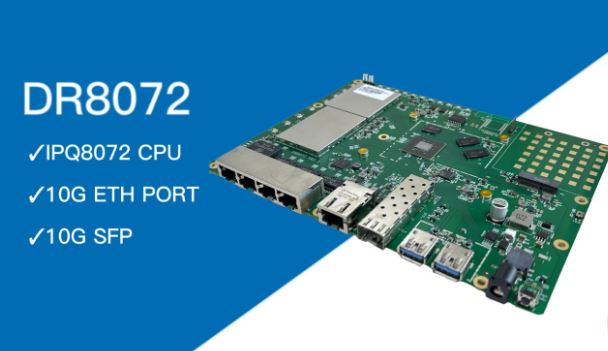
DR8072-IPQ8072 Dual-Band WiFi 6 Routerboard:
Powered by Qualcomm Atheros IPQ8072A AR Quad Core CPU Supports 11ax TX Beamforming, MU-MIMO DL and UL, and OFDMA DL and UL Dynamic Frequency Selection (DFS) support for improved spectrum utilization
DR8074-IPQ8074 WiFi 6 Routerboard with 2.4GHz Support:
Features Qualcomm Atheros IPQ8074A AR Quad Core CPUSupports 11ax TX Beamforming and MU-MIMO DL and ULTri-band support for versatile connectivity options
In addition to WiFi 6 offerings, Wallys also provides WiFi 7 solutions tailored to meet evolving wireless networking demands. Notable offerings in this category include:
DR9274-QCN9274|QCN6274 WiFi7 Single Band 5G:
Customized for single-band 5G applications Supports up to 4×4 MU-MIMO and 4096-QAMWide temperature operating range for industrial and commercial grades
DR9274-QCN9274|QCN6274 WiFi7 Single Band 6G:
Specifically designed for single-band 6G requirementsBoasts a 4T4R (4×4) MU-MIMO 6GHz solution
DR9274-QCN9274|QCN6274 WiFi7 Dual Band Dual Concurrent-2.4G&5G:
Ideal for dual-band, dual-concurrent operation in both 2.4G and 5G frequencies
DR9274-QCN9274|QCN6274 WiFi7 Dual Band Dual Concurrent-5G&6G:
Tailored for dual-band, dual-concurrent operation in 5G and 6G frequencies
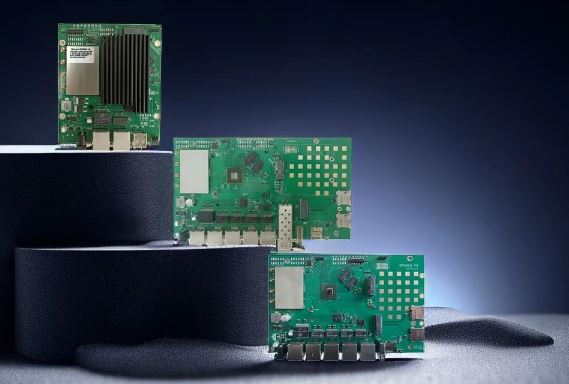
WiFi7 Platform DR9574-IPQ9574/IPQ9554:
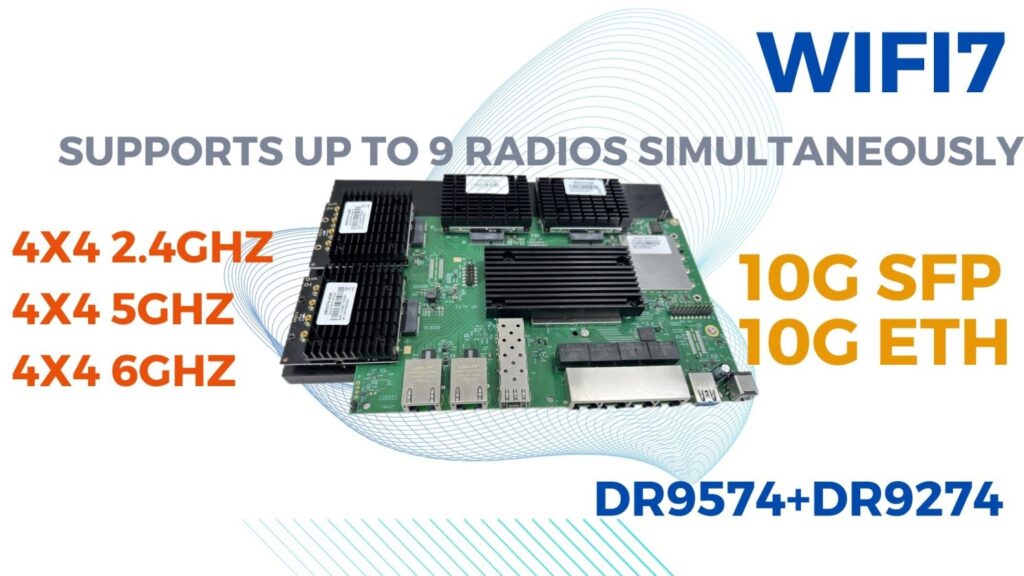
A robust platform featuring the Qualcomm IPQ9574, designed specifically for industrial WiFi 7 router applications
As the need for high-bitrate streaming and online gaming continues to rise, Wi-Fi 7 is increasingly becoming a necessity, particularly for those seeking top-notch wireless networking performance.
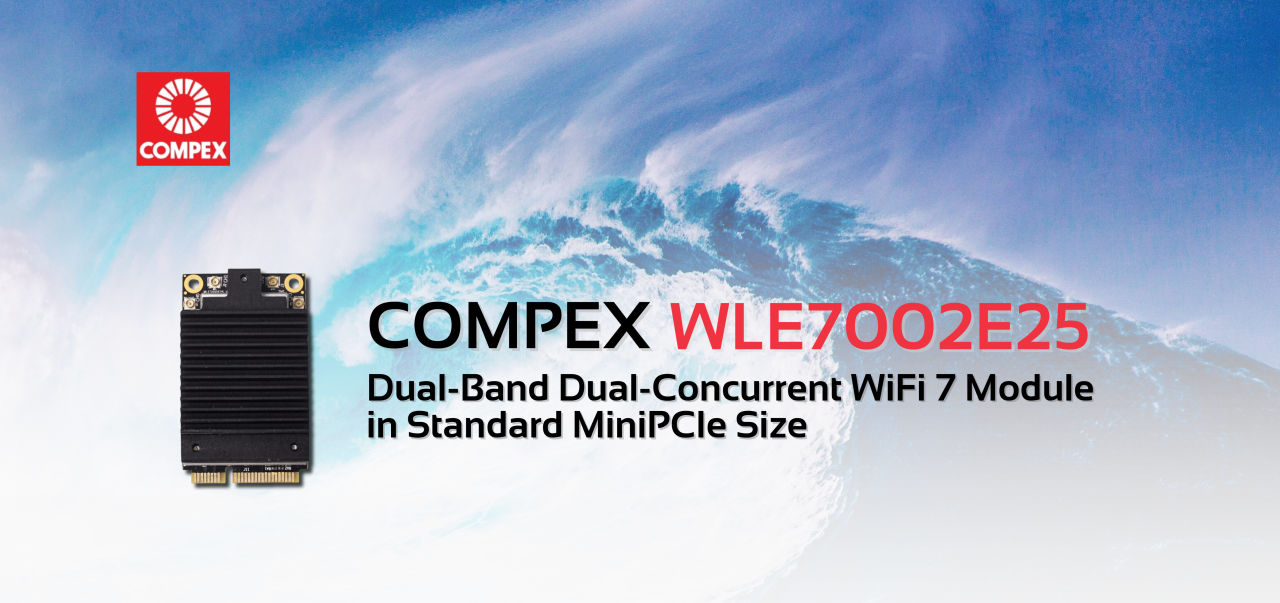
In today’s hyper-connected world, reliable and high-speed wireless connectivity is no longer a luxury, but a necessity. WiFi standards have evolved rapidly. WiFi 6, which has been around for only a few years, is now being replaced by WiFi 7 or IEEE 802.11be. Equipment manufacturers are now rushing to phase in WiFi 7 products. Compex has released its latest WiFi 7 module WLE7002E25 to help shorten time to market. The Compex WLE7002E25 is a dual band concurrent 2×2 2.4GHz and 2×2 5GHz radio based on Qualcomm’s Waikiki high performance WiFi 7 chipset which is capable of over 10Gbps raw data rate. It is in a stardard miniPCIe form factor.
1. Standard MiniPCIe Form Factor
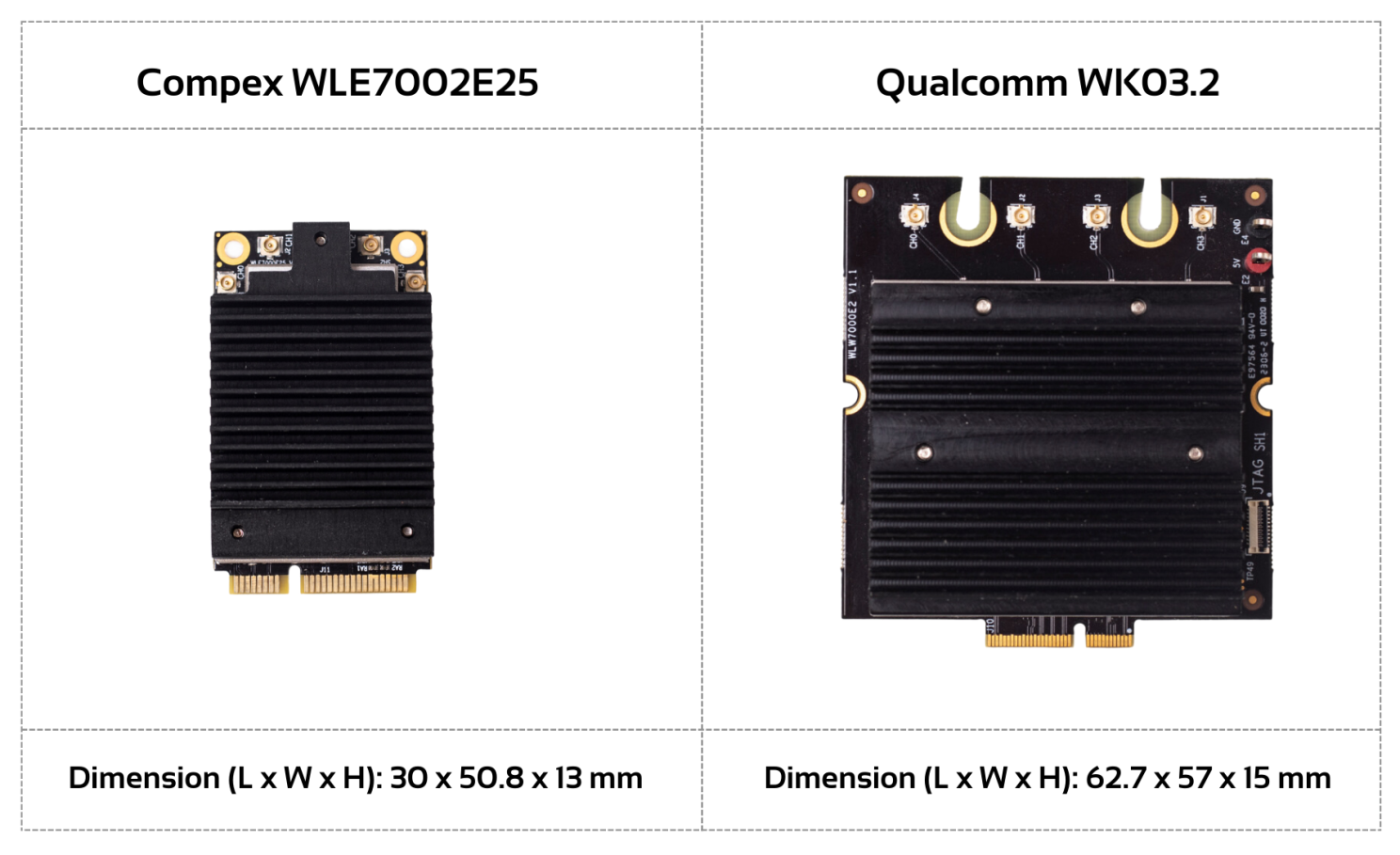
The standard miniPCIe footprint means that WLE7002E25 is readily compatible with existing systems and designs, particularly customers whose devices have been using WiFi 4 or WiFi 5 standard miniPCIe module. This simplifies integration since device manufacturers do not need to make modifications on their hardware to support a new generation WiFi module, thus reduces development costs and accelerates time-to-market.
Below diagram shows the dimension difference between Qualcomm’s high performance Waikiki M.2 E-key reference design and Compex’s standard size miniPCIe module using the same Waikiki chipset:
2. Lower Power Consumption, Impressive Transmit Power
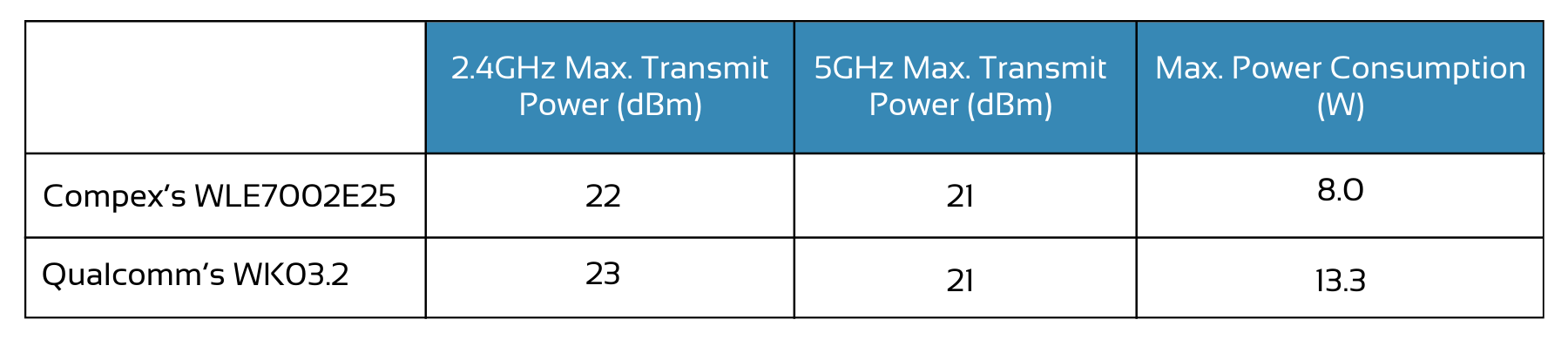
Compex’s RF engineers set themselves the twin targets of condensing the Qualcomm reference design by about 50% to an industrial standard form factor, as well as reducing its power consumption significantly. Compared with the high performance Qualcomm reference design, Compex is able to achieve the size and consumption targets with a little loss in performance. The following is a comparison of the RF power outputs and consumption between Compex WLE7002E25 and QualcommWK03.2 reference board.
3. Multi-Link Operation (MLO)
An Important differentiator of WiFi 7 to WiFi 6 is MLO (Multi Link Operation). This allows a client to connect to the AP through multiple bands simultaneously. This has significant advantage in reducing latency. Latency is of critical importance to interactive applications such as games, robotics, real-time translation, teleconferencing and etc.
Compex’s WLE7002E25 supports MLO between its 2.4GHz and 5GHz bands. It also implements MLO signals between adapters to support MLO between the WLE7002E25 and other WiFi 7 modules such as Compex’s 4×4 6GHz module WLE7000E6.
4. Open Source Ath12k Support on Foreign Platform
Compex Systems recognize the importance of supporting customers’ products integration with open source ath12k. Ath12k integration support for non-Qualcomm platforms such as x86 embedded boards is also available.
5. Competitive Pricing
Compex’s WLE7002E25 is only marginally more expensive than WiFi 6 products of similar configurations. This is to encourage direct migration from WiFi 4 and WiFi 5 to WiFi 7, skipping the WiFi 6 development time and costs.
Investing in the Future
The Compex WLE7002E25 represents more than just a Wi-Fi module; it’s an investment in the future. With its cutting-edge technology, comprehensive features, and diverse application potential, the Compex WLE7002E25 stands poised to rewrite the rules of wireless connectivity.
Maximizing Wi-Fi Connectivity while Minimizing Environmental Impact: The Case for Spectrum Efficiency in the 6 GHz Band
Maximizing Spectrum Efficiency for Wi-Fi Connectivity
In the ever-evolving landscape of wireless communication, Wi-Fi technology stands as a cornerstone, providing ubiquitous connectivity in homes, businesses, and public spaces. However, the seamless operation of Wi-Fi networks relies heavily on access to the radio spectrum—a finite and carefully managed resource governed by national regulatory bodies worldwide.
Challenges in Spectrum Management
As demand for wireless connectivity continues to soar, regulators face the complex task of managing spectrum allocation to meet diverse needs while ensuring equitable access and minimizing interference. This balancing act requires careful consideration of competing priorities, ranging from economic growth and technological innovation to environmental sustainability and social equity.
The Crucial Role of the 6 GHz Band
Among the various frequency bands allocated for wireless communication, the 6 GHz band has emerged as a focal point in spectrum policy discussions. With its relatively wide bandwidth and favorable propagation characteristics, the 6 GHz band holds immense potential for supporting high-performance Wi-Fi networks, especially with the advent of Wi-Fi CERTIFIED 7.
Importance of Full 6 GHz Access for Wi-Fi Performance
For Wi-Fi technology to fully leverage the capabilities of the latest standards and deliver optimal performance, unrestricted access to the entire 6 GHz band is essential. This allows for the deployment of wider channels, enabling higher data throughput rates, lower latencies, improved mobility, and better support for densely populated areas.
Global Regulatory Responses
Recognizing the significance of the 6 GHz band for Wi-Fi connectivity, several countries have taken proactive measures to expand Wi-Fi access to this spectrum. By doing so, they aim to meet the growing demand for indoor and outdoor connectivity while promoting innovation and economic development.
Environmental Considerations in Spectrum Policy
In recent years, environmental sustainability has emerged as a critical consideration in spectrum policy formulation. The deployment of wireless technologies, including Wi-Fi networks, has implications for energy consumption, carbon emissions, and electronic waste generation. As such, regulators are increasingly mindful of the environmental footprint associated with spectrum allocation decisions.
Impact on Connectivity and Energy Consumption
A comprehensive study, titled “Sustainability Benefits of 6 GHz Spectrum Policy,” provides empirical evidence of the environmental advantages of prioritizing Wi-Fi access in the 6 GHz band. By comparing different spectrum utilization scenarios, the study demonstrates that unrestricted Wi-Fi access leads to significant reductions in energy consumption and carbon emissions compared to alternative deployments.
Furthermore, the study highlights the tangible benefits of ensuring full Wi-Fi access to the 6 GHz band in terms of connectivity and energy efficiency. Restricted spectrum access not only hampers Wi-Fi performance but also drives users towards alternative cellular networks, resulting in higher energy consumption and associated environmental costs.
Conclusion: Balancing Connectivity and Environmental Impact
In conclusion, maximizing spectrum efficiency for Wi-Fi connectivity requires a multifaceted approach that considers technological advancements, regulatory frameworks, and environmental sustainability goals. By prioritizing Wi-Fi access in the 6 GHz band and optimizing spectrum utilization, policymakers can support the expansion of high-performance wireless networks while mitigating their environmental footprint. In doing so, they can achieve a harmonious balance between connectivity needs and environmental stewardship in the digital age.
DR9274-5G6G based on QCN9274 Chipset is an enterprise wireless module integrated with 2×2 5G & 2×2 6G MU-MIMO Dual Band Wireless Module designed specifically to provide users with mobile access to high-bandwidth video streaming, voice, and data transmission for office and challenging RFenvironment in factories, warehouses establishment.
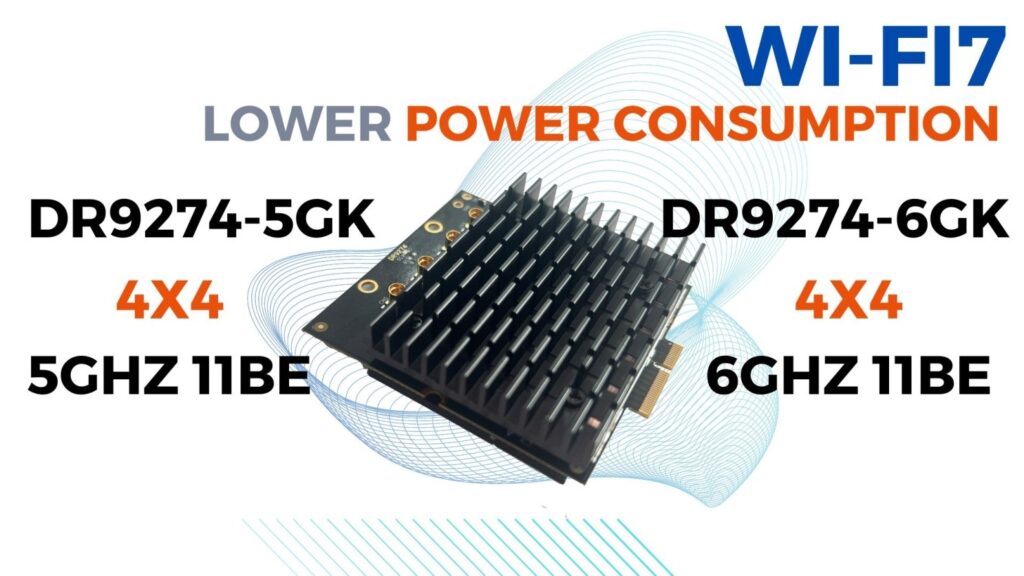
DR9274-6GK|4T4R QCN6224 QCN9274 QCN6274 WiFi7 Lower Power Consumption Network Card
Wallys DR9274-6GK
The 524WiFi Dream DR9274-6GK is an industrial grade wireless module based on the QCN9274 (QCN6274) chipset. It is designed to provide high-bandwidth video streaming, voice, and data transmission in office and challenging RF environments such as factories and warehouses.
Specifications:
Chipset: Qualcomm Atheros QCN9274 (QCN6274)
WLAN Host Interface: PCI Express 3.0
System Memory: 2Mbit serial I²C bus EEPROM
Standard Operating Voltage: 5V
Operating Systems: QSDK
Host Interface: M.2 E Key interface with PCIe 3.0
Antenna Cable/Port: 4 x MMCX Connectors
Data Rates for WLAN: 6GHz 802.11ax/be, max 22dBm per chain
Channel Spectrum Widths for WLAN: Supports 20/40/80/160/320MHz at 6GHz
Temperature Range: Operating: -20 °C to 70 °C, Storage: -40 °C to 85 °C
Humidity: Operating: 5% to 95%, Storage: Max. 90%
Certification: REACH & RoHS Compliance
Power Consumption: 10W (Maximum), 7W (Normally)
Dimensions (WxHxD): 30mm x 50mm x 14.5mm
Additionally, 524WiFi and Wallys offers a new version of the 4×4 5GHz lower power consumption WiFi7 network card, the DR9274-5GK.
Inquiries:
524WiFi is dedicated to continuous innovation, constantly pushing the boundaries of WiFi technology. In addition to its hardware products, Wallys also offers a range of ODM/OEM services, including:
Customization: We can customize its WiFi 5/6/7 products and embedded boards to meet the specific needs of its customers.
Title: A Comparative Analysis of QCA9882, QCA9880, and MT7915 WiFi Cards for OpenWrt
In the realm of OpenWrt-compatible WiFi cards, selecting the right one can significantly impact your network’s performance and reliability. Among the options available, the QCA9882, QCA9880, and MT7915 stand out as popular choices. In this article, we will delve into the differences between these WiFi cards to help you make an informed decision.
**QCA9882**
The QCA9882 WiFi card boasts a robust chipset designed to deliver exceptional performance. It supports various wireless standards, including WiFi 5 (802.11ac), ensuring compatibility with modern networks. Performance metrics such as throughput and range are commendable, making it suitable for demanding applications. QCA9882 is known for its seamless integration with OpenWrt, offering extensive configuration options and stability. While pricing may vary, it generally falls within a reasonable range, providing value for money.
**QCA9880**
Similar to the QCA9882, the QCA9880 WiFi card features a reliable chipset optimized for high-performance networking. It also supports WiFi 5 standards, guaranteeing compatibility with modern networks. Performance metrics are commendable, although specific benchmarks may vary. QCA9880 is well-supported by OpenWrt, offering users a plethora of configuration options and stability. Pricing for the QCA9880 is competitive, making it an attractive choice for budget-conscious consumers seeking reliable performance.
**MT7915**
The MT7915 WiFi card is another contender in the OpenWrt ecosystem, boasting a chipset designed to deliver robust performance. It supports WiFi 6 (802.11ax) standards, offering enhanced throughput and efficiency compared to its predecessors. Performance metrics such as throughput and latency are impressive, catering to demanding networking requirements. While OpenWrt compatibility may vary, efforts are underway to ensure seamless integration with the platform. Pricing for the MT7915 tends to be higher compared to WiFi 5 alternatives, reflecting its advanced features and capabilities.
**Comparative Analysis**
When comparing these WiFi cards, several factors come into play. Performance-wise, the MT7915 holds an edge with its support for WiFi 6 standards, offering superior throughput and efficiency. However, both the QCA9882 and QCA9880 remain competitive choices, especially for users with WiFi 5 networks. In terms of OpenWrt compatibility, all three options offer varying degrees of support, with QCA9882 and QCA9880 being more established within the community.
**Conclusion**
In conclusion, the choice between the QCA9882, QCA9880, and MT7915 WiFi cards depends on your specific requirements and budget constraints. If you prioritize cutting-edge performance and have the budget for it, the MT7915 is an excellent option. However, for users seeking reliable performance at a more affordable price point, both the QCA9882 and QCA9880 are viable alternatives. Regardless of your choice, each WiFi card offers unique features and capabilities that can enhance your OpenWrt experience.
524WiFi Modules and Platform
524WiFi Dream882 (QCA9882): – high power
Chipset: Atheros QCA9882
2×2 5G high-power radio card
Frequency range: 4.940GHz to 5.825GHz
2x 5G MMCX connectors
Bandwidth: 20MHz/40MHz/80MHz
Supports 802.11ac/an standards
RoHS compliant
524WiFi 900VX Pro+
Chipset: Qualcomm-Atheros QCA9880
Output power: 2.4GHz max 26dBm, 5GHz max 25dBm
IEEE 802.11a/b/g/n/ac compliant and backward compatible
3×3 MIMO technology, up to 1.3Gbps
Mini PCI Express edge connector
RoHS compliant
Supports various technologies and IEEE standards (e.g., spatial multiplexing, LDPC codes, MRC, STBC, DFS)
FCC, CE, and IC certification
524WiFi 600VX Pro+
Chipset: Qualcomm-Atheros QCA9880
Output power: 2.4GHz max 24dBm, 5GHz max 23dBm
IEEE 802.11a/b/g/n compliant and backward compatible
2×2 MIMO technology, up to 867Mbps
Mini PCI Express edge connector
Frequency support: 4920MHz~5825MHz
RoHS compliant
Supports various technologies and IEEE standards (e.g., spatial multiplexing, LDPC codes, MRC, STBC, DFS)
FCC, CE certification
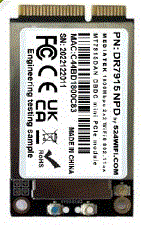
524WiFi 6 DR7915 – NPD DBDC
Chipset: MT7915+MT7975
Host Interface: Mini PCI Express 2.1
Antenna Connector: 2 x UF.L
Frequency Range: 2.4GHz: 2.412GHz to 2.472GHz, 5GHz: 5.180GHz to 5.825GHz
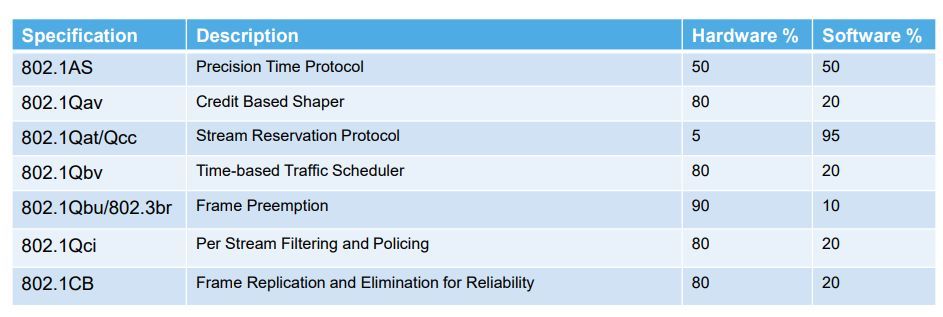
IEEE 1588 (802.1AS) and Time-Sensitive Networks (TSN): What Sets Them Apart?
1588 Soft Synchronization IEEE 1588-2008, also known as IEEE 1588v2, is a synchronization method designed specifically for wired networks. It facilitates clock sharing among devices by allowing the automatic selection of a grandmaster device, which then distributes timing packets to nodes in the network, synchronizing their system clocks. With 1588 soft synchronization, timing is guaranteed to be within 1 millisecond or less, although less stringent compared to hardware-timed synchronization due to latency introduced during packet transmission, reception, and data processing. IEEE-1588 exhibits robustness; in the event of the removal of a grandmaster from the network, an election process occurs to select a new grandmaster, ensuring continued operation. While any industrial switch can support 1588 soft synchronization, a switch compliant with 1588 may exhibit tighter synchronization among devices.
Time-Sensitive Networks (TSN) TSN is a timing and synchronization standard built upon the Ethernet standard, utilizing a profile of IEEE-1588 hardware synchronization. TSN shares hardware considerations with 1588 hardware-timed sync, requiring a direct connection from the Network Interface Card (NIC) to the timing source. TSN, however, differs from 1588 hardware sync in that TSN networks generate an error if synchronization deviates from expected bounds. Additionally, TSN timing packets feature priority scheduling, meaning they are sent from the grandmaster and TSN-enabled switching devices without waiting for other packets in the buffer. This ensures tight synchronization regardless of network traffic. TSN and 1588 networks are not interoperable and require bridging with compliant hardware. TSN necessitates switches that comply with 802.1AS to enable priority packet scheduling.
Recently, in response to client requests, our engineers are actively researching the integration of 1588v2 and TSN features into our DR6018 – IPQ6010 Wifi6 and DR9574 – IPQ9574 Wifi7 target hardware, respectively.
No project is too small, and no challenge is too big! Feel free to reach out to 524Wifi and Wallys teams if you seek solutions, be it hardware customization or software development, from concept to mass production. Let’s create value together!
Mesh networking is the answer to the growing demand for extended wireless coverage. Its primary purpose is to overcome obstacles like walls, addressing the need for connectivity throughout your home.
🌐 Mesh vs. EasyMesh It’s important to clarify that the term “Mesh” in this context refers to “EasyMesh.” Mesh, fundamentally, is a network topology, while EasyMesh is the specific technology used in Wi-Fi.
🔌 The Simplicity of EasyMesh EasyMesh is a more straightforward solution, designed for ease of use. Many manufacturers offer EasyMesh routers that are essentially ready to use out of the box. Users can set them up without requiring in-depth technical knowledge.
📶 Mesh Before EasyMesh Before the advent of EasyMesh, other methods like WDS or 802.11s were used to extend Wi-Fi coverage. However, these approaches often required technical expertise for configuration. In contrast, EasyMesh simplifies the process significantly.
🏡 Mesh’s Original Purpose Traditional Mesh networking aimed at redundancy and backup, particularly in scenarios where network link failures needed to be avoided, such as in wireless setups. For home use, the primary goal of Mesh is to expand coverage. Therefore, EasyMesh is better suited for this purpose compared to earlier Mesh technologies.
In conclusion, Mesh networking, or more specifically EasyMesh, is the go-to solution for extending your wireless coverage effortlessly, especially in home environments. Its simplicity, user-friendliness, and coverage enhancement capabilities make it an ideal choice for today’s connected world.
WIFI-SON(Wi-Fi self-organizing network) is Qualcomm’s wireless AD hoc network solution. It has perfect band steering, ap steering, APS and other functions. wifison requires nodes to support dual-frequency (or 3-frequency). The wifison network consists of one CAP(Adaptive path selection) and several RE(Range extender), and connects to the gateway through the CAP.
📢 The introduction of Wi-Fi SON technology aims to reduce the maintenance cost of Wi-Fi networks, improve network performance, and provide users with a better experience. This technology is often used in conjunction with Wi-Fi standards such as 802.11k, 802.11v, and 802.11r for more efficient network management.
📢 CAP (Central AP) : A wifison network connects to an external network through a CAP. A wifison network has only one CAP. Range Extender (RE) : All nodes in the wifison network except the CAP are RE. Whole Home Coverage (WHC) : Some wifison configuration names start with this parameter, for example, iwpriv ath0 | grep whc You can see some wifison configuration. 🔊 repacd (RE Placement and Auto-Configuration Daemon) : a script in the SDK that is used to automatically maintain wireless configurations related to wifison and start wifison services. 📣 Load balancing daemon (ldb) : used for Band Steering on a single node. However, if hyd is used, the Band Steering process is managed by hyd and is therefore unnecessary. 📣 hyd (Hy-Fi daemon) : Used to manage Band Steering, AP Steering, APS, and dual-band anti-ring. wifison is the core process. HyFi (Hybrid wifi) : Some module names start with this parameter. Self-organizing network (SON) : The main mode of wifison networking, based on WPS. 📯 BSS transition management (BTM) : Supports 802.11v device steering. Wi-Fi SON Placement Configuration Daemon (wsplcd) : A process used in the SDK to synchronize configurations between nodes. hyfi-bridging: The wifison key kernel module for APS and ring prevention.
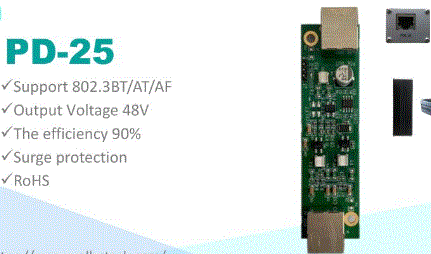
Unleash the potential of your network with our cutting-edge PD-25, a powerhouse designed for efficiency and reliability. Here’s a glimpse of its remarkable features:
🔌 Input Voltage Mastery: Accepts a robust input voltage range of 42~56V, ensuring compatibility with diverse power sources.
⚡ Optimized Output: Delivers a stable output voltage of 48V, with a maximum capability of 56V for those power-demanding scenarios.
🚀 Gigabit Connectivity: Equipped with 2x RJ45 ports for 10/100/1000Mbps Gigabit Ethernet. One RJ45 serves as input, while the other stands ready for seamless output.
⚙️ Surge Protection Shield: Fortified with surge protection, PD-25 safeguards your network against unexpected surges, providing uninterrupted connectivity.
🌡️ Extreme Environment Endurance: Fear no climate extremes! PD-25 operates flawlessly in temperatures ranging from -40 to +70°C, making it a reliable choice for varied environments.
💧 Adaptable Humidity Handling: From 5% to 95% operating humidity and 0% to 90% storage humidity (non-condensing), PD-25 adapts to the changing moisture levels with ease.
🌿 Eco-Friendly Assurance: Embrace sustainability with ROHS Compliance – PD-25 is designed with the environment in mind.
Revolutionize your network infrastructure with PD-25 – where power meets precision, and connectivity knows no limits! 🚀🔗
Key Features: Long-range 20km transfer capability 🌐 Industrial-grade solution ⚙️ Dualband support: 2.4G/5G 📡 OpenWRT compatibility 🧩 High compatibility with DR9074/DR7915/DR882 🤝
FCC certified
Additionally, Wallys R&D team supports hardware customization and software feature development services! 🛠️ Feel free to inquire and explore more about our collaborative solutions!